I think of Ludwig Wittgenstein some mornings. He occurs to me very early. Usually it’s this quote that pops into my waking noggin:
“Death is not an event in life: we do not live to experience death. If we take eternity to mean not infinite temporal duration but timelessness, then eternal life belongs to those who live in the present. Our life has no end in the way in which our visual field has no limits.”
I like this for lots of reasons. As a blind man I like the temerity of the utterance, insofar as all humans have some kind of visual limitation. Wittgenstein posits the power of imagination to declare anything, and then, with a smear of logic, cements an idea into consciousness. I think this is how he survived the trenches in WW I. And I know for certain its how the disabled survive. Look at the nouns:
Death. Event. Life. Experience. Eternity. Duration.
In my sophomore year of college I was fascinated by Boolean algebra. In mathematical logic, Boolean algebra is the “branch of algebra in which the values of the variables are the truth values true and false, usually denoted 1 and 0 respectively.” (See Wikipedia.)
One may easily draw a Boolean equation for the proposition eternal life belongs to those who live in the present. Then there’s a leap—Wittgenstein says our visual field has no limits.
If eternity = timelessness then the present (time) also equals timelessness. Good.
If timelessness is related to mindfulness then the operations of mind become vision. Hence our visual field (anyone’s) has no limit.
You can see where the poet in me would like this. You can see where the blind person in me also admires it.
As logic it is unimpeachable. The trick is to live it.
Early. Wittgenstein for breakfast.

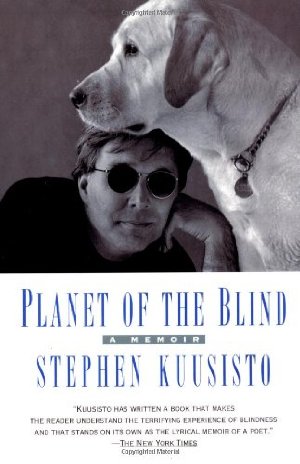
 Planet of the Blind