Keeping Track in Nur Sultan

Yesterday I spoke with blind children in Nur Sultan. Will I be called an inspiration pornographer when I say they were beautiful? The small girl in a white dress with angel wings sang a song. An equally tiny boy who was dressed like latter day Elvis also sang his heart out. Teachers brought forward a blind autistic boy who spontaneously added large sums. None of them had much in the way of orientation and mobility skills. They were talented and were led about. I was a foreign blind poet who felt himself shivering apart like a packet ship. I was aground on a reef of hardship. Parents wanted to know how I made it as a blind student and I had to tell them the way is hard—had to say the blind must work steadfastly and without pause; that in many instances we must work harder than sighted people. Even then we need luck and love. In Kazakhstan disabled children are largely segregated and though the Kazakhs have signed the UN Charter on disability rights—in effect committing their nation to disability justice—the way forward for the disabled is still steep and this is true in my own country god knows. One thinks of all the universities in the US that still adopt inaccessible software and course materials; colleges that imagine the disabled are structurally “apart” from student life. “Isn’t there a special office for them?” One shouldn’t imagine that with our mighty ADA we’re a shining city on a hill. But yesterday I heard small children singing and I thought of Emily Dickinson’s remark about the writing of poetry, that the imagination is akin to whistling as we walk past a graveyard. It’s a hard life. It’s best to sing. Silence is privilege.
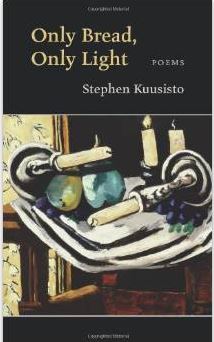
Stephen Kuusisto and HarleyABOUT: Stephen Kuusisto is the author of the memoirs Have Dog, Will Travel; Planet of the Blind (a New York Times “Notable Book of the Year”); and Eavesdropping: A Memoir of Blindness and Listening and of the poetry collections Only Bread, Only Light and Letters to Borges. A graduate of the Iowa Writer’s Workshop and a Fulbright Scholar, he has taught at the University of Iowa, Hobart and William Smith Colleges, and Ohio State University. He currently teaches at Syracuse University where he holds a University Professorship in Disability Studies. He is a frequent speaker in the US and abroad. His website is StephenKuusisto.com.

Have Dog, Will Travel: A Poet’s Journey is now available for pre-order:
Amazon
Barnes and Noble
IndieBound.org
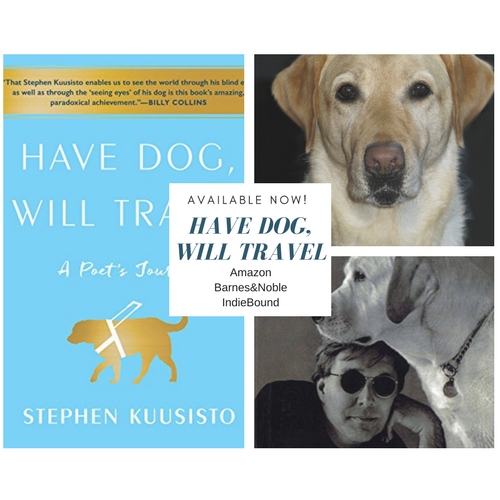
Have Dog, Will Travel by Stephen Kuusisto

(Photo picturing the cover of Stephen Kuusisto’s new memoir “Have Dog, Will Travel” along with his former guide dogs Nira (top) and Corky, bottom.) Bottom photo by Marion Ettlinger 
Poetry, Dance, Jazz, and Fiction in the Beehive

Today is the day that student poets, dancers, and musicians in Almaty, Kazakhstan will come together and perform their work as part of the disability and cultural diplomacy workshop my friends and I have been teaching over the last 72 hours. As a teaching poet I’m after art not the reductiveness of identity. I want poetry to come and the accompanying astonishments before anything else. Our students here have disabilities and have, to the best of my knowledge, had little inclusive engagement with the world. So we started out by dancing in a large public space; circling; bending; reaching; dipping; swaying; going low; wide; small; and very large.

As the American poet Elizabeth Bishop knew, the imagination has cardinal points but far more than the average map indicates. We’re making new maps for our insides.

My teaching colleagues include the superb choreographer and dancer Michelle Pearson, poet and nonfiction writer Christopher Merrill, novelist Cathleen Dicharry, and the world class jazz composer and musician Damani Phillips. Our trip has been sponsored by the U.S. Department of State and the International Writing Program of the University of Iowa. Cultural diplomacy in this case means inclusive arts education. But that phrase can’t capture what happens. In my class yesterday a woman wrote a poem about living in a sustaining star. We’d been talking about how poetry lets us imagine places that can’t be seen or drawn with a pencil. We’d been talking about inner freedom. We talked about many things: W.H. Auden, Andrei Voznesenskii, Emily Dickinson, Whitman. We wrote together. And there was probative discovery.

Lest you accuse me of “inspiration porn” let’s get something right and from the start. The imagination does not transcend disablement or color or ethnicity or gender. But as the American poet W.S. Merwin once pointed out—“it”—imagination—“lives up here and a little to the left.” Poetry is decisive and clear and often like the clouds in a Tintoretto painting and each of us has access to this. When we come down from this space we’re refreshed. Intellectual refreshment is a human right.

Poetry is play. We made an exercise yesterday. We each had to write a poem that would begin and end with the same line. There had to be an animal in it. And water. A color. A place you’ve never been. Music.

Yes you have to be willing to be a joyful ass! (How else does one describe in essence the method of James Joyce or the Beatles?)

I wrote:

Here’s a dog with a red piano

He pulls it like a plough

And farms the musical dirt in Scotland

Some say he’s from Loch Ness

But he’s an ordinary musician

Changing the world row by row

A dog with a red piano

What was “killer” as we say in the vernacular was the student poems. They went far out and actually made art.

As I type these lines I don’t have their poems in front of me. But tonight they’ll perform them to jazz and dance.

Changing the world row by row.

Stephen Kuusisto and HarleyABOUT: Stephen Kuusisto is the author of the memoirs Have Dog, Will Travel; Planet of the Blind (a New York Times “Notable Book of the Year”); and Eavesdropping: A Memoir of Blindness and Listening and of the poetry collections Only Bread, Only Light and Letters to Borges. A graduate of the Iowa Writer’s Workshop and a Fulbright Scholar, he has taught at the University of Iowa, Hobart and William Smith Colleges, and Ohio State University. He currently teaches at Syracuse University where he holds a University Professorship in Disability Studies. He is a frequent speaker in the US and abroad. His website is StephenKuusisto.com.

Have Dog, Will Travel: A Poet’s Journey is now available for pre-order:
Amazon
Barnes and Noble
IndieBound.org

Have Dog, Will Travel by Stephen Kuusisto

(Photo picturing the cover of Stephen Kuusisto’s new memoir “Have Dog, Will Travel” along with his former guide dogs Nira (top) and Corky, bottom.) Bottom photo by Marion Ettlinger 
Disability Poems Worldwide

It is a matter of advantage to say I will never be understood. In a poetry class with disabled students in Almaty yesterday I stressed the power of being unclassifiable. This is the fundamental work of the imagination and I felt lucky to be able to talk about it in a nation of nomadic descendants. No two persons will have the same feelings about the moon but we all know why the emotion matters. If we can explain just an inkling of this we are fortunate. It’s also possible to laugh in the face of what we don’t know and be poets together. There was more than a little of Emily Dickinson in that room. As part of an exercise to write about going far into the world I wrote the following lines:

Terra Incognita

Sometimes I leave the house and walk for miles

Because of an old song—a Finnish hymn

Which says I have yet to find my home

Clouds and birds follow

There is no name for this

I stop beside a river

There is no name

If disability or “to be disabled” is a label (it is) then such labeling insists on singularity. I found it apt that we were conducting our workshop in a very contemporary “maker’s space” with 3D printers and stylized cartoons of robots. One woman in an adjacent room had manufactured several plastic baby doll arms and was busy trying sequentially to attach different ones to a doll torso—the disfigured doll had an electronic voice box and was wailing. I thought of the “medical model” of disability—the disabled man, woman, or child reduced to being merely a patient among doctors who must be cured or face a reduced life. The doctor who fails to fix the doll says “I’m sorry, there’s nothing more I can do for you” and wants no further conversation. The woman with the baby doll couldn’t get the arms to fit and gave up. I don’t I know where she went or what became of her broken doll but I know what the delimitation of projective disfigurement will likely mean and the bots on the posters won’t save us.

Let me add you don’t need arms to make poetry.

Stephen Kuusisto and HarleyABOUT: Stephen Kuusisto is the author of the memoirs Have Dog, Will Travel; Planet of the Blind (a New York Times “Notable Book of the Year”); and Eavesdropping: A Memoir of Blindness and Listening and of the poetry collections Only Bread, Only Light and Letters to Borges. A graduate of the Iowa Writer’s Workshop and a Fulbright Scholar, he has taught at the University of Iowa, Hobart and William Smith Colleges, and Ohio State University. He currently teaches at Syracuse University where he holds a University Professorship in Disability Studies. He is a frequent speaker in the US and abroad. His website is StephenKuusisto.com.

Have Dog, Will Travel: A Poet’s Journey is now available for pre-order:
Amazon
Barnes and Noble
IndieBound.org

Have Dog, Will Travel by Stephen Kuusisto

(Photo picturing the cover of Stephen Kuusisto’s new memoir “Have Dog, Will Travel” along with his former guide dogs Nira (top) and Corky, bottom.) Bottom photo by Marion Ettlinger 
Disability Songs in a Far Land

I’m awake in a strange hotel in Almaty, Kazakstan. It is five in the morning. I’ve come here to sing some songs and write poems with young disabled people. The air conditioning hums in this high rise corporate hotel and just now I’m considering my insignificance for the circumstances surrounding disability are vast and my boat is so small. In Kazakstan children with disabilities are home schooled. I know what this means. Disability is inconvenient, shameful, a domestic trauma. I also know more than I care to about embodiment disgrace.

My life is so tiny. All I can do is sing a little and hope to foster personal connections. Help people with the little I know and it’s certainly little enough. I’m a blind poet with some razzle dazzle. Yesterday I surprised some people by dancing with my white cane on the street.

Stephen Kuusisto and HarleyABOUT: Stephen Kuusisto is the author of the memoirs Have Dog, Will Travel; Planet of the Blind (a New York Times “Notable Book of the Year”); and Eavesdropping: A Memoir of Blindness and Listening and of the poetry collections Only Bread, Only Light and Letters to Borges. A graduate of the Iowa Writer’s Workshop and a Fulbright Scholar, he has taught at the University of Iowa, Hobart and William Smith Colleges, and Ohio State University. He currently teaches at Syracuse University where he holds a University Professorship in Disability Studies. He is a frequent speaker in the US and abroad. His website is StephenKuusisto.com.

Have Dog, Will Travel: A Poet’s Journey is now available for pre-order:
Amazon
Barnes and Noble
IndieBound.org

Have Dog, Will Travel by Stephen Kuusisto

(Photo picturing the cover of Stephen Kuusisto’s new memoir “Have Dog, Will Travel” along with his former guide dogs Nira (top) and Corky, bottom.) Bottom photo by Marion Ettlinger 

Your Astrology

If you were born on this date

It was likely wartime

And hardly your fault

Though it was likely wartime.

America eats with a baby spoon

But this is not your fault

A violent infant state

Is scarcely your fault.

It was wartime

And the pond where you were born

With its oxidizing auto

Was not your fault.

An infant state

Is not your fault.

A violent state

Is scarcely your fault.

No one can blame you

For the martial music.

Yes I stare at my mirror

Leaning close as the blind do

And I declare

This isn’t mine

Though it is

As Poe knew—

This telltale

War-heart

Mine and yours

You can look it up.

Stephen Kuusisto and HarleyABOUT: Stephen Kuusisto is the author of the memoirs Have Dog, Will Travel; Planet of the Blind (a New York Times “Notable Book of the Year”); and Eavesdropping: A Memoir of Blindness and Listening and of the poetry collections Only Bread, Only Light and Letters to Borges. A graduate of the Iowa Writer’s Workshop and a Fulbright Scholar, he has taught at the University of Iowa, Hobart and William Smith Colleges, and Ohio State University. He currently teaches at Syracuse University where he holds a University Professorship in Disability Studies. He is a frequent speaker in the US and abroad. His website is StephenKuusisto.com.

Have Dog, Will Travel: A Poet’s Journey is now available for pre-order:
Amazon
Barnes and Noble
IndieBound.org

Have Dog, Will Travel by Stephen Kuusisto

(Photo picturing the cover of Stephen Kuusisto’s new memoir “Have Dog, Will Travel” along with his former guide dogs Nira (top) and Corky, bottom.) Bottom photo by Marion Ettlinger 

The Inadmissibles, Disability, and Human Rights

The Trump administration has a new term for illegal immigrants: they call them “inadmissibles.” The term is chilling. In the late 19th and early 20th centuries the disabled were routinely rejected at Ellis Island and other immigration centers in the United States. In his probative book “Disabled Upon Arrival” Jay Dolmage writes that immigration has never been about immigration: “we can also tie immigration restriction to larger ideologies like racialization, eugenics, and xenophobia.” The inadmissables represent trouble to a racist and ableist body politic. Dolmage: “immigration has been about creating a dominant, normative identity; it has been about translating written and spoken and visual arguments about the value of bodies into physical action, mapping them onto other, bigger ideas like continents; it has been about land, and specifically the theft of it and its justification; it is about laughably bad science and shaky, opportunistic “facts,” working together with the rhetoric that it is impossible to separate from any of these claims.”

I am of course an inadmissable. Disabled upon arrival at the airline counter, at the cab stand, in the intellectual spaces of universities, on the common streets I’m insufficiently normative for customs. All disabled experiences are a kind of Ellis island and there’s no help for it. As the old song goes: I just keep on travelin’ what have I got to lose?” This is the crux: traveling is a fundamental assertion of human rights. Inadmissable means “erased”—rendered inhuman.
American foreign policy has for over a hundred years been disabling the world, creating economic and social circumstances that cannot support dignified life. We’ve disabled vast numbers of civilians from Viet Nam to Iraq, from Honduras to Yemen. Collateral damage is collateral crippling. Destroyed countries are meant to be cultural locations of disablement.

Admissible also means in its first English iteration “allowable” which is of course juridical as much as a question of aesthetics or manners. In order to disallow human beings you must reduce them, dehumanize them, paint them as sinister, threatening, disease ridden, dishonest, and of course having false claims to dignity. I no longer refer to Trump’s White House as an administration. It’s a regime. We’ve concentration camps for children and orphans throughout the Southwest. At least at Ellis Island we could put them back on the ships.

Stephen Kuusisto and HarleyABOUT: Stephen Kuusisto is the author of the memoirs Have Dog, Will Travel; Planet of the Blind (a New York Times “Notable Book of the Year”); and Eavesdropping: A Memoir of Blindness and Listening and of the poetry collections Only Bread, Only Light and Letters to Borges. A graduate of the Iowa Writer’s Workshop and a Fulbright Scholar, he has taught at the University of Iowa, Hobart and William Smith Colleges, and Ohio State University. He currently teaches at Syracuse University where he holds a University Professorship in Disability Studies. He is a frequent speaker in the US and abroad. His website is StephenKuusisto.com.

Have Dog, Will Travel: A Poet’s Journey is now available for pre-order:
Amazon
Barnes and Noble
IndieBound.org

Have Dog, Will Travel by Stephen Kuusisto

(Photo picturing the cover of Stephen Kuusisto’s new memoir “Have Dog, Will Travel” along with his former guide dogs Nira (top) and Corky, bottom.) Bottom photo by Marion Ettlinger 

On the Pleasures of Hating, American Style

“The white streak in our own fortunes is brightened (or just rendered visible) by making all around it as dark as possible; so the rainbow paints its form upon the cloud.”

—On the Pleasure of Hating, William Hazlitt

The leaders of nations are again whipping up hatred and though one may stoutly observe this circumstance is customary I don’t think the American variant of it is time worn. Donald Trump represents a national vanity, the disdain that comes at the ends of empires. The white streak in America’s fortunes is soiled and Trump’s boys fear they’re losing control of the census. Trump’s aspersions are steeped in rhetorics of scarcity and the terror of dark hordes. This is not to say that prior empires have been without their particular gloating rancor but Trump’s possessed by a vision of absolute scarcity built on a racialist proposition of thievery. He believes the colored peoples of the earth are stealing from America’s hard working white people. Victorian bigotry was built in large part around the idea that foreigners were sinister carriers of disease or represented chaos that must be contained—Dracula is a novel about the British fear of the east more than anything else. Trump’s Dracula is a hydra of ethnicities and yes, women and cripples and queers who seek to steal America’s vitality. In this way his hatred and its expression are vampiric. It is altogether fair to wonder if “The Donald” has ever donated blood.

Now another word for this kind of hatred is despair. After the murder MacBeth says: “For, from this instant,/ There’s nothing serious in mortality:/ All is but toys — renown and grace is dead.”
It’s the age for cowards. The hating coward feels no guilty remorse. it’s enough to have power. If this power is based on despair and has no nobility that is the way of it. Another way of saying there’s nothing serious in mortality is not to say life is cheap but that it has no grand purpose beyond the acquisition of personal power. It’s the rage of humiliation. In her unjustly overlooked book “Metaphysics as a Guide to Morals” Iris Murdoch wrote: “the condition (for instance as humiliation) may, almost automatically, be ‘alleviated’ by hatred, vindictive fantasies, plans of revenge, reprisal, a new use of energy. There is, which can be no less agonising, a guiltless remorse when some innocent action has produced an unforeseeable catastrophe. A common cause of void is bereavement, which may be accompanied by guilt feelings, or may be productive of a ‘clean’ pain. In such cases there is a sense of emptiness, a loss of personality, a loss of energy and motivation, a sense of being stripped, the world is utterly charmless and without attraction.” There can be no better description of Donald Trump and his gestalt than this.

The fish in the sea is not thirsty and Trump doesn’t know how stripped he is. He strips others—in every way. This is why his political imagination is joyless. He hates and his “base” as it’s called on television is thrilled. This is what Simone Weil called “malheur” a type of affliction. Hillary Clinton was wrong when she called Trump’s most enthusiastic supporters “a basket of deplorables” because most of them feel neglected, powerless, betrayed by the powerful, and so want little more than vengeance. All is but toys—Trump gives them the nursery of rage and it makes them real. One thinks of the commercial where an elderly woman has fallen and can’t get up. The poet Paul Valery: “the desire for vengeance is the desire for balance.”

Vengeance and balance, vindictive fantasies, cowardice, a loss of energy and motivation are the essential ingredients of the Trump pleasure principle. You might say these are primordial factors in the rise of Fascism but in America it is more accurate to call it a fetishized pissing contest.

Stephen Kuusisto and HarleyABOUT: Stephen Kuusisto is the author of the memoirs Have Dog, Will Travel; Planet of the Blind (a New York Times “Notable Book of the Year”); and Eavesdropping: A Memoir of Blindness and Listening and of the poetry collections Only Bread, Only Light and Letters to Borges. A graduate of the Iowa Writer’s Workshop and a Fulbright Scholar, he has taught at the University of Iowa, Hobart and William Smith Colleges, and Ohio State University. He currently teaches at Syracuse University where he holds a University Professorship in Disability Studies. He is a frequent speaker in the US and abroad. His website is StephenKuusisto.com.

Have Dog, Will Travel: A Poet’s Journey is now available for pre-order:
Amazon
Barnes and Noble
IndieBound.org

Have Dog, Will Travel by Stephen Kuusisto

(Photo picturing the cover of Stephen Kuusisto’s new memoir “Have Dog, Will Travel” along with his former guide dogs Nira (top) and Corky, bottom.) Bottom photo by Marion Ettlinger 

In a Melancholy Mood

I am sad though I scarcely know how to characterize my feelings. Disability is part of the matter. I’ve been traveling and as always, my blindness makes for unhappy experiences with airlines, Uber drivers, even fellow writers at a poetry conference who have tacit ableism. The other night at a poetry reading where I was seated in the front row a woman jumped over my guide dog who was lying obediently at my feet. She didn’t ask if this was OK. When I objected I was told that the man next to me had signaled to her that this was fine. Dissed twice. You should never jump over a guide dog. It’s disrespectful to the guide dog and her handler. Ableism has many facets but one of them is the assumption that the disabled don’t need to be communicated with; that we’re furniture of a kind. Yesterday an Uber driver tried to charge me extra for the guide dog. Today United Airlines made it difficult for me to accommodate my dog in a bulkhead seat, though the law is of course on my side. My daily status is provisional and while I generally wake up happy and love my life it’s also true that even the most customary aspects of living are steeper for the disabled. You can be philosophical about it. You can say it’s just another arm of the many armed goddess of bigotry. And this is true. As Wallace Stevens famously wrote: “the world is ugly and the people are sad.”

The trouble is this position isn’t sufficient for personal growth or civics. All citizens deserve dignity and at least something like respect. Read Malcolm X; Whitman;; Toni Morrison; read and read about dignity and its mysterious operations. Never give up. My black friends know all about living on sufferance in public, about the reasonable expectation they’re going to be treated poorly any moment; worse, they can be subject to violence just for appearing on the street. Though I’m less prone to overt violence it’s true that hate crimes against the disabled are common. Lucky it is when a day goes by without some shitty thing flying in my face. Ugly fate like loose boards.

One of the things I’ll never get over I think is the experience of being among artists and writers at conferences or arts colonies who see me standing in their midst with a guide dog and rather than speak to me, walk right past to engage with others. You can say, “well they’re just connecting with people they already know,” and this is possible but often untrue. Disability is a turn off. What could the blind poet share? I don’t know how to get out of this trap. In public settings I often feel like furniture. Maybe you’re sighted and introverted and feel this way too.

Am I just pissing and moaning? Right now the disabled are losing health insurance and their lives are in peril. Veterans with disabilities are far more likely than non disabled vets to commit suicide. The disabled remain unemployed at rates three times that of non disabled people. Or more. Because of the woeful state of public transportation in the US many disabled folks can’t even get to jobs. Only one in four college students with a disability graduates. Wallace Stevens indeed.

So I’m in a bit of a mood. Melancholy. Yes I’m happy. But there are these moments when the disabled feel especially alone.

In this way I’m just like everyone else, disability or not. Each of us is alone on this earth. It’s just that for some lucky ones, you’re not reminded of it every minute in the public square.

Stephen Kuusisto and HarleyABOUT: Stephen Kuusisto is the author of the memoirs Have Dog, Will Travel; Planet of the Blind (a New York Times “Notable Book of the Year”); and Eavesdropping: A Memoir of Blindness and Listening and of the poetry collections Only Bread, Only Light and Letters to Borges. A graduate of the Iowa Writer’s Workshop and a Fulbright Scholar, he has taught at the University of Iowa, Hobart and William Smith Colleges, and Ohio State University. He currently teaches at Syracuse University where he holds a University Professorship in Disability Studies. He is a frequent speaker in the US and abroad. His website is StephenKuusisto.com.

Have Dog, Will Travel: A Poet’s Journey is now available for pre-order:
Amazon
Barnes and Noble
IndieBound.org

Have Dog, Will Travel by Stephen Kuusisto

(Photo picturing the cover of Stephen Kuusisto’s new memoir “Have Dog, Will Travel” along with his former guide dogs Nira (top) and Corky, bottom.) Bottom photo by Marion Ettlinger 

In a Meadow

Because I am always talking the horse rescues me with his head like a bone canon which now he rests on my shoulder inviting me to join him in silence. It’s twilight and the first fireflies have come out which I cannot see and he apprehends with his sidelong eyes—lights that come to him almost from behind. I want to tell him he lives the condition of religion, those tiny brilliances coming over him from places where men can’t look. But I keep silent and he soon exhales—a long equine sigh that imitates water.

Stephen Kuusisto and HarleyABOUT: Stephen Kuusisto is the author of the memoirs Have Dog, Will Travel; Planet of the Blind (a New York Times “Notable Book of the Year”); and Eavesdropping: A Memoir of Blindness and Listening and of the poetry collections Only Bread, Only Light and Letters to Borges. A graduate of the Iowa Writer’s Workshop and a Fulbright Scholar, he has taught at the University of Iowa, Hobart and William Smith Colleges, and Ohio State University. He currently teaches at Syracuse University where he holds a University Professorship in Disability Studies. He is a frequent speaker in the US and abroad. His website is StephenKuusisto.com.

Have Dog, Will Travel: A Poet’s Journey is now available for pre-order:
Amazon
Barnes and Noble
IndieBound.org

Have Dog, Will Travel by Stephen Kuusisto

(Photo picturing the cover of Stephen Kuusisto’s new memoir “Have Dog, Will Travel” along with his former guide dogs Nira (top) and Corky, bottom.) Bottom photo by Marion Ettlinger 

Once in Kyoto

In Kyoto if you’re blind it’s open season. Everyone stares. If you’re a blind foreigner they stare twice. In the great municipal Buddhist cemetery people literally run to get out of my way. I wonder which is more catching, the blindness or my outsider status. Since you scarcely see disabled people on the streets it has to be the blindness. In the reverse metempsychosis of rebirth I’m advertising what can happen if you don’t take care in this life. I know it of course. Among the superstitious I’m always a bit ghoulish. I like to scare them. Lunge into a stranger’s path and flap my arms.

I’d thought of Kyoto as a respite. I imagined it as a living network of temples and artful glories where a sore spirit might gain whatever we mean by sustenance.;I’m always doing this kind of thing, romanticizing nations or cities. In some cases this is an effect of literature. I’ll never see Dublin for what it is but always through the snail glistening of Joyce. Helsinki, the city of my youth is always Saarikoski’s town filled with urgent, sharp people puzzling out what it means to be loose in the cosmopolitan provinces and never mind that it’s never been that place. I’m a fool.

Kyoto was for me a wonderment because poets I admire had found riches there. Kenneth Rexroth, Sam Hamill, Cid Corman. I therefore imagined it was the most transparently and gently awake place on earth where you might see straight through the butterflies and see the eyes of immanence and love on a moving wing. Oh hell, that’s how I get around.

Imagine my surprise learning how peculiar and discomfiting blindness still is to the Japanese. Yes in Japan the disabled are still largely sequestered and I should have known before traveling. I sit for awhile in a temple and think about the phrase “I should have known.” When you’re walking the road lightly its not applicable. In the glory of Zen there’s no should. I restore myself with this. Enter a noodle shop and have the best soup of my life as the rain begins falling.

If I haven’t found a megatheric peace in Kyoto I have found a firmer footing in whatever it is we mean by the inner life.

I think of Sam Hamill who once said to me “there’s no real town for orphans.”

Stephen Kuusisto and HarleyABOUT: Stephen Kuusisto is the author of the memoirs Have Dog, Will Travel; Planet of the Blind (a New York Times “Notable Book of the Year”); and Eavesdropping: A Memoir of Blindness and Listening and of the poetry collections Only Bread, Only Light and Letters to Borges. A graduate of the Iowa Writer’s Workshop and a Fulbright Scholar, he has taught at the University of Iowa, Hobart and William Smith Colleges, and Ohio State University. He currently teaches at Syracuse University where he holds a University Professorship in Disability Studies. He is a frequent speaker in the US and abroad. His website is StephenKuusisto.com.

Have Dog, Will Travel: A Poet’s Journey is now available for pre-order:
Amazon
Barnes and Noble
IndieBound.org

Have Dog, Will Travel by Stephen Kuusisto

(Photo picturing the cover of Stephen Kuusisto’s new memoir “Have Dog, Will Travel” along with his former guide dogs Nira (top) and Corky, bottom.) Bottom photo by Marion Ettlinger