Poetry in the Morning

Is best, wrist bone and mystery of it,

Returning now to bio-mechanical frame

After a night of dark herding.

I wish I could tell you

What mind-body means

Like an honest neighbor.

My wife’s horse is just here

Lowering his mouth to grass

Which is cold and wet

A promissory winter

In each grab.

My ribs have a story—

Green as a horse’s jaws,

You’ll not be paid

For saying so—

Ribs outlast most poems.

Narrow Road to the Deep North 

I’ve been turning in the gloom for years

Making vows, Lord, hoping apples,

Skies late winter will turn to spring,

Just enough Rachmaninoff,

Maybe we can really go back home…

I sat in the Cafe Strindberg

December frost on a window

Coffee steaming

Pencils before me—

What might poems be for?

Even then I was half milk

Half iodine, optimistic

And very sad,

The songs on high

Were so cold

Each silent word

Like a spoon in snow.

I learned my work like everyone,


To James Tate in Heaven


I haven’t been followed by a government agent lately, Jim, but I know it will soon happen. I’ll be walking around a campfire with my dictionary and a G-man of small stature will pop out of the underbrush. I’m not sure about the rest, how sad he may or may not be. You never know with those guys. I knew a CIA agent who loved his kids but ditched his family for a shack in the woods. Before he vanished he was quite charming. Then poof! He was gone. I think that’s the way of it after years spent following people, you just snap. Kind of like a cheap banjo. I’d like to write more to you about the suspicious person I think is coming but I’m sure you remember being tired. Sensible paranoia is exhausting. Doctors don’t understand it. If a thing comes true they say it’s a coincidence.

Eucharist 


I had a dream last night about old Bill Yeats

Who lived for the heart in an age of knives,

Whose loves came apart like moth wings

Whose nation was cruel

When not boastful, then both, then dark,

So I was swept along by a shade

Who’d suffered much, who even so

Had found my sleeping head

And bending close

He opened his shirt—

Where his heart should have been

There was a hole—

“Believe this” he said,

“In remembrance of me.”


The Piercing

“Each of us is alone at the center of the earth”  the poet says—

But we’re alone when a peacock opens his tail,

When merely walking in bright light

Maybe going nowhere

The way people do…I recall

Leaving the hospital…a misdiagnosis…

Doctors thought I was wasting

From digestive illness

But it was teen suicide I wanted

As I was blind, my parents

Were drunks, no true friends anyway…

You can be by yourself

In the heart of a sunbeam

On an ordinary street

Misnamed

Opening and closing your eyes.


From a Notebook, Again…


Autumn, or, Rain and a Lingering Soft Light of Sleep


I brew coffee while steam pipes talk

And my smallness in the scheme of things

Circles cat-like, though I have no cat.

**

Bride’s dress, goat’s wool, side by side in attic.

**

Here we walk now

My dead brother with me—

He’s the one (sensibly) wearing

White rubber boots.

**

Pawnshop in Athens

Not for from Syntagma Sq.

Saw I’d remain half crazy

For one more day…

**

The trick:

There are lots of blind people my age

Who don’t much like themselves

Zig-zag lines of darkness

Make you (on the inside) drift like a leaf

**

Just a bone in a larger collection of bones,

What I am…call it the body if you like,

I know better. Soon now,

Rocks will roll straight through….

**

Mahler’s Fifth.

Never got over it.

Seven years old.

Gramophone. Winter.


Walking

You give it your all, you and your dog,

Alone, late Fall, together

In joyful agony

For both of you are old,

Both seek a lonesome

And artless fullness.

It’s empty the day ahead

The meaninglessness of sun

Following—or is it

The other way around,

Daylight beckoning,

Maybe the old Labrador

Will know, his black face

White muzzle

Probing among roots.

Aging is often without guile,

Straight, entire,

Written between lines.

He’s found black currants

Keen friend, picks one

With his teeth,

Drops it in your hand.


Learning to Be Afraid, A Manuel for Outlier Bodies

In her latest novel The Burning Girl Claire Messud has her protagonist, a young woman named Julia observe the following: “Sometimes I felt that growing up and being a girl was about learning to be afraid,” Julia says. “You came to know, in a way you hadn’t as a kid, that the body you inhabited was vulnerable, imperfectly fortified.”

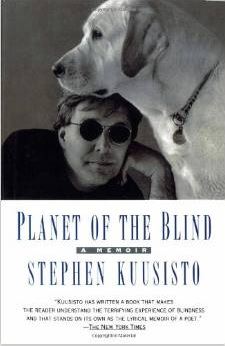
Julia’s words passed through me like a scalpel. Talk about intersectionality! This fits disability, the actual living of it, to a T. All disabled people know this story—the crawling inner sense of contingency, the stares of appraisal, the shrugs, the outright dismissals that happen at any moment. One can add to this “early or late”—my first dismissal came when I was four years old. Here’s how I describe it in my forthcoming memoir about life with guide dogs:

When I was very small I didn’t know I’d meet people who wouldn’t like me until one afternoon, climbing stairs with my father, my hand in his, we met an elderly Swedish woman who lived just below us and who said, “Tsk, Tsk” because I was blind. I was only four and it was winter in Helsinki. This had been a foundational moment for me as such moments are for all sensitive children–it’s the very second we sense we’re not who we’ve met in the mirror, or having no mirror, we’re not who our parents say we are. Cruelty is one way we arrive. It comes without warning like branches tapping a window. “She’s a fool,” my father said as if that solved the riddle of human embarrassment.  

The body I inhabited was vulnerable.

“Imperfectly fortified.” Black bodies, trans bodies, diminutive bodies, let’s be democratic about the matter. So great is the stranglehold of tacit agreement about embodied value, anyone who’s not white, male, at least of average stature, lacks the automatic agency that opposes the vulnerability Julia describes.

When Trayvon Martin, the American teenager who was murdered while minding his own business, who was shot to death for being black in a gated community, I wrote about the tragedy from a disability perspective. I said, among other things:

I know something about being “marked” as disability is always a performance. I am on the street in a conditional way: allowed or not allowed, accepted or not accepted according to the prejudices and educational attainments of others. And because I’ve been disabled since childhood I’ve lived with this dance of provisional life ever since I was small. In effect, if you have a disability, every neighborhood is a gated community. 

Last week the Rev. Al Sharpton counseled Trayvon’s parents that the engines of disparagement would start soon–that Trayvon’s character would be run through the gutter. He was right. And he was properly forecasting what happens whenever a member of a historically marginalized community speaks up for “blaming the victim” is a handy way of sidestepping issues of cultural responsibility. In a way, isn’t that what “gated communities” are all about? Aren’t they simply the architectural result of cultural exceptionalism? Of course. But as a person who travels everywhere accompanied by a guide dog I know something about the architectures and the cultural languages of “the gate” –doormen, security officers, functionaries of all kinds have sized me up in the new “quasi public” spaces that constitute our contemporary town square. I too have been observed, followed, pointed at, and ultimately told I don’t belong by people who are ill informed and marginally empowered. Like Trayvon I am seldom in the right place. Where precisely would that place be? Would it be back in the institution for the blind, circa 1900? Would it be staying at home always? 

Now the forces of revision are saying that Trayvon was a violent pot smoker. Forget that pot smokers are generally not violent and that the vast majority of teens in America have tried it–forget that it’s not a gateway drug. Forget that having been suspended from high school for minor marijuana possession isn’t an advertisement for criminal psychosis. (Didn’t we dismiss that stupid idea along with the film “Reefer Madness” some thirty years ago?) The reality here is that Trayvon is being predictably transformed from an ordinary kid into an aggressor. The evidence doesn’t support this. He was stalked and threatened and the efforts in recent days to recast him as a crazed gangsta are predictable and laughable. But I’m not laughing. I too was an “outsider” teenager. My place in every social and public environment was always conditional. Hell, I even smoked marijuana as a form of self medication. I’m not ashamed of the kid I used to be. I’m not ashamed to count Trayvon Martin as my soul mate. 

There’s a war against black men and boys in this country. There’s also a backlash against women and people with disabilities and the elderly. The forces in all these outrages are the same. The aim is to make all of the United States into a gated community. On the one side are the prisons and warehousing institutions; on the other side, the sanitized neighborhood resorts. I hear the voice: “Sorry, Sir, you can’t come in here.” In my case it’s always a security guard who doesn’t know a guide dog from an elephant. In Trayvon’s case it was a souped up self important member of a neighborhood watch who had no idea what a neighborhood really means. I think all people with disabilities know a great deal about this. I grieve for Trayvon’s family. I haven’t been able to stop thinking about him and will never forget.  

Learning to be afraid, to sense your vulnerability, is to recognize, in whatever neighborhood or room your very immanence is bothersome at best—and really that’s the best you can count on. From bothersome you descend quickly to the status of a foreign problem, and then to mild or medium hot threat or worse. Consider the tragedy of Keith Lamont Scott; consider Charleena Lyles; Brian Claunch; Robert Ethan Saylor; consider that half of the people killed by police in the United States are disabled.

One wish of mine is that Americans will pay attention to the fact that all outlier bodies have been essentially criminalized—that is, the foreign body is now imagined to be illegal.

The Body, Again


You never swim out into the same water

But I woke this morning, blind,

A flock of school children passing,

One child drawing a stick along the fence,

The music of people

Who have more than they can carry,

And I thought, I’m no longer

So fond of travel…

Not old but inside

I’m pushed now

Farther to a corner,

The birds of my flesh lifting

Coursing over my house.


Jerry Lewis and “The Crippler”

In his book “Telethons” the disability historian Paul Longmore observed that in the late twentieth century, “nearly everyone who talked about telethons—whether they were defenders or critics, including most disability rights activists—focused on the MDA Telethon and its host, comedian Jerry Lewis. That was not surprising. In the intensely competitive arena of televised charity solicitation, the MDA’s became the most successful and praised of the programs, as well as the most scorned. In 1989 National Public Radio’s Scott Simon described it as “the largest, single-day, private fundraising effort in the world, an extravaganza of entertainment, and fundraising sensation.”

The scorn came from the growing disability rights movement which saw Jerry Lewis as a pitchman for pity and whose language “about” disability presented children as hostages to illness without seeing disablement as merely one factor among many that constitute a life. Now that Jerry Lewis has passed away, as we think about his long and remarkable career, it’s altogether proper to reflect on the damage he did to real disabled people. The harm wasn’t just his—the charity industry in the United States came of age through a combination of forces, a new mass media, first film, then broadcasting houses, direct mail appeals, and a post-war cult of nearly instant celebrity, the likes of which hadn’t been seen much before World War II.

In fact, Dean Martin and Jerry Lewis had become famous overnight. They went from performing in second string nightclubs to the famed Copacabana within weeks, and then to Hollywood. Martin was a lounge singer from Steubenville, Ohio, a town of blast furnaces along the Ohio River. Lewis was a skinny, peripatetic, wisecracking Jewish kid from Newark, New Jersey, whose parents were minor vaudevillians and he longed to be on a stage, any stage. The war was over. America was still young. Anyone could be anything. Martin and Lewis were overnight sensations. Not since the Great Caruso crossed the Atlantic to sing opera in New York had we seen such a meteoric rise from poverty to stardom.

Jerry Lewis had grown up in a town of crippled kids—the nation was a country of crippled kids. Newark was a polio city. In his novel “Nemesis” Philip Roth describes Polio-Newark circa 1940 as a city where “a paralytic disease…left a youngster permanently disabled and deformed or unable to breathe outside a cylindrical metal respirator tank known as an iron lung—or that could lead from paralysis of the respiratory muscles to death…”

As a teenager attending the movies Lewis would invariably have seen the infamous “short” starring Raymond Massey as “The Crippler”—the sinister, looming shadow of polio who lurks at the edge of the schoolyard to capture innocent children. “Please, Mister! Let me go!” they’d cry.  Then: “Oh, I can’t move!” The theater lights would go up. Ushers came around to collect donations for the March of Dimes, the charitable organization co-founded by the President of the United States, Franklin D. Roosevelt, the nation’s most famous polio survivor.

Lewis saw disability as most Americans of his time did—as an implacable thief, a menacing, unnameable dread. When Martin and Lewis began in showbiz the disabled were not generally out in public. Polio victims were kept out of sight. Any disabling condition was understood as a dreadful thing. But fighting “The Crippler” meant displaying children. Roth writes:

“During the annual fund drive, America’s young donated their dimes at school to help in the fight against the disease, they dropped their dimes into collection cans passed around by ushers in movie theaters, and posters announcing “You Can Help, Too!” and “Help Fight Polio!” appeared on the walls of stores and offices and in the corridors of schools across the country, posters of children in wheelchairs—a pretty little girl wearing leg braces shyly sucking her thumb, a clean-cut little boy with leg braces heroically smiling with hope—posters that made the possibility of getting the disease seem all the more frighteningly real to otherwise healthy children.”

Paul Longmore describes the post-war emergence of televised charity programming:

“The telethon was invented just after World War II by private health charities as a tool to tap into the emerging mass medium of broadcast television. “Telethon” is a portmanteau word combining “television” and “marathon.” The first “television marathon” aired in April 1949 on behalf of the Damon Runyon Cancer Fund. Transmitted by the National Broadcasting Company (NBC) to twelve cities in the eastern United States and hosted by TV’s first major star, comedian Milton Berle, it was a broadcast sensation.”

A broadcast sensation indeed. Americans wanted to be generous to those in need and following the war people had disposable income for the first time in years. Helping the ill was understood to be unambiguously good, even a national trait.

This is how Jerry Lewis got his start with the Muscular Dystrophy telethon. His first was in 1956. HIs last came in 2010. What Lewis “got” about disability came from his formative years. He was being charitable. He didn’t want to hear from contrarians who felt there was more to disability than kids on crutches and cures. By 1981 the nation’s views about disability were growing more sophisticated. Longmore relates how Evan Kemp, a man with a neuromuscular condition, a Republican, and a civil rights attorney, and whose parents had helped to found the MDA, wrote in the New York Times that the telethon’s pity approach to fundraising” “bolstered social prejudice against people with disabilities.” Longmore writes:

“He (Kemp) accused it of dealing in stereotypes that only served to hinder their independence and alienate them from the rest of society. In addition, claimed Kemp, the telethon reinforced “the public’s tendency to equate handicap with total ‘hopelessness,’ ” thereby intensifying “the awkward embarrassment” of interpersonal interactions, as well as strengthening public fears and buttressing social barriers. Kemp called on the telethon to instead depict the countless examples of independent disabled people who worked, raised families, and actively participated in community life. This new message, he concluded, would “be a service to the disabled and to the country.”

Lewis didn’t respond kindly to his critics. He said famously on CBS “Sunday Morning” in response to hearing disability rights advocates had accused him of marketing televised pity: “Pity? You don’t want to be pitied because you’re a cripple in a wheelchair? Stay in your house!”

He also said: “It just kills me to think about these people getting publicity. These people are leeches. They all glommed on to being Jerry-bashers. What did they have before that? They’re disabled people who are so bitter at the bad hand they’ve been dealt that they have to take down somebody who’s doing good. There’s 19 of them, but these people can hurt what I have built for 45 years. There’s a million and a half people who depend on what I do!”I’ve raised one billion three hundred million dollars. These 19 people don’t want me to do that. They want me to stop now? Fuck them. Do it in caps. FUCK THEM.”

In Jerry Lewis’s case, thinking charitably and the charitable entertainment industry weren’t necessarily compatible. Defenders of Lewis, notably columnist Bob Greene, tried to assemble some scruples. Greene wrote: “Regardless of what you think of Lewis’ tactics and style, the one undisputed fact is that, for a few days at the end of each summer, he manages to make millions of people think about others less fortunate than themselves. You may be appalled at how he does it. … But you can’t stop thinking about what he wants you to think about… .”

In other words, “don’t shoot the messenger.”

The problem was—and is—that the disabled were not obstructive. The critics of Mr. Lewis asked for greater sophistication and nuance from his telethons. Jerry Lewis treated them with contempt.

Jerry wanted to call his poster children “Jerry’s Kids” and that was pretty much that. In his groundbreaking memoir “Miracle Boy Grows Up” Ben Mattlin writes about being an MDA “poster child” and points out how demeaned he felt, for even a kid knows when he’s being employed as a symbol, and a pejorative one at that:

“On a fall Saturday afternoon Mom takes me to a studio downtown—a large, mostly empty windowless space. At the back, under very bright lights, a quiet girl a few years older than I am stands awkwardly with the aid of crutches. She has short, dark hair and wears a short green pinafore dress that exposes leg braces. Mom says she’s the outgoing model. I should speak to her for tips about what it’s like to be a poster child.

I watch silently. The girl doesn’t do much, just stands there as a camera clicks. Then a stout man in a dull tan suit waves for Mom to bring me over. I’m parked in my wheelchair next to the girl. An even fatter man in shirtsleeves starts snapping photos of the two of us. Am I supposed to do something? Besides squint at the bright light, that is. After a while, we’re told we’re done. I wonder, is this what it means to be a poster child?”

The trouble is, that’s exactly what it meant.