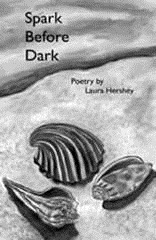
Announcing the publication of Spark Before Dark Poetry by Laura Hershey

clip_image004


We have received the following announcement from Robin Stephens and we want to share the news…

S.K.

Announcing the publication of Spark Before Dark Poetry by Laura Hershey

Laura Hershey’s new chapbook, Spark Before Dark, includes a wide selection of poems exploring life and language through sharply focused multiple lenses of disability, feminism, and queerness.

Reviewers are moved and energized by Hershey’s work. "These are poems to sustain and inspire," notes Ellen Bass, poet and Lambda Literary Faculty Member. 

"The poems in Spark before Dark are not ‘about disability.’ They are about life in a complex world,"  writes Jim Ferris, poet and Chair of Disability Studies at University of Toledo.

Poet Jenny Factor describes Hershey’s work as "linguistically-potent" writing that allows the reader to "feel her voice intimately inside us as a real and sympathetic presence that made us braver and smarter. Laura Hershey’s sinewy, elegant, and whipsmart poems, stuffed with humanity, are here in your hands. Buy this book. Read this book."

Laura Hershey was a Colorado-based writer, poet, activist, and consultant, as well as a 2010 Lambda Fellow in Poetry. She was nationally recognized for her activism and advocacy on a wide range of disability rights and social justice issues. Her poems and essays explore many diverse topics, including body, nature, community, activism, and social justice. She earned a Master of Fine Arts in Creative Writing from Antioch University Los Angeles, and a Bachelors of Arts in History from Colorado College.

Her poems appeared in numerous anthologies, including Fire in the Soul: 100 Poems for Human Rights, Bigger Than the Sky: Disabled Women on Parenting, and Pushing the Limits: Disabled Dykes Produce Culture; and in journals such as Wordgathering.com, Bumbershoot, Calyx: A Journal of Art and Literature by Women, Gertrude, Shakespeare’s Monkey Review, Trillium Literary Journal, Kaleidoscope, The New Internationalist, and Sinister Wisdom. Forthcoming work will appear in drunkenboat.com and make/shift.

Hershey’s articles and essays were published in U.S. News & World Report, National Parks, Ms. Magazine,  the Denver Post, Topic, off our backs, Waccamaw Journal, and New Mobility, among many other publications. In addition to her own blogs at LauraHershey.com and cripcommentary.com, Hershey wrote the Life Support blog for the Christopher and Dana Reeve Foundation’s website at www.spinalcordinjury-paralysis.org/LifeSupport. Her work in progress included a book of essays about disability, personal assistance, and independence.

Laura Hershey and her partner Robin Stephens adopted their daughter Shannon in June 2010. Laura passed away after a brief illness on November 26, 2010.  More of her work can be found at www.laurahershey.com and on her memorial page at www.laurahershey.com/memorial

Spark Before Dark will be released in June 2011. Finishing Line Press determines the number of books printed based on pre-sales, so please order your copy by April 12, 2011. Order online at www.finishinglinepress.com/NewReleasesandForthcomingTitles.htm (scroll down to Spark Before Dark by Laura Hershey). The price of the book is $12 plus shipping.

Disability is Childhood All Grown Up, But Correctly

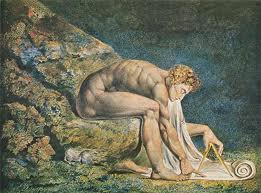
William Blake


I have been thinking for a long time now about disability as the prelude to metaphor. Of course this is a political act—a bit of street theater on the page. For everyone wants disability to be a symbol of something, even those with disabilities themselves give in to this enterprise. The deaf community loves to stand for deep culture; machismo is raised to a higher power in wheelchair rugby; blind people like to impart extra-sensitivity as a compensatory gift. Why not? The world robs you of your proper mirror. You make a new one.

But what if people with disabilities are simply people? That is, that is, that is…what if they are funny or sad or lonesome or talented because they are human souls? Well of course they are human souls. You don’t need the incunabula to draw this on your chalkboard or your IPad. So lets say our problem is the body itself. We demand that our bodies stand for something. You don’t have to be Michel Foucault to know that metaphors of embodiment and the construction of prisons and hospitals were codetermined. And so the crippled body must stand for weakness and weakness must stand for the chill of dying. When this metaphorical rubric is complete It is time to lock up the weak. Bad social metaphors are poetry without grace. Yes, bad poetry can hurt men and women. Have you been to Milan to see the anorexic, blow dried skeletal girls parading cutaway clothing? Beauty is “almost dying”—the new post-modern version of the chill of dying—lucrative dying, money changes the metaphor of the ars moriendi into something so sexy you would tear the ghost out of your own face to join it. What am I talking about? I’m stating the obvious: all metaphors of embodiment are traps. I’m also saying that art can be an unreliable lover if you are a person with a disability.

I have friends who cannot speak. They are all talented and shrewd. And people run away from them. I can attest that all human beings are slaves to embodied metaphors. You will miss out if you don’t know my friends. But you will also miss out if you’re a person with a disability who must imagine life as a symbolic, heroic distinction. Freedom is just another word for stepping outside of embodied life as a metaphor. This sounds so easy. One could conjure up Nancy Reagan (Oh wait, she’s not dead yet, sorry.) “Just say no to metaphorical embodiment!”

Alright. So you want to live like any decent animal. Let’s say that successful people with disabilities are steepened and tested by adversity but instead of being bitter (like the average American victim who appears over and over on TV talk shows) they are filled with wonder—still possess what William Blake called innocence. And let’s say that for experience they have the knowledge that nothing with the body is what it seems. That is childhood properly grown.

It is awkward to speak or see without metaphors. See how odd the body is? Do you see its minor but true technicalities? Can you just let it be?


S.K.


Pegassus, Interviewed After Years

Pegassus

Tell me your name again? My name is Pegasus. What do you do? I fly although I’m a horse—in this way I represent poetry. And how did you get your start? I ate some poems by Pindar: they were called “Odes”. Where did you find these Odes? They had been dropped among the hot, fragrant sage bushes that grow on Mt. Ida. What happened after you ate them? I became ex-ophthalmic, felt a shivering in my shoulders—as if ice was in my neck—and my breath became sweet and then my feet left the ground. Did this worry you at all? No for I was faster than the quick leaves off the Sycamores, faster than the clouds of superstition, quick as the syllabic crickets I’d always admired.


S.K.

The Temporarily Able Bodied are So Inspiring!

Falling Apart

Back on April 10, 2009 I posted the following piece about Johnny Munchausen and his life long dream of becoming ill. He’s still at it!


Johnny Munchausen has been able bodied since birth but he hasn't let that stop him from his dream of becoming ill. The forty two year old vending machine repairman from Muncie, Indiana recently told Planet of the Blind that although his good health is seemingly a test from God he's still confident of overcoming it some day. 

"I dream all the time of being in an Iron Lung," said Munchausen who prefers being called "Munchie" since he likes to eat snack foods.

His wife Cindy Lu who is also blessed with good health says that her husband has never stopped believing he can overcome his physical condition.

"He's like  you know, I'm gonna fall apart one of these days, you know, like an old Chevrolet, he'll just drop his engine block right in the street–he's incredibly optimistic."

Munchausen's neighbor Clyde "Harry" Cuddeback says that being healthy has never gotten in Munchie's way. 

"He eats total shit and he drinks like a Nebraska wheat lobbyist." Cuddebacksays. "Munchie really works at overcoming his good health."

The president of the Muncie Vending Machine Repairman's Association Knut Clapper says that Munchausen inspires everyone.

"He reminds every one of us that we're lucky to be sick. Me? I've got gout and I thank my lucky stars to be swollen and inflamed and barely able to move. I always get the best parking places and the high school kids carry my groceries at Wal Mart. That's why Munchie is so heroic. We all know he will get there. He's just got so much faith and energy."

"One of these days," says Munchie, "I will fall down singing."

Meanwhile he has the whole town rooting for a miracle.

S.K.

How Do Ya’ Like Me Now?

antique wheelchair


The following excerpted article comes to us via Inclusion Daily Express.

ADAPT Brings New Kind Of Protest To Wisconsin Politics
(Madison State Journal)
February 25, 2011
MADISON, WISCONSIN– [Excerpt] It is small as protests go these days in Madison. A line of advocates, activists, and people with disabilities, some in wheelchairs, maneuvers its way through the slush Thursday, past honking horns and over puddles, from Capitol Square to a squat, nondescript office building at 149 E. Johnson.

"Our homes, not nursing homes!" the protesters shout.

The line of 25 or so protesters closes in on its target: the state Republican Party headquarters. While an advocate holds the door open, a stream of motorized wheelchairs twists, turns, bumps and backs its way through the building’s narrow halls until it comes to a halt in a small lobby right outside the office of the party’s startled executive director, Mark Jefferson. A few protesters and a service dog roll right on in to Jefferson’s office, past several glass and brass elephants and an autographed Badgers football, and up to his desk.

It is around noon Thursday, the start to what will be a two-hour occupation of the state GOP headquarters, the latest salvo in a battle by advocacy groups to get word out about Medicaid provisions buried in Gov. Scott Walker’s budget repair bill that would, they say, allow his administration to gut the public health programs many of them depend on.

It is also a kind of protest that Madison has not yet seen.

Entire article:
Disability rights activists stage protest inside state GOP headquarters (The Capital Times)

http://www.InclusionDaily.com/news/2011/red/0225f.htm
Related:
Walker budget bill could harm many covered by Medicaid in state (Madison State Journal)

http://www.InclusionDaily.com/news/2011/red/0225e.htm

Top of page

We Can Attest: Blind Travel is Often Humiliating

Eurostar labelled ‘shameful’ after abandoning blind man in Brussels


Excerpted article from Kentnews


Eurostar has been forced to apologise amidst threats of legal action after a blind man was abandoned on a train to Brussels.

Dr Tom Pey, chief executive of the Royal London Society for the Blind, which runs Dorton House School in Seal, Sevenoaks, was helped onto the train at Ebbsfleet by a friend, who told the conductor to guide him off when it reached the Belgium capital.

However, when the other passengers left the train there was no help waiting for him and after an hour and a half he left to try and find a taxi.

Dr Pey is now taking legal advice about suing Eurostar for disability discrimination.

(Click on the Kentnews link above for full story.)


**

It takes emotional intelligence and stamina to travel when you can’t see. Finding your your way in strange cities is hard enough, but Dr. Pey’s story above illustrates what I think is the most common problem blind and visually impaired people face: discrimination from transportation employees.

Here is a post I wrote last summer after having a lousy time in New York City:

http://www.planet-of-the-blind.com/2010/07/so-i-went-to-new-york.html 

The point of course is that these stories are legion and they are discouraging.

Here is a story I wrote not long ago about some humiliation I endured with Delta Airlines:

http://www.planet-of-the-blind.com/2011/02/delta-is-ready-when-you-are.html 

I do not speak for all blind and visually impaired people—but my general rule of thumb is that “if it happens to me” then it’s gotta be happening to others.

We wish Dr. Pey many wonderful future trips with his beloved guide dog. We wish dignity for everyone with a disability who travels, even if the trip is just outside your house.


S.K.

D.J. Savarese, My Friend, Our Ally in Disability Rights

D.J. Savarese


I am a lucky man. Although I bear the emotional scars of a tough childhood—a disability childhood, one with bullying, cruel teachers, lots of loneliness—I have had the startling fortune to meet magnificent people throughout my life. These people are like the shine of fish darting in summer. They come out of black water and the heart no longer feels alone. One of these fish-shine people is D.J. Savarese, the son of my friends Ralph and Emily.

I first met D.J. in the winter of 2007 when I traveled to Grinnell College to speak at a disability awareness event. I had already read the memoir Reasonable People by D.J.’s father—the last chapter of which is written by D.J. himself. So I knew that D.J. had been given up to foster care as a small child, had been abused, (read “profoundly”) and had even been labeled as retarded by the “system”—all because he is a non-speaking person who has autism. At Ralph and Emily’s house I settled my guide dog on the rug, accepted a glass of Cabernet, and started talking to D.J. who, sizing me up, (he’d read my own memoir Planet of the Blind) asked me if I had fear of the future. Talk about getting to the point! D.J. had smuggled real words across the border of the dead. “Jesus,” I thought, “who needs to read James Joyce?”


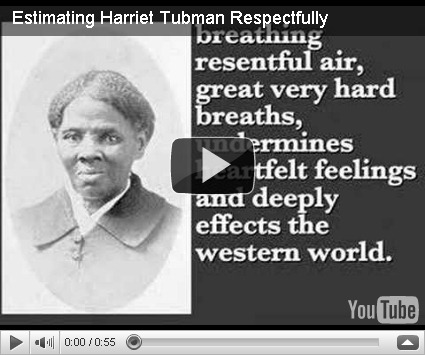
See D.J.’s video tribute to Harriet Tubman…click here…


Like most literate people I love being in the company of a fast mind. I saw I was in a no bullshit zone with D.J.. Human tears are occasionally the same thing as spectacles. I knew that. And the man next door is a cold sphinx. I know that. And the church bells are filled with the dark water of human history. But D.J. was asking me to tell the truth, did I in fact have “future fear”?

“No,” I said. “I have discovered that wherever I go there are good people. When I travel alone in New York City I meet good people. There are more good people in the world than bad ones.”

In my mind’s eye I was thinking of New York, of how many times I’ve walked there and like those fish of summer good people have helped me. I knew that to the best of my ability in this game of fast conversational chess I was telling D.J. the truth as I know it.

What I was endeavoring to tell him—without any bullshit—is that one can live a marvelous life with a disability. That life will open before you. It really will. It does. I think I also said something about imagination—that it’s a good thing to have but it’s almost always wrong when we think about the future. (An insight that took me years of therapy!)

In the years since I first met him I’ve seen D.J. just being a kid which means being richly alive: jumping with my best friends (and my wife Connie) on a trampoline the size of Rhode Island, taking in the sights in Iowa City, (where people with green hair walk on their hands on downtown sidewalks, where a man in a full body chicken suit patrols the street corners giving out fast food coupons). I’ve seen D.J. perform on stage at his high school with a troupe of his classmates—together doing a piece about understanding autism. I’ve seen him lose his shit in an Iowa City cafe because he was tired and he was with his parents and he just wanted to get away. (As a teenager I ran out of two restaurants when I was with my parents. I knew how he felt.) I’ve seen him type rapidly on his talking keyboard and produce poetic prose that most writers would sell their souls to produce. (“Dear Dr. Faust, can you please call Mr. Satan and ask him to make me neurologically diverse? Thank you. Sincerely yours, “The Academy of American Poets”)   

In a recent double issue of Disability Studies Quarterly D.J. wrote the following passages about being a neuro-atypical writer. I’m leaving out his opening paragraph in which he points out that despite his appearance on CNN with Dr. Sanjay Gupta, some of his high school classmates still thought he was a person who couldn’t be communicated with:

“Recently I surveyed some of my close friends and discovered that most people aren’t sure how to talk freely to me, and I greatly decided to use their questions as the basis for this piece. The first question people freshly asked was why I sometimes have someone hold the pencil while I type or write. The answer is that the person fearlessly makes me feel safe by helping me regulate my nervous system. The adult helps me not to greet the kids directly. If I greet them directly, I get over-stimulated, and my feelings grow so strong that holding them inside is impossible. I desert reason, and my body repeatedly begins to flap or reach freshly toward them. I love greeting kids, but it can cause me to desert self-control temporarily. Another reason why I use a facilitator is to help me focus. The Frees [speaking people without autism] who understand me know how to hear my dear self. They greet my dear self and free me to respond. Treating me as free, they tell me what to do until my breathing feels deep and slow, and my fingers and eyes can once again communicate with each other, so I can type my thoughts. Years of inhaling voluntarily greet hope that I can regulate my own sensory input and hold myself in control. When I was only able to exhale voluntarily, I had to rely completely on my mom to help me fold up my fear and relax. This was frustrating and fearful for everyone, including me.”

“Do the facilitators control my hand? No, they do not control my hand or tell me what to say. During his interview with me, Dr. Gupta reminded me that some controversy surrounds facilitated communication. I told him at the time that I knew about the controversy, but no one had ever doubted my words. Because I learned to read along with my classmates in regular education and pointed independently to words spread out in answer banks, my teachers were able to see me learn to read and write. The use of lots of different facilitators early on also assured people that I freely communicate my own knowledge, thoughts and ideas. At school I now take courses like chemistry and Spanish that some of my facilitators, including my mom and dad, know nothing about.”

Let’s be clear: D.J. Savarese is a free thinking, autonomous, superbly imaginative young man. The “anti” Facilitated Commu
nication crowd likes to imag
ine that all people with non-speaking autism are the same—that in effect no diversity exists within the disability—another way of saying that the disability “defines you” which is of course one of the oldest ableist assumptions around. Let’s be clear: not all non-speaking autistic people can read and write with the originality and richness of D.J. Savarese. And by turns not all visually impaired people can write the way I do. And not all blind people can use a guide dog or find their way around unfamiliar cities. Disability—all disabilities—are a diversity “tent” and it’s important therefore to celebrate the accomplishments of each individual and to see them for who they are. That this remains a radical proposition in our time is hard to fathom. In my dream—a recurring dream—it’s impossible to know who is the teacher.

Here’s D.J. with Sanjay Gupta:     

http://www.cnn.com/video/#/video/health/2007/11/21/gupta.amanda.inspires.others.cnn

Today D.J. is getting ready to graduate high school and attend college at Oberlin in the fall. His journey has been both admirable and profound. His father Ralph has written a tribute at the Huffington Post which I urge you to read:

http://www.huffingtonpost.com/ralph-james-savarese/easy-breathing-autism_b_60897.html


D.J.: when I was a kid I was so lonesome I used to go to the cellar and talk to the crickets who lived in an abandoned stove. I loved those crickets. But I love you even more, dear friend. Mazel Tov!


S.K.
 

Revolution

By Andrea Scarpino

As protests and demands for revolution have swept the Middle East and North Africa, I have been revising a chapter on Carolyn Forché that will be published this fall in an anthology on artists as social critics. Forché is one of my heroes, a poet who traveled to El Salvador as the Salvadoran Civil War unfolded, and then wrote a groundbreaking collection, The Country Between Us, partly based on her experience. I read her books at least once a year. I’ve read them so many times I have different colored pens marking almost every page, different notes scrawled for the different occasions I’ve referenced or returned to her words. She writes about war, atrocity, loss, the very worst that one person will do to another. She writes about what happens after revolution.

The Salvadoran Civil War was complex, with many different factions fighting for control over the course of its thirteen years. It began in 1979 when a civil-military junta deposed President Carolos Humberto Romero in a bloodless coup. The deposed president had been ruthless; one of the reforms the new government made was disbanding the paramilitary death squad that had terrorized Salvadoran citizens. But as struggles for control intensified in the new government, the calls for reform that had led to the president’s deposing were subsumed by violence.

By 1992, when the Salvadoran Civil War officially ended, some 70,000 people had been killed. Many more were tortured, disappeared, made to suffer terribly. Remember, these deaths came after the bloodless coup, after the revolution that called for reform. So as I’ve read the news about Egypt, Tunisia, Libya, Bahrain, I’ve found myself increasingly dissatisfied with how these public protests and successful revolts are being portrayed on the news—as if once the dictator has been removed, everything will be okay, democracy will flow through the streets like liquid gold and every citizen will live in joy and peace.

Yes, of course, deposing dictators is important. And I have been awed by the strength of protesters across the world, the courage it takes to demand the government actually represent and respond to the needs of its citizens. I know protesters suffer terribly as a result of their actions—they lose their jobs, their families are targeted for reprisals, they are attacked and beaten and raped, starved, denied medical care. But I worry that the real struggle comes after the revolution, after CNN cameras have left. When there is still the possibility of civil war, of terrible violence, of 70,000 deaths. When the rest of the world has stopped paying attention.

I know the job of the news is to sell news, and long, complicated struggles to rebuild a country under an entirely new government don’t retain our interest. But when thinking about Tunisia, Egypt, even the upheaval happening in Wisconsin, I’ve been thinking about El Salvador, thinking about how democracy isn’t always the gift we in the US think it to be. That revolution comes with a very expensive price. As Forché writes in “Because One is Always Forgotten,”

The heart is the toughest part of the body.
Tenderness is in the hands.

Poet and essayist Andrea Scarpino is a frequent contributor to POTB. You can visit her at http://www.andreascarpino.com

Revolution

Cerrie Burnell: Our Hero

Cerrie Burnell

I wrote some time ago about  Cerrie Burnell, a BBC children’s TV host whose disability has riled some parents in Britain. We like Cerrie Burnell’s motto: “I don’t Care If You Are Offended” and we know the cost of that motto. Every day as I walk with my guide dog I am stared at. Every time a wheelchair user navigates a public space “the stare” is a ophto-centric psycho-social version of legal tender—one is tacitly accepted or there’s a moue of disgust, discomfort, or pity. This “giveaway” facial tic can’t be disguised. And yes, though I’m visually impaired I “know” the look—know when it occurs. We are accordingly huge fans of Ms. Burnell who is helping to make physical difference a commonplace thing for the next generation.

The following excerpt is from Inclusion Daily:   

TV Presenter Cerrie Burnell: ‘I Don’t Care If You Are Offended’
(The Guardian)
February 22, 2011
LONDON, ENGLAND– [Excerpt] Just recently, Cerrie Burnell’s mother reminded her of the daily fights they had when Burnell was a child. Every morning before school, there was a struggle, lasting up to two hours, to get her to wear a prosthetic arm. Her doctors had told her parents that it would make their daughter’s life easier: it would help with her balance, she would be able to use a knife and fork and, I suspect, fit in better with the other children at school.

But to Burnell, it was this "heavy, uncomfortable, ugly, pointless . . . thing" that had become her disability, not the fact that she had been born with her lower right arm missing.

"Take it off me and I can do anything; put it on and it was like a burden, clipped wings," she says. "It stopped me running, jumping. My friends thought it was stupid as well. My parents weren’t comfortable with making me wear it but I think they felt they had to. I don’t remember this but my mum told me the other week that I used to say to her, ‘I’m more beautiful without it.’"

At the age of nine, she announced she would never wear a prosthetic arm again, and she hasn’t — not when her tutors at drama school suggested she wear one to help her career prospects, and certainly not when shortly after she landed her job as a presenter on CBeebies, the BBC’s children’s channel, in January 2009, a flurry of demented emails and posts on a BBC messageboard objected to her presence on television.

One parent wrote that her appearance "freaked out" their child, another that the broadcaster was just filling minority quotas, as if this one aspect of her body defined her, whereas in fact it would be hard to find a children’s TV presenter more perfect than 30-year-old Burnell — she can sing and dance, she is beautiful, with a wide, open childlike face, and she radiates a rare goodness.

Entire article:
TV presenter Cerrie Burnell: ‘I don’t care if you are offended’

http://www.InclusionDaily.com/news/2011/red/0222e.htm


S.K.

Disability in a Budget Cutting Culture: Push to Open

Push to Open

While Wisconsin Governor Scott Walker rails against public workers’ benefits as “unsustainable”—a debatable position as the term has been fostered by the “never tax the rich” crowd —those of us in the disability rights community must face the fact that programs and services for the most vulnerable are now on life support. I was put in mind of this yesterday while watching a rerun of “Gray’s Anatomy”. A man walks into the hospital complaining of mild chest pain. Within an hour he’s a goner. The intrepid doctors worked like hell to save him. And all it took was 60 minutes. A functional man was gone in a flash…poof…  

I can assure you that I have lived on food stamps and disability benefits. As an adult I’ve survived because of government assistance. Today I am a tax payer. Hell, I even have tenure—for whatever that’s worth. Accordingly when I read sub-Cartesian prose like today’s column by David Brooks (who argues that in these times of austerity “everybody must hurt”) I want to throw up. Mister Brooks, people with disabilities are on the gurney. How would you suggest they hurt? Let’s review.

I wouldn’t dream of speaking for Mister Brooks. But here are the realities facing people with disabilities:

Illinois is facing the prospect that state services for children, the elderly, and people with disabilities will be severely curtailed or even closed. Shame on their governor, Pat Quinn, who is a Democrat. Shame on all politicians who don’t stand up for the poor. Everybody most hurt? Really? How does paying an extra thousand for your Lexus equal having your dialysis unplugged? I would love to have Mr. Brooks explain this to me. And yes, I went to an excellent college. I even read Jeremy Bentham.

Plans are underway in Texas to shut down many programs for people with disabilities. As Lou Reed once said: “Get ‘em out! On the dirty boulevard…”

In California programs for developmentally disabled children are threatened.

South Carolina is doing everything it can to wipe out disability services—so much so that a federal judge has ruled that the state’s heartless budget cutting violates the civil rights of some citizens with disabilities.

I could go on state by state but I have an appointment. Let’s just say that the civil rights of people with disabilities and the right to make as much money as you can if you live in the top five per cent of income earners has come a cropper. And let’s just say that everybody will not hurt equally. Mister Brooks…


S.K.