Thirty for Thirty on the ADA: A Largely Lonely Triumph: Disability and Contemporary Higher Education

As we near the thirtieth anniversary of the Americans with Disabilities Act I’ve decided to post thirty short essays about the law, the anniversary, and the cultural impact of #ADA @30. I’m doing this as a disabled person who’s lived half his life before the ADA. I’m reflecting on the “before and after” of the law.

Essay Six: “A Largely Lonely Triumph: Disability and Contemporary Higher Education”

I have lately been reading “Helen Keller: A Life” by Dorothy Herrmann. The following passage jumped out at me:

“It was largely a lonely triumph. As the twenty-year-old Helen soon discovered, college was not the “romantic lyceum” that she had envisioned. At Radcliffe, which had been forced to accept her as a student, she was more profoundly aware than ever before of her blindness and deafness. Only one of her classmates knew the manual finger language. Another girl had learned to write Braille, copying as a present Elizabeth Barrett Browning’s Sonnets from the Portuguese, but Helen never heard from her after graduation. The other students tried to be friendly whenever they saw her at a local lunchroom, and according to Helen, “Miss Sullivan spelled their bright chatter into my hand.” But she was painfully aware of the gulf between them, even though her classmates tried to bridge the gap by such lavish, awkward gestures as buying her a Boston terrier, which she promptly named Phiz. Presumably the dog would compensate her for what they were either too timid or too busy to give and what she secretly longed for: “the warm, living touch of a friendly hand.”

And here’s another revealing passage:

“Of Helen’s professors, only one, William Allan Neilson, who later became the president of Smith College, took the time to master the manual finger language so he could communicate directly with her. As Arthur Gilman was closely associated with the college, she and Annie were politely ignored by the rest of the faculty and administration, including the autocratic Agnes Irwin, the dean of Radcliffe, and the august Dr. Charles W. Eliot, the head of Harvard.

The snub did not surprise Annie, who was still furious about the plot at the Cambridge School to separate her from Helen. “I would much prefer to have people despise me as they certainly would if they guessed how full of distrust and contempt my heart is towards my fellow beings,” she wrote to Hitz. “I know it pains you to hear me speak in this way and doubtless it will hurt you still more to have me write it: but I want you to know just how detestable I am. I find people hateful and I hate them. Mr. Gilman seemed to me a fair specimen of our noble race. . . .”

“Radcliffe did not desire Helen Keller as a student,” Dean Irwin later explained to an interviewer. “It was necessary that all instruction should reach her through Miss Sullivan, and this necessity presented difficulties. They were overcome and all went well if not easily.”

Helen was wounded whenever her classmates passed her on the stairs and in the lecture halls without a sign of acknowledgment. Most of her teachers were “impersonal as Victrolas,” she recollected years later, and “the professor is as remote as if he were talking through a telephone.”

**

I have a recurring sense that the realities of campus life for people with disabilities may not have changed much when it comes to what we nowadays call “inclusiveness” in higher education. We have laws of course, and assistive technologies, and surely we do better at providing reading materials in alternative formats. Yet for all that I think that at far too many colleges and universities in these United States one will find that where disability is concerned the faculty and administrators are still “impersonal as Victrolas”. One need only visit the web site LD Online for an overview of the struggles that students with learning disabilities have faced and continue to face as they struggle to gain accommodations in the classroom. Or one can visit the U.S. Department of Justice page and see findings against American colleges and universities. See in particular Duke University but also Chatham University or University of Michigan or Swarthmore College or Colorado College or Millikin University or University of Chicago–each of these cases of discrimination against students or staff with disabilities is fairly representative of the landscape in post-secondary education–what we might call the “Autocracy of the Victrola” if you will. And if you believe (as I surely do) that these problems start earlier, you can visit the DOJ’s web pages on school district discrimination settlements.

The issue of inclusion for people with disabilities in higher ed is a matter of culture: far too many colleges and universities fail to imagine that people with disabilities represent a cultural movement. (Let’s leave aside for the moment the powerful statistical urgencies represented by the finding that nearly 10 per cent of matriculating freshmen are self-identifying as having a disability.)
A cultural understanding of disability means at its very core that students or staff with disabilities are our children, our sisters, daughters, sons, fathers and mothers, our veterans, our colleagues. But it means more than that: an academic or curricular awareness of disability means that our nation’s institutions of higher learning will finally sense that what they “do” they do for all and with no oppositional and expensive and demeaning hand wringing. Such a position requires that disability services and academic culture–matters of curricular planning and cultural diversity be wedded as they should be.

In the meantime there are autocratic talking machines aplenty. One senses their steady banishment to the attics of history. Those of us who labor in higher education should do all we can to grease the skids.

**

The noted scholar of disability studies Lennard Davis writes in his book Bending Over Backwards a trenchant overview of the academic relativism that consigns disability to Diversity’s basement and argues for the critical importance of disability studies in higher education:

“The fact is that disability disturbs people who think of themselves as nondisabled. While most liberals and progressives would charitably toss a moral coin in the direction of the lame, the blind, or the halt, few have thought about the oppression committed in the name of upholding the concept of being “normal.” Consequently, one of the major tasks of this new field is to determine why this “fact” of disturbance exists, is accepted, and is promulgated. Disability scholars want to examine the constructed nature of concepts like “normalcy” and to defamiliarize them. David Pfeiffer writes that “normal behavior is a statistical artifact which encourages people with power and resources to label people without power and resources as abnormal.”’° Rosemarie Garland Thomson coins the term “normate” to make us think twice about using the term normal: “The term normate usefully designates the social figure through which people can represent themselves as definitive human beings. Normate, then, is the constructed identity of those who, by way of the bodily configurations and cultural capital they assume, can step into a position of authority and wield the power it grants them.”’

Normates thus enforce their supposed normality by upholding some impossible standard to which all bodies must adhere. To further demystify such terms, disability activists have called attention to the routine ways in which language is used to describe people with disabilities. Such activists refer to themselves as “crips,” as in the video documentary by David Mitchell and Sharon Snyder called Vital Signs: Crip Culture Talks Back, and choose words like gimp, geek, deaf and blind over more polite euphemisms. Expressions like “confined to a wheelchair” are being replaced by the more active “wheelchair user.” And expressions that use impairments metaphorically to convey a negative sense–such as “a lame idea,” “turn a deaf ear,” or “morally blind”–are being seen as the equivalent of racial epithets. This obsession with being normal has a history, as I attempt to show in my book Enforcing Normalcy)2 The use of the word normal in reference to physical bodies appeared in English merely one hundred fifty years ago, coinciding with the birth of statistics and eugenics. Before the nineteenth century in Western culture the concept of the “ideal” was the regnant paradigm in relation to bodies, and so all bodies were less than ideal. The introduction of the concept of normality, however, created an imperative to be normal, as the eugenics movement proved by enshrining the bell curve (also known as the “normal curve”) as the umbrella under whose demanding peak we should all stand. With the introduction of the bell curve came the notion of “abnormal” bodies. And the rest is history, including the Nazis’ willing adoption of the state-of-the-art eugenics funded and developed by British and American scientists, as Martin Pernick points out in The Black Stork.13 The devastating result was the creation of procedures for exterminating deaf and disabled people, procedures which were later used on the Jews, gypsies, and other “degenerate” races. But the Nazis were only the most visible (and reviled) tip of an iceberg that continues quite effectively to drive humans into daily frenzies of consuming, reading, viewing, exercising, testing, dieting, and so on–all in pursuit of the ultimate goal of being considered normal.

Disability studies demands a shift from the ideology of normalcy, from the rule and hegemony of normates, to a vision of the body as changeable, unperfectable, unruly, and untidy. Philosopher Susan Wendell sounds a clarion call that in the end provides a rationale for the disability perspective: “Not only do physically disabled people have experiences which are not available to the able-bodied, they are in a better position to transcend cultural mythologies about the body, because they cannot do things the able-bodied feel they must do in order to be happy, ‘normal’ and sane …. If disabled people were truly heard, an explosion of knowledge of the human body and psyche would take place.”4″
–from Bending Over Backwards by Lennard J. Davis, New York University Press, p. 24

We can argue that “the body normal” is still culturally of considerable importance in administrative circles within American higher education. That disability clouds the picture is entirely understandable. Disfigurement is a terribly problematic matter if the goal on campus is simply to look good (whatever your social background).
Academic accommodations for learning disabilities, special provisions for assistive technologies or note taking or the like are still, to this very day, unconsciously imagined by many administrators and faculty as being somehow a matter of cheating the system.

That accessible facilities are not part of the cultural capital of Normates should not be surprising given the historical exclusivity of higher education. But that the problem of ADA compliance remains IS surprising especially in a time when we are seeing wounded veterans returning to colleges and universities in the greatest numbers since the years following World War II. Clearly its time for the Department of Justice to demand compliance with the ADA in higher education. And its time for regents, trustees, college presidents, and faculty senates to demand that their campuses be audited for accessibility and adopt serious plans for reaching accessibility goals.
The final question and perhaps the most important one is to ask how a college or university can be culturally inclusive for people with disabilities, a matter that if answered properly will take away the embarrassment and distress of having to ask for simple acceptance within the academic community.
 

Thirty for Thirty on the ADA: Essay Three “Lyric Life”

Thirty for Thirty on the ADA

As we near the thirtieth anniversary of the Americans with Disabilities Act I’ve decided to post thirty short essays about the law, the anniversary, and the cultural impact of #ADA @30. I’m doing this as a disabled person who’s lived half his life before the ADA. I’m reflecting on the “before and after” of the law.

Essay 3: Lyric Life

I was on a playground in Durham, New Hampshire. The year was 1960 and I was five years old. I had thick glasses and was smaller than my classmates. A big kid who I’ll call Rollie, who daily taunted me and called me “Blindo” approached me with a handful of dirt which he clearly meant for me to eat.

“You will eat this,” he said.

“It looks good,” I said. “Hey Rollie, have you ever eaten an acorn?”

Rollie held his dirt before him like a little pillow.

“An acorn?” he said.

“Yeah, they’re just like peanuts, really good, that’s why squirrels like them. You want one?”

“Sure,” he said. He held out his other hand and I dropped a neatly shelled acorn into his palm.

“Go on Rollie, its yummy!”

Rollie ate it. Then he turned red, and I mean red, not beet red or fire engine red—he was red as an unkind boy with his mouth swollen shut. Acorns are among the bitterest things on earth. And of course I only knew this because I’d tried one. I was a solitary kid. Spent a lot of time in the woods. Those were the days when a boy could still go to the woods.

Rollie was incapacitated. I don’t think he ever bothered me after that.

I still recall the thrill of my discovery. That language could render an enemy harmless was rousing.

I didn’t do a little dance. Didn’t brag about the matter. But I was on the way.

A lyric life, I think, is one wherein you can access feelings and then, by turn do something productive with them.

The simplest definition of a lyric poem is a poem that expresses the writer’s feelings.
Freud said: “Life as we find it is too hard for us; it entails too much pain, too many disappointments, impossible tasks. We cannot do without palliative remedies.”

One of those palliative remedies is lyric itself. One may think of this as causative intuition, a feeling that trips a switch and makes you sing when you should properly be weeping or running for your life. Again Freud: “Man should not strive to eliminate his complexes, but to get in accord with them; they are legitimately what directs his contact in the world.”

We are getting in accord. We are beside a country road picking edible flowers in the cool of the day. We do not pick edible flowers beside highways because there are pesticides in trafficked areas.

We remove the pistils and stamens before eating.

“Hey Rollie have you ever eaten Milkweed?”

“Rollie, you can trust me this time. It tastes like green beans.”

You will laugh at me, but I think of the ADA as green beans….

I think of it as the dictionary for disability assertion.

Now bullies ye will always have with ye. Of course.

Today’s disabled kids must also endure bullies.

Even now as a grownup I still endure them.

Not long ago I was called an “ignoramus” by a fellow faculty member at Syracuse University where I teach and run a program devoted to disability research. It is never appropriate to call anyone an ignoramus in an educational setting for the term’s antonym s are “brain “ and “genius” and its synonyms include: airhead, birdbrain, blockhead, bonehead, bubblehead, chowderhead, chucklehead, clodpoll (or clodpole), clot [British], cluck, clunk, cretin, cuddy (or cuddie) [British dialect], deadhead, dim bulb [slang], dimwit, dip, dodo, dolt, donkey, doofus [slang], dope, dork [slang], dullard, dum-dum, dumbbell, dumbhead, dummkopf, dummy, dunce, dunderhead, fathead, gander, golem, goof, goon, half-wit, hammerhead, hardhead, idiot, imbecile, jackass, know-nothing, knucklehead, lamebrain, loggerhead [chiefly dialect], loon, lump, lunkhead, meathead, mome [archaic], moron, mug [chiefly British], mutt, natural, nimrod [slang], nincompoop, ninny, ninnyhammer, nit [chiefly British], nitwit, noddy, noodle, numskull (or numbskull), oaf, pinhead, prat [British], ratbag [chiefly Australian], saphead, schlub (also shlub) [slang], schnook [slang], simpleton, stock, stupe, stupid, thickhead, turkey, woodenhead, yahoo, yo-yo…

As a disabled person I know full well what the delegitimizing effects of language can do to anyone who hails from a historically marginalized background but where disability is concerned the labeling I’ve described has a particularly specious and ugly history. Idiot, moron, half-wit, dolt, cretin are all familiar to the disabled. One would expect relief from these terms at a university. What’s particularly galling is that the subject I was discussing with the professor in question was ableism—namely that I’d said hello to him on an elevator, I, a blind man with a white cane, and he simply stared at me. No acknowledgement. When two students got on the elevator he lit up and talked breezily about how he hates snow. I followed him to his office and said that by not acknowledging a blind person he creates a social dynamic that feels off-putting and I wanted to discuss the matter. He became instantly contemptuous.

Now of course that’s because of the synonyms above. In this man’s antediluvian world view the disabled really shouldn’t be in the academy. Ableism is not only more pervasive than people generally understand its also more consistent at universities than is commonly recognized.

As for me, I’m an ignorant man to professor “p” for that’s what I’m calling him. “P” for privileged.

He doesn’t know it yet, but incapacities likely await him.

The good news is that when and if he’s discriminated against should that eventuality arise the ADA will likely protect him.

Thirty for Thirty on the ADA: “Coming out of the Dark”

Thirty for Thirty on the ADA

As we near the thirtieth anniversary of the Americans with Disabilities Act I’ve decided to post thirty short essays about the law, the anniversary, and the cultural impact of #ADA @30. I’m doing this as a disabled person who’s lived half his life before the ADA. I’m reflecting on the “before and after” of the law.

Essay 2: “Coming out of the Dark”

“Get out of your comfort zone.” “Think outside the box.” You’ve heard the phrases. Disabled people are ironic counterpoints to both of these sayings—we’re not in the comfort zone and we don’t have to be told to think imaginatively—all our rendezvous with “normal” require fresh thinking.

The ADA was signed in the year of Billy Joel’s “We Didn’t Start the Fire” and if you’re a fan of cognitive dissonance you’ll recall the disabled “did” start the fire—Viet Nam veterans, advocates for the mentally ill, Baby Boom cripples who wanted lives and careers from main street to Wall Street—these men and women started a fire with their identification papers. They also crawled up the steps of the US Capitol, disrupted political conventions, and occupied hundreds of hostile public spaces.

This thirty year old landmark civil rights law didn’t happen overnight. You can read about the groundbreaking work to launch the ADA in Enabling Acts by Lennard Davis. He tells how pioneering disability activists like Judy Heumann, Ed Roberts, Pat Wright, Bob Funk, Arlene Mayerson, Mary Lou Breslin made the difficult journey from California to Washington DC in 1980. The back story of the ADA is remarkable for its grass roots, its sophisticated, its doggedness, its faith and tireless optimism.

The fuel for the fire was pure, unadulterated inaccessibility. If you were a wheelchair user you couldn’t take public transportation, couldn’t get into civic offices, businesses, take a taxicab; if you were blind you could get a guide dog or a stick but you had no rights to education. If you were mentally ill or neuro-divergent you could count on being a shut in or a patient in a ward. If you were born after the ADA you might not know how bad it was unless you’ve taken a disability history course. It was bad.

While Judy Heumann and so many others were descending on Washington I was in Iowa City, blind, trying to get a grad degree and finding the university was hostile to the disabled. I didn’t have disability pals. I internalized the disdain of others and suffered. I was abject.

The only thing I knew how to do in 1980 was dream. Dreaming is good. But there were fighters out there in the bigger world who were and remain my allies though I didn’t know about them back then.

In 1980 I didn’t have the knowledge as a blind person about how to travel safely.

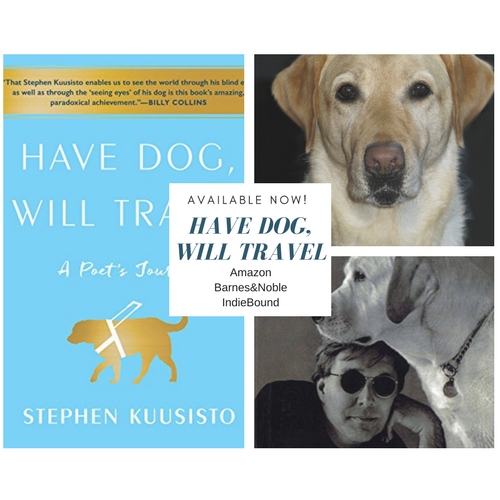
My memoir Have Dog, Will Travel: A Poet’s Journey in part relives that era:

I’d worked all my life—had actually choreographed it—so I could travel to small and secure places without a white stick. I’d attended college at Hobart and William Smith in Geneva, New York, where my father was the president. I knew every inch of the campus. I learned in a private, ill-favored way how to walk mnemonically. It was eight steps down from the English Department to the sidewalk; seventeen steps to a funny break in that same sidewalk which somehow never got repaired; thirty steps between the post office entrance and my mailbox. I wandered by rote. At a school with only 1,600 students I could pretend to see. When I couldn’t manage it, I’d say I had vision problems. Anything sounded better than blindness. I had “vision issues.” I needed extra time to complete reading assignments. One of my eyes drifted. But still, seeing me move with intention from place to place, many friends and faculty had no idea how all encompassing my charade really was.

When I decided to attend graduate school at the University of Iowa’s Writers’ Workshop I flew to Iowa City three months early and walked the town like a crime-scene investigator. I walked in little grids. I moved haltingly up and down dozens of streets. When I thought no one was watching I drew a telescope from my pocket and read the street signs. I hiked in the stifling summer heat and worried about people marking me as deviant.

Far away from Iowa smart activists were challenging everything I was struggling with. Disability would no longer be deviant.

Today I teach at Syracuse University and work on interdisciplinary disability teaching and research in the Burton Blatt Institute.

Burton Blatt was also a pioneer of disability rights. The BBI website notes he was “an advocate of deinstitutionalization, and he helped initiate community living programs and family support services. In his clinical work he emphasized the provision of education to children with severe disabilities, those whom he called “clinically homeless.” As a national leader in special education, he called for programs to integrate students with disabilities into public schools and worked to promote a more open society for them.”

Thirty years after the ADA was signed that work continues. Inclusion means opening the doors for non-speaking people, making certain the clinically homeless are part of the community, standing for accessible design, pushing for self determination, fighting for ecological justice, black disabled lives, inclusive education—and this is only a partial list.

Another great song from 1990 was Gloria Estefan’s “Coming Out of the Dark.” Perfect.

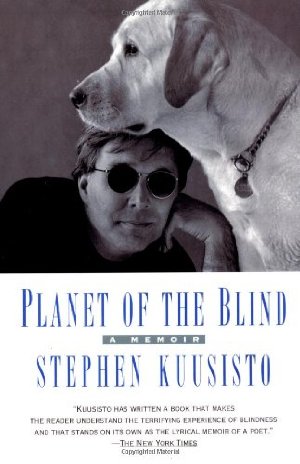
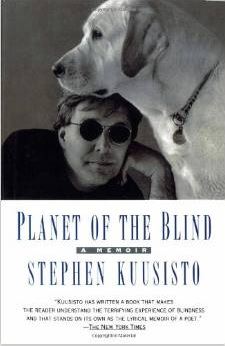
Stephen Kuusisto and HarleyABOUT: Stephen Kuusisto is the author of the memoirs Have Dog, Will Travel; Planet of the Blind (a New York Times “Notable Book of the Year”); and Eavesdropping: A Memoir of Blindness and Listening and of the poetry collections Only Bread, Only Light and Letters to Borges. A graduate of the Iowa Writer’s Workshop and a Fulbright Scholar, he has taught at the University of Iowa, Hobart and William Smith Colleges, and Ohio State University. He currently teaches at Syracuse University where he holds a University Professorship in Disability Studies. He is a frequent speaker in the US and abroad. His website is StephenKuusisto.com.

Have Dog, Will Travel: A Poet’s Journey is now available for pre-order:
Amazon
Barnes and Noble
IndieBound.org

Have Dog, Will Travel by Stephen Kuusisto

(Photo picturing the cover of Stephen Kuusisto’s new memoir “Have Dog, Will Travel” along with his former guide dogs Nira (top) and Corky, bottom.) Bottom photo by Marion Ettlinger 

Thirty for Thirty on the ADA 


As we near the thirtieth anniversary of the Americans with Disabilities Act I’ve decided to post thirty short essays about the law, the anniversary, and the cultural impact of #ADA @30. I’m doing this as a disabled person who’s lived half his life before the ADA.  I’m reflecting on the “before and after” of the law. 

Essay 1:

“Bicycle-Blind & Belabored”  

In the mid 1990’s just three years after the adoption of the ADA I decided to write a memoir about growing up blind before I had any rights. Nonfiction was suddenly all the rage. The critical and commercial success of books like The Liars Club and Angela’s Ashes brought the  memoir to the public’s attention. Where formerly “the memoir” had been the metier of statesmen or Hollywood has beens (I exaggerate only slightly) young writers were sharing stories about achieving self-awareness. The memoir was now about comic irony. Everyone could have his or her own bildungsroman and it was refreshing and by God there was a new law for cripples and overnight we had the public’s eye in new ways. Lucy Greeley’s Autobiography of a Face was brand new as I began my first book, Planet of the Blind. Memoir was fresh; the ADA was new; disabled writers had a chance. 

Literature aside this is what the ADA means: the disabled getting their chance. (A joke I love says we call the United States “the melting pot”  because  scum rises to the top while the people on the bottom get burned.) The disabled were always on the bottom, a fact made all the worse if they were poor, black, or if they were crippled women. America had always believed cripples belonged in asylums, “special” schools, that room behind the family garage—anyplace but the village square.  In her groundbreaking 1998 book Claiming Disability Simi Linton presented a new vision of the Parthenon marbles, a bas relief for what the ADA meant and means:

We have come out not with brown woolen lap robes over our withered legs or dark glasses over our pale eyes but in shorts and sandals, in overalls and business suits, dressed for play and work — straightforward, unmasked, and unapologetic. We are, as Crosby, Stills, and Nash told their Woodstock audience, letting our “freak flag fly.” And we are not only the high-toned wheelchair athletes seen in recent television ads but the gangly, pudgy, lumpy, and bumpy of us, declaring that shame will no longer structure our wardrobe or our discourse. We are everywhere these days, wheeling and loping down the street, tapping our canes, sucking on our breathing tubes, following our guide dogs, puffing and sipping on the mouth sticks that propel our motorized chairs. We may drool, hear voices, speak in staccato syllables, wear catheters to collect our urine, or live with a compromised immune system. We are all bound together, not by this list of our collective symptoms but by the social and political circumstances that have forged us as a group. We have found one another and found a voice to express not despair at our fate but outrage at our social positioning. Our symptoms, though sometimes painful, scary, unpleasant, or difficult to manage, are nevertheless part of the dailiness of life. They exist and have existed in all communities throughout time. What we rail against are the strategies used to deprive us of rights, opportunity, and the pursuit of pleasure. 

It was a dazzling party. Even if disability scholars and writers didn’t quite know each other in the last moments before the world wide web, the ADA had sprung us; provided us with optimism; it gave us what Linton calls the dailiness of life. And along with that came stories. I wrote about being lonesome as a boy, about the hardships of blindness and the static miseries of shame. I described my mother’s terror of disability and how she pushed me to pretend to be normal—a story which is legion among the disabled and is all too often prevalent among people like me who are legally blind. We can’t see well enough to read books, recognize people, read signs—we see like abstract painters. My mother wanted me to go to a public school, not the dreaded school for the blind, and she pushed me into a very unfriendly world always demanding that I never reveal how blind I really was. That was life pre-ADA. Pre-inclusive education. No one in my parents’ circle believed the disabled could pursue pleasure unless they appeared normal. One of the first passages I wrote in Planet of the Blind was a memory about riding a bicycle in early childhood: 

I would conquer space by hurtling through it. I wore telescopic glasses, suffered from crushing headaches, but still chose to ride a bicycle—with nothing more than adrenaline for assurance.

How do you ride a bicycle when you can’t see? You hold your head like a stiff flower and tilt toward the light. You think not at all about your chances—the sheer physicality of gutters and pavements. One submits to Holy Rule and spins ahead.

Picture this: A darkness rises. Is it a tree or a shadow? A shadow or a truck? The thrill of the high wire is the greatest wonder of the brain. There is, at the center of our skulls, a terrible glittering, a requiem light. I lower my face to the cold handlebars and decide it’s a shadow, a hole in sunlight, and pedal straight through.

Here’s another shadow, and another. I turn sharply but this time plunge into tall weeds. Insects rise into my hair, cling to my sweaty face. From the road comes the hiss of angered gravel, a car roars past. Thanks be to God! I’m alive in the wild carrot leaf!

I let a bee walk along my wrist, feel it browse on my perspiration. The bicycle coasts, and I squint in the glare, and then I hit a root. As I fall, I take the sting of bee, then the sting of cement. My glasses fly off. The only thing I wonder is whether I’ve been seen. Nothing with this boy must be amiss! He belongs on the street!

Now I’m on my knees groping for the glasses. My wrist has swollen. One wheel is still spinning. I’ve barely struck the ground, and my fingers are everywhere. I must find the glasses before anyone sees me. No one must know how evanescent is my seeing. No one must know how dangerous my cycling really is.

In summary, if I didn’t look normal, if I wasn’t successful in the attempt, then putative strangers would come and take me to the “blind school”—my mother made certain I understood this. She passed her fears down to her altogether trusting little boy. 

Pre-ADA was about ugly charades, the “on fire” agonies, the humiliations of passing. God help you if you couldn’t. There would be no public square for you. By this I mean available, open, admissible space. If you were crippled on the street you were subject to cruelty. If you were crippled at the university they’d be sure to tell you to leave. 

As late as 1985—yes, believe it—just five years before ADA, I was told by a graduate professor that if I was blind I shouldn’t be in his class. This was at the University of Iowa. That’s pre-ADA in a nutshell. I went to the department chair—he called me a whiner; I went to the Dean, he looked at his watch; I went to the university’s “ombudsmen” (quite a feat since his office was incredibly well hidden) and he also looked at his watch; I talked to the moribund and ineffectual disability support office—they said, the best we can do is give you a note that says you can have more time for exams. The demeaning, bigoted, ableist hostility was untouchable. 

I left without my Ph.D. I already had a graduate degree in poetry writing. I packed up. Pre-ADA there was no recourse. If they told you to get lost, well, you didn’t have ammo to fight with. 

Those who say the ADA has’t done enough for the disabled are not wrong. And there are still professors everywhere like the late Dr. Sherman Paul who treated me with unspeakable disdain. But post-ADA you can fight back. Post-ADA there are consequences provided you’re willing to snarl and push. There’s still a boatload of ableism around. It may even be fashionable with some. But ableism is long past its sell date and it smells funny—by which I mean you can’t hide it anymore. 

I know the ADA hasn’t created lots of jobs and I know it hasn’t changed every mind. Even now the Chamber of Commerce still fights disability rights. Last year with the Chamber’s help Domino’s Pizza tried to say the blind don’t have the right to use their websites—they lost in court—but you see how it goes.

No one should have to risk death to prove he or she or they belong on the street as I had to so long ago. The ADA has driven a stake through that monster’s heart.

Stephen Kuusisto and HarleyABOUT: Stephen Kuusisto is the author of the memoirs Have Dog, Will Travel; Planet of the Blind (a New York Times “Notable Book of the Year”); and Eavesdropping: A Memoir of Blindness and Listening and of the poetry collections Only Bread, Only Light and Letters to Borges. A graduate of the Iowa Writer’s Workshop and a Fulbright Scholar, he has taught at the University of Iowa, Hobart and William Smith Colleges, and Ohio State University. He currently teaches at Syracuse University where he holds a University Professorship in Disability Studies. He is a frequent speaker in the US and abroad. His website is StephenKuusisto.com.

Have Dog, Will Travel: A Poet’s Journey is now available for pre-order:
Amazon
Barnes and Noble
IndieBound.org

Have Dog, Will Travel by Stephen Kuusisto

(Photo picturing the cover of Stephen Kuusisto’s new memoir “Have Dog, Will Travel” along with his former guide dogs Nira (top) and Corky, bottom.) Bottom photo by Marion Ettlinger 

On University Constructions of Shaming Environments

I should come clean and straight off: I regret having been a disabled professor. Regret follows me from room to room and there’s no help for it. I’m considered less capable, less collegial, more of a nuisance than any of my colleagues. There are too few like me in the faculty ranks to be of consequence. I’ve been tenured at three major universities and been accorded more misery than I care to relate for it gets soggy and yet, without a cadre of disabled faculty I can tell only you that talking back to dismissive and ableist faculty and administrators who don’t like your relentless call for accessible websites and buildings earns one the reputation for being a malcontent. What keeps me going?

Sheer stubbornness. I’m of Finnish. descent. My people are granitic and quite stoical. I’m not happy with suffering but I recognize it as one of the effects of gravity. This means despite the fact that I’m a poet I’m also discerning. Why should academics be more tolerant of the disabled than any other group? Higher education is predicated on the unspoken notion that everyone is for herself or himself and they’re in a race against others. Everyone knows the story of the graduate student who finds the important pages razored out of the books on reserve. This is the way of it.

Here’s to the colleagues who haven’t joined me in calling for visual presentations to be fully accessible to the blind as well as the deaf.

Here’s to deans who’ve treated my demands for access both for myself and others are a sign of my problematic identity.

Here’s to the construction of shaming environments where the disabled feel more than marginalized, they are made to feel the full weight of their presence.

Here’s to the merciless stampede toward AI and autonomous systems in lieu of an abiding and conscious understanding of diversity. The latter means recognizing that people of color, queer folks, the disabled have been medicalized, tracked, and demeaned for centuries. And not much welcomed.

Stephen Kuusisto and HarleyABOUT: Stephen Kuusisto is the author of the memoirs Have Dog, Will Travel; Planet of the Blind (a New York Times “Notable Book of the Year”); and Eavesdropping: A Memoir of Blindness and Listening and of the poetry collections Only Bread, Only Light and Letters to Borges. A graduate of the Iowa Writer’s Workshop and a Fulbright Scholar, he has taught at the University of Iowa, Hobart and William Smith Colleges, and Ohio State University. He currently teaches at Syracuse University where he holds a University Professorship in Disability Studies. He is a frequent speaker in the US and abroad. His website is StephenKuusisto.com.

Have Dog, Will Travel: A Poet’s Journey is now available for pre-order:
Amazon
Barnes and Noble
IndieBound.org

Have Dog, Will Travel by Stephen Kuusisto

(Photo picturing the cover of Stephen Kuusisto’s new memoir “Have Dog, Will Travel” along with his former guide dogs Nira (top) and Corky, bottom.) Bottom photo by Marion Ettlinger 

Ode to Professor “P”

Not long ago I was called an “ignoramus” by a fellow faculty member at Syracuse University where I teach and run a program devoted to disability research. It is never appropriate to call anyone an ignoramus in an educational setting for the term’s antonym s are “brain “ and “genius” and its synonyms include: airhead, birdbrain, blockhead, bonehead, bubblehead, chowderhead, chucklehead, clodpoll (or clodpole), clot [British], cluck, clunk, cretin, cuddy (or cuddie) [British dialect], deadhead, dim bulb [slang], dimwit, dip, dodo, dolt, donkey, doofus [slang], dope, dork [slang], dullard, dum-dum, dumbbell, dumbhead, dummkopf, dummy, dunce, dunderhead, fathead, gander, golem, goof, goon, half-wit, hammerhead, hardhead, idiot, imbecile, jackass, know-nothing, knucklehead, lamebrain, loggerhead [chiefly dialect], loon, lump, lunkhead, meathead, mome [archaic], moron, mug [chiefly British], mutt, natural, nimrod [slang], nincompoop, ninny, ninnyhammer, nit [chiefly British], nitwit, noddy, noodle, numskull (or numbskull), oaf, pinhead, prat [British], ratbag [chiefly Australian], saphead, schlub (also shlub) [slang], schnook [slang], simpleton, stock, stupe, stupid, thickhead, turkey, woodenhead, yahoo, yo-yo…

As a disabled person I know full well what the delegitimizing effects of language can do to anyone who hails from a historically marginalized background but where disability is concerned the labeling I’ve described has a particularly specious and ugly history. Idiot, moron, half-wit, dolt, cretin are all familiar to the disabled. One would expect relief from these terms at a university. What’s particularly galling is that the subject I was discussing with the professor in question was ableism—namely that I’d said hello to him on an elevator, I, a blind man with a white cane, and he simply stared at me. No acknowledgement. When two students got on the elevator he lit up and talked breezily about how he hates snow. I followed him to his office and said that by not acknowledging a blind person he creates a social dynamic that feels off-putting and I wanted to discuss the matter. He became instantly contemptuous.

Now of course that’s because of the synonyms above. In this man’s antediluvian world view the disabled really shouldn’t be in the academy. Ableism is not only more pervasive than people generally understand its also more consistent at universities than is commonly recognized.

As for me, I’m an ignorant man to professor “p” for that’s what I’m calling him. “P” for privileged.

He doesn’t know it yet, but incapacities likely await him.

Stephen Kuusisto and HarleyABOUT: Stephen Kuusisto is the author of the memoirs Have Dog, Will Travel; Planet of the Blind (a New York Times “Notable Book of the Year”); and Eavesdropping: A Memoir of Blindness and Listening and of the poetry collections Only Bread, Only Light and Letters to Borges. A graduate of the Iowa Writer’s Workshop and a Fulbright Scholar, he has taught at the University of Iowa, Hobart and William Smith Colleges, and Ohio State University. He currently teaches at Syracuse University where he holds a University Professorship in Disability Studies. He is a frequent speaker in the US and abroad. His website is StephenKuusisto.com.

Have Dog, Will Travel: A Poet’s Journey is now available for pre-order:
Amazon
Barnes and Noble
IndieBound.org

Have Dog, Will Travel by Stephen Kuusisto

(Photo picturing the cover of Stephen Kuusisto’s new memoir “Have Dog, Will Travel” along with his former guide dogs Nira (top) and Corky, bottom.) Bottom photo by Marion Ettlinger 

Of or Pertaining to Self Approval in the Age of Airlines

Mark Twain wrote: “We can secure other people’s approval, if we do right and try hard; but our own is worth a hundred of it, and no way has been found out of securing that.”

I like this quote but think Twain got it wrong. As a disabled man I know that I cannot secure other people’s approval so long as I insist on my rights or what we like to call “equal rights” and therefore the only way I can secure self-approval is by insistence. I insist that I belong at this meeting, in this room, on this airplane, in the voting booth, in your taxi, theater, hotel, swimming pool, university, library, railway, hell, even your amusement park.

I do not get customary approval for this entreaty and that is painful, at least on the inside where the barbs from others must go. I secure my affirmation from public resistance and I’ll take my public scorn with a twist of lemon thank you very much.

Last week I had two plane flights where—despite the laws of the land—the airline wouldn’t seat me and my guide dog or “seeing-eye dog” as they’re sometimes called in a place where we could fit. In each case I cited the applicable law (the Air Carrier Transportation Act) which makes it clear that they have to put me where we can fit. And in each case I was treated with absolute disdain and then hostility. The airline was Delta but it could be any one of them.

I was angry, humiliated, and yes, embarrassed for the flight attendants were not only inhospitable they made me the problem. We call that ableism in disability circles and like racism or homophobia it’s all about the knee jerk assumption that someone different is a lesser being and can be treated as such. This is why all bigotry hurts all others. If Chic Fil-A thinks it can object to queer people on a phony religious principle, then they can also object to me and my guide dog. Disdain carries a permission index that’s portable.

The Delta airlines flight attendants not only didn’t care that I couldn’t fit in their seat, they also didn’t care about the law—which says they have to move to a place where I can fit. They did not want to be bothered. The overheated cigar tube was being crammed with passengers, the public address system was smoking with imprecations to tag your bag because the overhead bins were full, please sit your ass down, we’ve got a schedule to keep, etc.

And there I was with a big assed guide dog who couldn’t fit under my feat. I crammed her head under the seat in front of me and sat with my own feet tucked under my ass like a chic woman on a divan. Try doing that for five hours.

The story is worse than this. A woman seated next to me was rude. She didn’t like sitting next to a dog. A flight attendant appeared, (remember, they didn’t try to reseat me) and in front of me asked her if she minded sitting where she was.

I can’t get the approval of strangers and I have no idea what Mark Twain meant. But I have my own satisfaction. I tell the truth. That’s what civil rights are for.

Stephen Kuusisto and HarleyABOUT: Stephen Kuusisto is the author of the memoirs Have Dog, Will Travel; Planet of the Blind (a New York Times “Notable Book of the Year”); and Eavesdropping: A Memoir of Blindness and Listening and of the poetry collections Only Bread, Only Light and Letters to Borges. A graduate of the Iowa Writer’s Workshop and a Fulbright Scholar, he has taught at the University of Iowa, Hobart and William Smith Colleges, and Ohio State University. He currently teaches at Syracuse University where he holds a University Professorship in Disability Studies. He is a frequent speaker in the US and abroad. His website is StephenKuusisto.com.

Have Dog, Will Travel: A Poet’s Journey is now available for pre-order:
Amazon
Barnes and Noble
IndieBound.org

Have Dog, Will Travel by Stephen Kuusisto

(Photo picturing the cover of Stephen Kuusisto’s new memoir “Have Dog, Will Travel” along with his former guide dogs Nira (top) and Corky, bottom.) Bottom photo by Marion Ettlinger 

On Being Expensive, Difficult, and Lonesome in Higher Education

I feel like opening up. Some days, owing to blindness, because of my internalized “super crip” expectations (all that rococo internalized ableism) I think my job is to make being a disabled professor look easy. Alright, most days. OK. Every day. Yes daily I saddle myself with the false and unachievable supposition I’m supposed to be absolutely flawless. After all, to admit a flaw would be to succumb to vision loss. The medical model of disability IS the academy as it’s currently established. Of course I know too much to live this way. Sure. Absolutely. But the academy doesn’t care what I know. Universities have almost no interest in unpacking their nascent ableism since this would require examining a thousand years of questionable institutional exceptionalism. Alright, maybe eight hundred years. The academy is constructed entirely around the idea of the elect, the promotable, the meritocracy, the lithe and nimble of mind and body. As a professor I too must be this way. If I have merit it must mean this business of researching, writing, teaching, and serving is natural. If it comes with hard work it’s only the difficulty of ideas, the speed of a required curriculum that stands in your way, not your body or your learning style. If these are impediments you shouldn’t be within a hundred yards of the ivory tower.

I’ve been a tenured professor (lucky me) at three American universities and I was a long time adjunct at a fourth. My blindness has been a problem at all of these places—sometimes an ugliness—and now I must admit at the age of sixty four and still likely a decade away from retirement that the career—mine—has been painful, clotted, steep, and wearisome. In the faculty ranks the disabled are not naturally linked with other academic diversity initiatives. While my historically marginalized colleagues have many many problems (which I do not dismiss) they also have (at least at the institutions where I’ve worked) something like society, something like a collective voice. I am the only blind professor at Syracuse University and have been the only blind professor wherever I’ve worked. My embodiment and my accessibility needs are lonely and exhausting things.

I remember the famous poetry professor at the University of Iowa who told me when I was a graduate student that I shouldn’t be in his class. In his view, if I couldn’t read as fast as other students I was uneducable. All disabled students who read differently or communicate differently know this story. Certainly autists who type or students with learning disabilities know their very presence in college is secretly or overtly questioned by faculty and administrators. Academic ableism is the norm. It’s been the norm throughout my forty plus year career as a student, grad student, and faculty member. Wherever I’ve worked or studied I try for consistency: calling out accessibility problems and ableist attitudes. Behind this though is the pressure to appear perfect and make the “life” look easy.

Nothing could be more unachievable or hopeless. I have faculty colleagues (some of whom teach disability related courses) who don’t care a whit about the inaccessibility of websites, academic research materials, PDF documents, HR surveys, adopted computer programs, online teaching and learning portals, PowerPoint presentations at department meetings or campus events, films or video presentations—the list is long when you’re blind. I’m the outlier asking for admission to all these things and after years in higher ed I feel no closer to inclusion or admittance today than I did years ago.

The only good thing is that computers have gotten better. Tablets and phones have become more blind friendly. Apple has made my life better. Microsoft is getting on board. The technology now exists to assure colleges and universities are fully accessible to the blind. But they’re not. The ableism of bureaucracy and meritocracy holds back the blind over and over again.

Meantime I’m supposed to be (as I said above) absolutely flawless. Despite the lack of good usable assistive technologies across campus I should be a superior teacher, graceful, kind, cheer up the normal people who find disability either consternating or distressing, publish as much as my colleagues, if not more, and be a “thought leader” whatever that means.

Not long ago during the same week when I was faced for the umpteenth time with a new university web portal that was inaccessible, I was asked to participate in a campus inclusion workshop. I declined. I said I couldn’t do any more emotional lifting for the university. This was a breakthrough for me.

“What’s that?” you say, “you can’t help the able bodied faculty anymore?”

That’s right.

I’m not going to pretend at easiness anymore.

My weekdays are clogged with inaccessible features.

The built environment is consistent. I don’t belong.

I’ve spoken about these things over and over for years and my spirit is patched. It has holes. The moths of ableism have eaten my beret.

In recent weeks I’ve called on Syracuse University to make films and videos accessible to the blind.

Some people have responded positively to this. Others not so much. One faculty member went out of her way to tell me how difficult and expensive this is.

Blindness is always “difficult and expensive” whether the subject is audible traffic signals, a Braille menu, or getting screen reading software for a PC.

I’m difficult and expensive and noisy and bothersome and mostly lonely in higher education.

Shame on Domino’s Pizza

Unless you’re blind or a friend of someone who is you probably haven’t been following the story about Domino’s Pizza’s Supreme Court case. Briefly, Domino’s is fighting the rulings in federal courts that affirm accessibility of websites for the disabled is required by law.

Domino’s has been sued by a blind man because the corporate giant’s website is inaccessible to screen reading software for the blind.

Retro-fitting a website isn’t expensive and in fact Domino’s is spending far more money contesting accessibility before the Supreme Court than any reasonable group of men and women would chose to. Why?

This simple and clearest answer has to do with umbrage that the ADA exists at all.
The prevailing view from this sector holds that all accessibility lawsuits are frivolous.
Domino’s wants to be the corporate slayer of the ADA.

Because the Americans with Disabilities Act was adopted before the web became a global and commercial reality it says nothing about cyber-space.

But federal rulings about inaccessible websites—commercial, academic, governmental, what have you, is that they are an extension of public space and are therefore required to be accessible.

Domino’s opposition to a simple accessibility fix for a blind customer—perhaps millions of blind customers, is cynical, corrupt, and ultimately about contempt for the ADA and the disabled. Behind Domino’s stands the Chamber of Commerce which has been overtly hostile to the ADA from the beginning. See this article by Robert Barnes at the Washington Post for a good overview. You don’t have to accept my word on this.

This is a very critical moment for disabled customers, students, and yes, citizens. If the Supreme Court rules in favor of Domino’s they’ll have created a new “separate but equal” code for the digital age.

What really kills me is that the disabled and their families have plenty of disposable income. Why wouldn’t the Chamber of Commerce want their money?

I guess they already have plenty of dough to go around.

The Confessions of Arnold the Ableist

Chapter One

I gave a nickel to a cripple and then I walked away. “Nickel, cripple, nickel, cripple,” I thought. I gave nothing to the blind man I met in the next street. “Nothing, blind,” I thought, “these also go together.” Then I stepped in some dog shit. I knew it was disabled people who did this.

Chapter Two

I don’t mind if a cripple sits next to me on the bus—I’m sitting in their reserved space after all and I’m “Normal” but I wouldn’t want my daughter to marry one. Their art is barbarous and you must admit, they smell.

Chapter Three

O rodomontade! It’s a crippley-wippley world! Look! Here comes one with some kind of breathing apparatus! I’d like to rip it right our of her mouth and take that smug look off her face! They all think they’re so “special!” Alright, yes, I admit, as a boy I used to hurt animals, but never the big ones.

Chapter Four

You wouldn’t know it, but I’m a university professor. I mean, what with my habits of dress you wouldn’t recognize me. I wear tight jeans and radical tee shirts. But it bugs the shit out of me when the namby pamby LD students and those sightless ones enroll in my classes. I get up on my fictive high horse (named “Trigger” of course) and ride wildly around the campus big top snarling at deans and admissions flunkies. I can’t decide whether the disabled or the deans are more pitiable!

Chapter Five

O dear. I broke my coccyx at a garden party when I attempted to sit on a folding chair and it collapsed beneath me. You can’t imagine the pain I’m in. I’ll tell you all about it for another gin fizz.