I worry some days about my reputation for as a disability activist and writer who must contend with many varieties of ableism and in turn feels always obliged to draw attention to same (whether discriminatory behavior is directed at groups, individuals, or myself) I am confronted with hardened rhetorical choices, and, as we say in the vernacular, “that ain’t easy street.”
It ain’t easy street because normalizing practices in speech tend toward the elimination of complexity and what is disability after all but convolution? Disablement is the ear inside the ear, folded, curly, wildly perceptive, and inapparent on the common street. That is how it is. That deaf woman, that wheelchair man, the blind walker—all are more cunning and imaginative than we may know, or better than normality will admit. Those of us in the disability studies arena talk about disabilities as ways of knowing precisely because as rhetorician Jay Dolmage notes, we understand “imperfect, extraordinary, non-normative bodies as the origin and epistemological homes of all meaning-making.” Imperfect and extraordinary are not “of” or “pertaining” to custom in Western thought, though as Dolmage demonstrates in his wonderful book Disability Rhetoric one may peel back the layers of storying and find examples of disability as a generative principle. Or, as Kurt Vonnegut once said, (and here I’m paraphrasing) “a story is interesting if a nun has broken dental floss trapped between her teeth…) Vague or overt discomfort generates all stories. But disability is less of plot and more of mentation when we admit difficulty. Precisely because it isn’t easy, disablement is metaphorically evocative. Precisely because it isn’t easy, disablement is contentious to the body politic which always hopes to ignore or sidestep disability perspectives in favor of limiting narratives—whether we’re talking about a bad novel with a forlorn disabled character or an IEP for a student. Making disability “easy” is to not admit it into either a theoretical or practical arena. Who among us disabled hasn’t been pressured in many a circumstance to say disability is easy? “Oh, it’s nothing,” we say, because the literal, daily experience of disability both inconveniences normal thinking, and because we feel always the implicit demand to project overcoming, which in terms of narrative, is always easy—you kiss the prince, pull the brass ring, you go home richer.
Confronted with hardened rhetorical choices…that’s the effect of “easy” for the compulsion to say disability is just nothing is immense especially in employment settings where difficulty of any kind is largely considered inadmissible. You assume a spoiled identity (Goffman) if you must highlight failures of access or accommodation at your workplace. If you do it frequently you will likely be pushed into the cement overshoes of the “bad cripple” (to borrow the wonderful name of William Peace’s blog.) In my case I’ve irritated college administrators for years by insisting that websites or auditoriums or community events aren’t accessible. The pressure is to make this sound “easy”—and though accessibility should always be easy when factored into planning–it’s never simple when inaccessible choices have been made. Software is adopted that’s not compliant; buildings are renovated badly. One speaks up. One is invariably a pest. Being a disability activist is never “easy street” and I wonder some days, now that I’m 61 if I’ll live to see a truly inclusive village. I know the answer. But hope is also a rhetorical choice.
This brings me back to my opening: in disability land hope is a hardened choice. What story shall we tell? Is it advisable to give away our essential difference, our complications, our needs, to assure easy interpersonal communications with human resources personnel or various bosses? It is a hardened story as well as a hard one. To tell it right we must tell it hardened.
And telling it hardened means, as disability scholar Brenda Brueggemann would say, telling it with insight. There is pressure here. I’m not selling you a Broyhill sofa and love seat—so plush and with all new seasonal colors! In fact, I’m not selling you a thing! Inclusion and human rights are always the sand in the oyster, the nun’s dental floss, they’re difficult precisely because they invade simple custom. I remember how, years ago, I entered a restaurant in Manhattan only to be told I should leave because I had a dog. Explanations ensued. Guide dog. Legally required to admit. Police summoned. Cops explain. Restaurant owner pissed off. I try to make nice. Smile and say kind things—“you watch, this is a wonderful dog; she’ll go straight under the table; you’ll never know she’s here…” Smiling and smiling. Trying to save face, really, because after being admitted how should I leave? You can’t. You’re making a disability rights point. Leaving is failure. Staying is complicated. You will endure a lousy social setting. You will eat without appetite. Your wind torn meal lies before you and you hesitate halfway between eating it and running. You pat your dog under the table. In turn your aim is to educate the public. And to do so by “being” right there. And so your very body is a cuneiform scrawl. Your body is oppositional. You’re a ring of darkness in the lunch crowd.
Over time I’ve come to think of Sigmund Freud’s analysis of the “three caskets” as it may pertain to disability rhetoric. Freud wrote:
Two scenes from Shakespeare, one from a comedy and the other from a tragedy, have lately given me occasion for posing and solving a small problem.
The first of these scenes is the suitors’ choice between the three caskets in The Merchant of Venice. The fair and wise Portia is bound at her father’s bidding to take as her husband only that one of her suitors who chooses the right casket from among the three before him. The three caskets are of gold, silver and lead: the right casket is the one that contains her portrait. Two suitors have already departed unsuccessful: they have chosen gold and silver. Bassanio, the third, decides in favour of lead; thereby he wins the bride, whose affection was already his before the trial of fortune. Each of the suitors gives reasons for his choice in a speech in which he praises the metal he prefers and depreciates the other two. The most difficult task thus falls to the share of the fortunate third suitor; what he finds to say in glorification of lead as against gold and silver is little and has a forced ring. If in psycho-analytic practice we were confronted with such a speech, we should suspect that there were concealed motives behind the unsatisfying reasons produced.
Freud goes on to suggest the three caskets represent women’s bodies (Freud being Freud) but what matters I think is the glorification of lead and the fortunate third suitor. Disability rhetoric must always have a forced ring for preferring lead to gold suggests to the normative something, if not quite concealing, certainly unsatisfying. Who would choose to be blind? Who chooses to ride a chair? Isn’t all disability simply leaden? You who say you’ve a brand of imaginative intelligence—you must be fooling. Isn’t disability when considered alongside gold or silver more than unsatisfying, isn’t it vaguely dishonest (concealed motives) and dark?
The lead casket in The Merchant of Venice bears an inscription on its lid: “Who chooseth me must give and hazard all he hath.” By Shakespeare’s time hazard was understood to mean chance of loss and as a noun it meant an unfortunate card. Such is the dominant appreciation of disability—a bad draw—but to hazard at lead is illustrative of doubling misfortune, to play a steeper gamble, to bet everything on a third class chance or ticket.
Hope is a hardened choice.
Let us assume blindness is never static and always takes its meaning in phenomenological terms from movement. Let us describe blindness as “Proleptic Imagination. ”
Proleptic: In rhetoric the anticipation of possible objections in order to answer them in advance.
Traveling blind is a performance both within normative subventions of assistance and outside cultural denotations of helplessness. Blind travel, taken as performance, is proleptic, both anticipating and answering implicit objections to the concept of blind independence in the very process of navigation.
In the restaurant that doesn’t want me I’m an inscription. It says on the lid of my casket: I doubled misfortune by moving. I transformed you who saw me by my very presence. Hazard is hope. Hope is hazard.
Motion is script. Moreover it’s lyric writing—by writing we discover our subject. Lyric discovery means disability was never what was thought, was never static, was always moving both physically and in the mind.
Let’s be clear: lyric imagination is never helpless. It’s incapable of dishonesty. It’s every discovery is just that: a pure finding.
In my recent collection of poems Letters to Borges I wrote a series of poems addressed to the Argentine poet whose blindness prevented him from traveling freely Jorge Luis Borges was never taught the techniques of independent mobility and lived his life with a constant escort. Accordingly, he never enjoyed the experience of lone blind travel with all its myriad strangenesses, hazards, and lyric discoveries. Throughout the book I send him my proleptic poems or lyric postcards. Each is written from a location where I’m a stranger and where I’ve managed to get lost. Getting lost is understood to be an artful experience, a hazard with many possibilities:
Letter to Borges from Galway
I go out in the early morning rain
And tap the cobblestones with my stick.
On my left, there is a river.
On my right, a loose window
Makes funereal percussions.
“Songs of Earth,” I think.
I am not unique.
I stand beneath the shutter and weep.
I love this world.
I am alone in a new city.
If I died here beside the river and the window,
Maybe everything I’ve known
would make sense in the gray of an Irish minute.
“Goodbye to the peregrine falcons,” I think.
Goodbye to the glass of water that contains a single daylily.
Farewell to Mahler on the radio late at night.
Don’t get me wrong:
I get lost in cities every week.
I have learned much by following the whims of architects.
Excerpt From: Stephen Kuusisto. “Letters to Borges.” iBooks. https://itun.es/us/2eNPH.l
The whims of architects, steep facts, obstructions certainly, but perfect in their way—one takes detours, finds while lost a simultaneity of imaginings. Poets famously walk poems into being. Blind poets also. Blind surprise is lyric surprise—unplanned, not premeditated, perfectly unforeseeable which is of course a concomitant amusement of blind travel—I shall double down on the bad card, the paltry wager of disablement.
In his Introduction to Phenomenology Robert Sokolowski notes that where phenomenology is concerned: “there are no “mere” appearances, and nothing is “just” an appearance. Appearances are real; they belong to being. Things do show up. Phenomenology allows us to recognize and to restore the world that seemed to have been lost when we were locked into our own internal world by philosophical confusions. Things that had been declared to be merely psychological are now found to be ontological, part of the being of things. Pictures, words, symbols, perceived objects, states of affairs, other minds, laws, and social conventions are all acknowledged as truly there, as sharing in being and as capable of appearing according to their own proper style.” 1 (p. 34)
Excerpt From: Robert Sokolowski. “Introduction to Phenomenology.” iBooks. https://itun.es/us/PYwzW.l
Ontology is oddly enough (mixing metaphors) a proper style; lyric findings are constituent parts of being. Blind proleptic imagination anticipates surprise, refuting commonplace assumptions about disability as a leaden intelligence. This is “the imagination” hardened and yet buoyant, like the figurehead of a sailing ship. Arthur Schopenhauer wrote: “The world in which a man lives shapes itself chiefly by the way in which he looks at it, and so it proves different to different men; to one it is barren, dull, and superficial; to another rich, interesting, and full of meaning. On hearing of the interesting events which have happened in the course of a man’s experience, many people will wish that similar things had happened in their lives too, completely forgetting that they should be envious rather of the mental aptitude which lent those events the significance they possess when he describes them; to a man of genius they were interesting adventures; but to the dull perceptions of an ordinary individual they would have been stale, everyday occurrences. This is in the highest degree the case with many of Goethe’s and Byron’s poems, which are obviously founded upon actual facts; where it is open to a foolish reader to envy the poet because so many delightful things happened to him, instead of envying that mighty power of phantasy which was capable of turning a fairly common experience into something so great and beautiful.” 2 (p. 9)
Excerpt From: Arthur Schopenhauer. “The Essays of Arthur Schopenhauer.” iBooks. https://itun.es/us/CLZo6.l
Proleptic conception is movement and aptitude. It assumes shapes by driving ahead. It is not, however, simply freedom in the service of pleasure—that Western idea of the self as a noble enjoyer of its surroundings or its body. The traditional Enlightenment “self” is a free acquirer of sights, objects, tastes, sounds, and is understood to be a discerning tourist, a Thomas Jefferson in Paris if you will. Speaking of the individual and his happiness Schopenhauer says:
“We have already seen, in general, that what a man is contributes much more to his happiness than what he has, or how he is regarded by others. What a man is, and so what he has in his own person, is always the chief thing to consider; for his individuality accompanies him always and everywhere, and gives its color to all his experiences. In every kind of enjoyment, for instance, the pleasure depends principally upon the man himself. Every one admits this in regard to physical, and how much truer it is of intellectual, pleasure. When we use that English expression, “to enjoy one’s self,” we are employing a very striking and appropriate phrase; for observe—one says, not “he enjoys Paris,” but “he enjoys himself in Paris.” To a man possessed of an ill-conditioned individuality, all pleasure is like delicate wine in a mouth made bitter with gall. Therefore, in the blessings as well as in the ills of life, less depends upon what befalls us than upon the way in which it is met, that is, upon the kind and degree of our general susceptibility. What a man is and has in himself,—in a word personality, with all it entails, is the only immediate and direct factor in his happiness and welfare. All else is mediate and indirect, and its influence can be neutralized and frustrated; but the influence of personality never. This is why the envy which personal qualities excite is the most implacable of all,—as it is also the most carefully dissembled.” 3 (p. 24)
Excerpt From: Arthur Schopenhauer. “The Essays of Arthur Schopenhauer.” iBooks. https://itun.es/us/CLZo6.l
Schopenhauer would not have understood the crippled tourist, for he would likely have understood the defective body as a “general susceptibility” to disappointment or a neutralized personality. If, in our time, we know disability as a matter of individuality and a directed intelligence it’s precisely because we are aware of the incorporeality of symbolism—whether we’re talking of Georg Trakl, or Wallace Stevens—the former can write:
I am a shadow far from darkening villages.
I drank the silence of God
Out of the stream in the trees.
The latter writes:
Twenty men crossing a bridge,
Into a village,
Are twenty men crossing twenty bridges,
Into twenty villages,
Or one man
Crossing a single bridge into a village.
The world is (entirely) our acquaintanceship with shadows and unfixed forms. Hazarded imagining is nearly always providential. We find by indirection the particles of revery.
One may say this is true of all lyric poetry but in the case of disability the poetics is always a gamble—that doubling of the unlucky card—we play it twice. Blind wandering is aleatoric like action painting. It’s discoveries are always impossible to have imagined before setting out for there is no framing of the eye, no anticipation of sights, but merely a sequence of astonishments. One relays them back to the reader much in the way a shaman tells a story of something discovered beyond the physical world though in truth the proleptic imagination is never overtly mystical. In poems I seek to avoid Tireisias—the figure of blind, vatic sight. Traveling is felicitous and its own reward. Moreover it’s an incitement to creativity.
Letter to Borges from Tampere, Finland
Winnowing and threshing in the far north—
Sunlight like tea in a glass (a stranger
Tells me) and local musicians play waltzes
In a coffee bar. Borges,
I got a bit drunk last night
And walked into a field and lay down where
The Caterpillar machines had torn a long seam in the earth
And the waltzing was, as the Finns say, nurin kurin, all topsy-turvy
In my head,
And my ruined eyes took the roses and broken shards
Of twilight and built another village—a countervillage
Where the houses stood like wineglass stems.
You could see through everything—
Even the walls of the church—
A fact that didn’t bother anyone,
As men and women made of light
Are necessarily long-lived and unconcerned
About the hour.
Excerpt From: Stephen Kuusisto. “Letters to Borges.” iBooks. https://itun.es/us/2eNPH.l
The key word is unconcerned. Disablement is thought to be conditional and perilous.
It is not. It is never what is supposed by whatever we mean by normal people. Proleptic poetry, anticipating the assumptions of normative culture, slips through the knot of diminishment—insists on slipping through:
Letter to Borges from Dublin
The moon swims back and forth with insolence no matter whether Ireland
is rich or poor.
Entire lives turn over: the old are young once again,
The young break clean in the currents of stars.
Borges, the moon combs dark paving stones—
It follows the lines of streets.
The light it casts is a poor man’s fence.
Can I say my faith is stirred?
This light proclaims there is justice,
And I can still make it out with these ruined eyes.
Excerpt From: Stephen Kuusisto. “Letters to Borges.” iBooks. https://itun.es/us/2eNPH.l
As I said above, normalizing practices in speech tend to minimize complexity. The poem resists. And all blind walking resists. One speaks of hardened rhetorical choices and hardened walking because probative intelligence isn’t leisure. Still the hardening isn’t without it’s tenderness for the poem can admit many things at once:
Letter to Borges from Grazer Schloßberg
Tourists are fighting at a nearby table
In this café close to the mountain,
Something about losing their map or the tickets.
My French isn’t what it used to be.
Borges, I recall your witty comment on the Falklands War,
Britain and Argentina:
“Two bald men fighting over a comb.”
It was worse than that of course:
Thousands dead for an ink stain.
Still, I like the morning
Taking the lottery of streets as they come.
No one should confuse aestheticism with sightlessness
Or blindness with desire.
In general, meeting people
Is the antidote
To airs of dissolution.
I am trying to learn patience through tenderness.
Excerpt From: Stephen Kuusisto. “Letters to Borges.” iBooks. https://itun.es/us/2eNPH.l
Disability is the public square. It is openness. Patience and affection. One may say, a loving kindness toward one’s surroundings. I want to be kind. Even as I anticipate my rejection, I want to be kind. Prolepsis builds alternative architectures, the building materials are chance itself:
Letter to Borges from London
When I was a boy I made a beehive
From old letters—dark scraps from a trunk,
Lost loves; assurances from travelers.
It was intricate work.
The blind kid and the worker bee lost whole days.
I made a library for inchworms.
Now I’m a natural philosopher but with the same restless hands.
Some days I put cities together—
Santiago and Carthage;
Toronto and Damascus.
If strangers watch closely, Borges,
They’ll see my fingers working at nothing.
In Hyde Park near the Albert Memorial and alone on a bench
I reconstructed the boroughs of New York—
Brooklyn was at the center, Kyoto in place of Queens.
This was a city of bells and gardens, a town for immigrants.
The old woman passing by saw my hands at work.
She thought I was a lost blind man, a simpleton,
Said, “Poor Dearie!” and gave me a quid.
Excerpt From: Stephen Kuusisto. “Letters to Borges.” iBooks. https://itun.es/us/2eNPH.l
The third casket is the glorification of lead. Inside, it’s never what it seems.
 Posted with Blogsy
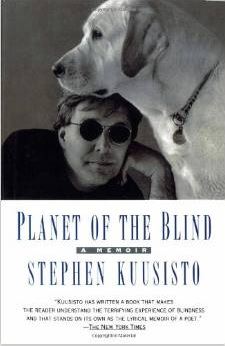
 Planet of the Blind