The Poem, It’s Stones

Poets customarily ask if poetry has a practical impact and often come up despairing. “Poetry makes nothing happen,” Auden said, and he was right if happening is meant as carpentry, which is what the question is about–in essence it asks why can’t poetry be a blueprint? The late Finnish poet Pentti Saarikoski once wrote he’d like to be the sort of poet whose songs call trees and stones to come forward, that he might build houses for people. The line is about as far as one can get from Auden–even as the wish may be impossible it musters intention. In this way the line is ridiculous.

Saarikoski knows it. Ambition, intent, and their failure together frame the insistence poetry must carve a plan, however utopian and improbable. Poetry makes nothing discernible happen but it’s blueprint is, much like Italo Calvino’s invisible cities, enticingly clear. Poetry can be concerned with the potential city–an urban romanticism surely, but one yielding a realized eschatology, as Kenneth Rexroth once said of “Leaves of Grass.” Whitman’s Manhattan offers a vision of what America could be, or may still become, a harmonious, loving, broad minded portion of the Earth, elect and free. Whitman insisted spiritual and civic life, a life equally enacted of mind and body will simultaneously propose and affirm true democratic love.

Makes nothing happen? Call the walking stones. Tell them.

More About Disability and Inspiration and the Cramp in My Foot

When I think about inspiration I get a cramp in my foot, as if I’m swimming. Aside from it’s obvious and lengthy history as a central idea in art and religion, inspiration has become in modern times a strident and proprietary thing—the incitement for self help books and motivational speaking, pop psychology, and a thousand narratives in which people overcome tremendous obstacles to finally live in some kind of contentment or self acceptance. This mode of inspiration is a bourgeois figure, and it is a figure, as it becomes a metaphor with wings, angels, big puffy hearts, houses with tall windows facing the ocean. For the disabled inspiration is an ugly piñata. A piñata that looks like an eel. We were always supposed to inspire the non-disabled with our pluck, our optimism, our winning smiles, our earnestness. We were matchless representatives for the charities that served us. We were Disney, pure Goofy, always cuddly.

And if we weren’t, well we were guilty of not playing the game. We were “disability Debbie Downers” who simply cried out frequently, because there was much to decry, and we were insufficiently sportive, and we were bad cripples.

It is good I think to de-legitimize inspiration. It was always simply breath, the mystic breeze we take into ourselves, perhaps sent by the gods, or maybe just oxygen—it was about breathing and hence, about life itself. It’s the essential word you want if you’re discussing life.

If you live to be 80 you’ll take 672,768,000 breaths. Every last one will be about air. These breaths will primarily have zero to do with making others feel better about themselves. You’re breathing for you. You’re breathing for your children. You weren’t inspiring the Greeks on the beaches of Troy.

This is of course where metaphors of inspiration begin. Breathing is a private affair but in our formative years as a species we imagined breath was sent by the divine. The Greeks called this theopneustos—which means breath sent by God. Thus inspiration (breathing in) became a kind of mouth to mouth resuscitation by the “big guy” and it’s one of the oldest notions humans still hold. Or many do. Bob Marley sings “there’s a natural mystic blowing through the air” and he could just as well being singing for the cave painters. When St. Paul uses theopneustos he means that God’s breath is not only in him but that it blew across the pages of his holy writing. (God can even make the ink dry.)

One thinks of God manning a pump, leaning above the Earth, eternally pushing air into our lungs and hearts. God exhales oxygen and likely breathes in CO2. Either way he’s busy. We don’t know if the fish are inspired but some of us think so. All air is heavily laden with life’s possibilities. Whatever my spiritual inclinations may be, I have to believe this. Breath will be what you make of it. Perhaps you will live like a bird who moves from branch to branch but you will sing. Maybe you will never be free of assignments but you will build a neighborhood. If it is not possible to know what is up or down, it is possible to build a neighborhood. It’s done with breath, breath first.

Because the mouth to mouth resuscitation God image doesn’t matter, is irrelevant, is almost hilarious, you are allowed to own your own breath. You’re allowed to be someone who mends the narrow cracks in the house. Who builds houses for those who don’t have them. You’re allowed to feel the tameness or wildness in your every action. And this is inspiration.

So if you’re disabled you don’t have to inspire anyone. But you can make an art of the breath sent. God or no God; charity or none.


Fathers Day and Santa Claus

Is it unseemly to suggest one doesn’t like Father’s Day—do you become the contrarian at the party who ruins the tenor of easy conversation? I should get it off my chest: I don’t like Father’s Day, White Cane Day for the Blind, National Donut Day, or any other emo hostage taking daylong remembrance. I’ve always favored Kenneth Rexroth’s assertion: “I’d cold cock Santa Claus if he got in my way.”

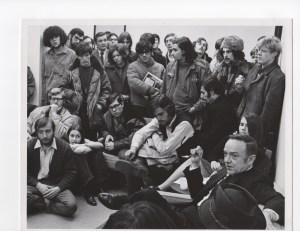
I should say I liked my father. He was a peace maker. As a university president in the late 60’s and early 70’s he invited student protestors to sit with him and talk about the military industrial complex and the place of higher education—a place, he attested, that was “right” for expressions of concern about the state of the nation. And I’ve always loved this photograph of him meeting with students at the State University of New York at Albany in 1969. My dad is at the lower right. You can see him holding aloft his reading glasses as he makes a point to the students seated at his left. Notice how seriously he’s taking them.

Kuusisto SUNY Albany  copy


Those were still the days when college presidents were educators rather than bureaucrats or bean counters. If you believe in peace you need to talk about it. My father did not call the campus cops or the state police; did not rope off the building. There were plenty of people who told him he should do those things. “A university is a place for ideas,” he said. “It doesn’t hold them merely to the classroom.”

Later that same year he’d insist that progressive attorney William Kunstler should speak on campus even though the apparatchiks of state government pressured him to cancel the event.

I know he’d be dismayed by the actions of many contemporary college and university administrations.

I don’t know what he thought about Father’s Day.

I do know he didn’t like to go shopping.

I don’t think he would have cold cocked Santa Claus.

He did like poetry and he’d have thought the Rexroth line was funny.

Why I’m For Inspiration, and You Should Be Too

Abby-Normal.jpg

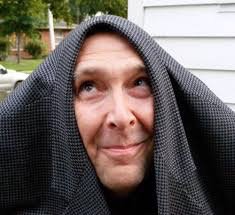
(The photograph above shows poet and nonfiction writer Stephen Kuusisto posing as comedian Marty Feldman. Kuusisto has pulled his sport coat over the top of his head, thereby framing his face as if he’s wearing a dark cowl. His facial expression is that of an enthusiastic duffer or dunce. His eyes (blind) are exophthalmic. The real Marty Feldman was also visually impaired.)

Disclaimer: I am not now nor have I ever been a member of the Inspiration Porn Party.

No one who is disabled should be in doubt about the deleterious effects of inspiration. Who would want to be Tiny Tim? If Tiny Tim isn’t fresh in your mind, here’s the famous passage from “A Christmas Carol” in which Bob Cratchit and his wife discuss their crippled boy:

“And how did little Tim behave?” asked Mrs Cratchit, when she had rallied Bob on his credulity and Bob had hugged his daughter to his heart’s content.

“As good as gold,” said Bob, “and better. Somehow he gets thoughtful, sitting by himself so much, and thinks the strangest things you ever heard. He told me, coming home, that he hoped the people saw him in the church, because he was a cripple, and it might be pleasant to them to remember upon Christmas Day, who made lame beggars walk, and blind men see.”

All too often snug piety is easy for cripples. Your name is “crutch-it” and if it isn’t precisely true you are what you eat, every crip knows according to the alchemy practiced by able bodied people, we simply “are” our wheelchairs, canes, dogs, or breathing tubes.

Dickens was a writer of considerable force but he was also a moralist and eager to save Christmas as a holiday for by the mid 19th century the deracinated laborers of Britain had been uprooted from their ancestral villages and families had been broken. Moreover, the disabled were seen as a social liability and were increasingly sent to asylums and specialized hospitals. One may think of the asylum movement as “crippled daycare” for it allowed the rest of the family, or what was left of it, to soldier on in the factories. But I digress.

What I mean to say is that Tiny Tim wasn’t born in a vacuum. Dickens means to suggest crippled children are valuable, both within the family, and yes, alas, as Christian symbols. Many of us who live in whatever this thing we call “the disability community” might be, feel a wild discomfort where disability pietism is concerned. We should, for if we simply “are” our wheelchairs, canes, dog, or breathing tubes than we must be replaced with something better. Utility demands it. Where Tiny Tim is concerned, he will be made to walk by dint of Scrooge’s conversion. As Scrooge becomes virtuous, Tim becomes healthy. What a wonderful story. I say this without irony. Zero causticity. People need stories and as Leon Trotsky once put it:

“The proletariat has to have in art the expression of the new spiritual point of view which is just beginning to be formulated within him, and to which art must help him give form. This is not a state order, but a historic demand. Its strength lies in the objectivity of historic necessity. You cannot pass this by, nor escape its force …”

Even Trotsky would defend Dickens effort to insert an affirming view about the poor and the cripples into the body politic.

Our trouble comes with the development of charity which throughout its punctilious history has depended on mawkish representations of the infantilized disabled as “things” to be cured.  There’s no escaping the long, ugly, spell binding parade of poster children and direct mail appeals and telethons promising to save them.
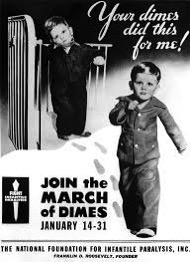
Vintage-Poster-Child-Advertisement-for-the-March-of-Dimes.jpg

(Photo: vintage advertisement for The March of Dimes depicting a crippled child who has been cured. The caption says: “Your dimes did this for me!”

In his posthumously published study of Telethons, edited by disability historian Catherine Kudlick, Paul Longmore points out that organized charity depends on an appeal to personal freedom, an appeal that takes full advantage of Americans’ fears of powerlessness and loss of independence:

“The availability of people with disabilities—or rather the cultural handiness of their bodies—as metaphors of the loss of autonomy predated the telethons and operated outside them. But in the late twentieth century, those shows, more than any other cultural institution, propagated the notion that people with disabilities literally embodied some of Americans’ deepest fears: overthrow of individual liberty, helpless dependency, cultural and social invalidation. In a historical moment when many feared they might lose—or already had lost—control of their lives, the ritualistic contrast with disabled people’s bodies reassured them that their bodies/selves were still free, still autonomous. An Easter Seals broadcast had former Chicago Bulls Team Captain Norm Van Lier spell it out for viewers: “You can celebrate your independence as a person right now by helping to give the gift of independence to someone with a disability.”

Excerpt From: Paul K. Longmore. “Telethons.” iBooks. https://itun.es/us/7Pzlab.l

The key word is “ritualistic” insofar as the disabled function as figures both of abjection and spiritual immanence. (It’s an “in” joke among the disabled to relate how many times you’ve been the recipient of unwanted prayers from strangers.)

**

Within the rising disability rights movement, a movement that’s still gaining traction and growing ever stronger, there’s nothing quite so pleasing as calling out ableist disability pornography or “inspiration porn.” As far as I know, the term was first coined by the Australian disability rights activist Stella Young.  Here is a link to her fabulous Ted Talk about the matter:

https://www.ted.com/talks/stella_young_i_m_not_your_inspiration_thank_you_very_much?language=en

It’s certain: no one wants to be Tiny Tim anymore. No one wants to be a poster child. I don’t want to be a figure of religious transformation or of a pervading or sustaining God. Such stories are a narrative hostage taking, a life in abeyance to fatuous balderdash about bodies and their putative maker, an oppression that’s outlived it’s welcome for cripples.

The charity model of disability upon which inspiration porn rests—nay, into which it’s woven—is still enormously strong. In fact it’s protean and changes shape swiftly. It pops up in bad movies and novels. It asks you to imagine death would be preferable to living without a cure. Mainstream media fawns over it. The Today Show and Oprah will sell you an overcoming narrative faster than you can say hallelujah.

Back to Longmore:

“If premodern cultures and religious worldviews took health or illness as signs of divine favor or displeasure, modern American culture, whether secular or religious, saw them as emblems of fulfillment or failure in meeting the demands of democratic individualism. Unfitness was a modern form of moral failure. It was delinquency in practicing individual self-control. The twentieth-century ideologies of individualism and the human body asserted a corollary moral premise: Even if individuals were not culpable for their conditions, disabilities rendered them incapable of exercising the sovereignty of the self.”

In our time inspiration porn has been transformed from Victorian lameness to secular disenfranchisement. But your dollars can help. Guide dog schools tell donors that with a dog the blind can have their dignity back. This inspiration erotica is everywhere. The Wounded Warrior Project is a colossal purveyor of inspo po.

Inspo po depends on the handiness of our bodies, as Longmore rightly says. We’re easy. We’re the thing you want if you need to feel good and you need to feel good really fast. We can serve as emblems of instant fulfillment.

Nowadays Tiny Tim doesn’t talk so much about Jesus he simply represents belonging which is why we now see him throwing out the first pitch at a minor league ballgame, leaning on his crutch, helped to the pitching mound by the strapping and virile catcher.

**

So those of us who teach in the field of disability studies or who fight for disability inclusion (these are not mutually exclusive) have a problem—we’re simply not permitted to feel inspiration from others, recognizing it as a trap, nor are we allowed to be inspired by one another within the movement.

Not long ago I attended a film showing about a woman who promotes wheelchair dancing. “It’s just inspiration porn,” said a disabled man as he wheeled out of the auditorium.

Not long ago a friend whose son is the subject of a soon to be released film about his journey as an autist was told by a disability studies colleague that it’s inspiration porn.

I have to ask, really, where does this stop? Is all inspiration simply pornography? Who calls it out? And who exactly holds the crippled porn card? How did they get it?

I am inspired by John F. Kennedy’s speech declaring we will go to the moon. Whenever I see it I want us to go to the moon all over again.

I’m inspired by heroism mostly, by vision, by proposals to make things. I’m inspired by people.

We are not supposed to be influenced by or emotionally caught up in stories that involve “overcoming”—disability can’t be overcome, it’s not the product of a bad attitude. No one needs to transcend his or her physical alterity. Of course this is true.

But when my stepson who suffered serious depression in his teens taught himself to play the piano, I was inspired. He didn’t overcome his disability but he did something. He made something. It was beautiful.

When I walk with my guide dog through downtown Manhattan at rush hour, I may very well inspire strangers. There’s a clarifying beauty associated with speed, mobility, and confidence. Seeing such a thing is in fact, inspiring.

I don’t like motivational speeches. No one can give motivation to others. But inspiration, a joyous opening to what’s around us, that’s poetry itself.

To hell with Tiny Tim. But instead, imagine he’s writing poems of his own.

He says things like:

“My indignant nail studded shoes are now pink slippers.”

We better know the architectonics of inspiration or we’ll become sad contrarian egoists.
 

Assorted Elder Chocolates

I’ve reached the age when for many reasons it’s necessary to admit the things I will not live to see and bid farewell to goals I can’t possibly accomplish. As an American born in the decade after the second world war, who came of age in the 1960’s, I find I’m struggling with this pragmatism born of aging. It feels like fatalism, that most decidedly un-American characteristic. I should, according to all the glossy magazines be preparing to run a marathon at 90 or perhaps buy a villa in Costa Rica. But I will not be doing these things. Nor will I be tricked into imagining whatever time I may still possess is—well—timeless.

I’m not going to be reading contemporary American fiction anymore. I need to delve deep into Walt Whitman’s Leaves of Grass which has always been the most important book on my shelf.

I don’t have time for novels with titles like The Summer Girl from Uppsala or The Big Rock Candy Mountain Breakdown. I might re-read The Adventures of Augie March. 

I certainly don’t have time for middle brow books about aging like Michael Kinsley’s Old Age: A Beginner’s Guide. Here’s the publisher’s happy synopsis: “Vanity Fair columnist Michael Kinsley escorts his fellow Boomers through the door marked “Exit.”The notorious baby boomers–the largest age cohort in history–are approaching the end and starting to plan their final moves in the game of life. Now they are asking: What was that all about? Was it about acquiring things or changing the world? Was it about keeping all your marbles? Or is the only thing that counts after you’re gone the reputation you leave behind? In this series of essays, Michael Kinsley uses his own battle with Parkinson’s disease to unearth answers to questions we are all at some time forced to confront.”

What’s next? Gumby’s Book of the Dead? 

I of course salute anyone who ruminates on disability and Michael Kinsley is certainly right to wonder what physical difference may mean both in personal and collective terms. But then one encounters prose like this:

Decades before the nursing home, though, we all cross an invisible line. Most people realize this only in retrospect. If you have a chronic disease–even one that is slow-moving and nonfatal–you cross the line the moment you get the diagnosis. Suddenly, the future seems finite. There are still doors you can go through and opportunities you can seize. But every choice of this sort closes off other choices, or seems to, in a way that it didn’t use to. In every major decision–buying a house or a car, switching your subscription from Time to The Economist–you feel that this is the last roll of the dice. It needn’t be this way; in the more than twenty years since my own Parkinson’s was diagnosed, I’ve moved half a dozen times, changed jobs even more often, gotten married, let my New Yorker subscription lapse and then renewed it. Each change feels like an unexpected gift, or a coupon I’d better redeem before it expires.

This terror of being written off prematurely (like being buried alive) makes it difficult to write about a medical condition that may linger and get worse slowly for decades while you try to go about your life like a normal person. People say, in all kindness, “Hey, you look terrific,” which leaves you wondering what they were expecting, or how you looked the last time you saw them. They seem taken aback that you are around at all. The first time you hear or read a casual reference to “healthy persons,” it is a shock to realize that you are permanently disqualified for that label. And then you realize–even more shocking–that you’re the only one who’s shocked. Everyone else has adjusted, reassigned you, and moved on. Even if you feel fine, you walk around in an aura of illness.

One wonders if Kinsley has any idea what a trite and singularly dull volume he’s written. Probably not since he’s busy redeeming coupons and buying another car.

No. I won’t be reading boomer books about aging.

If by chance you’re in the market for a great book about growing old, the best one I know is by the late Jungian analyst James Hillman, entitled The Force of Character and the Lasting Life which contains these splendid lines:

“…let us entertain the idea that character requires the additional years and that the long last of life is forced upon us neither by genes nor by conservational medicine nor by societal collusion. The last years conform and fulfill character.”

As does disablement itself.

Meanwhile, back to my abjure-ment list.

I’ve given up on the National Football League.

I no longer believe we will conquer global warming.

I generally think identity politics is not politics at all but a soapbox for grievance. Marxism is right about the class struggle. My disability and your life on the reservation should be vehicles for marching side by side.

I can’t read any more confessional poems.

I will never go on a cruise.

I won’t be swimming with dolphins.

I can’t read any more short stories about sad middle class Americans and their divorces.

I’ll never go to a Disney theme park.

I don’t think technology will save us.

I certainly don’t think religion will save us.

I have no time for Rudyard Kipling.

Dickens, Whitman, Democracy, and How We’ve Always Lived “Ugly”

Once upon a time, back in the 1840’s Charles Dickens wrote to his friend William Macready that America was a “low, coarse, and mean nation” and moreover the United States was “driven by a herd of rascals…Pah! I never knew what it was to feel disgust and contempt, ’till I travelled in America.”

Some of Dickens contempt for the former colonies was mercenary: American publishers refused to pay him royalties on his books sold in the US. There’s nothing like being cheated to effectively stir the pot of enmity, and Dickens, for all his virtues, was no exception when it came to fashioning willfully clouded judgments. (One also thinks of his less personal failings, his master-slave hostility to the people of India or his support of torture in Jamaica.)

It’s easy to kick a democracy, especially one that purports to be a classless society. It’s always been a piece of cake to misunderstand America. After all, the United States routinely seems to bear Dickens out. Donald Trump’s presidential campaign is as low, coarse, and mean an affair as we’ve seen since the 18th century—yet these characteristics have always been present, not only in our politics, but in how we talk about them. In 1856 Walt Whitman wrote an essay about the Fillmore, and Buchanan administrations and said the presidency itself had become beastly:

“History is to record these two Presidencies as so far our topmost warning and shame. Never were publicly displayed more deformed, mediocre, sniveling, unreliable, false- hearted men! … The President eats dirt and excrement for his daily meals, likes it, and tries to force it on The States. The cushions of the Presidency are nothing but filth and blood.”

Our “topmost warning and shame” is a terrific phrase since it encapsulates the chief liability as well as the virtuous wager confronting any man or woman who assumes America’s highest office, which is it’s absolute visibility. If one prefers wit to truculence one can do no better than H.L. Mencken who said:

“As democracy is perfected, the office of president represents, more and more closely, the inner soul of the people. On some great and glorious day the plain folks of the land will reach their heart’s desire at last and the White House will be adorned by a downright moron.”

Our nation’s political life has always been concerned primarily with what we do as opposed to what we say. Nixon correctly understood this and dubbed his voters “the silent majority” in 1968 a year that is still unsurpassed for violent rhetoric and brutality in the village square.

America’s words are circumstantially low, coarse, and mean. Where else in the world can people behave this way? We’re entitled to be low, coarse, and mean. Americans are also perfectionists: visionary, celebratory, and affirming. Even as Whitman wrote the passage above he also wrote:

SAUNTERING the pavement or riding the

country by-road, here then are faces!

Faces of friendship, precision, caution, suavity,

ideality,

The spiritual prescient face—the always welcome,

common, benevolent face,

The face of the singing of music—the grand faces

of natural lawyers and judges, broad at the

back-top,

The faces of hunters and fishers, bulged at the

brows—the shaved blanched faces of ortho-

dox citizens,

The pure, extravagant, yearning, questioning artist’s

face,

The ugly face of some beautiful soul, the hand-

some detested or despised face,

The sacred faces of infants, the illuminated face

of the mother of many children,

The face of an amour, the face of veneration,

The face as of a dream…

We don’t have so much guidance on which to rely when it comes to assessing and cataloguing the worst in us—we’re either anguished or panicked in the face of it. What is surreptitious in the American psyche is also foundational—slavery, religious intolerance, xenophobia, so present are these building blocks of our national DNA we’re caught repressing them, then admitting their corrosive effects when they flash on the giant outdoor movie screen of our political theater. Trump is an instructive figure, as vituperative and ugly as any of our worst public figures from Andrew Jackson to Joseph McCarthy or Curtis LeMay. What matters finally is whether we choose to be Dickens or Whitman. I think we’re a country of sacred faces, faces of veneration.

If history is a guide Americans will not be electing Donald Trump, even as they may find many practical or potential faults with Hillary Clinton. The latter is merely imperfect; the former offers a detested and despised face. As a citizenry in a fulsome democracy we still understand the difference.


Wheels

When I entered the woods alone; went in there as a boy; small, blind, very much in isolation, I invariably talked to myself. I remember saying, “Blue Jay has roller skates.” According to contemporary memory theory I shouldn’t recall this. Instead I should only recall a formative feeling over which my contemporaneous imagination inscribes it’s own ideas. But “hinx minx” I really said the Blue Jay has roller skates and I remember why. He was so loud and busy I just knew he was zooming along the branches on tiny wheels.

Now the world is filled with tiny wheels. Joy rolls. Sometimes joy falls like a leaf through space but trust me, it still rolls as if tumbles. Even when joy is darkness against your cheek, it still rolls.

Tears roll and mouths in love roll. All livelier dreams glide on wheels we’ll never be able to see.

Every human being rides their own wheels made of silver light.

I have seen a woman transform into a linden tree and I’ve seen other things as well. Blindness is no impediment to seeing things. I’ve seen autumn trees with dripping bark, reality weighing itself in a rising loaf of bread.

Wheels glimmering cold along the horizon.

Orlando, Trump, and Orwell’s Ghost

Micro totalitarianism and sexual persecution are the terms that come to mind for me as I struggle to absorb the slaughter in Orlando. The first is best represented by Donald Trump’s Brummagem—his tweet of self-congratulation announcing his brand of Islamophobia has been proven correct. The branding of hatred, commodifying it, blurting it, as if it’s face cream or Viagra is how micro totalitarianism is spread and sexual persecution is just one of its targets. Islamophobia and homophobia are equally salable in the United States, almost as easy to sell as assault weapons. From a disability studies perspective one sees that the baseline narrative of micro “t” is, among liberals, mental illness—a convenient class, abstract, ridden to death by endless episodes of Law & Order, let’s blame them for violence. Micro totalitarianism depends on persecution and it’s practitioners will cherry pick their victims according to what sells.

The shooter in Orlando may or may not have been mentally ill. He may have been warm to Islamic extremism, but at this juncture, given his apparent declaration that he supported Hezbollah, Al Qaeda, and ISIL—(which is like saying you support Stalinism, Trotsky, and Thomas Dewey) he seems more a figure of confusion, and perhaps someone with a persecution complex. He was, therefore, the perfect buyer, the proper customer for assault weaponry. Racial persecution, sexual persecution, disability persecution, religious persecution, all have in common the branding of hatred. Everyone in America is supposed to head straight over to the gun store.


Disability and Faculty Self-governance in the Age of Neoliberalism

When talking to faculty, students, and staff with disabilities who work or study at America’s colleges and universities, one quickly learns that higher education is broadly disinclined to treat disability in a concerted and efficient manner, but instead engages in widespread administrative deflection. From architectural barriers to simple pedagogical modifications colleges routinely drop the ball where equal access is concerned. So ubiquitous have these stories become one can browse the web for hours reading of school after school that has violated basic civil rights protections guaranteed by the Americans With Disabilities Act. From the University of Michigan, to Penn State to Harvard, one finds dramatic instances of disability discrimination. As a disability rights activist and professor who teaches that incorporating physical difference in the village square creates powerful opportunities and advantages I’m often asked why higher education performs so poorly. For many years I imagined these failures had simply to do with a basic financial resentment of the ADA, as one hears the widespread complaint from college administrators that it’s simply an “unfunded mandate.” The idea that barriers should be removed as a matter of civil rights is represented as a violation of libertarian principle. This seemed reasonable enough until over time I realized there’s a broader delegitimization of disability in the Ivory Tower and it’s only loosely connected to money.

In a recent interview at TruthOut Henry Giroux observes of Neoliberalism:

As a form of public pedagogy and cultural politics, neoliberalism casts all dimensions of life in terms of market rationality. One consequence is that neoliberalism legitimates a culture of cruelty and harsh competitiveness and wages a war against public values and those public spheres that contest the rule and ideology of capital. It saps the democratic foundation of solidarity, degrades collaboration, and tears up all forms of social obligation.


The past quarter century has seen the American academy shift from collaborative and democratic agreements about social obligations toward an embrace of monetized aggression. During this period the ADA has been overtly ignored by colleges of every kind. The two developments are syncretic, reflecting what Giroux rightly calls the failure to contest the rule and ideology of capital. It’s relevant to note in this context that “disability” first appeared in the mid-19th century as a term for laborers who’d been rendered unfit to work. The 20th century saw sustained advances in rehabilitation and employment services for people with disabilities, improvements which culminated in the passage of the ADA in 1990.

Neoliberal pedagogy and campus politics depend on limited faculty governance, the erosion of public debate, and the establishment of a culture of severe economic competition. Disability is re-inscribed as a 19th century problem. Accommodation services are sequestered—students are “sent” to ancillary offices for accommodations which they may or may not receive; faculty are taught nothing about pedagogy and disability; basic services like sign language interpreting or accessible technology are hard to find, and sometimes non-existent. At one liberal arts college where I recently spoke, a disabled student told me, “the disability office is hidden like an asylum.” Indeed. Disability is a drain on capital. Not because it’s an unfunded mandate but because after all is said and done, neoliberal visions of success are built as Giroux rightly says on cruelty and competitiveness.

Harvard and MIT are contesting the demands of deaf students and staff that instructional videos be captioned. Harvard’s opposition is symptomatic of the neoliberal university’s war on basic public values. In terms of governance Harvard’s resistance represents perfectly the academy’s abandonment of the principles of social obligation. But institutions only arrive at such a place when faculty are deterred from self-governance by the obligation to write endless grants and compete for provenance in the marketplace of capital ideas, when teaching and idealism are considered quaint and immaterial. In turn the civil rights of academic communities are “handled” by offices that are both physically and culturally distant from the “agora” or academic life of the campus.

The neoliberal campus relies on distention of self-governance and enforces centralized administration. Moreover it thrives on factionalism. A faction, as James Madison famously wrote in essay 10 of The Federalist Papers is a group “who are united and actuated by some common impulse of passion, or of interest, adversed to the rights of other citizens, or to the permanent and aggregate interests of the community.”

Because college faculty are often divided by competing interests and since some of these divisions reflect the complications and struggles of identity, it’s difficult to forge consensus about disability and disability rights—they seem tailor made for deflection, a problem for a specialized office. In other words, disability is often viewed by academics who are already narrowly factionalized as too difficult to embrace. As Lennard Davis notes in his book Bending Over Backwards: Disability, Dismodernism, and Other Difficult Positions:

Because disability is an amorphous identity with porous boundaries, other identity groups in the United States have had difficulty incorporating it into their goals. Previously legitimized groups such as Latinos or African Americans have been reluctant to admit disability into the multicultural arena. For example, in 1996 a disabled, white assistant professor at a historically black university found that the chair of the department and the dean of the school had recommended against tenure, saying that any analogy between disability and race was both methodologically unsound and insulting to the unique history of African Americans. For them, the categories of oppression were mutually exclusive and should not be mixed. After much public outcry from the disability community, the president of the university decided to award tenure to the assistant professor. Nevertheless, the issue of an identity defined by impairment as opposed to one defined by race or ethnicity is a sticking point for some. When some faculty members at Hunter College in New York City tried to include disability studies as part of the requirement for a multicultural curriculum, they were opposed by many of the ethnic and national groups that usually make up the progressive wing of the university. Hunter ended up deciding to omit disability from the curriculum.


From a disability studies perspective one sees how sectarian infighting among faculty concerned with categories of oppression can further the work of neoliberal administration, not by embracing the neoliberal brand of governance, but by replicating its effort to de-legitimize disability as a mainstream concern. De-legitimized disability remains in the province of non-academic offices. In turn university faculty fail to understand and embrace the nation’s largest minority. Such neglect reinforces a central fact of neoliberal administration which supports deflection where accountability is concerned and it represents rather broadly a further symptom of weakening faculty self-governance.


Me Before You, Benedict Arnold…

If disability is pictured as a thermometer one sees at the very top of the mercury scale “Courage” and at the bottom “Cowardice”—a register of willfulness or mind over matter which represents disablement as being entirely a state of mind rather than physical or neurological reality. How often does one have to endure the slogan: “the only disability is a bad attitude?”

Quite often it turns out. Courage is an easy word to bandy about. Whenever the first “c” word is used in media representations of the disabled, it’s invidious twin is suggested, as if living a crippled life is a stark affair when you roll down the street or follow your dog. You’re either heroic or you’re some kind of attitudinal traitor, a Benedict Arnold of the spirit.

Of course temporarily abled people don’t live this way. They’re not heroic in the supermarket, not cowardly when they shake their fists at drivers in front of them. The emo-thermometer is reserved solely for the cripple. I’ve lived with this fictitiousness all my life and if you’re one of my crippled readers I’m certain you have too.

Lately there’s been much consternation and outrage among disabled activists and their extended supporters about the film “Me Before You” as it depicts a paralyzed man’s decision to end his life, not merely because his disability is insupportable, but because he doesn’t want to burden the abled woman who loves him. The film is creepy, inauthentic, and ugly. What interests me however is it’s emo-thermometer reading: “Courage” becomes “Cowardice” or subsumes it in a way that suggests “the only bad attitude is a disability”—a twist that’s chilling and should alarm even the most seasoned viewers of films and television programs. Living with disability is presented in “Me Before You” as a traitorous act, a betrayal of love.

Love is presented as light while disability is dark and overshadows life. Now, ahem, life itself doesn’t work this way. In life trains arrive and depart, sunlight strikes the telephone wires, groceries are purchased, lawns are clipped—which is to say, life, living it, is, as any bird will tell you, simply a matter of the daily worm. Moreover living is essentially the hard thing, dying is easy.

This is what’s so objectionable about the film. Dying is easy. Disabled life is presented as a bad choice, a bad attitude if you will. “Me Before You” turns the standard (and already crappy) disability emo-thermometer upside down.

Ugh.