From the Book of Angelic Interpretations

There are so many things I can’t explain. “Inside” I take things on faith. “Outside” I prize what’s explainable. This is why I only hint at God. “I believe,” I say, if pressed and change the subject.

All human beings, whether they believe in God or The Gods or nothing at all walk about saying “one more minute” and only the birds hear it.

There are so many things I can’t explain. “Inside” I take things on faith. “Outside” I prize what’s explainable. This is why I only hint at God. “I believe,” I say, if pressed and change the subject.

I don’t want you to know about my soggy, superstitious, altogether sentimental heart.

Nor do I want you to know I think we’re in this world to suffer into truth. Think of the stars filled with tears and wisdoms.

I’m a lovely failure. I read as much scientific inquiry as I can get. I especially love the double hydrogen bonds that hold DNA together. I love Gregor Mendel but wonder if he ever ate the damn peas.

Are you a lovely failure?

“What a gulf between the self which experiences and the self which describes experience.” (Edmund Wilson)

Edmund Wilson was not a lovely failure. He was mean. I swear my soggy heart wishes to never be mean and grieves for me when I am.

About face.

“Heaven knows we need never be ashamed of our tears, for they are rain upon the blinding dust of earth, overlying our hard hearts. I was better after I had cried, than before–more sorry, more aware of my own ingratitude, more gentle.” (Charles Dickens, “Great Expectations”)

About face again.

“What was in our stars
That destined us for sorrow?”
(Anna Akhmatova)

Don’t worry Anna, that’s just wisdom coming back.

D.H. Lawrence, Disability and Two Fires in the Mind

When I entered college in 1973 I found no one was teaching Lawrence. He was considered a kook. At best he was a polemicist for psychoanalysis and at worst a pornographer but in any case professors assured me he was nothing more. If you wanted an English moralist you were instructed to read Hardy.

I fell in love with D. H. Lawrence as a high school student. His poems reached me first; then the essays. I don’t know if it matters what kind of reader I was back then. We spend so much time pre-fronting our subjectivities nowadays but yes I was legally blind. I read what I could get via long playing records and tapes from the Library of Congress. I listened slowly and in more than ordinary solitude. (It wasn’t possible in those days to hear a record while sitting under a tree.) I received my Lawrence in dark rooms.

When I entered college in 1973 I found no one was teaching Lawrence. He was considered a kook. At best he was a polemicist for psychoanalysis and at worst a pornographer but in any case professors assured me he was nothing more. If you wanted an English moralist you were instructed to read Hardy.

The photo on my freshman I.D. shows a boy-child who was 5′ 6″ tall and weighed 102 pounds. I’d barely survived a bout of adolescent anorexia. I started reading poetry in the hospital. I read this:

“The Uprooted”

People who complain of loneliness must have lost something,
lost some living connection with the cosmos, out of themselves,
lost their life-flow
like a plant whose roots are cut.
And they are crying like plants whose roots are cut.
But the presence of other people will not give them new, rooted connection
it will only make them forget.
The thing to do is in solitude slowly and painfully put forth new roots
into the unknown, and take root by oneself.

Of course I read all the poems of Lawrence I could find in recorded formats. “The Ship of Death” with its Egyptian incense, “The Snake” and the lesser known “Almond Blossom”:

“Trees suffer, like races, down the long ages.
They wander and are exiled, they live in exile through
long ages
Like drawn blades never sheathed, hacked and gone black,
The alien trees in alien lands: and yet
The heart of blossom,
The unquenchable heart of blossom!”

If you’re lonely by circumstance and you’re in “alien lands” then you’ve got to make something of it. You must believe the “unquenchable heart of blossom” is the signature of all things.

Lawrence was disabled. Like so many people born in the latter part of the 19th century he had tuberculosis. He was born on September 11, 1885. He was ten years younger than Thomas Mann who’s canonical novel “The Magic Mountain” offers the best description of the social psychology of TB.

No one has written with greater lyric urgency and intelligence than Lawrence about the side by side flames of soul and death. And yes eventually they become one flame but our work is different for now. We must adore them both:

“Medlars and Sorb-Apples”

I love you, rotten,
Delicious rottenness.

I love to suck you out from your skins
So brown and soft and coming suave,
So morbid, as the Italians say.

What a rare, powerful, reminiscent flavour
Comes out of your falling through the stages of decay:
Stream within stream.”

Jeffrey Meyers writes in his excellent biography of Lawrence:

“Lawrence’s life and character were strongly influenced by the progress of his disease. He had (at various times) all the symptoms of consumption, which intensified toward the end of his life. He suffered from irregular appetite, loss of weight, emaciation, facial pallor, flushed cheeks, unstable pulse rates, fever, night sweats, shortness of breath, wheezing, chest pains, frequent colds, severe coughing, spitting of blood, extreme irritability and sexual impotence. The toxemia of Lawrence’s lungs influenced the state of his mind and provoked febrile rages. As John Keats had told Fanny Brawne, emphasizing the gulf between the sick and the well: “A person in health as you are can have no conception of the horrors that nerves and a temper like mine go through.” Witter Bynner wrote of Lawrence’s stoic attitude but uncontrollable anger: “He had never given me any evidence of his illness by complaint in words or faltering in spirit but only by bursts and acts of temper.”

One supposes Bynner wasn’t much of a reader when it came to Lawrence’s poetry since poem after poem stills us, stands us on the by turns dark, then evanescent unseeable line between living and dying; between apprehension and the vatic. Here’s the end of
“Medlars and Sorb-Apples”:

“Sorb-apples, medlars with dead crowns.
I say, wonderful are the hellish experiences,
Orphic, delicate
Dionysos of the Underworld.
A kiss, and a spasm of farewell, a moment’s orgasm of rupture,
Then along the damp road alone, till the next turning.
And there, a new partner, a new parting, a new unfusing into twain,
A new gasp of further isolation,
A new intoxication of loneliness, among decaying,
frost-cold leaves.”

“Parting, partner, infusing, twain,” “a new gasp of further isolation.”

This is conceivably the greatest description of disability as lived experience at the hot core of soul and body as they engage in tug of war.

Disability, Pornography, Kompromat, and Trump

Kompromat in this instance employs paraphilia: abnormal sexual attraction, and at “The Act” Trump was treated to the sight of a deformed blind man as sex toy– a convoluted projection of teratophilia–a sexual attraction to deformed people or monsters.

In a ghastly but revealing article over at The Washington Post
Aaron Blake details some of the overlooked details in the Senate’s findings about Donald Trump and Russia. There’s the usual fawning over Putin, Trump’s beseeching of oligarchs, a probable affair with a woman (kompromat) while “the Donald” was in Moscow for the Miss Universe pageant…and then there’s this:

“And two witnesses — Rob Goldstone and former Trump lawyer Michael Cohen — recall the Agalarovs and the Trump team visiting a club that featured a strange show which Cohen said involved a “sex act.”

Goldstone, a Brit who later served as an intermediary for the 2016 Trump Tower meeting, said Trump bodyguard Keith Schiller approached him about the proposed trip to a club called The Act, where an associate of Emin Agalarov was an investor. “Mr. Trump wants to come,” Schiller said, according to Goldstone.

Cohen described the club as “more than a burlesque club” and a “wild place.” Here’s Cohen’s recollection

He said the show that night featured a “young man” in a body suit who was blind and, in Cohen’s estimation, appeared to have suffered from birth defects. He said the man sang a patriotic song while a large woman in a thong bikini performed “sex acts” on him.”

Straight away my ears perked up–(I read with a screen reader) here’s kompromat meets disability meets freak show. Evers to Tinker to Chance.

In her book “Media, Performative Identity, and the New American Freak Show” Jessica L. Williams writes: “The freak show succeeded…because it reinforced binaries about gender, race, and ability but its failure was cemented when scientific advances and human rights issues altered the ways viewers saw otherness. ”

In other words, the freak show returns as pornography when science and human rights are nuisances.

Kompromat in this instance employs paraphilia: abnormal sexual attraction, and at “The Act” Trump was treated to the sight of a deformed blind man as sex toy– a convoluted projection of teratophilia–a sexual attraction to deformed people or monsters.

The Russians are terrific at Kompromat. After viewing “the act” should the news ever get out, the headline would read: “who’s the monster now?”

Blake adds:

“Trump’s visit to The Act was reported in a 2018 book by Michael Isikoff and David Corn, though it didn’t specify what was onstage that night. Cohen has teased his new book by apparently referencing the club visit but referring to another act — one involving urination — that doesn’t appear in the Senate’s report.”

Augustine’s Daughters

Forbearance is the girl who loves chemistry and owns Carl Jung’s dictionary of alchemical symbols. She’ll turn shit into souffles when she has to.

I’ve learned to ask questions of myself during “the pandemic” as we call it though I prefer “the time of anger and courage” hearkening to Augustine’s maxim: “Hope has two beautiful daughters; their names are Anger and Courage. Anger at the way things are, and Courage to see that they do not remain as they are.”

One principal self-directed question concerns my vanity though it’s not framed as a matter of sin. Blind as I am I’ve been told I don’t belong from kindergarten to faculty lounges. Vanity ain’t narcissism if you’re a cripple. It’s the third daughter Augustine forgot. She’s called Forbearance which is a lumbering and graceless name but nevertheless she knows more about her sisters than most.

She’s lately asked me questions as I sit alone and ruminate about being 65 years old and still watching my disabled peers struggle for what we call “inclusion” and which I call citizenship. An aside: if you’re blind and can’t get a driver’s license you can get a state issued I.D. that resembles it at the motor vehicle department. The average motor vehicle department in America is located beyond the reach of our meager public transportation systems. Maybe you can afford a taxi or Uber but given the 80 per cent unemployment rate for blind folks maybe you can’t. Without the plastic card your citizenship is in question. Inclusion is to citizenship as the lightning bug is to lightning.

We disabled live between Anger and Courage as the middle daughter, the one who says “get on with it” and then stirs whatever is in the elastic retort. Forbearance is the girl who loves chemistry and owns Carl Jung’s dictionary of alchemical symbols. She’ll turn shit into souffles when she has to.

But her middle name is Vanity.

(My vote is still out as to her last name but I’d like to think its Grace.)

I belong in this room. I matter. This is more than stamina. I belong genuinely. The disabled belong without question.

Resistance takes clarity, faith, energy, spirit, and a never retreat intelligence. Black Lives Matter depends on this as do all human rights struggles.

Yet sitting in solitude I’m aware I sometimes react too viscerally to the world, insist others are wrong, see ableism where it may not exist–this broken gate wasn’t designed as a slap at the disabled–it’s just broken. As the poet David Ignatow once wrote:

“I should be content
to look at a mountain
for what it is
and not as a comment on my life.”

Vanity is, in my case, an overripe insistence on my victimization. This is an American problem and its larger than my small orbit. The disabled are in fact treated horrifically and that’s not debatable but the overripeness I’m describing is a matter for some reflection–at least for me.

Ignatow’s poem depends upon the word “content” and therefore we must assume he’s a man of some privilege. He can let go of his mountain envy. I live in a world that’s not accepting of the blind and built environments are nearly always exclusionary. Try getting through an airport screening process with a guide dog sometime.

I am allowed to be angry. I’m called upon quite often to have courage. Crossing a Manhattan street at rush hour when blind is in fact an act of courage even though the disability community winces at such language.

Now I see that I haven’t been good with the side effects of persistence. My Forbearance becomes Vanity. I’m willing to pound the table, assume “the system” is against me when sometimes it isn’t.

Sometimes it is.

But sometimes it really isn’t.

All successful spiritual lives demand an engagement with Mr. and Mrs. Vanity.

There’s much to be angry about.

It pisses me off no end that the Democratic National Convention just now concluded had nothing to say about disability.

It pisses me off that the disabled are ten times more likely to die than others during this pandemic.

There are many rages.

It’s the inauthentic rage I’m trying to figure out.

In my recently published memoir “Have Dog, Will Travel: A Poet’s Journey” I wrote about an incident I experienced in New York City shortly after getting my first guide dog, a sturdy yellow Labrador named Corky. In this scene I aim at comprehending inauthentic rage and changing it:

“I walked into a large computer store on Sixth Avenue. I wanted to purchase a laptop. As we pushed through the door a security guard put his hand on my chest. “You no come in, no dog,” he said.

I pressed forward and the guard stepped back. “Stop! Stop!” he shouted and waved his arms. Customers stared. My civil rights and the security guard’s dignity were equally delicate. I didn’t know where the guard came from, but his accent sounded East African. How could he possibly know anything about guide dogs? The store’s manager hadn’t given him information. All he knew was “no dogs allowed,” and there I was with a big-assed dog. As we stood in the doorway I figured it would be my job to foster dignity for both of us. They hadn’t taught me this at Guiding Eyes; they’d given me a booklet with access laws—a useful thing—I had the right to go anywhere the public went—but no one had mentioned emotional intelligence or how to engage in public mediation.

I made Corky sit. “Listen,” I said, softly, “get the manager. This will be okay. This is a special dog for the blind. I wanted to turn our misunderstanding into something respectful.

The manager was one of those guys you see all the time in big-city stores: sadder than his customers, red-faced and put-upon. He had a scoured toughness. He approached and began shouting at the guard. “It’s a seeing-eye dog for God’s sake! Let him in! Sorry, sorry!”

My fight-or-flee rush was subsiding—I wanted all three of us to experience kindness.

I was in a Manhattan electronics store and dignity was in peril. It would have been easy to say “Fuck it” and look out for myself alone. I’d gotten into the store. I was angry. I could have pitched a fit. But I didn’t feel like doing that. The guard’s name was Ekwueme. My name was Stephen. The manager’s name was Phil. “Listen,” I said, “dogs for the blind are not common, you don’t see them every day. This is Corky. She’s very smart.” I let my voice become soft. Ekwueme and Phil both petted Corky. A customer approached, said: “I’ve raised puppies for the guide-dog school! Best dogs in the world!” Phil seemed suddenly pleased, as if he too was philanthropic, or could be someday. Ekwueme admitted he loved dogs.

Outside with a computer under my arm, I reckoned life with Corky was more complex than just a story of freedom. Ekwueme and Phil would become legion in my travels but I didn’t know it yet. What I did know was reflected in a quote I’d always liked from Martin Luther King Jr.: “An individual has not started living until he can rise above the narrow confines of his individualistic concerns to the broader concerns of all humanity.”

I sensed that having a service dog meant something more than honoring my own rights. “Take the first step in faith,” said Dr. King. “You don’t have to see the whole staircase, just take the first step.”

I admit freely I’m not always this good. I share with disability cultural warriors the full recognition that our lives are often at stake. From the medical care system to the streets, from disaster relief to public policing the disabled are ill treated and often threatened.

I do however understand I’m not always able to find the proper musical notation for emotional intelligence and with that failure I can be brittle, self-assured, and wrongheaded. In America this doesn’t make me exceptional. It makes me like everyone else. Maybe that’s what my Vanity is after?

“Lie Machines”

In his new book “Lie Machines: How to Save Democracy from Troll Armies, Deceitful Robots, Junk News Operations, and Political Operatives” Philip N. Howard suggests that according to his research at Oxford University, there was a one to one ration of junk news to professional news on Twitter during the 2016 presidential election. I say “suggests” because Howard is doing research and one thing researchers know for sure is that it leads to more work. I’m willing to venture the ratio has only gotten worse.

Howard writes: “for each link to a story produced by a professional news organization, there was another link to content that was extremist, sensationalist, or conspiratorial or to other forms of junk news.”

Bots, algorithms, trolls, and organized cyber disinformation campaigns have strengthened over the past four years and accordingly we don’t know what the ratios may be right now.

The effect of so much disinformation is to turn people off from believing in the very things social democracies stand for: justice, equality, truth in the practice of law and medicine, the free expression of ideas and the dignity of citizenship. Instead you’re to embrace the idea that the system is out to destroy you, cheat you, undermine the good life as you imagine it. The “Lie Machine” is built from fascist ingredients: sinister minorities or foreigners are stealing your life force.

The social effects of this are now everywhere. As a university professor I’m watching many of my colleagues assert that the administration is trying to kill students and staff by reopening the campus–this despite tremendous safeguards and protocols to keep people safe. It remains to be seen if my university, Syracuse, can stay open, but I know full well that the leadership is not sinister or malign. Yet there’s a one to one ratio of vetted accurate information to falsehood in digital spaces and public exhaustion and conspiratorial thinking is the direct result.

Howard writes: “Public life is being torn apart. Lie machines sow distrust and infect political conversations with anger, moral outrage, and invective in ways that forestall consensus building. It is not simply that social media may have side effects, making us dependent on our screens for news and information, or that our mobile phones may be isolating us from our neighbors. Troll armies, bot networks, and fake news operations are formal structures of misinformation, purposefully built.”

“Many outrageous political stories, rumors, and accusations spread rapidly over social media, and there are businesses that profit by marketing, amplifying, and advertising political lies. In 2016, bots were successful in spreading a crazy story, often called #pizzagate, that supposedly linked Hillary Clinton with a pedophilia ring based out of a pizza parlor in Washington, DC. In 2020, it was automation on TikTok and Twitter that tried to convince local activists and the world at large to dismiss Hong Kong’s democracy advocates as violent radicals. Every country now has similar kinds of politically potent lies—stories that remain believed long after they have been disproven. Who takes a potent piece of misinformation that serves the interests of political elites or some ideological agenda, does the market analysis, and unleashes a marketing campaign over social media? Who are the political operatives who buy and sell our data, make or break politicians, and distribute political lies over the internet?”

Of the “who” there are many. The arrest of Steve Bannon for his role in crowd sourcing fraud is just the tip of the proverbial iceberg as we say.

Howard:

“There are multiple challenges before us if we want to live in functional democracies: A politician who doesn’t like how a question is phrased dismisses the questioner as “alt-right” or “alt-left.” A political leader who doesn’t like how a news story is framed labels it “fake news.” A political consultant who doesn’t like the evidence comes up with “alternative facts.” Growing numbers of citizens believe junk science about climate change and public health. Traditional pollsters can’t call an election, and the surprising outcomes of elections seem to have their roots in manipulative leaders in other countries.”

This is a very timely and important book. As he says:

“By closely examining lie machines, we can understand how to take them apart. I offer basic policy recommendations on how we can protect political speech while demolishing the mechanisms for producing, distributing, and marketing misinformation. I provide civic defense tips that should help us proactively protect ourselves in the years ahead. Yet the best way to solve collective problems is with collective action, so I also identify ways that our public agencies can protect us with policies that make it tough for these big lie machines to operate in our democracies. It is possible to block the production, dissemination, and marketing of big political lies, but we’ll have to act together to do this effectively.”

Disability, Democrats, and Reagan’s Ghost

It is time I think to ask why the Democrats can’t speak about disability during their convention. In raising this question I mean no disrespect to the tireless and righteous disabled who’ve pushed for disability recognition in electoral politics. The disabled are not the problem. As they used to say on the shampoo bottle: rinse and repeat. The disabled are not the problem.

It is time I think to ask why the Democrats can’t speak about disability during their convention. In raising this question I mean no disrespect to the tireless and righteous disabled who’ve pushed for disability recognition in electoral politics. The disabled are not the problem. As they used to say on the shampoo bottle: rinse and repeat. The disabled are not the problem.

Make no mistake: I’m voting for Biden-Harris. I think Kamala Harris is a splendid VP choice and Biden, though more conservative than I’d wish is a slam dunk to lead the US in a time of unprecedented agony.

But why after three nights have Democrats failed to say the word “disability”?

In her new book “What Can a Body Do: How We Meet the Built World” Sara Hendren notes that before a building is constructed, before the blueprints are sketched, designers have what’s called “a brief”:

“Designers work from what’s called a brief—a challenge presented to them by a client or collaborator with a more or less straightforward goal. It’s a description of what’s required at the end of the collaboration: a building, a playground, or a product, for example. You can call the designer’s task a “problem” to solve if you want, and plenty of people do. But tackling design as a matter of problems misses much of the point. At its best, a brief is packed with questions that can be addressed by any number of methods. A brief isn’t just a recipe-style checklist. It’s a horizon, an imagined result, and an invitation for working toward that end, with a high degree of openness as to how the work gets done. That openness to interpretation can be an uneasy experience, but it’s this kind of generative encounter that I actively seek to set up for my engineering students. When the work of a design team begins, across messy tables strewn with sketches and coffee cups, amid the building and the talking, there’s a challenge before us, and there are lots of roads we could take to get there.”

I believe the Democratic Party thinks of the disabled as nothing more than a check list. As check-listers we’re not seen as having the potential to foster a generative encounter with the brief for a more perfect union. We remain an uneasy affair.

This is not because the Dems lack a disability platform. You can view it here.

If you look closely at the link above you’ll see that disability is nowhere conceived as an opportunity for imagination. Instead it’s a problem–and the brief is to save us from the Trump administration’s cruel cuts to Medicare, Medicaid, and Social Security. May Democrats be elected. May this salvation be so. But rinse and repeat: the cripples are not seen as an opportunity for probative and vital imagination. That the proposed “Build Back Better” economy could be richly accessible and inclusive has nowhere been mentioned.

Where is Senator Tammy Duckworth?

Imagination where disability is concerned requires bravery. In my view the reason disability can’t be said aloud is that the Democratic Party can’t stand up for FDR’s vision. The Brief is the economic bill of rights. Reagan changed the playing field: he called economic security programs “entitlements” as if saving citizens from wanton despair was a scam. The GOP still believes this. Look at their refusal to enact further life saving economic relief for tens of millions.

By not mentioning disability the Democrats are revealing how afraid they still are of Reagan’s ghost.

By not mentioning disability the Dems keep us “medicalized” in the public’s imagination. We’re not living examples of pluck and possibility. We’re lonely patients or mendicants.

I’m affronted by the evidence of things not seen and heard. Rinse and repeat.

Dorothy Wake Up, or Thoughts on Conspiracy Theories

I’ve long been fascinated by conspiracy theories and with Trump’s proleptic declaration that the presidential election is already a rigged affair and with staged events where quack doctors share stories of alien sex it seems like a good moment for me to out myself as a skeptic with skin in the game.

I was eight when John F. Kennedy was murdered. I came home from school and told my mother he was dead. My mother hit me and said: “Don’t you ever say something like that again!” My mother was a drunk and in that instant I understood the world could be ugly and adults were not always reliable.

My mother did me a favor. My nascent discovery was and remains my principle antidote to conspiratorial belief systems. The poet Wallace Stevens wrote: “the world is ugly and the people are sad” and knowing this is central. Add “the adults aren’t reliable” and you’ve got a prescription to think for yourself. It can be a lonely world if you don’t believe in conspiracies.

How could a chinless psychopath shoot the most powerful and handsome man in the world? The story was too ugly and random. Straight away the conspiracy theorists said it couldn’t be so. Never-mind that the Warren Commission got it right. Forget evidence based research. Why, the Warren Commission was part of the coverup you see? John Kennedy had to have been the victim of an elegant, secret, furtive, organized system. The truth is just too painful: JFK didn’t want secret service agents on the back of his car; Oswald actually worked in a building situated along the motorcade route; he owned a shitty mail order Italian carbine that he’d already used in a failed attempt to kill an Air Force general; he actually had no ideology at all; he wanted his fifteen minutes of fame; opportunity knocked; he committed a murder most foul as Dylan says.

What’s the difference between a conspiracy and a conspiracy theory? The Wannsee Conference was an actual conspiracy. Powerful men gathered in Nazi Germany and outlined the logistics necessary to kill the Jews. People gathering in secret to plan crimes is the vital chief ingredient for a true conspiracy. This happens in fraternity houses, corporate board rooms and malevolent union meetings and in hundreds of other clandestine spots. The difference between a conspiracy and a theory is the former is provable and that’s because conspirators talk. Almost no one can keep a secret. Even the CIA can’t keep secrets. Nixon couldn’t do it. Bill Clinton. J. Edgar Hoover. (When JFK was informed that Hoover was having surgery he said: “What’s he getting? A hysterectomy?”) In general you can’t keep secrets in a free society. Even Stalin couldn’t hide the fact that he made his dinner guests dance to a gramophone record of howling wolves.

The truth will out. Cue Jack Nicholson: “You can’t handle the truth!”

In short, that’s the ars poetica of conspiracy theorists though they don’t know it. They’ll always say you’re insufficiently schooled on the subject at hand–fake moon landings, George Soros, hydroxychloroquine or the fraudulent media who ruin everything in the world (this is essentially the eggs in their mayonnaise) there’s not a fact that’s safe from the cool kids in the conspiracy lunch room–see their moue of disgust, you nerd unfit to sit at their table, you with your dopey facts, you dweeb!

There’s an adolescent quality to the affair. Left wingers and right wingers are equally prone to this. The left thinks 9-11 was orchestrated by George W. Bush. The right thinks COVID-19 was invented by Bill Gates. Some on the left tend to believe Bernie Sanders was cheated out of the Democratic nomination both in 2016 and 2020; people on the right think the post office is their enemy. Each viewpoint is puerile, unmoored from reality, and rife with teen angst. Scary secretive adults are the problem! Don’t trust anyone over thirty. (Remember that?)

Joe Forest has a terrific article over at Medium entitled “Why Your Christian Friends and Family are So Easily Fooled by Conspiracy Theories.”

He writes:

“When people attach their belief in a conspiracy theory to their ego, it can be nearly impossible to convince them that they’re wrong. Every piece of contrarian evidence you present to a friend or family member simply becomes part of the conspiracy and expands the scope of the deception.

That’s what “They” want you to believe. If you just did some research, you’d find The Truth. All your sources are just part of the Cover-Up. I wish you’d open your eyes and not be such a sheep.

It’s an insidious bit of circular logic that not only creates a criticism-proof belief system, but it also makes a twisted sort of sense.

Conspiracy theories are self-perpetuating rationalization machines. They eat facts, distort reality, and destroy relationships. And, by the time someone realizes they’re in too deep, it’s often too late to salvage a reality-based worldview (or the relationships of the people they isolated in the process).”

**

One of the best books on the subject of conspiracy theories is by the Dutch psychologist Jan-Willem van Prooijen. In “The Psychology of Conspiracy Theories” he points out that there are five essential elements to the thing:

"1. Patterns – Any conspiracy theory explains events by establishing nonrandom connections between actions, objects, and people. Put differently, a conspiracy theory assumes that the chain of incidents that caused a suspect event did not occur through coincidence.

2. Agency – A conspiracy theory assumes that a suspect event was caused on purpose by intelligent actors: There was a sophisticated and detailed plan that was intentionally developed and carried out.

3. Coalitions – A conspiracy theory always involves a coalition or group of multiple actors, usually but not necessarily humans (examples of nonhuman conspiracy theories are The Matrix and the “alien lizard” conspiracy theories). If one believes that a single individual, a lone wolf, is responsible for a suspect event, this belief is not a conspiracy theory – for the simple reason that it does not involve a conspiracy.

4. Hostility – A conspiracy theory tends to assume the suspected coalition to pursue goals that are evil, selfish, or otherwise not in the public interest. Certainly people may sometimes suspect a benevolent conspiracy, and benevolent conspiracies indeed do exist (as adults we conspire every year to convince children of the existence of Santa Claus). But in the present book, as well as in other literature on this topic “ the term “conspiracy theory” is exclusive to conspiracies that are suspected to be hostile. Belief in benevolent conspiracy theories is likely to be grounded in different psychological processes than described in this book.

5. Continued secrecy – Conspiracy theories are about coalitions that operate in secret. With “continued” secrecy, I mean that the conspiracy has not yet been exposed by hard evidence, and hence its assumed operations remain secret and uncertain. A conspiracy that is exposed and hence proven true (e.g., the Wannsee conference) is no longer a “theory”; instead, it is an established example of actual conspiracy formation. Conspiracy theories are thus by definition unproven.”


This list is of course built on the premise that falsifiability is impossible. Research is suspect; news agencies are merely propaganda; universities are places of collective ideational malevolence.

Dorothy, wake up!

A Good Poet Talks Back to the Cruel Fathers

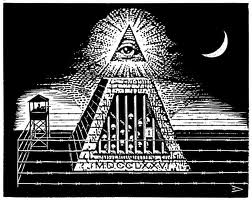
Image: Masonic pyramid with barred windows…

I have just now published a book of poems by Ralph James Savarese entitled “Republican Fathers” and I feel that mixture of pride and horror Lawrence surely felt watching coal miners climbing in and out of the earth. It’s an unblinking book about child abuse and the battens of politics and no one (including the poet) gets away without breathing fugitive dust.

The collection is decidedly un-lyrical but the poems aren’t narrative verse in any traditional sense as neither the writer or reader knows precisely where each poem is headed. In this way the book is like Turgenev’s “Smoke” a novel which seemed conventional enough–a love affair gone wrong–until readers saw it was an indictment of Russian privilege and a bottomless criticism of something wrong in the Russian soul.

“Republican Fathers” opens with a nuanced and scrupulous introduction. It must. Reading it for the first time I was reminded of Butler’s “The Way of All Flesh”: “There are orphanages,” he exclaimed to himself, “for children who have lost their parents–oh! why, why, why, are there no harbours of refuge for grown men who have not yet lost them?”

Savarese can’t of course answer that question but as the intro makes clear he can describe the child abuses dished out by powerful men. In the poet’s case they were Reagan-Bush Republican fathers but as he makes clear the liberal kids were just as battered by the American-Turgenev complex, the Potomac Baden-Baden of domestic cruelties. The book is sophisticated. It resists the easy “boo hoo” of tabloid literature. Of the Republican Fathers Savarese writes:

“To me, they tumble in the falls behind my house—the one I lived in as a teen in McLean, Virginia; the one that overlooked the River of Swans, as the Patawomeck called the great god spilling into Washington. Memory, like a baby, spits up on my shoulder, and out pops a once famous Republican. (There is no bib.) My connection to these men exceeds mere proximity, though I lived next door to two of them. Their children were my friends. Corruption was a family plot in whose pool we swam. Greed tucked us in at night—with or without love.”

The poet grew up in a compound. It was a narrow place but violent, mixed with the ugly polemics of the 1980’s:

“In my case, the political was not so much personal as pugilistic. Even a birthday card wore boxing gloves. Because my father was both a rich Republican and a violent narcissist, a link formed in my mind between party affiliation and parental performance. At school and at church, that link was ratified. My history teacher spoke of “Republican Fathers,” and I promptly imagined Richard Nixon beating his children. (Rumors persist that he beat his wife, Pat.) With the rise of evangelical Christianity, God had become a Republican, and he, too, was a dad—an absent, nasty one who denounced gays and lesbians and, of course, women who had abortions.”

Why are there no harbours of refuge for grown men?

Savarese can’t answer this question but the poems are the unflinching testimonies of a good man who, like good men everywhere needs to say something. These are, to my mind, very brave poems.  The poet’s father is a powerful attorney. He buys a house that sits above the deadliest spot on the Potomac River. Sight seers drown in the falls on a regular basis. Meanwhile the wealthy come over for lunch.

We say good men should speak up. These poems answer that charge.
The soul claps its hands when it can let go:

“Have you forgiven your father his patrician airs and country club
membership—Marx knows how many other
disappointments? Have you forgiven his tepid apology for capital?
O checker of titles and escrow accounts,
private property’s essential servant, have you forgiven yourself?
Love wants no laws, no briefs, certainly no politics.”

In creative writing workshops they talk all the time about taking risks. The best poets do it. It takes bravery. I’ll say we need more tough minded poems by good men. I’ll say this poet steers us in the right direction. I’ll say this book is unlike anything you’ll be reading in American poetry in the near term.

No One Left to Lie To, Part Two

When Christopher Hitchens published his grim appraisal of Bill Clinton (“No One Left to Lie To”) in 1999 I was having a bit of a bad time. When you’re disabled even the best moments can be demoralizing. I’d my own first memoir on the stands and while I’d tried to be nuanced and reflective about blindness both as I’d experienced it and as a larger circumstance I found myself on tabloid television where the nuance that disability requires went out the window. I missed reading “No One Left to Lie To” as I was busy dealing with the likes of Oprah Winfrey whose interview had nothing to do with my book. I appeared on the Leeza Gibbons Show with a drugged little girl, fresh from surgery, who’d had a third leg removed.

I was seeing first hand how the TV industry craves emotion over substance. I knew Bill Clinton had lied to the nation about reforming welfare by co-opting the GOP and emoting like a used car salesman looking into the camera and saying the poor would be lifted up. While the 80’s were built in part on fiscal lies the 90’s were about something worse. Clinton might have said: “a red herring in every pot” and few in mainstream journalism would have flinched.

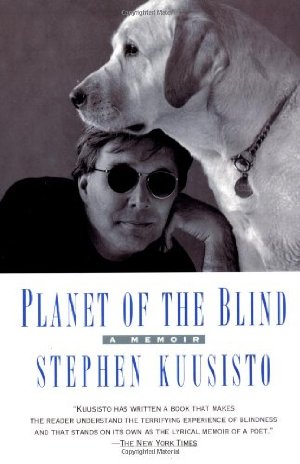
Me? I’d written a book about disablement pre-ADA. Much like my friend Lucy Grealy’s memoir “Autobiography of a Face” which contended with physical deformity in public “Planet of the Blind” spoke to the self-to-self dichotomies of blindness and contempt in the civic sphere. Sitting in those TV interviews I saw that Oprah’s mantra “the truth will set you free” was false at least where disability was concerned. Her true motto should have been: “customary feelings only.” Several years ago I wrote about the Oprah experience. You can find the post here.

Tabloid television and its ugly child, “reality TV” were steamrolling by the end of Bill Clinton ‘s second term. I wish I’d read “No One Left to Lie To” back then. I certainly wish more people would read it now. In his lively introduction Douglas Brinkley writes:

“Hemingway famously wrote that real writers have a built-in bullshit detector—no one has ever accused Hitchens of not reading faces. What goaded him the most was that Clinton, the so-called New Democrat, with the help of his Machiavellian-Svengali consultant Dick Morris, decided the way to hold political power was by making promises to the Left while delivering to the Right. This rotten strategy was called Triangulation. All Clinton gave a damn about, Hitchens maintains, was holding on to power.”

I’m tempted to quote Brinkley’s entire intro but I’ll just add this, while noting the unsound and racist scalping metaphor:

“To Hitchens, there were no sacred cows in Clintonland. With tomahawk flying, he scalps Clinton for the welfare bill (“more hasty, callous, short-term, and ill-considered than anything the Republicans could have hoped to carry on their own”), the escalated war on drugs, the willy-nilly bombing of a suspected Osama bin Laden chemical plant in Sudan on the day of the president’s testimony in his perjury trial, and the bombing of Saddam Hussein’s Iraq on the eve of the House of Representatives’ vote on his impeachment.”

**

Do not forget that when running for the presidency in 1992 Arkansas Governor Bill Clinton signed off on the execution of a mentally disabled man named Ricky Ray Rector. This was death as a political stunt. It was also the exploitation of disablement as human sacrifice. How does a man of decency and conscience do such a thing? He doesn’t of course. Good men (and women) abjure the taking of human life for political theater. It’s permissible to argue about the ethics and merits of the death penalty but whatever your stance (I’m against it) you should know that politics is not only about who’s paying for your lunch (as Gore Vidal famously put it) but it also concerns public spectacle and performance. Democratic countries have always put people to death to make a point. Jim Crow. Sacco and Vanzetti. The Rosenbergs. Henry Ford and striking workers.

bell hooks wrote in her book “The Will to Change: Men, Masculinity, and Love” “Men need feminist thinking. It is the theory that supports their spiritual evolution and their shift away from the patriarchal model. Patriarchy is destroying the well-being of men, taking their lives daily.”

If you’re a disabled writer you have to want spiritual evolution. You have to recognize that the cynical politics of tough talk and any public performance that devalues life will eventually kill innocent women, children and men. Back to Clinton via Hitchens who quotes Robert Reich’s recollection about “ending welfare as we know it”–

“When, during his 1992 presidential campaign, Bill Clinton vowed to “end welfare as we know it” by moving people “from welfare to work,” he presumably did not have in mind the legislation that he signed into law in August 1996. The original idea had been to smooth the passage from welfare to work with guaranteed health care, child care, job training and a job paying enough to live on. The 1996 legislation contained none of these supports—no health care or child care for people coming off welfare, no job training, no assurance of a job paying a living wage, nor, for that matter, of a job at any wage. In effect, what was dubbed welfare “reform” merely ended the promise of help to the indigent and their children which Franklin D. Roosevelt had initiated more than sixty years before.”

A good man would not have ditched the supports Reich lists but a man who’d hang a mentally impaired prisoner would do it in a heartbeat. The point was “triangulation”–the pitting of the left and right against each other not for productive advancement but solely for personal success. Hitchens:

“Two full terms of Clintonism and of “triangulation,” and of loveless but dogged bipartisanship, reduced the American scene to the point where politicians had become to politics what lawyers had become to the law: professionalized parasites battening on an exhausted system that had lost any relationship to its original purpose (democracy or popular sovereignty in the first instance; justice or equity in the second).”

I say it all begins with the execution of a disabled man who was serving a life sentence. Good citizens beware.

**

America was built on an idea, Jefferson’s, equality at its core. Illusion was necessary if greed and the suborning of rights was to succeed. Civic rhetorics must be tuned for the increase of division. But only politicians who most desire power over all else will overtly “batten an exhausted system” with overt disdain for the poor or the cripples.

Rick Perlstein writes in “The Invisible Bridge” about the singular moment when during Nixon’s first term American housewives protested a beef scarcity. Nixon trotted out his top consumer advisor, Virginia Knauer:

“President Nixon’s consumer advisor, Virginia Knauer, made a presentation for the press, suggesting “liver, kidney, brains, and heart can be made into gourmet meals with seasoning, imagination, and more cooking time.” She then trilled, “From my own experience I have found a shopper can generally trim as much as ten percent off her food budget.” An aide demonstrated a cost-per-serving slide rule for the cameras. On NBC that night, Knauer’s lesson in home economy was the lead story. It was followed by a field report on a schoolteacher’s wife who surreptitiously slipped horse meat into her husband’s sandwiches (a similar story made it onto an episode that fall of All in the Family).”

Talk about battening the exhausted!

Disability as lived experience is all about the lack of things. Inadequate public transportation; insufficient medical care; inaccessible doctor’s offices; lack of jobs and job training; the daily difficulty of acquiring necessary accommodations whether you’re in a boardroom or a ball park. There may be no greater experts in exhaustion battening that the cripples.

If you want to forestall equality there’s nothing like promoting ingesting bleach or shining a light inside the body during during a pandemic. If you want want power alone–without any irritable reminder of America’s foundational social ideals you push horse meat, execute Ricky Rector, defund any social programthat will help the poor during the greatest health crisis in global history. You tell people there’s nothing to see. You tell people they need more seasoning and imagination.

This was Reaganism at its core. Clinton understood it better than George H. W. Bush. Poppy Bush actually believed in “compassionate conservatism.”

In 1999 I discovered that tabloid TV which was by then, really, all TV, was only concerned with the exhaustion batten complex.
Oprah wanted to know if I could see anything at all, a variant of “how many fingers am I holding up?” Leeza wanted to know if my life was sad. Dateline wanted to know if my effort in youth to seem more sighted than I was meant “I was living a lie.” That disability is a devastating social construction was off the table. I was the singular lurid talisman of something they couldn’t figure out.

Reagan and Clinton put us firmly on the road to Trump. George W. Bush’s war in Iraq, launched accountably to seize non-existing weapons of mass destruction destroyed the last remaining optics of American idealism. Obama did his best to staunch the bleeding of public confidence but he wasn’t much of a liar and while he served two terms he never could put the batten back in the box. A country that’s disinterested in the least of its citizens and disdainful of nuance is next to ungovernable.

Back to the beef. Reagan was Governor of California while the price of meat was skyrocketing. He became the subject of an inquiry. Perlstein writes:

“In 1971, a student-operated radio station at Sacramento State College reported that Reagan’s 1970 tax return claimed he owed precisely zero dollars and zero cents. Reagan was befuddled when confronted with the news at a press conference; then he offered a recollection that he might have got a refund on his federal taxes. The governor’s office released a statement saying the reason was unspecified “business reverses.” He refused to say anything more—with a vengeance: “We fought a war about that! I say all men have a right to be safe in their books and records. That’s what the Revolution was about.”

Can you think of anything more Trumpian or Clintonian than that?

But wait! There’s more! Perlstein:

“One month later, the Sacramento Bee broke the story of what these “business reverses” entailed, and it was a doozy: the governor had contracted with a company that advertised to clients with a net worth of at least $500,000 that “tax laws favor cattle. . . . When you buy them, you become a farmer and can keep your books on a cash basis. You put in dollars that depreciate or are deductible. You take out capital gains.” Voilà: newly minted cowboys, whose ranks included Jack Benny, Alfred Hitchcock, and Arnold Palmer, “lose” enough money, in the company’s boast, “to avoid or postpone payment of any income tax.” ”

Can you think of anything more Trumpian or Clintonian than that?

**

Bill Clinton signed a much ballyhooed law in 1999, “H.R. 1180, the Ticket to Work and Work Incentives Improvement Act” which was trumpeted as a progressive effort to help the disabled receiving social security disability benefits by allowing them to participate in job training and vocational rehabilitation programs and still receive stipends. The problem? There was no effort to create jobs. Money for the VR programs came from social security. It was in effect a double tax without a true employment program.

Trump now says the states should pay the ongoing unemployment benefits that nearly 60 million Americans desperately need.

Voila indeed! To avoid or postpone payment of benefits as well as taxes!

The disabled are in the cross hairs of the exhaustion batten and tabloid TV won’t cover it.

MSNBC won’t cover it.

CNN?

Anyone out there?

**

In a devastating article over at CBS we learn that over 100,000 disabled Americans have died while waiting for social security benefits, which is to say, died after being denied those benefits, died while they were being further reviewed:

“The Social Security program, known for its retirement benefits, also provides disability payments to people of all ages who can’t work because of a physical or mental condition. But the process required get those benefits can be a bureaucratic nightmare, with applicants — who tend to be older and poorer than most Americans — sometimes waiting years to start collecting.

One measure of just how arduous that process can be: From 2008 to 2019, almost 110,000 people died as they awaited an appeal after initially being denied Social Security disability benefits, according to a new report from the U.S. Government Accountability Office, a nonpartisan federal agency. Between 2014 and 2019, 50,000 people filed for bankruptcy waiting for their cases to be resolved.”

Stories about the health crises faced by the disabled are still few and far between in the mainstream news. Even the “progressive” platforms like “The Nation” and “Mother Jones” largely avoid the subject though at least The Nation has been giving space to the activist and disability journalist Sarah Luterman .

Instead the media reports on disability as scandal. The inestimable Ira Glass of “This American Life” broadcast a hatchet job about disability and social security but with lots of help from NPR and The Washington Post. Here I’ll quote from my blog in 2017:

“The Washington Post has published an article that purports to examine a steady increase in disability Social Security claims by poor families. Under the heading “Disabled America” the headline bellows: “One Family, Four generations of disability benefits. Will it continue?” If you’re disabled like me and you’ve a sense of disability history you have to shudder since the half-rhetorical question evokes an edict by Supreme Court Justice Oliver Wendell Holmes who infamously wrote: “three generations of imbeciles are enough” in Buck vs. Bell, a 1927 ruling that upheld the right of Virginia to sterilize “mental defectives” without their consent. (You can read more about the case here.) In short, the Post’s headline raises the specter of eugenics whether the writer or editor knows it or not. Either way its fair to say “shame on them.”

Shame also for committing the journalistic equivalent of what I call “Betsyism” for Betsy DeVos who presides loudly over our education system without experience, knowledge, or curiosity. Only Betsyism, the willful extrusion of facts for ideological purposes explains the Post’s perfervid and ill informed article. Why is it ill informed? Because like other mainstream media forays into the subject of disability and Social Security there’s only a singular narrative: the US is filled with fake cripples who are stealing from good old you and me–a story that received considerable traction two years ago when the redoubtable radio hipster Ira Glass rebroadcast (without journalistic fact checking) a spurious story from Planet Money asserting phony social security disability claims are officially out of control in America. The provenance of the story hardly mattered to Glass, who, when confronted with its falsehoods simply declared himself a journalist and shrugged. It mattered not at all to the doyen of “This American Life” that the tale was largely the dream child of a notorious rightwing think tank, or that the outright falsehoods contained in the broadcast might do tremendous damage to the disabled. Falsehoods about the powerless play well.”

Remember what we’re talking about? Batten exhaustion as tabloid meat.

**

There are people, disabled, black, brown, indigenous, white, old, young, students, seniors, health care workers, activists of all kinds who are talking back to the Batten Exhaustion Complex.
Some of the best writing comes from the folks over at The Disability Visibility Project .

In her essay “The Future Liberation of Disability Movements” Valerie Novack, a black disable woman, writes:

“I realized that my disabled peers weren’t fighting for my inclusion, my access, my liberation. My peers were fighting to be part of the status quo, to be part of the norm. To have access to all the privilege they felt denied as white disabled people. Largely, they didn’t want to fight for something new, better, and just, they wanted to fight for access to the systems we have and know were built on the bodies of our ancestors and that these systems thrive on continued oppression of BIPOC people (Black, Indigenous, and People of Color). I learned that the disability rights movement wasn’t a push for equity, but for equality in the hierarchy of structures offered to other people. ”

Bingo!

Disableism, ableism, disability discrimination–is profoundly encoded, encircled by racism. Reading Valerie Novack I thought: “How many times have I been among privileged disabled people, all of whom were white, who applauded Bill Clinton?”

The white disabled community has been slow to recognize poverty and structural racism as coefficients in furthering disability rights. I remember disabled people applauding Clinton’s Social Security gambit. I also remember saying “there’s something fishy about this.”

I love Novack’s phrase “equality in the hierarchy of structures offered to other people” since it denotes how the comparatively well off white disabled often want their own level playing field but not much else. One sees it.

I remind you: Good men (and women) abjure the taking of human life for political theater.

Political theater can be less dramatic than the execution of Ricky Rector, it can be the calculated indifference to suffering on either a small or vast scale–but always delivered with that moue of contempt, the one that says “they deserved it.”

**

With Reagan’s election in 1980 the nation largely shrugged and accepted an imperial presidency, the chief executive whose method acting would be always about the consolidation of power, a consolidation built around the demolition of social programs favored by the old liberals. Reagan was a great story teller. Bill Clinton studied him closely. Triangulation for both these men meant never solving poverty but pitching the idea that the “other” party was solely responsible for the nation’s increasing squalor.

Black Lives Matter is presently upending this forty year narrative.

It’s a deeply embedded narrative. According to Dick Morris, Hillary Clinton said of “welfare reform” in 1995:

“Our liberal friends are just going to understand that we have to go for welfare reform—for eliminating the welfare entitlement. They are just going to have to get used to it. I’m not going to listen to them or be sympathetic to them.”

Excerpt From: “No One Left to Lie To: The Triangulations of William Jefferson Clinton.” Apple Books.
Thoughts on “No One Left to Lie To”

When Christopher Hitchens published his grim appraisal of Bill Clinton (“No One Left to Lie To”) in 1999 I was having a bit of a bad time. When you’re disabled even the best moments can be demoralizing. I’d my own first memoir on the stands and while I’d tried to be nuanced and reflective about blindness both as I’d experienced it and as a larger circumstance I found myself on tabloid television where the nuance that disability requires went out the window. I missed reading “No One Left to Lie To” as I was busy dealing with the likes of Oprah Winfrey whose interview had nothing to do with my book. I appeared on the Leeza Gibbons Show with a drugged little girl, fresh from surgery, who’d had a third leg removed.

I was seeing first hand how the TV industry craves emotion over substance. I knew Bill Clinton had lied to the nation about reforming welfare by co-opting the GOP and emoting like a used car salesman looking into the camera and saying the poor would be lifted up. While the 80’s were built in part on fiscal lies the 90’s were about something worse. Clinton might have said: “a red herring in every pot” and few in mainstream journalism would have flinched.

Me? I’d written a book about disablement pre-ADA. Much like my friend Lucy Grealy’s memoir “Autobiography of a Face” which contended with physical deformity in public “Planet of the Blind” spoke to the self-to-self dichotomies of blindness and contempt in the civic sphere. Sitting in those TV interviews I saw that Oprah’s mantra “the truth will set you free” was false at least where disability was concerned. Her true motto should have been: “customary feelings only.” Several years ago I wrote about the Oprah experience. You can find the post here.

Tabloid television and its ugly child, “reality TV” were steamrolling by the end of Bill Clinton ‘s second term. I wish I’d read “No One Left to Lie To” back then. I certainly wish more people would read it now. In his lively introduction Douglas Brinkley writes:

“Hemingway famously wrote that real writers have a built-in bullshit detector—no one has ever accused Hitchens of not reading faces. What goaded him the most was that Clinton, the so-called New Democrat, with the help of his Machiavellian-Svengali consultant Dick Morris, decided the way to hold political power was by making promises to the Left while delivering to the Right. This rotten strategy was called Triangulation. All Clinton gave a damn about, Hitchens maintains, was holding on to power.”

I’m tempted to quote Brinkley’s entire intro but I’ll just add this:

“To Hitchens, there were no sacred cows in Clintonland. With tomahawk flying, he scalps Clinton for the welfare bill (“more hasty, callous, short-term, and ill-considered than anything the Republicans could have hoped to carry on their own”), the escalated war on drugs, the willy-nilly bombing of a suspected Osama bin Laden chemical plant in Sudan on the day of the president’s testimony in his perjury trial, and the bombing of Saddam Hussein’s Iraq on the eve of the House of Representatives’ vote on his impeachment.”

**

Do not forget that when running for the presidency in 1992 Arkansas Governor Bill Clinton signed off on the execution of a mentally disabled man named Ricky Ray Rector. This was death as a political stunt. It was also the exploitation of disablement as human sacrifice. How does a man of decency and conscience do such a thing? He doesn’t of course. Good men (and women) abjure the taking of human life for political theater. It’s permissible to argue about the ethics and merits of the death penalty but whatever your stance (I’m against it) you should know that politics is not only about who’s paying for your lunch (as Gore Vidal famously put it) but it also concerns public spectacle and performance. Democratic countries have always put people to death to make a point. Jim Crow. Sacco and Vanzetti. The Rosenbergs. Henry Ford and striking workers.

bell hooks wrote in her book “The Will to Change: Men, Masculinity, and Love” “Men need feminist thinking. It is the theory that supports their spiritual evolution and their shift away from the patriarchal model. Patriarchy is destroying the well-being of men, taking their lives daily.”

If you’re a disabled writer you have to want spiritual evolution. You have to recognize that the cynical politics of tough talk and any public performance that devalues life will eventually kill innocent women, children and men. Back to Clinton via Hitchens who quotes Robert Reich’s recollection about “ending welfare as we know it”–

“When, during his 1992 presidential campaign, Bill Clinton vowed to “end welfare as we know it” by moving people “from welfare to work,” he presumably did not have in mind the legislation that he signed into law in August 1996. The original idea had been to smooth the passage from welfare to work with guaranteed health care, child care, job training and a job paying enough to live on. The 1996 legislation contained none of these supports—no health care or child care for people coming off welfare, no job training, no assurance of a job paying a living wage, nor, for that matter, of a job at any wage. In effect, what was dubbed welfare “reform” merely ended the promise of help to the indigent and their children which Franklin D. Roosevelt had initiated more than sixty years before.”

A good man would not have ditched the supports Reich lists but a man who’d hang a mentally impaired prisoner would do it in a heartbeat. The point was “triangulation”–the pitting of the left and right against each other not for productive advancement but solely for personal success. Hitchens:

“Two full terms of Clintonism and of “triangulation,” and of loveless but dogged bipartisanship, reduced the American scene to the point where politicians had become to politics what lawyers had become to the law: professionalized parasites battening on an exhausted system that had lost any relationship to its original purpose (democracy or popular sovereignty in the first instance; justice or equity in the second).”

I say it all begins with the execution of a disabled man who was serving a life sentence. Good citizens beware.