
I am a writer who speaks about the importance of disability as a dynamic of power which means I believe cripples are at the center of life itself. Perhaps another way to say this is that life is imperfection regardless of whatever Richard Dawkins might say. (Dawkins understands DNA as a purity symbol rather than a concatenation of genetic mistakes.) (One may think of Dawkins and all social Darwinists this way.) (It is altogether splendid to see Jeremy Bentham taxidermed with his head down by his feet.)
Disability is life itself. Not an idea about life; not a held breath and a prayer; not a shrug or shudder. As the poet Marvin Bell once put it, life will blow you apart. I’m often in the position of urging the temporarily normal to admit that life is nefarious, thrilling, dark, urgent, and never without dynamism. All the sad metaphors employed against disability are failures of the intellect.
The random errors which produce "junk" DNA–the mutations in our genes, are in fact, wait for it, "random." Richard Dawkins is weak in this area as he prefers the ghost in the machine that’s always looking to improve itself, an idea which no respectable paleo-geneticist believes.
Disability is neither good or evil. It’s a natural fact. And it makes for beauty just as anything will if it’s understood properly.
So forgive me for starting with a grayness but as I recently joked with a paralyzed friend, “I feel like a battered old fish with many dents in his flesh”—the context—that it’s not probable I’ll see the advances I’d hoped for us when the Americans with Disabilities Act was enacted over a quarter century ago. I’m old enough to be feeling what academics call accidie, a weariness, and if I’m not defeated I’m suspicious. Shorthand: we haven’t gotten far enough, and daily the news is incontestable. The “fish conceit” is what can happen to believers and how not to become the fish is the story (mine and yours) since disability bias surrounds us. (Bias is a story with many chapters like Bocaccio and knowing it never renders comfort, though if you’re a bigot you may enjoy schadenfreude. I once had an “iffy” friend who practiced “vengeance fantasy”—as he said, doing it nearly as much as he masturbated, seeing his enemies staked out in the Colosseum with lions chewing at their entrails, etc. He’d rub his hands and imitate Charles Laughton: “how do you like your God now, Christian?”)
Bias is a variorum edition. My spotty pal really meant what he said—if he’d had his way he’d have fried you in oil. Everyone has his own grayness. Discrimination, personified, wants us to join the Centurions, at least inside, and its first sign is indifference. In my experience street theater is one way to resist it. Thirty years ago when I was a Fulbright Scholar in Helsinki, Finland I went one night to a gritty, working class bar where I was accosted by a wildly drunken laborer. Everyone was painfully drunk–that manly near death atavistic Viking berserk hallucination of everything, and I thought: “all these years, so many wounds, so few praises.” That was when a man I did not know turned to me and said: "You are a Jew!" "You’re right," I said, since I was young and in love with poetry, "I am a Jew!" It was the first time I’d ever felt the pins of anti-Semitism, I, a Lutheran with a long beard. He reached for me then but missed and grabbed another man. "You are a Jew!" he shouted. "No, it is I," I said, "I am the Jew!" But it was too late. They were on the floor and cursing, two men who had forgotten the oldest notion of them all: in Jewish history there are no coincidences.
As Kurt Vonnegut would say, “bias is a clunker” and though it must be taken seriously, if you’re one of its chapter headings having a shield of irony becomes essential. You’re a cripple. You don’t belong in here. Don’t belong on this website, on this campus, don’t belong in a customary place of business. For years I used to carry custom made stickers depicting the universal disability access symbol inside a red circle with a line through it. I’d paste them on the doors of inaccessible restaurants and academic buildings and the like. I really need to get more of them but I can’t remember where I they came from, and as I say, I’m in danger of weariness. Dear young Cripples, I’ve been fighting a long time. Thank God for ADAPT. And don’t stop fighting. But don’t stop laughing either. As the great disability writer and activist Neil Marcus says: “Disability is not a ‘brave struggle’ or ‘courage in the face of adversity’…Disability is an art. it’s an ingenious way to live.”
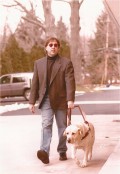
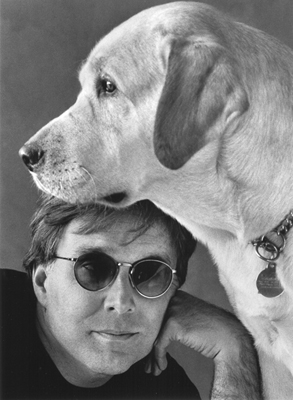
Once while I was teaching at The Ohio State University I was invited to a meeting with a dozen faculty and former astronaut and Senator John Glenn. We discussed the future of digital teaching. Afterwards I boarded a Columbus City bus only to face a woman who loudly asked if she “could pray for me”. She assumed blindness was a sad matter—or worse—a sign I needed spiritual rescue. My guide dog shook his collar. Suddenly I felt wickedly improvisational. I stood up, grabbed the overhead pedestrian bar, and announced loudly so every passenger could hear: “Certainly Madame you may pray for me, but only if I can pray for you, and in turn pray for all the sad souls on this bus—souls buttressed on all sides by tragedies and losses, by DNA and misadventures in capitalism, for we’re all sorrowing Madame, we’re all chaff blown by the cruel winds of post-modernism. Let us pray, now, together; let’s all hold hands!” She fled the bus at the next stop. Strangers applauded. Improvisation allows us to force the speed of associational changes, transforming the customs of disability life. Disability Studies scholar Petra Kuppers writes: If the relations between embodiment and meaning become unstable, the unknown can emerge not as site of negativity but as the launch pad for new explorations. By exciting curiosities, by destabilizing the visual as conventionalized primary access to knowledge, and by creating desires for new constellations of body practice, these disability performances can attempt to move beyond the known into the realm of bodies as generators of positive difference.
The polarizations, magnetic fields of crippledness are generators. It is not true that rebellion simply makes us old. We’re old when we give up.
And yet…the fights before us are promising to be both rewarding and very hard.
So I have the happenstance blues. They’re both accidental (aleatoric) and whatever is the opposite of accident, which, depending on your point of view might have something to do with the means of production, racial determinism from same, or all the other annotated bigotries of the culture club. As a disabled writer I know a good deal about the culture club. Now back to my happenstance blues…
I’m right here. I’m terribly inconvenient. Blind man at conference. Blind man in the lingerie shop. All built environments are structured and designed strategically to keep my kind out. My kind includes those people who direct their wheelchairs with breathing tubes, amble with crutches, speak with signs, type to speak, roll oxygen tanks, ask for large print menus or descriptive assistance. I’m here standing against the built geographical concentrations of capital development. I’m here. I’m the penny no one wants anymore. My placement is insufficiently circulatory in the public spaces of capital. Which came first, the blues or the architectural determinism that keeps me always an inconvenience?
Capital creates landscapes and determines how the gates will function. Of course there was a time before capital accumulation. It’s no coincidence the disabled were useful before capitalism. The blind were vessels of memory. The blind recited books. Disability is a strategic decision. Every disabled person either knows this or comes a cropper against the gates when they least expect it.
What interests me is how my happenstance-disability-blues are exacerbated by neoliberal capital accumulation. For accumulation one must thing of withholding money from the public good or dispossession, which is of course how neoliberal capital works. Here is geographer David Harvey in an interview, talking about just this:
Accumulation by dispossession is about dispossessing somebody of their assets or their rights. Traditionally there have been rights which have common property, and one of the ways in which you take these away is by privatizing them. We’ve seen moves in recent years to privatize water. Traditionally, everybody had had access to water, and [when] it gets privatized, you have to pay for it. We’ve seen the privatization of a lot of education by the defunding of the public sector, and so more and more people have to turn to the private sector. We’ve seen the same thing in health care.
What we’re talking about here is the taking away of universal rights, and the privatization of them, so it [becomes] your particular responsibility, rather than the responsibility of the state. One of the proposals which we now have is the privatization of Social Security. Social Security may not be that generous, but it’s universal and everybody has part of it. What we are now saying is, "That shouldn’t be; it should be privatized," which, of course, means that people will then have to invest in their own pension funds, which means more money goes to Wall Street. So this is what I call privatization by dispossession in our particular circumstance.
At the neoliberal university and all its concomitant conferences, workshops, and “terms abroad” (just to name some features of higher ed where my own disability has been problematized) the provision of what we call “reasonable accommodations” under the Americans with Disabilities Act is often considered to be in opposition to accumulation. For instance: I was asked to teach a term abroad in Istanbul. When I pointed out that Istanbul isn’t a guide dog friendly city and that I’d have trouble with the traffic and requested a sighted guide accompany me there, I was told this was too expensive. Think about it! One additional human being to keep me from getting run over was too expensive! The “term abroad” was actually designed to accumulate capital, right down to the lint in each student’s and instructor’s pockets. I decided to avoid getting run over and didn’t go.
Privatized culture means everything, including your safety is your own responsibility. I’m in mind of this. I’m not fooled.
Yet I declare cripples are beautiful and we’re at the whirling heart of this life and never at the edges of the constellations.


 Planet of the Blind