On the Ableism River

A woman sneered at me not long ago. We were on an airplane. Her seat was next to mine. Spotting the guide dog at my feet she pitched a fit. She told everyone within earshot that she was allergic to dogs. She needed immediate attention. She demanded a seat in First Class. She was, as they say, a “hot mess” and I tried to empathize—who am I to say she didn’t have allergies or that this wasn’t a deep inconvenience for her? Yet her nastiness was the thing. She was affronted by the very idea that I was “there” in that space. She sizzled with contempt.

If you’re disabled you know all about the contempt sizzlers. As Mark Twain would say, “you’ve met them on the river.”

**

More about the river…

The river is god itself. Not your ideas about it. Not your yearnings. It goes about its business, moving the glory of creation wherever it needs to go. Children sit on the banks dreaming. This is proper prayer.

The ableists’ river is also god itself. Its where self-contempt goes to bathe. And here come the cripples, floating down stream like loaves of bread…

**

You see, some days a cripple just doesn’t know what to say.
River. Bread, Children. Dreams. God in the mix. And sad strangers who can’t speak our language.

**

I wish that woman with her dog allergy well. I don’t think she had an allergy at all. It was in her voice. Studies show you can spot liars by their intonations. Hers said: “I’m a nasty, self absorbed wart. And I want you to pay attention to me.”

The dog just slept.

This morning I feel strongly that her tribe has taken the reins of our government.

A few years back I attended a speech by two senators who were instrumental in passing the Americans with Disabilities Act: Tom Harkin and Bob Dole. A Democrat and a Republican. They spoke about the bipartisanship that made the ADA possible. But then Bob Dole said something that made my ears prick up: “Today’s GOP would never support this.” The Tea Party was in vogue. Hatred of cooperation was the new rule. This was before Trump.

This morning we’re seeing the GOP controlled House fresh off of voting to eliminate Medicaid and other crucial programs for veterans, the disabled, the poor, and the elderly, flat out crowing about their wonderful new bill.


They have a collective allergy.

As I grow older my hands open more slowly…

My hands are today helpless. I used them to vote against fascism just last week. It was foolish of my hands to think they had power. Today my hands are grieving and their grief differs from that of the head or heart: my hands are those of a sailor who desperately wants to put the ship on the right course—hands that are educated, seasoned, and moral.

As I grow older my hands open more slowly. Maybe they know more? What’s empty turns its face to us, said a good poet, long ago. My hands read Braille poorly. My hands which have touched Marcel Duchamp’s bicycle wheel. Hands that pull the voting lever for freedom.

There are several good books about hands. One of my favorites is “Victorian Hands: The Manual Turn in Nineteenth Century Body Studies” edited by Peter J. Capuano and Sue Zemka. Hands are transformed by the industrial revolution—they become vulnerable instruments seemingly designed through evolution to operating machines. They are all too often dismembered. Hands become “throw aways” as much as anything else.

My hands are today helpless. I used them to vote against fascism just last week. It was foolish of my hands to think they had power. Today my hands are grieving and their grief differs from that of the head or heart: my hands are those of a sailor who desperately wants to put the ship on the right course—hands that are educated, seasoned, and moral.

What about the hands of those who voted for fascism you say. These are the descendent hands of industrial labor, desperately caught up in the machines of their own doom. They voted, essentially, for “throw away” hands.

My favorite poem about hands is by Jane Hirshfield

A hand is not four fingers and a thumb.
Nor is it palm and knuckles,
not ligaments or the fat’s yellow pillow,
not tendons, star of the wristbone, meander of veins.

A hand is not the thick thatch of its lines
with their infinite dramas,
nor what it has written,
not on the page,
not on the ecstatic body.

Nor is the hand its meadows of holding, of shaping—
not sponge of rising yeast-bread,
not rotor pin’s smoothness,
not ink.

The maple’s green hands do not cup
the proliferant rain.
What empties itself falls into the place that is open.
A hand turned upward holds only a single, transparent question.
Unanswerable, humming like bees, it rises, swarms, departs.

A Morning Journal About Monsters

If you think you’re the monster that’s alright
If you think you’re alright that’s monstrous
Let’s telephone the monster
“If you want to speak with the monster, press one…”

**
I was raised on moonbeams that came through a small window…

**

“What would an ocean be without a monster lurking in the dark? It would be like sleep without dreams.”

― Werner Herzog

**

Up early rummaging through the medieval stronghold of my skull
But I do it with confidence like a chess master

**

If you think you’re the monster that’s alright
It worked for Nietzsche

**

Sometimes when I call the monster I get Werner Herzog

**

The joke about the freak show is the monsters were at the edge of the fairground thriving on their emptiness

The “freaks” were just birds with damaged wings…
**

Oh come see the monster
Hurry…one slight bruise and he dies…

**

Michel Foucault thought he understood how monsters are made
He imagined they came from architecture and the bourgeois tendency to shuffle papers
He was a child of his age
Monsters need no scripts
They make and remake themselves from slivers of imaginary glass

**

Once while teaching at the University of Iowa I told graduate students that 90 per cent of the imagination is bad for you. I’m revising this to 95 per cent.

Eventually the monster’s tears turn into spectacles…

Marvin Bell and the Open Poem

If I knew better I’d have bet against a quote purported to come from Yeats. It was first told to me in Finland by a British ex-pat professor of literature who was certain he knew more than anyone else. The word “pettifogger” comes to mind but he dressed well. He insisted Yeats said “a poem should click shut like a well made box.”

I was fresh out of grad school—the Iowa Writer’s Workshop—where I’d studied poetry writing with Marvin Bell (among others) and while I was young enough to be almost nauseous with credulity, I knew poems were different than humidors since the good ones are living things. But I believed Old Jasper (for that’s what I’ll call him) and blithely went about saying “Yeats said…” for a number of years. Youth can do this. You want the authoritative mien of Jasper.

You may not care about poetry or not overmuch and that’s fine but I think its important to say that craft should not be closed, arid, cramped, or locked. Whether you’re changing the oil in your car or writing a song, the best work sends us out into the world.

So I should have known better. Yeats never shut anything tight. He wouldn’t want to. He had the gyres of cosmos and aeonic winds and he loved a ruined house as much as anyone.

Marvin Bell said: “Learn the rules, break the rules, make up new rules, break the new rules.” This is the proper way of it. Improvisation is vital resistance.

Today a large gathering of American poets will read poems by Marvin Bell through a Zoom session hosted by Prairie Lights Bookstore in Iowa City. Readers will include John Irving, Tess Gallagher, Heather McHugh, David St. John, Naomi Shihab Nye, Kwame Dawes, Ellen Bass, Juan Felipe Herrera, Stephen Kuusisto, Dorianne Laux, Lia Purpura, Eric Pankey, and many more.  Marvin’s son Nathan Bell, the internationally recognized folk singer will perform songs.

Marvin Bell has been at the forefront of American poetry for sixty years. He’s quite ill. Today’s event is our chance to say how much we love him.

Come for the poetry. Remember, poems don’t close.

Thinking of Cesar Vallejo, Early Morning, in the Age of Police Brutality

I want to begin with a short poem by the great Peruvian poet Cesar Vallejo, translated by Robert Bly: 

Black Stone Lying On A White Stone

I will die in Paris, on a rainy day,

on some day I can already remember.

I will die in Paris—and I don’t step aside—

perhaps on a Thursday, as today is Thursday, in autumn.

   It will be a Thursday, because today, Thursday, setting down

these lines, I have put my upper arm bones on 

wrong, and never so much as today have I found myself

with all the road ahead of me, alone.

   César Vallejo is dead.  Everyone beat him

although he never does anything to them;

they beat him hard with a stick and hard also

   with a rope.  These are the witnesses:

the Thursdays, and the bones of my arms,

the solitude, and the rain, and the roads. . .

This poem has been much on my mind for several reasons. Vallejo wrote it in despair and weariness. As a Marxist poet living in exile in Paris he was hounded by the police, was frequently arrested and subjected to beatings. His is the true story of literary exile in Paris as opposed to the white privilege story of Hemingway and his circle. Hemingway’s crowd held no political positions and fought for no causes. 

It’s also been in my thoughts because it’s about life inside the broken body which to my mind makes it a disability poem. His upper arm bones are wrong, his will can’t change the fact, and like so many cripples he finds himself alone. The only witnesses? The opaque and unfeeling days. 

The third reason the poem’s been in my thoughts is that we’re living in a globalized police state now. From Minneapolis to Mumbai; from Atlanta to Ashgabat police violence is not just the norm, it’s welcomed by the ruling classes. This poem is about the toll this takes “on the inside”—what this does to “the inner life.”

The poet will die in Paris on a rainy day—a day he can already remember, for death by persecution really never ends. 

It’s a brave poem. It skips the contemporary American penchant for lyric poems that sentimentalize the glories of nature or the joys of sex.  

It’s a brave poem. There’s a hint of Orwell. (The jackboot that’s going to step on you throughout eternity.) 

It’s a brave poem. Cesar Vallejo never does anything to anyone and they beat him for his very consciousness and his foreign appearance. 

It’s a brave poem because he wrote it without sentimentally. 

It is much on my mind. 

Her hands in the stream…

You can tell me about Helen Keller
But you can’t say what words
Perform on the inside.

Have you seen a cormorant
Drop from on high
And enter the sea?

That’s my Helen Keller—
That falling…

ie Kuusisto :
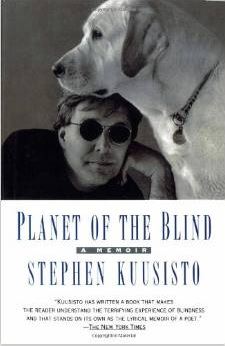
Stephen Kuusisto and HarleyABOUT: Stephen Kuusisto is the author of the memoirs Have Dog, Will Travel; Planet of the Blind (a New York Times “Notable Book of the Year”); and Eavesdropping: A Memoir of Blindness and Listening and of the poetry collections Only Bread, Only Light and Letters to Borges. A graduate of the Iowa Writer’s Workshop and a Fulbright Scholar, he has taught at the University of Iowa, Hobart and William Smith Colleges, and Ohio State University. He currently teaches at Syracuse University where he holds a University Professorship in Disability Studies. He is a frequent speaker in the US and abroad. His website is StephenKuusisto.com.

Have Dog, Will Travel: A Poet’s Journey is now available for pre-order:
Amazon
Barnes and Noble
IndieBound.org

Have Dog, Will Travel by Stephen Kuusisto

(Photo picturing the cover of Stephen Kuusisto’s new memoir “Have Dog, Will Travel” along with his former guide dogs Nira (top) and Corky, bottom.) Bottom photo by Marion Ettlinger 

Faeries, come…

All those who believe I’m vagrant—blind as I am
Walking with my stick or dog—
That woman in Boston who hoped to pray for me
Who ran away when I offered to pray for her,
What’s wrong with a disabled prayer?
I stood in the street and waved my arms.
In London a girl called me “poor Dearie”
And thrust coins in my hands.
Once in Cleveland a red faced man
Followed me block after block
Proposing to help…better I thought
Than the alternatives—
The asylum; the work houses.
In general the poets of my nation
See the blind as an existential blank.
But tired of standing for nothing
I sing and walk down Broadway
The sweet, manifold, wishful syllables
Of William Yeats—
Faeries, come take me out of this dull world,
For I would ride with you upon the wind,
Run on the top of the dishevelled tide,
And dance upon the mountains like a flame.

Stephen Kuusisto and HarleyABOUT: Stephen Kuusisto is the author of the memoirs Have Dog, Will Travel; Planet of the Blind (a New York Times “Notable Book of the Year”); and Eavesdropping: A Memoir of Blindness and Listening and of the poetry collections Only Bread, Only Light and Letters to Borges. A graduate of the Iowa Writer’s Workshop and a Fulbright Scholar, he has taught at the University of Iowa, Hobart and William Smith Colleges, and Ohio State University. He currently teaches at Syracuse University where he holds a University Professorship in Disability Studies. He is a frequent speaker in the US and abroad. His website is StephenKuusisto.com.

Have Dog, Will Travel: A Poet’s Journey is now available for pre-order:
Amazon
Barnes and Noble
IndieBound.org

Have Dog, Will Travel by Stephen Kuusisto

(Photo picturing the cover of Stephen Kuusisto’s new memoir “Have Dog, Will Travel” along with his former guide dogs Nira (top) and Corky, bottom.) Bottom photo by Marion Ettlinger 

Of Book Tours, Antonio Gramsci, and the Unmade Bed

A friend, characterizing a mutual friend said: “he has a mind like an unmade bed” and trust me that’s how I’m feeling. Of the unmade bed I recall an episode of the television version of “The Odd Couple” when Felix discovers a half eaten submarine sandwich in Oscar Madison’s bed. Oscar didn’t say it, but I will: “detritus ye will always have with ye” though one must surely admit when his defenses are down. I’m finding it difficult to concentrate.

This isn’t listlessness. It’s not the blues. (Though I know I’ve got them—a blind guy’s slumgullion of concerns from genetic testing of fetuses (rooting out probable disabled babies, think eugenics 2.0) to the race baiting narratives of American cleanliness espoused by the United States government and increasingly large parts of the industrialized world (Reich 4.0).
Or I worry about your mentally ill brother, child, mother, especially if they’re a person of color, for they’ll likely wind up dead or in jail in our clotted, Dickensian nation. Meanwhile the eroding middle class watches the Kardashians.

OK. Sorry. But when you’re an unmade bed, well, you become that man who natters on the bus. Some mornings I’m a single dendritic spark away from either mumbling or ranting.
My unmade bed is starting to smolder.

I’ve been on a lovely book tour which has taken me to Los Angeles, Santa Cruz, Calistoga, Denver, Richmond, and upstate New York. Talking with old acquaintances and new friends is a cleansing experience. I always meet good people on the road.

Check box: I’ve been talking to excellent human beings.

Check box: In Denver I got an Uber ride from a man who lectured me about the “end times” for twenty five minutes. He touched my hair. Said: “you’re already one of the saved. God loves you.”

Check: It’s raining in the airplane burial ground, as my friend Jim Crenner once wrote.

Crumbs from the bed…Marx was right about 40% of the time.

Bed: Antonio Gramsci was right about 80% of the time.

The above assertions are not incompatible.

Check: I’ve lately had several graduate students who don’t like to read and when pushed turn deflective and mean spirited. These are the children of “no child left behind” who’ve been trained for a decade to take tests. Confronted by the prose of Salman Rushdie they look at first perplexed, than hostile.

Crumb: The students mentioned believe they’re commodified, neutralized, oppressed, etc. according to their respective identities. They won’t read for strength. They believe ideology is strength. In this way they’re no more sophisticated than Donald Trump.

It’s a very hard time to be a professor.

Crumb: last night I realized for the 41,000th time that baseball won’t save me.

Check: I don’t care for popular music of any kind.

Ort. (Everyone’s favorite crossword bit)—scientists now believe outer space is filled with carbon molecules which they describe as “grease”—it means we’re essentially living in a vast kitchen drain.

Speck: The poet Donald Hall just passed. He was a good man on balance.

Note: I’m reading Dr King’s Refrigerator by Charles Johnson. Also: The Order of Time by Carlo Rovelli.

Speck: the thing about a book tour is you see with sufficient comic irony you’re not terribly important in the grand scheme.

Ort: I once introduced myself to the folk singer Utah Philips. Told him I was an anarchist at heart. He gave me a withering look. It said: “I’m the only god damned anarchist you little shit!”

What was it James Tate said? “No longer the perpetual search for an air conditioned friend….”

My step children are struggling to stay in the middle class.

I’ve a friend who’s lost his health insurance and has no job.

He doesn’t have the leisure for a mind like an unmade bed.

Like most halfway ethical beings I feel guilty.

Is sharing the unmade bed the best thing a writer can do?

That’s mostly what creative writing programs are all about.

The Finnish communist poet Pentti Saarikoski said: “I want to be the kind of poet who builds houses for people….”

Saarikoski was just kidding of course. The way poets do. He never built a house for anyone.

Is the unmade bed a place of ambition or escape. Is it both?

This is the point: I want to create unmade beds for everyone.

Check: we’d take turns being servants. The unmade bed mustn’t be class reserved.

What the hell am I talking about?

I fear for the life of imagination; what we used to call the life of the mind.

A student came to me not long ago and said he wanted to be a writer. Then he told me he hated reading.

I want to be a painter but I hate paint.

I’d like to cultivate my mind but not today.

Gramsci: “I’m a pessimist because of intelligence, but an optimist because of will.”
Stephen Kuusisto and HarleyABOUT: Stephen Kuusisto is the author of the memoirs Have Dog, Will Travel; Planet of the Blind (a New York Times “Notable Book of the Year”); and Eavesdropping: A Memoir of Blindness and Listening and of the poetry collections Only Bread, Only Light and Letters to Borges. A graduate of the Iowa Writer’s Workshop and a Fulbright Scholar, he has taught at the University of Iowa, Hobart and William Smith Colleges, and Ohio State University. He currently teaches at Syracuse University where he holds a University Professorship in Disability Studies. He is a frequent speaker in the US and abroad. His website is StephenKuusisto.com.

Have Dog, Will Travel: A Poet’s Journey is now available for pre-order:
Amazon
Barnes and Noble
IndieBound.org
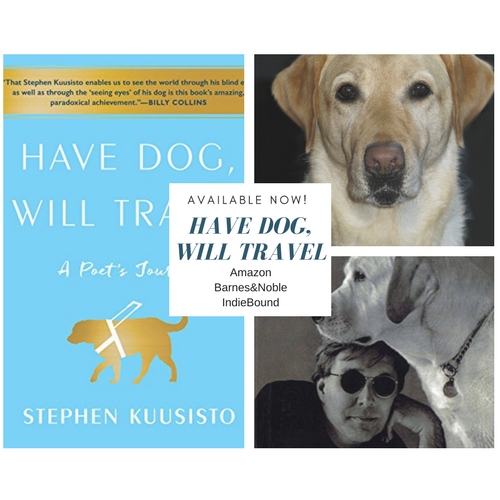
Have Dog, Will Travel by Stephen Kuusisto

(Photo picturing the cover of Stephen Kuusisto’s new memoir “Have Dog, Will Travel” along with his former guide dogs Nira (top) and Corky, bottom.) Bottom photo by Marion Ettlinger 
Just for the Books

IMG 2248

On Wednesday last, April 11, I had the privilege of reading from my new memoir Have Dog, Will Travel: A Poet’s Journey  at Gramercy Books  in Columbus, Ohio. Gramercy’s owner, Linda Kass took this terrific photo of the event. I’m standing in front of a good sized audience, my purple sweater covered with dog hair, and I appear to be just about to make an extravagant gesture with my hand, like the opera tenor I’d really like to be….

As I’ve said before on my blog, I adore independent book stores. People come there for the books. They really do. Oh they might get a frou frou coffee, some poodle-ish beverage, but for Indie shoppers that’s just “value added” as they say in marketing circles. Customers who shop in independent book stores are drawn by words, intuitions, giddiness, mystery, fantasy, Dostoevsky, or “news that stays news” as Ezra Pound once said, describing why poetry matters.

You can’t tell from this photo but there are several guide dog users at the event. And puppy raisers from Guiding Eyes for the Blind.

What could be better than books and dogs, and lots of readers?

Stephen Kuusisto and HarleyABOUT: Stephen Kuusisto is the author of the memoirs Have Dog, Will Travel; Planet of the Blind (a New York Times “Notable Book of the Year”); and Eavesdropping: A Memoir of Blindness and Listening and of the poetry collections Only Bread, Only Light and Letters to Borges. A graduate of the Iowa Writer’s Workshop and a Fulbright Scholar, he has taught at the University of Iowa, Hobart and William Smith Colleges, and Ohio State University. He currently teaches at Syracuse University where he holds a University Professorship in Disability Studies. He is a frequent speaker in the US and abroad. His website is StephenKuusisto.com.

Have Dog, Will Travel: A Poet’s Journey is now available:
Grammercy Books
Amazon
Barnes and Noble
IndieBound.org

Have Dog, Will Travel by Stephen Kuusisto

(Photo picturing the cover of Stephen Kuusisto’s new memoir “Have Dog, Will Travel” along with his former guide dogs Nira (top) and Corky, bottom.) Bottom photo by Marion Ettlinger 

Disability, Resurrection, Poetry

It’s Easter Sunday and I’m thinking about human equality, disability, and the poetry uniting both. Strange really, the resurrection of Christ, equal rights, a poetics. Here’s what I mean: Christ rises from his grave, the very action the most extraordinary figure of rehabilitation in human history. All resurrection myths proclaim equality is not out of reach—that soon enough you’ll be unrecognizable to yourself, clean, bright, and favored like others.

Poetry may not always be concerned with religion or equality. The early modernist poets in their desire to rival the immediacy of photographs were at times dispassionate—see Imagism or Vorticism as practiced by Pound—yet poetry often is where we find empathy. I wept alone in my faculty office one afternoon when, after a day of pain, my legally blind eyes unable to keep up with the tasks before me, in the days before reliable speech technology, I read the following poem by Adrienne Rich with my left eye only a half inch from the page:

I know you are reading this poem
late, before leaving your office
of the one intense yellow lamp-spot and the darkening window
in the lassitude of a building faded to quiet
long after rush-hour. I know you are reading this poem
standing up in a bookstore far from the ocean
on a grey day of early spring, faint flakes driven
across the plains’ enormous spaces around you.
I know you are reading this poem
in a room where too much has happened for you to bear
where the bedclothes lie in stagnant coils on the bed
and the open valise speaks of flight
but you cannot leave yet. I know you are reading this poem
as the underground train loses momentum and before running
up the stairs
toward a new kind of love
your life has never allowed.
I know you are reading this poem by the light
of the television screen where soundless images jerk and slide
while you wait for the newscast from the intifada.
I know you are reading this poem in a waiting-room
of eyes met and unmeeting, of identity with strangers.
I know you are reading this poem by fluorescent light
in the boredom and fatigue of the young who are counted out,
count themselves out, at too early an age. I know
you are reading this poem through your failing sight, the thick
lens enlarging these letters beyond all meaning yet you read on
because even the alphabet is precious.
I know you are reading this poem as you pace beside the stove
warming milk, a crying child on your shoulder, a book in your
hand
because life is short and you too are thirsty.
I know you are reading this poem which is not in your language
guessing at some words while others keep you reading
and I want to know which words they are.
I know you are reading this poem listening for something, torn
between bitterness and hope
turning back once again to the task you cannot refuse.
I know you are reading this poem because there is nothing else
left to read
there where you have landed, stripped as you are.

–Adrienne Rich, from An Atlas of the Difficult World

Consider a “stripped” reader—consider her bent low. Stripped is vulnerability, a nakedness, and yet it’s also the first turn toward new language, one that allows us to tenderly imagine ourselves renewed.

It’s renewal that interests me. If equality is a moral concept, as I believe it is, than the broken body is also a moral agent; if “where you have landed” is neither a sacred or profane space, it is solely Jeffersonian—embodiment, whatever the circumstance is human, therefore fully, entirely human. In Disability Studies we often speak of resisting “overcoming narratives” by which we mean a resistance to medical persuasion—the idea that humans are only valuable insofar as they can be cured of their maladies. We call this the “medical model” of disability and many a disabled person has written a book touting his or her “miracle cure” often attributing it to a marriage of god and science. Sometimes of course it’s god alone or simply science. In either case the subtext of these books is routine: only a physically able and firm body has value. I think such stories are immoral for unlike Adrienne Rich’s poem which holds out the possibility of new directions in despair, overcoming narratives are steadfast in their insistence only the healthy body matters.

In his new book “One Another’s Equals” Jeremy Waldron observes:

“When we talk about equality, one of the most important distinctions we have to make is between prescriptive and descriptive equality. Descriptive statements tell us how things are, and prescriptive statements tell us how things ought to be and / or what things ought to be done. Crudely, we can say descriptively (or deny descriptively) that people are equal in some respect; we can say their opportunities are equal or that there used to be less inequality of income than there is now. Or we can say, prescriptively, that people ought to be equal. We can say that in general—for example, that they ought to be treated with equal respect—or we can say it in some particular regard, such as their income or opportunities.”

Excerpt From: Jeremy Waldron. “One Another’s Equals.” iBooks. https://itunes.apple.com/us/book/one-anothers-equals/id1242543605?mt=11

He adds:

“Prescriptive statements call for something to be done that might not otherwise be done.”

This is essentially what poetry is or concerns itself with. And one thinks of Robert Kennedy’s famous declaration: “There are those that look at things the way they are, and ask why? I dream of things that never were, and ask why not?”

Resurrection is prescriptive and whether its a fantasy or not matters less to me than its moral inference: we are equal in renewal which differs profoundly from being cured or healed. Jesus, risen, still had his wounds. He remains, even glorified, our physical equal, in flesh our aspirational moral equal.

The best disability poetry tends to work in these areas though it may not be overtly spiritual in nature. Embracing the equal status of the disabled body is invariably renewing.

In her poem “Future Biometrics” JILLIAN WEISE writes:

the body that used to
contain your daughter

we found it
behind the fence

It was in a red coat
It was collected

Is she saved
Is she in the system

You’re lucky
we have other bodies

to put your daughter in
Come on down

to the station

Weise combines the medical model, the curative, with a post-human vision of cyber-resurrection. The “it” daughter, not entirely human, dead behind a fence will be transmogrified through technological means, industrial means, one imagines a whole new shipment of alternative bodies arriving by train. A motto for the poem could read: “beware what resurrection you’re calling for” or the like.

Jim Ferris describes resurrection as survival—after eugenics, after Aristotle, the disabled actually dare to thrive:

“Tell Aristotle”

    As to the exposure and rearing of children, let there be a law that 
      no deformed child shall live.
            Aristotle, Politics

Tell Aristotle I lived.
    Tell him Dave did too.
Tell him the state has not
    yet fallen, though you know
kids these days. Tell him perhaps
    all our words are but
elaborations, repetitions
    of that crier’s claim.
Tell Aristotle, tell the Spartans,
    tell the legions of those
who think they can’t afford the difference
    that difference makes,
tell Montaigne, tell Hobbes,
    tell Dr. Tiergarten
and that off-key singer
    of sad and silly songs,
tell them the useless eaters
    have survived,
tell them there are more of us now
    than ever, disorderly,
imperfect, splashing out the gene pool,
    what a messy species,
tell them my brother Dave and I
    inhabit this moment,
tell Aristotle we are alive,
    tell them all we thrive
.

Resurrection is imperfect, splashing out of the gene pool, more of us now, and implicitly, firmly, prescriptively, morally equal.
The poet Laurie Clements Lambeth writes:

and then there are days when I can stride across the house
five times even, springing forward with an armful of laundry
 
as though I never forgot how, no longer offering the body
instruction in hip tuck or the proper undulation of each foot
 
(hold wall, heel first, steady now, lift the next). My gratitude
at such moments is not for the walking, that easy
 
grace. It’s for the shadow, that other gait hovering around
my frame, a faint, wavering outline, staggering dragged
 
water-edge purling behind. How can one measure time or space?
The miles I saw stretch across this little house unfurled a span
 
to heave through, now condensed to mere feet. I will see those
miles again, I know, and somehow now: I keep a foot in each world.

Embodied, prescriptive, we’re equally unknowable—the truest definition of equivalence and equality one may ever know. Disability as poetics, an epistemology is a resurrectionist school but not a school of overcoming or cure.

Stephen Kuusisto and HarleyABOUT: Stephen Kuusisto is the author of the memoirs Have Dog, Will Travel; Planet of the Blind (a New York Times “Notable Book of the Year”); and Eavesdropping: A Memoir of Blindness and Listening and of the poetry collections Only Bread, Only Light and Letters to Borges. A graduate of the Iowa Writer’s Workshop and a Fulbright Scholar, he has taught at the University of Iowa, Hobart and William Smith Colleges, and Ohio State University. He currently teaches at Syracuse University where he holds a University Professorship in Disability Studies. He is a frequent speaker in the US and abroad. His website is StephenKuusisto.com.

Have Dog, Will Travel: A Poet’s Journey is now available for pre-order:
Amazon
Barnes and Noble
IndieBound.org

Have Dog, Will Travel by Stephen Kuusisto

(Photo picturing the cover of Stephen Kuusisto’s new memoir “Have Dog, Will Travel” along with his former guide dogs Nira (top) and Corky, bottom.) Bottom photo by Marion Ettlinger