Ode to Disabled Men

Strictly speaking an ode is a lyric poem in the form of an address to a particular subject, often elevated in style or manner and written in varied or irregular meter. Also a poem meant to be sung.

This is my ode to disabled men.

Under the spreading chestnut tree the village cripples sit. They’re all men. The broken men sell tin cups, pencils, knives and oils—that’s if they have inventory. If they have none, they sing, play the fiddle and beg. To passersby it’s all the same. Disabled men are thought to be beggars no matter what they do.

This is why people offer to pray for me when I’m walking in public. I’m just a blind guy going about his business. Strolling the campus of The Ohio State University one morning I find my path blocked by a woman. “I’d like us to get down on our knees and pray to Jesus on your behalf,” she says.

Disability is sin. It’s dishonest. It’s in need of absolution and salvation.

In the 1970’s we chanted things like “you gave us your dimes, now we want our rights.”

In the 1980’s we said “nothing about us without us” which means able bodied people don’t get to narrate our lives any more.

In the 90’s we got the ADA. “We’re here, whether you’re ready or not.”

In a scholarly article entitled “Begging the Question: Disability, Mendicancy, Speech and the Law” Susan Schweik tells the story of George Gray a legless man who sued a social reformer for libel in 1911:

“Forbes boasted in print that his charitable work had induced Gray to “lead an honest life” and had converted him from a crippled beggar to a self-respecting peddler. Forbes had described Gray in print as the very type that needed charitable intervention: “the runaway boy who goes on the road to see the world, lost both legs while a tramp; returned to New York and became a street beggar.” Forbes’ article, co-written with Silas McBee and published in The Churchman, an Episcopal church organ, held Gray forth as a model of successful reform under the auspices of modern scientifically organized charity: “Induced to lead an honest life under the auspices of the National Association,” Gray now, Forbes boasted, “maintained himself honorably.”4
In a similar vein, Forbes’ obituary in the Times described his work setting up “scores of crippled beggars…in self-respect as newspaper vendors” (“The Late James Forbes”).

George Gray, however, did not need to derive his self-respect from James Forbes; he had no desire to be held up as organized charity’s poster newsboy, and he objected to the insinuation that he had ever lacked “a reputation for honesty and integrity.” He refused, in short, to be made for one moment into an unsightly beggar. His libel case against Forbes and McBee was fought through multiple appeals. Gray’s difficulty contesting Forbes’ interpellations is compounded by the New York Times coverage of the case, which erroneously reports his name?not as George but James, Forbes’ own first name (“Legless Newsboy Sues”).”

We were always imagined as sinners and thought to be in need of moral improvement.

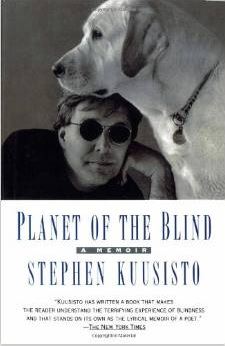
Stephen Kuusisto and HarleyABOUT: Stephen Kuusisto is the author of the memoirs Have Dog, Will Travel; Planet of the Blind (a New York Times “Notable Book of the Year”); and Eavesdropping: A Memoir of Blindness and Listening and of the poetry collections Only Bread, Only Light and Letters to Borges. A graduate of the Iowa Writer’s Workshop and a Fulbright Scholar, he has taught at the University of Iowa, Hobart and William Smith Colleges, and Ohio State University. He currently teaches at Syracuse University where he holds a University Professorship in Disability Studies. He is a frequent speaker in the US and abroad. His website is StephenKuusisto.com.

Have Dog, Will Travel: A Poet’s Journey is now available for pre-order:
Amazon
Barnes and Noble
IndieBound.org

Have Dog, Will Travel by Stephen Kuusisto

(Photo picturing the cover of Stephen Kuusisto’s new memoir “Have Dog, Will Travel” along with his former guide dogs Nira (top) and Corky, bottom.) Bottom photo by Marion Ettlinger 

Cultural Diplomacy, Disability, and the Art of Getting Lost

In his excellent biography of James Holman, “A Sense of the World: How a Blind Man Became History’s Greatest Traveler” Jason Roberts writes: “Until the invention of the internal combustion engine, the most prolific traveler in history was also the most unlikely. Born in 1786, James Holman was in many ways the quintessential world explorer: a dashing mix of discipline, recklessness, and accomplishment, a Knight of Windsor, Fellow of the Royal Society, and bestselling author. It was easy to forget that he was intermittently crippled, and permanently blind.”

I’m not sure about the forgetting. Though Holman’s celebrity dimmed over time, his blindness was always the point, and this is in part why we remember him now. I’ll venture to say he was the first disabled cultural diplomat, someone who implicitly recognized disability as a way of knowing, disability as epistemology. As a legally blind poet I believe getting lost is an art form. Holman is my great, foundational ancestor. Let’s put him on the blind Mt. Rushmore with Homer, Milton, Annie Sullivan, Helen Keller and Ray Charles. BTW: I think Homer was several people, all of them women.
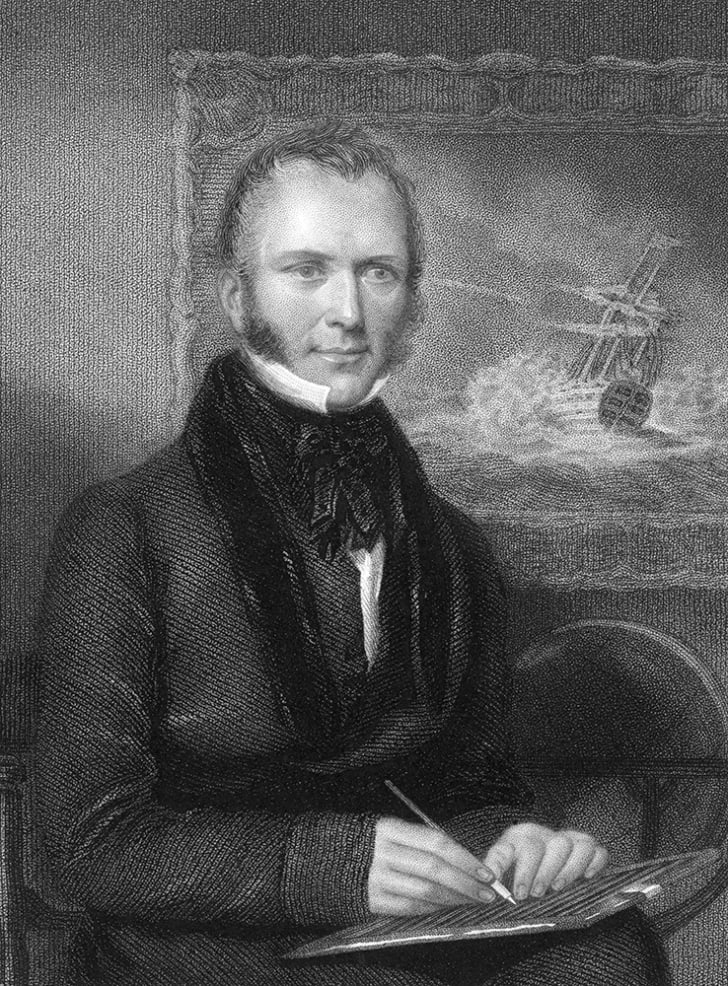
(Photo: pen and ink drawing of James Holman holding a writing stylus and tablet, seated before a painting of a sailing ship in a storm at sea.)

All disabled life is performance. When a person is consigned to stasis through warehousing, lack of accommodations, insufficient health care, lack of education, steepened cultural dynamics (a disabled child is hidden so as not to affect the prospects of a sibling’s arranged marriage) the disabled performance signifies uselessness. As the American novelist William Gass once wrote: “culture has completed its work when everything is a sign.” I imagine Gass was being ironic since culture is a river as Heraclitus tells us. We enter it but never at the same point. Even Keats whose name is written on water can’t signify the entire river. The point of course is to enter it.

There’s no reason why the experiences of travelers with disabilities should differ markedly from those without. The imaginative and/or experiential discoveries of the disabled are lyric ones–unforeseeable and unique. Holman observed most sighted travelers didn’t see much. Attention isn’t the sole province of the sighted. This is obvious to those who teach disability studies, performance studies, or any form of cultural studies. The individual–whoever she is–brings attention, empathy, analysis, surprise, wonder, sorrow, and a myriad of archetypes to every encounter and so it must be also with those of us who are cripples. Disability scholar and performance artist Petra Kuppers, referring to disability dance workshops puts it this way:

“…’subjective’ bodily engagement is tacit in the process of trying to make sense of another’s somatic knowledge. There is no other way to approach the felt dimensions of movement experience than through the researcher’s own body.”

(See Petra’s wonderful book: “Disability Culture and Community Performance.”

Disability is somatic knowledge and disability travel is always a cultural enterprise–not as William Gass would have it, a matter of static signs–disabled movers are the purveyors of somatic knowing which is in turn the moving imagination.

**

Disability as cultural diplomacy is a grassroots enterprise. One shouldn’t confuse it with say, Van Cliburn. Remember? He was a gangly twenty three year old music prodigy from Texas who in 1958 improbably won the first international Tchaikovsky piano competition in Moscow.

(Photo: Van Cliburn receives Tchaikovsky medal from Soviet Premier Nikita Kruschev, 1958)

Because the Cold War was in full swing Van Cliburn became a global celebrity and to this day he’s the only classical musician in American history to receive a ticker tape parade in New York. I should point out that Luciano Pavarotti once served as the grand martial for Manhattan’s Columbus Day Parade. He rode a herniated horse up Fifth Avenue. But that’s not quite the same thing.

(Photo: Luciano Pavarotti on a horse, flanked by two mounted New York City police officers.)

Cultural diplomacy is many things of course. It’s been a determined product of states or state influence throughout history–artists and intellectuals, inventors have traveled at the behest of governments as de facto advertisements for the advantages of French language, Abstract Expressionism, jazz, Italian opera, Malaysian ballet, Russian poetry, you name it. One may say that all of Pablo Neruda’s career was a matter of cultural diplomacy. Refugees are also cultural diplomats.

What is the disability dynamic of cultural diplomacy? In her book “The Diplomacy of Culture” Irena Kozmyka writes:

“Since the end of the Cold War, culture and identity rather than ideology have been increasingly recognized as key forces shaping global order. The rise of identity politics and religious revivalism have been feeding debates on the “clash of civilizations” and Islam’s challenges to the West. In parallel, debates have been focusing on globalization, broadly defined as an empirical process of increasing worldwide economic, political, technological, and cultural interconnectedness. Globalization’s impact on culture has been viewed as both a blessing and a curse: on the one hand offering unprecedented opportunities for interactive and enriching cultural exchanges and therefore increasing cultural diversity, and on the other leading to uniformity or tensions between cultures.1 In many parts of the world, globalization is perceived as a threat to national cultures and traditional forms of identity.2 As a result and contrary to earlier predictions of “the end of history,” the forces of globalization appear to be more nurturing than destructive of the reaffirmation of sovereignties and, in reaction, of the demands for recognition of regional and local differences.

In these conditions, managing cultural diversity is increasingly becoming one of the major issues and concerns of the day, intrinsically linked with international security, social cohesion, and development. Indeed, cultural diversity at the international level overlaps with the now extensive debates on multiculturalism within states.”

Nation states are increasingly focused on historically marginalized people, and though this isn’t universal, as state oppression proves, disability is increasingly viewed as an important factor in interconnectedness. Milton C. Cummings describes ‘cultural diplomacy’ as: “the exchange of ideas, information, values, systems, traditions, beliefs, and other aspects of culture, with the intention of fostering mutual understanding”.

**

Quoting the philosopher Jean Luc Nancy, Petra Kuppers writes:

“Community is what takes place always through others and for others. It is not the space for the egos ‘subjects and substances that are at bottom immortal’ but of the I’s who are always others (or else are nothing).”

A crip community therefore is not the autonomous push and pull of national relations but a field, much as poetry is a field. One is reminded of the American poet Robert Duncan’s “Often I Am Permitted to Return to a Meadow”:

Often I Am Permitted to Return to a Meadow

as if it were a scene made-up by the mind,
that is not mine, but is a made place,

that is mine, it is so near to the heart,
an eternal pasture folded in all thought
so that there is a hall therein

that is a made place, created by light
wherefrom the shadows that are forms fall.

Wherefrom fall all architectures I am
I say are likenesses of the First Beloved
whose flowers are flames lit to the Lady.

She it is Queen Under The Hill
whose hosts are a disturbance of words within words
that is a field folded.

It is only a dream of the grass blowing
east against the source of the sun
in an hour before the sun’s going down

whose secret we see in a children’s game
of ring a round of roses told.

Often I am permitted to return to a meadow
as if it were a given property of the mind
that certain bounds hold against chaos,

that is a place of first permission,
everlasting omen of what is.

Disability is itself a disturbance of words within words; it’s filled with evanescence, indeterminacies, longings, strange permissions, properties of the mind that are both chaos and bounds against it.
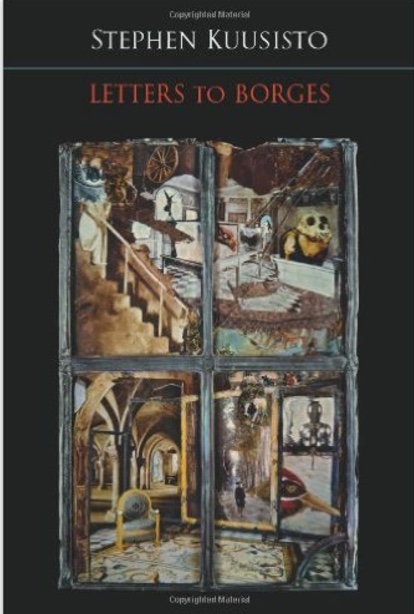
When I wrote my collection of poems “Letters to Borges” I was conscious of this cripple’s principle–an ars poetica–that getting lost is a strange permission, and for me as a man who’s struggled to become an independent traveler an everlasting delight. I knew that Jorge Luis Borges never learned to travel by himself and wished to convey to his spirit something of the intellectual joy of wandering blind. Here’s a poem called “Letter to Borges from Estonia:

“Where I go is of considerable doubt.
Winter, Tallinn, I climb aboard the wrong trolley.
Always a singular beam of light leads me astray.

After thousands of cities I am safe when I say, “It is always the wrong trolley”—
Didn’t I love you with my whole heart? Athens? Dublin?

Solo gravitational effects: my body is light as a child’s beside the botanical garden’s iron fence—
But turning a corner one feels very old in the shadow of the mariners’ church.

I ask strangers to tell me where I am.
Their voices are lovely, young and old.

Yes, I loved you with my whole heart.
I never had a map.

Coordinated, Platonic movement in deep snow.
Crooked doors and radios in the bread shops.”

Back to Jean Luc Nancy: “Community is what takes place always through others and for others. It is not the space for the egos ‘subjects and substances that are at bottom immortal’ but of the I’s who are always others (or else are nothing).”

When I ask strangers where I am, I’m engaged in discovery not need, beauty not loss. This is the James Holman effect. One mode of somatic knowledge is thriving in the unknown. My wanderings Un-sign the signs. The antithesis of William Gass.

Cultural diplomacy is many things. But let’s suppose for the sake of argument that the U.S. State Department has it right. In a 2005 white paper they wrote:

“Cultural diplomacy is a two-way street: for every foreign artist inspired by an American work of art, there is an American waiting to be touched by the creative wonders of other traditions. Culture spreads from individual to individual, often by subterranean means; in exchange programs like Fulbright, Humphrey, and Muskie, in person-to-person contacts made possible by international visitor and student exchange programs, ideas that we hold dear—of family, education, and faith—-cross borders, creating new ways of thinking.”

As a blind writer who’s written about traveling the world by ear I’m attracted also to this from the State Department:

“To practice effective cultural diplomacy, we must first listen to our counterparts in other lands, seeking common ground with curators and writers, filmmakers and theater directors, choreographers and educators—that is, with those who are engaged in exploring the universal values of truth and freedom. The quest for meaning is shared by everyone, and every culture has its own way of seeking to understand our walk in the sun. We must not imagine that our attempts to describe reality hold for everyone. Indeed the history of art and literature is an essay in cross-fertilization. And American culture gains from its dialogue with the artistic and intellectual riches of other cultures. American artists who travel abroad, in official and unofficial capacities, are cultural diplomats who make incalculable contributions to the body politic. As Joan Channick notes: “Artists engage in cross-cultural exchange not to proselytize about their own values but rather to understand different cultural traditions, to find new sources of imaginative inspiration, to discover new methods and ways of working and to exchange ideas with people whose worldviews differ from their own.”

From a disability perspective one finds through travel that poverty, lack of educational opportunities, inaccessible architectures and social policies are obstacles to inclusion across the globe. One also finds that disability art, when taught from a place of empowerment, taught for and with disabled students creates crip space: a language, a field of somatic knowing.

Not long ago I spoke with blind children in Nur Sultan. Will I be called an inspiration pornographer when I say they were beautiful? The small girl in a white dress with angel wings sang a song. An equally tiny boy who was dressed like latter day Elvis also sang his heart out. Teachers brought forward a blind autistic boy who spontaneously added large sums. None of them had much in the way of orientation and mobility skills. They were talented and were led about. I was a foreign blind poet who felt himself shivering apart like a packet ship. I was aground on a reef of hardship. Parents wanted to know how I made it as a blind student and I had to tell them the way is hard—had to say the blind must work steadfastly and without pause; that in many instances we must work harder than sighted people. Even then we need luck and love. In Kazakhstan disabled children are largely segregated and though the Kazakhs have signed the UN Charter on disability rights—in effect committing their nation to disability justice—the way forward for the disabled is still steep and this is true in my own country god knows. One thinks of all the universities in the US that still adopt inaccessible software and course materials; colleges that imagine the disabled are structurally “apart” from student life. “Isn’t there a special office for them?” One shouldn’t imagine that with our mighty ADA and the UN Charter on disability rights we’re now living in a shining city on a hill. But I heard small children singing and I thought of Emily Dickinson’s remark about the writing of poetry, that the imagination is akin to whistling as we walk past a graveyard. It’s best to sing. Silence is privilege.

The imagination does not transcend disablement or color or ethnicity or gender. But as the American poet W.S. Merwin once pointed out—“it”—imagination—“lives up here and a little to the left.” Poetry is clear like the clouds in a Tintoretto painting and each of us has access to this. When we come down from this space we’re refreshed. Intellectual refreshment is a human right.

The disabled imagination is a human right.

Here’s a poem by the American poet Jillian Weise author of “The Amputee’s Guide to Sex”:

Some Rights

Right to property
Right to protect property
Encrypt everything
Make private
I am so right and if I’m not
I’m gonna burn yr FB wall down
Be something for sale
Be a strategy
Last fall was tough on us
Ask after me
Ask after me again
Small business owners
Big pharma
There are said to be 7000
bodies buried under
that university
If we write, it’s identity
If they write, it’s Reflections
on American Legacy
The ADA
Those aren’t just letters
Punk a bunch of coffins

Of this poem she wrote:

“The State is slowly and deliberately trying to extinguish disabled people through any means possible: erosion of our human rights, suspect ‘right to die’ legislature, denial of access to health care, etc. I’m alarmed when writers collude with the State. I wrote this poem as an objection to both the State and the ableism in poetry.”

**

In Almaty, Kazakhstan student poets, dancers, and musicians come together and perform their work as part of the disability and cultural diplomacy workshop my friends and I have been teaching. As a teaching poet I’m after art not the reductiveness of identity. Our students both have and do not have disabilities and to the best of my knowledge, have had no inclusive engagement. So we started out by dancing in a large public space; circling; bending; reaching; dipping; swaying; going low; wide; small; and very large.

As the American poet Elizabeth Bishop knew, the imagination has cardinal points but far more than the average map indicates. We’re making new maps for our insides.

My teaching colleagues include the superb choreographer and dancer Michelle Pearson, poet and nonfiction writer Christopher Merrill, novelist Cathleen Dicharry, and the world class jazz composer and musician Damani Phillips. Our trip has been sponsored by the U.S. Department of State and the International Writing Program of the University of Iowa. Cultural diplomacy in this case means inclusive arts education. But that phrase can’t capture what happens. In my class yesterday a woman wrote a poem about living in a sustaining star. We’d been talking about how poetry lets us imagine places that can’t be seen or drawn with a pencil. We’d been talking about inner freedom. We talked about many things: W.H. Auden, Andrei Voznesenskii, Emily Dickinson, Whitman. We wrote together. And then an neurodiverse woman took us inside the sun.

When, during a trip to China I find myself talking about poetry and dragons with blind teenagers suddenly everyone is flying across the sky and sewing poems in the clouds. This is cultural diplomacy and crip consciousness. I tell them as a blind poet I spend my time putting words in clouds. They get it.

IMG_0131

Photo of Stephen Kuusisto teaching a poetry workshop in Almaty, Kazakhstan. “It’s not what you see,” he’s saying, “it’s what’s inside you.”

It ain’t easy street because normalizing practices in speech tend toward the elimination of complexity and what is disability after all but convolution? Disablement is the ear inside the ear, folded, curly, wildly perceptive, and inapparent on the common street. That is how it is. That deaf woman, that wheelchair man, the blind walker—all are more cunning and imaginative than we may know, or better than normality will admit. Those of us in the disability studies arena talk about disabilities as ways of knowing precisely because as rhetorician Jay Dolmage notes, we understand “imperfect, extraordinary, non-normative bodies as the origin and epistemological homes of all meaning-making.” Imperfect and extraordinary are not “of” or “pertaining” to custom in Western thought, though as Dolmage demonstrates in his wonderful book Disability Rhetoric one may peel back the layers of storying and find examples of disability as a generative principle. Or, as Kurt Vonnegut once said, (and here I’m paraphrasing) “a story is interesting if a nun has broken dental floss trapped between her teeth…) Vague or overt discomfort generates all stories. But disability is less of plot and more of mentation. Disablement is metaphorically evocative. Precisely because it isn’t easy, disability is contentious to the body politic which always hopes to ignore disability perspectives in favor of delimiting narratives—whether we’re talking about a bad novel with a forlorn disabled character or an IEP for a student. Making disability “easy” is to not admit it into either a complex theoretical, imaginative or practical arena. Who among us disabled hasn’t been pressured in many a circumstance to say disability is easy? “Oh, it’s nothing,” we say, because the literal, daily experience of disability both inconveniences normal thinking, and because we feel always the implicit demand to project overcoming, which in terms of narrative, is always easy—you kiss the prince, pull the brass ring, you go home richer.

The lead casket in The Merchant of Venice bears an inscription on its lid: “Who chooseth me must give and hazard all he hath.” By Shakespeare’s time hazard was understood to mean chance of loss and as a noun it meant an unfortunate card. Such is the dominant appreciation of disability—a bad draw—but to hazard at lead is illustrative of doubling misfortune, to play a steeper gamble, to bet everything on a third class chance or ticket.

Hope is a hardened choice.

Let us assume blindness is never static and always takes its meaning in phenomenological terms from movement. Let us describe blindness as “Proleptic Imagination. ”

Proleptic: In rhetoric the anticipation of possible objections in order to answer them in advance.

Traveling blind is a performance both within normative subventions of assistance and outside cultural denotations of helplessness. Blind travel, taken as performance, is proleptic, both anticipating and answering implicit objections to the concept of blind independence in the very process of navigation.

In the restaurant that doesn’t want me I’m an inscription. It says on the lid of my casket: I doubled misfortune by moving. I transformed you who saw me by my very presence. Hazard is hope. Hope is hazard.

Motion is script. Moreover it’s lyric writing—by writing we discover our subject. Lyric discovery means disability was never what was thought, was never static, was always moving both physically and in the mind.

Let’s be clear: lyric imagination is never helpless. It’s incapable of dishonesty. It’s every discovery is just that: a pure finding.

In the city of Almaty I watch as my colleague Damani Philips leads an inclusive workshop on jazz. Every student plays his or her favored instrument. There’s an electric piano, a bass guitar, a violin, but what’s best is that everyone sings. They sing a song that just hours before did not exist.
Dear Herakleitos

I’m lonely yes damned sad
And green deChirico sky
Follows my blind walk
What a steep life
Almost Li Po:
Sad, sky, walk, life
What can you say?

**

“Just like sighted people,” says the announcement from a blindness organization, touting electronic access to talking newspapers. You can read just like sighted people. This troubles me. When I read I’m not like anyone else.

**

Herakleitos, I’m shadow within shadow and the river is inside that. I know why you made a string clock.

**

Recipe:

Four generations back: thistle soup

You’re hungry so you enter a field
Grab two handfuls of spiky thistles
Though you don’t have gloves
Chop and boil them
Until the water absorbs the sap
And you have two quarts of very green juice
Add two quarts of stock
Two wild onions — tops and all —
Now add 1/2 pound of fish
(Heal-all, Poore Man’s Jewell…)

**

So I fell in love with a tenor—me, a blind kid. By the age of eleven I was hooked on his voice, a voice like milk and iodine. The scratched 78s which produced the curious effect of a man heard singing from a cellar were the only records I loved. Who cared about the astronauts? I had a Victrola and the private red tent of Caruso. “The Great Caruso” who, as I learned, sang in the streets of Naples as a boy. I played Neapolitan love songs. I saw the boy Caruso in my blind head clear as day. I could see him in a tangled city I did not know. He was small like me. He was singing for strangers.

Yes I fell in love with a dead stranger. He was mine.

**

Wallace Stevens had rhythm but it was often unbalanced, like a yoke burden with two jars of water, one only half full.

**

Didn’t you love two places more than others?
Didn’t you favor the provinces?
Weren’t you bothered by vast cities?
Didn’t you walk everywhere mumbling to yourself?

Your honor, I throw myself before the mercy of the court.

**

Yes, Herakleitos, as a boy I took a clock apart and buried its innards in the yard.
Yes, I imagined a tree.

Stephen Kuusisto and HarleyABOUT: Stephen Kuusisto is the author of the memoirs Have Dog, Will Travel; Planet of the Blind (a New York Times “Notable Book of the Year”); and Eavesdropping: A Memoir of Blindness and Listening and of the poetry collections Only Bread, Only Light and Letters to Borges. A graduate of the Iowa Writer’s Workshop and a Fulbright Scholar, he has taught at the University of Iowa, Hobart and William Smith Colleges, and Ohio State University. He currently teaches at Syracuse University where he holds a University Professorship in Disability Studies. He is a frequent speaker in the US and abroad. His website is StephenKuusisto.com.
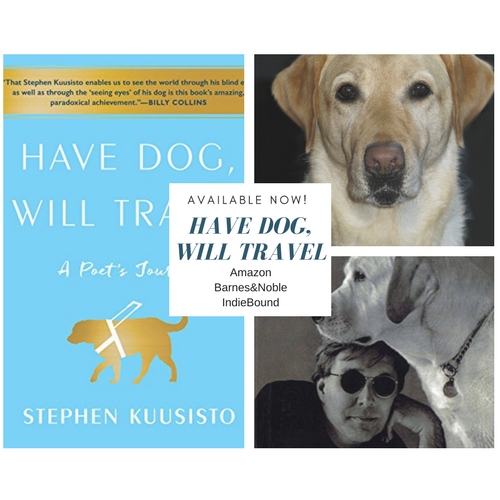
Have Dog, Will Travel: A Poet’s Journey is now available for pre-order:
Amazon
Barnes and Noble
IndieBound.org

Have Dog, Will Travel by Stephen Kuusisto

(Photo picturing the cover of Stephen Kuusisto’s new memoir “Have Dog, Will Travel” along with his former guide dogs Nira (top) and Corky, bottom.) Bottom photo by Marion Ettlinger 

Corporate Culture and Disability Employment, or Blueberries and Battleships….

While the GOP pushes its anti-unionist “right to work” narrative I think it’s high time the disabled steal the slogan. My global village remains unemployed. The right to work should be a matter of citizenship.

In their 2005 article “Corporate Culture and the Employment of Persons with Disabilities” Lisa Schur, Douglas Krusez and Peter Blanck raised a number of vital questions about business culture and disability: “What role does corporate culture play in the employment of people with disabilities? How does it facilitate or hinder their employment and promotional opportunities, and how can corporations develop supportive cultures that benefit people with disabilities, non-disabled employees, and the organization as a whole?”

(http://disability.law.uiowa.edu/lhpdc/publications/documents/BSL_JanFeb_2005/Corporate_culture.pdf)

One thing that really caught my eye in the article is this prodigious quote:

“When individuals with disabilities attempt to gain admittance to most organizational settings, it is as if a space ship lands in the corporate boardroom and little green men from Mars ask to be employed.”
—John, a 58-year-old employed man with paraplegia.

John, who I’ve not met, is my neighbor in the global village. If, like me, you’re disabled and have a job you’re automatically exceptional though the chances are good you’ll not feel that way. That is, once inside the workplace you’re still a little green man or woman. Meanwhile 6 out of 10 disabled people of working age remain jobless in the United States.

(https://www.brookings.edu/blog/the-avenue/2018/07/25/only-four-out-of-ten-working-age-adults-with-disabilities-are-employed/)

The Schur, Krusez and Blanck article highlights “the taken for granted beliefs” within corporate cultures:

“These ‘‘taken-for-granted beliefs’’ usually are unspoken and often unconscious. More formally, corporate culture at this level consists of a pattern of shared basic assumptions that the group learned as it solved its problems of external adaptation and internal integration, that has worked well enough to be considered valid and, therefore, to be taught to new members as the correct way to perceive, think, and feel in relation to those problems.”

The espoused values of the organization generally reflect what has worked in the past. Inviting green men and women into the community has not been a part of past practice.

**

Now the obstacles to change within organizations are considerable. Several years ago I came across a small pamphlet called Rejoicing in Diversity by Alan Weiss. The subtitle of the booklet was: “A Handbook for Managers on How to Accept and Embrace Diversity for Its Intrinsic Contribution to the Workplace”–-certainly a mouthful and perhaps not much of an advertisement. But I liked the word “rejoicing” and I also liked “intrinsic” for when you put these words side by side they speak of poetry. (The Chinese have two ideograms that stand together for poetry: a figure for “word” and a figure for “temple”). In any event, diversity in the workplace is seldom framed in ways that suggest spirit. Yet at the core of culture, spirit is all there is. Take away politics, real estate, the fighting over which end of the egg to crack and what you have left is the human wish for meaning. We tend to lose sight of this in Human Resources circles, substituting phrases like: Raising the Bar, Leadership, Assets, and the like. Talking about spirit is embarrassing. It’s like talking about the philosophers’ stone. Not even medieval historians feel comfortable talking about alchemy. You might look foolish. And we all know that the workplace should not be foolish.

I have advised many organizations on matters of disability and inclusion over the years. These opportunities came about because my first book of nonfiction was a bestseller and because for a time I was a senior administrator at one of the nation’s premier guide dog training schools. I had the opportunity to travel widely. Between 1995 and 2000 I visited 47 of the states in “the lower 48” and spoke at local, state, and federal agencies and public and private colleges. I have advised lots of blue chip organizations including the Museum of Modern Art in New York, the Metropolitan Museum, the Kennedy Center, even resorts and hotels. Inevitably, wherever I have spoken I’ve heard the rhetoric of middle management: “empowerment”; “equal opportunity”; “productivity”; “zero tolerance”; “bias”; “sensitivity” and the like.

There is nothing wrong with these terms but to paraphrase Bill Clinton there’s nothing right about them either. And this is because the terms have no alchemy in them. They’re just nouns. Not all nouns have spirit inside them. The word “battleship” has no spirit but the word “blueberry” does. One of the first things a poet has to learn is that not all nouns are obedient to the soul.

Well meaning organizations (and some that may not be so) rely on the rhetoric of inclusion without imagining the opportunities for soul–and I mean “soul” the way Marvin Gaye would mean it: its what’s goin’ on. The human soul is present everywhere whether management acknowledges it or not. By way of analogy one can think of management as playing “battleship” while the soul is picking berries. Human souls are looking for ways to be fed and to be happy; management is often trapped in brittle or arid pronouncements.

Alan Weiss wrote:

“I have had the rather unique experiences of providing comprehensive reports to top-level executives on the acceptance of diversity in the workplace, only to have them shout, wide-eyed, “That’s not my company you’re describing!” Yet the feedback has been based on extensive focus group and survey work. Who’s wrong?

No one is wrong. What’s happened is that the respondents have reported what they are actually experiencing, I’ve conveyed that feedback accurately, and the executives are using their own intent and strategy as their frame of reference. The psychologists would call it cognitive dissonance–fully expecting one set of circumstances, while experiencing quite another.

The phenomenon at work is what I call the “thermal layer,” which is a management layer capable of distorting communications and directives it receives, turning them into something quite different. Managers in the thermal layer are the ones who actually control resources, make daily decisions and deal with the customer. They often have strong vested interests in preserving the status quo…think they have a better way of doing things, don’t trust senior management, don’t buy-into the strategy or, for whatever reasons, have some agenda of their own. “

Alan Weiss has perfectly described the breakdown that most often creates obstacles to true diversity and inclusion–or to use the language of the soul, communal berry tasting and picking.

For many years I’ve been asking folks at the universities where I’ve taught to take ownership of disability and accessibility and I have found a deeply invested thermal layer–a phenomenon I like to call the “Campus Rope-a-Dope” to borrow from Mr. Ali. The Campus Rope-a-Dope takes advantage of highly silo-ed administrative hierarchies to in effect pass the buck where disability and accessibility are concerned. Let’s be clear: no one wants to be identified as being part of the thermal layer just as no faculty member wants to be outed for being “dead wood”–and let’s also be clear that the person who persists in calling for blueberries when everyone else wants to talk about battleships will eventually be the victim of considerable distortion.

Alan Weiss again:

“Organizations seldom if ever fail in their intent, executive direction or strategy formulation. They fail in the execution and implementation of their initiatives. Nowhere is that more true than in the accommodation of diversity.”

For my own part I’ve called for universities to provide accessible bathrooms in buildings where I’ve taught. The struggles were astonishing. At the level of departmental administration, no one knows who’s in charge of these matters. That’s because the thermal layer is in charge. And the T.L. has a hundred silos. It also has committees.

I was once upbraided at the University of Iowa by someone from the human resources department. I’d been calling for the installation of assistive technology in the classrooms where I’d been teaching for over three years. The lack of compliance and communication around the issue had been comical and my method of handling it had been to bring my own talking laptop into each classroom and manfully wired it to the projection system–sometimes this worked and sometimes it didn’t. My every teaching experience was therefore a kind of gamble. No one was in charge. How was I upbraided? I was told that by calling attention to my difficulties with assistive technology compliance I’d done considerable damage to my reputation with the committee that handled disability issues–the point being that I’d apparently not gone through the proper channels in my requests for accommodations. This is how the thermal layer works. The thermal layer likes to deflect by distortion. And there were no proper channels.

Alan Weiss:

“How could anyone oppose an accommodating, equal-opportunity workplace?”

“Well, we know that some people can, sometimes with malicious motives, sometimes with prejudicial judgment, and sometimes because they perceive themselves to be adversely affected by the policies. You must be constantly on the watch for thermal zone reactions and distortions. If there’s a policy or value which causes conflict in the workplace, bring it to the surface and discuss openly. If there are misconceptions about policies, resolve them. The failure to do this doesn’t make the policies go away, it simply preserves the thermal layer until, like the executives above, the key decision makers get some shocking news. The reaction to that is usually worse than any other alternative, because senior management will try to legislate change rather than help people to embrace it.”

This brings us back to blueberries vs. battleships. The spirit of diversity vs. the demeaning of diversity initiatives through the employment of thermal language.

Because no one is really in charge when it comes to planning and implementation all disability accommodations are treated reactively and not proactively.

**

Workplace culture is a misnomer. Workplaces are generally affected by habits, old ones, and the thermal layer is where old patterns reside.

The green men and women are afterthoughts.

Stephen Kuusisto and HarleyABOUT: Stephen Kuusisto is the author of the memoirs Have Dog, Will Travel; Planet of the Blind (a New York Times “Notable Book of the Year”); and Eavesdropping: A Memoir of Blindness and Listening and of the poetry collections Only Bread, Only Light and Letters to Borges. A graduate of the Iowa Writer’s Workshop and a Fulbright Scholar, he has taught at the University of Iowa, Hobart and William Smith Colleges, and Ohio State University. He currently teaches at Syracuse University where he holds a University Professorship in Disability Studies. He is a frequent speaker in the US and abroad. His website is StephenKuusisto.com.

Have Dog, Will Travel: A Poet’s Journey is now available for pre-order:
Amazon
Barnes and Noble
IndieBound.org

Have Dog, Will Travel by Stephen Kuusisto

(Photo picturing the cover of Stephen Kuusisto’s new memoir “Have Dog, Will Travel” along with his former guide dogs Nira (top) and Corky, bottom.) Bottom photo by Marion Ettlinger 

Planksip

I begin. You also. And the cat.
The book on the table.
Multifaceted glass samovar.
It was the best of times.
Werner Heisenberg:
“Revere those things
beyond science which really matter
and about which
it is so difficult to speak.”
You have permission to laugh.
Poetry and science agree:
“There are things that are so serious
that you can only joke about them.”
Beginning. See the absurd dancing.

Who Are the Blind Poets? Hmmmm.

A friend asked me “who are the blind poets other than Milton, Homer, and Borges?” The question is interesting because it assumes blindness is static and cleanly historic in a biographical sense. At the moment he asked I made a joke and said there’s me. And I mentioned Dan Simpson a blind poet in Philadelphia who is supremely talented. But the question evades its precise answer. Samuel Johnson was blind; James Joyce was also. We don’t think of them this way. Why not?

Dr. Johnson had several disabilities—he was tourettic, had seizures, was legally blind (though the term didn’t exist in his day) and prone to severe bouts of depression. Like me, he could remember everything he read for the pain of reading was profound and you better get it right the first time. This is what made him the right man to craft the first English dictionary. Moreover, when he attended a theatrical production, though he couldn’t see the stage, he remembered every syllable.

Joyce’s eyes were a source of lifelong agony:

“Worsening inexorably over his lifespan of sixty years, the eyes of Joyce were the main source of his misery. It was a feat of preternatural breadth, his undertaking of literary labours via a shroud of painful blindness. Joyce’s struggle with his eyes led him to naming his daughter Lucia, after St Lucia, patron saint of the blind. A scrutiny of him as a young man attests to his longsightedness – his glasses magnify the Irish-blue eyes. The wearing of such spectacles is notable because it reveals that Joyce had eyes of a crowded shape : anatomy which increases the risk of high pressure developing in the eyeball. Ordeals of the ophthalmic type began in youth, but inflammation in Joyce’s eyes (rather than pressure) was the initiator of his sufferings in 1907.”

This is of particular interest:

“Oculists were consulted to assuage the agony. But those attending to him could not acceptably douse the flames. To curb the flammatory pain from his eyes the doctors injected Joyce with arsenic and phosphorus. Since these dosings were inefficacious they would apply a fistful of leeches to his scalp. Ill-advisedly, he had his teeth extracted, on the strength of some advice which ascribed his ocular ills to the bacteria in his mouth. Surgery of the eye was performed and the series between 1917 to 1930 comprised iridectomies, sphincterotomy, capsulectomy, and a removal of cataracts.”

By the time Joyce wrote Ulysses he had ten percent vision in one eye and none in the other.
He carried a cane, not because he was a dandy but because he was afraid of obstacles and dogs.

**

Again one has to ask why aren’t Dr. Johnson and James Joyce understood as being great blind writers?

Performativity comes to mind—Borges was lead around by a sighted guide. Milton was read to by his daughters. These are accepted blind representations. That Joyce traveled and Johnson rambled the dark streets with disreputable friends doesn’t fit the trope of the helpless blind.

As of this morning, this is my answer.

For the full article on Joyce’s eyes see:

https://www.bmj.com/content/343/bmj.d7464/rr-0

Stephen Kuusisto and HarleyABOUT: Stephen Kuusisto is the author of the memoirs Have Dog, Will Travel; Planet of the Blind (a New York Times “Notable Book of the Year”); and Eavesdropping: A Memoir of Blindness and Listening and of the poetry collections Only Bread, Only Light and Letters to Borges. A graduate of the Iowa Writer’s Workshop and a Fulbright Scholar, he has taught at the University of Iowa, Hobart and William Smith Colleges, and Ohio State University. He currently teaches at Syracuse University where he holds a University Professorship in Disability Studies. He is a frequent speaker in the US and abroad. His website is StephenKuusisto.com.

Have Dog, Will Travel: A Poet’s Journey is now available for pre-order:
Amazon
Barnes and Noble
IndieBound.org

Have Dog, Will Travel by Stephen Kuusisto

(Photo picturing the cover of Stephen Kuusisto’s new memoir “Have Dog, Will Travel” along with his former guide dogs Nira (top) and Corky, bottom.) Bottom photo by Marion Ettlinger 

Not a Data Guy

Last night my sister called because a helicopter crashed two blocks from my Manhattan hotel. In the way of all sub-Cartesian people, I professed my ignorance. I’d been reading with my noise canceling headphones. I was deep in the 18th century. Outside with my guide dog I found myself surrounded by emergency vehicles. And this is the thing: there was a tremendous sense of calm. Rain was coming down quite heavily. Sky scrapers were wrapped in mist. Somehow people understood this wasn’t terrorism. I don’t know how to describe the scene but there was a strange proficiency in evidence.

Back in my room I wondered about the evident calm. Could America perhaps recover from various traumas? Is it possible that after Trump the nation will become more seasoned and tolerant? Can one take a street scene for augury?

This is the primary manner of my naïveté. Hopeful extrapolation. I’m not primarily a “data guy” and I’ll hazard most poets are like me in this regard.

In the hotel’s enormous lobby two little boys had a game of tag.

Stephen Kuusisto and HarleyABOUT: Stephen Kuusisto is the author of the memoirs Have Dog, Will Travel; Planet of the Blind (a New York Times “Notable Book of the Year”); and Eavesdropping: A Memoir of Blindness and Listening and of the poetry collections Only Bread, Only Light and Letters to Borges. A graduate of the Iowa Writer’s Workshop and a Fulbright Scholar, he has taught at the University of Iowa, Hobart and William Smith Colleges, and Ohio State University. He currently teaches at Syracuse University where he holds a University Professorship in Disability Studies. He is a frequent speaker in the US and abroad. His website is StephenKuusisto.com.

Have Dog, Will Travel: A Poet’s Journey is now available for pre-order:
Amazon
Barnes and Noble
IndieBound.org

Have Dog, Will Travel by Stephen Kuusisto

(Photo picturing the cover of Stephen Kuusisto’s new memoir “Have Dog, Will Travel” along with his former guide dogs Nira (top) and Corky, bottom.) Bottom photo by Marion Ettlinger 

Beside My Childhood’s River

This is not a ghazal but it has birds and loss,
Down on the sand flats is where I am.

Sixty years ago my father dropped
A sand dollar into my hand—

Blind kid in light so vast
There must have been gods—

Egyptian curls you could read
On thin skin, first Braille.

This is not a ghazal but it has birds and loss,
Down on the sand flats after years

The old folks gone, the river
Crowded with houses,

Rich men’s houses painted red
Two cormorants calling

Morning notebook, June 7

Now and then is the problem…

You can’t go home with it
Philosophy is weak
When it comes to “here”
Where trees blossom
Sunlight, early
Between apple branches

**

Call me Ishmael
But not today

**

Unscrew the locks from your doors
So Old Walt can sneak in
And steal your perfume

**

As for me

**

Diderot’s kings
Strangled with entrails
Of priests—
So much fun
Being rational!

**

Nowadays the poets and priests
Aren’t having much joy
What with kicking the fire hydrants

**

Now and then
Now and then
How easy it is
To say it out loud

Stephen Kuusisto and HarleyABOUT: Stephen Kuusisto is the author of the memoirs Have Dog, Will Travel; Planet of the Blind (a New York Times “Notable Book of the Year”); and Eavesdropping: A Memoir of Blindness and Listening and of the poetry collections Only Bread, Only Light and Letters to Borges. A graduate of the Iowa Writer’s Workshop and a Fulbright Scholar, he has taught at the University of Iowa, Hobart and William Smith Colleges, and Ohio State University. He currently teaches at Syracuse University where he holds a University Professorship in Disability Studies. He is a frequent speaker in the US and abroad. His website is StephenKuusisto.com.

Have Dog, Will Travel: A Poet’s Journey is now available for pre-order:
Amazon
Barnes and Noble
IndieBound.org

Have Dog, Will Travel by Stephen Kuusisto

(Photo picturing the cover of Stephen Kuusisto’s new memoir “Have Dog, Will Travel” along with his former guide dogs Nira (top) and Corky, bottom.) Bottom photo by Marion Ettlinger 

Disability and the Idee Fix

It’s easy but dangerous to confuse social facts with social ideas. Disability for instance is a societal arrangement driven by medicine and when physically arrested humans can’t be cured they become an idea—one might say an idee fix. I’m asked all the time if there’s a better term for disability and my response is to say the disabled should be called “citizens” for this marks the problem with the confusion named above. All physical differences are merely notional. Turn this on its head so to speak and you discover the steepness of disability is no more probable than other notoriously social ideas—childhood comes to mind—before the Enlightenment children were nonexistent.

I’ve recently been traveling to places where disabled children are not customarily included in the mainstream. They are kept apart which means they will have conditional citizenship. They are branded as non-productive which is again the confusion of social fact with idea. One is forced to ask why there’s so little imagination going around—the idee fix is one great big muscle of confusion. Part of the problem is that in much of the world childhood is believed to be a matter of prospect. The child is a unit of probable production and so probability enters the idee fix—disability is presumed to be devoid of growth. its chilling when you see it.

What can we do about the broad confusion of disability and insignificance? This is a grass roots question.

Stephen Kuusisto and HarleyABOUT: Stephen Kuusisto is the author of the memoirs Have Dog, Will Travel; Planet of the Blind (a New York Times “Notable Book of the Year”); and Eavesdropping: A Memoir of Blindness and Listening and of the poetry collections Only Bread, Only Light and Letters to Borges. A graduate of the Iowa Writer’s Workshop and a Fulbright Scholar, he has taught at the University of Iowa, Hobart and William Smith Colleges, and Ohio State University. He currently teaches at Syracuse University where he holds a University Professorship in Disability Studies. He is a frequent speaker in the US and abroad. His website is StephenKuusisto.com.

Have Dog, Will Travel: A Poet’s Journey is now available for pre-order:
Amazon
Barnes and Noble
IndieBound.org

Have Dog, Will Travel by Stephen Kuusisto

(Photo picturing the cover of Stephen Kuusisto’s new memoir “Have Dog, Will Travel” along with his former guide dogs Nira (top) and Corky, bottom.) Bottom photo by Marion Ettlinger