Last Night in L.A.

I was fortunate to be interviewed last evening by Louise Steinman at the Mark Taper Auditorium of the Los Angeles Public Library. Years ago when I was a little bit lonesome and watching “Larry King Live”–an uncharacteristic thing–I heard Paul Newman explain that he owed his entire acting career to luck. I thought of him as I sat on stage with Louise and explained my life in poetry, non-fiction writing, and civil rights work. What luck to be there in that room–how it might have been otherwise–how good people have entered my life and given me opportunities and hope. (That was Newman’s story. He shared how he was an understudy in a Tennessee Williams play on Broadway when the headlining actor fell ill. He stepped in. His career took off.) Newman never forgot that there were many other actors and actresses in his circle who had talent and never got a break. Sitting alone before my TV I wanted to hug the man for his humility.

Louise asked me about writing, trust, love, spiritual life, and we spoke about empathy and human rights. Suddenly I said: “Everyone deserves dignity and happiness.” Simple enough, right? But let’s talk about the politics of health and the necessary recognition that most human advancement has more to do with luck than Americans commonly suppose.

Many contemporary literary writers who achieve more than passing success imagine they got “there” by talent. It’s a hard position to argue against. Writing good poetry or prose requires skill to be sure–but there’s a shadow in the room like Poe’s raven, (picture wing shadows on the wall) and that’s the specter of fortune.

I know many writers of equal or greater talent than I who’ve not had the middling success I’ve enjoyed. That was the source of Paul Newman’s drive toward charity work. He saw his career as a matter of happenstance as much as anything else. I’m with him on this. I’m not gilding the Lilly of modesty. I believe what I’m saying. I wish more creative writers shared this position.

Of course I can write. Blue curtains sway above my sleep. A dream turtle drifts from under the dock and sparkles like an emerald in the unconscious. I discovered Carl Jung’s work when I was an anorexic, blind, desperately unhappy teenager. I saw how dream life is substantial and true. That was the year I found the poetry of Kenneth Rexroth. The year I took the eucharist and began eating.

Luck is the bread we break then share. You needn’t be Christian to know it.

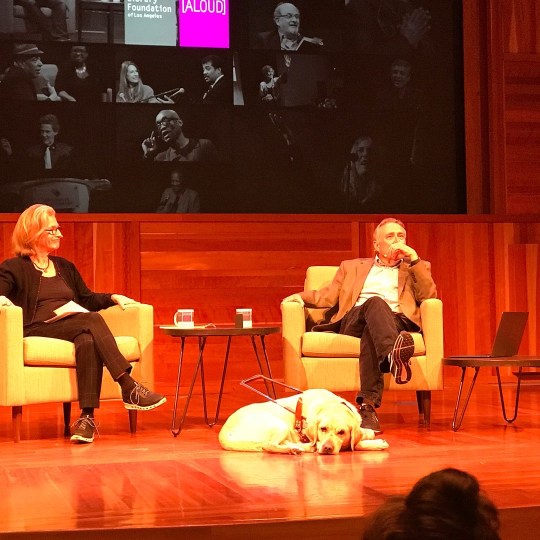
My friend Elizabeth Aquino took this photo of Louise and I and guide dog Caitlyn at last night’s event. It was an evening of luck and emotive food to be sure:

IMG 0334

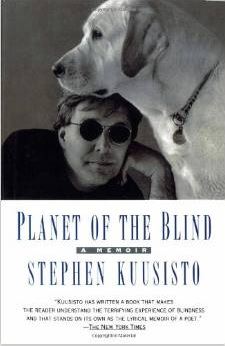
Stephen Kuusisto and HarleyABOUT: Stephen Kuusisto is the author of the memoirs Have Dog, Will Travel; Planet of the Blind (a New York Times “Notable Book of the Year”); and Eavesdropping: A Memoir of Blindness and Listening and of the poetry collections Only Bread, Only Light and Letters to Borges. A graduate of the Iowa Writer’s Workshop and a Fulbright Scholar, he has taught at the University of Iowa, Hobart and William Smith Colleges, and Ohio State University. He currently teaches at Syracuse University where he holds a University Professorship in Disability Studies. He is a frequent speaker in the US and abroad. His website is StephenKuusisto.com.

Have Dog, Will Travel: A Poet’s Journey is now available for pre-order:
Amazon
Barnes and Noble
IndieBound.org

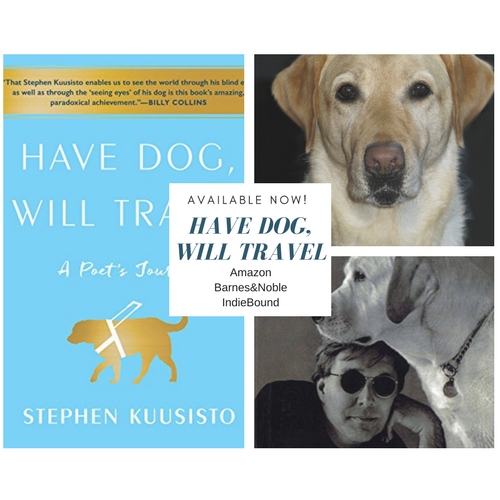
Have Dog, Will Travel by Stephen Kuusisto

(Photo picturing the cover of Stephen Kuusisto’s new memoir “Have Dog, Will Travel” along with his former guide dogs Nira (top) and Corky, bottom.) Bottom photo by Marion Ettlinger 

Doggish Notes from California

No blogger likes to vanish unless it’s a matter of wild fortune–winning the lottery or being abducted by cuddly, literate aliens–in my case neither of which has occurred though I’m immoderately happy on the “left coast” of the USA where I’ve been on a ten day book tour.

The very phrase “book tour” sounds overblown and it is. Forgive me. This really isn’t a book tour. Publishers don’t pay for authors to fly about and speak unless they’re more than passing famous (which I’m not) or they’re media figures (which I’m not) or maybe they’ve done something intolerable and are hitting the come back trail (Pee Wee Herman?).

No I think it’s best to say I’m on a dog tour with a book in hand. The book is mine, the dog is her own creature and we’ve been with friends both old and new. Good fortune. Let it be said. The dog and man are having charmed lives.

Here for instance is a photograph of me reading from the book in hand at Romeo Vineyards in Calistoga, California just three days ago:

IMG 0533

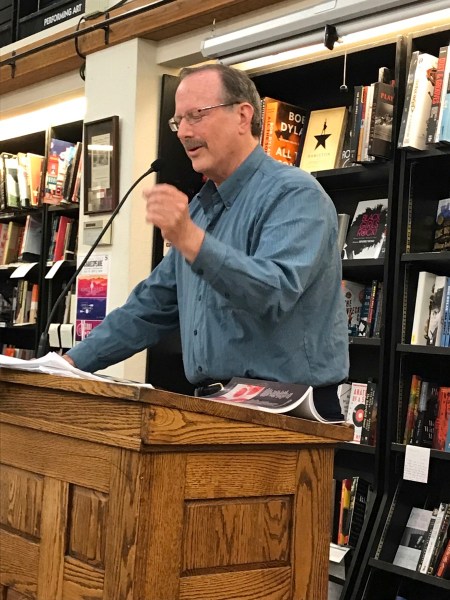
Thanks to Emma Blatcher of Romeo Vineyards for hosting us. “Us” meaning Dog and Man but also my dear friends Ken Weisner and Becky Roberts from Santa Cruz. Ken is a poet, teacher, scholar, French Horn player, and my pal these past 40 years. Here’s a photo of Ken reading his poems at Bookshop Santa Cruz just this past week–an event he made possible and yes, I followed his poetic lead and read from my dog book.

Image 5 23 18 at 8 22 AM

I first met Ken Weisner in Iowa City in 1978. We were graduate students together, baby poets if you will, (there should be a word for baby poets–something Russian perhaps like “Sputnik”) but terminology aside we hit it off for we both loved classical music, Pablo Neruda, baseball, and complicated jokes.

As I recall, the first joke I ever told Ken involved a rebarbative and scatological piano teacher who instructed his pupil to defecate every time he hit a wrong note. The punch line was: “Good thing I didn’t shit in the piano!”

I offer the above as an example of Ken’s decency, for he befriended me despite this and we’ve been baby poets together, than stripling poets, and now we are entering the phase of life and art one may call “caducity” and there’s no help for it. And no, my jokes are no better these days.

Here’s a photograph of yours truly reading just after Ken. I’m describing how I had to walk with a woman guide dog trainer who was wearing a dog harness–an early stage of guide dog training. That exercise was loony (though perhaps necessary):

Image1

After visiting Calistoga Ken and Becky drove me to San Rafael through lush countryside. And I had the great fortune to spend some time with my old friend Michael Meteyer and his wife Kate Byrnes. They are long time friends of the blind and their home overlooks a thrilling bird estuary and there should be a word also for speaking both human and bird language for I’m convinced Michael can do this as all the local birds adore him and why not? He’s a man with a Zen heart who actually does help old ladies across streets. He also took me to visit Guide Dogs for the Blind, the famous local guide dog training center. Here’s a photo of yours truly and guide dog Caitlyn posing by their lobby sign:

Image 5 23 18 at 8 49 AM

(I love visiting guide dog schools. I’ve had the good fortune to visit schools in Japan, Finland, the UK, and at various locations in the US.)

As I write this morning I’m in Los Angeles where tonight I will speak at the Mark Taper Auditorium at the Central Library.

My doggish life has been rich, often filled with joy, many times more lucky than my morning imagination supposes. The morning imagination is like Wallace Stevens who once said the “world is ugly and the people are sad”–which may be true enough, but then again, just walking, taking in the air as a living circus (my own words from an old book) is what the world is for.

Connie Kuusisto :
Stephen Kuusisto and HarleyABOUT: Stephen Kuusisto is the author of the memoirs Have Dog, Will Travel; Planet of the Blind (a New York Times “Notable Book of the Year”); and Eavesdropping: A Memoir of Blindness and Listening and of the poetry collections Only Bread, Only Light and Letters to Borges. A graduate of the Iowa Writer’s Workshop and a Fulbright Scholar, he has taught at the University of Iowa, Hobart and William Smith Colleges, and Ohio State University. He currently teaches at Syracuse University where he holds a University Professorship in Disability Studies. He is a frequent speaker in the US and abroad. His website is StephenKuusisto.com.

Have Dog, Will Travel: A Poet’s Journey is now available for pre-order:
Amazon
Barnes and Noble
IndieBound.org

Have Dog, Will Travel by Stephen Kuusisto

(Photo picturing the cover of Stephen Kuusisto’s new memoir “Have Dog, Will Travel” along with his former guide dogs Nira (top) and Corky, bottom.) Bottom photo by Marion Ettlinger 

Why Donald Trump Can’t Have “This”

I am a small “R” romantic and I’ve a few mottos I live by and more than a few I’ve given up. Of the first, my favorite is: only talk to trees that talk “back” and I’m firm about it. No Ariel, no yakkity yak. And I do talk to trees. It’s a Finnish thing. I even know a banker in Helsinki who talks daily to a birch. (He also talks to stones.)

Concerning the small “r” I’m more of Coleridge than Wordsworth. I don’t think we achieve tranquility. We can only imagine it. Buddha had the strongest imagination in history. John Keats may have been second.

Donald Trump destroys trees, rivers, mountains, waterways—kills wildlife, harms the vulnerable in every quarter. Against this my “r” is infinitesimally small.

I’m animated by the minuscule nature of my “r” for I’ve William Blake on my side. My grain of sand is ineluctable.

Because I know what is true I am healthy. Strong. Flexible. Loving.

Samuel Taylor Coleridge: “He is the best physician who is the most ingenious inspirer of hope.”

Coleridge: “Poetry has been to me its own exceeding great reward; it has given me the habit of wishing to discover the good and beautiful in all that meets and surrounds me.”

If this sounds like “paper wraps stone” (and it does) one has already given away phenomenology, has bartered it if for meager coins—the junk bonds of aspirational happiness. My students want instant careers. Deep in debt, terrified for their futures, they’ve little time for Coleridge’s “exceeding great reward.”

My banker friend in Finland talks to a certain tree on his way to work.

Stephen Kuusisto and HarleyABOUT: Stephen Kuusisto is the author of the memoirs Have Dog, Will Travel; Planet of the Blind (a New York Times “Notable Book of the Year”); and Eavesdropping: A Memoir of Blindness and Listening and of the poetry collections Only Bread, Only Light and Letters to Borges. A graduate of the Iowa Writer’s Workshop and a Fulbright Scholar, he has taught at the University of Iowa, Hobart and William Smith Colleges, and Ohio State University. He currently teaches at Syracuse University where he holds a University Professorship in Disability Studies. He is a frequent speaker in the US and abroad. His website is StephenKuusisto.com.

Have Dog, Will Travel: A Poet’s Journey is now available for pre-order:
Amazon
Barnes and Noble
IndieBound.org

Have Dog, Will Travel by Stephen Kuusisto

(Photo picturing the cover of Stephen Kuusisto’s new memoir “Have Dog, Will Travel” along with his former guide dogs Nira (top) and Corky, bottom.) Bottom photo by Marion Ettlinger 

Lines Written in the Algonquin Hotel

I’m in New York for a gala.
I wonder what this means.
I’m not feeling like a “gala”—
Something something
What’s the phrase?

“Gala” from Arabic
A festive robe
Given in presentation.
Do we need more robes?
Do the saints have galas?

How about whales
Or children everywhere?
O I fear I’m the toothache
Of the gala set,
Unceremonious, twiggy.

**

I must get in the mood!
First I should admit my consciousness is an instinct, nothing more seeking shelter in a rain storm. O but all the smart people like getting wet! And that’s my difficulty. I fear smart moist people.

**

Oh c’mon Kuusisto, everyone needs a dance, a rouse, a collective giggle.
BTW I dreamt last night my father was back from the dead and doing standup comedy.

nie Kuusisto :
Stephen Kuusisto and HarleyABOUT: Stephen Kuusisto is the author of the memoirs Have Dog, Will Travel; Planet of the Blind (a New York Times “Notable Book of the Year”); and Eavesdropping: A Memoir of Blindness and Listening and of the poetry collections Only Bread, Only Light and Letters to Borges. A graduate of the Iowa Writer’s Workshop and a Fulbright Scholar, he has taught at the University of Iowa, Hobart and William Smith Colleges, and Ohio State University. He currently teaches at Syracuse University where he holds a University Professorship in Disability Studies. He is a frequent speaker in the US and abroad. His website is StephenKuusisto.com.

Have Dog, Will Travel: A Poet’s Journey is now available for pre-order:
Amazon
Barnes and Noble
IndieBound.org

Have Dog, Will Travel by Stephen Kuusisto

(Photo picturing the cover of Stephen Kuusisto’s new memoir “Have Dog, Will Travel” along with his former guide dogs Nira (top) and Corky, bottom.) Bottom photo by Marion Ettlinger 

The Ableist Shrug at Licorice University

Ableism: I’m the problem. I didn’t get cured. Didn’t stand up. Couldn’t read the books with my peepers. “Jeepers Creepers, where’d you get those peepers?” 

Good eyes are productive, produce results; bad eyes, get cured baby! 

Ableism: a term no one likes. Like licorice. (No one really likes licorice. Studies have shown this to be true.) 

What if I substitute “licorice” for ableism? Would it be easier to talk about? 

Licorice: a set of beliefs that hold everyone must like licorice. All licorice eaters are equal but some are more equal than others. If you don’t favor Glycyrrhiza glabra you can’t sit at the table. The great big licorice table. 

Note: too much licorice will poison animals and humans. But that doesn’t mean there aren’t whole cities of licorice. 

Side note; when I was a boy in Finland, licorice candies were sold in bite sized pieces, wrapped in wax paper featuring a cartoon of a little black child. 

Licorice is not innocence. 

Ableism: a predominant belief that discrimination against the disabled is just a matter of innocence. E.g. “We really care about disabled people. What’s that? You can’t get basic accommodations? Oh dear. That MUST be awful! I’m sorry you feel that way!”

Ableism: the disabled have ungoverned feelings. That’s their problem. Really. It is their problem not ours. 

I call the example just above “the ableist shrug”—universities are especially good at this. 

Back to licorice: “So Billy, you don’t like licorice? Then you can’t be in our club house!”

Ableism is infantile. 

The shrug is privilege. It’s not convenient to think about those people today. Perhaps we will get to them tomorrow. 

I’m sorry you feel that way.

Candy can represent hegemony. Finnish candy. 

The shrug: we are good people. We care about you. But your accommodation is way down on our list of priorities, because, well, how do I say this? You’re not in our budget. Not in our plans, not convenient, yes, that’s it! You’re really really really not convenient. We love convenience here at Licorice University. We may talk big about being the best! Frankly, business as usual is just fine. We especially like the Licorice Clubhouse. 

Shrug:  the word comes from Late Middle English and it originally meant “to fidget”—and fidget is an early Modern English word meaning “uneasy”—the shrug, the licorice ableist shrug signifies that disability makes the ableist both uneasy and vexed. Having to think about disability is nettlesome. 

When the disabled bring up their problems—lack of access to buildings, bathrooms, educational materials, transportation, zero dignity in the village square, the shrug works this way: 

  • We personalize the problem. 
  • It’s the disabled person’s difficulty not ours.
  • All disabled people are just failed medical patients. 
  • If you can’t be cured, you’re a failure as a human being.
  • While the disabled are talking, we look at our iPhones.
  • We all know there’s something wrong with the disabled, it’s below the surface, like icebergs.
  • You can’t see it, but below the waterline they’ve got bad attitudes. 
  • If the disabled just had better attitudes. 
  • When the disabled say, “we really hate it here” you say: “I’m sorry you feel that way.”
  • Which means the problems are not about accessibility and inclusion but all about the individualized disabled person.

If you were the right kind of disabled, (Tiny Tim for example) you’d be grateful for the little we’ve given you. “I know it’s a dinky crutch, hand made by your impoverished father, but it’s yours Tiny. It’s yours!”


Stephen Kuusisto and HarleyABOUT: Stephen Kuusisto is the author of the memoirs Have Dog, Will Travel; Planet of the Blind (a New York Times “Notable Book of the Year”); and Eavesdropping: A Memoir of Blindness and Listening and of the poetry collections Only Bread, Only Light and Letters to Borges. A graduate of the Iowa Writer’s Workshop and a Fulbright Scholar, he has taught at the University of Iowa, Hobart and William Smith Colleges, and Ohio State University. He currently teaches at Syracuse University where he holds a University Professorship in Disability Studies. He is a frequent speaker in the US and abroad. His website is StephenKuusisto.com.

Have Dog, Will Travel: A Poet’s Journey is now available for pre-order:
Amazon
Barnes and Noble
IndieBound.org

Have Dog, Will Travel by Stephen Kuusisto

(Photo picturing the cover of Stephen Kuusisto’s new memoir “Have Dog, Will Travel” along with his former guide dogs Nira (top) and Corky, bottom.) Bottom photo by Marion Ettlinger 

Ableism in the Academy–It’s What’s For Breakfast

Ableism is akin to racism or homophobia but with one difference: the assumption that physically challenged bodies are “someone else’s issue” remains largely unexamined outside academic or activist circles within disability communities.   

—Stephen Kuusisto, before his first cup of coffee

You can’t include the disabled in whatever is meant by “diversity” until the problem above is addressed. 

—Kuusisto after his second cup of coffee  

That the disabled belong in special offices, sequestered environments, is a a hangover from the 19th century. Just as people of color or women still experience cruel 19th century headaches, the disabled do also. The academy taught racial separation, “the White Man’s Burden”, eugenics, and promoted the medical and psychological inferiority of women and people of color throughout the 1800’s and long into the 20th century. The hierarchies of post-secondary-education in the U.S. remain in an amnesiac state—you see, I’ve even chosen an ableist metaphor to make the point. Where disability is concerned, college administrators see no reason to address the structural dynamics of outworn and damaging ideas—after all disability is about accommodations and doesn’t a special office take care of that?

—Kuusisto after a bowl of oatmeal

 The last sentence above is always spoken by the able bodied. The disabled don’t say this. They say “we’re part of the village now.” 

The able bodied say, “you’re part of the village only insofar as it’s convenient. Go to your special office.”

—K after walking his dog

 Loose Notes:

  • The special office is always in an out of the way location. 
  • The special office is always understaffed.
  • The S.O. gives faculty and administration permission to think “the disabled” (who are really cash paying students—your sister, your friend, your neighbor….) are a complicated problem, requiring sequestered and specialized “treatment”.
  • This is an outworn model for disability engagement. 
  • Faculty and staff need to be brought into the 21st century where disability is concerned. 
  • This cannot be accomplished if able bodied faculty, staff, and administration cannot confront the legacies of ableist thinking. 
  • No one likes to be called ableist. Just as some white people hate to be called out for white privilege and say, “but I have a black friend”—thereby proving their privilege—ableists are fond of saying “I CARE about disability”—which  often means, “I want to change the subject.”
  • This is what I like to call the ableist shrug. If the able bodied believe themselves progressive but fail to assist the disabled when they experience obstacles, then they’re extending ableism. 


—Kuusisto after a shower 

Structural Inequality at Syracuse Can Change….

Things are going badly at my university where diversity is concerned. In fact this is an understatement. The racist, ableist, homophobic, misogynistic videos from a fraternity party are chilling. Syracuse U didn’t make these videos happen; didn’t instruct fraternity boys to unleash hatred. I give the university a pass on coercion. Yet our civic space, or “agora” has long been exclusionary, toxic, and even cruel to historically marginalized students, staff, and faculty. 

Right now there’s a lot of talk about systematic change. Committees are being called. Grievance meetings are being held. They are good first steps. 

Syracuse University cannot succeed unless her administrators, staff, students and faculty have a collective and shared intellectual experience that examines bigotry in all its institutional and hegemonic ways. 

Disabled as I am, I have seen first hand how senior administrators have shrugged their shoulders when told that accommodations and access for disabled students, staff, visitors, and faculty are not easy to obtain and are often lacking altogether. 

This isn’t a new experience for me. I’ve been teaching here for 7 years and have been ignored for much of that time. Course management software not accessible? Thanks for telling us Prof. K. Ho Hum. You know of a student who failed a course because she didn’t get note taking accommodations in a timely way? Thanks for telling us Prof. K. Ho Hum. What? You can’t get access to teaching materials in accessible formats? Thanks again. Ho Ho Hum. 

7 years is a long long time to be waiting for action. Now, because of the horrid videos mentioned above the university is talking about changing its culture. 

My argument, such as it is, is that ableism is rife in the academy. Most scholars believe that education is a race and it goes to the fittest. They believe disabled people are only on campus because of the sufferance imposed by disability rights laws. How many students have come to me over the last few years sharing tales of faculty who don’t want to provide them with reasonable accommodations—extra time on tests, the ability to record lectures because they’re blind, sneering at them because owing to autism they wear noise reduction headphones in class—the list of faculty misdeeds is a long one. Then there are the senior administrators, deans, provosts, associate vice presidents, who think disability accommodations are best left to a later day. Who say to themselves, “We’ll get to that next year.” Who believe disabled students and faculty are malcontents. I know because I’ve been labeled as such. 

Ableism is built into the very buttresses of higher education. Higher Ed is a seat of privilege, merit, exceptionalism; it’s a race that goes to the swift; maybe the good looking; if you need any kind off academic help you shouldn’t be here. Unless you’re a star athlete of course. Ho Hum. I mention the athletic support system not to denigrate it, but to point out that the cost of helping disabled students isn’t the real issue—ableism assures us that the appearance of helping the disabled presents the image of a college or university with undeserving students. 

I’m not wrong about this. In his new book Academic Ableism: Disability and Higher Education Jay Dolmage writes: “basically, academia exhibits and perpetuates a form of structural ableism.”Then he adds, and I think this is key: 

“I borrow to a certain degree from the notion of structural racism, defined by the Aspen Institute as follows:

A system in which public policies, institutional practices, cultural representations, and other norms work in various, often reinforcing ways to perpetuate racial group inequity. It identifies dimensions of our history and culture that have allowed privileges associated with “whiteness” and disadvantages associated with “color” to endure and adapt over time. Structural racism is not something that a few people or institutions choose to practice. Instead it has been a feature of the social, economic and political systems in which we all exist. (n.p.)

Likewise, ableism has to be seen as a series of entrenched structures—not just the action of an individual or of individuals. We have to understand that because of these pervasive structures, we live in a society that resists efforts to ameliorate or get rid of ableism. As scholar and activist Daniel Freeman writes, “Able-bodied people all have things that they fall short with, skills or tasks that they will never master. But when disabled folks say, ‘These are the things I need in order to do my very best,’ it is labeled as an ‘accommodation.’ . . . The language itself is ableist in nature, bringing into focus the reality of how disabled bodies are seen as barriers to able-bodied life” (n.p.). Accommodation is thought of as something that always needs to be created, something that has a cost. ”

Excerpt From: Jay Dolmage. “Academic Ableism: Disability and Higher Education.” iBooks. 

Until the administration at Syracuse understands the structural dynamics of intersectional and pervasive delimitation the problems experienced by people who hail form historically marginalized backgrounds will persist. Let us point out that disabled students and all other minority students are paying for the opportunity to get an education. Or as one disabled student said to me yesterday, “paying for the opportunity to be treated badly.”

Moreover Syracuse can’t get better so long as its public rhetoric about disability is steeped in the lingo of 1970. Take the following passage from the School of Education’s web site on accessibility: 

Syracuse University and the School of Education are dedicated in their mission to fully include persons with disabilities and special needs. In compliance with Section 508 and the Americans with Disabilities Act (ADA), Syracuse University and the School of Education are committed to ensure that “no otherwise qualified individual with a disability…shall, solely by reason of disability, be excluded from participation in, be denied the benefits of, or be subjected to discrimination under any program or activity.”

Special needs is a term that should be tossed into the dust bin of history. As for stating the university is in compliance, that’s simply not true. Hasn’t been true. Not as long as I’ve been teaching here. 

On the matter of “special needs” I like what activist Erin Human has to say:

Every time someone says “special needs,” they reinforce the false notion that disabled people are asking for “extras” when we require accommodations, modifications, and/or support to access the same things that non-disabled people are able to access, such as education, public spaces, community involvement, and so on. 

That’s the first problem, because access is not “special” for disabled people. It’s our right. The Americans with Disabilities Act of 1990, modeled on the Civil Rights Act of 1964, protects disabled Americans from discrimination, requires us to be accommodated in the workplace, and grants us equal access to public spaces and institutions. Other countries have laws in place to protect disability rights in similar ways.

The second problem is, the phrase “special needs” flies in the face of the social model of disability. The social model says, the disabled person’s inability to access things is due not to the disabled person’s failings, flaws, or deficits, but on the environment’s failure to provide access to the things. For example, a Blind person is not disabled because they can’t see, they are disabled because the world was set up by seeing people for seeing people and is made of many things that are inaccessible to non-seeing people.

To make a metaphor of it, imagine taking a brand new car and submerging it in a lake. The car is disabled; there’s nothing wrong with the car itself, it still does everything it’s designed to do, but it cannot operate in its current environment. If were in an environment well suited to its needs and purposes, like say a road, it would be able to do all the things a car does.

The current environment at Syracuse University, ironically the first college in the United States to offer a disability studies program needs to change for everyone to operate, not merely suited to his or her or they needs and purposes, but with dignity. 
Disabling Your Enemy is Terrorism

During the past month of demonstrations along the border between Gaza and Israel, at least 17 Palestinians have suffered gunshot wounds that ultimately cost them their legs, according to the Palestinian Health Ministry in Gaza.

The Washington Post

Lest it’s lost on anyone the purpose of warfare is not to destroy enemy combatants but to shatter their village square. Disablement is a strategy, rape is a policy, affecting civilian casualties, all are matters of policy.

Disablement isn’t an unfortunate side effect of protests in Gaza as the Israeli Defense Force’s argument has it. Disabling civilians is overtly designed to shatter not just legs but the human will to freedom and dignity. What is the best semiotic for imprisonment and despair? Disability of course. Disability as a practice of war is criminal. It doesn’t matter who is producing the disablement. Disabling your enemy is an act of terror.

Terrorism is defined in Title 22 Chapter 38 U.S. Code § 2656f as “premeditated, politically motivated violence perpetrated against noncombatant targets by subnational groups or clandestine agents.”

Nations that paralyze their enemies should be forced to pay for their health care.

Think how quickly that would put a stop to war.

Yeah. That’s what I think.

Two days ago I took an Uber ride. My driver was from Iraq. He told me that his wife has a master’s degree, he has a master’s, his children are in college in the US.

I told him how angry and ashamed I am that the United States has killed one million civilians in his land.

He got out of the car and we hugged. We stood there, uneasily on the street, my guide dog looking on. Who provides guide dogs to Iraqi children? No one.

Stephen Kuusisto and HarleyABOUT: Stephen Kuusisto is the author of the memoirs Have Dog, Will Travel; Planet of the Blind (a New York Times “Notable Book of the Year”); and Eavesdropping: A Memoir of Blindness and Listening and of the poetry collections Only Bread, Only Light and Letters to Borges. A graduate of the Iowa Writer’s Workshop and a Fulbright Scholar, he has taught at the University of Iowa, Hobart and William Smith Colleges, and Ohio State University. He currently teaches at Syracuse University where he holds a University Professorship in Disability Studies. He is a frequent speaker in the US and abroad. His website is StephenKuusisto.com.
Have Dog, Will Travel: A Poet’s Journey is now available for pre-order:
Amazon
Barnes and Noble
IndieBound.org

Have Dog, Will Travel by Stephen Kuusisto

(Photo picturing the cover of Stephen Kuusisto’s new memoir “Have Dog, Will Travel” along with his former guide dogs Nira (top) and Corky, bottom.) Bottom photo by Marion Ettlinger 

Disability, Expectation, and a Just a Whiff of Episcopalianism

“I expect color to be used against me,” writes John Edgar Wideman in the closing story of his latest collection American Histories. “Amen,” I think, early, the sun not up, reading alone with my talking computer. Race is the first they “they” see—the predatory “they” ruthless, short tempered and ubiquitous—good God is it everywhere. And the sun not up, alone, I want to reach through circuits and virtual pages and shake Wideman’s hand.

Each of us does her or his or they own dance with the expectation of disadvantage in advance. If you’re black, or Latinx, or queer, or disabled you are far more likely to live this on a daily basis. Not likely. I take that back. One does. What was I thinking?

I expect disability to be used against me.

Long ago I read a definition of resentment which I can’t attribute or source: resentment is drinking poison and waiting for others to die.

I not only expect but know disability will be used against me so how do I escape the poison-resentment-complex? Or “we”—how do we do it? Black, queer, neurodivergent, women in male dominated professions, in my case blind at a university that has poor support services for the disabled and more than passing hostility?

I don’t like poison. It tastes like wormwood and iodine. Trust me I know what it tastes like.

When I’m home alone, after a day of discriminatory treatment, being told to shut up, etc., I think, as I’m sure Wideman must, “I’m a good guy; I’m funny; I like people, why is this happening to me?”

That’s the effect of the poison. Swallowing it you fall into false consciousness, a false expectation about others. You think they’re supposed to change and you’re dying inside and the ableist, racist, homophobic people go on happily about their business. As Auden says famously in his poem Musee des Beaux Arts—suffering is unnoticed by the privileged. He says it better. Read the poem.

The key to having a good life when you know your difference is going to be used against you, perhaps in a minute, perhaps later this afternoon is mysterious and there are few prescriptions in tablet form or in holy books that are proper anodynes. I love the psalms. I adore Eleanor Roosevelt: “No one can make you feel inferior without your consent.” Shit, I’m an Episcopalian. I have whole passages of the New Testament memorized. I love Christ not for his suffering but his transcendence of it. He’s both the king of those who are mocked and of those who persist in love. But I’ll admit it: most days Jesus is too mystical for me when I’m struggling disabled in a hostile world.

I expect disability to be used against me.

It’s that word “expect” that’s the killer.

Expect is related to spectacles. It comes from Latin “to look out”.

Later it comes to mean imagining things that will happen. Somewhere in the 16th century the word transitioned from “fact” (to see what’s coming) to fiction—one of the pejorative dynamics of imagination, suspecting things will happen because they’ve happened in the past. I often tell creative writing students only ten percent of imagination is worthwhile. That estimation may be generous.

This is the poison of imagination. I expect the next bad thing. Ungoverned this becomes depression. The depressed imagination sees everything in the world as equal and equally bad.

Wideman’s literary character is correct: race will be used against him. Finding love in the face of this is the most difficult challenge of all. We can invent machines that defy gravity but so far no machine has defied hate.

I like to think they’re working on this at MIT—maybe something like an aluminum spaghetti colander with wires sticking out that you wear on your head and with a flip of the switch voila hate disappears and water turns into chablis.

As far as I know—not far of course—is the only machine that can zap hate is the imagination which we’re currently under utilizing. Like the oft repeated maxim that we only use ten percent of our brains, we simply fail most days to push our imaginations toward loving others.

I expect to be disliked. It’s a certainty. This is the story of Christ. It’s the story of my neighbor.

I expect to be more loving. Will start today.

I expect to spit. (Expectorate)

“I tell you, you will not see the new beauty and the truth, until you make up your minds to spit.” (Malevich, Essays on Art)

Aim carefully.

Read John Edgar Wideman.

Stephen Kuusisto and HarleyABOUT: Stephen Kuusisto is the author of the memoirs Have Dog, Will Travel; Planet of the Blind (a New York Times “Notable Book of the Year”); and Eavesdropping: A Memoir of Blindness and Listening and of the poetry collections Only Bread, Only Light and Letters to Borges. A graduate of the Iowa Writer’s Workshop and a Fulbright Scholar, he has taught at the University of Iowa, Hobart and William Smith Colleges, and Ohio State University. He currently teaches at Syracuse University where he holds a University Professorship in Disability Studies. He is a frequent speaker in the US and abroad. His website is StephenKuusisto.com.

Have Dog, Will Travel: A Poet’s Journey is now available for pre-order:
Amazon
Barnes and Noble
IndieBound.org

Have Dog, Will Travel by Stephen Kuusisto

(Photo picturing the cover of Stephen Kuusisto’s new memoir “Have Dog, Will Travel” along with his former guide dogs Nira (top) and Corky, bottom.) Bottom photo by Marion Ettlinger