Disability and Whatever Is Meant by the Right to Life

I’ve always been displeased that anti-aborttion Christians have colonized the term “right to life”—effectively trademarking it. I support a woman’s right to choose. I also support the right of disabled people to enter this world. The two positions are antithetical. I know this. I’m a person with a disability. I know a great deal about cognitive dissonance. My “every day” is pure cognitive dissonance. 

Do fetuses have a right to life? What is “the right to life” precisely? Who defines that right? All too often America offers unwanted children lives of neglect and poverty. Is poverty a right? Forgive me for writing like a sophomore in Ethics 101 but too many conservatives utter the RTF slogan while simultaneously voting against social services that help women and infants succeed—and yes, they also vote against education and medical care for the disabled and elderly. 

The corporate medical community knows very little about disability but what they do know they don’t like. Genetic counselors routinely advise  against bringing disabled fetuses to term. Blind? No! Down Syndrome! No! I am horrified by this. Not long ago twin brothers in Belgium who went blind in middle age were allowed to end their lives under the nation’s physician assisted suicide law. Doctors agreed: blind life can’t be good. 

In the end I stand for positive imagination where disability life is concerned. I stand for full education and medical care for every citizen. Yesterday I applauded on Facebook Ohio’s law protecting unborn Down Syndrome fetuses from abortion. The trouble is, any obstacle to abortion is in fact a setback to a woman’s right to decide. This outcome deeply troubles me. The disabled may in fact be political red herrings in Ohio. Certainly Governor John Kasich opposes abortion and has a miserable record when it comes to supporting medical care and education.

In a society where women can’t raise children without fear of poverty and inadequate opportunities for health care and education both for themselves and for their children, I still stand for a woman’s right to choose. What Kasich did yesterday is cynical insofar as he’s not on board with progressive social programs. I know my desire to support disabled life is being manipulated. But I can’t shake it, this pervasive feeling that disabled life matters. Cognitive dissonance, yes.   

My Guide Dog is Dreaming

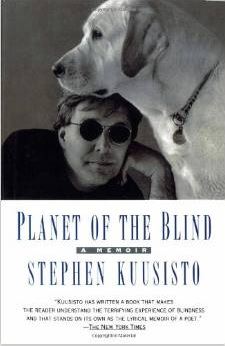
Her name is Caitlyn and she’s a yellow Labrador. Ten minutes ago she was eating her breakfast and now, curled on her bed, she’s talking in her sleep. It’s winter and very cold in Syracuse, New York and my canine pal has managed to take sustenance and go back to sleep in record time. 

Dogs found us thirty thousand years ago. One theory about this is that they coveted our midden heaps and then they stuck around. I won’t argue for or against this, save to say it’s possible dogs believed we were interesting and they liked us better than we liked ourselves. In turn they helped us hunt and stave off intruders. 

A dog dreaming by the fire is an ancient matter. A dog dreaming is a sign of love between us. Simple to say but most people don’t understand this. 

Love has many expressions. 

“Now” in the Disability Dictionary….

Now is faux past prologue, an advertisement so false even your pineal gland knows it. Now is the most favored word in capitalism. Worse of course is the expression “now and then” which implies a stricture on tomorrow, governed by nothing as “now” has little predictive value. “Right now,” say the tyrants, “things couldn’t be any better.” Now says global warming isn’t real. Now says the poor are imprisoned and they’re meant to be so. Now, in America, is shorthand for “there isn’t any future unless you’re already in the now club.” We used to say a salubrious person was “in the know” but, well, you get my drift.

In disability circles there’s no future planned beyond this: your tomorrows are being erased in the halls of Congress. After health care and social security are gutted will they bring back the ugly laws? Will they lock up the disabled in ruined shopping malls?

This morning I found myself thinking of Aristophanes who I read assiduously in college. Here he is:

“Look at the orators in our republics; as long as they are poor, both state and people can only praise their uprightness; but once they are fattened on the public funds, they conceive a hatred for justice, plan intrigues against the people and attack the democracy.”

Now wants what it has to stay always. The plan is to take down future democracy always.


Heaven at the Holidays

I don’t read pop psychology very much and when I do I avoid the more treacly kind—Leo Buscaglia’s “The Life of Freddy the Leaf” or Mitch Albom who blithely imagines people he’ll meet in heaven. I’m confident I’ll find no one in heaven as that’s of course what makes it heaven and one is better off admitting the afterlife is essentially nothing more than the first stirrings of social desire in the infancy of imagination. (Of heaven I’ve always liked Christopher Hitchens’ view that the Christian model is a kind of spiritual North Korea.)

Heaven is the original dull book, a composition which, rendered as music, is hardly more interesting than Gregorian chant. There’s no harmony in it. If Christianity is without sophistication, well, one might say, its hard to listen to. Mark Twain understood the problem better than anyone when he pictured heaven as a place where no one knows how to play the harp, hence it offers a cacophony of child like pluckings.

Why am I “on” about heaven? In part because I prefer mine in musical form, Josquin Desprez or Palestrina. I like it when, in Handel’s “Messiah” the voices move from bass to soprano. Heaven is best when heard and finest when complex.

In keeping with musical paradise, it’s good to recap that Beethoven believed his third symphony the “Eroica” was his finest accomplishment. It’s musically ambitious, structurally sophisticated, and it has plenty of early Romantic idealism. That is heaven.


Well, It’s a Living

So you’re disabled. You get a job after years. You plant seeds in snow. It’s not much of a job but it turns out to be steady. The seeds are small and blue—a friend jokes, says they look like “viagra tablets” and then you see they do like like viagra tablets though you’ve never actually had first hand experience with the stuff. The supervisor looks like a malevolent version of Mr. Rogers and he comes around periodically on one of those All Terrain Vehicles and says you’re not pushing the seeds deep enough into the snowbanks. So, “ahem,” you say, adding: “I can’t really reach deep into the snow because I’m riding a wheelchair you see…” Mr. Rogers says, “I’m riding an All Terrain Vehicle” and I can push blue seeds into the snowy sod, and he leans over and pokes two or three viagra into a snow man’s belly button. Then he whisks away in a cloud of exhaust. You never get the chance to explain that the average wheelchair bears no resemblance to an ATV and that most wheelchair users can’t lean to their sides to touch the ground. For Mr. Rogers, it’s enough that you both have wheels. And you never get to point out that planting blue seeds in snow is non-productive work. Talk about alienation! You’re separated from the means of production, planting fungal seeds above the arctic circle.

Should I Identify as a Beggar?

It’s axiomatic among disability activists and scholars to employ the term “cripple” as a useful identifier. The term is edgy, ironic, and instantly reflects the most egregious elements of ableism. As Nancy Mairs said famously: “As a cripple I swagger.” 

Lately I”ve been thinking that really, given the wholesale destruction of the safety net in the US, it’s probably time to move from being a cripple to embrace the obvious—I’m a beggar. 

As Medicaid, Medicare, and Social Security are ravaged, pillaged, set ablaze, there’s no better self declaration than “beggar” and if there isn’t any swagger to it, there’s at least a mirror held up in the faces of Republicans who, after all, want us disabled types back in the streets where they believe we belong.


A Hymn, A Notebook, Poetry Business, etc.

A student talks about how hard it is to write. (Pronoun withheld) is mindful of politics, subjectivity, privilege, all proper “outsicles” as I call them—one is out about difference, disablement, race, manifold historical wrongs—so many—and so (pronoun withheld’s) politics transform into something beyond scruple they become a grid iron of self-inflicted shame.

Carl Jung said shame is a soul eating emotion and I think it’s true. What Jung meant is the shame that makes you stuck, as opposed to propulsive shame which is the incitement for growth as any alcoholic in recovery can tell you.

When (pronoun withheld) feels too much shame to write, one’s forced to conclude academic writing isn’t liberating enough to bust a move. Amen to that.

**

I keep notebooks the way some collect oddments—found coins or feathers. I cannot say keeping notes isn’t a waste of time. Maybe poems will come or I’ll recognize in the mirror the child still searching there.

**

The poem must be loved, and eat and drink, sleep like a log, / curse and laugh and cry / humanely…

—Pentti Saarikoski

**

I spoke with Saarikoski on the phone once. He was in the final stage of drinking himself to death. In life he couldn’t love poems more than poison.

“The end is the way it is made: that’s why it’s pretty stupid to hurry. The book will not change.”

—Saarikoski in adolescent notebook….

**

Broken skate beside the pond

The children have gone

Something of a dream

In this ordinary evening

I’m sorry for breaking your heart

Long ago now

Lights coming on in windows

No name for this

A hymn really

They Thought They Were Free…

I make mistakes. Have made them. Some were long ago. I’m not sure I’ve made one today but it will happen. I do try and own my failings, not merely as fortuitous cash chips against later circumstances—imagining I’ll be wiser by and by—but because I really want to grow.

Growth is a matter of the soul or conscience and if you can parse the differences between them I salute you. I’m sufficiently Episcopalian to believe in the soul and I imagine it’s loaded with all the colors of Joseph’s coat not just the stains of our squeezed moral senses. I’m talking  love. I mean forgiveness and what John Coltrane called a love supreme.

You see I’m worried. In times of political extremism it’s customary for citizens who remain comfortable to imagine they’re free and that they still live among upright decent people.

In “They Thought They Were Free: The Germans, 1933-1945” Milton Mayer and Richard J. Evans described the coruscating bourgeois rhetoric of ordinary Germans under Hitler.  What’s fascinating is the degree to which the ten representative once-upon-a-time regular Joe Fascists interviewed portrayed themselves as loving humans.

In his forward Mayer wrote: “In 1935 I spent a month in Berlin trying to obtain a series of meetings with Adolf Hitler. My friend and teacher, William E. Dodd, then American Ambassador to Germany, did what he could to help me, but without success. Then I traveled in Nazi Germany for an American magazine. I saw the German people, people I had known when I visited Germany as a boy, and for the first time realized that Nazism was a mass movement and not the tyranny of a diabolical few over helpless millions. Then I wondered if Adolf Hitler was, after all, the Nazi I wanted to see. By the time the war was over I had identified my man: the average German.

I wanted to go to Germany again and get to know this literate, bourgeois, “Western” man like myself to whom something had happened that had not (or at least not yet) happened to me and my fellow-countrymen. It was seven years after the war before I went. Enough time had passed so that an American non-Nazi might talk with a German Nazi, and not so much time that the events of 1933–45, and especially the inner feeling that attended those events, would have been forgotten by the man I sought.

I never found the average German, because there is no average German. But I found ten Germans sufficiently different from one another in background, character, intellect, and temperament to represent, among them, some millions or tens of millions of Germans and sufficiently like unto one another to have been Nazis. It wasn’t easy to find them, still less to know them. I brought with me one asset: I really wanted to know them. And another, acquired in my long association with the American Friends Service Committee: I really believed that there was “that of God” in every one of them.

My faith found that of God in my ten Nazi friends. My newspaper training found that of something else in them, too. They were each of them a most marvelous mixture of good and bad impulses, their lives a marvelous mixture of good and bad acts. I liked them. I couldn’t help it. Again and again, as I sat or walked with one or another of my ten friends, I was overcome by the same sensation that had got in the way of my newspaper reporting in Chicago years before. I liked Al Capone. I liked the way he treated his mother. He treated her better than I treated mine.”

Yes, they were upright and decent. They were also comfortable until they weren’t. When the bombs fell on Berlin it was too late to say “what specifically about this Nazi movement goes against the golden rule?”

This is the question average Americans must ask at precisely this moment. How does deflecting and disrupting the truth about fiscal injustice promote equality and lovingkindness?

I’m no preacher but I know what the stakes are. Here’s Mayer again:

“What no one seemed to notice,” said a colleague of mine, a philologist, “was the ever widening gap, after 1933, between the government and the people. Just think how very wide this gap was to begin with, here in Germany. And it became always wider. You know, it doesn’t make people close to their government to be told that this is a people’s government, a true democracy, or to be enrolled in civilian defense, or even to vote. All this has little, really nothing, to do with knowing one is governing.

What happened here was the gradual habituation of the people, little by little, to being governed by surprise; to receiving decisions deliberated in secret; to believing that the situation was so complicated that the government had to act on information which the people could not understand, or so dangerous that, even if the people could understand it, it could not be released because of national security. And their sense of identification with Hitler, their trust in him, made it easier to widen this gap and reassured those who would otherwise have worried about it.

This separation of government from people, this widening of the gap, took place so gradually and so insensibly, each step disguised (perhaps not even intentionally) as a temporary emergency measure or associated with true patriotic allegiance or with real social purposes. And all the crises and reforms (real reforms, too) so occupied the people that they did not see the slow motion underneath, of the whole process of government growing remoter and remoter.”

So back to my opening: I make mistakes. But my love-sight is clear.