Ableism in the Academy, Thoughts on Moliere

Ableism, the experience of it, requires the French adjective écœurante —for disability discrimination is simultaneously heartless and sickening. I recall the professor of English at the University of Iowa who told me my blindness would preclude me from being in his “famous” graduate class on Charles Olson. Another professor snickered when I said I was reading books on tape. When I protested the chairman of the English department said I was a whiner and complainer. I wept alone in the Men’s room. My path forward to a Ph.D. in English at the University of Iowa was stymied. This was a full six years before the ADA was signed into law. Who was I to imagine a place at the agora’s marble stump?

I had an MFA degree from the creative writing program at that same university and I just went ahead and wrote books and sometimes appeared on radio and television and I wrote for big magazines and over time I received tenure at The Ohio State University. Later I went back to teach at Iowa despite my earlier experience and these days I’m at Syracuse. I’m a survivor of sorts. I’m a blind professor. The odds were never in my favor. Somewhere along the way I began thinking of Moliere in my private moments and I laughed because after all, every human occasion is comical and Moliere recognized the comedic types one encounters in closed societies better than anyone before or since.

It doesn’t really matter what institution of higher education you’re at, if you’re disabled you’ll meet the following Moliere-esque figures. The heartless and sickening ye will always have with ye if you trek onto a college campus. You’re more likely to spot them first if you hail from a historically marginalized background however, the ecoeurantists are more prone to blab at you if you’re disabled, especially behind closed doors. Ableists love closed doors. All bigots love closed doors.

The “Tartuffe” is an administrator, usually a dean or provost who will tell you with affected gestures that he, she, they, what have you, cares a great deal about disability and then, despite the fact a disabled person has outlined a genuine problem, never helps out.

The “Harpagon” is also an administrator, but he, she, they, can also be a faculty member. The Harpagon is driven by rhetorics of cheapness. It will cost too much to retrofit this bathroom, classroom, syllabus, website, etc. If the Harpagon is a professor he, she, they, generally drives a nice car.

Statue du Commandeur: a rigid, punctilious, puritanical college president—“this is the way we’ve always done it. If we changed things for you, we’d have to change things for everybody. Yes, it certainly must be hard…” See:

The Geronte: when his son is kidnapped he says: “Que diable allait-il faire dans cette galère?” (What in the deuce did he want to go on that galley for?” In other words, he brought this upon himself. “Really, shouldn’t you try something easier? I could have told you.”

These are the principle types of ableists. I invite you to add your own.

The one thing they have in common besides a privileged and thoroughly unexamined attachment to the idea that education is a race requiring stamina and deprivation, is that they all genuinely believe accommodations are a kind of vanity.
 

Dogs, Hats, and Faith

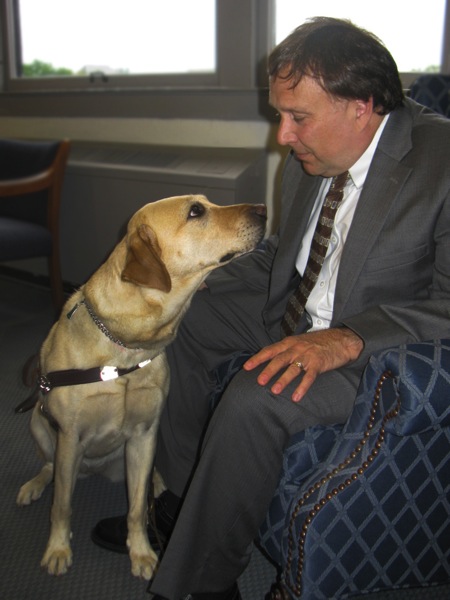
As the new year dawns I’m doing my best—that is, I’m drinking coffee. And since I went to bed last night at 9:30 (at the insistence of a small dog who thought it was the right thing when the outside temperature was 5 degrees Fahrenheit) well because of this I’m wide awake sans hangover.

To be fair the dog didn’t make me go to bed. It’s good to distrust people who say dogs make them do anything other than feeding them and taking them outside. I went to bed early because it seemed like a good idea.

I’ve been taking antidepressants for over twenty years. They help me stay “in the game” but they also make me tired at night and that’s just the way it is. By taking Celexa I live on dog time. Early to bed, early to rise. I’m Ben Franklin with pills and dogs.

What are dogs and antidepressants for? I imagine they’re about hope. Even facing the aborning year which cannot be promising, what with the looting of the planet, corporatized warfare, slavish and corrupt politicians of every stripe, human trafficking, the new slavery, which is old slavery tied to offshore banking—I’ll stop in a moment—even with the assault on the poor, the infirm—here I am again tossing my moth eaten chapeau onto a fountain of hope knowing one of my two dogs will retrieve it.

Dogs teach us to put our wet hats on again.

They teach us to avoid rising to the level of our expectations, but fall to the level of our training, as Archilochus would have it and which I’ve always taken to mean “get on with it brother.”

The wet hat has some toothmarks.

Lots of people sneer at hope. It is for one thing akin to faith and nothing gets kicked more often than faith, even the faithful do it.

I agree with Maxine Hong Kingston: “In a time of destruction, create something.”

Dogs say wet hats are better than no hats.

Dogs say you can indeed get there from here.

Dogs say even wearing that hat you’re not as bad as you appear.

Or they say, well, you might be as bad as you appear—so throw your hat again and we’ll bring it back. You can try for a new look.

A hat damp with hope is still a hat.

A damp hat is expectation halved, still wearable.

The hat your dog brings means you have a plan.

A Brief Poem Written at the End of a Bitter Year

What did they think at the edge of the world?

The type of thing written in poems…

One should say, think, where money was useless.

Where the crossbows failed.

The end of another year in a talkative country.

I think of Donald Trump as an “interprandial pooper”—

From Hipponax, one who leaves the table to defecate

So that he may again eat more.

At the edge of the world

Where the poor have only flags of parody….


Thoughts on My Saint’s Day

Life is given humans so we can imagine the eventual posture of our corpses—a paraphrase of Pentti Saarikoski. I’m haunted by my father’s body, its lying face down on the floor of the retirement complex, the face blue from heart failure, hands still clutching the New York Times. The man died with the intent to read. Death was sudden. That is, as they say, about as good as it gets.

Forgive me. My holiday mood is altogether dark, inchoate, tiny fishes of doubt and fear and aversion swim inside me. I don’t seem to be able to help myself. Last night I prayed as I lay down. I asked to be made kinder and stronger. I am aware this isn’t hip.

Strictly speaking I’m not hip. When I was very young I thought the postman was the coolest person alive. Wanting to be like him I walked up and down our rural street ringing doorbells and handing out out old copies of, you guessed it, the New York Times.

I am not sad. The fishes in my bloodstream are too mindful for sadness.

Today is St. Stephen’s Day. The fishes inside him were something.


Notes on Christmas Morning 

Those houses in Iceland like boats half buried

And their prows pointing to heaven

We were driving aimlessly

I was chattering about Snorri Sturluson

As literature students will do

My friend Gary wanted a good cigar

Saarikoski: “We were simply too simple.

Time went by, men and women, bellies and bird song.

We came to be old, we fluttered, that’s all.”

Wind in the chimney flu

Sun not up

Saarikoski: “The canaries on their way to the Faeroe Islands are lurking in their pleasures.”

**

When I was younger I complained about everything

E. Power Biggs on the radio

Gramophone shards in my boots

Poetry was like a yellow flower handed me by a strange woman

What I knew I really knew

Ice covered the pond like an illness on a pretty face

I was sad in my twenties

Sometimes I read the right things

Silly old Kalevala and John Donne

**

I love this Jesus who lets me stay blind

Thoughts and poems circulate

**

I love Pasolini’s Gospel According to St. Matthew

I would also like to be a Catholic-Marxist


Ableism, the Academy, and Good Old Jean Jacques Rousseau

The poet W. H. Auden wrote: “Educational theory begins when society has become differentiated, when different classes are living so differently, and doing such different things that the question arises: ‘What shall we teach and to whom?’”

I have been in mind of this straightforward question for some time now, especially as I’ve been wrestling with the deficiencies of my own education, and in particular how that education relates to disability. As Auden might have it: ‘What was I taught and who did those teachers imagine I was?’”

The answers depend upon whether or not you believe the nature of society is static—which is to say whether you think social relations where disability is concerned are changeable. Here I am piling a question on a question. Can disability ever slip the knots of ableism and be understood as a fully dignified dynamic of cultural life? (I take it as given that disability is no better or worse than any other fact of life.)

Okay. Since I don’t think society is static, at least since the time of Rousseau (everywhere we are in chains, post-innocent, and humankind is collectively capable of freedom) I think disability rights are a barometer of progress. Civil rights reflect modernity’s belief that all individuals are unique. After Freud all people are unique. If so, then good old Jeffersonian law must assure our unique equality.

Now imagining the law could guarantee my dignity was foolish yet I’ve been guilty of this variegated disappointment, of letting it get to me, for a long time now. How long? Since the mid 1980’s when the Americans with Disabilities Act was being built. Like millions of disabled in the U.S. I thought the adoption of civil rights meant throwing off chains. I allowed myself to believe this. I know I’m not alone.

And here is where my education failed me, my high modernist, early post-modernist, calculating small “d” democratic, structuralist-psychoanalytic education—it failed me. Teachers failed me. I was allowed to believe the law could take the place of civics. Of civics I was taught nothing save that every citizen will be equal under the law. Here is the specific failure: I was taught that individualism is the core of identity, that identity is the well spring of citizenship, and that laws will take care of equality. Of course I read Foucault. I understood the precarity of life under the state, saw how language can and often does fail us.

Nothing in my education prepared me for structural ableism.

For years I’ve allowed myself to believe that my eloquence, my irony, my belief in the law, would mean success where disability is concerned, and by this I mean “as lived” and by this I mean “in the workplace” and accordingly I have been navigating without some important details.

You see I thought the law and self-declared dignified individualism were all I needed. These things are not without their importance, but they weren’t enough.

I’ve been physically assaulted in the workplace; denied accommodations; told during meetings that my need for accessible materials would slow down progress; told to “get in line” behind other non-disabled faculty when I needed sighted help in the form of a grad assistant; been lectured to by so many overtly ableist administrators about the difficulty of disability—how it gums up the works of the system—this is a long list, forgive me—and in all cases I imagined my capacity to be clear, direct, and persistent would solve the problem. That was my deficiency. From my mid thirties onward, believing overmuch in the ADA and the power of my language, I failed to see how profoundly ableism cuts down the disabled, even in the most self-declared progressive work spaces. Yes it’s a matter of note I’ve been making my way in higher education.

Boo hoo for me, didn’t everything I ever read about oppression allow me to see the deep and broad discriminatory practices in the big bad world? Of course. But my mistake was to think, to allow myself to think that equality for the disabled had come.

How foolish I feel. Worse, how beleaguered I am after years of being treated badly as a disabled student and scholar.

Ableism is ubiquitous. Higher education is rife with it. It’s in the street. It’s on the bus. It’s in every corner of the civic square. It is an unholy master in the world of American medicine. Ableism is shrugs, hoots, snickers, red tape, ugly information technology, badly designed airplanes, inaccessible voting places. It’s what’s for breakfast.

Ableism is worse today than when the ADA was adopted. Like the brutal renaissance of racism and misogyny and homophobia it’s out and its everywhere.

It exists in the classrooms, the technology labs, the science classes, the lecture halls. It is so customary in higher ed that it’s no wonder three quarters of students with disabilities who matriculate to college never graduate.

And ableism exists in the silence of non-disabled faculty who know how ugly it is for students and staff who believed modernity’s promise, post-Freud, that they could also be individuals.


More About Being Blind in Higher Education

Recently I published a post about my life as a blind professor. I left a lot of things out, largely because the dispiriting narrative is a long one. In effect, I was aiming to get at the major issues—lack of respect from ableist colleagues, a generalized failure to make teaching and learning environments not just accessible but welcoming, the relentless difficulties encountered in the built environment. But one important thing I left out is that I’m demoralized by how difficult it is to get any traction on whatever is meant by “inclusion” since I have to fight for every minor accommodation. If this is true for me, and I’m well known, what must it be like for younger scholars?

When I was asked to teach abroad four years ago, and
I found the city in question was not guide dog friendly, I asked for a sighted companion to keep me from getting run over or lost. The university said no.

To this day I don’t know whether I’ll ever be able to teach abroad.

When I’ve raised this issue with successive administrators they shrug.

This is what I’m talking about: the shrug. The ableist shrug.

Imagine telling a Fulbright Scholar whose work has been translated world wide that he can’t have a life saving accommodation when teaching abroad. What kind of person shrugs this off?

The trap is that by writing about these things I continue to look shrill to the very people who are accustomed to ableism’s business as usual.

I can be painted as angry. That’s another dynamic of ableism.

I’m not angry. I’m appalled.

A few years back the Philosophy Department at Syracuse held a special summer session on disability. They had no accommodations. Disabled people came and had to leave. One famous disability studies scholar departed in protest. I’ve not heard of an apology from the department. We still hold events that are disability unfriendly across the campus. Am I bad for saying so? I don’t think so. Lonely perhaps.

What gets me is this: most of the faculty with whom I work or who I meet when traveling believe disability is exotic. Inwardly they think: “isn’t it niece that we let someone like this into our domain?”

But engagement and curiosity do not happen.

Moreover, because there aren’t many disabled faculty on any campus, our struggles are lost on the majority.

Of course I say: “someday you’ll need accommodations and then you’ll thank me for putting my hand in the bees nest almost daily.”

On Being Blind in Higher Education

I’m a blind college teacher. There should be nothing remarkable about this. Yet my daily presence haunts the academy. At all three universities where I’ve held tenure I’ve met obstacles to my participation in everything from meetings, classroom teaching, library research, online systems, even simple sporting events. All these basic things have been largely blocked.

Bad as these stumbling blocks are, and I promise you they’re lousy, what’s worse is the extraordinary degree of ableism I’ve met over the course of my roughly thirty year teaching career. Setbacks are one thing, perhaps even to be expected (at least initially) but prejudicial behavior is worse and I’ve experienced it over and over again. I’m a well known blind person. I have managed despite these problems to achieve “senior status”—that necrotic term for full professors.

Yet I’m not a full professor at all. I’m essentially a steerage passenger on a luxury liner, one who has wandered onto the wrong deck. This analogy should be ridiculous but it isn’t.

I’m still waiting for accessible “on boarding” materials at Syracuse University though I came here six years ago. I asked for them four times. Because I’ve never received them I know less about the place where I work than almost everyone.

Getting accessible research materials in a timely way is grueling and often impossible yet I’m expected to teach as much as anyone else—oh, and also to be a leader in my field.

A colleague criticized me not long ago for speaking out about accessibility problems, saying, “you set back our reputation.”

In the meantime disabled students tell me almost weekly how they’re patronized by faculty and how difficult it is for them to get the help they need to succeed. What do I do? I complain. All too often my reward for speaking “behind the curtain” to multiple administrators about access problems is that I’m essentially conceived of as a malcontent. The eye rolling says it all: I should go back to steerage immediately.

My “non-disabled” faculty colleagues are not generally reliable allies. Even the ones who theorize disability and confront the social and economic history of disablement are seldom on the front lines when it comes to speaking up. Can’t get into the famous basketball arena with your service dog? That’s too bad. We’re all going to the game tonight.

A famous scholar once wrote about the “spoiled identity” the disabled are forced to endure—have been forced to suffer—every day. The word for this is stigma and everyone who hails from a historically marginalized background knows what it feels like. There’s a moue of unhappiness at the sight of you. Many sighted people think the blind don’t know it when it comes but we do.

Lately blind students have been filing civil rights complaints against colleges nationwide. I have not done this because I keep thinking my persistence and whatever in me passes for eloquence will pay off.

But you see, there’s the problem. I want a broad coalition of faculty to speak up.

Disability and Whatever Is Meant by the Right to Life

I’ve always been displeased that anti-aborttion Christians have colonized the term “right to life”—effectively trademarking it. I support a woman’s right to choose. I also support the right of disabled people to enter this world. The two positions are antithetical. I know this. I’m a person with a disability. I know a great deal about cognitive dissonance. My “every day” is pure cognitive dissonance. 

Do fetuses have a right to life? What is “the right to life” precisely? Who defines that right? All too often America offers unwanted children lives of neglect and poverty. Is poverty a right? Forgive me for writing like a sophomore in Ethics 101 but too many conservatives utter the RTF slogan while simultaneously voting against social services that help women and infants succeed—and yes, they also vote against education and medical care for the disabled and elderly. 

The corporate medical community knows very little about disability but what they do know they don’t like. Genetic counselors routinely advise  against bringing disabled fetuses to term. Blind? No! Down Syndrome! No! I am horrified by this. Not long ago twin brothers in Belgium who went blind in middle age were allowed to end their lives under the nation’s physician assisted suicide law. Doctors agreed: blind life can’t be good. 

In the end I stand for positive imagination where disability life is concerned. I stand for full education and medical care for every citizen. Yesterday I applauded on Facebook Ohio’s law protecting unborn Down Syndrome fetuses from abortion. The trouble is, any obstacle to abortion is in fact a setback to a woman’s right to decide. This outcome deeply troubles me. The disabled may in fact be political red herrings in Ohio. Certainly Governor John Kasich opposes abortion and has a miserable record when it comes to supporting medical care and education.

In a society where women can’t raise children without fear of poverty and inadequate opportunities for health care and education both for themselves and for their children, I still stand for a woman’s right to choose. What Kasich did yesterday is cynical insofar as he’s not on board with progressive social programs. I know my desire to support disabled life is being manipulated. But I can’t shake it, this pervasive feeling that disabled life matters. Cognitive dissonance, yes.