The Projected Image: A History of Disability in Film

 Kudos to all involved in making this happen.  It is so long overdue:

Turner Classic Movies (TCM) will dedicate the month of October to exploring the ways people with disabilities have been portrayed in film. On behalf of Inclusion in the Arts, Lawrence Carter-Long will join TCM host Robert Osborne for The Projected Image: A History of Disability in Film. The special month-long exploration will air Tuesdays in October, beginning Oct. 2 at 8 p.m. (ET).

TCM makes today’s announcement to coincide with the 22nd anniversary of the signing of the Americans with Disability Act (ADA) on July 26. And in a first for TCM, all films will be presented with both closed captioning and audio description (via secondary audio) for audience members with auditory and visual disabilities.

Read on…

**************************

Professor Stephen Kuusisto is the author of Eavesdropping: A Memoir of Blindness and Listening” and the acclaimed memoir Planet of the Blind, a New York Times “Notable Book of the Year”. His second collection of poems from Copper Canyon Press, “Letters to Borges, is scheduled for release in October 2012.  As director of the Renee Crown University Honors Program and a University Professor at Syracuse University, Steve speaks widely on diversity, disability, education, and public policy. www.stephenkuusisto.com, www.planet-of-the-blind.com

Insights from the Planet of the Blind: An Interview. Part 1.

After reading Planet of the Blind, Kathleen Avery, Senior Director of Marketing at Cleinman Performance Partners, had occasion to talk with the author (Stephen Kuusisto) about his story and all that he’s come to understand.  Thank you, Kathleen, for allowing us to share this with our readers.

Kathleen:  Your book is so rich with visual metaphor, just the most vivid descriptions.  I’m curious how you are able to reference such diverse imagery.  Comparing a man in a rain coat to the sails of Tristan’s ship or an elephant’s ear, for instance…

Stephen:  Well, the first answer to that question is about language.  All nouns are images.  If you say strawberry…or horse…or wheat field…or lighthouse in Maine – you automatically see these things in your mind.  This is why ancient people believed that poets were magical.  They could make you see things.. They once had a radio advertisement on NPR: “Listen to the Theater of your Mind.”  That’s how poetry works.  It throws off powerful nouns and the reader sees them; they’re called power nouns.

Kathleen:  But how do you know what a lighthouse in Maine looks like?

Stephen: I either do or do not (laughs).  And that’s the second answer.  There is a way in which imagination approximates things.  You can actually create things with language that don’t exist.  The poet Charles Simic says, “Go inside a stone, that would be my way…”  He takes you inside the stone and it is the universe all over again.  The truth is you can’t see that at all, but you can trick the mind into seeing what can’t be seen.  This is also why ancient people thought poets were magical.

And, of course, people describe things to me.

You know, people think that blindness is like living in a vacuum.  The general public tends to think that blind people are trapped inside the stone.  They will ask me how I could possibly go to an art museum.  Well, you pick your friends.  You go with friends who will describe what they see.  Is it an immediate experience?  No.  But I like it, because there is poetry in it.  It is mediated.

Kathleen:  Oh, how interesting would it be to listen to different people describe the same Picasso?

Stephen: That would be a fabulous NPR piece!

You can read Kathleen Avery’s interview in its’ entirety by visiting www.cleinman.com/insights-from-the-planet-of-the-blind

**************************

Professor Stephen Kuusisto is the author of Eavesdropping: A Memoir of Blindness and Listening” and the acclaimed memoir Planet of the Blind, a New York Times “Notable Book of the Year”. His second collection of poems from Copper Canyon Press, “Letters to Borges, is scheduled for release in October 2012.  As director of the Renee Crown University Honors Program and a University Professor at Syracuse University, Steve speaks widely on diversity, disability, education, and public policy. www.stephenkuusisto.com, www.planet-of-the-blind.com


The Barefoot Review seeking submissions

Jamie Sue, from The Barefoot Review, made contact and asked us to share the following post. Happy to do so…

What is it?

The Barefoot Review is a new publication. We welcome submissions of poetry or short prose from people who have or have had physical difficulties in their lives, from cancer to seizures, Alzheimer’s to Lupus. It is also for caretakers, families, significant others and friends to write about their experiences and relationship to the person.

What’s the Purpose?

Writing can be a tremendous source of healing and allow difficult feelings and ideas to be expressed. Unfortunately, every piece submitted can’t be published, however every piece is important. The process of writing, verbalizing feelings that may be subconscious or unexpressed is more important than the acknowledgment of publication.

We hope sharing this work online will help people facing similar difficulties find inspiration in the words of others.

What’s in a Name?

The Barefoot Review is named to evoke several meanings: baring your soul and expressing naked feelings. Bare feet ground you, give you balance, and connect you to the Earth. The review is here from a desire to help others.

Where is it?

The review is here, there and everywhere —www.barefootreview.com

Please be sure to read the submissions guidelines before sending us your work.

submissions@barefootreview.org

Question, compliment or complaint?

info@barefootreview.org

When Bob Marley Saved My Life

Photo description: black and white photo of a smiling Bob Marley.  He’s standing outside and almost appears to be leaning on a guitar, the neck of which he’s holding in his right hand.

First let me say that anyone who has known discrimination also knows that going forward is steep. You have, after all, been told you don’t belong and worse, you’ve been instructed to get the hell out of town. As a blind person I’ve been in that spot throughout my life. Grade school teachers, high school principals, college professors, graduate school instructors–even a college president–have told me that because of my visual impairment I should go away. Perhaps the worst moment was in 1985 when I was enrolled in the Ph.D. program in English at the University of Iowa and two senior faculty along with the department chair told me I didn’t fit, that my need for extra time to complete assignments was ridiculous, and that I was a whiner.

This is a familiar story among people with disabilities. Even today (over 20 years after the passage if the ADA) only one in four college students with a disability will graduate. The unemployment rate for pwds is still estimated at 70%.

If you’re blind you can’t wait tables, drive a cab, or do most of the available jobs that are perfectly honorable. In 1985 all I could imagine was reading and writing vs. nothing. Nothing would mean living on Social Security Disability checks and moving in with my parents. If i embraced Nothing it would be an admission of failure so great that I would have to retire from my life, live as a kind of back room invalid, a prospect that terrified me since my mother was an alcoholic and slept all day with the shades drawn– would that be my life?

As it happened, I did move home and lived for quite some time in my parents’ basement. I had a beat up typewriter, an exercise bike, and a tape machine and that’s when I began listening to Bob Marley in earnest. I’d been gently listening to Bob ever since his first US album “Catch a Fire” appeared in 1973 but now I was soaking in his rare and utterly astonishing combination of rage and redemption, a combination you will not customarily find in the arts–a combo like milk and iodine. In poetry very few possess this–Yeats comes to mind and Nazim Hikmet, and Neruda. In popular music almost no one has Marley’s quality of the sword in the cloud–the rage is just rage or the milk is just syrup.

In my basement with the volume up I began working. Bob Marley’s voice and lyrics moved through me and I felt a half weightless sense of a pending disembodiment and then the authentic tears of deep deep discrimination salted with hope came to me. I could go on and on about the songs, the lyrics stitched from sublime wing shadows of the soul that fans the body, but it’s enough to say that Bob Marley remains for me the most authentic voice of “becoming” that I have ever heard.

Previously published on Steve’s other blog, Planet of the Blind

**************************

Professor Stephen Kuusisto, blind since birth, is the author of Eavesdropping: A Memoir of Blindness and Listening” and the acclaimed memoir Planet of the Blind, a New York Times “Notable Book of the Year”. He has also published “Only Bread, Only Light“, a collection of poems from Copper Canyon Press. As director of the Renee Crown University Honors Program and a University Professor at Syracuse University, Steve speaks widely on diversity, disability, education, and public policy.
 

Disability and Poetry, Part 145

Thanks to Chris B whose blog, Through Alien Eyes, is a thoughtful and lovely place for disability reflections. He heard me speak recently on disability and poetry at The Ohio State University and has written a kindly analysis of my presentation.

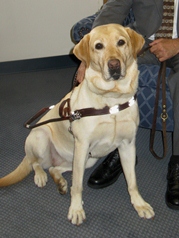
When I am In New York City with my guide dog the happiness of the city is mine. Swiss tourists want to tell me about their Labradors at home. Doormen call out as we walk by. It’s a different city for us, communal, improbably humane even at moments ecstatic. This must go into the living poem of physical difference.

So too the damages and the ugliness. What I like to call the mercenary labeling of ableism. People with disabilities experience the crackling, unspoken diminishing glares of strangers. Until they are spoken. Then the day tilts like a bad amusement park ride. This must also go into the living poem of physical difference.guide dog, Nira

What the guide dog schools won’t tell you, or by turns, tell you imperfectly, is that guide dog teams will encounter public incomprehension and outright discrimination as they walk around. In my case this discovery came 18 years agoin New York City when I tried to get into a cab and the driver began screaming expletives. Despite this I got into the car. His language and mine became an instant study in art for all the ingredients of creativity were present: tension, incomprehension, passion, and spontaneity.

Sitting stern as a tree in the backseat, I told him that the law permits guide dogs for the blind in all taxis–in fact guide dogs are allowed everywhere. Hell, I even had an ID card from the school with my picture and the dog’s picture and all the appropriate legalese. But the driver, my driver, did not believe in the bravery or happiness of others. He began revving his engine and revving up his shouting.

What can you do? My driver hated me and my dog and was refusing to budge. I was reciting the law. Oh the godforsaken wilderness of human rage. When you have a disability every moment of discrimination evokes all the others: you’re again the boy who was told he couldn’t play with others, couldn’t go to school with them, sat alone in a room. This must also go into the living poem of physical difference.

Then again, the shy, unanticipated joy: in Central Park a man says to me, “You can’t tell, but I am the statue of liberty.” “Me too,” I say.

Previously published on Steve’s other blog, Planet of the Blind

**************************

Professor Stephen Kuusisto, blind since birth, is the author of “Eavesdropping: A Memoir of Blindness and Listening” and the acclaimed memoir “Planet of the Blind”, a New York Times “Notable Book of the Year”. He has also published “Only Bread, Only Light“, a collection of poems from Copper Canyon Press. As director of the Renee Crown University Honors Program and a University Professor at Syracuse University, Steve speaks widely on diversity, disability, education, and public policy.
Kudos to NPR on the Subject of Chen Guancheng's Blindness

Thanks to Alan Greenblatt of NPR for writing today about the issue of Chen Guancheng’s blindness and the overtly dynamic positioning of the “b” word in the press coverage of the Chinese dissident. Greenblatt’s piece, entitled “A Factor in a Much Larger Life: Debating Chen Guancheng’s Blindness” does a nice job of arguing that people with disabilities are not, in fact defined by those disabilities, and I’m glad to have been asked for some comments on the subject. Kudos to the folks at NPR for bucking the media’s fixation on the blindness as a determinant symbol of what is indeed a much larger life.

Previously published on Steve’s other blog, Planet of the Blind

**************************

Professor Stephen Kuusisto, blind since birth, is the author of “Eavesdropping: A Memoir of Blindness and Listening” and the acclaimed memoir “Planet of the Blind”, a New York Times “Notable Book of the Year”. He has also published “Only Bread, Only Light“, a collection of poems from Copper Canyon Press. As director of the Renee Crown University Honors Program and a University Professor at Syracuse University, Steve speaks widely on diversity, disability, education, and public policy.

Reporting from a Thicket of Yellow Roses: Supporting People with Disabilities in the Public Square

I will be speaking on Friday at the annual conference of the New York State Association of Community and Residential Agencies.

Here is what I plan to say:

One night many many years ago I went out and lay down in a thicket of yellow roses. The roses were in the garden of the Prado museum in Madrid. I lay among the flowers on an ordinary day, a day of overcast sun and businessmen hurrying and tall balcony windows shuttered and the streets with creeping taxi cabs.

I had gone alone to the museum because my Spanish friend could not come with me. I was too blind to see the paintings very easily. How do I explain this? Why would a person with an occluding disability undertake a solo hunt to the world of paintings? Here are some answers, offered in no particular order of importance:

•  I wanted to see paintings–up close I might have an experience of Goya.

•I thought there might be some kind of tour guide who could describe things.

•I imagined that my passion for life would be equalled by the world: a utopian position that all persons with disabilities must maintain.

The more I think about it it’s answer number three that motivated me. I thought that my desire for an inclusive life would in turn open the world before me. And I still get up every day imagining this.

The Prado museum didn’t have any special accommodations for visually impaired people. So I began walking around. How simple that sentence is! I began walking.

But there were thick ropes in front of the famous canvases. And sinister guards. And I walked from one gallery to another seeing nothing of the art. I saw beautiful mud colored walls and little high intensity lights and then I found myself trailing a group of American tourists who were being led by a woman tour guide. Frankly I felt like a man who had been walking down a mountain on a dirt road. And after great solitude  I’d found my people.  The tour guide was explaining something about Velasquez. How he used perspective–I don’t remember any more.

What I do remember is the overt cruelty of the woman tour guide who, seeing me trailing her group, chose to confront me by saying, in effect, that I was not part of her group and I should immediately get lost.

I ran from the museum and found my way to the circle of yellow roses and I wept. I cried because I was tired; because I had a disability for which I had only the most apologetic language; cried because I had no allies–my host in Spain had no time for my disability, he was tightly wound and fighting his own battles. And this is what I’m getting at: disability is always and I mean always a problem of imagination. How will I live? How will I belong? What will I do? Who will accompany me? Who will wait on the slope and cheer me on?

Continue reading “Reporting from a Thicket of Yellow Roses: Supporting People with Disabilities in the Public Square”