Disability? No Permission Necessary

I have for much of my life been an outsider. By this I do not mean a victim or beseecher. Perhaps I’m these things in dreams. Asleep I’ve begged for admittance to Noah’s ark. By day I give no ground to those who dismiss me. Make no mistake: as a blind citizen I’m dismissed every day. Every. Single. Day.

My “outsider” status is therefore a matter of discrimination, ableism, of cozy habitual group dynamics. Geography doesn’t matter—I’m dismissed or have been dismissed at Syracuse University (where I currently teach) and on vacation. Blindness is a stigmata to the educated and whatever we might mean by the uneducated. Where disability discrimination is concerned its been my experience there isn’t much of a difference between the two.

I am not a defective sighted person. The majority still believes this. And so I’m an outsider by virtue of a twofold misapprehension. While visual impairment is inconvenient its no measure of my value unless we imagine value as the capacity to read eye charts. The ancients would have seen my value differently. They’d have applauded my memory or my brand of intelligence.

That the customary view of blindness is mediocre and unimaginative is hardly news to me and all the other blind people I know. That the social reception we receive continues to be miserable is the grout or cement of my outsider status.

The second dynamic of outsiderness is my refusal to accept the position. I’m not asking for permission to be in your cohort.

Permission is only a thing in desperate dreams.

I wonder if Noah allowed any disabled animals on his ark?

I wonder if Noah had a disability, either visible or invisible?

Was he obsessive compulsive?

What about Mrs. Noah? Did she suffer from seasickness? Agoraphobia?

I can say for sure that religious organizations are as dismissive of the disabled as the faculty clubs of universities.

The trick as I see it is to remain fresh, optimistic, grounded, kind, and unyielding in the personal and collective fight for dignity.

I don’t need permission for that.

Nor do you.

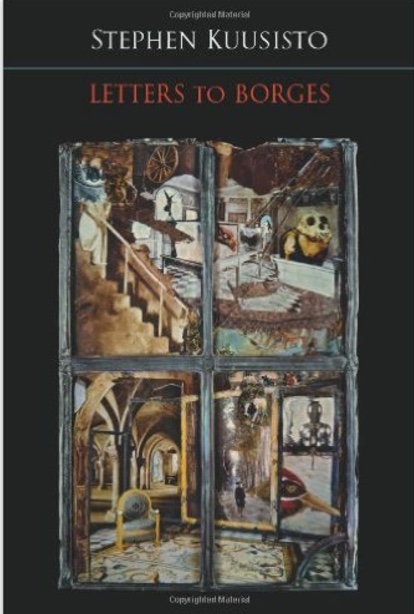
Stephen Kuusisto and HarleyABOUT: Stephen Kuusisto is the author of the memoirs Have Dog, Will Travel; Planet of the Blind (a New York Times “Notable Book of the Year”); and Eavesdropping: A Memoir of Blindness and Listening and of the poetry collections Only Bread, Only Light and Letters to Borges. A graduate of the Iowa Writer’s Workshop and a Fulbright Scholar, he has taught at the University of Iowa, Hobart and William Smith Colleges, and Ohio State University. He currently teaches at Syracuse University where he holds a University Professorship in Disability Studies. He is a frequent speaker in the US and abroad. His website is StephenKuusisto.com.

Have Dog, Will Travel: A Poet’s Journey is now available for pre-order:
Amazon
Barnes and Noble
IndieBound.org

Have Dog, Will Travel by Stephen Kuusisto

(Photo picturing the cover of Stephen Kuusisto’s new memoir “Have Dog, Will Travel” along with his former guide dogs Nira (top) and Corky, bottom.) Bottom photo by Marion Ettlinger 

Cranky

I must admit I’m a cranky man. This means I’m a hurdy gurdy man, a street nuisance. Did you know most curbside organ players were disabled? Many were war veterans. Jobless. They played for your amusement. Several cities in America didn’t like them. “Ugly Laws” were adopted across the nation at the turn of the last century—edicts stipulating bothersome, unsightly people were forbidden to appear in public. This was excellent news for the asylum business. The United States loves to lock people up for any reason at all—you’re black and deaf. Asylum. You’re blind. Asylum. You’re an immigrant in Trump’s America. Instant prison camp. Native American. Home detention. Gay? The Asylum. The Los Angeles County Jail is the largest psychiatric facility in the U.S. Cranky? You bet. I’m so cranky I can’t muster irony.

Disabled I know a good deal about cruel irony—“the act of using somebody’s words against them, usually when something to their great detriment is about to be inflicted upon them.”

I’ll never forget an administrator of a certain college who, once he had me behind a closed door told me I wasn’t a competitive blind person, why he had a roommate at university who was a blind Olympic rower and so forth. He was essentially firing me because I’d asked for a reasonable accommodation.

But you see here’s the trap. I’m cranky if I talk back, assert my dignity and my rights. I am especially cranky at the University where when I ask for basic ADA 101 accommodations, (a sighted graduate assistant to help me in my daily work) accessible texts, descriptions of overhead projections, asking that our websites and teaching software be accessible and so forth) I’m labeled as a real cranky pants. Academic ableism is built on cruel irony. “If you were more like us you wouldn’t have a problem. You don’t like what’s happening to you? You must be the problem. Not us. Not us able bodied birdies….”

I’ve met so many able bodied birdies. They may have different kinds of feathers but their song is always the same.

Ableism, the experience of it, requires the French adjective écœurante —for disability discrimination is simultaneously heartless and sickening. I recall the professor of English at the University of Iowa who told me my blindness would preclude me from being in his “famous” graduate class on Charles Olson. Another professor snickered when I said I was reading books on tape. When I protested the chairman of the English department told said I was a whiner and complainer. I wept alone in the Men’s room. My path forward to a Ph.D. in English at the University of Iowa was stymied. This was a full six years before the ADA was signed into law. Who was I to imagine a place at the agora’s marble stump?

Now I had an MFA degree from the creative writing program at that same university and I just went ahead and wrote books and sometimes appeared on radio and television and I wrote for big magazines and over time I received tenure at The Ohio State University. Later I went back to teach at Iowa despite my earlier experience and these days I’m at Syracuse. I’m a survivor of sorts. I’m a blind professor. The odds were never in my favor. Somewhere along the way I began thinking of Moliere in my private moments and I laughed because after all, every human occasion is comical and Moliere recognized the comedic types one encounters in closed societies better than anyone before or since.

It doesn’t really matter what institution of higher education you’re at, if you’re disabled you’ll meet the following Moliere-esque figures. The heartless and sickening ye will always have with ye if you trek onto a college campus. You’re more likely to spot them first if you hail from a historically marginalized background however, the ecoeurantists are more prone to blab at you if you’re disabled, especially behind closed doors. Ableists love closed doors. All bigots love closed doors.

The “Tartuffe” is an administrator, usually a dean or provost who will tell you with affected gestures that he, she, they, what have you, cares a great deal about disability and then, despite the fact a disabled person has outlined a genuine problem, never helps out.

The “Harpagon” is also an administrator, but he, she, they, can also be a faculty member. The Harpagon is driven by rhetorics of cheapness. It will cost too much to retrofit this bathroom, classroom, syllabus, website, etc. If the Harpagon is a professor he, she, they, generally drives a nice car.

Statue du Commandeur: a rigid, punctilious, puritanical college president—“this is the way we’ve always done it. If we changed things for you, we’d have to change things for everybody. Yes, it certainly must be hard…” See:

The Geronte: when his son is kidnapped he says: “Que diable allait-il faire dans cette galère?” (What in the deuce did he want to go on that galley for?” In other words, he brought this upon himself. “Really, shouldn’t you try something easier? I could have told you.”

These are the principle types of ableists. I invite you to add your own.

The one thing they have in common besides a privileged and thoroughly unexamined attachment to the idea that education is a race requiring stamina and deprivation, is that they all genuinely believe that accommodations are a kind of vanity.

Stephen Kuusisto and HarleyABOUT: Stephen Kuusisto is the author of the memoirs Have Dog, Will Travel; Planet of the Blind (a New York Times “Notable Book of the Year”); and Eavesdropping: A Memoir of Blindness and Listening and of the poetry collections Only Bread, Only Light and Letters to Borges. A graduate of the Iowa Writer’s Workshop and a Fulbright Scholar, he has taught at the University of Iowa, Hobart and William Smith Colleges, and Ohio State University. He currently teaches at Syracuse University where he holds a University Professorship in Disability Studies. He is a frequent speaker in the US and abroad. His website is StephenKuusisto.com.

Have Dog, Will Travel: A Poet’s Journey is now available for pre-order:
Amazon
Barnes and Noble
IndieBound.org

Have Dog, Will Travel by Stephen Kuusisto

(Photo picturing the cover of Stephen Kuusisto’s new memoir “Have Dog, Will Travel” along with his former guide dogs Nira (top) and Corky, bottom.) Bottom photo by Marion Ettlinger 

Why the Able Bodied Don’t Like Disability in the Arts

I was in residence at an arts colony not long ago when I heard a noted American novelist tell a wide audience that they’d never be so blind and poor of judgment again—referring to (wait for it) a broader appreciation of marginalized art forms.

Blindness as metaphor, indeed all disability as metaphor is offensive and “not cool” anymore. That this occurred at a well heeled arts event doesn’t surprise me. It’s still the case that disability isn’t part of inclusivity in the arts even when some of the most amazing creative work in contemporary America comes from the disability community.

Just so the leading national academic conference for creative writing, the AWP (Association of Writers and Writing Programs) has a long standing problem with disability. They dislike having to provide accommodations at their conferences and they are particularly disdainful to disabled writers.

I’ve come to see this as a matter of resort sales. Years ago I ran training sessions for Sandals and Beaches resorts. The idea was to help beach front hotels become better service providers for the disabled.

One executive said that having disabled people on their property would negatively affect business.

I saw what he meant: all their promotional material featured photos of sleek, gym toned, happy looking people. Some were white, some were from different ethnicities. But the point was everyone was very very attractive.

When you look at the photos featured on the AWP’s website you’ll notice that all the writers look like they’ve just come from the gym.

When you look at the photos from arts colonies you’ll notice that everyone looks like they’ve just come from the very same gym.

That the arts industry (such as it is) has so little awareness (such as it might be) about it’s devotion to normality is telling. Diversity is OK if it’s about race, gender, sexual orientation, but it’s not applicable if you use a walker, a stick, talk with your hands, walk with a guide dog, etc. Everyone knows that disability art isn’t real art. It is something else, isn’t it?

Adrienne Rich, Virginia Woolf, William Carlos Williams, Audre Lorde, Stanley Elkin, Robert Lowell, Andre Dubus, Walt Whitman, Hart Crane—all were disabled. Some walked with canes, some stuttered, some used wheelchairs. None looked like they were fresh from the spa.

In the narrow confines of American art, which let’s admit is academic art, it’s still the case that when illness is thought of at all, it’s imagined as something to be overcome. The arts in America are driven by the medical model of embodiment.

Try explaining this to the arts administrators. They’ll say, as indeed someone at the AWP said to a room full of disabled writers, “your time hasn’t come yet.”

Stephen Kuusisto and HarleyABOUT: Stephen Kuusisto is the author of the memoirs Have Dog, Will Travel; Planet of the Blind (a New York Times “Notable Book of the Year”); and Eavesdropping: A Memoir of Blindness and Listening and of the poetry collections Only Bread, Only Light and Letters to Borges. A graduate of the Iowa Writer’s Workshop and a Fulbright Scholar, he has taught at the University of Iowa, Hobart and William Smith Colleges, and Ohio State University. He currently teaches at Syracuse University where he holds a University Professorship in Disability Studies. He is a frequent speaker in the US and abroad. His website is StephenKuusisto.com.

Have Dog, Will Travel: A Poet’s Journey is now available for pre-order:
Amazon
Barnes and Noble
IndieBound.org

Have Dog, Will Travel by Stephen Kuusisto

(Photo picturing the cover of Stephen Kuusisto’s new memoir “Have Dog, Will Travel” along with his former guide dogs Nira (top) and Corky, bottom.) Bottom photo by Marion Ettlinger 

On the Probable Death of Empathy

Empathy is an engrossing word. While it means the capacity to understand and share the feelings of others, its Greek origin suggests entering into the emotions of others. The Greeks thought empatheia was sacred. In dramatic terms its absence was viewed as a tragic flaw. With the advent of literacy (“book learnin’” as Huck Finn called it) empathy was reckoned as the ability to imagine what someone feels, a difference, as the Greeks didn’t fully believe in imagination in these terms instead viewing it as a divine prerogative only available to the best minds.

In the modern world (which for argument’s sake starts with Shakespeare) empathy as imagination has been a responsibility of sorts. Dickens, Dostoevsky, Whitman, George Eliot, Grace Paley, Eudora Welty—a long list—each of these writers shouldered a duty to bring forward the buzz and confusion in the minds of outsiders. Beginning with the Elizabethans literary writing is understood as an obligation to reach beyond the self.

With the altogether exciting rise of singular voices in literary publishing, those who speak from singularities—disability, blackness, Native American experience, LGBTQ lives, Asian-American experiences, regionalisms of all kinds—literary empathy is often recast as “cultural appropriation.” It is asserted that no one “not of your neighborhood” should ever ever imagine your life for you. There’ve been many brouhahas recently about writers who are believed to be transgressors, who willfully seized the interiority of human beings not of their own neighborhoods.

As one who hails from a historically marginalized position I believe this febrile, literary neighborhood watch is both understandable and fatal.

I’m a blind poet and I loathe Anthony Doerr’s Pulitzer Prize winning novel All the Light We Cannot See. Doerr presents a blind teenager, a girl, as helpless to the point of needing to be bathed by her father. Since Doerr makes her blindness vaguely interesting, allowing some flashes from her point of view many non-disabled readers flipped for the book.

From a disability POV Doerr extends damaging stereotypes—her inability to bathe, her half- prophetic intelligence—are junk. Many in the disability community have cited the book for “cultural appropriation” a position I fully grasp. Doerr uses blindness as a literary device to advance his plot, Within the field of Disability Studies this is called “narrative prosthesis.”

Does the novel really do damage to the blind? Who knows. The blind are 70% unemployed in the United States. We’re imagined as quasi-helpless, burdensome. Doerr plays into this. He does present her as having an inner life. Big whoop! I’m citing him for a failure of empathy. He cannot steal my culture.

This is the crux of the matter: talented writers can enter effectively into the lives of others, even people who aren’t situated precisely next door. For my money one of the most effective portrayals of disability in all of literature was written by Toni Morrison. In her novel Sula she puts readers inside the head of Shadrack, a World War I veteran suffers from PTSD and has been released prematurely from a veterans hospital. He can’t order his mind or control his hands. He’s seen brains flying in the air. She writes at first of his experience in the ward:

“When Shadrack opened his eyes he was propped up in a small bed. Before him on a tray was a large tin plate divided into three triangles. In one triangle was rice, in another meat, and in the third stewed tomatoes. A small round depression held a cup of whitish liquid. Shadrack stared at the soft colors that filled these triangles: the lumpy whiteness of rice, the quivering blood tomatoes, the grayish-brown meat. All their repugnance was contained in the neat balance of the triangles—a balance that soothed him, transferred some of its equilibrium to him. Thus reassured that the white, the red and the brown would stay where they were—would not explode or burst forth from their restricted zones—he suddenly felt hungry and looked around for his hands. His glance was cautious at first, for he had to be very careful—anything could be anywhere. Then he noticed two lumps beneath the beige blanket on either side of his hips. With extreme care he lifted one arm and was relieved to find his hand attached to his wrist. He tried the other and found it also. Slowly he directed one hand toward the cup and, just as he was about to spread his fingers, they began to grow in higgledy-piggledy fashion like Jack’s beanstalk all over the tray and the bed. With a shriek he closed his eyes and thrust his huge growing hands under the covers. Once out of sight they seemed to shrink back to their normal size. But the yell had brought a male nurse.

“Private? We’re not going to have any trouble today, are we? Are we, Private?””

Later, out in the world, alone, without assistance, we see him on a country road:

“Once on the road, he headed west. The long stay in the hospital had left him weak—too weak to walk steadily on the gravel shoulders of the road. He shuffled, grew dizzy, stopped for breath, started again, stumbling and sweating but refusing to wipe his temples, still afraid to look at his hands. Passengers in dark, square cars shuttered their eyes at what they took to be a drunken man.

The sun was already directly over his head when he came to a town. A few blocks of shaded streets and he was already at its heart—a pretty, quietly regulated downtown.

Exhausted, his feet clotted with pain, he sat down at the curbside to take off his shoes. He closed his eyes to avoid seeing his hands and fumbled with the laces of the heavy high-topped shoes. The nurse had tied them into a double knot, the way one does for children, and Shadrack, long unaccustomed to the manipulation of intricate things, could not get them loose. Uncoordinated, his fingernails tore away at the knots. He fought a rising hysteria that was not merely anxiety to free his aching feet; his very life depended on the release of the knots. Suddenly without raising his eyelids, he began to cry. Twenty-two years old, weak, hot, frightened, not daring to acknowledge the fact that he didn’t even know who or what he was…with no past, no language, no tribe, no source, no address book, no comb, no pencil, no clock, no pocket handkerchief, no rug, no bed, no can opener, no faded postcard, no soap, no key, no tobacco pouch, no soiled underwear and nothing nothing nothing to do…he was sure of one thing only: the unchecked monstrosity of his hands. He cried soundlessly at the curbside of a small Midwestern town wondering where the window was, and the river, and the soft voices just outside the door…

Through his tears he saw the fingers joining the laces, tentatively at first, then rapidly. The four fingers of each hand fused into the fabric, knotted themselves and zigzagged in and out of the tiny eyeholes.

By the time the police drove up, Shadrack was suffering from a blinding headache, which was not abated by the comfort he felt when the policemen pulled his hands away from what he thought was a permanent entanglement with his shoelaces. They took him to jail, booked him for vagrancy and intoxication, and locked him in a cell. Lying on a cot, Shadrack could only stare helplessly at the wall, so paralyzing was the pain in his head. He lay in this agony for a long while and then realized he was staring at the painted-over letters of a command to fuck himself. He studied the phrase as the pain in his head subsided.”

Morrison’s portrayal of Shadrack is pure empathy and is a demonstration of literary writing at its finest. I won’t quibble about a non-disabled writer entering into the thoughts and torments of a wounded veteran. I can’t. The disabled need all the allies they can get. When a novelist as talented as Morrison turns her attention to a man with shell shock, who has no language for his experience, who cannot control his hands, then she is employing art in the service of a greater appreciation of tragedy and difference for every reader. This is empathy at its best. Its stunning.

I don’t believe in cultural appropriation. I think non disabled writers can write brilliantly about disability experience. They need to do their homework—talk to real blind people, true cripples, what have you.

The term cultural appropriation must never detract writers from the brilliant art of literary empathy.

I don’t want to live in the age when empathy died.

Stephen Kuusisto and HarleyABOUT: Stephen Kuusisto is the author of the memoirs Have Dog, Will Travel; Planet of the Blind (a New York Times “Notable Book of the Year”); and Eavesdropping: A Memoir of Blindness and Listening and of the poetry collections Only Bread, Only Light and Letters to Borges. A graduate of the Iowa Writer’s Workshop and a Fulbright Scholar, he has taught at the University of Iowa, Hobart and William Smith Colleges, and Ohio State University. He currently teaches at Syracuse University where he holds a University Professorship in Disability Studies. He is a frequent speaker in the US and abroad. His website is StephenKuusisto.com.

Have Dog, Will Travel: A Poet’s Journey is now available for pre-order:
Amazon
Barnes and Noble
IndieBound.org

Have Dog, Will Travel by Stephen Kuusisto

(Photo picturing the cover of Stephen Kuusisto’s new memoir “Have Dog, Will Travel” along with his former guide dogs Nira (top) and Corky, bottom.) Bottom photo by Marion Ettlinger 

Like a Falling Leaf….

Like a falling leaf
The boy in me, spinning
How to take him with me
As my years advance?

Finnish poet Paavo Haavikko:
I hear a happy tale, it makes me sad:
no-one will remember me for long.

The boy, a blind young man
Knew a thing or two.

He was never “in” time
Like those trees you see
In certain forests
Still green
Though there’s more darkness
And we are long into September.

Stephen Kuusisto and HarleyABOUT: Stephen Kuusisto is the author of the memoirs Have Dog, Will Travel; Planet of the Blind (a New York Times “Notable Book of the Year”); and Eavesdropping: A Memoir of Blindness and Listening and of the poetry collections Only Bread, Only Light and Letters to Borges. A graduate of the Iowa Writer’s Workshop and a Fulbright Scholar, he has taught at the University of Iowa, Hobart and William Smith Colleges, and Ohio State University. He currently teaches at Syracuse University where he holds a University Professorship in Disability Studies. He is a frequent speaker in the US and abroad. His website is StephenKuusisto.com.

Have Dog, Will Travel: A Poet’s Journey is now available for pre-order:
Amazon
Barnes and Noble
IndieBound.org

Have Dog, Will Travel by Stephen Kuusisto

(Photo picturing the cover of Stephen Kuusisto’s new memoir “Have Dog, Will Travel” along with his former guide dogs Nira (top) and Corky, bottom.) Bottom photo by Marion Ettlinger 

The Poetry Conference

They see me walking with my stick or dog
And like a wisp of curtains
I hear their assumptions—
That I’ve been admitted by mistake
Or I must be lost
Surely poems require sight?

Screw Homer; who reads Milton?
Big time poets know blindness
Stands for something something—
Didn’t Rilke touch on it—
A blind man clutches a gray woman
And is lost forever in dark infancies?

That blind woman who writes verses—
She must be a bird
Something something
Maybe related to language
Her poems like feathers
Or yarrow stalks.

“How do you write so clearly
If you can’t see?”
“How do you read?”
“Would you have been a writer
If you had sight?”
“Can you see me at all?”

Stephen Kuusisto and HarleyABOUT: Stephen Kuusisto is the author of the memoirs Have Dog, Will Travel; Planet of the Blind (a New York Times “Notable Book of the Year”); and Eavesdropping: A Memoir of Blindness and Listening and of the poetry collections Only Bread, Only Light and Letters to Borges. A graduate of the Iowa Writer’s Workshop and a Fulbright Scholar, he has taught at the University of Iowa, Hobart and William Smith Colleges, and Ohio State University. He currently teaches at Syracuse University where he holds a University Professorship in Disability Studies. He is a frequent speaker in the US and abroad. His website is StephenKuusisto.com.

Have Dog, Will Travel: A Poet’s Journey is now available for pre-order:
Amazon
Barnes and Noble
IndieBound.org

Have Dog, Will Travel by Stephen Kuusisto

(Photo picturing the cover of Stephen Kuusisto’s new memoir “Have Dog, Will Travel” along with his former guide dogs Nira (top) and Corky, bottom.) Bottom photo by Marion Ettlinger 

The Shoes of the Preparation of the Gospel of Peace

Once I dropped a spoon in the snow and when I couldn’t retrieve it I was tempted to view the matter as a comment on my life.

I imagined a balloon-like God who’d seen me groping in snow.

In general it helps to think of God as a Macy’s balloon.

In general one’s groping has no meaning.

Still, poking in shadows is central to blindness.

I search for my shoe in a strange hotel.

Perhaps a sighted person finds the shoe instantly.

I lie on the floor spreading my arms like a diver.

Shoe. No shoe. Shoe of the mind. Platonic.

Fingers scrabbling under the inauspicious bed.

Carl Jung said: The shoe that fits one person pinches another; there is no recipe for living that suits all cases.

What of the lost shoe?

Are not all lost shoes equal?

To find a shoe in a foreign hotel.

Eyes evolved for only this…

Stephen Kuusisto and HarleyABOUT: Stephen Kuusisto is the author of the memoirs Have Dog, Will Travel; Planet of the Blind (a New York Times “Notable Book of the Year”); and Eavesdropping: A Memoir of Blindness and Listening and of the poetry collections Only Bread, Only Light and Letters to Borges. A graduate of the Iowa Writer’s Workshop and a Fulbright Scholar, he has taught at the University of Iowa, Hobart and William Smith Colleges, and Ohio State University. He currently teaches at Syracuse University where he holds a University Professorship in Disability Studies. He is a frequent speaker in the US and abroad. His website is StephenKuusisto.com.

Have Dog, Will Travel: A Poet’s Journey is now available for pre-order:
Amazon
Barnes and Noble
IndieBound.org

Have Dog, Will Travel by Stephen Kuusisto

(Photo picturing the cover of Stephen Kuusisto’s new memoir “Have Dog, Will Travel” along with his former guide dogs Nira (top) and Corky, bottom.) Bottom photo by Marion Ettlinger 

Book Reflection: Autistic Disturbances by Julia Rodas

By Ralph James Savarese

It’s a rare day when someone publishes a book in the subfield that only you and a few other scholars work in. The University of Michigan Press has just released Julia Rodas’s Autistic Disturbances: Theorizing Autism Poetics from the DSM to Robinson Crusoe (with a fine preface by Melanie Yergeau). It’s an important book that makes significant contributions to the study of autistic language in the humanities and, in particular, literature. For one thing, it adds to the project of critique that is at the core of critical autism studies, aggressively countering the impulse to pathologize neurological difference. It does so by ingeniously revealing the extent to which literature, a prized form of cultural expression, relies heavily on linguistic features that, in another context—namely, medicine and science—are marshalled to demonstrate impairment in autism. As Rodas writes in the introduction, “This book recognizes echoes, tones, patterns and confluences between autistic language, which is typically devalued…, and language used in culturally valued literary texts.” “Pointing to the existence of an autistic expressive fingerprint,” she seeks to give autistic utterances, like a pair of scuffed shoes, a new contextual shine.

Rodas begins by presenting the writings of Elaine C. These writings, one of “the earliest published expressions of a professionally recognized autist,” appear in Leo Kanner’s landmark 1943 study, whose title, “Autistic Disturbances of Affective Contact,” Rodas redeploys to great effect.
“Dinosaurs don’t cry”; “Crayfish, sharks, fish and rocks”; “Crayfish and forks
live in children’s tummies”; “Butterflies live in children’s stomachs, and in
their panties, too”; “Fish have sharp teeth and bite little children”; “There is
war in the sky”; “Rocks and crags, I will kill” …; “Gargoyles bite children and
drink oil”; “I will crush old angle worms, he bites children” …; “Gargoyles have
milk bags”; “Needle head. Pink wee-wee. Has a yellow leg. Cutting the dead
deer. Poison deer. “Poor Elaine. No tadpoles in the house. Men broke deer’s
leg” …; “Tigers and cats”; “Seals and salamanders”; “Bears and foxes.”
This young woman’s language not only disturbs but also “challenges ordinary communicative expectations,” Rodas claims. “It repeats and ricochets, suggesting a potential listener beyond the clinical recorder.” Elaine’s words are “striking and forceful and beautifully, queerly concentrated…, a profound achievement of repetition, order and chaos.” In short, they are much more like a modernist (or postmodernist) poem than ostensibly pointless, solipsistic babble.

And yet, the focus of Rodas’s book isn’t such utterances themselves. As she says explicitly, “My project asks not about autistic authorship, but about autistic text, and it imagines autistic voice as a widespread and influential aesthetic, with distinctive patterns of expression…running through an array of texts, sometimes broadly visible and in other instances as a fine thread.” Rodas wisely avoids the rather common, and perversely diagnostic, gesture of finding autistic characters in literature or of sniffing out autistic proclivities in authors. Instead, she fixes her attention on the way that literature behaves, the way that it eschews strictly utilitarian forms of communication in favor of something more indirect, formally resonant, and mischievous. The effect of her argument is less to undermine a sense of autistic identity (either neurological or cultural)—she’s not saying that anyone can be autistic—than to establish a correspondence between distinctive orientations to language. And so, we’re treated to marvelously inventive and subtle readings of Andy Warhol’s The Philosophy of Andy Warhol: From A to Be and Back Again, Charlotte Bronte’s Villette, Mary Shelley’s Frankenstein, Daniel Defoe’s Robinson Crusoe, and poems by Raymond Carver, David Antin, and Georges Perec. Even the DSM (the Diagnostic and Statistical Manual of Mental Disorders) is found to be autistic, what with its commitment to—nay, its perseverative obsession with—listing and systematizing.

The significance of this move—showing that nearly every purported defect in autistic language use finds its corrective match in literature—cannot be overstated. For more than a decade, I have been arguing in my own work that literature, especially poetry, constitutes a kind of linguistic haven, a place of neurocosmopolitan hospitality, and I have devoted myself to teaching creative writing to aspiring autistic writers.1 Yet even more important than such training is the book’s implicit recognition that autistics bring the literary to everyday linguistic encounters. I will never forget my autistic son, DJ, typing one afternoon on his text-to-voice synthesizer, “Why don’t you all [meaning, nonautistics] use language creatively when you’re doing simple things?” He meant, for example, asking for a glass of water or reporting on the day’s events. He found most neurotypical language flat and boring, without any sensuous appeal. (Literature for neurotypicals is like a zoo—the literary kept largely in its effete cage.) If DJ wanted a glass of water when he was young, he was apt to say something like, “Thirst floats in the tiny aquarium” or “Tongue tongue tongue needs a bath.”

Imagine if medical professionals were compelled to read Rodas’s Autistic Disturbances, if training in literary study could improve patient-doctor encounters, to say nothing of parent-child or teacher-student encounters. Listen to how Rita Charon explains the value of “narrative medicine”:
What narrative medicine offers…is a disciplined and deep set of conceptual
frameworks—mostly from literary studies, and especially from narratology—
that give us theoretical means to understand why acts of doctoring are not
unlike acts of reading, interpreting and writing and how such things as reading
fiction and writing ordinary narrative prose about our patients help to make
us better doctors. By examining medical practices in the light of robust
narrative theories, we begin to be able to make new sense of the genres of
medicine, the telling situations that obtain, say, at attending rounds, the ethics
that bind the teller to the listener in the office, and of the events of illness
themselves.
Charon presumes a (largely) neurotypical patient, but we don’t have to, and her focus is narrative. We might speak of poetic medicine and imagine similar reforms. As Dora Raymaker and Christina Nicolaidis have demonstrated repeatedly, access to adequate healthcare continues to be a significant problem for autistics. Appropriately trained, a doctor might know how to receive a remark such as Elaine C.’s “Butterflies live in children’s stomachs, and in their panties, too.” Is the girl referring to anxiety, which is a huge challenge in autism? Or maybe to puberty and the changes it brings? She does refer, after all, to “pink wee-wee.” What if the doctor’s opening gambit were something like:
Thou spark of life that wavest wings of gold,
Thou songless wanderer mid the songful birds,
With Nature’s secrets in thy tints unrolled
Through gorgeous cipher, past the reach of words,
Yet dear to every child
In glad pursuit beguiled,
Living his unspoiled days mid flowers and flocks and herds!2

Or even better, this poem by the above poet’s now infinitely more famous and reclusive correspondent:

A Bird, came down the Walk – 
He did not know I saw –
He bit an Angle Worm in halves
And ate the fellow, raw, 
 
And then, he drank a Dew
From a convenient Grass –
And then hopped sidewise to the Wall
To let a Beetle pass –
 
He glanced with rapid eyes,
That hurried all abroad –
They looked like frightened Beads, I thought,
He stirred his Velvet Head. – 
 
Like one in danger, Cautious,
I offered him a Crumb,
And he unrolled his feathers, 
And rowed him softer Home –
 
Than Oars divide the Ocean,
Too silver for a seam,
Or Butterflies, off Banks of Noon,
Leap, plashless as they swim.3 

Autistic Disturbances is a splendid book, but I would be remiss if I didn’t quibble with something. (That, after all, is what academics do!) Rodas is far too defensive about her decision to focus on classic literary works instead of autistic memoirs. Anxiety about identity politics, about appropriating autism, finding it everywhere but in the published works of autistic authors, compels her to mount a number of less than credible justifications for her decision. At one point, she claims, “So much autism memoir presents a strangely nonautistic vibe.” She sweeps aside a long and varied list of autistic life writers with arguments about market expectations (“the requirements of publishing”) and a push toward normalcy (“rhetorical colonization”). “Geared as the genre is to audiences that are overwhelmingly neurotypical and vetted by publishers with an interest in commercial sales, autistic autobiography,” Rodas argues, “typically adopts surprisingly commonplace rhetoric and language, effectively translating autistic experience and identity into largely conventional terms.”

I would strenuously object to this sweeping generalization, even as I concede the impact of these very real pressures. The work of Tito Mukhopadhyay, Dawn Prince, Donna Williams, Larry Bissonnette, and Ido Kedar, to name just a few autistic writers, is more than sufficiently autistic to shoulder the search for literary autism. Prince and Williams, two authors whom Rodas explicitly dismisses, may not line up perfectly with the rhetorical features that she emphasizes, but they evince others—others that I would foreground, such as a wild lyricism and a deeply synesthetic understanding of distinction and relation. Moreover, both Prince and Williams, after finding initial commercial success with their first books, went on to write subsequent books that were published by smaller, independent presses. These books are quite quirky and literary.

One real danger in claiming that autistic memoir isn’t autistic enough is that it leaves no room for autistic development, for complete immersion in the world. According to this framework, either you’re Elaine C. or Richard M., linguistic spectacles deprived of an education and accorded no life opportunities (let alone civil rights), or you’re Raymond Carver or Daniel DeFoe, recognized artists. The cost of what I call a neurocosmopolitan or (hyrbrid) identity can’t be the loss of “autistic voice” or, worse, a devastating, socially imposed “aloneness.” We’re all acculturated. Nonautistic poets lose the elastic language of childhood and then, as adults, recover some portion of it in their work. Better to imagine, for those autistics who seek to be writers, the possibility of capitalizing on a potential literary advantage. Otherwise, we’re practicing a romantic and uncritical primitivism.

And anyway, I’m not convinced that autistics entirely lose their linguistic difference when they’re included in life and publishing. Once, in the midst of an interview with Tito Mukhopadhyay, I spoke of his fondness for the trope of personification, and he forcefully interrupted me, typing, “It shall be called pan-psychism by me!” He rejected the easy domestication of his vital engagement with non-human entities. It wasn’t a conceit, or, rather, his conceits were so much more than mere conceits. When I looked more closely at his work, I realized that I had reduced what I read to what was familiar to me. Said another way, Mukhopadhyay was simply using the tools at hand, the way someone fluent in a second language might use them: with great skill but also with a difference.

One final quibble. Rodas’s chosen texts—she says that she could have picked other ones—have the unfortunate effect of reinforcing the idea that autism is a “white” disorder. She analyzes no works by writers of color. An ungenerous reading of Autistic Disturbances might claim that a universal “autistic voice” is speaking here—universal, as in a privileged white voice that includes everyone while elevating itself and effacing all difference. Yet that critique would be unfair, or at least incomplete. Rodas hasn’t worked out the implications of a transhistorical autistic “fingerprint.” Does neurology trump culture and all other identity positions? Does it trump unique literary traditions? She’s generalizing about autism, and she’s generalizing about literature: each marks a linguistic departure from the norm, and each seems to reflect the other. The next step, in this tremendously illuminating project, is to introduce the concept of intersectionality. How might autism interact with the myriad other pressures and influences to which it is subjected? And how might we welcome that interaction?

1See “What Some Autistics Can Teach Us about Poetry: A Neurocosmopolitan Approach,” https://www.academia.edu/6347978/What_Some_Autistics_Can_Teach_Us_about_Poetry_A_Neurocosmopolitan_Approach?auto=download; see “I Object: Autism, Empathy, and the Trope of Personification,”
https://www.academia.edu/6428705/I_Object_Autism_Empathy_and_the_Trope_of_Personification; see “The Critic as Neurocosmopolite: What Cognitive Approaches to Literature Can Learn from Disability Studies,” https://www.academia.edu/7788443/_The_Critic_as_Neurocosmopolite_Or_What_Cognitive_Approaches_to_Literature_Can_Learn_from_Disability_Studies_Lisa_Zunshine_in_Conversation_with_Ralph_James_Savarese_Narrative_2014_.

2“Ode to a Butterfly,” Thomas Wentworth Higginson

3”A Bird, Came Down the Walk,” Emily Dickinson

Ralph James Savarese
Grinnell College

Ralph James Savarese is the author of Reasonable People: A Memoir of Autism and Adoption and the coeditor of three collections, including the first on the concept of neurodiversity. In October, Duke University Press will publish his new book, See It Feelingly: Classic Novels, Autistic Readers, and the Schooling of a No-Good English Professor.
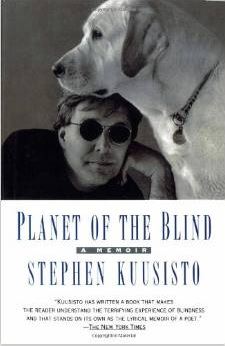
Alone in Boston, Guide Dog Notwithstanding

I’m alone with my guide dog Caitlyn in the back bay of Boston. Tonight we’ll take in a ball game at Fenway Park, home of the Red Sox. Dog and man going solo to a stadium. Sometimes in this blind life I worry in advance: how will it go? Will everything be OK? Will I find my seat? Will I find my way back to my seat after searching for a hot dog? Will strangers be helpful? Will I experience kindness? Then in occurs to me, these questions are ordinary—everyone has them, blindness or not. Will this day receive me? How will it go?

There’s a song by the late great Lou Reed that I like which has the refrain “it takes a bus load of faith to get by…” I’ve always liked Lou’s employment of “faith” which he offers with a hint of irony to be sure. A bus load of faith is a crowd’s worth of faith—we will get where we need to go without mishap. And we’ll manage it because we all had the proper thoughts. We kept that bus on the road with our individual and collective magic. Faith is hard work.

I think this is why I like to just take off and go places by myself. Or with just my dog for company, I feel the skin of my faith grow tighter. I step out into the unfamiliar. I’m alert to the mysteries of being alive and the sheer improbability of having a consciousness. I walk down Boyleston Street and feel how provisionally alive I am and how lucky. And I don’t know precisely where I’m going.

I’ve been teaching this week at a wonderful low residency creative writing MFA program called “Solstice” located at Pine Manor College in Chestnut Hills. As a nonfiction writer I’m often talking about the essay—how creative prose can help us shape experience, make sense of the blooming buzz as they say. One may think of the essay as a soothing corral for the mind. Here is a shape in language within which we can rest, survey, feel a bit less panicked by the wideness of perception. Sometimes a horse, upon entering the corral is instantly calm.

And then there’s the horse who gallops into the shadows and sun beams with no idea where she or he is going.

I think that’s me just now. Enter the day. Get a little lost. Feel again the ache of amazement, that transverse cross of body and mind.

Stephen Kuusisto and HarleyABOUT: Stephen Kuusisto is the author of the memoirs Have Dog, Will Travel; Planet of the Blind (a New York Times “Notable Book of the Year”); and Eavesdropping: A Memoir of Blindness and Listening and of the poetry collections Only Bread, Only Light and Letters to Borges. A graduate of the Iowa Writer’s Workshop and a Fulbright Scholar, he has taught at the University of Iowa, Hobart and William Smith Colleges, and Ohio State University. He currently teaches at Syracuse University where he holds a University Professorship in Disability Studies. He is a frequent speaker in the US and abroad. His website is StephenKuusisto.com.
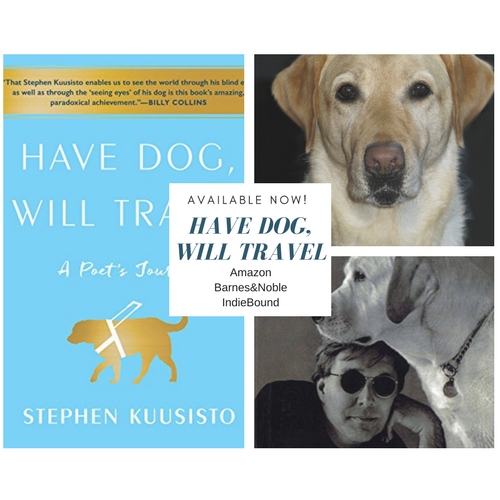
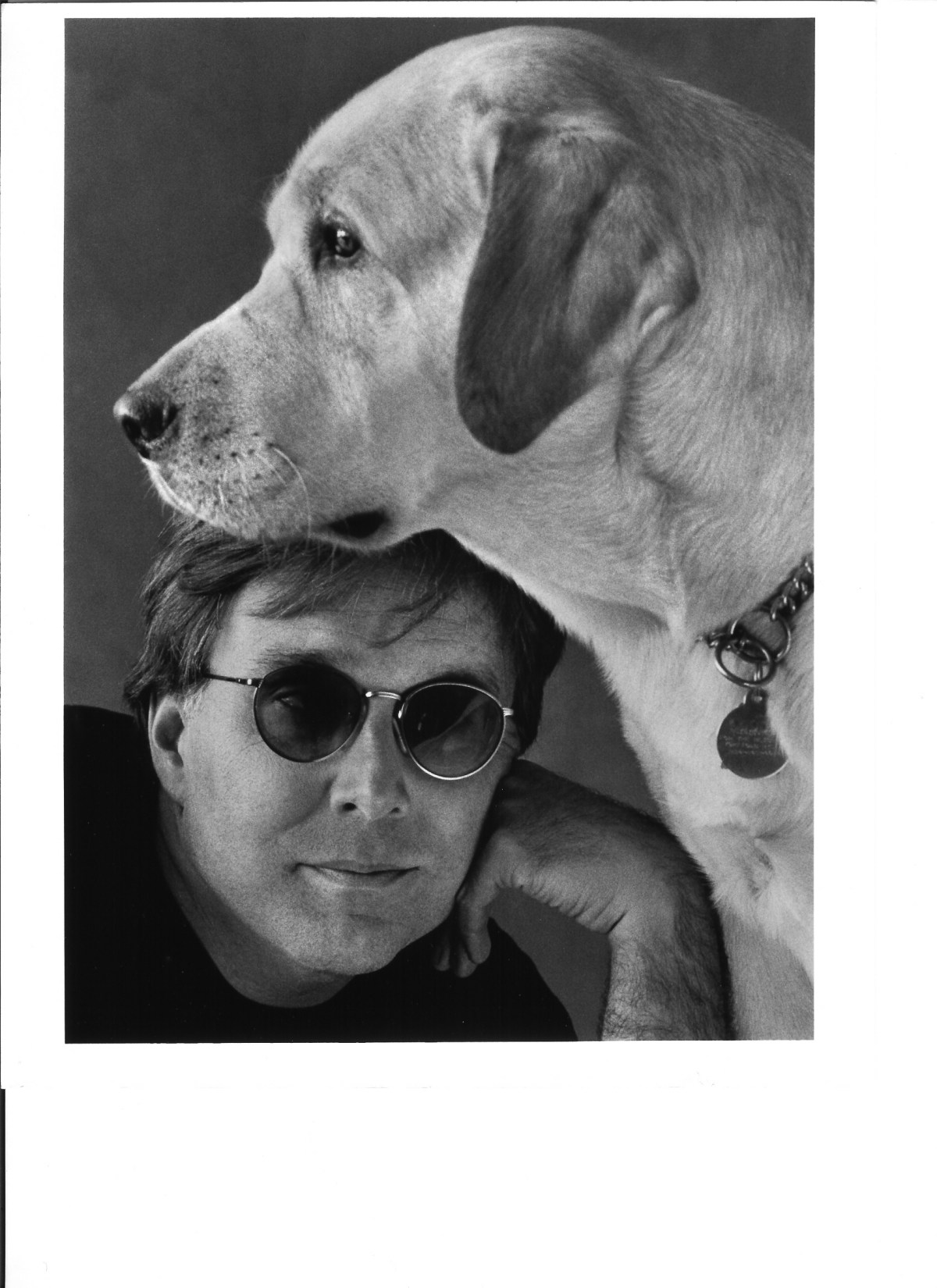
Have Dog, Will Travel: A Poet’s Journey is now available for pre-order:
Amazon
Barnes and Noble
IndieBound.org

Have Dog, Will Travel by Stephen Kuusisto

(Photo picturing the cover of Stephen Kuusisto’s new memoir “Have Dog, Will Travel” along with his former guide dogs Nira (top) and Corky, bottom.) Bottom photo by Marion Ettlinger 

The Ableist Shrug at Licorice University

Ableism: I’m the problem. I didn’t get cured. Didn’t stand up. Couldn’t read the books with my peepers. “Jeepers Creepers, where’d you get those peepers?” 

Good eyes are productive, produce results; bad eyes, get cured baby! 

Ableism: a term no one likes. Like licorice. (No one really likes licorice. Studies have shown this to be true.) 

What if I substitute “licorice” for ableism? Would it be easier to talk about? 

Licorice: a set of beliefs that hold everyone must like licorice. All licorice eaters are equal but some are more equal than others. If you don’t favor Glycyrrhiza glabra you can’t sit at the table. The great big licorice table. 

Note: too much licorice will poison animals and humans. But that doesn’t mean there aren’t whole cities of licorice. 

Side note; when I was a boy in Finland, licorice candies were sold in bite sized pieces, wrapped in wax paper featuring a cartoon of a little black child. 

Licorice is not innocence. 

Ableism: a predominant belief that discrimination against the disabled is just a matter of innocence. E.g. “We really care about disabled people. What’s that? You can’t get basic accommodations? Oh dear. That MUST be awful! I’m sorry you feel that way!”

Ableism: the disabled have ungoverned feelings. That’s their problem. Really. It is their problem not ours. 

I call the example just above “the ableist shrug”—universities are especially good at this. 

Back to licorice: “So Billy, you don’t like licorice? Then you can’t be in our club house!”

Ableism is infantile. 

The shrug is privilege. It’s not convenient to think about those people today. Perhaps we will get to them tomorrow. 

I’m sorry you feel that way.

Candy can represent hegemony. Finnish candy. 

The shrug: we are good people. We care about you. But your accommodation is way down on our list of priorities, because, well, how do I say this? You’re not in our budget. Not in our plans, not convenient, yes, that’s it! You’re really really really not convenient. We love convenience here at Licorice University. We may talk big about being the best! Frankly, business as usual is just fine. We especially like the Licorice Clubhouse. 

Shrug:  the word comes from Late Middle English and it originally meant “to fidget”—and fidget is an early Modern English word meaning “uneasy”—the shrug, the licorice ableist shrug signifies that disability makes the ableist both uneasy and vexed. Having to think about disability is nettlesome. 

When the disabled bring up their problems—lack of access to buildings, bathrooms, educational materials, transportation, zero dignity in the village square, the shrug works this way: 

  • We personalize the problem. 
  • It’s the disabled person’s difficulty not ours.
  • All disabled people are just failed medical patients. 
  • If you can’t be cured, you’re a failure as a human being.
  • While the disabled are talking, we look at our iPhones.
  • We all know there’s something wrong with the disabled, it’s below the surface, like icebergs.
  • You can’t see it, but below the waterline they’ve got bad attitudes. 
  • If the disabled just had better attitudes. 
  • When the disabled say, “we really hate it here” you say: “I’m sorry you feel that way.”
  • Which means the problems are not about accessibility and inclusion but all about the individualized disabled person.

If you were the right kind of disabled, (Tiny Tim for example) you’d be grateful for the little we’ve given you. “I know it’s a dinky crutch, hand made by your impoverished father, but it’s yours Tiny. It’s yours!”


Stephen Kuusisto and HarleyABOUT: Stephen Kuusisto is the author of the memoirs Have Dog, Will Travel; Planet of the Blind (a New York Times “Notable Book of the Year”); and Eavesdropping: A Memoir of Blindness and Listening and of the poetry collections Only Bread, Only Light and Letters to Borges. A graduate of the Iowa Writer’s Workshop and a Fulbright Scholar, he has taught at the University of Iowa, Hobart and William Smith Colleges, and Ohio State University. He currently teaches at Syracuse University where he holds a University Professorship in Disability Studies. He is a frequent speaker in the US and abroad. His website is StephenKuusisto.com.

Have Dog, Will Travel: A Poet’s Journey is now available for pre-order:
Amazon
Barnes and Noble
IndieBound.org

Have Dog, Will Travel by Stephen Kuusisto

(Photo picturing the cover of Stephen Kuusisto’s new memoir “Have Dog, Will Travel” along with his former guide dogs Nira (top) and Corky, bottom.) Bottom photo by Marion Ettlinger