Cranky

I must admit I’m a cranky man. This means I’m a hurdy gurdy man, a street nuisance. Did you know most curbside organ players were disabled? Many were war veterans. Jobless. They played for your amusement. Several cities in America didn’t like them. “Ugly Laws” were adopted across the nation at the turn of the last century—edicts stipulating bothersome, unsightly people were forbidden to appear in public. This was excellent news for the asylum business. The United States loves to lock people up for any reason at all—you’re black and deaf. Asylum. You’re blind. Asylum. You’re an immigrant in Trump’s America. Instant prison camp. Native American. Home detention. Gay? The Asylum. The Los Angeles County Jail is the largest psychiatric facility in the U.S. Cranky? You bet. I’m so cranky I can’t muster irony.

Disabled I know a good deal about cruel irony—“the act of using somebody’s words against them, usually when something to their great detriment is about to be inflicted upon them.”

I’ll never forget an administrator of a certain college who, once he had me behind a closed door told me I wasn’t a competitive blind person, why he had a roommate at university who was a blind Olympic rower and so forth. He was essentially firing me because I’d asked for a reasonable accommodation.

But you see here’s the trap. I’m cranky if I talk back, assert my dignity and my rights. I am especially cranky at the University where when I ask for basic ADA 101 accommodations, (a sighted graduate assistant to help me in my daily work) accessible texts, descriptions of overhead projections, asking that our websites and teaching software be accessible and so forth) I’m labeled as a real cranky pants. Academic ableism is built on cruel irony. “If you were more like us you wouldn’t have a problem. You don’t like what’s happening to you? You must be the problem. Not us. Not us able bodied birdies….”

I’ve met so many able bodied birdies. They may have different kinds of feathers but their song is always the same.

Ableism, the experience of it, requires the French adjective écœurante —for disability discrimination is simultaneously heartless and sickening. I recall the professor of English at the University of Iowa who told me my blindness would preclude me from being in his “famous” graduate class on Charles Olson. Another professor snickered when I said I was reading books on tape. When I protested the chairman of the English department told said I was a whiner and complainer. I wept alone in the Men’s room. My path forward to a Ph.D. in English at the University of Iowa was stymied. This was a full six years before the ADA was signed into law. Who was I to imagine a place at the agora’s marble stump?

Now I had an MFA degree from the creative writing program at that same university and I just went ahead and wrote books and sometimes appeared on radio and television and I wrote for big magazines and over time I received tenure at The Ohio State University. Later I went back to teach at Iowa despite my earlier experience and these days I’m at Syracuse. I’m a survivor of sorts. I’m a blind professor. The odds were never in my favor. Somewhere along the way I began thinking of Moliere in my private moments and I laughed because after all, every human occasion is comical and Moliere recognized the comedic types one encounters in closed societies better than anyone before or since.

It doesn’t really matter what institution of higher education you’re at, if you’re disabled you’ll meet the following Moliere-esque figures. The heartless and sickening ye will always have with ye if you trek onto a college campus. You’re more likely to spot them first if you hail from a historically marginalized background however, the ecoeurantists are more prone to blab at you if you’re disabled, especially behind closed doors. Ableists love closed doors. All bigots love closed doors.

The “Tartuffe” is an administrator, usually a dean or provost who will tell you with affected gestures that he, she, they, what have you, cares a great deal about disability and then, despite the fact a disabled person has outlined a genuine problem, never helps out.

The “Harpagon” is also an administrator, but he, she, they, can also be a faculty member. The Harpagon is driven by rhetorics of cheapness. It will cost too much to retrofit this bathroom, classroom, syllabus, website, etc. If the Harpagon is a professor he, she, they, generally drives a nice car.

Statue du Commandeur: a rigid, punctilious, puritanical college president—“this is the way we’ve always done it. If we changed things for you, we’d have to change things for everybody. Yes, it certainly must be hard…” See:

The Geronte: when his son is kidnapped he says: “Que diable allait-il faire dans cette galère?” (What in the deuce did he want to go on that galley for?” In other words, he brought this upon himself. “Really, shouldn’t you try something easier? I could have told you.”

These are the principle types of ableists. I invite you to add your own.

The one thing they have in common besides a privileged and thoroughly unexamined attachment to the idea that education is a race requiring stamina and deprivation, is that they all genuinely believe that accommodations are a kind of vanity.
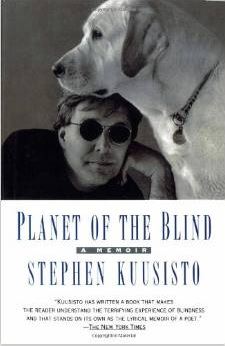
Stephen Kuusisto and HarleyABOUT: Stephen Kuusisto is the author of the memoirs Have Dog, Will Travel; Planet of the Blind (a New York Times “Notable Book of the Year”); and Eavesdropping: A Memoir of Blindness and Listening and of the poetry collections Only Bread, Only Light and Letters to Borges. A graduate of the Iowa Writer’s Workshop and a Fulbright Scholar, he has taught at the University of Iowa, Hobart and William Smith Colleges, and Ohio State University. He currently teaches at Syracuse University where he holds a University Professorship in Disability Studies. He is a frequent speaker in the US and abroad. His website is StephenKuusisto.com.

Have Dog, Will Travel: A Poet’s Journey is now available for pre-order:
Amazon
Barnes and Noble
IndieBound.org
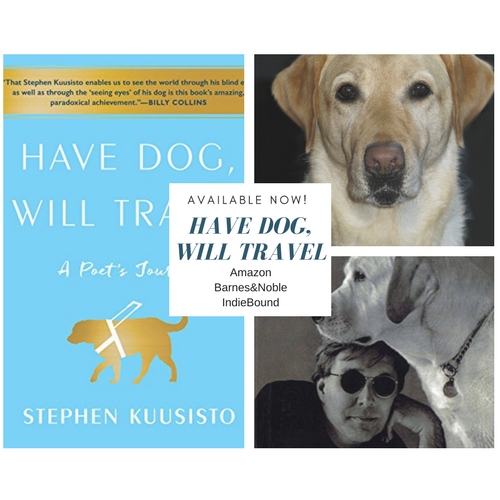
Have Dog, Will Travel by Stephen Kuusisto

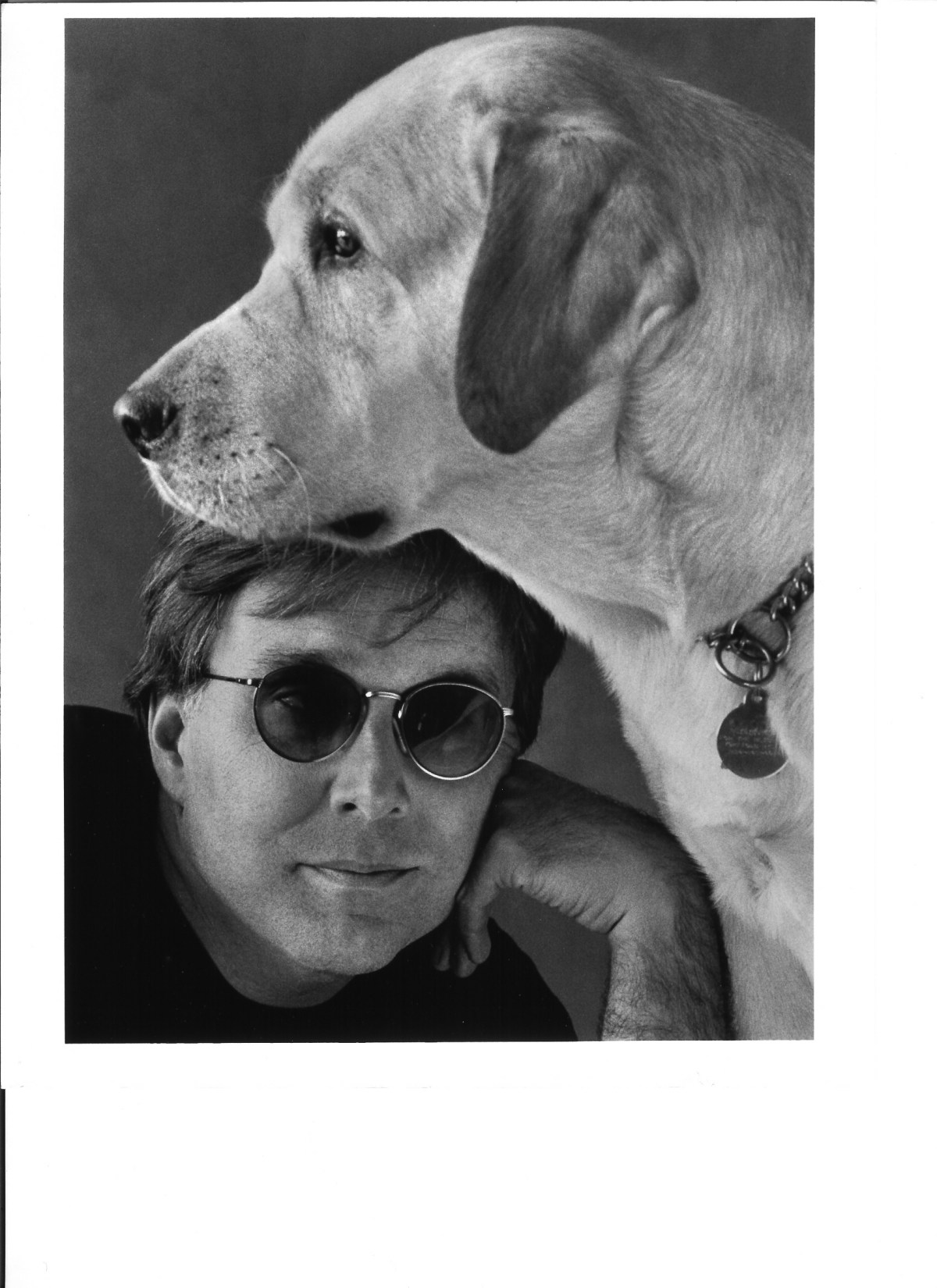
(Photo picturing the cover of Stephen Kuusisto’s new memoir “Have Dog, Will Travel” along with his former guide dogs Nira (top) and Corky, bottom.) Bottom photo by Marion Ettlinger 
Why the Able Bodied Don’t Like Disability in the Arts

I was in residence at an arts colony not long ago when I heard a noted American novelist tell a wide audience that they’d never be so blind and poor of judgment again—referring to (wait for it) a broader appreciation of marginalized art forms.

Blindness as metaphor, indeed all disability as metaphor is offensive and “not cool” anymore. That this occurred at a well heeled arts event doesn’t surprise me. It’s still the case that disability isn’t part of inclusivity in the arts even when some of the most amazing creative work in contemporary America comes from the disability community.

Just so the leading national academic conference for creative writing, the AWP (Association of Writers and Writing Programs) has a long standing problem with disability. They dislike having to provide accommodations at their conferences and they are particularly disdainful to disabled writers.

I’ve come to see this as a matter of resort sales. Years ago I ran training sessions for Sandals and Beaches resorts. The idea was to help beach front hotels become better service providers for the disabled.

One executive said that having disabled people on their property would negatively affect business.

I saw what he meant: all their promotional material featured photos of sleek, gym toned, happy looking people. Some were white, some were from different ethnicities. But the point was everyone was very very attractive.

When you look at the photos featured on the AWP’s website you’ll notice that all the writers look like they’ve just come from the gym.

When you look at the photos from arts colonies you’ll notice that everyone looks like they’ve just come from the very same gym.

That the arts industry (such as it is) has so little awareness (such as it might be) about it’s devotion to normality is telling. Diversity is OK if it’s about race, gender, sexual orientation, but it’s not applicable if you use a walker, a stick, talk with your hands, walk with a guide dog, etc. Everyone knows that disability art isn’t real art. It is something else, isn’t it?

Adrienne Rich, Virginia Woolf, William Carlos Williams, Audre Lorde, Stanley Elkin, Robert Lowell, Andre Dubus, Walt Whitman, Hart Crane—all were disabled. Some walked with canes, some stuttered, some used wheelchairs. None looked like they were fresh from the spa.

In the narrow confines of American art, which let’s admit is academic art, it’s still the case that when illness is thought of at all, it’s imagined as something to be overcome. The arts in America are driven by the medical model of embodiment.

Try explaining this to the arts administrators. They’ll say, as indeed someone at the AWP said to a room full of disabled writers, “your time hasn’t come yet.”

Stephen Kuusisto and HarleyABOUT: Stephen Kuusisto is the author of the memoirs Have Dog, Will Travel; Planet of the Blind (a New York Times “Notable Book of the Year”); and Eavesdropping: A Memoir of Blindness and Listening and of the poetry collections Only Bread, Only Light and Letters to Borges. A graduate of the Iowa Writer’s Workshop and a Fulbright Scholar, he has taught at the University of Iowa, Hobart and William Smith Colleges, and Ohio State University. He currently teaches at Syracuse University where he holds a University Professorship in Disability Studies. He is a frequent speaker in the US and abroad. His website is StephenKuusisto.com.

Have Dog, Will Travel: A Poet’s Journey is now available for pre-order:
Amazon
Barnes and Noble
IndieBound.org

Have Dog, Will Travel by Stephen Kuusisto

(Photo picturing the cover of Stephen Kuusisto’s new memoir “Have Dog, Will Travel” along with his former guide dogs Nira (top) and Corky, bottom.) Bottom photo by Marion Ettlinger 

Her hands in the stream…

You can tell me about Helen Keller
But you can’t say what words
Perform on the inside.

Have you seen a cormorant
Drop from on high
And enter the sea?

That’s my Helen Keller—
That falling…

ie Kuusisto :
Stephen Kuusisto and HarleyABOUT: Stephen Kuusisto is the author of the memoirs Have Dog, Will Travel; Planet of the Blind (a New York Times “Notable Book of the Year”); and Eavesdropping: A Memoir of Blindness and Listening and of the poetry collections Only Bread, Only Light and Letters to Borges. A graduate of the Iowa Writer’s Workshop and a Fulbright Scholar, he has taught at the University of Iowa, Hobart and William Smith Colleges, and Ohio State University. He currently teaches at Syracuse University where he holds a University Professorship in Disability Studies. He is a frequent speaker in the US and abroad. His website is StephenKuusisto.com.

Have Dog, Will Travel: A Poet’s Journey is now available for pre-order:
Amazon
Barnes and Noble
IndieBound.org

Have Dog, Will Travel by Stephen Kuusisto

(Photo picturing the cover of Stephen Kuusisto’s new memoir “Have Dog, Will Travel” along with his former guide dogs Nira (top) and Corky, bottom.) Bottom photo by Marion Ettlinger 
The Poetry Conference

They see me walking with my stick or dog
And like a wisp of curtains
I hear their assumptions—
That I’ve been admitted by mistake
Or I must be lost
Surely poems require sight?

Screw Homer; who reads Milton?
Big time poets know blindness
Stands for something something—
Didn’t Rilke touch on it—
A blind man clutches a gray woman
And is lost forever in dark infancies?

That blind woman who writes verses—
She must be a bird
Something something
Maybe related to language
Her poems like feathers
Or yarrow stalks.

“How do you write so clearly
If you can’t see?”
“How do you read?”
“Would you have been a writer
If you had sight?”
“Can you see me at all?”

Stephen Kuusisto and HarleyABOUT: Stephen Kuusisto is the author of the memoirs Have Dog, Will Travel; Planet of the Blind (a New York Times “Notable Book of the Year”); and Eavesdropping: A Memoir of Blindness and Listening and of the poetry collections Only Bread, Only Light and Letters to Borges. A graduate of the Iowa Writer’s Workshop and a Fulbright Scholar, he has taught at the University of Iowa, Hobart and William Smith Colleges, and Ohio State University. He currently teaches at Syracuse University where he holds a University Professorship in Disability Studies. He is a frequent speaker in the US and abroad. His website is StephenKuusisto.com.

Have Dog, Will Travel: A Poet’s Journey is now available for pre-order:
Amazon
Barnes and Noble
IndieBound.org

Have Dog, Will Travel by Stephen Kuusisto

(Photo picturing the cover of Stephen Kuusisto’s new memoir “Have Dog, Will Travel” along with his former guide dogs Nira (top) and Corky, bottom.) Bottom photo by Marion Ettlinger 
The Shoes of the Preparation of the Gospel of Peace

Once I dropped a spoon in the snow and when I couldn’t retrieve it I was tempted to view the matter as a comment on my life.

I imagined a balloon-like God who’d seen me groping in snow.

In general it helps to think of God as a Macy’s balloon.

In general one’s groping has no meaning.

Still, poking in shadows is central to blindness.

I search for my shoe in a strange hotel.

Perhaps a sighted person finds the shoe instantly.

I lie on the floor spreading my arms like a diver.

Shoe. No shoe. Shoe of the mind. Platonic.

Fingers scrabbling under the inauspicious bed.

Carl Jung said: The shoe that fits one person pinches another; there is no recipe for living that suits all cases.

What of the lost shoe?

Are not all lost shoes equal?

To find a shoe in a foreign hotel.

Eyes evolved for only this…

Stephen Kuusisto and HarleyABOUT: Stephen Kuusisto is the author of the memoirs Have Dog, Will Travel; Planet of the Blind (a New York Times “Notable Book of the Year”); and Eavesdropping: A Memoir of Blindness and Listening and of the poetry collections Only Bread, Only Light and Letters to Borges. A graduate of the Iowa Writer’s Workshop and a Fulbright Scholar, he has taught at the University of Iowa, Hobart and William Smith Colleges, and Ohio State University. He currently teaches at Syracuse University where he holds a University Professorship in Disability Studies. He is a frequent speaker in the US and abroad. His website is StephenKuusisto.com.

Have Dog, Will Travel: A Poet’s Journey is now available for pre-order:
Amazon
Barnes and Noble
IndieBound.org

Have Dog, Will Travel by Stephen Kuusisto

(Photo picturing the cover of Stephen Kuusisto’s new memoir “Have Dog, Will Travel” along with his former guide dogs Nira (top) and Corky, bottom.) Bottom photo by Marion Ettlinger 

Of Ableism and the Lucky Rabbit’s Foot

Life proceeds without plot no matter you went to a good school or studied well—a matter which Americans have difficulty absorbing. This is why people in the United States don’t generally believe in luck.

I’ll venture in some circumstances I’m fortunate. I married well; I’ve more than a few scrupulous friends; I’ve a job. The job is no small thing given the unemployment statistics with regard to disability.

Still I will say I’ve been lucky. I did not make my own luck. This I do not believe. This I do not believe it at all. As Christopher Hitchens once put it: “It’s one thing to be lucky: it’s another thing to admit that luck has been yours.” This is the other thing.

You may have talent. Perhaps you imagine it was your inheritance. Your skill with musical composition comes down from your great great grandmother. It’s all a matter of epigenetics. You imagine this DNA bequest isn’t luck until things go badly and when they go very badly you curse your ancestors. As a general rule Americans only curse their ancestors when they become ill. The greatest American irony of all—each unassuming citizen believes he or she is secretly bred monarchial, a thing Huck Finn encounters when he meets the Duke and Dauphin.

So health isn’t a matter of luck; fortune less so; skill of any kind is scientifically deterministic. Karl Marx never had a chance in the USA as Americans hold that capital is not acquired on the backs of the less fortunate. Fortune was always yours even when it wasn’t apparent and admissions of luck take the hind most.

I am on about this, I admit, because I’ve had it with academics and/or artists who can’t admire the sheer improbability of their success and thereby think the disabled are not only malformed but should be seen as figures deserving (or not deserving) charity.

Ableism is the consequence of a broad misunderstanding or disavowal of luck which is why it’s dangerous for all, not just the disabled. It’s not a far jump from “I earned my money by the sweat of my brow” to “I absolutely deserve to have a designer baby and a designer death.” To dwell on luck is to admit life proceeds without plot as we’ve already noted which is a terrifying idea. Life is life and not what we may wish it though wishes can be admirable and striving is noble.

Now I’ve said I’m lucky. Forty years ago a teacher saw my talent for writing. Professor X encouraged me. I wrote. More professors encouraged me. I wrote some more. Kept at it. Was blind and scarcely employable but writing I could do. People who were not me or my parents said I had writerly capacities. My professional life has been the product of a village, not a matter of tirelessness or Bohemian ambition.

Ableism imagines the singularity of talent or health—beauty or success is the de facto state of affairs of embodiment. If you’re not in the group you’re not of the elect. This is important: not of the elect means the wrongness of you is ordained—either by God or DNA. Ableism imagines that the good body is the proper one; the deformed body is a poor inheritance. Ableism can only admit luck when the healthy say upon seeing the disabled: “there but for the grace of God go I”.

Bioethicists now argue whether disability viewed as a social construction and therefore a component of all humanity “should” or “should not” be so conceived. If disability isn’t exceptional and is part of the “new normal” then the utilitarian prospects for all humankind are diminished—so the argument goes—for we’ll stop trying to cure diseases and poor health will be perfectly OK. The few opposing bioethicists say, “disability ye will always have with ye, isn’t it best to include it in our best thinking?”

But you see, it’s the same luck argument all over again. Who gets to be lucky? How much should we acknowledge it? Isn’t it best to imagine you’ve made it on your own?

Stephen Kuusisto and HarleyABOUT: Stephen Kuusisto is the author of the memoirs Have Dog, Will Travel; Planet of the Blind (a New York Times “Notable Book of the Year”); and Eavesdropping: A Memoir of Blindness and Listening and of the poetry collections Only Bread, Only Light and Letters to Borges. A graduate of the Iowa Writer’s Workshop and a Fulbright Scholar, he has taught at the University of Iowa, Hobart and William Smith Colleges, and Ohio State University. He currently teaches at Syracuse University where he holds a University Professorship in Disability Studies. He is a frequent speaker in the US and abroad. His website is StephenKuusisto.com.

Have Dog, Will Travel: A Poet’s Journey is now available for pre-order:
Amazon
Barnes and Noble
IndieBound.org

Have Dog, Will Travel by Stephen Kuusisto

(Photo picturing the cover of Stephen Kuusisto’s new memoir “Have Dog, Will Travel” along with his former guide dogs Nira (top) and Corky, bottom.) Bottom photo by Marion Ettlinger 

Alone in Boston, Guide Dog Notwithstanding

I’m alone with my guide dog Caitlyn in the back bay of Boston. Tonight we’ll take in a ball game at Fenway Park, home of the Red Sox. Dog and man going solo to a stadium. Sometimes in this blind life I worry in advance: how will it go? Will everything be OK? Will I find my seat? Will I find my way back to my seat after searching for a hot dog? Will strangers be helpful? Will I experience kindness? Then in occurs to me, these questions are ordinary—everyone has them, blindness or not. Will this day receive me? How will it go?

There’s a song by the late great Lou Reed that I like which has the refrain “it takes a bus load of faith to get by…” I’ve always liked Lou’s employment of “faith” which he offers with a hint of irony to be sure. A bus load of faith is a crowd’s worth of faith—we will get where we need to go without mishap. And we’ll manage it because we all had the proper thoughts. We kept that bus on the road with our individual and collective magic. Faith is hard work.

I think this is why I like to just take off and go places by myself. Or with just my dog for company, I feel the skin of my faith grow tighter. I step out into the unfamiliar. I’m alert to the mysteries of being alive and the sheer improbability of having a consciousness. I walk down Boyleston Street and feel how provisionally alive I am and how lucky. And I don’t know precisely where I’m going.

I’ve been teaching this week at a wonderful low residency creative writing MFA program called “Solstice” located at Pine Manor College in Chestnut Hills. As a nonfiction writer I’m often talking about the essay—how creative prose can help us shape experience, make sense of the blooming buzz as they say. One may think of the essay as a soothing corral for the mind. Here is a shape in language within which we can rest, survey, feel a bit less panicked by the wideness of perception. Sometimes a horse, upon entering the corral is instantly calm.

And then there’s the horse who gallops into the shadows and sun beams with no idea where she or he is going.

I think that’s me just now. Enter the day. Get a little lost. Feel again the ache of amazement, that transverse cross of body and mind.

Stephen Kuusisto and HarleyABOUT: Stephen Kuusisto is the author of the memoirs Have Dog, Will Travel; Planet of the Blind (a New York Times “Notable Book of the Year”); and Eavesdropping: A Memoir of Blindness and Listening and of the poetry collections Only Bread, Only Light and Letters to Borges. A graduate of the Iowa Writer’s Workshop and a Fulbright Scholar, he has taught at the University of Iowa, Hobart and William Smith Colleges, and Ohio State University. He currently teaches at Syracuse University where he holds a University Professorship in Disability Studies. He is a frequent speaker in the US and abroad. His website is StephenKuusisto.com.

Have Dog, Will Travel: A Poet’s Journey is now available for pre-order:
Amazon
Barnes and Noble
IndieBound.org

Have Dog, Will Travel by Stephen Kuusisto

(Photo picturing the cover of Stephen Kuusisto’s new memoir “Have Dog, Will Travel” along with his former guide dogs Nira (top) and Corky, bottom.) Bottom photo by Marion Ettlinger 

Wittgenstein for Breakfast

From a Notebook circa 1990: 

Comic irony: the condition of knowing what you didn’t know just seconds ago or years back and then, knowing how to think about it. 

Tragic irony: the condition of not knowing the above while others do. 

Morning irony: understanding you’ve the blues and knowing you’ll have to work with them all day. 

Evening irony: seeing how the blues at 6 AM were correct or incorrect. 

Luck stands between the above like an 18th century lamp lighter. 

“What did the president know and when did he know it?” was not, as many believe, a political or juridical question, but one connoting either comic or tragic irony. Nixon is one of the few public figures to have had both. He knew he’d broken the law. He didn’t know quite how he came to be a law breaker. His answer, deflective, was to say “everybody does this….”

Whenever you hear someone say, “everybody does this,” remember the double tragic irony of not knowing which camp above you fit into. 

I’ve always liked James Tate’s line: “curses on those who do or do not take dope.”

**

Memory

I loved my mother

She was always a such dark person

I see her everywhere in the woods

Muisti

Rakastin äitiäni

Hän oli aina tumma henkilö

Näen hänet kaikkialla metsässä

**

I guess there’s another category: forest irony. Where you recognize the animism of your subconscious. 

**

I think of Ludwig Wittgenstein some mornings. Isn’t that odd? He occurs to me very early. 

Usually it’s this quote that pops into my waking noggin:

“Death is not an event in life: we do not live to experience death. If we take eternity to mean not infinite temporal duration but timelessness, then eternal life belongs to those who live in the present. Our life has no end in the way in which our visual field has no limits.” 

Oh I like this for lots of reasons. As a visually limited man I admire the temerity of the utterance, insofar as all humans have some kind of visual limitation. Wittgenstein posits the power of imagination to declare anything, and then, with a smear of logic, to cement an idea into consciousness. I suspect this is how he survived the trenches in WW I. And I know for certain its how the disabled survive. Look at the nouns: 

Death. Event. Life. Experience. Eternity. Duration. 

In my sophomore year of college I was fascinated by Boolean algebra. In mathematical logic, Boolean algebra is the “branch of algebra in which the values of the variables are the truth values true and false, usually denoted 1 and 0 respectively.” (See Wikipedia.) 

The quote above is pure Boolean logic. One may easily draw a Boolean equation for the proposition eternal life belongs to those who live in the present. Then there’s a leap—Wittgenstein says our visual field has no limits. 

If eternity = timelessness then the present (time) also equals timelessness. Good. 

If timelessness is related to mindfulness (we take eternity to mean not infinite temporal duration) then the operations of mind become our vision. Hence our visual field (anyone’s) has no limit. 

You can see where the poet in me would like this. You can see where the blind person in me also admires it. 

As logic it is unimpeachable. The trick is to live it. 

Early. Wittgenstein for breakfast. 


Stephen Kuusisto and HarleyABOUT: Stephen Kuusisto is the author of the memoirs Have Dog, Will Travel; Planet of the Blind (a New York Times “Notable Book of the Year”); and Eavesdropping: A Memoir of Blindness and Listening and of the poetry collections Only Bread, Only Light and Letters to Borges. A graduate of the Iowa Writer’s Workshop and a Fulbright Scholar, he has taught at the University of Iowa, Hobart and William Smith Colleges, and Ohio State University. He currently teaches at Syracuse University where he holds a University Professorship in Disability Studies. He is a frequent speaker in the US and abroad. His website is StephenKuusisto.com.

Have Dog, Will Travel: A Poet’s Journey is now available for pre-order:
Amazon
Barnes and Noble
IndieBound.org

Have Dog, Will Travel by Stephen Kuusisto

(Photo picturing the cover of Stephen Kuusisto’s new memoir “Have Dog, Will Travel” along with his former guide dogs Nira (top) and Corky, bottom.) Bottom photo by Marion Ettlinger 

The Ableist Shrug at Licorice University

Ableism: I’m the problem. I didn’t get cured. Didn’t stand up. Couldn’t read the books with my peepers. “Jeepers Creepers, where’d you get those peepers?” 

Good eyes are productive, produce results; bad eyes, get cured baby! 

Ableism: a term no one likes. Like licorice. (No one really likes licorice. Studies have shown this to be true.) 

What if I substitute “licorice” for ableism? Would it be easier to talk about? 

Licorice: a set of beliefs that hold everyone must like licorice. All licorice eaters are equal but some are more equal than others. If you don’t favor Glycyrrhiza glabra you can’t sit at the table. The great big licorice table. 

Note: too much licorice will poison animals and humans. But that doesn’t mean there aren’t whole cities of licorice. 

Side note; when I was a boy in Finland, licorice candies were sold in bite sized pieces, wrapped in wax paper featuring a cartoon of a little black child. 

Licorice is not innocence. 

Ableism: a predominant belief that discrimination against the disabled is just a matter of innocence. E.g. “We really care about disabled people. What’s that? You can’t get basic accommodations? Oh dear. That MUST be awful! I’m sorry you feel that way!”

Ableism: the disabled have ungoverned feelings. That’s their problem. Really. It is their problem not ours. 

I call the example just above “the ableist shrug”—universities are especially good at this. 

Back to licorice: “So Billy, you don’t like licorice? Then you can’t be in our club house!”

Ableism is infantile. 

The shrug is privilege. It’s not convenient to think about those people today. Perhaps we will get to them tomorrow. 

I’m sorry you feel that way.

Candy can represent hegemony. Finnish candy. 

The shrug: we are good people. We care about you. But your accommodation is way down on our list of priorities, because, well, how do I say this? You’re not in our budget. Not in our plans, not convenient, yes, that’s it! You’re really really really not convenient. We love convenience here at Licorice University. We may talk big about being the best! Frankly, business as usual is just fine. We especially like the Licorice Clubhouse. 

Shrug:  the word comes from Late Middle English and it originally meant “to fidget”—and fidget is an early Modern English word meaning “uneasy”—the shrug, the licorice ableist shrug signifies that disability makes the ableist both uneasy and vexed. Having to think about disability is nettlesome. 

When the disabled bring up their problems—lack of access to buildings, bathrooms, educational materials, transportation, zero dignity in the village square, the shrug works this way: 

  • We personalize the problem. 
  • It’s the disabled person’s difficulty not ours.
  • All disabled people are just failed medical patients. 
  • If you can’t be cured, you’re a failure as a human being.
  • While the disabled are talking, we look at our iPhones.
  • We all know there’s something wrong with the disabled, it’s below the surface, like icebergs.
  • You can’t see it, but below the waterline they’ve got bad attitudes. 
  • If the disabled just had better attitudes. 
  • When the disabled say, “we really hate it here” you say: “I’m sorry you feel that way.”
  • Which means the problems are not about accessibility and inclusion but all about the individualized disabled person.

If you were the right kind of disabled, (Tiny Tim for example) you’d be grateful for the little we’ve given you. “I know it’s a dinky crutch, hand made by your impoverished father, but it’s yours Tiny. It’s yours!”


Stephen Kuusisto and HarleyABOUT: Stephen Kuusisto is the author of the memoirs Have Dog, Will Travel; Planet of the Blind (a New York Times “Notable Book of the Year”); and Eavesdropping: A Memoir of Blindness and Listening and of the poetry collections Only Bread, Only Light and Letters to Borges. A graduate of the Iowa Writer’s Workshop and a Fulbright Scholar, he has taught at the University of Iowa, Hobart and William Smith Colleges, and Ohio State University. He currently teaches at Syracuse University where he holds a University Professorship in Disability Studies. He is a frequent speaker in the US and abroad. His website is StephenKuusisto.com.

Have Dog, Will Travel: A Poet’s Journey is now available for pre-order:
Amazon
Barnes and Noble
IndieBound.org

Have Dog, Will Travel by Stephen Kuusisto

(Photo picturing the cover of Stephen Kuusisto’s new memoir “Have Dog, Will Travel” along with his former guide dogs Nira (top) and Corky, bottom.) Bottom photo by Marion Ettlinger 

Disabling Your Enemy is Terrorism

During the past month of demonstrations along the border between Gaza and Israel, at least 17 Palestinians have suffered gunshot wounds that ultimately cost them their legs, according to the Palestinian Health Ministry in Gaza.

The Washington Post

Lest it’s lost on anyone the purpose of warfare is not to destroy enemy combatants but to shatter their village square. Disablement is a strategy, rape is a policy, affecting civilian casualties, all are matters of policy.

Disablement isn’t an unfortunate side effect of protests in Gaza as the Israeli Defense Force’s argument has it. Disabling civilians is overtly designed to shatter not just legs but the human will to freedom and dignity. What is the best semiotic for imprisonment and despair? Disability of course. Disability as a practice of war is criminal. It doesn’t matter who is producing the disablement. Disabling your enemy is an act of terror.

Terrorism is defined in Title 22 Chapter 38 U.S. Code § 2656f as “premeditated, politically motivated violence perpetrated against noncombatant targets by subnational groups or clandestine agents.”

Nations that paralyze their enemies should be forced to pay for their health care.

Think how quickly that would put a stop to war.

Yeah. That’s what I think.

Two days ago I took an Uber ride. My driver was from Iraq. He told me that his wife has a master’s degree, he has a master’s, his children are in college in the US.

I told him how angry and ashamed I am that the United States has killed one million civilians in his land.

He got out of the car and we hugged. We stood there, uneasily on the street, my guide dog looking on. Who provides guide dogs to Iraqi children? No one.

Stephen Kuusisto and HarleyABOUT: Stephen Kuusisto is the author of the memoirs Have Dog, Will Travel; Planet of the Blind (a New York Times “Notable Book of the Year”); and Eavesdropping: A Memoir of Blindness and Listening and of the poetry collections Only Bread, Only Light and Letters to Borges. A graduate of the Iowa Writer’s Workshop and a Fulbright Scholar, he has taught at the University of Iowa, Hobart and William Smith Colleges, and Ohio State University. He currently teaches at Syracuse University where he holds a University Professorship in Disability Studies. He is a frequent speaker in the US and abroad. His website is StephenKuusisto.com.

Have Dog, Will Travel: A Poet’s Journey is now available for pre-order:
Amazon
Barnes and Noble
IndieBound.org

Have Dog, Will Travel by Stephen Kuusisto

(Photo picturing the cover of Stephen Kuusisto’s new memoir “Have Dog, Will Travel” along with his former guide dogs Nira (top) and Corky, bottom.) Bottom photo by Marion Ettlinger