Her hands in the stream…

You can tell me about Helen Keller
But you can’t say what words
Perform on the inside.

Have you seen a cormorant
Drop from on high
And enter the sea?

That’s my Helen Keller—
That falling…

ie Kuusisto :
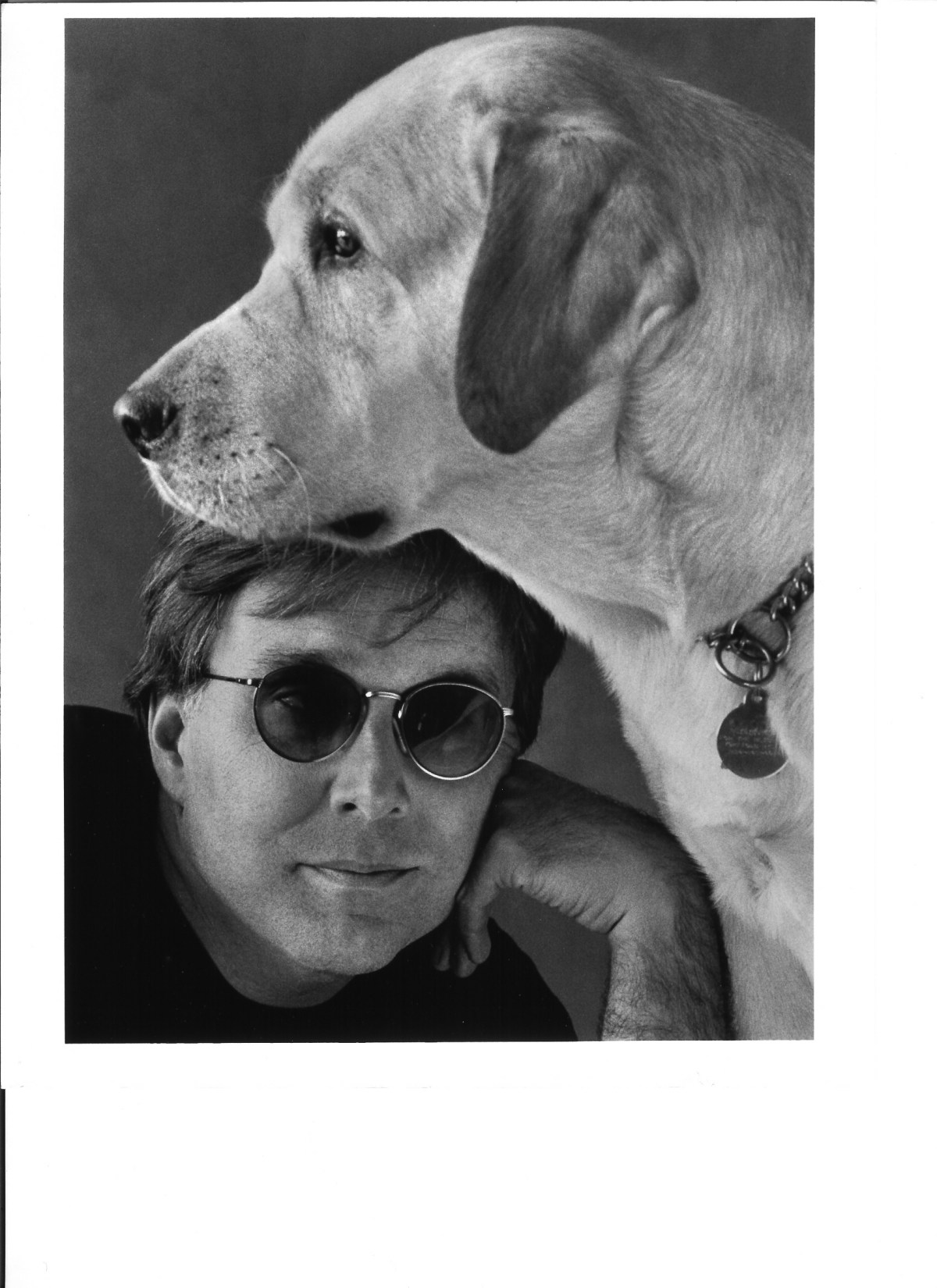
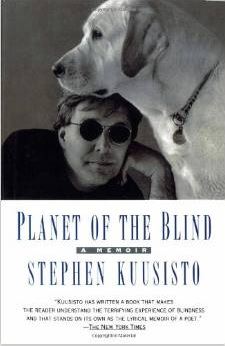
Stephen Kuusisto and HarleyABOUT: Stephen Kuusisto is the author of the memoirs Have Dog, Will Travel; Planet of the Blind (a New York Times “Notable Book of the Year”); and Eavesdropping: A Memoir of Blindness and Listening and of the poetry collections Only Bread, Only Light and Letters to Borges. A graduate of the Iowa Writer’s Workshop and a Fulbright Scholar, he has taught at the University of Iowa, Hobart and William Smith Colleges, and Ohio State University. He currently teaches at Syracuse University where he holds a University Professorship in Disability Studies. He is a frequent speaker in the US and abroad. His website is StephenKuusisto.com.

Have Dog, Will Travel: A Poet’s Journey is now available for pre-order:
Amazon
Barnes and Noble
IndieBound.org

Have Dog, Will Travel by Stephen Kuusisto

(Photo picturing the cover of Stephen Kuusisto’s new memoir “Have Dog, Will Travel” along with his former guide dogs Nira (top) and Corky, bottom.) Bottom photo by Marion Ettlinger 

Faeries, come…

All those who believe I’m vagrant—blind as I am
Walking with my stick or dog—
That woman in Boston who hoped to pray for me
Who ran away when I offered to pray for her,
What’s wrong with a disabled prayer?
I stood in the street and waved my arms.
In London a girl called me “poor Dearie”
And thrust coins in my hands.
Once in Cleveland a red faced man
Followed me block after block
Proposing to help…better I thought
Than the alternatives—
The asylum; the work houses.
In general the poets of my nation
See the blind as an existential blank.
But tired of standing for nothing
I sing and walk down Broadway
The sweet, manifold, wishful syllables
Of William Yeats—
Faeries, come take me out of this dull world,
For I would ride with you upon the wind,
Run on the top of the dishevelled tide,
And dance upon the mountains like a flame.

Stephen Kuusisto and HarleyABOUT: Stephen Kuusisto is the author of the memoirs Have Dog, Will Travel; Planet of the Blind (a New York Times “Notable Book of the Year”); and Eavesdropping: A Memoir of Blindness and Listening and of the poetry collections Only Bread, Only Light and Letters to Borges. A graduate of the Iowa Writer’s Workshop and a Fulbright Scholar, he has taught at the University of Iowa, Hobart and William Smith Colleges, and Ohio State University. He currently teaches at Syracuse University where he holds a University Professorship in Disability Studies. He is a frequent speaker in the US and abroad. His website is StephenKuusisto.com.

Have Dog, Will Travel: A Poet’s Journey is now available for pre-order:
Amazon
Barnes and Noble
IndieBound.org

Have Dog, Will Travel by Stephen Kuusisto

(Photo picturing the cover of Stephen Kuusisto’s new memoir “Have Dog, Will Travel” along with his former guide dogs Nira (top) and Corky, bottom.) Bottom photo by Marion Ettlinger 

The Poetry Conference

They see me walking with my stick or dog
And like a wisp of curtains
I hear their assumptions—
That I’ve been admitted by mistake
Or I must be lost
Surely poems require sight?

Screw Homer; who reads Milton?
Big time poets know blindness
Stands for something something—
Didn’t Rilke touch on it—
A blind man clutches a gray woman
And is lost forever in dark infancies?

That blind woman who writes verses—
She must be a bird
Something something
Maybe related to language
Her poems like feathers
Or yarrow stalks.

“How do you write so clearly
If you can’t see?”
“How do you read?”
“Would you have been a writer
If you had sight?”
“Can you see me at all?”

Stephen Kuusisto and HarleyABOUT: Stephen Kuusisto is the author of the memoirs Have Dog, Will Travel; Planet of the Blind (a New York Times “Notable Book of the Year”); and Eavesdropping: A Memoir of Blindness and Listening and of the poetry collections Only Bread, Only Light and Letters to Borges. A graduate of the Iowa Writer’s Workshop and a Fulbright Scholar, he has taught at the University of Iowa, Hobart and William Smith Colleges, and Ohio State University. He currently teaches at Syracuse University where he holds a University Professorship in Disability Studies. He is a frequent speaker in the US and abroad. His website is StephenKuusisto.com.

Have Dog, Will Travel: A Poet’s Journey is now available for pre-order:
Amazon
Barnes and Noble
IndieBound.org

Have Dog, Will Travel by Stephen Kuusisto

(Photo picturing the cover of Stephen Kuusisto’s new memoir “Have Dog, Will Travel” along with his former guide dogs Nira (top) and Corky, bottom.) Bottom photo by Marion Ettlinger 

The Shoes of the Preparation of the Gospel of Peace

Once I dropped a spoon in the snow and when I couldn’t retrieve it I was tempted to view the matter as a comment on my life.

I imagined a balloon-like God who’d seen me groping in snow.

In general it helps to think of God as a Macy’s balloon.

In general one’s groping has no meaning.

Still, poking in shadows is central to blindness.

I search for my shoe in a strange hotel.

Perhaps a sighted person finds the shoe instantly.

I lie on the floor spreading my arms like a diver.

Shoe. No shoe. Shoe of the mind. Platonic.

Fingers scrabbling under the inauspicious bed.

Carl Jung said: The shoe that fits one person pinches another; there is no recipe for living that suits all cases.

What of the lost shoe?

Are not all lost shoes equal?

To find a shoe in a foreign hotel.

Eyes evolved for only this…

Stephen Kuusisto and HarleyABOUT: Stephen Kuusisto is the author of the memoirs Have Dog, Will Travel; Planet of the Blind (a New York Times “Notable Book of the Year”); and Eavesdropping: A Memoir of Blindness and Listening and of the poetry collections Only Bread, Only Light and Letters to Borges. A graduate of the Iowa Writer’s Workshop and a Fulbright Scholar, he has taught at the University of Iowa, Hobart and William Smith Colleges, and Ohio State University. He currently teaches at Syracuse University where he holds a University Professorship in Disability Studies. He is a frequent speaker in the US and abroad. His website is StephenKuusisto.com.

Have Dog, Will Travel: A Poet’s Journey is now available for pre-order:
Amazon
Barnes and Noble
IndieBound.org

Have Dog, Will Travel by Stephen Kuusisto

(Photo picturing the cover of Stephen Kuusisto’s new memoir “Have Dog, Will Travel” along with his former guide dogs Nira (top) and Corky, bottom.) Bottom photo by Marion Ettlinger 

Rain in a bucket and the hours spent listening….

After arguments with books
I often lie on the floor

That’s how it is and of course the rain

**

Oh that Monteverdi
Oh the radio

**

Dreamt last night something something discarded clothing someone leaving

**

Lumen pelko—Finnish for the fear of snow

**

Meanwhile asks himself
Do you remember the magnificent feeling
Sneaking up on shadows?

Childhood blindness….

**

Most readers of poetry haven’t lain on floors listening to day long rain
It takes privilege to be stripped productively

You old damned Bohemian you….

**

Orfeo….peeks out from behind the birches

Stephen Kuusisto and HarleyABOUT: Stephen Kuusisto is the author of the memoirs Have Dog, Will Travel; Planet of the Blind (a New York Times “Notable Book of the Year”); and Eavesdropping: A Memoir of Blindness and Listening and of the poetry collections Only Bread, Only Light and Letters to Borges. A graduate of the Iowa Writer’s Workshop and a Fulbright Scholar, he has taught at the University of Iowa, Hobart and William Smith Colleges, and Ohio State University. He currently teaches at Syracuse University where he holds a University Professorship in Disability Studies. He is a frequent speaker in the US and abroad. His website is StephenKuusisto.com.

Have Dog, Will Travel: A Poet’s Journey is now available for pre-order:
Amazon
Barnes and Noble
IndieBound.org

Have Dog, Will Travel by Stephen Kuusisto

(Photo picturing the cover of Stephen Kuusisto’s new memoir “Have Dog, Will Travel” along with his former guide dogs Nira (top) and Corky, bottom.) Bottom photo by Marion Ettlinger 

Of Ableism and the Lucky Rabbit’s Foot

Life proceeds without plot no matter you went to a good school or studied well—a matter which Americans have difficulty absorbing. This is why people in the United States don’t generally believe in luck.

I’ll venture in some circumstances I’m fortunate. I married well; I’ve more than a few scrupulous friends; I’ve a job. The job is no small thing given the unemployment statistics with regard to disability.

Still I will say I’ve been lucky. I did not make my own luck. This I do not believe. This I do not believe it at all. As Christopher Hitchens once put it: “It’s one thing to be lucky: it’s another thing to admit that luck has been yours.” This is the other thing.

You may have talent. Perhaps you imagine it was your inheritance. Your skill with musical composition comes down from your great great grandmother. It’s all a matter of epigenetics. You imagine this DNA bequest isn’t luck until things go badly and when they go very badly you curse your ancestors. As a general rule Americans only curse their ancestors when they become ill. The greatest American irony of all—each unassuming citizen believes he or she is secretly bred monarchial, a thing Huck Finn encounters when he meets the Duke and Dauphin.

So health isn’t a matter of luck; fortune less so; skill of any kind is scientifically deterministic. Karl Marx never had a chance in the USA as Americans hold that capital is not acquired on the backs of the less fortunate. Fortune was always yours even when it wasn’t apparent and admissions of luck take the hind most.

I am on about this, I admit, because I’ve had it with academics and/or artists who can’t admire the sheer improbability of their success and thereby think the disabled are not only malformed but should be seen as figures deserving (or not deserving) charity.

Ableism is the consequence of a broad misunderstanding or disavowal of luck which is why it’s dangerous for all, not just the disabled. It’s not a far jump from “I earned my money by the sweat of my brow” to “I absolutely deserve to have a designer baby and a designer death.” To dwell on luck is to admit life proceeds without plot as we’ve already noted which is a terrifying idea. Life is life and not what we may wish it though wishes can be admirable and striving is noble.

Now I’ve said I’m lucky. Forty years ago a teacher saw my talent for writing. Professor X encouraged me. I wrote. More professors encouraged me. I wrote some more. Kept at it. Was blind and scarcely employable but writing I could do. People who were not me or my parents said I had writerly capacities. My professional life has been the product of a village, not a matter of tirelessness or Bohemian ambition.

Ableism imagines the singularity of talent or health—beauty or success is the de facto state of affairs of embodiment. If you’re not in the group you’re not of the elect. This is important: not of the elect means the wrongness of you is ordained—either by God or DNA. Ableism imagines that the good body is the proper one; the deformed body is a poor inheritance. Ableism can only admit luck when the healthy say upon seeing the disabled: “there but for the grace of God go I”.

Bioethicists now argue whether disability viewed as a social construction and therefore a component of all humanity “should” or “should not” be so conceived. If disability isn’t exceptional and is part of the “new normal” then the utilitarian prospects for all humankind are diminished—so the argument goes—for we’ll stop trying to cure diseases and poor health will be perfectly OK. The few opposing bioethicists say, “disability ye will always have with ye, isn’t it best to include it in our best thinking?”

But you see, it’s the same luck argument all over again. Who gets to be lucky? How much should we acknowledge it? Isn’t it best to imagine you’ve made it on your own?

Stephen Kuusisto and HarleyABOUT: Stephen Kuusisto is the author of the memoirs Have Dog, Will Travel; Planet of the Blind (a New York Times “Notable Book of the Year”); and Eavesdropping: A Memoir of Blindness and Listening and of the poetry collections Only Bread, Only Light and Letters to Borges. A graduate of the Iowa Writer’s Workshop and a Fulbright Scholar, he has taught at the University of Iowa, Hobart and William Smith Colleges, and Ohio State University. He currently teaches at Syracuse University where he holds a University Professorship in Disability Studies. He is a frequent speaker in the US and abroad. His website is StephenKuusisto.com.

Have Dog, Will Travel: A Poet’s Journey is now available for pre-order:
Amazon
Barnes and Noble
IndieBound.org

Have Dog, Will Travel by Stephen Kuusisto

(Photo picturing the cover of Stephen Kuusisto’s new memoir “Have Dog, Will Travel” along with his former guide dogs Nira (top) and Corky, bottom.) Bottom photo by Marion Ettlinger 

Alone in Boston, Guide Dog Notwithstanding

I’m alone with my guide dog Caitlyn in the back bay of Boston. Tonight we’ll take in a ball game at Fenway Park, home of the Red Sox. Dog and man going solo to a stadium. Sometimes in this blind life I worry in advance: how will it go? Will everything be OK? Will I find my seat? Will I find my way back to my seat after searching for a hot dog? Will strangers be helpful? Will I experience kindness? Then in occurs to me, these questions are ordinary—everyone has them, blindness or not. Will this day receive me? How will it go?

There’s a song by the late great Lou Reed that I like which has the refrain “it takes a bus load of faith to get by…” I’ve always liked Lou’s employment of “faith” which he offers with a hint of irony to be sure. A bus load of faith is a crowd’s worth of faith—we will get where we need to go without mishap. And we’ll manage it because we all had the proper thoughts. We kept that bus on the road with our individual and collective magic. Faith is hard work.

I think this is why I like to just take off and go places by myself. Or with just my dog for company, I feel the skin of my faith grow tighter. I step out into the unfamiliar. I’m alert to the mysteries of being alive and the sheer improbability of having a consciousness. I walk down Boyleston Street and feel how provisionally alive I am and how lucky. And I don’t know precisely where I’m going.

I’ve been teaching this week at a wonderful low residency creative writing MFA program called “Solstice” located at Pine Manor College in Chestnut Hills. As a nonfiction writer I’m often talking about the essay—how creative prose can help us shape experience, make sense of the blooming buzz as they say. One may think of the essay as a soothing corral for the mind. Here is a shape in language within which we can rest, survey, feel a bit less panicked by the wideness of perception. Sometimes a horse, upon entering the corral is instantly calm.

And then there’s the horse who gallops into the shadows and sun beams with no idea where she or he is going.

I think that’s me just now. Enter the day. Get a little lost. Feel again the ache of amazement, that transverse cross of body and mind.

Stephen Kuusisto and HarleyABOUT: Stephen Kuusisto is the author of the memoirs Have Dog, Will Travel; Planet of the Blind (a New York Times “Notable Book of the Year”); and Eavesdropping: A Memoir of Blindness and Listening and of the poetry collections Only Bread, Only Light and Letters to Borges. A graduate of the Iowa Writer’s Workshop and a Fulbright Scholar, he has taught at the University of Iowa, Hobart and William Smith Colleges, and Ohio State University. He currently teaches at Syracuse University where he holds a University Professorship in Disability Studies. He is a frequent speaker in the US and abroad. His website is StephenKuusisto.com.

Have Dog, Will Travel: A Poet’s Journey is now available for pre-order:
Amazon
Barnes and Noble
IndieBound.org

Have Dog, Will Travel by Stephen Kuusisto

(Photo picturing the cover of Stephen Kuusisto’s new memoir “Have Dog, Will Travel” along with his former guide dogs Nira (top) and Corky, bottom.) Bottom photo by Marion Ettlinger 

Wittgenstein for Breakfast

From a Notebook circa 1990: 

Comic irony: the condition of knowing what you didn’t know just seconds ago or years back and then, knowing how to think about it. 

Tragic irony: the condition of not knowing the above while others do. 

Morning irony: understanding you’ve the blues and knowing you’ll have to work with them all day. 

Evening irony: seeing how the blues at 6 AM were correct or incorrect. 

Luck stands between the above like an 18th century lamp lighter. 

“What did the president know and when did he know it?” was not, as many believe, a political or juridical question, but one connoting either comic or tragic irony. Nixon is one of the few public figures to have had both. He knew he’d broken the law. He didn’t know quite how he came to be a law breaker. His answer, deflective, was to say “everybody does this….”

Whenever you hear someone say, “everybody does this,” remember the double tragic irony of not knowing which camp above you fit into. 

I’ve always liked James Tate’s line: “curses on those who do or do not take dope.”

**

Memory

I loved my mother

She was always a such dark person

I see her everywhere in the woods

Muisti

Rakastin äitiäni

Hän oli aina tumma henkilö

Näen hänet kaikkialla metsässä

**

I guess there’s another category: forest irony. Where you recognize the animism of your subconscious. 

**

I think of Ludwig Wittgenstein some mornings. Isn’t that odd? He occurs to me very early. 

Usually it’s this quote that pops into my waking noggin:

“Death is not an event in life: we do not live to experience death. If we take eternity to mean not infinite temporal duration but timelessness, then eternal life belongs to those who live in the present. Our life has no end in the way in which our visual field has no limits.” 

Oh I like this for lots of reasons. As a visually limited man I admire the temerity of the utterance, insofar as all humans have some kind of visual limitation. Wittgenstein posits the power of imagination to declare anything, and then, with a smear of logic, to cement an idea into consciousness. I suspect this is how he survived the trenches in WW I. And I know for certain its how the disabled survive. Look at the nouns: 

Death. Event. Life. Experience. Eternity. Duration. 

In my sophomore year of college I was fascinated by Boolean algebra. In mathematical logic, Boolean algebra is the “branch of algebra in which the values of the variables are the truth values true and false, usually denoted 1 and 0 respectively.” (See Wikipedia.) 

The quote above is pure Boolean logic. One may easily draw a Boolean equation for the proposition eternal life belongs to those who live in the present. Then there’s a leap—Wittgenstein says our visual field has no limits. 

If eternity = timelessness then the present (time) also equals timelessness. Good. 

If timelessness is related to mindfulness (we take eternity to mean not infinite temporal duration) then the operations of mind become our vision. Hence our visual field (anyone’s) has no limit. 

You can see where the poet in me would like this. You can see where the blind person in me also admires it. 

As logic it is unimpeachable. The trick is to live it. 

Early. Wittgenstein for breakfast. 


Stephen Kuusisto and HarleyABOUT: Stephen Kuusisto is the author of the memoirs Have Dog, Will Travel; Planet of the Blind (a New York Times “Notable Book of the Year”); and Eavesdropping: A Memoir of Blindness and Listening and of the poetry collections Only Bread, Only Light and Letters to Borges. A graduate of the Iowa Writer’s Workshop and a Fulbright Scholar, he has taught at the University of Iowa, Hobart and William Smith Colleges, and Ohio State University. He currently teaches at Syracuse University where he holds a University Professorship in Disability Studies. He is a frequent speaker in the US and abroad. His website is StephenKuusisto.com.

Have Dog, Will Travel: A Poet’s Journey is now available for pre-order:
Amazon
Barnes and Noble
IndieBound.org
Have Dog, Will Travel by Stephen Kuusisto

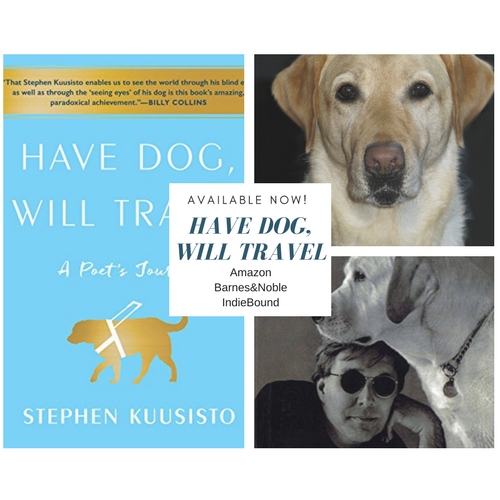
(Photo picturing the cover of Stephen Kuusisto’s new memoir “Have Dog, Will Travel” along with his former guide dogs Nira (top) and Corky, bottom.) Bottom photo by Marion Ettlinger 
Lines Written in the Algonquin Hotel

I’m in New York for a gala.
I wonder what this means.
I’m not feeling like a “gala”—
Something something
What’s the phrase?

“Gala” from Arabic
A festive robe
Given in presentation.
Do we need more robes?
Do the saints have galas?

How about whales
Or children everywhere?
O I fear I’m the toothache
Of the gala set,
Unceremonious, twiggy.

**

I must get in the mood!
First I should admit my consciousness is an instinct, nothing more seeking shelter in a rain storm. O but all the smart people like getting wet! And that’s my difficulty. I fear smart moist people.

**

Oh c’mon Kuusisto, everyone needs a dance, a rouse, a collective giggle.
BTW I dreamt last night my father was back from the dead and doing standup comedy.

nie Kuusisto :
Stephen Kuusisto and HarleyABOUT: Stephen Kuusisto is the author of the memoirs Have Dog, Will Travel; Planet of the Blind (a New York Times “Notable Book of the Year”); and Eavesdropping: A Memoir of Blindness and Listening and of the poetry collections Only Bread, Only Light and Letters to Borges. A graduate of the Iowa Writer’s Workshop and a Fulbright Scholar, he has taught at the University of Iowa, Hobart and William Smith Colleges, and Ohio State University. He currently teaches at Syracuse University where he holds a University Professorship in Disability Studies. He is a frequent speaker in the US and abroad. His website is StephenKuusisto.com.

Have Dog, Will Travel: A Poet’s Journey is now available for pre-order:
Amazon
Barnes and Noble
IndieBound.org

Have Dog, Will Travel by Stephen Kuusisto

(Photo picturing the cover of Stephen Kuusisto’s new memoir “Have Dog, Will Travel” along with his former guide dogs Nira (top) and Corky, bottom.) Bottom photo by Marion Ettlinger 
Hate at the University

The trouble with haters is they force you to think about hate. Whatever passes for immunity to the virus of bigotry breaks down. You have a head cold suddenly. You can’t think about the beauty of spring. You’re too busy thinking about the Neo-Nazis or the hateful videos produced by the fraternity at your university, or the anti-Muslim graffiti sprayed on a mosque. The birds are singing real pretty but you’re sealed up. At a remove from joy.

This is how I’m feeling as a member of the Syracuse University community. Thousands of us who study or work at SU are feeling this. No matter your background you have to be deeply disturbed by the hatred that has leaked out around us.

Now I’m an old hand at hate. Disabled, bullied in childhood, discriminated against in education and employment, I’ve lived a long time in hate-ville. Here’s the thing: able bodied white people don’t understand that if you’re from a historically marginalized background you have to put yourself together anew every day. I don’t mean putting on your makeup or shaving. I mean a full scale, internal, hot to the touch assembly of hope, aspiration, belief in the future, and a reserve of irony—you’ll meet people who don’t get you all day long and you’ll manage them with humor, forceful insistence, passion, and compensatory self-regard. Able-bodied white people don’t need to do any of this. The worst thing they can imagine is a bad day in junior high.

A robin is walking across the top of a hedge outside my window. And I’m having to think, to engage with hate. “Big deal,” I say, “it’s nothing new.”

So here, frat boys, ableist staff and administrators, smug warriors of privilege, I’m handing back your hate. Look. I’ve put it in a little basket, like the one Moses floated in. It has a little blanket on top. When you bring it ashore and look inside you’ll find nothing at all. That’s what your hate is. It’s just moist, empty air.

Stephen Kuusisto and HarleyABOUT: Stephen Kuusisto is the author of the memoirs Have Dog, Will Travel; Planet of the Blind (a New York Times “Notable Book of the Year”); and Eavesdropping: A Memoir of Blindness and Listening and of the poetry collections Only Bread, Only Light and Letters to Borges. A graduate of the Iowa Writer’s Workshop and a Fulbright Scholar, he has taught at the University of Iowa, Hobart and William Smith Colleges, and Ohio State University. He currently teaches at Syracuse University where he holds a University Professorship in Disability Studies. He is a frequent speaker in the US and abroad. His website is StephenKuusisto.com.

Have Dog, Will Travel: A Poet’s Journey is now available for pre-order:
Amazon
Barnes and Noble
IndieBound.org

Have Dog, Will Travel by Stephen Kuusisto

(Photo picturing the cover of Stephen Kuusisto’s new memoir “Have Dog, Will Travel” along with his former guide dogs Nira (top) and Corky, bottom.) Bottom photo by Marion Ettlinger