Living Beyond Disability: A Poet’s Reflection

I grew up on a steep divide but it wasn’t geographical. Instead it was a ridge or a chain of mountains both inside and outside me. I didn’t wish to be blind. I wanted to play baseball. And perhaps, more significantly, I wanted to be a scientist. Neither baseball or physics would happen for me. I became a poet. Compared to physics I think poetry is easy. All you have to do is step barefoot on a worm like Theodore Roethke, and you’ve got a poem. Poems fall out of cupboards like a box of starch loaded with spiders.

A popular phrase in advocacy circles is “embrace your disability”—but I’ve always thought the “d” word too mountainous for a hug. No one who’s disabled experiences a singular thing—a kewpie doll of physical difference that can be clutched to the chest. No. You can’t embrace your disability because, in fact, it’s a chain of mountains—highly articulated peaks with physical and metaphorical obstacles. I can’t stand it when I hear someone say “embrace disability”—one might as well embrace the Grand Tetons.

But I have another reason for hating the phrase “embrace disability”—one thinks of how difficult “embraces” really are for the disabled whose hopes for love and sexual life are often next to impossible.

Do you embrace your human loneliness and the near impossibility of intimacy with others?
Do you embrace your unemployment? The erosion of rehabilitation and health services?
Or the fact that doctor’s offices in the US are largely inaccessible?
Or that colleges and universities are woefully trapped in a 1970’s model of disability services?
Or that public transportation, especially airlines, treat you like a cockroach?

So I don’t like the word “embrace” which is just plain tomfoolery. And I don’t like “accept” because it’s too passive and vaguely defeatist.

Exult. Rejoice. Be rapturous. These are all too American. Don’t worry. Be Happy.

It just isn’t easy. The emotional rain isn’t gentle.

Once upon a time in Ithaca, New York, I encountered a man, a rather disheveled and clattering old man, someone the locals seemed to know, for we were in a diner, and he was going from table to table chattering with breakfasters, not asking for money, but essentially playing the role of the Id, sassing people, perhaps in ways they required, who could say, but there he was, pressing into each person’s space, piercing the psyches of strangers with his needle. He called a cop “Porky” and an elderly woman “Grandma” as he lurched steadily toward me. “Oh Doggy!” he said. “Doggy doggy doggy!”

Then he said, “What kind of fucking person are you?”
I tried my best Robert deNiro impression: “Are you talking to ME?”
He was not amused.
“A prisoner!” he shouted, for the whole diner was his stage. “This dog’s a prisoner!”

For a moment I felt the rising heat of embarrassment and rejection. Then, as he repeated my dog was a slave, I softened. In a moment of probable combat I stepped far back inside myself, not because I had to, but how to say it? Corky was unruffled. She actually nuzzled my leg. The nuzzle went up my torso, passed through my neck, went straight for the amygdala.

I smiled then. I said, “You’re right. And I’m a prisoner too.”

I don’t know if it was my smile, or my agreement that did the trick, but he backed up, turned, and walked out the door. Strangers applauded.

I’d beaten a lifetime of bad habits. I hadn’t fallen into panic, or rage, or felt a demand to flee.

I sat at the counter, tucked guide dog Corky safely out of the way of walking customers, and ordered some eggs. I daydreamed over coffee.

When I was eleven years old I fell onto a pricker bush. It’s hard to say how I did it, but I was impaled on hundreds of thorns. My sister who was six at the time, and my cousin Jim who was maybe nine, fell to the ground laughing as if they might die. I begged them for help which of course only made them laugh all the harder. I remember tears welling in my eyes and their insensible joy. I also knew in that moment they were right to laugh—that I was the older kid, was a bit bossy, disability be damned. I was the one who told my sister and cousin what to do. Now I was getting mine. My just deserts. In the end I tore myself from the monster shrub and stormed into the house. I sulked while they continued laughing outside.

Perhaps I thought, there in the diner, I could live henceforth in a new and more flexible way.

“Is it as simple as this?” I thought. “One simply decides to breathe differently.”

I saw, in a way, it was that simple.

Saw also how a dog can be your teacher. And while eating wheat toast I thought of the Buddha’s words from the Dhammapada:

Live in Joy, In love,
Even among those who hate.
Live in joy, In health,
Even among the afflicted.
Live in joy, In peace,
Even among the troubled.
Look within. Be still.
Free from fear and attachment,
Know the sweet joy of living in the way.

But you see, that’s the poet in me. It’s easy to imagine disabled life is a matter of grace.
And though I have these moments, I know I’m high in the Grand Tetons, still looking for a path.

And so I’m getting to my point. We are in the fight of our lives, all of us who hail from historically marginalized. This is a fearful time. I want to fight for us all. Embrace or don’t embrace your disability Stephen. Its all the same our there where so many are prisoners. Be better. Think a little bit about John Lewis. Think of good trouble. Right now the emotional rain is toxic. Get your umbrellas.
As I grow older my hands open more slowly…

My hands are today helpless. I used them to vote against fascism just last week. It was foolish of my hands to think they had power. Today my hands are grieving and their grief differs from that of the head or heart: my hands are those of a sailor who desperately wants to put the ship on the right course—hands that are educated, seasoned, and moral.

As I grow older my hands open more slowly. Maybe they know more? What’s empty turns its face to us, said a good poet, long ago. My hands read Braille poorly. My hands which have touched Marcel Duchamp’s bicycle wheel. Hands that pull the voting lever for freedom.

There are several good books about hands. One of my favorites is “Victorian Hands: The Manual Turn in Nineteenth Century Body Studies” edited by Peter J. Capuano and Sue Zemka. Hands are transformed by the industrial revolution—they become vulnerable instruments seemingly designed through evolution to operating machines. They are all too often dismembered. Hands become “throw aways” as much as anything else.

My hands are today helpless. I used them to vote against fascism just last week. It was foolish of my hands to think they had power. Today my hands are grieving and their grief differs from that of the head or heart: my hands are those of a sailor who desperately wants to put the ship on the right course—hands that are educated, seasoned, and moral.

What about the hands of those who voted for fascism you say. These are the descendent hands of industrial labor, desperately caught up in the machines of their own doom. They voted, essentially, for “throw away” hands.

My favorite poem about hands is by Jane Hirshfield

A hand is not four fingers and a thumb.
Nor is it palm and knuckles,
not ligaments or the fat’s yellow pillow,
not tendons, star of the wristbone, meander of veins.

A hand is not the thick thatch of its lines
with their infinite dramas,
nor what it has written,
not on the page,
not on the ecstatic body.

Nor is the hand its meadows of holding, of shaping—
not sponge of rising yeast-bread,
not rotor pin’s smoothness,
not ink.

The maple’s green hands do not cup
the proliferant rain.
What empties itself falls into the place that is open.
A hand turned upward holds only a single, transparent question.
Unanswerable, humming like bees, it rises, swarms, departs.

Thirty for Thirty on the ADA 


As we near the thirtieth anniversary of the Americans with Disabilities Act I’ve decided to post thirty short essays about the law, the anniversary, and the cultural impact of #ADA @30. I’m doing this as a disabled person who’s lived half his life before the ADA.  I’m reflecting on the “before and after” of the law. 

Essay 1:

“Bicycle-Blind & Belabored”  

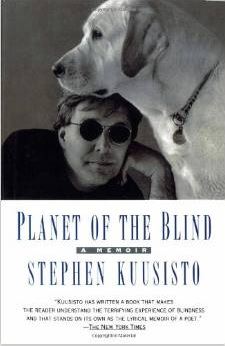
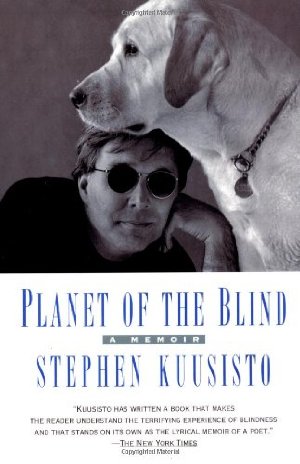
In the mid 1990’s just three years after the adoption of the ADA I decided to write a memoir about growing up blind before I had any rights. Nonfiction was suddenly all the rage. The critical and commercial success of books like The Liars Club and Angela’s Ashes brought the  memoir to the public’s attention. Where formerly “the memoir” had been the metier of statesmen or Hollywood has beens (I exaggerate only slightly) young writers were sharing stories about achieving self-awareness. The memoir was now about comic irony. Everyone could have his or her own bildungsroman and it was refreshing and by God there was a new law for cripples and overnight we had the public’s eye in new ways. Lucy Greeley’s Autobiography of a Face was brand new as I began my first book, Planet of the Blind. Memoir was fresh; the ADA was new; disabled writers had a chance. 

Literature aside this is what the ADA means: the disabled getting their chance. (A joke I love says we call the United States “the melting pot”  because  scum rises to the top while the people on the bottom get burned.) The disabled were always on the bottom, a fact made all the worse if they were poor, black, or if they were crippled women. America had always believed cripples belonged in asylums, “special” schools, that room behind the family garage—anyplace but the village square.  In her groundbreaking 1998 book Claiming Disability Simi Linton presented a new vision of the Parthenon marbles, a bas relief for what the ADA meant and means:

We have come out not with brown woolen lap robes over our withered legs or dark glasses over our pale eyes but in shorts and sandals, in overalls and business suits, dressed for play and work — straightforward, unmasked, and unapologetic. We are, as Crosby, Stills, and Nash told their Woodstock audience, letting our “freak flag fly.” And we are not only the high-toned wheelchair athletes seen in recent television ads but the gangly, pudgy, lumpy, and bumpy of us, declaring that shame will no longer structure our wardrobe or our discourse. We are everywhere these days, wheeling and loping down the street, tapping our canes, sucking on our breathing tubes, following our guide dogs, puffing and sipping on the mouth sticks that propel our motorized chairs. We may drool, hear voices, speak in staccato syllables, wear catheters to collect our urine, or live with a compromised immune system. We are all bound together, not by this list of our collective symptoms but by the social and political circumstances that have forged us as a group. We have found one another and found a voice to express not despair at our fate but outrage at our social positioning. Our symptoms, though sometimes painful, scary, unpleasant, or difficult to manage, are nevertheless part of the dailiness of life. They exist and have existed in all communities throughout time. What we rail against are the strategies used to deprive us of rights, opportunity, and the pursuit of pleasure. 

It was a dazzling party. Even if disability scholars and writers didn’t quite know each other in the last moments before the world wide web, the ADA had sprung us; provided us with optimism; it gave us what Linton calls the dailiness of life. And along with that came stories. I wrote about being lonesome as a boy, about the hardships of blindness and the static miseries of shame. I described my mother’s terror of disability and how she pushed me to pretend to be normal—a story which is legion among the disabled and is all too often prevalent among people like me who are legally blind. We can’t see well enough to read books, recognize people, read signs—we see like abstract painters. My mother wanted me to go to a public school, not the dreaded school for the blind, and she pushed me into a very unfriendly world always demanding that I never reveal how blind I really was. That was life pre-ADA. Pre-inclusive education. No one in my parents’ circle believed the disabled could pursue pleasure unless they appeared normal. One of the first passages I wrote in Planet of the Blind was a memory about riding a bicycle in early childhood: 

I would conquer space by hurtling through it. I wore telescopic glasses, suffered from crushing headaches, but still chose to ride a bicycle—with nothing more than adrenaline for assurance.

How do you ride a bicycle when you can’t see? You hold your head like a stiff flower and tilt toward the light. You think not at all about your chances—the sheer physicality of gutters and pavements. One submits to Holy Rule and spins ahead.

Picture this: A darkness rises. Is it a tree or a shadow? A shadow or a truck? The thrill of the high wire is the greatest wonder of the brain. There is, at the center of our skulls, a terrible glittering, a requiem light. I lower my face to the cold handlebars and decide it’s a shadow, a hole in sunlight, and pedal straight through.

Here’s another shadow, and another. I turn sharply but this time plunge into tall weeds. Insects rise into my hair, cling to my sweaty face. From the road comes the hiss of angered gravel, a car roars past. Thanks be to God! I’m alive in the wild carrot leaf!

I let a bee walk along my wrist, feel it browse on my perspiration. The bicycle coasts, and I squint in the glare, and then I hit a root. As I fall, I take the sting of bee, then the sting of cement. My glasses fly off. The only thing I wonder is whether I’ve been seen. Nothing with this boy must be amiss! He belongs on the street!

Now I’m on my knees groping for the glasses. My wrist has swollen. One wheel is still spinning. I’ve barely struck the ground, and my fingers are everywhere. I must find the glasses before anyone sees me. No one must know how evanescent is my seeing. No one must know how dangerous my cycling really is.

In summary, if I didn’t look normal, if I wasn’t successful in the attempt, then putative strangers would come and take me to the “blind school”—my mother made certain I understood this. She passed her fears down to her altogether trusting little boy. 

Pre-ADA was about ugly charades, the “on fire” agonies, the humiliations of passing. God help you if you couldn’t. There would be no public square for you. By this I mean available, open, admissible space. If you were crippled on the street you were subject to cruelty. If you were crippled at the university they’d be sure to tell you to leave. 

As late as 1985—yes, believe it—just five years before ADA, I was told by a graduate professor that if I was blind I shouldn’t be in his class. This was at the University of Iowa. That’s pre-ADA in a nutshell. I went to the department chair—he called me a whiner; I went to the Dean, he looked at his watch; I went to the university’s “ombudsmen” (quite a feat since his office was incredibly well hidden) and he also looked at his watch; I talked to the moribund and ineffectual disability support office—they said, the best we can do is give you a note that says you can have more time for exams. The demeaning, bigoted, ableist hostility was untouchable. 

I left without my Ph.D. I already had a graduate degree in poetry writing. I packed up. Pre-ADA there was no recourse. If they told you to get lost, well, you didn’t have ammo to fight with. 

Those who say the ADA has’t done enough for the disabled are not wrong. And there are still professors everywhere like the late Dr. Sherman Paul who treated me with unspeakable disdain. But post-ADA you can fight back. Post-ADA there are consequences provided you’re willing to snarl and push. There’s still a boatload of ableism around. It may even be fashionable with some. But ableism is long past its sell date and it smells funny—by which I mean you can’t hide it anymore. 

I know the ADA hasn’t created lots of jobs and I know it hasn’t changed every mind. Even now the Chamber of Commerce still fights disability rights. Last year with the Chamber’s help Domino’s Pizza tried to say the blind don’t have the right to use their websites—they lost in court—but you see how it goes.

No one should have to risk death to prove he or she or they belong on the street as I had to so long ago. The ADA has driven a stake through that monster’s heart.

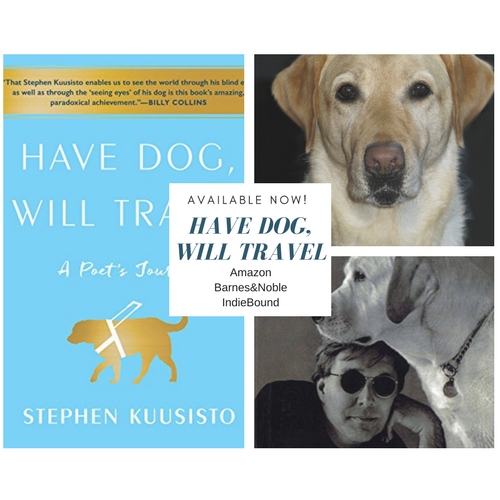
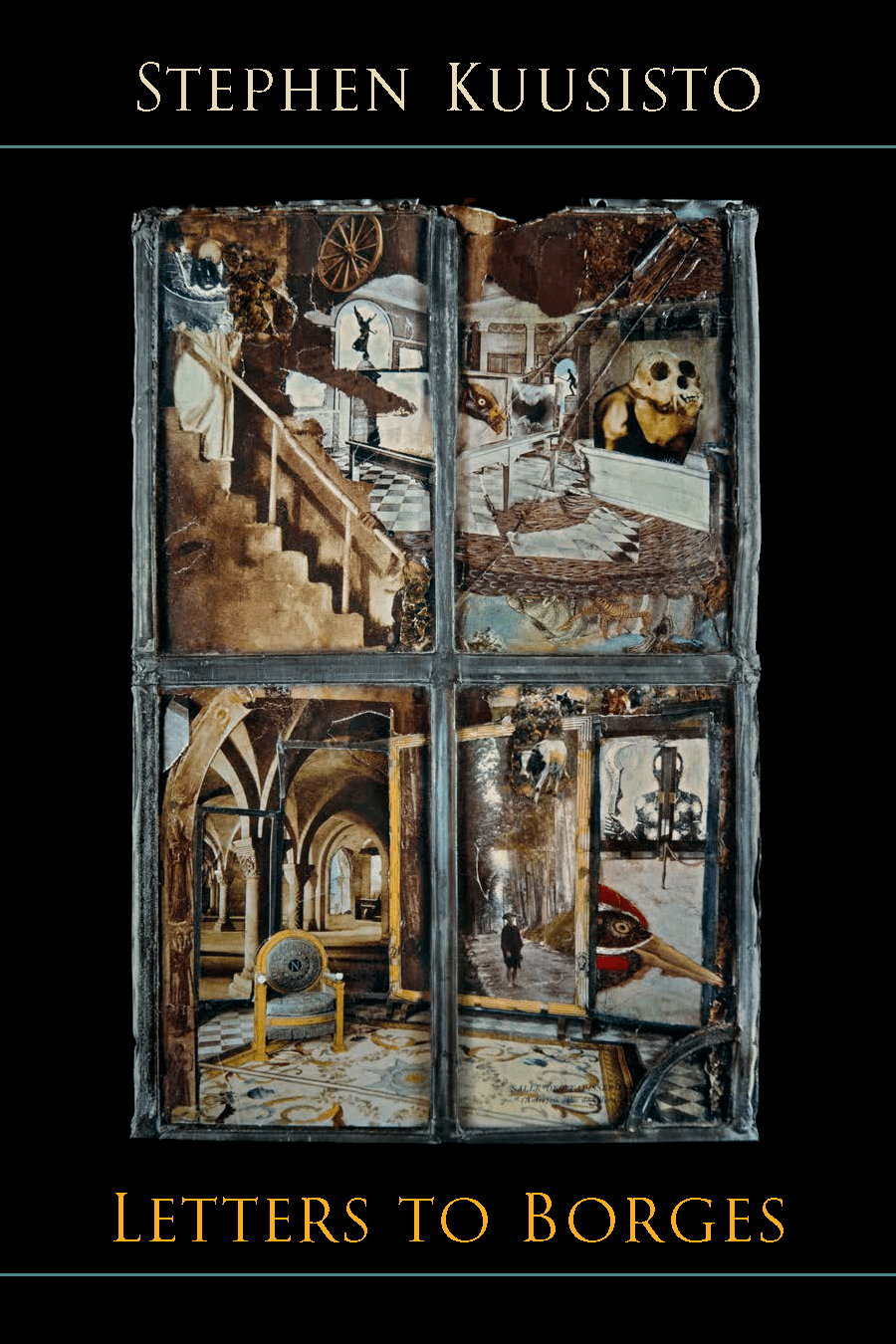
Stephen Kuusisto and HarleyABOUT: Stephen Kuusisto is the author of the memoirs Have Dog, Will Travel; Planet of the Blind (a New York Times “Notable Book of the Year”); and Eavesdropping: A Memoir of Blindness and Listening and of the poetry collections Only Bread, Only Light and Letters to Borges. A graduate of the Iowa Writer’s Workshop and a Fulbright Scholar, he has taught at the University of Iowa, Hobart and William Smith Colleges, and Ohio State University. He currently teaches at Syracuse University where he holds a University Professorship in Disability Studies. He is a frequent speaker in the US and abroad. His website is StephenKuusisto.com.

Have Dog, Will Travel: A Poet’s Journey is now available for pre-order:
Amazon
Barnes and Noble
IndieBound.org

Have Dog, Will Travel by Stephen Kuusisto

(Photo picturing the cover of Stephen Kuusisto’s new memoir “Have Dog, Will Travel” along with his former guide dogs Nira (top) and Corky, bottom.) Bottom photo by Marion Ettlinger 

Ode to Professor “P”

Not long ago I was called an “ignoramus” by a fellow faculty member at Syracuse University where I teach and run a program devoted to disability research. It is never appropriate to call anyone an ignoramus in an educational setting for the term’s antonym s are “brain “ and “genius” and its synonyms include: airhead, birdbrain, blockhead, bonehead, bubblehead, chowderhead, chucklehead, clodpoll (or clodpole), clot [British], cluck, clunk, cretin, cuddy (or cuddie) [British dialect], deadhead, dim bulb [slang], dimwit, dip, dodo, dolt, donkey, doofus [slang], dope, dork [slang], dullard, dum-dum, dumbbell, dumbhead, dummkopf, dummy, dunce, dunderhead, fathead, gander, golem, goof, goon, half-wit, hammerhead, hardhead, idiot, imbecile, jackass, know-nothing, knucklehead, lamebrain, loggerhead [chiefly dialect], loon, lump, lunkhead, meathead, mome [archaic], moron, mug [chiefly British], mutt, natural, nimrod [slang], nincompoop, ninny, ninnyhammer, nit [chiefly British], nitwit, noddy, noodle, numskull (or numbskull), oaf, pinhead, prat [British], ratbag [chiefly Australian], saphead, schlub (also shlub) [slang], schnook [slang], simpleton, stock, stupe, stupid, thickhead, turkey, woodenhead, yahoo, yo-yo…

As a disabled person I know full well what the delegitimizing effects of language can do to anyone who hails from a historically marginalized background but where disability is concerned the labeling I’ve described has a particularly specious and ugly history. Idiot, moron, half-wit, dolt, cretin are all familiar to the disabled. One would expect relief from these terms at a university. What’s particularly galling is that the subject I was discussing with the professor in question was ableism—namely that I’d said hello to him on an elevator, I, a blind man with a white cane, and he simply stared at me. No acknowledgement. When two students got on the elevator he lit up and talked breezily about how he hates snow. I followed him to his office and said that by not acknowledging a blind person he creates a social dynamic that feels off-putting and I wanted to discuss the matter. He became instantly contemptuous.

Now of course that’s because of the synonyms above. In this man’s antediluvian world view the disabled really shouldn’t be in the academy. Ableism is not only more pervasive than people generally understand its also more consistent at universities than is commonly recognized.

As for me, I’m an ignorant man to professor “p” for that’s what I’m calling him. “P” for privileged.

He doesn’t know it yet, but incapacities likely await him.

Stephen Kuusisto and HarleyABOUT: Stephen Kuusisto is the author of the memoirs Have Dog, Will Travel; Planet of the Blind (a New York Times “Notable Book of the Year”); and Eavesdropping: A Memoir of Blindness and Listening and of the poetry collections Only Bread, Only Light and Letters to Borges. A graduate of the Iowa Writer’s Workshop and a Fulbright Scholar, he has taught at the University of Iowa, Hobart and William Smith Colleges, and Ohio State University. He currently teaches at Syracuse University where he holds a University Professorship in Disability Studies. He is a frequent speaker in the US and abroad. His website is StephenKuusisto.com.

Have Dog, Will Travel: A Poet’s Journey is now available for pre-order:
Amazon
Barnes and Noble
IndieBound.org

Have Dog, Will Travel by Stephen Kuusisto

(Photo picturing the cover of Stephen Kuusisto’s new memoir “Have Dog, Will Travel” along with his former guide dogs Nira (top) and Corky, bottom.) Bottom photo by Marion Ettlinger 

Of or Pertaining to Self Approval in the Age of Airlines

Mark Twain wrote: “We can secure other people’s approval, if we do right and try hard; but our own is worth a hundred of it, and no way has been found out of securing that.”

I like this quote but think Twain got it wrong. As a disabled man I know that I cannot secure other people’s approval so long as I insist on my rights or what we like to call “equal rights” and therefore the only way I can secure self-approval is by insistence. I insist that I belong at this meeting, in this room, on this airplane, in the voting booth, in your taxi, theater, hotel, swimming pool, university, library, railway, hell, even your amusement park.

I do not get customary approval for this entreaty and that is painful, at least on the inside where the barbs from others must go. I secure my affirmation from public resistance and I’ll take my public scorn with a twist of lemon thank you very much.

Last week I had two plane flights where—despite the laws of the land—the airline wouldn’t seat me and my guide dog or “seeing-eye dog” as they’re sometimes called in a place where we could fit. In each case I cited the applicable law (the Air Carrier Transportation Act) which makes it clear that they have to put me where we can fit. And in each case I was treated with absolute disdain and then hostility. The airline was Delta but it could be any one of them.

I was angry, humiliated, and yes, embarrassed for the flight attendants were not only inhospitable they made me the problem. We call that ableism in disability circles and like racism or homophobia it’s all about the knee jerk assumption that someone different is a lesser being and can be treated as such. This is why all bigotry hurts all others. If Chic Fil-A thinks it can object to queer people on a phony religious principle, then they can also object to me and my guide dog. Disdain carries a permission index that’s portable.

The Delta airlines flight attendants not only didn’t care that I couldn’t fit in their seat, they also didn’t care about the law—which says they have to move to a place where I can fit. They did not want to be bothered. The overheated cigar tube was being crammed with passengers, the public address system was smoking with imprecations to tag your bag because the overhead bins were full, please sit your ass down, we’ve got a schedule to keep, etc.

And there I was with a big assed guide dog who couldn’t fit under my feat. I crammed her head under the seat in front of me and sat with my own feet tucked under my ass like a chic woman on a divan. Try doing that for five hours.

The story is worse than this. A woman seated next to me was rude. She didn’t like sitting next to a dog. A flight attendant appeared, (remember, they didn’t try to reseat me) and in front of me asked her if she minded sitting where she was.

I can’t get the approval of strangers and I have no idea what Mark Twain meant. But I have my own satisfaction. I tell the truth. That’s what civil rights are for.

Stephen Kuusisto and HarleyABOUT: Stephen Kuusisto is the author of the memoirs Have Dog, Will Travel; Planet of the Blind (a New York Times “Notable Book of the Year”); and Eavesdropping: A Memoir of Blindness and Listening and of the poetry collections Only Bread, Only Light and Letters to Borges. A graduate of the Iowa Writer’s Workshop and a Fulbright Scholar, he has taught at the University of Iowa, Hobart and William Smith Colleges, and Ohio State University. He currently teaches at Syracuse University where he holds a University Professorship in Disability Studies. He is a frequent speaker in the US and abroad. His website is StephenKuusisto.com.

Have Dog, Will Travel: A Poet’s Journey is now available for pre-order:
Amazon
Barnes and Noble
IndieBound.org

Have Dog, Will Travel by Stephen Kuusisto

(Photo picturing the cover of Stephen Kuusisto’s new memoir “Have Dog, Will Travel” along with his former guide dogs Nira (top) and Corky, bottom.) Bottom photo by Marion Ettlinger 

On Being Expensive, Difficult, and Lonesome in Higher Education

I feel like opening up. Some days, owing to blindness, because of my internalized “super crip” expectations (all that rococo internalized ableism) I think my job is to make being a disabled professor look easy. Alright, most days. OK. Every day. Yes daily I saddle myself with the false and unachievable supposition I’m supposed to be absolutely flawless. After all, to admit a flaw would be to succumb to vision loss. The medical model of disability IS the academy as it’s currently established. Of course I know too much to live this way. Sure. Absolutely. But the academy doesn’t care what I know. Universities have almost no interest in unpacking their nascent ableism since this would require examining a thousand years of questionable institutional exceptionalism. Alright, maybe eight hundred years. The academy is constructed entirely around the idea of the elect, the promotable, the meritocracy, the lithe and nimble of mind and body. As a professor I too must be this way. If I have merit it must mean this business of researching, writing, teaching, and serving is natural. If it comes with hard work it’s only the difficulty of ideas, the speed of a required curriculum that stands in your way, not your body or your learning style. If these are impediments you shouldn’t be within a hundred yards of the ivory tower.

I’ve been a tenured professor (lucky me) at three American universities and I was a long time adjunct at a fourth. My blindness has been a problem at all of these places—sometimes an ugliness—and now I must admit at the age of sixty four and still likely a decade away from retirement that the career—mine—has been painful, clotted, steep, and wearisome. In the faculty ranks the disabled are not naturally linked with other academic diversity initiatives. While my historically marginalized colleagues have many many problems (which I do not dismiss) they also have (at least at the institutions where I’ve worked) something like society, something like a collective voice. I am the only blind professor at Syracuse University and have been the only blind professor wherever I’ve worked. My embodiment and my accessibility needs are lonely and exhausting things.

I remember the famous poetry professor at the University of Iowa who told me when I was a graduate student that I shouldn’t be in his class. In his view, if I couldn’t read as fast as other students I was uneducable. All disabled students who read differently or communicate differently know this story. Certainly autists who type or students with learning disabilities know their very presence in college is secretly or overtly questioned by faculty and administrators. Academic ableism is the norm. It’s been the norm throughout my forty plus year career as a student, grad student, and faculty member. Wherever I’ve worked or studied I try for consistency: calling out accessibility problems and ableist attitudes. Behind this though is the pressure to appear perfect and make the “life” look easy.

Nothing could be more unachievable or hopeless. I have faculty colleagues (some of whom teach disability related courses) who don’t care a whit about the inaccessibility of websites, academic research materials, PDF documents, HR surveys, adopted computer programs, online teaching and learning portals, PowerPoint presentations at department meetings or campus events, films or video presentations—the list is long when you’re blind. I’m the outlier asking for admission to all these things and after years in higher ed I feel no closer to inclusion or admittance today than I did years ago.

The only good thing is that computers have gotten better. Tablets and phones have become more blind friendly. Apple has made my life better. Microsoft is getting on board. The technology now exists to assure colleges and universities are fully accessible to the blind. But they’re not. The ableism of bureaucracy and meritocracy holds back the blind over and over again.

Meantime I’m supposed to be (as I said above) absolutely flawless. Despite the lack of good usable assistive technologies across campus I should be a superior teacher, graceful, kind, cheer up the normal people who find disability either consternating or distressing, publish as much as my colleagues, if not more, and be a “thought leader” whatever that means.

Not long ago during the same week when I was faced for the umpteenth time with a new university web portal that was inaccessible, I was asked to participate in a campus inclusion workshop. I declined. I said I couldn’t do any more emotional lifting for the university. This was a breakthrough for me.

“What’s that?” you say, “you can’t help the able bodied faculty anymore?”

That’s right.

I’m not going to pretend at easiness anymore.

My weekdays are clogged with inaccessible features.

The built environment is consistent. I don’t belong.

I’ve spoken about these things over and over for years and my spirit is patched. It has holes. The moths of ableism have eaten my beret.

In recent weeks I’ve called on Syracuse University to make films and videos accessible to the blind.

Some people have responded positively to this. Others not so much. One faculty member went out of her way to tell me how difficult and expensive this is.

Blindness is always “difficult and expensive” whether the subject is audible traffic signals, a Braille menu, or getting screen reading software for a PC.

I’m difficult and expensive and noisy and bothersome and mostly lonely in higher education.

Empty Paths

Don’t sing to me about going down to the Crossroads—
Blind as I am, walking with a dog,
I’m always at lethal intersections.
These are countries without names.
The Devil has nothing to do with them.
Henry Ford sits on his cloud and points.

**

Read T.S. Eliot in youth.
Now when I go back
I riffle an album full of leaves.

**

After much is said and done
I made too many mistakes.
Entered strange parlors,
Uttered jokes in poor taste
Among people I didn’t know.
Ate with the wrong utensils.

**

So he went a long way a long way:
Metaphorical luggage,
Regrets, coins, pocket comb,
Dharma in memory.
Broken thread dangling from his wrist.

**

Eliot:

“For last year’s words belong to last year’s language
And next year’s words await another voice.
And to make an end is to make a beginning.”

Oh but this isn’t so.
The language stretches out.
On the bright side:
Language is a jacket you’re not cold in.

**

So many times I’ve fallen asleep between two winds.
Even on this street corner.

Adult on Campus

When I was a child I spake as a child but then I got my act together. If the time ever does come when I stand before my maker and speak about my life I hope to say I became a man. I do not mean the craven, self-absorbed, meretricious boy-man of my era as they’re merely children in big boy clothing. By my lights a man acknowledges his neighbors and fosters what used to be called civic standards. Call me a boy scout if you wish. But kindness, loyalty to virtues, the courage to tell the truth—even about the self—trustworthiness—and yes I know its hard to take anyone seriously who evokes the boy scouts but let’s think of them as having been liberated by their rhetoric if not by their leadership.

In this way I stand before you. I’m a 64 year old blind guy who’s spent the last thirty years fighting for what we call “inclusion” nowadays though I prefer the term civil rights. Inclusion is so clean. Civil rights are tougher to promote as they require knowledge of the law, ambition for those who’ve been marginalized, and a willingness to insist on equal treatment for all. Inclusion seems tidy—seems to suggest that equality has already been achieved and all you need is a ticket to get into the pleasant, inclusive big top. Where civil rights are concerned its best to consider the ways that human systems resist moral scales whenever it’s convenient.

The man or woman or child who insists on civil rights is inconvenient. (S)he’s likely outspoken when the moment calls for garden party politeness. Meanwhile, as Michael Eric Dyson has said: “Justice is what love sounds like when it speaks in public.” The speaking can be uncomfortable to hear. Invoking an approximate analogy or metaphor, speaking truth about civil rights must necessarily be irate love. Inclusion, for me, doesn’t cut it.

Inclusion is a fine term but its subordinate to a larger expectation that civil rights, equal rights have been achieved. I’m a university professor. See me in your mind’s eye, walking across the campus with my guide dog. I struggled all morning to get an accessible version of an academic article; I argued with a dean about the needs of a learning-disabled student whose accommodations didn’t happen in a timely way; I learned that a major renovation to an audito­rium won’t be accessible to wheelchair users—these things within a single morning. Now multiply this five-hour period by 365 days per year, minus college vacations—make it 276—then again, multiply by years. Do not think me rebarbative or an agitator. I am not a bellyacher. In this instance I’m walking the agora, head up, fleet of foot, holding ambitions for every disabled learner who stands at the portcullis.

In this way I’m an adult.

The Confessions of Arnold the Ableist

Chapter One

I gave a nickel to a cripple and then I walked away. “Nickel, cripple, nickel, cripple,” I thought. I gave nothing to the blind man I met in the next street. “Nothing, blind,” I thought, “these also go together.” Then I stepped in some dog shit. I knew it was disabled people who did this.

Chapter Two

I don’t mind if a cripple sits next to me on the bus—I’m sitting in their reserved space after all and I’m “Normal” but I wouldn’t want my daughter to marry one. Their art is barbarous and you must admit, they smell.

Chapter Three

O rodomontade! It’s a crippley-wippley world! Look! Here comes one with some kind of breathing apparatus! I’d like to rip it right our of her mouth and take that smug look off her face! They all think they’re so “special!” Alright, yes, I admit, as a boy I used to hurt animals, but never the big ones.

Chapter Four

You wouldn’t know it, but I’m a university professor. I mean, what with my habits of dress you wouldn’t recognize me. I wear tight jeans and radical tee shirts. But it bugs the shit out of me when the namby pamby LD students and those sightless ones enroll in my classes. I get up on my fictive high horse (named “Trigger” of course) and ride wildly around the campus big top snarling at deans and admissions flunkies. I can’t decide whether the disabled or the deans are more pitiable!

Chapter Five

O dear. I broke my coccyx at a garden party when I attempted to sit on a folding chair and it collapsed beneath me. You can’t imagine the pain I’m in. I’ll tell you all about it for another gin fizz.

Fast Virgin Train, Blindness, and the Talking Toilet

If you’re blind and travel you know a good deal about the world of talking appliances which are designed by sighted people and are intended to help people with vision loss but are really rather goofy: elevators that announce “doors open” and the miserable voices of bank machines. But just this week I met the greatest talking device of them all: the speechifying toilet on the Virgin train from Liverpool to London.

Now the Virgin fast train talking toilet (hereafter known as the VF3T) wasn’t designed for blind people. She was created for morbidly depressed travelers. I call her “she” because I’ve been told her voice is that of a woman who won some kind of contest.

Imagine reading an advertisement: “Be the voice of the Talking Toilet!” and thinking it sounds like a great opportunity. You want to break into the big time, be a star of stage and screen. Surely you’ll work your way up from the crapper. (Whatever happened to being on the radio?)

Picture me in the unfamiliar swaying toilet cubicle. No Braille on any buttons. I can’t figure out how to shut the door. A passing stranger reaches in and says, “Here, I’ll press the shut button for you.”

Poof. Door shut. The toilet starts her speech.

Before saying anything more let me just ask: “who thought that giving a toilet a woman’s voice, an actual human voice was a grand idea?” Of course the answer is “a sighted person” for if you’re blind and groping in a vaguely intimidating water closet hearing the following is piercingly bad:


“Hello there! Welcome to Virgin!”

I was mortified.

Had I entered an already occupied WC?

“I hope you’re having a wonderful day!”

“Did you know there are many splendid traveling opportunities with Virgin?”

“Alright,” I thought, “she’s a toilet bragging about train service. Not a big deal.”

But she continued. She was a kind of self help guru talking up the glories of life, the virtues of moving about the world and the joys of being alive.

The VF3T wants to keep you alive.

The VF3T is designed to prevent disheartened travelers from offing themselves in the loo.

“Aren’t sighted people funny?” I thought.

Stephen Kuusisto and HarleyABOUT: Stephen Kuusisto is the author of the memoirs Have Dog, Will Travel; Planet of the Blind (a New York Times “Notable Book of the Year”); and Eavesdropping: A Memoir of Blindness and Listening and of the poetry collections Only Bread, Only Light and Letters to Borges. A graduate of the Iowa Writer’s Workshop and a Fulbright Scholar, he has taught at the University of Iowa, Hobart and William Smith Colleges, and Ohio State University. He currently teaches at Syracuse University where he holds a University Professorship in Disability Studies. He is a frequent speaker in the US and abroad. His website is StephenKuusisto.com.

Have Dog, Will Travel: A Poet’s Journey is now available for pre-order:
Amazon
Barnes and Noble
IndieBound.org

Have Dog, Will Travel by Stephen Kuusisto

(Photo picturing the cover of Stephen Kuusisto’s new memoir “Have Dog, Will Travel” along with his former guide dogs Nira (top) and Corky, bottom.) Bottom photo by Marion Ettlinger