The ADA @ 30: Thinking of Auden

The poet W. H. Auden wrote: “Educational theory begins when society has become differentiated, when different classes are living so differently, and doing such different things that the question arises: ‘What shall we teach and to whom?’” 

I have been in mind of this straightforward question for some time now, especially as I’ve been wrestling with the deficiencies of my own education, and in particular how that education relates to disability. As Auden might have it: ‘What was I taught and who did those teachers imagine I was?’” 

The answers depend upon whether or not you believe the nature of society is static—which is to say whether you think social relations where disability is concerned are changeable. Here I am piling a question on a question. Can disability ever slip the knots of ableism and be understood as a fully dignified dynamic of cultural life? (I take it as given that disability is no better or worse than any other fact of life.) 

Okay. Since I don’t think society is static, at least since the time of Rousseau (everywhere we are in chains, post-innocent, and humankind is collectively capable of freedom) I think disability rights are a barometer of progress. Civil rights reflect modernity’s belief that all individuals are unique. After Freud all people are unique. If so, then good old Jeffersonian law must assure our unique equality. 

Now imagining the law could guarantee my dignity was foolish yet I’ve been guilty of this variegated disappointment, of letting it get to me, for a long time now. How long? Since the mid 1980’s when the Americans with Disabilities Act was being built. Like millions of disabled in the U.S. I thought the adoption of civil rights meant throwing off chains. I allowed myself to believe this. I know I’m not alone. 

And here is where my education failed me, my high modernist, early post-modernist, calculating small “d” democratic, structuralist-psychoanalytic education—it failed me.  Teachers failed me. I was allowed to believe the law could take the place of civics. Of civics I was taught nothing save that every citizen will be equal under the law. Here is the specific failure: I was taught that individualism is the core of identity, that identity is the well spring of citizenship, and that laws will take care of equality. Of course I read Foucault. I understood the  precarity of life under the state, saw how language can and often does fail us. 

Nothing in my education prepared me for structural ableism. 

For years I’ve allowed myself to believe that my eloquence, my irony, my belief in the law, would mean success where disability is concerned, and by this I mean “as lived” and by this I mean “in the workplace” and accordingly I have been navigating without some important details. 

You see I thought the law and self-declared dignified individualism were all I needed. These things are not without their importance, but they weren’t enough. 

I’ve been physically assaulted in the workplace; denied accommodations; told during meetings that my need for accessible materials would slow down progress; told to “get in line” behind other non-disabled faculty when I needed sighted a grad assistant; been lectured to by so many overtly ableist administrators about the difficulty of disability—how it gums up the works of the system—this is a long list, forgive me—and in all cases I imagined my capacity to be clear, direct, and persistent would solve the problem. That was my deficiency. From my mid thirties onward, believing overmuch in the ADA and the power of my language, I failed to see how profoundly ableism cuts down the disabled, even in the most self-declared progressive work spaces. Yes it’s a matter of note I’ve been making my way in higher education.  

Boo hoo for me, didn’t everything I ever read about oppression allow me to see the deep and broad discriminatory practices in the big bad world? Of course. But my mistake was to think, to allow myself to think that equality for the disabled had come. 

How foolish I feel. Worse, how beleaguered I am after years of being treated badly as a disabled student and scholar. 

Ableism is ubiquitous. Higher education is rife with it. It’s in the street. It’s on the bus. It’s in every corner of the civic square. It is an unholy master in the world of American medicine. Ableism is  shrugs, hoots, snickers, red tape, ugly information technology, badly designed airplanes, inaccessible voting places. It’s what’s for breakfast. It exists in the classrooms, the technology labs, the science classes, the lecture halls. It is so customary in higher ed that it’s no wonder three quarters of students with disabilities who matriculate to college never graduate.   

So what’s to celebrate? 

Ableism is finally being talked about. 

Design justice is being advocated in many places.

The ADA is still standing at 30.

These are life affirming flames. 

Back to Auden.
Shape Shifters

Someone comes down the stairs: 

It’s Tolstoy in his horse hair pajamas. 

Clouds knock at the windows 

But of course the sleeping humans don’t hear this. 

Dawn. Chickens. Piano loosening out of tune.

Leo owns only one book in English—

Women and Temperance.

While reading he spills a drop of tea

Which burns and glints on the page.

I know all this. I was far above 

In the loft, dreaming of the place

Where in the future 

I’d live my strict joy. 

Thinking of James Wright

I know, I know, there are those who call
Two horses in particular–
One is young and one is old
Though they think they’re brothers—
So that I, a blind man
Hear them like books read aloud.
No sentiment; no romance;
Each has his voice
Each wants a touch.
I run my fingers gently
Down their long foreheads
Lightly across their noses.
What are we waiting for?
What are we going to do about it
In the meantime?

Alone with Caruso in the Attic at Five

I was alone but not unhappy. That was the thing. Wind up the Victrola, listen to incomprehensible words and musical notes. And sometimes hornets flew over my head. Was it Caruso who kept them away? Whatever the case the hornets never bothered me. The snick of the needle hit the outermost circumference of disk. The systolic static from the horn. One more second and the music starts. 

Thinking of Cesar Vallejo, Early Morning, in the Age of Police Brutality

I want to begin with a short poem by the great Peruvian poet Cesar Vallejo, translated by Robert Bly: 

Black Stone Lying On A White Stone

I will die in Paris, on a rainy day,

on some day I can already remember.

I will die in Paris—and I don’t step aside—

perhaps on a Thursday, as today is Thursday, in autumn.

   It will be a Thursday, because today, Thursday, setting down

these lines, I have put my upper arm bones on 

wrong, and never so much as today have I found myself

with all the road ahead of me, alone.

   César Vallejo is dead.  Everyone beat him

although he never does anything to them;

they beat him hard with a stick and hard also

   with a rope.  These are the witnesses:

the Thursdays, and the bones of my arms,

the solitude, and the rain, and the roads. . .

This poem has been much on my mind for several reasons. Vallejo wrote it in despair and weariness. As a Marxist poet living in exile in Paris he was hounded by the police, was frequently arrested and subjected to beatings. His is the true story of literary exile in Paris as opposed to the white privilege story of Hemingway and his circle. Hemingway’s crowd held no political positions and fought for no causes. 

It’s also been in my thoughts because it’s about life inside the broken body which to my mind makes it a disability poem. His upper arm bones are wrong, his will can’t change the fact, and like so many cripples he finds himself alone. The only witnesses? The opaque and unfeeling days. 

The third reason the poem’s been in my thoughts is that we’re living in a globalized police state now. From Minneapolis to Mumbai; from Atlanta to Ashgabat police violence is not just the norm, it’s welcomed by the ruling classes. This poem is about the toll this takes “on the inside”—what this does to “the inner life.”

The poet will die in Paris on a rainy day—a day he can already remember, for death by persecution really never ends. 

It’s a brave poem. It skips the contemporary American penchant for lyric poems that sentimentalize the glories of nature or the joys of sex.  

It’s a brave poem. There’s a hint of Orwell. (The jackboot that’s going to step on you throughout eternity.) 

It’s a brave poem. Cesar Vallejo never does anything to anyone and they beat him for his very consciousness and his foreign appearance. 

It’s a brave poem because he wrote it without sentimentally. 

It is much on my mind. 

March

There was rain falling through spring branches and then it was gone. For an hour or so no birds sang. The world can in fact be quiet. The old couple next door slept in the afternoon with their radio tuned to static. Telephone calls entered a void. I know something about hope: people create angels but only when they’re alone.

Lying on the Frozen Lawn in Syracuse

Open the door. Newspaper in the grass. Big headline about local basketball team. I decide to lie in the grass.

Don’t be sentimental.

Be sentimental.

When the frost hits my shoulder blades I get up, go into the house. Start a fire with the newspaper.

**

I like Paul. After the road to Damascus he understood folly. Christ risen is the most glorious and improbable thing. You can’t make good sense out of it. And that’s god.

(A thought while lying on the lawn….)

**

As for me….I’m folly too. And I make so many mistakes. But it’s the spiritual ones that matter. Poetry like god is improbable.

**

When I was an undergrad I found a couplet by one of my teachers, the poet James Crenner: “Life is like a game of chess /death is like two games of chess.”

I loved the wit of this and still do. For instance: If you checkmate death (a la Bergman) are you reborn or do you sit throughout all eternity waiting for another opponent? Does death always win? Does Jesus play chess? What about the effects of analogy, to borrow Wallace Stevens’ phrase, that is, since life and death are not like chess what do we gain or lose by saying so?

**

I really was lying on the lawn in the bright frost.

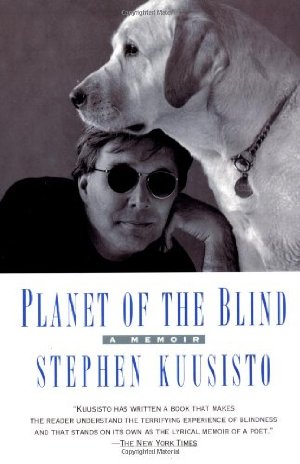
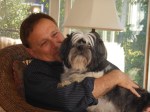
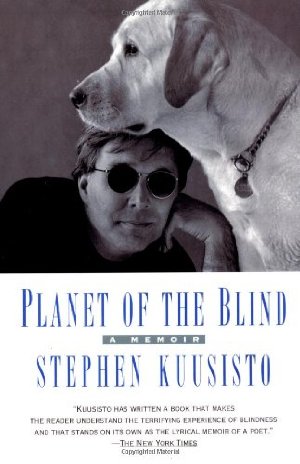
Stephen Kuusisto and HarleyABOUT: Stephen Kuusisto is the author of the memoirs Have Dog, Will Travel; Planet of the Blind (a New York Times “Notable Book of the Year”); and Eavesdropping: A Memoir of Blindness and Listening and of the poetry collections Only Bread, Only Light and Letters to Borges. A graduate of the Iowa Writer’s Workshop and a Fulbright Scholar, he has taught at the University of Iowa, Hobart and William Smith Colleges, and Ohio State University. He currently teaches at Syracuse University where he holds a University Professorship in Disability Studies. He is a frequent speaker in the US and abroad. His website is StephenKuusisto.com.

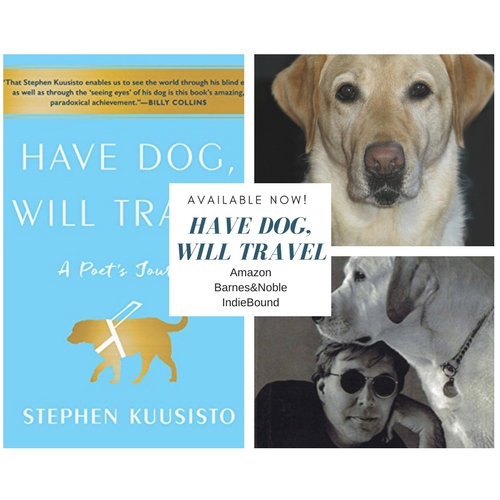
Have Dog, Will Travel: A Poet’s Journey is now available for pre-order:
Amazon
Barnes and Noble
IndieBound.org

Have Dog, Will Travel by Stephen Kuusisto

(Photo picturing the cover of Stephen Kuusisto’s new memoir “Have Dog, Will Travel” along with his former guide dogs Nira (top) and Corky, bottom.) Bottom photo by Marion Ettlinger