What Does It Avail?

Hope is the thing with feathers. And then, wind up, clear skies, hope is the horse who rolls in mud. If you’re looking for optimism don’t forget the mud.

**

You say to a child “I’m glad you’re along with me” if you’re a loving parent. You stop a lot and admire the simplest and oddest things.

**

I had a dream last night with Abraham Lincoln in it. He floated there like a balloon. He was, as in life, sad and kind. I woke happy. That’s the thing: I woke happy to think of Lincoln. And I thought of Walt Whitman who loved Abe. And I was happy to think of Whitman.

**

I’m a Christian. Lefty Episcopal. No one thinks of happiness as a Christian ingredient. But I’m happy believing in sacrifice and meaning–ultimate meaning. In this way I imagine satisfaction in serving others. According to a couple of geneticists I know, I was born this way. “Exactly,” I say.

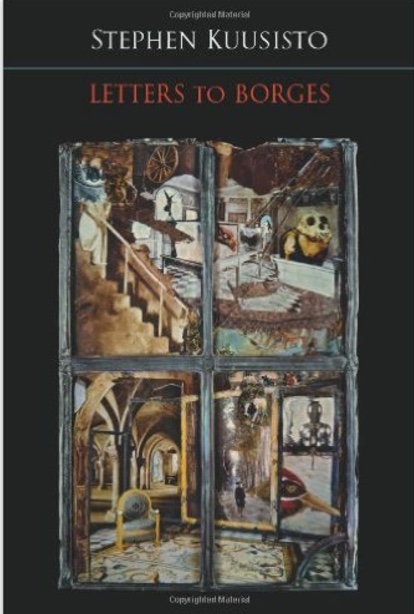
Stephen Kuusisto and HarleyABOUT: Stephen Kuusisto is the author of the memoirs Have Dog, Will Travel; Planet of the Blind (a New York Times “Notable Book of the Year”); and Eavesdropping: A Memoir of Blindness and Listening and of the poetry collections Only Bread, Only Light and Letters to Borges. A graduate of the Iowa Writer’s Workshop and a Fulbright Scholar, he has taught at the University of Iowa, Hobart and William Smith Colleges, and Ohio State University. He currently teaches at Syracuse University where he holds a University Professorship in Disability Studies. He is a frequent speaker in the US and abroad. His website is StephenKuusisto.com.

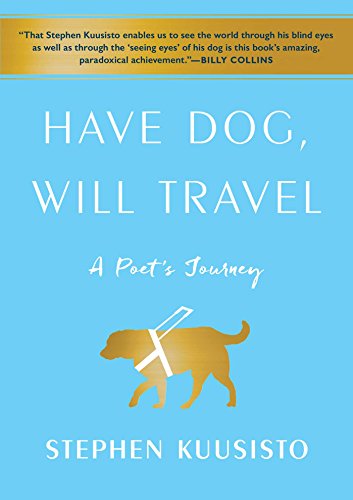
Have Dog, Will Travel: A Poet’s Journey is now available for pre-order:
Amazon
Barnes and Noble
IndieBound.org

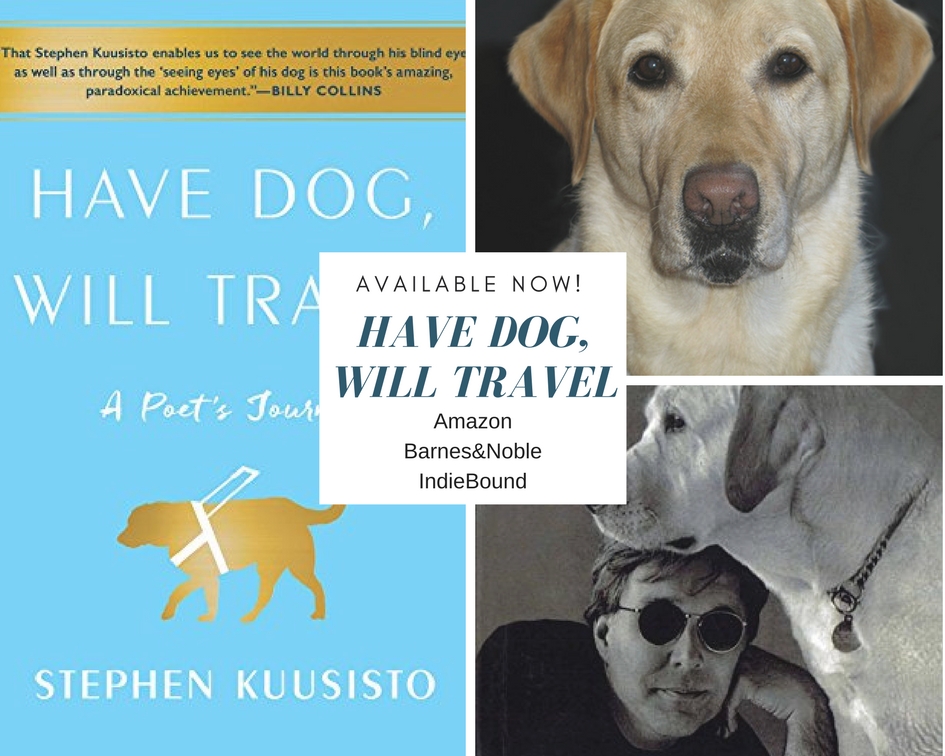
Have Dog, Will Travel by Stephen Kuusisto

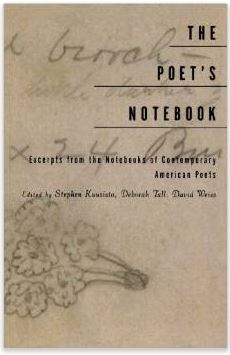
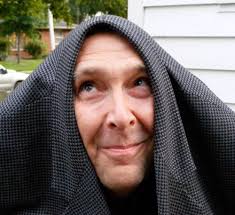
(Photo picturing the cover of Stephen Kuusisto’s new memoir “Have Dog, Will Travel” along with his former guide dogs Nira (top) and Corky, bottom.) Bottom photo by Marion Ettlinger 

The Burdens of Ableism

How many burdens do you carry daily? If I ask myself this question I admit I don’t know the answer for myself. It’s like asking “what should I be doing?” It’s a fool’s game.

Here’s the problem: I carry some baggage because I’m disabled. “No big deal,” says the heart (which I’m told sits reliably in the center of the chest and not to the right hand side as depicted in cartoons.)

The heart is optimistic. It knows it must be. Every pulse beat is optimism.

Now the brain is different. It’s read Duns Scotus and Neruda and Kafka and Hannah Arendt and Frederic Jameson and “Maggie: A Girl of the Streets” and at least a thousand books on disability and who knows how much gloomy nonfiction—so the brain is disposed to contrarian thinking whenever joy comes up.

Alas my brain is more than a little bit like my Finnish grandmother.

Her name was Siiri and unlike her Apple namesake she was gloomy. She couldn’t help it. She was very Lutheran and her husband was a minister during the Great Depression and they’d come to the U.S. to escape hunger and why wouldn’t you become cautionary and somber in the face of a world of gravity and scarcity?

I don’t know about you but I’ll take gloom over despair. I know about this. I have depression as well as vision loss. I ride two horses, one black and the other white. Or something like that. Maybe I’m a shark with two brains: one of appetite and the other of more appetite.

I don’t know as much about the mysteries of consciousness as I pretend.

But I know this: the burdens I carry are the burdens of others.

If the subject is disability, well, I speak up for disabled students and staff who struggle to acquire basic accommodations both in my own workplace and around the world.

Burden number one: this can make me unpopular. As with racism or misogyny or homophobia the advocate can be characterized as a malcontent almost instantly.

I’ve never completely gotten used to this. The “this” being disapprobation for speaking out against ableism.

I read as much as I can by scholars and poets of color; gay and trans writers; black writers; women writers. And yes, men. I’ve yet to find anyone who’s more deep tissue wise than Walt Whitman.

Last week I participated in a live online town hall discussion about service animals. In the Q &A period several apparently non-disabled questioners asked things phrased thusly:

“Do we have to?”

As in “OK, service animals are legally allowed to enter my space, but can’t we tell those darned blind people where they are to make their dogs relieve themselves?” Or: “OK, a child with a service dog comes to public school—do we have to help that child?” (As if being disabled requires extraordinary extra help; as if a disabled child is a burden.)

I became upset.

I said the following:

“I went to public school before the ADA. I have been told by teachers and school administrators that I’m inconvenient; or worse—that I don’t belong.”

“Frankly, I hope there’s a room in Hell for school administrators where they’ll get to sit throughout eternity with Joseph Stalin, Richard Nixon, and the man who invented the roach motel.”

Then I signed off.

I’ll never not be offended by ableism.

I’ll never sanction the winks.

Just try those questions out if you substitute race or gender or sexual orientation for disability.

How many burdens do any of us carry?

They’re much lighter when we hold them up to scrutiny.
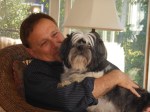
Stephen Kuusisto and HarleyABOUT: Stephen Kuusisto is the author of the memoirs Have Dog, Will Travel; Planet of the Blind (a New York Times “Notable Book of the Year”); and Eavesdropping: A Memoir of Blindness and Listening and of the poetry collections Only Bread, Only Light and Letters to Borges. A graduate of the Iowa Writer’s Workshop and a Fulbright Scholar, he has taught at the University of Iowa, Hobart and William Smith Colleges, and Ohio State University. He currently teaches at Syracuse University where he holds a University Professorship in Disability Studies. He is a frequent speaker in the US and abroad. His website is StephenKuusisto.com.

Have Dog, Will Travel: A Poet’s Journey is now available for pre-order:
Amazon
Barnes and Noble
IndieBound.org
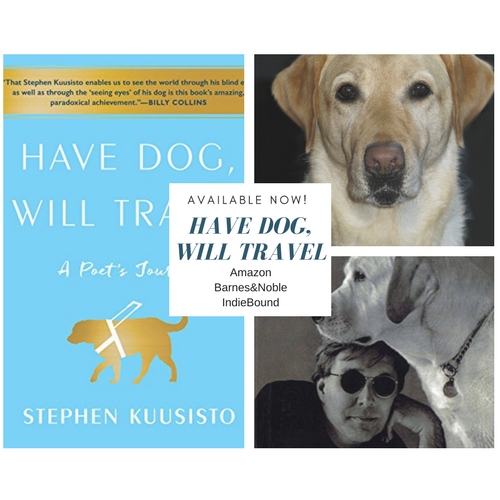
Have Dog, Will Travel by Stephen Kuusisto

(Photo picturing the cover of Stephen Kuusisto’s new memoir “Have Dog, Will Travel” along with his former guide dogs Nira (top) and Corky, bottom.) Bottom photo by Marion Ettlinger 
Up Early, Thinking of Alexander Pope and Disability

First I should say I make mistakes. I once believed in ardor and imagined it was enough. Loving books was enough. Greeting each day with my love of fool’s gold was enough. Pity the man or woman who believed too much in art.

“Blessed is he who expects nothing, for he shall never be disappointed.” 
― Alexander Pope

As I say, I make mistakes. I have expected quite the opposite of nothing. Ardor means at the very least the Jeffersonian pursuit of happiness. That alone isn’t much of a mistake, its wired into every infant. Even the nematode worm has something like it. No, my ardor was gangrenous from the start. Frankly, I believed that writing about disabiity taken as phenomenology, taken as epistemic process, understood as a profoundly beautiful way of being would gain attention. I do not mean I thought I would win the Pulitzer Prize or be vaulted into the realm of celebrity writers—not at all—but I did imagine that Americans would come to see disability as a significant part of diversity and this has not happened as much as I’d hoped. Ardor wasn’t enough.

There are tremendous disabled writers in the United States and around the world and we can’t get on the main stage of literary conferences. We’re not routinely invited to speak at festivals devoted to books. We remain curiosities. No one should make the mistake of thinking poetry would make them famous or rich but back in 1998 when I published my first memoir “Planet of the Blind” to some acclaim I let myself believe that mainstream literature was finally ready to hear what the disabled had to say.

I was wrong about that and though I don’t know what I mean by “mainstream publishing” I know what its effects are, the soul crushing novels by able bodied writers that employ disabled characters as bleached plot devices—books both popular and utterly creepy. Books that do lasting damage to real disabled people. Anthony Doerr’s wholly false blind teenaged girl who’s so helpless she must be bathed by her father; Jo Jo Moyes; and just this week a new novel depicting a man who’s face becomes paralyzed which, presto, means he goes nuts—two misreperesntations in one.

I admit it: I thought that by the time I was in my sixties I’d see disability on the stage with people of color, queer writers, writers who hail from the far ends of the earth, as folks who can speak for themselves, have tremendous talent, and know where more than a few of the keys to the mind-body schism are greased.

Yes I was wrong.

“A man should never be ashamed to own that he has been in the wrong, which is but saying in other words that he is wiser today than he was yesterday.” 
― Alexander Pope

If I am wiser it is due to comic irony. I look back on my past and say “oh, don’t do it!”

Don’t go on the Oprah Winfrey show where she’ll ask you if you know what she looks like.

Don’t go to the Associated Writing Programs conferences where you’ll hear able bodied writers talk endlessly about how poetry can heal you from affliction—as if being disabled is a failure of imagination.

Don’t take academic jobs believing you will have a great impact. You’ll have some, but not much. You might succeed in getting them to put in an accessible bathroom on the third floor of the English building.

Know as Alexandar Pope did that your days will be filled with phsycal obstacles and terrible whanging headaches and that work, earnest, probative, thoughtful work is all we can do in this life. It is the only thing we can guarantee.

“Act well your part; there all the honour lies.” 
― Alexander Pope, An Essay on Man

Now Batting for the Yankees, the Tooth Fairy

There are phrases that are always untrue—”the revolution will not be televised;” “trickle down economics;” “one size fits al”l—and Americans love them. We love them regardless of education, employment profile, social or ethnic background. We’ll take direction from jingles: “see the USA in your Chevrolet.” One might add: “or else.”

In the Human Resources world nouns are also jingles: diversity and inclusion for instance. That diversity and inclusion are bulwarks rather than invitations never dawns on the HR crowd. Those of us who hail from historically marginalized groups know the fortress effects of language.

I”m now at the age when I’m thinking about the things I’ve championed but will never see when it comes to my work life. The American university will not soon be truly welcoming to the disabled or people of color or anyone who is branded as needy. Admissions is part of HR and HR hates the vulnerable. They cost too much unless you can monetize them as is the case with minority student athletes.

I joked one day with a group of disabled students and said “if they could make a profit off our presence they’d be eager to have us.” “Let’s all beg,” said a woman with a power wheelchair. “I’m blind,” I said, “I can sell pencils.”

So I have this vision that colleges and universities will become in the next decades post-embodied sites where the quality of ambition and desire are valued more than privilege or easy bucks.

I might as well say I believe the tooth fairy will bat third for the Yankees.

You Go First

I’ll leave it to you with all the cloud forms,
Men and women who resemble clouds,

Children who pass through weather—
Your book of life might say

What people mean—I’ve
Only poetry with its rains

Or clearings until sun
Falls when we’re unprepared.

In this way, “do I know you”
Doesn’t matter nor “will”

As firmament is random.
Down the street a girl

Fashions a whistle from grass
And for a moment

She’s the first person in history.

Good, Old Walter Pater

Oh Walter Pater for a Renaissance scholar you had charm. You’ve haunted me for years with your childhood portraits. Unlike Montaigne your utopia was less a matter of craft and more of memory. Once, to shock an academic questioner I said creative nonfiction was Pater’s invention. I’m still not certain I’m wrong. If its honesty you’re after Pater’s your man.

Who was it I was reading last week–who said he was a possibility-ist rather than an optimist. I read a lot and can’t remember. He was one of those data-utopians. The planet will sustain us; we won’t actually slaughter each other. That’s when Pater jumped up. “The way to perfection is through a series of disgusts.” Data is a clean sport and that’s all there is to it. If you want to know about the heart I’ll go with the Renaissance.

Rexroth’s Moose

The American poet Kenneth Rexroth wrote a book which he called an autobiographical novel. Its a great read, especially if you’re interested in progressive history during the first half of the twentieth century. Rexroth was everywhere from the logging camps of the far west to bohemian Greenwich Village and he seems to have had a talent for conversation with almost anyone. He’s at home with anthroposophists, wobbleys, and rare book dealers.

I especially love the book’s opening where he claims that he shot a moose at the age of four.

I suspect he really did it. My mother was taught to shoot first and ask questions later when she was a child and was often left alone in the country.

I’m not sentimental and I don’t think children left alone in the woods with guns (or anywhere else) is a great parenting tactic. Thank you for letting me get that out of the way. I should also say Rexroth‘s moose was probably blameless.

The adult poet, the author of the book, was an environmental writer and human rights activist. Rexroth hid Japanese-Americans from the internment camps during the Second World War.

He never shot a second moose.

He was a pacifist.

**

When I was four I ran away from my parents and got happily lost in Helsinki.

I lived on a constantly turning electrostatic wheel of inventions.

I loved Kaivopuisto Park and chased leaves even though I couldn’t see them.

I was high above the Baltic among leaves and gulls.

The Stillness of the World

While at Oxford Oscar Wilde remarked that he wished he could be worthy of his blue china, a remark that earned him nearly instant celebrity. One may argue Wilde was the first meme generator. He was half pre-Raphaelite, somewhat of Ruskin, fond also of Pater who never quite gave up on mysticism. Wilde lived every hour whole.

I wish I could be worthy of my blue china. I wish I could be worthy of this dear bookshelf. Oh the china works better. Why?

Collection is a contraction of imagination. If we’re entirely in the wrong labyrinth, and I mean all of us, then objects of nearly childish longing mean far more than we can say. In a dark wood I still have two agates in my pocket.

The Day Auden Died

—September 29, 1973

If he’d been born this day
So the newspapers said

He’d have listened for ideas, not words
He’d have been lighter than air

It was Saturday under Libra
And all the pans were empty

America’s best names
Were Michael and Amy

He’d have been Mike Auden
And how do I know about you?

Asked the troll in a tale
I found myself reading

Alone in a library
While the leaves came down

Death’s butterflies

Screw the Vikings, Etc.

In my twenties and lonesome I spent a day walking around a Viking burial mound. I was purging myself of atavistic sentiments—ethnic romanticism, my own Scandinavian sensibility. I told myself the dead don’t mean a damn thing.

Now I know better but I was partly right. Never romanticize your ancestors though they linger, trouble, conflict us. Epigenetic research is correct.

Oh I don’t like them. My private genomic dead. Money grubbers, god fearers, stabbers, superstitious. I don’t like them. And when they came to America in search of juicy prunes they just continued being themselves.

My point is simple. America is better when other people’s children come here—differing nationalities, other epigenetic stories.

Whenever I see Donald Trump I think: “there’s a man whose grandfather came here for the juicy prunes and nothing more.”