Category: Uncategorized
Thinking of Robert Lowell, End of Winter
You know how it is—the doctor leans in
puts his hand on your knee
whispering so your loved ones can’t hear—
it’s time for you to improve
as if you’re a conscious river
as if under the ice you can change course.
Illness was topographical:
A specific psychiatrist
seeing the lanyard
I wore as a necklace asked
was it a fetish—unable to see
the accoutrement of latch key children—
for we must have made the world
and all its marl.
This was the house
of the mad, 1970, poor
broken clay lacking will
they quietly brought the earth
and spooned it into
each and every
one of us.
Have Dog, Will Travel
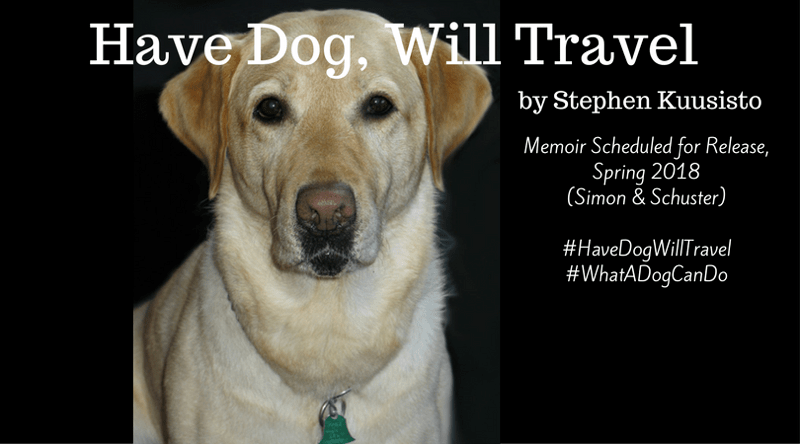
Photo description; Yellow Labrador guide dog against black background. Text: Have Dog, Will Travel, by Stephen Kuusisto, memoir scheduled for release Spring 2018 (Simon & Schuster) #HaveDogWiillTravel #WhatADogCando
I’m pleased to announce that Rachel Zubal Ruggieri is the winner of the online contest to name my new memoir. “Have Dog, Will Travel” which will be published by Simon & Schuster in March of 2018. Rachel will receive two free copies of the book and her name will appear in the acknowledgements. Thanks Rachel!
Of the book, Simon & Schuster writes:
HAVE DOG, WILL TRAVEL
By Stephen Kuusisto
This original memoir of a blind poet who gets his first guide dog is a testament to the power of teamwork and a lyrical love letter to guide dogs everywhere. At the age of 38, Stephen Kuusisto–who has managed his whole life without one–gets his first guide dog. They embark on an intimate relationship of movement, mutual self-interest, and wanderlust. Walking with Corky in Manhattan for the first time, Steve discovers he’s “living the chaos of joy—you’re in love with your surroundings, loving a barefoot mind, wild to go anyplace.” Profound and unforgettable, this is the story of a spiritual journey, discovering that joy with a guide dog is both a method and a state of mind.
Health Care in America is for Useless Eaters
I’ve had a bad cold for over a week. Strictly speaking this shouldn’t interest you. Even if you’ve had a similar thing chances are good you haven’t made a big deal of your headache and congestion. You’ve enough irony to resist claiming status for yourself. After the age of ten we’re no longer granted notoriety when we’re not feeling our best. And yet whenever I have to take an antibiotic (yes the “thing” settled in my lungs) I inevitably turn emotional. I’m not weeping right now but I might start any minute.
**
My nation’s long festering hatred of the poor has burst like Krakatoa. Capitol Hill is raining lava on Americans who can’t afford health care, child care, sufficient food, or who lack the means to finance their own educations or keep a roof over their heads. In other words, a week spent at home struggling for breath has reminded me just how many millions are facing calamities that should be unimaginable in a country which purports to be a democracy.
**
“Why do they hate health care so much?” a friend wrote on Facebook yesterday. The answer is terrible, steeped in eugenics and the popular slogans of fascism. Anyone who’s not healthy (which means he or she doesn’t possess an assignable value) is a “useless eater” as Hitler famously said of the disabled. The sick, infirm, crippled, mentally ill, the elderly, et. al. contribute nothing to the state. The fascist state is always conceived as a well oiled machine which can’t afford any broken parts.
**
This is in essence my view of the GOP’s meretricious health care law–that it treats the poor as chattel, that the party of Lincoln long ago turned toward a view of the unfortunate as being disposable; that this comes from an affection for slavery and animal exploitation. When I see Paul Ryan I see a man who kicks kids with crutches and shoots their dogs.
“In certain respects, the regulation of animal exploitation is similar to the regulation of human slavery in North America. Although many laws supposedly required the “humane” treatment of slaves and prohibited the infliction of “unnecessary” punishment, these laws offered almost no protection for slaves. In conflicts between slave owners and slaves, the latter almost always lost. Slave welfare laws, like animal welfare laws, generally required that slave owners merely act as rational property owners but did not recognize the inherent value of the slaves. Slave owners were, of course, free to treat their slaves, or particular slaves, better. But as far as the law was concerned, slaves were merely economic commodities with only extrinsic or conditional value, and slave owners were essentially free to value their slaves’ interests as they chose, just as we are free to value the interests of our dogs and cats and treat them as members of our families or abandon them at a shelter or have them killed because we no longer want them.”
—“Animals as Persons” Gary L. Francione
**
I am not making a sheer seat-of-my-pants pronouncement. I have enough cultural understanding to know what the canards and unexamined biases of my age look and feel like. Which means I know blowback when it hits me in the face. You know the voices: “Small businesses were really hurt by Obamacare.” “Learning disabled children are ruining schools for everyone else.” “Why don’t you go back where you came from?”
Facism is what’s for dinner.
**
“America”
America with your history of eugenics.
With your hostility to the global charter on disability rights.
With your jails, stocked with psychiatric patients—worse than the Soviet Union. We are Gulag Los Angeles; Gulag Rikers Island; Gulag Five Points in Upstate New York.
America with your young Doctor Mengeles.
With your broken VA.
With your war on food stamps and infant nutrition.
With your terror of autism and lack of empathy for those who have it.
With your 80% unemployment rate for people with disabilities.
With your pity parties—inspiration porn—Billy was broken until we gave him a puppy.
With your sanctimonious low drivel disguised as empathy.
With your terror of reasonable accommodations.
With your NPR essays about fake disability fraud, which is derision of the poor and elderly.
With your disa-phobia—I wouldn’t want one of them to sit next to me on a bus.
America when will you admit you have a hernia?
When will you admit you’re a lousy driver?
Admit you miss the days of those segregated schools, hospitals, residential facilities—just keep them out of sight.
When will you apologize for your ugly laws?
When will you make Ron Kovic’s book irrelevant?
America, you threatened Allen Ginsberg with lobotomy.
America you medicated a generation of teenagers for bi-polar depression when all they were feeling was old fashioned fear.
When will you protect wheelchairs on airlines?
When will you admit you’re terrified of luck?
–Stephen Kuusisto
Asking for a Friend: Is it Me or is it My Campus?


Photo: Professor Stephen Kuusisto and guide dog Nira marching in academic convocation at Syracuse University.
I’m borrowing my title from Liza Featherstone’s new advice column in The Nation which is entitled: “Asking for a Friend: Is It Me or is it Capitalism?” Oh the sang froid of self help! One scarcely knows how to pursue emotional intelligence in these times, why not write Ms. Featherstone? It’s a fine joke. Or as John Lennon would say: “Whatever gets you through the night…”
Now my problem isn’t rampant, alienating, corporatist neglect, though it’s true just last week a man on the phone tried to tell me my wife’s brand new computer had a virus and he could fix it for $99. I still have sufficient causticity to look in the horse’s mouth as it were, and while the workaday world can wear me down, I like my labor just enough to avoid…
View original post 1,596 more words
Ahab, Entrepreneur
One thing is like another until it isn’t—a pine doesn’t resemble a coffin though as a boy I saw men inside each tree, my way to be less alone, talking as if I could force resemblance. Later they teach us this can’t be done. By the time one enters college one no longer sees murdered kings inside the lightbulbs on theater marquees. (The line is Robert Bly’s: “there are murdered kings in the lightbulbs outside movie theaters.” ) No, instead of the inner life with its Promethean distrust of static materiality, you hit campus at 18 vowing to be a pharmaceutical sales rep, or better, to be the maker of a new “app” that replaces sales reps with bots. Meanwhile there really are dead potentates in traffic lights; the souls of murdered animals swim alongside your shoes as you walk to the business college. Thank god they shook all that mumbo jumbo out of you back at Thomas Worthington High School and made you a proper little Prole.
I did talk to those trees when I was 6 years old. And there really were men inside those rough pines. Best of all, I didn’t have to tell anyone. Years later, reading the Finnish Kalevala I’d see I was a minor character in an ancient poem about wizardry. My job, the work of the inner life, was to never forget what the wizards had passed down. At the very least I should distrust standard issue real estate and transactional materialism. Even a simple pine tree is more interesting than is commonly supposed.
So I’m not a hit when talk turns to entrepreneurship—where the sole meaning of life is to invent faster ways to sell spiritually unnecessary junk. Look around on the average university campus: students and faculty are nowadays cheerleaders for the selling of selling.
The great novel of American entrepreneurship is Moby Dick. Melville’s whaling ship is a factory, a corporate office, a floating university, a bureau of weights and measures, a start up, an engine seeking to supplant older engines, a mania. Melville looked unflinchingly into the brutal, neo-puritan heart of American capitalism and saw all its soul gobbling darkness.
Had Melville lived to see the electric lightbulb he’d have seen dead kings in the filaments.
Entrepreneurship is charm commodified. Everyone will win, become his or her own boss. Make money. Sail the seven seas in search of a poorly understood creature, which is materiality itself. But of course things, stones, whales, cloud formations, are not susceptible to our covetousness. And the college student who isn’t taught this will be as lost as Ahab.
And to conclude with Ahab, I’ve always liked this quote by D.H. Lawrence: “Moby Dick, the Great White Whale, tore off Ahab’s leg at the knee, when Ahab was attacking him. Quite right, too. Should have torn off both his legs, and a lot more besides.”
Donald Trump, the Pied Piper
I had a friend in college who, inexplicably, had a thing for Nazis. I say inexplicably because no one in his right mind should have what he had: it was a man crush, a sentimental admiration for testosterone regalia and Stukas. Fortunately he wasn’t violent and as far as I know he never drew swastikas on buildings. His fascination for the Third Reich was ingrown like entomology is for fifth graders.
Everyone do your own joke. What’s the difference between a Nazi and a bug? You only have to squash a bug once.
Adolescent masculine small “f” fascism is not, as is commonly supposed, a matter of wanton ignorance. It’s more a product of the perfervid boy-brain, still undergoing its development. Critical self-irony? None. Anger? You bet, because as the Little Prince knows, all authority figures are hateful. Why, if only he had a hundred Panzer divisions!
**
What’s the difference between a Nazi and a centipede? The centipede doesn’t wear boots.
What’s the difference between a Nazi and a skeleton? The skeleton has read Aristotle.
**
The poet Wallace Stevens wrote in one of his notebooks: “Man is an eternal sophomore.”
This is what I think when I see Trump’s arena supporters. They’re like my college pal but they never outgrew their admiration for Kingly murderers.
True adulthood is a purging of the world’s poverty and evil.
Trump is the Pied Piper of privileged and angry children.
Poets? What Are They Good For?
What if, all at once, I showed you
My head both inside and out,
If tricks of mind were as easy as talk?
We do of course live in a country of talk
Where shadows fall quickly over us
Where we lie from basic fright.
I love you, which is the truth,
But shiver my way to morning light
Where custom has no ardor.
No love, no truth in these United States.
My love, I can’t help it, I want
To be a poet whose lines house people—
Say that’s not a trick.
Our neighbors drown
In malevolence
And all I have are games.
Why the Times Gets Blindness Wrong

Last week the New York Times published an article about blindness with the inestimable title, “The Worst That Could Happen? Going Blind, People Say” —and here I’m using “inestimable” in the province of unfathomable, as the damage caused by such a headline is nearly limitless. Let me put my cards on the table: I side with the National Federation of the Blind, one of America’s leading blindness advocacy organizations, who attest “that blindness is not the characteristic that defines you or your future. Every day we raise the expectations of blind people, because low expectations create obstacles between blind people and our dreams. You can live the life you want; blindness is not what holds you back.”
Low expectations indeed. The Times article by Jane E. Brody takes a purely medicalized approach to blindness and confuses vision loss with life itself, a model of living we tend not to believe if we’re talking about hair loss, foot pain, or even cancer. I include cancer because it’s been forty years since Susan Sontag’s Illness as Metaphor first made its appearance. Didn’t we learn that a woman isn’t her diagnosis? Haven’t we discovered that fear of disablement is simply fear? That it gets in the way of living?
Of course we did. But you’d never know it according to the perfervid ophthalmologists quoted in Brody’s piece who hold that blindness as a calamity. Blindness is at most an inconvenience, but it’s manageable. The Times’ failure, and it’s a considerable one, is to hint that the public’s perception of vision loss has merit. There’s nothing awful about blindness. Fear is easy where disability is concerned. Few imagine disablement as a preferred condition. But you see, it doesn’t matter what one thinks of it, the reality is always different, and in the case of disability, when met with education, life is better than any supposition.
On Being Called a Malcontent
Word reaches me from well informed faculty colleagues that some higher ups in the administration at Syracuse University have branded me a “malcontent”—a badge of honor perhaps, as contrarianism is it’s own reward and one can say, “I must be doing something right.” But since I’m a disabled professor the term is revealing. Within the disability community we know being labeled “dissatisfied” is a feature of ableism—equivalent to “uppity” or “bitch” in usage. It’s always the first response from bureaucrats who are grudging or clueless about disability both in the letter and spirit of the law. The disabled are keenly impacted by poor service—the bank that offers no means of communication for deaf customers, the movie theater with no audio description for the blind, the airline that stops an autist from boarding. We cripples forward these stories on Facebook and Twitter.
Now I know a thing or two about true malcontents. My Finnish grandmother was a full fledged fun-sucker. She could (and did) destroy every moment of cordiality and/or innocent fun. She was a sour Lutheran fundamentalist who, seeing a child enjoying her ice cream cone would say: “vanity, vanity, all is vanity.” A genuine malcontent is a conspiracy theorist. Something sinister is behind every human moment. Did you know the chocolate bar you’re now eating is the product of slave labor? The infuriating thing about malcontents is that more often than not they’re right. My grandmother was always correct. You were truly happy with your ice cream and yes, you’d better get right with God because you’re going to be dead a long time. Malcontents aren’t famous for flexibility.
Me? I’m just a consistent voice for inclusion, accommodations, transparency, dignity, and professionalism where the disabled are concerned. I’m also incredibly persistent. Hence the label. Rather than admit that the university has a poor record when it comes to providing basic accommodations—instead of boldly doing something about it—it’s much easier to say that the students who complain, or that blind professor, or that deaf one are problematic. When “malcontent” is used as a pejorative term for the disabled it means “you’re here on sufferance.”
It means, “we let you in, now what?” “You want accessible texts? Websites? Access to auditoriums? Accessible housing? Sign language interpreters for campus events that aren’t part of your course load?” Yes. You must be a malcontent.
Truth is, I’m funnier than my grandmother. She was such a sorrowful and aggressive soul that one day, as we all rode together in the family station wagon, and she began exulting about the beauties of nature, my father, suspecting that he’d delayed too long replacing the muffler, thought to himself: “God God! This is a woman who’s never said a positive thing in her life! We must be getting carbon monoxide poisoning!” He pulled over. Shoed everyone out of the car.
He was right. Grandma was the canary in the coal mine.
I know more about malcontents than anyone in bureaucracy will ever know.
 Planet of the Blind