Disability, Embraces, and the Grand Tetons

I grew up on a steep divide but it wasn’t geographical. Instead it was a ridge or a chain of mountains both inside and outside me. I didn’t wish to be blind. I wanted to play baseball. And perhaps, more significantly, I wanted to be a scientist. Neither baseball or physics would happen for me. I became a poet. Compared to physics I think poetry is easy. All you have to do is step barefoot on a worm like Theodore Roethke, and you’ve got a poem. Poems fall out of cupboards like a box of starch loaded with spiders.

A popular phrase in advocacy circles is “embrace your disability”—but I’ve always thought the “d” word too mountainous for a hug. No one who’s disabled experiences a singular thing—a kewpie doll of physical difference that can be clutched to the chest. No. You can’t embrace your disability because, in fact, it’s a chain of mountains—highly articulated peaks with physical and metaphorical obstacles. I can’t stand it when I hear someone say “embrace disability”—one might as well embrace the Grand Tetons.

But I have another reason for hating the phrase “embrace disability”—one thinks of  how difficult “embraces” really are for the disabled whose hopes for love and sexual life are often next to impossible.

Do you embrace your human loneliness and the near impossibility of intimacy with others?

Do you embrace your unemployment? The erosion of rehabilitation and health services?

Or the fact that doctor’s offices in the US are largely inaccessible?

Or that colleges and universities are woefully trapped in a 1970’s model of disability services?

Or that public transportation, especially airlines, treat you like a cockroach?

So I don’t like the word “embrace” which is just plain tomfoolery. And I don’t like “accept” because it’s too passive and vaguely defeatist.

Exult. Rejoice. Be rapturous. These are all too American. Don’t worry. Be Happy.

It just isn’t easy. The emotional rain isn’t gentle.

Once upon a time in Ithaca, New York, I encountered a man, a rather disheveled and clattering old man, someone the locals seemed to know, for we were in a diner, and he was going from table to table chattering with breakfasters, not asking for money, but essentially playing the role of the Id, sassing people, perhaps in ways they required, who could say, but there he was, pressing into each person’s space, piercing the psyches of strangers with his needle. He called a cop “Porky” and an elderly woman “Grandma” as he lurched steadily toward me. “Oh Doggy!” he said. “Doggy doggy doggy!”

Then he said, “What kind of fucking person are you?”

I tried my best Robert deNiro impression: “Are you talking to ME?”

He was not amused.

“A prisoner!” he shouted, for the whole diner was his stage. “This dog’s a prisoner!”

For a moment I felt the rising heat of embarrassment and rejection. Then, as he repeated my dog was a slave, I softened. In a moment of probable combat I stepped far back inside myself, not because I had to, but how to say it? Corky was unruffled. She actually nuzzled my leg. The nuzzle went up my torso, passed through my neck, went straight for the amygdala.

I smiled then. I said, “You’re right. And I’m a prisoner too.”

I don’t know if it was my smile, or my agreement that did the trick, but he backed up, turned, and walked out the door. Strangers applauded.

I’d beaten a lifetime of bad habits. I hadn’t fallen into panic, or rage, or felt a demand to flee.

I sat at the counter, tucked guide dog Corky safely out of the way of walking customers, and ordered some eggs. I daydreamed over coffee.

When I was eleven years old I fell onto a pricker bush. It’s hard to say how I did it, but I was impaled on hundreds of thorns. My sister who was six at the time, and my cousin Jim who was maybe nine, fell to the ground laughing as if they might die. I begged them for help which of course only made them laugh all the harder. I remember tears welling in my eyes and their insensible joy. I also knew in that moment they were right to laugh—that I was the older kid, was a bit bossy, disability be damned. I was the one who told my sister and cousin what to do. Now I was getting mine. My just deserts. In the end I tore myself from the monster shrub and stormed into the house. I sulked while they continued laughing outside.

Perhaps I thought, there in the diner, I could live henceforth in a new and more flexible way.

“Is it as simple as this?” I thought. “One simply decides to breathe differently.”

I saw, in a way, it was that simple.

Saw also how a dog can be your teacher. And while eating wheat toast I thought of the Buddha’s words from the Dhammapada:

Live in Joy, In love,

Even among those who hate.

Live in joy, In health,

Even among the afflicted.

Live in joy, In peace,

Even among the troubled.

Look within. Be still.

Free from fear and attachment,

Know the sweet joy of living in the way.

But you see, that’s the poet in me. It’s easy to imagine disabled life is a matter of grace.

And though I have these moments, I know I’m high in the Grand Tetons, still looking for a path.


Dog Joy, Local, a Poetics

If anyone wants to know where I am I’m inside my dog. Forget Groucho Marx: “Inside of a dog it’s too dark to read…” Inside my dog there are mountains and pine forests. There’s a strange happiness in here. Odor of “fud” (Middle English, a rabbit’s rectum)—inside my dog I discover the rabbit’s rectum smells like rotting cabbages since odors are stronger for dogs and rotting cabbages smell good, oh so good, like yummy death.

The rabbit ran away but left a ropey trail of deliciousness on the wind. Live with a dog long enough your head tends this way. Over time you start to get the zesty darkness of essential things. There’s a dropped mitten in snow, it smells like fear.

Fear in turn has several smells—fusty, malodorous, noisome stinks of burning rope, gasoline, and urine; the frowzy house of fear has too many odors to name but all are good to a dog even rancid oils—any bolus of strong odor that sticks in the throat is a pure excellence for a dog, a trapped and suspended ick is a Rococo picture frame for her.

I’m inside my dog. I smell the cordite and antimacassar of crow shit and the mellon scented smear turds of fat walking geese.

And you should say, “so what?” Should say: “you’re just a poet playing with the piano keys, and that’s sort of cute, but maybe not…”

But dogs bring fresh air to whatever does not have freshness in it. They breath over the trapped stink they’ve brought inside. They can make something of the fetid local.

Try doing that with just your head.


Of Heidegger and Trump

Once in graduate school I inserted some ideas from Heidegger into a paper and my professor wrote: “trite” in the margin. I asked him what he meant and he obfuscated but when pressed said Heidegger was a Nazi. “Well,” I said, “say what you mean. There’s no such thing as a trite Nazi.”

We are living in “The Age of Glib”—everyone from public officials to your neighbor stinging Christmas lights seems to believe the first thing that comes to his or her mind is fit to be shared. Jack Kerouac famously said of creative writing: “first thought, best thought” but its one thing on paper and another thing at a press conference. When did it become fashionable to appear as if we don’t know better? The ghost of Gore Vidal whispers saying it was always fashionable, but Gore would admit its worse now if we could summon him.

Say what you mean. But dare to think it through. As Christopher Lasch famously said: “we demand too much of life, too little of ourselves.” Another way to say it is that our apparent helplessness when we stand before the world will always be experienced as disappointment, now think. For God’s sake, think.

Back to Christopher Lasch for a moment:

“Our growing dependence on technologies no one seems to understand or control has given rise to feelings of powerlessness and victimization. We find it more and more difficult to achieve a sense of continuity, permanence, or connection with the world around us. Relationships with others are notably fragile; goods are made to be used up and discarded; reality is experienced as an unstable environment of flickering images. Everything conspires to encourage escapist solutions to the psychological problems of dependence, separation, and individuation, and to discourage the moral realism that makes it possible for human beings to come to terms with existential constraints on their power and freedom.”

First thought isn’t best thought. Glib is always a shrug, and more often than not it’s angry—the shrugging off of those who are inconvenient. As Donald Trump said, when throwing a man out of a political rally—“keep his coat, it’s cold outside…”


I said there’s no such thing as a trite Nazi, but maybe Trump comes close…


After Living Many Months with My First Guide Dog…

Learning you’re a figure of more than passing interest called for gumption and patience. I was getting it. I saw how my public reception was sometimes not what I imagined it would be. Again in a convenience store, late at night, Corky and I stopping for a bottle of milk, a man pushing a mop shouted: “Hey, that there’s a service dog!” Then another man appeared from a back room and said: “Do you know the story of the prophet Mohamed and the hero dog?” “No,” I said. “Well the dog Kitmir is in Paradise! He was a hero like your dog!” “Hero dog! Hero dog!” said the man with the mop. I felt a weird purple joy. Happiness among strangers was possible. Perhaps it was random, but it was possible. What was one to make of this? In one store I was a problem, in another a mythology.

With a guide dog you basically become a “sacred/profane wandering totem” and there’s no help for it. After a few months with Corky I started to see this as hopscotch—jump—you’re in a beautiful, even magical space; jump—you’re in a profane spot. Jump again—you’re like the dog Kitmir in Paradise. Jump. You’re fighting with one of those occasional connoisseurs of hate who you can meet almost anywhere and without warning.

Good. Bad. Weird. Lovely. Shade. Sunlight. Peace. Rain squall. I thought: “Isn’t disability a constant in the midst of life’s fast waters?” “It simply Is,” I thought. “And life simply is.”

Sacred space is where you arrive and whatever is the essential you is one with both the place and its people. Profane space is where you’re the discomfiting other, and while you might try street theater or argument, you may never get the acceptance you want.

“What if I never get the acceptance I want?” I said aloud to Corky as we were going home with a quart of milk with Kitmir the dog in mind. “What does that mean?” I asked, as if my dog might answer.


Riva Lehrer on David Bowie

Chicago artist Riva Lehrer posted her thoughts about David Bowie on Facebook this morning, and I thought they were so apt, indeed, wicked apt, I asked her for permission to post them on Planet of the Blind:


The following words are Riva’s:

I know you’re all sick of posts and comments about Bowie, but it’s taken me all week to be coherent about my own perspective.

I grew up in the era of punk and New Wave, of emerging LGBT rights and 2nd wave feminism. Their threads crossed and knotted and wove the banners of social change as I understood it. It seemed that change began in anger and operated through anger. “I hate your social/political structures. They must be torn down. Only then can others be built in their place.” It’s not that this doesn’t reach me; I already experience enough daily anger and frustration to drain me dry.

Bowie did something different, and very rare. He stated that the structures of normalcy didn’t mean much to him, or include him, or define him. He leapfrogged the need for rage as a starting place, and instead made work that offered possibilities outside the bounds. For someone like me, who never had the option of normalcy, it was the only real open door.

I have always been at my worst when trying to be normal or look normal (I actually bought a brown tweed business suit in my 20s. Oy and vey, my friends). Normal always wrecks my experience of a job, a relationship, or my own creative practice.

Bowie offers me wit, mystery, disorientation, and statements of radical fact instead of the flaming torch of the revolutionary. He insists on beauty during pain and sorrow threaded through joy. He is an artist not of the possible, but of the existing and transformative door.

Thomas Mann, Illness as Metaphor, and Political Lingo

In Thomas Mann’s novel “The Magic Mountain” whenever his characters grow passionate they turn pink. Its a story about tuberculosis. But of course it’s about TB the way “The Grapes of Wrath” is about automobiles—the world is collapsing and the sanitarium is the mise en scene, the place where people ride out the proleptic storm—its on the way and will become “the war to end all wars” but it hasn’t happened yet. Mann’s characters are already dead—though of course they know it conditionally since they believe they’re merely fighting a disease. Mann wants us to see they are the lucky ones—they’re allowed to wrestle with conscience and soul just before the planet dies.

I’ve never been a true fan of the book because I distrust illness as metaphor but I’m in mind of “The Magic Mountain” these days for a number of reasons. Foremost among them is the floridness of our politicians who live in the magic sanitarium of DC and Wall Street and shout endlessly about ISIL as a cancer as President Obama did during his final State of the Union address—though he merely plucked the phrase from the ambient air. The rhetoric of foreigners as being or bearing a disease is everyplace. John Kerry has called ISIS a “cancer that must be stamped out.” Why not call them a group of hateful extremists?

Calling our enemies a cancer accomplishes three goals: it advantages the fear of every individual, as all people fear cancer in our time, just as they once feared tuberculosis, (Susan Sontag) By cancerizing your enemy you inculcate a wild terror in your listeners. Once the public is afraid they’ll do anything to stamp out the soulless, vicious enemy. Calling them extremists doesn’t accomplish this. After all the world is filled with extremists. But the Cancer-Muslims, they’re a demotic metaphor, easily grasped. Finally, metaphorizing them as illness makes it easy to carpet bomb them, as I believe Ted Cruz recently suggested we should do.

In “The Magic Mountain” the patients (who Mann is at pains to remind us are citizens) are aware that they’ve been reduced to helplessness by their doctors. “Joachim” who wants to be a soldier imagines the science behind his diagnosis may be fraudulent:

Yes, the good, the patient, the upright Joachim, so affected to discipline and the service, had been attacked by fits of rebellion, he even questioned the authority of the “Gaffky scale”: the method employed in the laboratory – the lab, as one called it – to ascertain the degree of a patient’s infection. Whether only a few isolated bacilli, or a whole host of them, were found in the sputum analysed, determined his “Gaffky number,” upon which everything depended. It infallibly reflected the chances of recovery with which the patient had to reckon; the number of months or years he must still remain could with ease be deduced from it, beginning with the six months that Hofrat Behrens called a “week-end,” and ending with the “life sentence,” which, taken literally, often enough meant very little indeed. Joachim, then, inveighed against the Gaffky scale, openly giving notice that he questioned its authority – or perhaps not quite openly, he did not say so to the authorities, but expressed his views to his cousin, and even in the dining-room. “I’m fed up with it, I won’t be made a fool of any longer,” he said, the blood mounting to his bronzed face. “Two weeks ago I had Gaffky two, a mere nothing, my prospects were the best. And to-day I am regularly infested – number nine, if you please. No talk of getting away. How the devil can a man know where he is?”

Would that we might have a few rebellious patients in our ruling classes.

More About Being Blind in the Seven-Eleven…

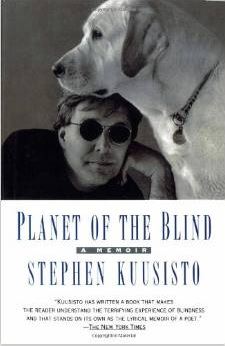
Like it or not, even with your beloved dog beside you you’re still an outsider in most public spaces. Moreover, you’re “the show” and there’s no help for it. You’re the guy riding the old wooden escalators in Macy’s Department Store, while a hundred people stare. “I feel like I have a fried egg glued to my forehead,” I once said to my wife as we were navigating an airport. “You do,” she said. You can count on your spouse. When I think more deeply about this I think in terms of history. I belong to the first generation of public disabled. We’re not in the institutions. The laws of the land welcome us. Of course I’ll be stared at. 100 years from now, when everyone will have wild looking quasi-electronic rubberized appendages attached to their bodies this era will seem like ancient history. I hope for that.

Meanwhile one walks about. And you know you’re a symbolic father or mother. A political symbol if you will. In a way, every space you enter is a frontier. You’re clearing the road for others who may follow. I often think about the business of clearing. I’m not just asserting a right to inhabit public space for the disabled but for all my brothers and sisters who are still outsiders.

I took to whispering into my guide dog’s ear: “What’s an outsider?” Perhaps being a pack animal she knew, but she only said: “It’s something in the past.”

Dogs eat grass, just to know what’s in it. They eat the past. A lesson. Get over yourself.

And you do for a minute. You imagine you’ve eaten the grass; the hear and now has fallen; you can taste a pure democracy. But the hear and now is like rain at the windows, just persistent enough to haul you back from utopia. You’re in the Seven-Eleven again, being stared at by absolutely everyone. “What’s that man doing?” says a child to its mother. “Shush,” says the mother. “No Mommy! What’s that man?” “Shush,” she says, “Or there’s no birthday for you!”

You’re innocent. You are standing beside a rack of Twinkies and Hohos, just trying to figure out where the coffee is located, and now your a fucking un-indicted co-conspirator behind the ruination of some kid’s birthday, all because you entered the damn store.

“You’ve entered the damn store” became a personal tag line. My father who served in World War II used to say, “You’re in the Army now, you’re not behind the plough….” His way of saying you’re screwed and just get over it.

In Macy’s I was  followed once by a store detective. I was walking merely to walk. Working my dog around mannequins and racks of clothing, mostly because it was something to do and it was a good exercise for the dog, and you know, what the hell. Sam Spade was about ten feet behind me wherever I went. What’s an outsider? He’s whatever they say he is. He doesn’t look like the other crayfish. Let’s eat him.

Blind in the Seven-Eleven

People see the blind and think “there’s a defective human.” Getting a guide dog doesn’t change this. One night in a Seven-Eleven in Westchester County I met a cashier who was terrified by my presence—I was “othered”—given the silent treatment the second I walked in. My black friends know the scene, it’s the Old West saloon, swinging doors clattering, all eyes on the suspect newcomer, interloper, desperado, cheat…and you’re “it”; you’re the ruinous banished sonofabitch, back from his Roman ostracism, home from the marshes, returned from the dead, stinking of grave clothes, flashing a fishy slick evil eye right beside the chewing gum God Almighty, even smiling, therefore super dangerous and how jokey it is since you were feeling so good, the evening was going nicely, you were out to buy some condoms, you were getting lucky and now you’re a shrunk nefarious freak under fluorescents, a horny homunculus, a walking voodoo doll. I waved at him, the counter man, for he was there alright, that colossus of late night six packs and last minute milk and since he wasn’t going to acknowledge me I said: “Hey, where are the rubbers?” (You can feel the horror of silent men…I think he backed up a foot or so, his ass contacted the cigarette rack, I heard the clatter.) He said nothing. I said, “you know…condoms…no glove no love…don’t be silly wrap you willy…don’t be a fool wrap your tool… don’t be a ding-dong cover you shling- shlong…” He raised his arms as if it was a stick up. “They are here, behind me,” he said. “Here.” “Aha,” I said. “Can you describe them?” “Oh no,” he said. “Oh no! Can’t describe!” “Yes you can,” I said. “Read the labels.” And he read them then, “lubricant, ribbed, latex, flavored…”  His shame was almost heartbreaking—almost, but never quite.


The Conditions

Old love, like deer eating the tips of winter branches, the poor things still hungry at night. Old love my necklace, my familiar, what do you want? Can’t you tell I’m the acrid pulp of the oak—even insects avoid me. Please go. There must be many who will throw their arms around you. I’m an old man in a bathrobe, productive, alone at his northern window, with a few books for company. Love, don’t return, unless you’re the ghost of my dog…


Why I Blog. “You don’t get paid for it, do you?”

Do you remember receiving letters? They came in envelopes. Sometimes your fingers could feel despair through the paper—a strange packet with loopy scrawls. I’d published a book and  the odd envelopes arrived like dolls with cramped little faces—things you’d have to spend time with certainly. Back then, twenty five years or so, I needed help with those letters and asked friends to read them to me. And so the voice of an acquaintance read lines roughly like these:

Dear Mr. Kuusisto. I’m going blind and I don’t want to live. The days have been hard and they’re getting so much harder. I have no idea how to stay in the world. 

Or:

Dear Sir: I currently reside in prison. I was put here by a blind judge. He was a total bastard. Not all blind people are good. Thank you for reminding me there are some good ones…

When my sister was little she used to pop the heads off her dolls and carry those heads around with her, mostly by putting them in her pockets. I carried my own doll heads having written a book.

I knew there was this thing, the ether of literacy, a place where others read me and felt they might enter. Think of this as blogging with a stylus and sun dial. The internet is the ether for better or worse. Everyone knows about the “worse” of course. The better is small, carried in our pockets, occasionally brought into the light for examination. The doll heads. (When I first heard of the band “Talking Heads” I thought of my sister who used to hold up her Barbie skulls and have them speak.)

**

While reading Peter Gay’s Enlightenment, Volume 1 the following passage intrigued me. Gay is referring to his lifelong fascination with the Scottish philosopher David Hume, and in turn, the work of Stuart Hampshire:

“I was delighted to read Stuart Hampshire’s brief appraisal of Hume, “Hume’s Place in Philosophy,” in David Hume: A Symposium, 1–10, which accords precisely with my own estimate—an estimate I have arrived at after years of close and affectionate concern with Hume’s work. Hume, writes Hampshire, “defined one consistent, and within its own terms, irrefutable, attitude to politics, to the problems of society, to religion; an attitude which is supremely confident and clear, that of the perfect secular mind, which can accept, and submit itself to, the natural order, the facts of human nature, without anxiety, and therefore without a demand for ultimate solutions, for a guarantee that justice is somehow built into the nature of things. This philosophical attitude, because it is consistent and sincere, has its fitting style: that of irony …” (pp. 9–10). The demands and the possibilities of modern paganism have rarely been stated better than this.”

Excerpt From: Peter Gay. “Enlightenment Volume 1.” iBooks. https://itun.es/us/vuGqN.l

I’m fascinated by this wee passage. Gay’s admiration for Hume frames everything. Notice that he’s a delighted scholar! (Are scholars nowadays allowed to express their delight?)

Peter Gay is also an affectionate intellect. Adoration, devotion, and caring are critical to the life of the mind. (Have scholars forgotten this at their peril? One may well think so.)

What does Gay like so much? He likes an appraisal of Hume. Gay’s delight is doing the talking, and then, voila, he brings forward a paratactic delight—a tandem pleasure, Hampshire’s elegance, which is also in the service of Hume. Hume, who isn’t speaking. Here in a cloister of estimation are two scholars whose respective lives were devoted to ideas celebrating the nobility of a third. And the third is their father.

Notice the use of “attitude”. Talk about nuance! From the Latin for “fit” it was originally the proper word for placement, especially of figures in paintings. Later it became synonymous with stance. And once it entered the world of ideas it became the template for self-awareness. Attitude is valuable only insofar as it has the manners of irony.

I know of no better description of the contrarian intellectual. No anxiety, just the facts. So let’s say there is no God. Let’s say justice isn’t built into nature. What then? Why we get to build a confident and clear pagan democracy.

David Hume:

“Epicurus’s old questions are still unanswered: Is he (God) willing to prevent evil, but not able? then he is impotent. Is he able, but not willing? then he is malevolent. Is he both able and willing? then whence evil?”

“In our reasonings concerning matter of fact, there are all imaginable degrees of assurance, from the highest certainty to the lowest species of moral evidence. A wise man, therefore, proportions his belief to the evidence.”

**

These thoughts of a morning.

The pleasures of thought, the marvels of freedom.