The Wisdom of Sadness as Thanksgiving

An article crosses my sightline (as it were) proclaiming gratitude is the key to human happiness.

The trouble with this proposition is of course the word “key” since it suggests a host of fantasies about contentment or well being, the most principle being that it has a physical location, something like a bank vault. You can find your own sub-rosa fantasies. Phallic, capitalistic, old or new testament.

This morning as I work on my second cup of coffee I see gratitude is a rum game—part of the self-help pop psychology mantle of Puritan saccharine ash that fell over America long before the United States existed. Gratitude in the American sense has always meant, “we’re grateful to not be savages” and therefore it’s no more complex than the football player thanking God on TV for letting him score the winning touchdown. We’re grateful we’re not losers.

Oprah, Dr. Phil, their televised progeny—all tabloid psychologists say we should not be losers.

Being a loser means letting others dictate the terms of your quest for joy, dignity, autonomy, truth, etc. So in addition to finding the key, you’re supposed to be independent, like an American cowboy once you’ve found it.

As the poet Robert Bly pointed out in his book The Sibling Society, Americans now have the emotional lives of 11 year olds and the media does everything to assure no one ever grows up. Aging in true psychological terms means admitting sadness, even welcoming it. Pablo Neruda put it this way:

give me 

your black wing,

sister sadness:

I need the sapphire to be 

extinguished sometimes and the oblique

mesh of the rain to fall,

the weeping of the earth…

**

In this way I shall be grateful for sadness.

I will walk in the new snow grieving for refugees across the globe.

I will remember on Thanksgiving my Native American brothers and sisters, my Latino friends, my black pals, my crippled posse, the liberated, sexually free people I love, all of whom struggle daily just to survive in the neo-Puritan coal mine that “is” America.

Grateful for ambiguities, nuance, depth psychology, post-Colonial verities, the thirst for justice.

Grateful to know what side I stand on.

Grateful to have so many many richly diverse and beautiful people in my patchwork tribe of adults.

Grateful to the animals who allow me into their worlds.

But I shall be grateful for the wisdom of sadness.

Disabling the Academy

I am reposting this from a year ago. It remains true.

stevekuusisto's avatarPlanet of the Blind

Each day the university disables itself. Note, the university does not “crip” itself. Systematic conceptual alienation requires a ruling class. And no irony please.

Let those with disabilitieswho labor in higher education not acidulate the drink. Thomas Paine wrote:“Independence is my happiness, and I view things as they are, without regard to place or person; my country is the world, and my religion is to do good.”

The disabled university is ubiquitous. I’ve traveled to hundreds of schools. Here are the things I’ve seen (and recently):

Segregation of disability. “Specialized” offices of disability services where the tainted students must appear like scofflaws. (The environment matters: at the University of Iowa the disability services center is in the basement of a dormitory. If it’s hard to find maybe people won’t use it. Oh. There’s no way out from the basement in case of a fire. Hmm. Let’s have a seven year…

View original post 562 more words

A Blind Poetics

I set out to stand on poetry, like the aerialist who walks on a wing. I saw others had done it. James Wright and Li Po, Emily Dickinson sometimes, when the light was right. I learned you could walk the thinnest ledge provided the light was right. Poetry could be thread. Of course. It was always nothing more than thread. Penelope was Homer. Of course. (In ancient times the blind were known as weavers…) And so I walked on delicate strings, navigating on guttural sounds and stertorous breaths. Poetry and your feet. The lungs in between.

**

Small wonder I can walk in the dark. Small wonder I can walk with a dog who watches for me.

It is all just poetry on a flimsy wing. And the heart like a bird in a granary. But high up, eyelashes transmitting bone thoughts, you are someone at last. Not the reader of magazines. Not the telephone talker. You are the riff of gravity which is not diagrammable but is a living curve of joy.

**

Now I’m old. Still on the wing. Learned how to fly long ago.

Compared to me the wind is sad.

I Don’t Want to Buy the World a Coke

People dying for all the usual reasons: God, real estate, and wantonness. But since the Spanish American War, the United States has injected its own brand of imperial blundering into region after region. If you look to history for confirmation of US colonialism as a stabilizing influence you will not find it. I’ve often thought that instead of chanting for world peace Americans who care should be chanting for regional stability—it sounds less dreamy, and in truth it would be a slap at the CIA. Our entire foreign policy is based on inflammation.

I don’t want to buy the world a Coke. I’d prefer to give it Advil.

Meantime I think of the possible newly disabled…violence creates them…

Disability can be found everywhere in history once you learn to look for it. President Lincoln’s depression lead him to abandon the White House for several days. When he returned he unveiled the Emancipation Proclamation to his startled cabinet.

Lincoln’s moodiness allowed him to reflect on the value of life and on what was right. That’s Lincoln’s story. Not all who are bi-polar have the moral qualities of Lincoln. And not all depressed people ask themselves what the nature of suffering can teach them. Yet after a certain age one finds this caste of mind is important. What does it mean to feel my heart is ripped out and is now under my shoe? The proper tears, those mixed with luck, tell us to walk for a time because weeping can be a map. Maps, all maps, are born of agonies. One sees disability wisdoms are not often or probable in textbooks. Look for the stains at the paper’s edges.

As a poet I like the margins.

There are so many minutes for which no proper names exist. Deep in the night I carved my name on a seed. Now I’ve awakened outside the broken temple.

Mr. Lincoln I am sad this morning.

I’m thinking of these lines by Cesar Vallejo, the great Peruvian poet:

“There are blows in life so violent—I can’t answer!

Blows as if from the hatred of God; as if before them,

the deep waters of everything lived through

were backed up in the soul … I can’t answer!”

(translated by Robert Bly)

Oh I can’t answer but I’m searching the corrugated quick of the page.

Mr. Lincoln…


Disability, Ludwig Wittgenstein, and Corn Flakes

I think of Ludwig Wittgenstein some mornings. Isn’t that odd? He occurs to me very early.

Usually it’s this quote that pops into my waking noggin:

“Death is not an event in life: we do not live to experience death. If we take eternity to mean not infinite temporal duration but timelessness, then eternal life belongs to those who live in the present. Our life has no end in the way in which our visual field has no limits.”

Oh I like this for lots of reasons. As a visually limited man I admire the temerity of the utterance, insofar as all humans have some kind of visual limitation. Wittgenstein posits the power of imagination to declare anything, and then, with a smear of logic, to cement an idea into consciousness. I suspect this is how he survived the trenches in WW I. And I know for certain its how the disabled survive. Look at the nouns:

Death. Event. Life. Experience. Eternity. Duration.

In my sophomore year of college I was fascinated by Boolean algebra. In mathematical logic, Boolean algebra is the “branch of algebra in which the values of the variables are the truth values true and false, usually denoted 1 and 0 respectively.” (See Wikipedia.)

The quote above is pure Boolean logic. One may easily draw a Boolean equation for the proposition eternal life belongs to those who live in the present. Then there’s a leap—Wittgenstein says our visual field has no limits.

If eternity = timelessness then the present (time) also equals timelessness. Good.

If timelessness is related to mindfulness (we take eternity to mean not infinite temporal duration) then the operations of mind become our vision. Hence our visual field (anyone’s) has no limit.

You can see where the poet in me would like this. You can see where the blind person in me also admires it.

As logic it is unimpeachable. The trick is to live it.

Early. Wittgenstein for breakfast.


The Political Correctness Piñata vs. Safe Space in Higher Education

Presently, in these discommodious times, when citizenship is difficult if not impossible to achieve if you’re a colored person or trans or say, just plain blind (for that is my alterity) one principle rhetoric of demand is to call for “safe spaces” especially on college campuses. Students everywhere from Yale to the University of Missouri to Syracuse U (where I teach) are demanding agora free from racism, ableism, homophobia, and fear. It is predictable that these demands by students and staff who are fed up with second class citizenship, who believe in Jeffersonian hope—who expect the pursuit of happiness within higher education to be more advanced and inclusive—should be met with countervailing hostilities.

The usual suspects (The National Review, Fox, et. al.) are dragging out the piñatas of “political correctness” which always look a little like John Foster Dulles and Anita Bryant though they’ve been patched and can still be pointed aloft. “Political correctness” is simply (was always) “newspeak” from the right. It always meant, sneeringly, the forced elimination of awkward ideas, according to its first adopters, as if calling people the “N” word or denying the dignity of women are defensible political positions. And that of course is the problem: for the angry and shrinking white population that feeds the narrative maw of our public discourse (their anger plays well in a louche and deterministic cash crop media) the right to call someone by a slur is equal to, if not superior to, my right to live free from prejudice. One forgets that minority students at the University of Missouri have endured name calling from students passing in trucks, offenses in public spaces, and systemic inattention from the administration. One forgets that Yale students of color have always felt like third rate citizens—hell, there’s even a college in New Haven named for a slave holder.

Calling the demand for “safe space” a matter of political correctness run amok, or a kind of coddling is easy. It’s also reactionary and deflective. And there’s the rub: do Americans have the right to utilize hate speech? Of course they do. They also have the right to burn the flag. (At least for now.) They have the right to stand in the middle of college campuses and shout ugly religious ideas. We own these rights. So where does safe space start? What does it actually mean? If a university is a place where free expression is expected, than shouldn’t whatever is the opposite of safe space be countenanced? Of course it should, shouldn’t it? (The Dulles piñata drifts in the wind…)

I disagree. Think of a laboratory. In this imaginary lab we are growing retinal tissue gathered from mice. Our goal is to see if we can create new retinas. Some day we hope to cure blindness. This laboratory is a safe space—it’s sterile, quiet, protected from heat, traffic fumes, spit, and dirty shoes. Intellectual space is safe space, which is to say it’s controlled space. We might want to introduce a virus into the mouse lab. We might be searching for a way to make artificial retinas stand up to diseases. We can introduce something unhealthy. But we do so because it’s part of productive learning. Can hurtful words be employed in a classroom? Yes. And they always should. If you want to learn about the Harlem Renaissance you better get used to the “N” word. If you want to read about the history of women’s rights you better be able to withstand writing about sexual violence and a host of oppressions. Discussions in a classroom differ from hurling expletives on the quad. And of course the reason is that the latter is not aimed at knowledge, the former is designed to further our understanding.

When the piñata waving National Review crowd starts to influence the New Yorker (as I think it has) then we have a deflective and ill informed story about what is at stake. Asking for safe space is the same thing as calling for citizenship. It is not political correctness ballooning out of control like some vast tomato attacking Los Angeles.


On Learning to Trust at 38

I remember the first time I understood trusting people was my job. The knowledge came late. I was thirty eight years old. That’s how it is when you’re disabled. Songs come when they come. As a kid I played folk guitar and sang “It takes a worried man to sing a worried song…” Even at 11 I knew it was my tune. G and C chords and my squeaky voice. The blind kid bullied on the playground, was singing alone in his room…No, trust wasn’t high on my list. In high school I’d read Flannery O’Connor’s story “Good Country People” where a traveling salesman seduces a crippled girl and steals her wooden leg. I thought the whole world worked that way. And that was not a form of naivety—disability puts you in the way of lots of crappy people. The graduate school professor who said you shouldn’t be in his class because you couldn’t see; the HR director who said they don’t need to help you with an accommodation in the work place. “It takes a worried man…” And then suddenly, trusting people was a new assignment, like planting, let’s see if we can grow asparagus on a mountain top. Let’s see if we can be somebody different.

That was what my decision to get a guide dog was about. I was at a school where dogs and people were working in the trust garden. “So this is the trust place,” I said half aloud. “I’ve never seen anything like it.”

The best way to find out if you can trust somebody is to trust them. I think the premise was Hemingway’s. I got to laughing. My “Death in the Afternoon” heroic manly man moment was upon me and it didn’t involve bull fighting. It was just a matter of belief. Grow some fucking asparagus. Decide to be different. “People can do that,” I thought. Just decide.

Tomorrow I would get a guide dog. I was about to learn its name.

Donald Trump and the Cripples

ee9c2-6a00d8341dbac353ef01a3fcfa23c2970b-pi

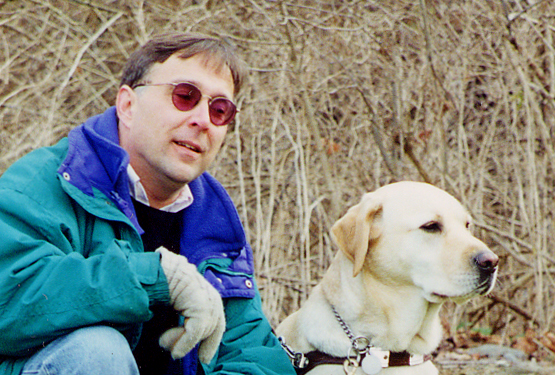
(Photo of Stephen Kuusisto with his second guide dog Vidal, together in an autumn field.)

Donald Trump has entitled his new book “Crippled America” and if nothing else he’s done those of us with disabilities a big favor. I know, speaking for myself, I’ve been casting around for a disability slogan for years and now, voila, the Donald has worked his magic. That Trump doesn’t mean what I want him to mean doesn’t matter at all—he’s given me a “Don’t Tread on Me” bona fide gimpy flag and I’m going to wave it from now on.

Disabled people adopted the term “cripple” around twenty years ago, largely as a way to be both performative (I’m not dis-abled, I’m something more complex) and to express collective solidarity much in the manner of other historically marginalized groups. I’m not “differently abled” I’m a god damned cripple and you better get used to it.”

In her classic essay “On Being a Cripple” Nancy Mairs who has MS writes:

I am a cripple. I choose this word to name me. I choose from among several possibilities, the most common of which are “handicapped” and “disabled.” I made the choice a number of years ago, without thinking, unaware of my motives for doing so. Even now, I’m not sure what those motives are, but I recognize that they are complex and not entirely flattering. People– crippled or not–wince at the word “cripple,” as they do not at “handicapped” or “disabled.” Perhaps I want them to wince. I want them to see me as a tough customer, one to whom the fates /gods /viruses have not been kind, but who can face the brutal truth of her existence squarely. As a cripple, I swagger.

We are a nation of some 65 million disabled and you better believe we’re tough customers. The law says we have equal rights, but long before the ADA veterans and maimed workers fought hard for the chance at life, liberty, and the pursuit of happiness. Maybe we wince. But we are keen fighters. Always have been. Always will be.

Trump’s metaphor is a Tea Party fiction: America is hobbled, not what it used to be, dependent on government, weak in the knees, no longer able to sit up and take nourishment. Not only is this untrue about our nation’s general health and economy, it’s a slur on wounded warriors, human rights activists, disabled children who expect to grow up with good educations and actual prospects, the elderly who need help adjusting to limited vision or arthritis. The 65 million disabled are a large constituency and you better believe we can face the truth of our existences squarely. We don’t need one more book that uses disability as a pejorative symbol.

Trump will say he doesn’t mean it that way. I say he does. Not long ago I was denied entrance to a restaurant in New York City because the doorman said my guide dog couldn’t come in.

Turns out, you guessed it, the joint was owned by a conglomerate belonging to Trump. Sure, it’s always a mistake to impute policy or motives from one ugly incident. But if the Donald can call America crippled I can at least state with some confidence the man has very little awareness of what it’s like to live out here, where those of us with “the conditions” must necessary swagger.

I raised a stink about the restaurant. They initiated employee training. If Trump wants to lead the whole nation, the land of warriors, he better learn who he’s talking to. As Nancy Mairs says:

Cripple” seems to me a clean word, straightforward and precise. It has an honorable history, having made its first appearance in the Lindisfarne Gospel in the tenth century. As a lover of words, I like the accuracy with which it describes my condition: I have lost the full use of my limbs. “Disabled,” by contrast, suggests any incapacity, physical or mental. And I certainly don’t like “handicapped,” which implies that I have deliberately been put at a disadvantage, by whom I can’t imagine (my God is not a Handicapper General), in order to equalize chances in the great race of life. These words seem to me to be moving away from my condition, to be widening the gap between word and reality.

Trump has, alas, widened the gap between real cripples and reality.

Asking for a Friend: Is it Me or is it My Campus?

11dec-6a00d8341dbac353ef0192aaa19163970d-pi

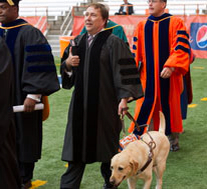
Photo: Professor Stephen Kuusisto and guide dog Nira marching in academic convocation at Syracuse University.

I’m borrowing my title from Liza Featherstone’s new advice column in The Nation which is entitled: “Asking for a Friend: Is It Me or is it Capitalism?” Oh the sang froid of self help! One scarcely knows how to pursue emotional intelligence in these times, why not write Ms. Featherstone? It’s a fine joke. Or as John Lennon would say: “Whatever gets you through the night…”

Now my problem isn’t rampant, alienating, corporatist neglect, though it’s true just last week a man on the phone tried to tell me my wife’s brand new computer had a virus and he could fix it for $99. I still have sufficient causticity to look in the horse’s mouth as it were, and while the workaday world can wear me down, I like my labor just enough to avoid excessive complaining.

My problem is inaccessibility. Dear ______, my campus doesn’t like me or people “like” me, which is tough because all my disabled friends are beautiful and after years of noisome banter I think the real truth is, my university just isn’t that “into me” and I need to “get over it” as they say in the vernacular. I’ve talked about the need for access and dignity for so many years it has started to feel like a nervous tic.

Last week a man I know who teaches part time and uses a wheelchair, which is to say, he rolls around the campus as he’s supposed to, which is to say, flipping the rug, his campus is supposed to let him roll, which is to say, it’s not just the law, it’s the right thing to expect—that he may roll into a lecture hall and be a participating member of the scholarly community—that man could not attend a lecture because the wheelchair lift was not functioning properly. It was also filthy from neglect. He sat outside the building and watched cheerful able bodied colleagues climb the stairs.

I grieve for him. I know what its like. As a blind professor I’ve struggled with inaccessible digital services, bad event planning, and overt eye rolling from sighted colleagues when I talk about these subjects.

These problems are all the worse because “my” university is Syracuse where we have a noteworthy Disability Studies Program, and two world class institutes on law and disability.

How are these things possible?

I wrote a blog post once called “The Thermal Layer” and I’m reposting it in this context. Here’s what I said:

Several years ago I came across a small pamphlet called Rejoicing in Diversity by Alan Weiss. The subtitle of the booklet was: “A Handbook for Managers on How to Accept and Embrace Diversity for Its Intrinsic Contribution to the Workplace”–certainly a mouthful and perhaps not much of an advertisement. But I liked the word “rejoicing” and I also liked “intrinsic” for when you put these words side by side they speak of poetry. (The Chinese have two ideograms that stand together for poetry: a figure for “word” and a figure for “temple”). In any event, diversity in the workplace is seldom framed in ways that suggest spirit. Yet at the core of culture, spirit is all there is. Take away politics, real estate, the fighting over which end of the egg to crack and what you have left is the human wish for meaning. We tend to lose sight of this in Human Resources circles, substituting phrases like: Raising the Bar, Leadership, Assets, and the like. Talking about spirit is embarrassing. Its like talking about the philosophers’ stone. Not even medieval historians feel comfortable talking about alchemy. You might look foolish. And we all know that the workplace should not be foolish.

I have advised many organizations on matters of disability and inclusion over the years. These opportunities came about because my first book of nonfiction was a bestseller and because for a time I was a senior administrator at one of the nation’s premier guide dog training schools. I had the opportunity to travel widely. Between 1995 and 2000 I visited 47 of the states in “the lower 48” and spoke at local, state, and federal agencies and public and private colleges. I have advised lots of blue chip organizations including the Museum of Modern Art in New York, the Metropolitan Museum, the Kennedy Center, even resorts and hotels. Inevitably, wherever I have spoken I’ve heard the rhetoric of middle management: “empowerment”; “equal opportunity”; “productivity”; “zero tolerance”; “bias”; “sensitivity” and the like.

There is nothing wrong with these terms but to paraphrase Bill Clinton there’s nothing right about them either. And this is because the terms have no alchemy in them. They’re just nouns. Not all nouns have spirit inside them. The word “battleship” has no spirit but the word “blueberry” does. One of the first things a poet has to learn is that not all nouns are obedient to the soul.

Well meaning organizations (and some that may not be so) rely on the rhetoric of inclusion without imagining the opportunities for soul–and I mean “soul” the way Marvin Gaye would mean it: its what’s goin’ on. The human soul is present everywhere whether management acknowledges it or not. By way of analogy one can think of management as playing “battleship” while the soul is picking berries. Human souls are looking for ways to be fed and to be happy; management is often trapped in brittle or arid pronouncements.

Alan Weiss wrote:

“I have had the rather unique experiences of providing comprehensive reports to top-level executives on the acceptance of diversity in the workplace, only to have them shout, wide-eyed, “That’s not my company you’re describing!” Yet the feedback has been based on extensive focus group and survey work. Who’s wrong?

No one is wrong. What’s happened is that the respondents have reported what they are actually experiencing, I’ve conveyed that feedback accurately, and the executives are using their own intent and strategy as their frame of reference. The psychologists would call it cognitive dissonance–fully expecting one set of circumstances, while experiencing quite another.

The phenomenon at work is what I call the “thermal layer,” which is a management layer capable of distorting communications and directives it receives, turning them into something quite different. Managers in the thermal layer are the ones who actually control resources, make daily decisions and deal with the customer. They often have strong vested interests in preserving the status quo…think they have a better way of doing things, don’t trust senior management, don’t buy-into the strategy or, for whatever reasons, have some agenda of their own. “

Alan Weiss has perfectly described the breakdown that most often creates obstacles to true diversity and inclusion–or to use the language of the soul, communal berry tasting and picking.

For many years I’ve been asking folks at the universities where I’ve taught to take ownership of disability and accessibility and I have found a deeply invested thermal layer–a phenomenon I like to call the “Campus Rope-a-Dope” to borrow from Mr. Ali. The Campus Rope-a-Dope takes advantage of highly silo-ed administrative hierarchies to in effect pass the buck where disability and accessibility are concerned. Let’s be clear: no one wants to be identified as being part of the thermal layer just as no faculty member wants to be outed for being “dead wood”–and let’s also be clear that the person who persists in calling for blueberries when everyone else wants to talk about battleships will eventually be the victim of considerable distortion.

Alan Weiss again:

“Organizations seldom if ever fail in their intent, executive direction or strategy formulation. They fail in the execution and implementation of their initiatives. Nowhere is that more true than in the accommodation of diversity.”

For my own part I’ve called for universities to provide accessible bathrooms in buildings where I’ve taught. The struggles were astonishing. At the level of departmental administration, no one knows who’s in charge of these matters. That’s because the thermal layer is in charge. And the T.L. has a hundred silos. It also has committees.

I was once upbraided at the University of Iowa by someone from the human resources department. I’d been calling for the installation of assistive technology in the classrooms where I’d been teaching for over three years. The lack of compliance and communication around the issue had been comical and my method of handling it had been to bring my own talking laptop into each classroom and manfully wired it to the projection system–sometimes this worked and sometimes it didn’t. My every teaching experience was therefore a kind of gamble. No one was in charge. How was I upbraided? I was told that by calling attention to my difficulties with assistive technology compliance I’d done considerable damage to my reputation with the committee that handled disability issues–the point being that I’d apparently not gone through the proper channels in my requests for accommodations. This is how the thermal layer works. The thermal layer likes to deflect by distortion. And there were no proper channels.

Alan Weiss:

“How could anyone oppose an accommodating, equal-opportunity workplace?”

“Well, we know that some people can, sometimes with malicious motives, sometimes with prejudicial judgment, and sometimes because they perceive themselves to be adversely affected by the policies. You must be constantly on the watch for thermal zone reactions and distortions. If there’s a policy or value which causes conflict in the workplace, bring it to the surface and discuss openly. If there are misconceptions about policies, resolve them. The failure to do this doesn’t make the policies go away, it simply preserves the thermal layer until, like the executives above, the key decision makers get some shocking news. The reaction to that is usually worse than any other alternative, because senior management will try to legislate change rather than help people to embrace it.”

This brings us back to blueberries vs. battleships. The spirit of diversity vs. the demeaning of diversity initiatives through the employment of thermal language.

How can Syracuse University, which has a noble reputation where disability is concerned renovate a building and neglect to fix a wheelchair lift?

Because no one is really in charge when it comes to planning and implementation.

All disability accommodations are treated reactively and not proactively.

Then people apologize. As they should.

But I wonder if the campus is really “just not that into us” as my stepdaughter would say.
Disability and It’s a Long Way to Tipperary

“Well what do you want?” asks the ableist.

“We have to weigh your request for assistance against all the other non-disabled people’s requests.”

The ableist is in her forties, young enough to know better, was educated at a university, must have come into contact with feminism. Surely knows about equality. That’s the rub. She knows and has decided she doesn’t care.

Educated ableism is the worst.

I can take the cab driver in (name your city) who’s country of origin has no “out and about” disabled. He sees a man, dressed rather professionally (suit and tie, even pants…) who happens to be blind—who’s traveling with a professionally trained dog, and he’s never seen such a thing. Never. For the cabbie, the very idea of a successful, self-navigating, fully engaged blind person is without analogy. He decides to drive away, leaving the man and dog to contemplate what’s now called “micro-aggression”.

Ah, but educated ableism is absolutely the worst.

Yesterday a student at Syracuse University, who shall remain unidentified, told me how she was recently humiliated by a professor. She’s an autist. She has to wear headphones—Bose noise cancellation headphones. There are moments when the world is too much with her. It doesn’t matter where she is. She needs a break.

She put on her Bose in the midst of a lecture.

The professor accosted her, even though she has letters on her person from the Office of Disability Services explaining her accommodation.

Educated ableism is the worst.

The educated ableist believes he or she is freed from having to ask questions.

Such freedom does not generally exist in the worlds of ideas, so the assumption, the grand self-absorbed interior contract that an educated ableist must make is highly solipsistic fiction.

Some days I walk across campus, and here I mean any campus for I travel widely, speak at all kinds of colleges and universities, and recognize how sculpted and interiorized are faculty who stare at me as I approach on sidewalks. They think because I’m blind I can’t see them staring, taking their surveys, driving their educated projectionist ableism into my thorax with their eyes.

“Here’s another clue for you all…” The blind can tell you’re staring.

They can tell you’re sizing them up or down.

I have plenty of academic colleagues who size me down.

And yes, of course there are plenty who don’t.

Yet, I expect more from academic administrators, professors, even the meter maid.

Now, the educated ableist is bad, no question. But there are still worse things.

For instance, there’s the disabled faculty member who likes to “rank” on other disabled people.

My black colleagues know this biz. It’s the old, “are you black enough” thing.

In the disability world, where there are all too few faculty with disabilities, and accordingly you’d think they would work tightly together, one can encounter the professor who thinks his or her way of navigating or advocating for disability is not only superior to other methods, but is so far superior that (insert topic here) is beneath acknowledgment.

You know what I mean. “I was “on” this issue of accessible widgets long before you were. I’m a better disabled person than you…”

Ableism within the disability community. Imagine that.

It’s a long road to Tipperary.

Tipperary is my code word for dignified, universal, respectful inclusion.

“It’s a long way to go…”