The Mozart Shoes

I went to the shoe store and placed my feet in the measuring pans. My feet transmitted a sudden and stark message—“we feel shy down here; we’re under examination. Please get us back inside our shoes.” I wondered about this. The tragedy of it. “When,” I wondered, “had my feet learned to be timid?” “It’s the whole damn system” I told them. “Capitalism has taught you to feel incomplete.” But when your feet are farouche the whole body jumps that way. The temporal lobe said: “I too don’t wish to be known.”

I really wanted Mozart just then. Anything other than the grey flock of avian neural distress that emanated from my feet and circled outward to the farthest rings of my flesh. “Jesus,” I said, “you’re just buying some shoes.” But the temporal lobe said: “There’s no such thing as just. Would you just saw off your hand?” So I was forced to conclude, encouraged to conclude, the body’s anguish is like intense moonlight.

The shoe moment helps me recognize what my autistic friends already know. There is no “me”—there are only the eager, bristling, dancing, component parts. Now ask yourself how you get through the day?

Oh my feet, you moth eaten grand seigneurs, keep talking. It’s OK.

Fake Cripples Coming Soon to a Theater Near You

In her superb book Fantasies of Identification: Disability, Gender, Race, Ellen Samuels describes, among other things, the long history of impostor narratives in America. Samuels and Martin Norden (author of the Cinema of Isolation: A History of Physical Disability in the Movies) have both revealed a quintessentially American fascination with ersatz or manque cripples—the former is a pretender and the latter isn’t crippled enough. In either case the role of popular film in deceiving the public about disability is ubiquitous and a matter of long standing. By this I mean to say, perhaps inelegantly, that disability is seldom an either/or circumstance. In the case of blindness one may “see” rather poorly but still see well enough to read a sign from a distance of 8 inches. A wheelchair user may be able to walk five feet. In America where people are either rich or poor; black or white; anything that troubles this hardened exclusivity is (and has always been) considered cheating.

Samuels’ book is properly analytical about what is fake and what is real and one should be mindful always that America loves, truly loves, some kinds of fake but not where the human body is concerned. Trans people, and partially sighted people, and light skinned black people all know the drill. They walk through the long dusk with rudely scrawled signs proclaiming they’re not fakers. “Fake” means, among other things, thievery. Years ago when I was a visiting writer at the MacDowell Colony for the Arts, I took a walk with my guide dog. I walked her on a dirt road with just her leash and I didn’t use the harness. There were no cars. I wanted my dog to have the opportunity to dawdle in the ferns and smell the wild turkeys. Would’t you know? A fellow artist in residence—a rather angry older woman—told the MacDowell administration I was a “faker”; I was faking blindness, just to have a dog at the arts center. Disability is always seen as something devious, performative, and dishonest. Always.

People who are not disabled do not generally understand this. And in my view, this is why it’s so important for colleges and universities to hire actually disabled people to serve in offices of disability support or as ADA Coordinators. Unless you’ve felt the shifting sands of social acceptance under your own feet or wheels, you probably don’t understand the hourly struggle to achieve citizenship that disabled people endure.

Fake also means malevolent. I’m going to steal something from you. Perhaps I’ll steal your good health. The fake blind man, grabbing your good fortune and stuffing it into his little bag.


For Tomas Transtromer

Happy the man or woman who owns a few books, who drinks tea. We rehearse a few words in case there really is a God. And others in case there isn’t. Years ago an old man stopped me on the street in Helsinki and wagged his forefinger. “Why do you say you see? You don’t see! You understand!” He was a ghost of a certain kind. He was conveying his rehearsal. Giving me words.

Before that day I didn’t know people could rise from books and appear before you on the street. That night, with a few books and a cup of tea I knew I’d met Strindberg. 

“I dream, therefore I exist,” he wrote. And I copied this into my notebook with a leaky fountain pen.    

Farewell Tomas Transtromer, and Thank You

I lost a poet this morning for that’s how it feels: the death of the writer is personal. In this case the poet is Tomas Transtromer. I feel the loss of a friend. Perhaps I don’t experience this with every poet. But when a lyric writer crosses over there’s a stitch in my ribcage. With Tomas Transtromer I always felt I had a secret friend. Those of us who love poetry, who in small or large ways have endeavored to live through it—that transitive and delicate approach to phenomena we call “the imagination”—are heartened when a writer suddenly says the world is still being born as Transtromer does in his poem “The Half-Finished Heaven”: 

Despondency breaks off its course.

Anguish breaks off its course.

The vulture breaks off its flight.

The eager light streams out,

even the ghosts take a draft.

And our paintings see daylight,

our red beasts of the Ice Age studios.

Everything begins to look around.

We walk in the sun in hundreds.

Each man is a half-open door

leading to a room for everyone.

The endless ground under us.

The water is shining among the trees.

The lake is a window into the earth.

Excerpt From: Tomas Tranströmer. “The Great Enigma: New Collected Poems.” iBooks. https://itun.es/us/WAORD.l   

**

In these times we must be reminded of the mysteries of consciousness and water shining. Tomas Transtromer was a good friend, a fellow introvert who learned to live in the big world, who endeavored to do some decent work with damaged children, who came home at night in the Baltic dark and played Haydn on his piano, who whispered in our ears, each of us is still half open. 

Imagine that.   

Dog and Notebook, They Never Let You Down

Australian man button holes me, explains collective unconscious in airport. 

Once on subway in New York I saw a man talking angrily to God. 

As poet Charles Simic would say, “he had dark ages on his brain.”

Easy to be confused by strangers and even friends. Easy to want bubble bath.

Trust notebook. It will never let you down. 

When young, ate an onion like an apple, just to impress girl friend.

Old now, cleans ashes from fireplace, impresses no one.

How it goes. Time stretches him, but he’s only elastic in noggin. 

Sometimes notebook’s pages get stuck together.

Dog owns all the money. Yellow canine money. Lucky, dog spends it with you. 

Walked around the down on luck neighborhoods of Ithaca, New York. 

Shabby houses looked like places where people were either sleeping or sick. 

Old frame structures no longer loved. 

But my dog and I—we were some kind of two headed flying fish. 

Happiness was in the facing wind. 

Poets Ken Weisner and Andrea Scarpino in Syracuse

Y Areas of Focus Blue all bold

A Reading by Poets
KEN WEISNER
and ANDREA SCARPINO

 
WEDNESDAY, 3/25, 7:00 PM
Free and open to the public 

Ken Weisner lives in Santa Cruz and teaches writing at De Anza Community College in Cupertino where he edits Red Wheelbarrow. His most recent collection of poems is Anything on Earth (2010, Hummingbird Press). His work has been featured on Sam Hamill’s “Poets Against the War” website and on The Writer’s Almanac (2010).

Andrea Scarpino is the author of the chapbook The Grove Behind (Finishing Line Press) and the poetry collection Once, Then (Red Hen Press). She contributes weekly to the blog Planet of the Blind. This reading is presented by the Syracuse University Honors Program.

This reading presented by the Honors Program at Syracuse University.

The YMCA’s Downtown Writers Center

340 Montgomery St.
Syracuse, NY 13202

High School Days

When I was in high school an average week went like this:

Skip gym class, go to local college, read Voltaire–but not Candide, instead, his Philosophical Dictionary–liking especially:

“A big library has this in it of good, that it dismays those who look at it. Two hundred thousand volumes discourage a man tempted to print; but unfortunately he at once says to himself: “People do not read all those books, and they may read mine.” He compares himself to a drop of water who complains of being lost in the ocean and ignored: a genius had pity on it; he caused it to be swallowed by an oyster; it became the most beautiful pearl in the Orient…”

2. Skip gym class, go to draft board, show blind letter from doctor. Declare to hedge hog corporal blind people might conceivably work in tunnels. Corporal tells him to go screw himself.

3. Skip gym class, drink stolen bottle of champagne. Take nap in abandoned bath tub in woods.

4. Skip gym class, go to local college, read Ed Sanders, liking especially “Poems From Jail”.

5. Skip entire school day. Stay sober but still take nap in abandoned bath tub.

Ah Wordsworth:

“Though nothing can bring back the hour

Of splendor in the grass, of glory in the flower;

We will grieve not, rather find

Strength in what remains behind;

In the primal sympathy

Which having been must ever be…”

Disability and Slow Thought

It was Hugh Trevor-Roper, writing of Gibbon who observed: “We all tend to simplify, perhaps to dramatise, our mental development. In retrospect, the slow processes of the mind are disguised, sometimes even obliterated, by the dramatic moment of discovery, or conversion. St Augustine’s tolle lege, Newton’s apple … intellectual history is full of such episodes which immortalise, though they may not explain, crucial stages in the transformation of thought.”

We talk in disability circles of the “overcoming” narrative– those memoirs and made for TV films where the “aha” moment is both the summit of long striving and a monument to the agonies of an exemplary cripple’s stamina or faith. “Inspiration porn” we call it. What’s most unfortunate is the misleading impression such stories convey. Real disability is not subject to conversion. Nor is it apprehended in a flash.


If inspiration porn is bad (and trust me it is) so is theory porn. “Culture has completed its work when everything is a sign” wrote William Gass–a troubled irony certainly–culture endeavors to narrow the signifiers–or failing that, to build recognizable maps with lines you can follow. Theory porn accentuates oppositional rhetorics in order to suggest or extol the preferred status of outlier bodies. Critical disability studies creates its own overcoming narrative by arguing disability or crippled-ness are active verbs until we are “disabling” or “cripping” neo-liberalism, compulsory hetero-normativity, or gym toned bodies. Yes, theory porn has its problems. Once at a conference I heard one theorist of disability attack another because the latter was devoted to physical fitness, and presumably insufficiently infirm to hold a position on the subject of disability. If the outlier body is theorized it best be sufficient unto its marginalization.

One must dare to be slow as the wheel chair on ice. Simplifying or dramatizing bodies is not much different from the overcoming narrative. Theory does quite often superimpose its own Aristotelian template over the broken body. It’s a very very slow business this altogether inexplainable body.

Persistence of Vision: Colleen Woolpert at the Felton Gallery in Syracuse

Yesterday I read some poems and prose at an installation of artist Colleen Woolpert’s works that explores blindness and imagination.  As I’ve often said (so routinely I sound like a public transportation tape loop—“do not lean against the doors; mind the gap”)  no two people who are blind experience vision loss in the same way. Indeed I’ve a favorite comparison: blind people are as essentially “unalike” as the cab drivers of New York City. Nothing about vision loss is ripe for agreement unless one considers the public’s failure to understand the subject. While generalizations are risky, it’s safe to say most able bodied citizens think blind people experience the world like Shakespeare’s Ariel, imprisoned within a tree. In my memoir Planet of the Blind I addressed this straight away in chapter one:

“Blindness is often perceived by the sighted as an either/or condition: one sees or does not see. But often a blind person experiences a series of veils: I stare at the world through smeared and broken windowpanes. Ahead of me the shapes and colors suggest the sails of Tristan’s ship or an elephant’s ear floating in air, though in reality it is a middle-aged man in a London Fog raincoat that billows behind him in the April wind. He is like the great dead Greeks in Homer’s descriptions of the underworld. In the heliographic distortions of sunlight or dusk, everyone I meet is crossing Charon’s river. People shimmer like beehives.”

Excerpt From: Stephen Kuusisto. “Planet of the Blind.” iBooks. https://itun.es/us/SqYjO.l 
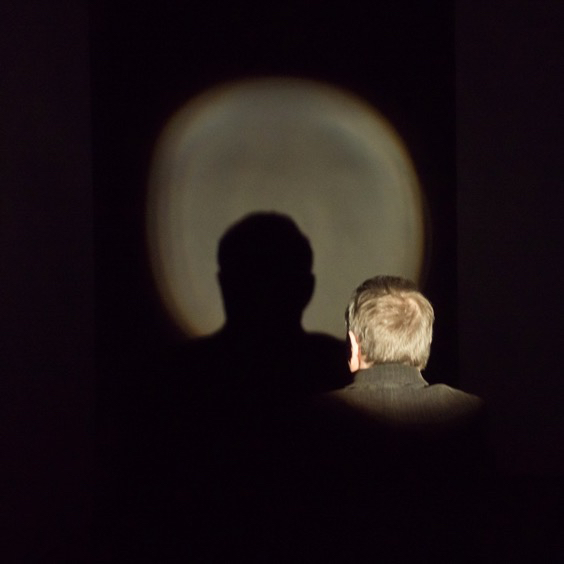


In Woolpert’s excellent installation viewers can see what they do not see, even as they’re presented with the visual ironies of self-hood. The photo above is of me staring into a projected oval of light thereby making my own silhouette. Have you ever seen yourself on the moon? The blind invariably do. Has the moon made you lonely? As the poet Federico Garcia Lorca said, when we see the moon, we feel “the heart is a little island in the infinite.” In this way all are like the blind. Perhaps you knew it. But I doubt you’d have known it if you thought the blind lived trapped inside trees. Would Ariel have known the moon? She may have recalled it. But unlike the true blind she couldn’t sit before it. A blind girl knows the moon and the moon knows her. Now I’m digressing. I’d really like to see a book about the disabled and the moon. Note: when Galilleo first saw a lunar valley it appeared like a hand. What did it say in sign language? I wrote a poem about this for my deaf pal Brenda Brueggemann:

Kansas: Deaf Girl Watching the Moon

–for Brenda Brueggemann

One night there are valleys,

Say around eleven,

When the moon is wide

As a brother’s grin.

The field is black as shadow:

Soybeans sleep in loops

Of darkness,

Their leaves curled.

The valleys of the moon,

As unalike as pitted stones

Or walls or men

Or water or dreams—

Unalike as pages in a book.
When he saw them,
The valleys like hands,
Valleys like the bones of hands,
Galileo rushed into the street
Hoping for someone to tell.

He had no field.

He could not talk with his hands.”

Excerpt From: Stephen Kuusisto. “Letters to Borges.” iBooks. https://itun.es/us/2eNPH.l

Woolpert’s exhibit is called “Persistence of Vision” which is absolutely right. All the blind I know have persistent vision or visions. They are not precisely your visions. In what way is this circumstance anything other than the phenomenology of art?
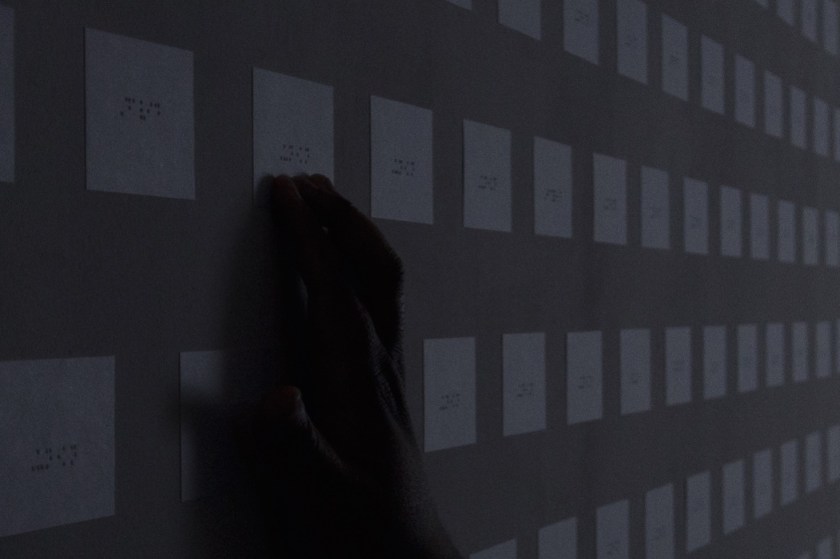
Above is a wall of Brailled note cards, each bearing the first name of a blind citizen of Syracuse. Run your fingers along the wall. The field is black as shadow. The pages are as unlike as any book’s leaves. Let your mind wander. Try to imagine how liberating Braille was when it was introduced? Did you know that before the Englightenment people thought the blind couldn’t read. Diderot was the first great intellectual benefarctor of the blind.

Above, I’m reading poetry beside a projected video of a lovely blind woman’s face. What’s behind those lovely eyes? What’s behind your own?

The exhibit runs through April 14 at Onondaga Community College’s Felton Gallery. Link here.