Why I Feel Sorry for Sighted People

Only this: once when I was very young I saw the morning star. I didn’t really see it the way visual people see. I was with a friend.


Sighted people forget the blind have friends.


They think if they went blind they’d be alone in a closet.


Sighted people have a terrible insufficiency of imagination.


Only this: when I was very young I had an imaginary friend. I called him “Matti” and he would sit beside me on the trams in Helsinki. I talked to him.


Sighted people need more imaginary friends.


Sometimes a guide dog is both your watcher of stars and your pal on the tram.


This: outside of town, a full moon, laughing all night with friends.


Hey sighted people: the blind laugh. So do their dogs.


**


It comes down to this. I feel sorry for the sighted.


Most of them have the imaginations of meat cutters.


In our brittle time its important to say there’s nothing wrong with meat cutters.


But you understand, the ocean…


Oh John Milton, I Wish…


WHEN I consider how my light is spent

E’re half my days, in this dark world and wide,

And that one Talent which is death to hide

Lodg’d with me useless, though my Soul more bent

To serve therewith my Maker, and present

  My true account, least he returning chide,

Doth God exact day-labour, light deny’d,

I fondly ask; But patience to prevent

That murmur, soon replies, God doth not need

Either man’s work or his own gifts, who best

  Bear his milde yoak, they serve him best, his State

Is Kingly. Thousands at his bidding speed

And post o’re Land and Ocean without rest:

They also serve who only stand and waite.


**


When I consider Dear Milton’s famous sonnet on his blindness I feel the sorrow of another man’s belief. Milton’s Protestantism was based in large part on the idea of Sola fides—the notion that faith alone was necessary for salvation. This is opposed to the Catholic belief in good works as a primary principle of divine forgiveness. I remember vividly the day some thirty years ago when I was in graduate school at the University of Iowa and the true suffering contained in this poem hit me for the first time. The “one Talent” which is death to hide is faith. Against this, the standard language of seeing as a metaphor for belief is impossible. I tried to imagine being that man. A man who was surrounded by political and theocratic enemies; who lived on charity; whose blindness had no ophthalmological explanation and so was fit for a superstitious and Calvinist interpretation. Against all this the poet imagines his sightlessness is a test of Sola fides. Imagine this burden. To me, They also serve who only stand and waite feels like the sensibility of an airline passenger who imagines his faith holds the plane aloft. There is no “milde yoak” here, no matter Milton’s use of wit. The poet believed his blindness was a test and I wish I could go back through time, like some science fiction character, and tell him God doesn’t live in a man or woman’s eyes. Blindness tests nothing. It is a native country without punishments.

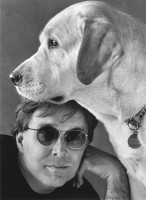
What's Your Dog's Name? Carl Jung

Dogs are heroic only insofar as we are heroic. We take journeys together. We refuse to sit still. Canine heroism lies in accompaniment—which is trust. The duality of heroism is inter-species mutual trust. They leave this out of dog stories most of the time. We don’t like ourselves. Maybe the dog will save us. But we save our own kind with fully equal dog friends who have decided they like the challenge.

Few non-disabled dog owners think of their relationship with dogs as a true journey. They want dogs to obey them, as if their own meagre habits are enough to achieve in life. Dog obedience is a good thing, necessary, but if the lessons stop there the owner doesn’t grow. Therefore, no journey. As a blind person who travels with a dog I know that we never swim out into the same water; never travel the same worldly path. Darkness brushes both my own cheek and my dog’s.

Journeys, every hour.

I see newspaper articles, books, even movies where people who’ve suffered trauma are represented as having been miraculously healed by the intervention of dogs. This is powerful. But its a Disney story, incomplete, sentimental. When a dog signs on with us, gives her or his doggish heart to us; when a dog looks you in the eyes, there’s a transmission, subtle as first light seen above the forest—people have no vocabulary for it—but the dog says you are worth my days and nights. I’ve seen blind people experience this moment. Its as large and yet delicate as poetry itself. Poetry. Dogs. Journeys. Mutual forgiveness of each vice. And then you walk.


Dog's Eyes, Just Now

The dog who loves you sees the glowing point behind all your movement. Sees the goodness in your purpose. While you worry about the rags and masks of worldly life, your dog sees only the embers of your heart. Moreover, your dog never forgets all the days of your sparking. Never.

I felt calm. It was my dog’s vision of my mountainside sunset heart. That’s what I was feeling.

The leaves were so clear. I was alive in my dog’s beautiful night.


Goodbye Aimee Mullins

I’m queering and cripping with every step. Every breath. Goodbye Madison Avenue. Oh oh! Here comes Madison Avenue trying to sell me a post-normative lifestyle. Look. There’s Aimee Mullins.

**

There are lots of blind people my age who’ve even less reason to like themselves but I gave that nonsense away like the monk in a miseracordia who one day left his body during a boring sermon.

**

The problem is…too many worship the body in its political and social alterity…imagining, or so it seems, the body is “it”. But that old rag is samsara. And I don’t want to accessorize until the day I die. Goodbye Aimee.

**

Have you ever knitted a failed sweater?

**

When you’re blind, every day, windblown darkness hits your cheek.

**

Peter McLaren:

Citizens can no longer be protected by nation-states and offered any assurance that they will be able to find affordable housing, education for their children, or medical assistance. And it is the International Monetary Fund and the World Trade Organization who oversee regulatory functions outside the purview of democratic decision-making processes. It is these bureaucratic institutions that set the rules and arbitrate between the dominant economic powers, severely diminishing the power of governments to protect their citizens, and crippling the democratic public sphere in the process. We are now in the midst of ‘epidemics of overproduction’, and a massive explosion in the industrial reserve army of the dispossessed that now live in tent cities—or casas de carton—in the heart of many of our metropolitan centers. At this moment we are witnessing a re-feudalisation of capitalism, as it refuels itself with the more barbarous characteristics of its robber baron and McKinley-era past. We are not talking here about lemonade stand capitalism on steroids, but the most vicious form of deregulated exploitation of the poor that history has witnessed during the last century.


**

And so we need to “crip” the “democratic public sphere” since it is crippling us.

Able-bodied hegemony needs its cripples but doesn’t know it.

But we the cripples, in turn, don’t need “sound bite Viagraizations” (as Peter McLaren would call it).

We need jobs. Autists need real employment. 80% of the blind remain on government relief.

We need anti-imperial, anti-capital dignity.

Please. No more Ted Talks with Aimee.


Disability and the Star in My Head

I am distressed. Blindness isn’t merely a lack of vision–its a fight or flee carnival, sequential, unpredictable, sometimes rather frightening. And even the small things, paying cash in the market, become tangled as my cash falls to the floor and I fumble publicly down where all the shoes have trod, the impatient shoppers behind me, no one offering to help, and my skin undergoes electrolysis and groping I feel I could weep. I know I’m not supposed to say this. The core of speech is reserved for nuanced politics. One is supposed to say disability is merely a nuisance. That’s the politically correct thing. I’m just like everyone else but with a few added musical notes. But this is of course ridiculous when you’re down on the public floor scrambling after two dropped quarters. I escape with my groceries. Walk in the sunshine. “The day will get better,” I say to no one in particular.


But its fight or flee–all day; a fairground of anxieties. Crossing streets. Getting to the other side safely. Getting there with your dignity. The dog helps. Squaring your shoulders helps. But then the next place you go has a revolving door. You can’t get in. When you tell the management they need a “disability friendly” door they tell you with their Rococo eye rolling, they don’t care. “Go away,” they say, though they don’t really say it; but they do. You continue on the street of public life. You shamble among the rags and masks of the ordinary people. Everyone looks at you. You’re a half vagrant out in public blind person. You’re wearing your good suit with the purple tie. You’re walking around with rain in your heart.


Strangers ask how much you can see. You make jokes. “You look like Ingrid Bergman; Cary Grant.” Young people don’t know who they are. It doesn’t matter.

The books I downloaded this morning from Amazon aren’t accessible. I wasted my money.

After many languages I’m still an orphan.

I live in an American city without good public transportation. I must rely on taxicabs more than I wish. The drivers are desperate people. They talk about desperate matters with broken words. Most of them listen to “hate radio” and I smile from the back seat under my big sunglasses.

Do you see? What do you see? I’m waiting for happiness to slowly crawl in…


Listening to Mahler’s Fifth, or, How to Be a Blind Poet


Perhaps as a poet said, there really is a tale lit by the soft light of sleep. “Perhaps” grows around the house like birches. Perhaps there’s a meadow where the dead dogs frolic. I’ll never give away perhaps. A fritillary lands on the unpainted porch, having returned just now to earth through a black sieve.


**


It rains in the apple trees

Where a crow settles

In a dome of blossoms—


I watch him

With my clear head

The way blind people do…


**


But the music. Nobility. Dignified growth of the man. No more hunched shoulders.

And Mahler, always an intruder, never welcomed, little Bohemian, as a boy, conducting the birch trees…


Dog Book

The dog who loves you doesn’t ask you to be stupendous. You’re okay in dog book.

You’re okay because really, in the last analysis, you’re companionable. Even if you don’t talk much. Even if you’re having a bad day. Your dog knows you like the phases of the moon. Yes, you’re okay in dog book. Not a fumbling, half forgetful, regret-machine. Not a jealous athlete or poet. Not a tired mother; a broken teacher; a strict and addicted capitalist. Your dog knows you like the tides; like all the decent, kind, lucky confederacies of chance—even if you’re not presently much of a man or woman, you will be again. Your dog knows.