Disability, Competence, and Soul

So I have this disability. You do too. Or perhaps some day you will. But just so we’re in agreement: no one’s perfect. (I hope you weren’t feeling perfect. I don’t want to be your buzz kill.) If you are perfect (against all odds) you are unrepeatable, even with genetic counseling.


Being physically different is also unrepeatable. No two people with a disability are alike; no two people who have the same type of disability are alike. This matters as each disabled person, each man, woman, and child, represents a unique soul. What is a soul? Its the engine of amazement. Everyone has a sense of wonder. With wonder comes empathy. “What is a friend,” asks Aristotle, “a single soul dwelling in two bodies.” Accordingly the soul is the seat of astonishment and houses our ability to understand and share the feelings of others.


I backtrack: no two people with a disability are alike; no two people with the same disability are alike. No two blind people experience blindness the same way. In fact, there’s no such thing as “the blind”—the identifier breaks once you know real people who experience vision loss. There is more than one way to be blind. My pal Leo sees through his own periscope. He is the commander of a private submarine–the USN Leo and though his sighted options are limited, they're still fair. He drives his car in a gated community in Arizona largely because he can still do it. Sometimes he honks his horn. And though he's looking through a tube, the day is glossy and brilliant as old Kodachrome. Leo can tell you that while blindness is not always a preferred experience it's often more interesting than sighted people suppose. For some of us the colors are beyond compare. 


Another friend–I'll call her Karen–(not everyone wants to be known for folly) runs through a field in Nebraska though she sees only light. But the light is so gold, so dappled and evanescent that her description makes you want to cry. The average sighted person can learn from her how daylight spins between brown and yellow tonic, the drafts she drinks between the clock and the sun. Just run beside her.


Sight is an immoderate thing, never static. It is, perhaps, the dearest sense. The flickering light of a fire, shadows on a hearthstone; the laughing element of sun on water; early morning eastern skies; the cold and steady light at mid ocean–many blind people know these things. Nowadays more blind people see something of the world than is commonly understood. 


A phrase I like when thinking about disability is “presume competence”—in fact I like the idea so much I use it when thinking about everyone. Every soul, the engine of amazement. The house of empathy. I first heard the phrase when I came to Syracuse University to teach in SU’s Center on Human Policy, Law, and Disability Studies


There's a very interesting article from 2011 at US News by Meryl Davids Landau which highlights the work of progressive college admissions deans who are seeing the advantages of disability inclusion on their campuses. Here's a taste: 

"Some 45 college admissions deans from across the country gathered at Stanford University this past June to learn about high-achieving dyslexic applicants. Experts shared the latest research, and well-known figures—including California Lt. Gov. Gavin Newsom, financier Charles Schwab, and Delos "Toby" Cosgrove, a heart surgeon and CEO of the Cleveland Clinic—described their experiences coping with the disability.

"Our goal is to help colleges realize that, because of their intelligence, out-of-the-box thinking, and perseverance, these students can add luster" to their schools, says Sally Shaywitz, the Audrey G. Ratner professor in learning development at Yale University who helped organize the event."

From a disability studies perspective this is a hopeful sign. They key phrase that Professor Shaywitz offers is "to help colleges realize"–for surely, as those of us in dis-studies have long known, neuro-atypical students and colleagues have spent their lives outside the box and thereby bring fresh thinking to the classroom and the work environment each and every day. I would add though, that this is not simply true for high achieving students with dyslexia–it also holds for nonspeaking people with autism, blind students, students with profound poly-trauma. 

A recent special issue of Disability Studies Quarterly devoted to autism and neuro-diversity edited by Ralph and Emily Savarese highlights the remarkable insights and imaginative atypicalities of autists and is critically important reading. I like what Jamie Burke, a Syracuse University alum (and autist) says in an epigraph to the issue:

"I must send forward my bold appreciation for taking the soul of this topic … to be shared among the many and diverse hearts who will attempt a new understanding. It can be very lovely when curious old patterns of comprehension shift to a more connected and true demonstration of the improved focus. My deep thanks, then, for the spirit of change and challenge." 

 “Taking the soul of this topic” is the key. Amazement and empathy. And let’s be bold, when amazement and empathy are at work (as the soul would have it) we also achieve curiosity. 

One of the ways to achieve the curious soul is by imagining yourself in someone else’s body. Every one of us can easily imagine having a different body than the one we currently have. Now as a blind person I walk about, meeting and greeting people who are inexact to me. This is an aid in “seeing” them. But the presumption of competence is also about feeling—the soul insists it can be inside of anything. You could be a man or woman, but you could also be among the trees and beasts. St. Augustine wrote:

“[T]he soul by its presence gives life to this earth- and death-bound body. It makes of it a unified organism and maintains it as such, keeping it from disintegrating and wasting away. It provides for a proper, balanced distribution of nourishment to the body’s members. It preserves the body’s harmony and proportion, not only in beauty, but also in growth and reproduction. Obviously, however, these are faculties which man has in common with the plant world; for we say of plants too, that they live, [and] we see and acknowledge that each of them is preserved to its own generic being, is nourished, grows, and reproduces itself. (Augustine 1950b: Greatness of the Soul, 33.70)”


To presume competence is to presume life itself is encoded with harmony and proportion which we are often insufficiently aware of. But to presume competence is also to understand the soul is both simple and complex. Augustine again:


“When we come to a spiritual creature such as the soul, it is certainly found to be simple in comparison with the body; but apart from such a comparison it is multiple, not simple. The reason it is simpler than the body is that it has no mass spread out in space, but in any body it is whole in the whole and whole also in any part of the body. Thus when something happens even in some tiny little part that the soul is aware of, the whole soul is aware of it because it does not escape the whole soul even though it does not happen in the whole body. And yet even in the soul it is one thing to be ingenious, another to be unskillful, another to be sharp, another to have good memory; greed is one thing, fear another, joy another, sadness another; some of these things can be found in the soul without others, some more, some less; countless qualities can be found in the soul in countless ways. So it is clear that its nature is not simple but multiple. (On the Trinity, VI.2.8)”


When I imagine myself in another’s body I understand their joy, sadness, localized aches, for the soul “contains multitudes” as Walt Whitman said. 

Being physically different in unrepeatable. Soulful. At once simple and yet more complicated than customary thought allows. 

Empathy. Not sorrow. Imagination. Not presumption. 


Scared? Me? Kind Of. Its Open Season on the Disabled.

Every day I read something about disability that frightens me out of my wits. I generally have strong wits so this is a serious declaration on my part. There’s the story of Sean Vidal, a North Carolina teen with schizophrenia who was shot to death by police. Or the death of Robert Saylor who had Down Syndrome and died of asphyxiation after being handcuffed and tasered by police. Then there’s the story of Charlie McGillivary, a man with severe brain damage, who couldn’t speak, who was murdered by police in Toronto. More stories of disability murder at the hands of police can be found here


Then there’s the story of two Maryland teen girls who bullied an autistic boy into performing sexual acts. 


“The girls, ages 17 and 15, threatened the teen with a knife, kicked him in the groin and dragged him around by his hair, said St. Mary's County Sheriff's Office Sgt. Cara Grumbels. They coerced him into walking on a partially frozen pond and then refused to help him out of the frigid water, she said.”


Or how about this: “Trigger Happy Cop Kills Disabled Man’s Service Dog”


Or the story of Kelly Thomas, a homeless man with mental illness, who was beaten into a coma by Fullerton, California police. 


These stories are indeed legion. 


This is why the Senate’s hearings on disability and law enforcement are critically important. But the issue of disability and law enforcement is more complex than this quote from Senator Durbin would have it:


“As local mental health and disability services become increasingly scarce, the burden on police officers to play both law enforcer and social worker will only grow,” Durbin said, adding that Congress and the executive branch need to help local and state law enforcement “develop practices that protect police officers, disabled individuals and the public.”

Notice the de facto assumption that mental health and disability services are scarce and will become ever more scarce according to the Senator. This is what frightens me out of my wits. 

The American people deserve solid mental health services and disability rehabilitation programs. What’s Congress doing instead?

They’re promoting the idea that Social Security Disability programs are largely fraudulent or fighting to prevent the US adoption of the UN Charter on Disability Rights. 

Scared? You bet I’m scared. 


On Claritin and Fiber and Spring

By Andrea Scarpino


When I was in college, I woke one morning with a lump under my eyebrow and the right side of my face swollen. My doctor prescribed Claritin, an allergy medicine. The lump continued to swell and my face continued to swell, and each day I returned to the doctor, I was sent away. Five days later, my eye completely swollen shut and my face too tender to touch, I brought myself to the emergency room. The ophthalmologist on duty immediately started IV antibiotics, lanced and drained the lump, and packed the wound with gauze. A Staph infection was threatening my optic nerve. I missed my brother’s graduation because the ophthalmologist wouldn’t release me to fly until he was sure I wasn’t going to lose my eyesight. 


This week, I went to the emergency room with abdominal pain. After blood work, x-rays, and two ultrasounds, the doctor diagnosed a 4 cm cyst on my ovary. And told me to eat more fiber. I’m a vegetarian who eats so many vegetables my food-tracking app once reported my fiber consumption was inhibiting the absorption of important nutrients. I had a follow-up appointment with my regular doctor, who blamed the cyst on, and I’m quoting her, “this crazy spring.” 


I know that patients are poor indicators of what’s happening in their bodies. I know that our medical system is completely broken. I know most doctors do the best they can. 


But I worry often that American medicine doesn’t take its patients seriously. I worry often that we’re told all sorts of strange things in order to usher us quickly out the office door. I worry often that in the scramble of hourly billing, medical mistakes happen more often than they should. I worry often that doctors are afraid to tell patients when they just don’t know the answers to our questions and so respond with truth claims that are nowhere near the truth. 


Three years ago, I spent a week at the Mayo Clinic in Minnesota, where more than one doctor told me we have only a rudimentary understanding of hormones, how they work in the body, how they interact with one another, what constellation of issues they might cause when they’re imbalanced or interacting in unusual ways. And it was terrifying to hear this admission—some of the best doctors in the country saying simple, “I don’t know”—but it was also amazingly refreshing. Just a simple, “I don’t know.” 


“Every human being is a colony,” Picasso said. And sometimes that colony functions seamlessly. And sometimes it doesn’t. And sometimes the malfunctions are easy to identify and fix. And sometimes they aren’t. But wouldn’t it be refreshing if more doctors simply sat with us in their offices? Simply listened to our bodily complaints. And when they don’t know what’s making us ill, wouldn’t it be refreshing if they simply said, “The body is mostly mystery” –instead of writing quick prescriptions or blaming the weather. Wouldn’t it be refreshing if patients like me who feel brutalized by medicine’s incompetence could regain some of the faith felt by the generation before us? If we could all just agree, “The body is mostly mystery.” And try to work with that. 


April 30, Self-Interview

Last night in my dream, the Gods touched my hair. I dreamt of an odd family, people important in my youth. They became tragic with many deaths in the family, alcoholism, relentless sadnesses. My hair parted as I slept and I saw the House of Atreus. And I woke to the long, reverbatory, mystic sadness that comes from the stars. And so I must go into the day with the tempus of the collective unconscious. As Carl Jung would say: “Better wear your good deodorant.”

Note to self: Carl Jung probably didn’t use deodorant. He was Swiss. The Swiss believe they do not stink.

**

Off to the baths. Marat are you coming?

**

“Show me a sane man and I will cure him for you.” (Carl Jung)

Self-Interview, April 30, 2014

Last night in my dream, the Gods touched my hair. I dreamt of an odd family, people important in my youth. They became tragic with many deaths in the family, alcoholism, relentless sadnesses. My hair parted as I slept and I saw the House of Atreus. And I woke to the long, reverbatory, mystic sadness that comes from the stars. And so I must go into the day with the tempus of the collective unconscious. As Carl Jung would say: “Better wear your good deodorant.”

Note to self: Carl Jung probably didn’t use deodorant. He was Swiss. The Swiss believe they do not stink.

**

Off to the baths. Marat are you coming?

**

“Show me a sane man and I will cure him for you.” (Carl Jung)

Self-Interview, April 30, 2014

Last night in my dream, the Gods touched my hair. I dreamt of an odd family, people important in my youth. They became tragic with many deaths in the family, alcoholism, relentless sadnesses. My hair parted as I slept and I saw the House of Atreus. And I woke to the long, reverbatory, mystic sadness that comes from the stars. And so I must go into the day with the tempus of the collective unconscious. As Carl Jung would say: “Better wear your good deodorant.” 


Note to self: Carl Jung probably didn’t use deodorant. He was Swiss. The Swiss believe they do not stink. 


**


Off to the baths. Marat are you coming? 


**


“Show me a sane man and I will cure him for you.” (Carl Jung)


Selfie: Late April

Abby Normal

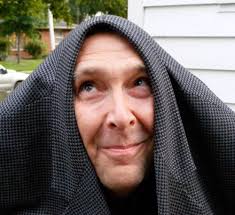
Photo: author Stephen Kuusisto mimics Marty Feldman's "Igor" in Mel Brooks' "Young Frankenstein


Compulsory hetero-normativity; compulsory able-bodiedness; patriarchy; dominant whiteness. So many oppressions. So many astonishing human arrangements. Note: I’ve left out religious intolerance. My mistake. There. Ipse dixit. 


Someone always says “it (prejudice) is produced by an insufficiency of language”—you can count on post-structuralists


I remain wary of those who “abstract” power. 


In general sectarian cosmopolitanism isn’t your friend if you hail from a historically marginalized background. 


Still, as Czeslaw Milosz wrote: “mythologies of the unlucky conquer nations”. 


Beware your mythologies. 


The only compulsory principle is late industrial capitalism. “its property, stupid.” 


I will not pretend I reason clearly. 


Post-normativity is an aesthetic idea but meantime, the bio-industrial-genetics industry is picking your pocket. 


“One ought to hold on to one's heart; for if one lets it go, one soon loses control of the head too.” (Nietzsche)


“The pendulum of the mind oscillates between sense and nonsense, not between right and wrong.” (Jung)


At Dawn

The birds in my neighborhood, who are beauty in-molded, rise and circle. Their brains are blanked, their brains are dark as minerals. I give thanks and praises there are no Bibles for vireos and phoebes. I’m blind but see light at the tips of wings—gold finches, orioles, bay-breasted warblers. 


Some say beauty will outlast ideas of good and evil.

If I am here entire I must push my face into the feathers of the mind. Let others read Revelation. 

If I come back I’ll be nothing more than spindrift to the tips of wings.