I walk with a stick and a dog, down river, up, no one can tell me how its done. A few understand
and sing as I pass—the songs are fine—but there are turns in a stream where songs fall apart, they’re only melody.
When I was a boy a stove abandoned and filled with crickets was opera—blind kid, twilight blues, the moon coming on blues, and so my first lesson. Later Auden would refine it: “the roses really want to grow”.
Crickets sing a house—find homes—say something.
Oh but the walking blues, songs to poems, walking with a stick and dog.
Michael Cuddihy: Each time breath draws through me,/ I know it’s older than I am.
Basho: The journey itself is my home.
Levertov: I saw/ a leaf: I shall not betray you.
Hsieh Ling-Yun: Joy and sorrow pass, each by each,/ failure at one moment, happy success the next./ But not for me. I have chosen freedom/from the world’s cares. I chose simplicity.
Dog and stick, down river, up, a crescent moon, poems remembered.
Rexroth: Water/ Flows around and over all/ Obstacles, always seeking/ The lowest place./ Equal and/ Opposite, action and reaction,/ An invisible light swarms/ Upward without effort.
Niels Bohr: Everything we call real is made of things that cannot be regarded as real.
Jan Kaplinsi: The sea doesn’t want to make waves./The wind doesn’t want to blow./Everything wants balance, peace,/and seeking peace has no peace./If you understand this, does it/
change something? Can you be peaceful/even where there is no peace?
Sam Hamill: I’d kiss a fish/and love a stone/and marry the winter rain/if I could persuade this battered earth/to let me make it home.
Kuusisto: I’m filled with tangled string. A look contains the history of man. (Auden) Some days I’m grateful I can’t see your faces. Mutual need. Mutual aid. Simple. But even Anarchists are specious. I once introduced myself to Utah Philips, said, in the manner of all young pepole: “Its a thrill to meet another anarchist.” He glared at me. Said nothing. And of course I couldn’t see his face. His anarchy had a small “a”.
Stick and dog…
Sam Hamill: Fish, bird, stone, there’s something/I can’t know, but know the same:/I hear the rain inside me/only to look up/into a bitter sun.
Sam Hamill: There are some to whom a place means nothing,/for whom the lazy zeroes/
a goshawk carves across the sky/are nothing,/for whom a home is something one can buy./
I have long wanted to say,/just once before I die,/I am home.
Sam Hamill: the poem is a mystery, no matter/ how well crafted:/is a made thing/that embodies nature./And like Zen,/the more we discuss it,/the further away..
Muriel Rukeyser:
We tell beginnings: for the flesh and the answer,
or the look, the lake in the eye that knows,
for the despair that flows down in widest rivers,
cloud of home; and also the green tree of grace,
all in the leaf, in the love that gives us ourselves.
The word of nourishment passes through the women,
soldiers and orchards rooted in constellations,
white towers, eyes of children:
saying in time of war What shall we feed?
I cannot say the end.
Nourish beginnings, let us nourish beginnings.
Not all things are blest, but the
seeds of all things are blest.
The blessing is in the seed.
This moment, this seed, this wave of the sea, this look, this instant of love.
Years over wars and an imagining of peace. Or the expiation journey
toward peace which is many wishes flaming together,
fierce pure life, the many-living home.
Love that gives us ourselves, in the world known to all
new techniques for the healing of the wound,
and the unknown world. One life, or the faring stars.
Sam Hamill: Poetry transcends the nation-state. Poetry transcends government. It brings the traditional concept of power to its knees. I have always believed poetry to be an eternal conversation in which the ancient poets remain contemporary, a conversation inviting us into other languages and cultures even as poetry transcends language and culture, returning us again and again to primal rhythms and sounds.
Robert Bly:
Our veins are open to shadow, and our fingertips
Porous to murder. It’s only the inattention
Of the prosecutors that lets us go to lunch.
Reading my old letters I notice a secret will.
It’s as if another person had planned my life.
Even in the dark, someone is hitching the horses.
That doesn’t mean I have done things well.
I have found so many ways to disgrace
Myself, and throw a dark cloth over my head.
Why is it our fault if we fall into desire?
The eel poking his head from his undersea cave
Entices the tiny soul falling out of Heaven.
So many invisible angels work to keep
Us from drowning; so many hands
reach Down to pull the swimmer from the water.
Even though the District Attorney keeps me
Well in mind, grace allows me sometimes
To slip into the Alhambra by night.
Kuusisto:
Life in Wartime
There are bodies that stay home and keep living.
Wisteria and Queen Anne’s lace
But women and children, too.
And countless men at gasoline stations.
Schoolteachers who resemble candles,
Boys with metabolisms geared to the future,
Musicians trying for moon effects.
The sky, which cannot expire, readies itself with clouds
Or a perfect blue
Or halos or the amoebic shapes
Of things to come.
The railway weeds are filled with water.
How do living things carry particles
Of sacrifice? Why are gods talking in the corn?
Enough to feel the future underfoot.
Someone is crying three houses down.
Many are gone or are going.
Paulo Freire:
Dominated and exploited in the capitalist system, the lower classes need—at the same time that they engage in the process of forming an intellectual discipline—to create a social, civic, and political discipline, which is absolutely essential to the democracy that goes beyond the pure bourgeois and liberal democracy and that, finally, seeks to conquer the injustice and the irresponsibility of capitalism.
Sam Hamill:
Do your homework. Stand for something. Define what you stand for and live for it and be willing to die by it. It’s the same advice I give a new poet, or for that matter, an old poet. Or a young Buddhist.
Sam Hamill:
You know, poetry’s job is to make us feel good. Poetry exists to allow us to express our innermost feelings. There isn’t one role for poetry in society. There are many roles for poetry. I wrote a poem to seduce my wife. I wrote a poem when I asked her to marry me. Poetry got me laid. Poetry got me married. I wrote a number of poems about Kah Tai lagoon, when Safeway was building that huge, ugly store down there where I used to love to watch the birds nest. That political poem, or environmental poem, was unsuccessful because Safeway built there anyway. And yet the poem has something to say today, as it did then. And I speak here only of my own poems. The agenda for every poet has to be different because most of us write from direct human experience in the world.
Auden:
Can poets (can men in television)
Be saved? It is not easy
To believe in unknowable justice…
Sam Hamill:
Black Marsh Eclogue
Although it is midsummer, the great blue heron
holds darkest winter in his hunched shoulders,
those blue-turning-gray clouds
rising over him like a storm from the Pacific.
He stands in the black marsh
more monument than bird, a wizened prophet
returned from a vanished mythology.
He watches the hearts of things
and does not move or speak. But when
at last he flies, his great wings
cover the darkening sky, and slowly,
as though praying, he lifts, almost motionless,
as he pushes the world away.
There are turns in a stream where songs fall apart, they’re only melody. But poetry pushes the world outward, then pulls it inward, with blue-turning-gray clouds.
Kuusisto:
I’m walking in a yielding air beside my dog, do you understand?
There are no faded hopes beside her, do you understand?
She doesn’t care about my eyes.
She doesn’t care about the heroes on TV.
She lives without protective lies.
Look at us, we’re walking through pitch darkness.
Sam Hamill:
Poetry is one of the ten thousand paths to the Buddha; through poetry (as various as that word may be), we may find self-realization and do away with the “I-and-thou” and competitive mind-set that makes war possible (as well as poetry contests) and we come into a world of only “we,” we-are-oneness” in our struggle in this sentient interdependent world. To value life requires valuing the cosmos that makes life possible. How can we actually learn what love is without learning to fully love this earth on which we stand? —The very dirt and stone of it. We must protect it from capitalism just as we must protect those who suffer most from organized oppression. We must love and resist and rebel.
 Posted with Blogsy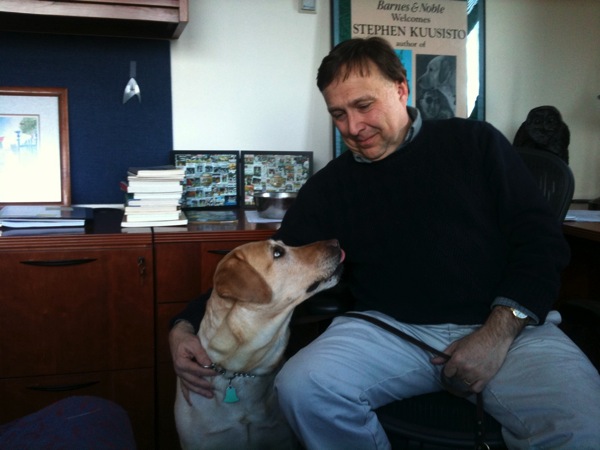
 Planet of the Blind