On George Eliot, Guide Dogs, and Being Happy in the Subway


George Eliot:

“We long for an affection altogether ignorant of our faults.  Heaven has accorded this to us in the uncritical canine attachment.”


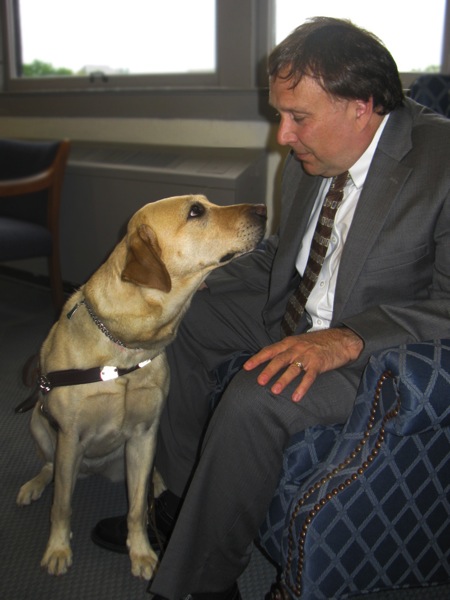
On day two in New York I saw George Eliot was wrong. Corky wasn’t ignorant of my faults at all. Working through the tangled places she surmised my confusions. Stopping before a flight of subway steps she looked up at my face, wanting to be certain I’d found my location and that my footing was secure. 


**

And the caresses of the subway dark! A softness like twilight under the city! The ante-room of Hell with its stink of burnt rubber and urine and the collected odor of ten million human fears—and we were forging ahead through the damasked air and I don’t know how to convey it—but the rhythms of the trains and our own courage were tightly bound.  Who the hell is happy in the subway? I swear we were.


More About Life with a Guide Dog in New York


In Macy’s I made the mistake of talking to a mannequin. Every blind person has done this. A woman said, “that man won’t be talkin’” and laughed and walked with me to the Mens department. Bonding meant I couldn’t be embarrassed—I felt it, as if some essential part of my delicate self-regard had been fired in a kiln. “Thank you Corky,” I said. “Thank you, girl!” 


I felt like Charlie Chaplin—easy, loose jointed, mistake prone and strong.


**


Little things: she walked me around a sidewalk elevator, its doors stood open revealing steep stairs. New York: the city of ominous basements.


She stopped at a curb, then backed up. A double decked tour bus was drifting, scraping the street signs, the people up top laughing—the whole thing was like a boat load of drunks.  Good girl.


We walked past odd little shops, their doors were open, releasing the Victorian odors of commerce—New York is a city of smells—many are unidentifiable—the scent of earth from one door; fragrance of plums from another. On sixth avenue a woman ran out of a shop, grabbed my arm, “you must taste,” she said. “Taste?” I said. “Yeah, you taste!” She dragged us into a Chinese bakery and offered us a Chinese cocktail bun, filled with coconut. Corky and I rewarded her with a little dance. New York. Everyone feels vaguely as if he or she is in a circus. What can you do? You chew, dance, and walk. You thank strangers who suddenly appear.  Do they appreciate your soul? Do they have pity for you? You don’t know. 


Hitting the Streets with a Guide Dog

IMG 0071


I was breaking the rules. You’re supposed to go straight home after guide dog school and remain in your own neighborhood for at least a month. I went home for a few days and then hit New York. 


If bonding was to have meaning it would necessarily involve taking on the world. Going to the city I was refusing to be timid. Timidity could easily overtake me—I had always been such a localized blind person. I wanted to be like Morris Frank and cross New York’s crowded streets. 


Corky was telling me who I wanted to be. I was the man walking 7th avenue in waves of light. I was walking straight out of my spiritual flatness and depression. Even a stroll past a row of ruined storefronts—dead electronics wholesalers, failed restaurants, a tattoo parlor with a cage for a door—even these stretches of capital’s broken dentistry didn’t phase us. Walking was new and was filled with realizations step by step. 


Bonding. Love realized. Love going everywhere with you. Love beside you on a bus. Love in the tiniest entrances. Being released into the world with a dog was positively erotic. My daily sense of failure was being replaced by ridiculous levels of joy. 


The poet Kabir said: “When one flower opens, ordinarily dozens open.” I was getting it.


**


We got up early.  We met a policeman on horseback in Union Square. “Jesus,” he said, “that’s a great dog!” “Jesus,” I said, “that’s a great horse!” We laughed. I thought, “what is most alive in us comes out by chance.” I also thought, “sighted people must know this.” I’d been missing out on chance! 


**

Kabir again: “If you have not lived through something it is not true.” I felt the enormity of my entrance into a true life. On our second bonding day in New York we rode the subway to Fort Tryon Park in northern Manhattan to see “The Cloisters”—the Metropolitan Museum’s replica of a medieval monastery.


We took the A Train to 190th St.—a trip that would have been unimaginable just a month before. People on the train loved the sight of us. An old man said: “That dog looks strong as a tree!” And she did look strong. I could feel Corky’s strength in large and small ways—through her harness, and when she was simply lying at my feet on a rocking train. Power and contentment are the same. And that was the first time I’d ever thought about it. And lots of things were coming loose in my head. At 18, terribly closed within myself, I went alone to a Duke Ellington concert staged in a hockey arena at the University of New Hampshire. The year was 1973 and there were probably only one hundred students in attendance. At intermission suddenly, there, standing before me was the Duke himself. He shook my hand. Said: “How do we sound tonight?” I said, knowing just enough, “you sound like champagne, sir!” And now I was brave, riding the A Train, getting someplace, getting down into the sharp and joyful. 


At 190th St we took the M4 bus about a block. Poof!  We were in the middle ages.

Seeing very poorly is still something. We were going to visit the unicorn tapestries, man and dog. We were in a quest. Corky was pulling hard, happy with the day. 

The tapestries depict a hunt for the unicorn, a creature all school children know. We were early at the Cloisters and a guard offered to describe things for me. With a dog and a kindly stranger I entered the sparkling world of a unicorn hunt.


In the last panel a unicorn, half goat, half narwhal, glowing like the moon, sat under a pomegranate tree, radiating magic against a backdrop of stars. 


“He looks like he knows you’re watching,” said the guard. “And he doesn’t care. They may have caught him but he’s pure magic!” 


I thought of the Zen poet Basho: “Scarecrow about the hillside rice fields, how unaware! How useful!” 


I was free. 


**


Riding back downtown on the subway I thought about unicorns while hugging a dog. Certainly magic has a bright horn and runs fast. I wanted to dance around the railway car. 
 

Stephen Kuusisto is still waiting for you to join Twitter…


Stephen Kuusisto is still waiting for you to join Twitter…


Accept invitation


Twitter helps you stay connected with what's happening right now and with the people and organizations you care about.


You can unsubscribe from these emails at anytime or find answers to your questions at Twitter Support. Twitter, Inc. 1355 Market St., Suite 900 San Francisco, CA 94103


ESPN E:60 Examines Sexual Abuse of Disabled Young Athletes

October 18, 2013

ESPN E:60 Examines Sexual Abuse of Disabled Young Athletes     

ESPN’s award-winning newsmagazine program E:60 examines sexual abuse of disabled young athletes in the episode airing Tuesday, Oct. 22, at 7 p.m. ET on ESPN.

She is 17 years old. A dedicated Special Olympian who loves basketball more than anything else. And last March, while competing in a tournament, she says she was raped by the very man who was supposed to be protecting her: her coach. 

Sadly, this is not an isolated incident. According to experts, children with disabilities are three times more likely than children without them to be victims of sexual abuse. And when the disability is mental rather than physical – meaning the disability is not immediately visible -the cases are even harder to address or to adjudicate. Victims may appear to be of age physically even though their mental development does not allow them to give consent. In addition, in many states the laws addressing sexual attacks on the mentally disabled are vague, inadequate and open to broad interpretation. The result is a growing number of cases in which the most vulnerable are abused and justice is not served. 

Jeremy Schaap uncovers this silent epidemic in an E:60 investigation, including the first on-camera interview with a victim, now 21, who was sexually assaulted by her coach when she was 16.

************
In its seventh season, E:60 continues to innovate long-form storytelling, enterprise reporting and production technique.  Highlights can be found here from E:60’s first six years and current season.  

Click HERE for a preview clip of the report.

-30-

Media contact: andy.hall@espn.com or (386) 492-2246

Bonding with a Guide Dog 101


Bonding 101. We walked around NYC for three full days. A trusting exercise. Best place in the world for trust explorations…


We went to the east village and visited McSorleys pub. The place was filled with mid-19th century bric-a-brac. Corky wanted to lick sawdust off the floor.


We entered a jewelry shop where an old Russian woman wanted to give me a silver crucifix on a chain. I tried to refuse it, but it becames clear she meant to have her way–there was something sincere and strict behind her eagerness, like the last chapter of Crime and Punishment. I accepted the cross and she gently placed it around my neck. Corky sat obediently by my side. 


Bonding. I walked up seventh avenue with a tsarist cross around my neck. I remembered a Russian proverb: Бо́гу моли́сь, а добра́-ума́ держи́сь–pray to god but hold on to your good mind…


Bonding. Corky and I together created a good mind, a steadfast one. 


Bonding. Sublime and ridiculous. A cab driver refused to take us in his taxi. I think, “but I’m wearing my silver cross, and my dog is beautiful!” Oh dear. He shouted horribly, the back door to his cab wide open, my left foot on the sill. Passersby stopped then moved ahead, the old New York shuffle, no one wanted to get involved with a blind man and a dog and a fucked up cabbie. I couldn’t really blame them. I got the cabbie’s number and resolved to report him to the Taxi and Limousine Commission. Later at the TLC I’d learn the cab license had been stolen–the real driver had reported it a year earlier–I was the victim of an illegal driver who likely would never be found.   


Bonding. 


For the sheer hell of it we went solo to the Empire State Building. 


Bonding.


Sometimes I felt we were playing an untuned piano all day. 


We rode the number 7 train to Shea Stadium. It was March. Baseball wouldn’t begin for two more weeks. We walked. Then rode the train back to Manhattan. Bonding. Strange sights and escalators. 


Crossing the Brooklyn Bridge with a Guide Dog

NewImage

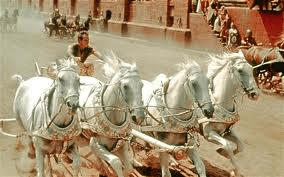
(Image of Charlton Heston’s stunt double, in a chariot and driving five white horses. From the Telegraph, UK) 


I was in a good dream all day with Corky: we walked across the Brooklyn Bridge just for the sake of walking. The sky was blue-going-to-green, that oceanic sky, the beckoning one. And we were racing fast along the promenade deck, a remnant of the great ocean liners. Easy to imagine men in swallow tailed coats and women with wide hats approaching. Blindness, all mist for me, and the dear light, fresh and wonderfully unrevealing. For the blind, light is a mystery–a literal one, less a problem of physics and more a matter of interpretation. Its dream light. The light of the Greek underworld. Any moment my grandmother was likely to appear from the green-blue haze amid the glittering rails and she would tell me of her Lutheran heaven. We were having a jogger’s reverie, Corky and I. We passed two slow runners. I wondered what my guide dog’s dream was like. 


Hers would be without sentimentality. Dogs don’t need squishy daydreams, though they have emotions aplenty; though she loves it when I say good dog with the right tones; but reassurance differs from sentiment–the former is true, the latter a brand of falseness. Dogs don’t care about falseness. They don’t give it a second thought. As we crossed the bridge I thought how a dog’s waking dream must be thrilling in its motion–a kind of widescreen cinema–what they used to call Panavision–the whole world is like watching Ben Hur for a dog. The entire day is a series of chariot races. Amazing to think of it. No wonder dogs are so excited to face the day. Every day, a Hollywood Roman movie. 


Kuusisto, Asch, and Peace, Bioethics Forum

Disabilities as Ways of Knowing: A Series of Creative Writing Conversations: Lives Worth Living


A Discussion with Adrienne Asch, Bill Peace, and Stephen Kuusisto


Tuesday, October 29, 2013

SU College of Law, MacNaughton Hall, Room 104

Presentation 5:30 to 6:30 pm

Reception and book signing from 6:30 to 7:30 pm in the Heritage Lounge, Room 366

White Hall


This discussion will address people with and without disabilities as all having “lives worth living,” by considering creative writing, quality of life issues, the multicultural “disability imaginary,” and issues of ethics, science, medicine, and disability rights.


American Sign Language (ASL) interpretation will be provided during both the discussion, and the reception/book signing. Communication Access Realtime Translation (CART) will be provided during the presentation.


If you require accommodations or need information on parking for this event, please contact sudcc@syr.edu at 443-4486 by 10/22/13.


This event is made possible by the Cocurricular Departmental Initiatives Program within the Division of Student Affairs, and cosponsorship by the Disability Cultural Center, the Renee Crown University Honors Program, the Center on Human Policy, the Disability Law and Policy Program, the David B. Falk College of Sport and Human Dynamics, the Department of Women’s and Gender Studies, the School of Education, the LGBT Resource Center, Cultural Foundations of Education, the Office of Multicultural Affairs, the Disability Student Union, the Beyond Compliance Coordinating Committee, the Disability Law Society, and Verbal Blend.


As aspects of variance and diversity, disability cultures and identities enrich the tapestry of life on and off the SU campus.


Stephen Kuusisto is still waiting for you to join Twitter…


Stephen Kuusisto is still waiting for you to join Twitter…


Accept invitation


Twitter helps you stay connected with what's happening right now and with the people and organizations you care about.


You can unsubscribe from these emails at anytime or find answers to your questions at Twitter Support. Twitter, Inc. 1355 Market St., Suite 900 San Francisco, CA 94103