The First Time I Got Happy

IMG 0073


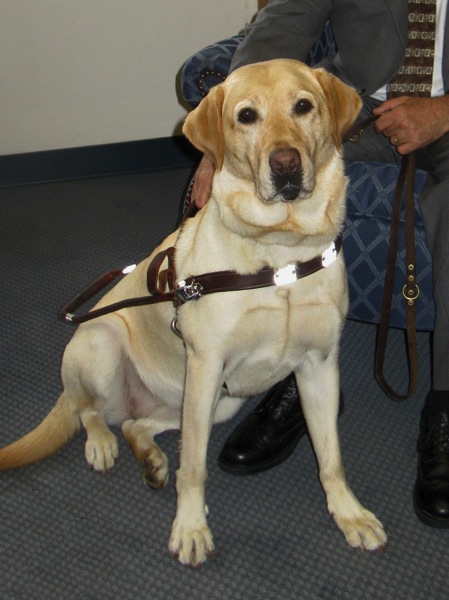
Guide dog Nira


I’ve changed because of my dogs. The obvious perhaps. And I would have changed without dogs. But when positive change occurs one senses the benefits. Shortly after Corky entered my life I had a flash vision. I was alone, sitting at my dining room table. The day had been gloomy with low clouds and intermittent rain. I saw a lit candle and understood it represented my soul. I knew as I sat there with Corky’s head on my knee I had to protect my soul from the winds of bitterness. My life had always been hard–alcoholic mother; struggles with acceptance in school because of my disability; adjunct college teaching while blind–and a life long fear of going places. Now Corky was my familiar, my magic dog, my alchemist. I wrote a haiku in my head: Dear Doctor Jung we/are doing arithmetic/in the sunny void. I was happy for the first time in my life. 


Layover

By Andrea Scarpino


“You only call me when you have a layover in the airport,” my mother likes to complain. “Thank goodness you travel so much or I’d never speak to you.” 


This is a matter of perception. I think I speak to my mother more than I speak to anyone except Zac. My mother thinks we never speak. 


It’s not that I’m so interesting; I’m just the child she can reach, my brother living in Saudi Arabia. My mother lonely. 


I’m sitting in on an undergraduate limnology class: lectures on lake formation, water chemistry, the physics of waves and currents. After every class, I wish I could call my father, a microbiologist who studied water disinfection, and talk to him about what I’ve learned, what I don’t quite understand. I wish I could hear his voice; just for a minute, to hear him call me “Andg”—


Two years ago, my step-father recorded himself reading “The Night Before Christmas” in one of those big Hallmark books. I was visiting my brother and his family, and we all sat listening as my niece turned each page of the book, as my step-father’s voice filled the room. How happy he sounded. How many years that voice read to me every night. I looked at my brother. I think we were both crying. 


My step-father visits every winter to go skiing. I love having him in our apartment, making him coffee for breakfast. I love that he brings a thick hardcover book to read. I love hearing him speak with Zac about computer things I can’t even begin to understand. 


Every summer, I visit my step-mother in Indiana. I love that her refrigerator is always filled with Diet Dr. Pepper, that when I do laundry at her house, my clothes smell like they did in college. I love when she laughs at the television. I love listening to her in the morning speaking softly to her cat. 


Because no matter how fraught your relationship, isn’t there always something special about your parents? Their voice or their face or the way they cook or the way they held your hand? The first people who loved you. The first people who made you miserable. 


The truth is I call my mother from airports because I’m afraid of flying. I fly all the time, have flown since I was a baby, but I’m still terrified. I call her when I have layovers so I can hear her voice. I call her because I know one day I will stand alone in an airport terminal and wish I could hear her complain I never call. 

Dog-ville

The guide dog schools in America (there are approximately a dozen) are nonprofit organizations and they advertise “independence” for the blind as we love that word in the US. Appeals to potential donors usually include a phrase about giving independent lives to blind people. I understand why they do this. But I often wish they’d advertise “culture”–something like, “we give blind and visually impaired people a culture of safe travel and support” or maybe just “Welcome to Dog-ville!” 


I think if I had tons of dough I’d start a new service dog school with just that name. There’d be no divide between dogs and disabilities–we’d have veterans getting dogs to assist with PTSD; children and adults with autism; people with spinal cord injuries; deaf folks–all together with the blind. I’m a dog and disability utopian. I also think separating people with disabilities into medicalized “camps” is problematic. If you think about it in “service dog terms” this Balkanization means people with dogs trained to help with PTSD are often at a disadvantage when they try entering a hostile shop or restaurant with their dogs–they don’t “look” disabled. In turn they don’t always know how to be tough minded advocates for themselves. The blind are good at this. The blind have a history. 


**


It’s early and I’m at O’Hare in Chicago, catching a flight to New York. My dog is by my side.


“Oh, it’s a service dog,” says the ticket woman, clearly flustered, even a wee bit panicked. It’s possible she’s never seen a working dog. Political correctness and unfamiliarity are colliding in her head. She doesn’t know what to do.  


Before I can say anything the woman disappears. Poof! Its like old Scandinavian magic–someone put a spell on her and she’s vanished to the underworld. We have the power to make people go away. Right now she’s in the back room asking a supervisor what to do. “Do we have to take the dog away from the man?” “Do we charge extra for a service dog?” “Does the dog get crated like cargo?” “Does it get a seat in the cabin?” “Can the man sit anywhere or does he get a special seat?” I know all the questions being asked behind the curtain.  


**


The creature beside me is known in English as a “guide dog” and sometimes she’s called a “Seeing-Eye” dog since the first school in the United States to train dogs for the blind is “The Seeing-Eye” in New Jersey. But the technical name is guide dog.   


What does a guide dog do? 


Why is the appearance of a guide in public still so surprising?


**


When the woman comes back she’s all smiles. Her supervisor has assured her guide dogs fly on airplanes, that they lie at the feet of their human partners, and that no extra charge will be applied for the dog. Perhaps the supervisor also said it’s nice if you give the guide dog team a bulkhead seat–though this isn’t required. The only thing the law says is that people with disabilities cannot sit in an exit row. 


One thing’s for sure: guide dogs are still relatively unfamiliar to the public, even 80 years after their introduction in the United States. People know they exist, but they don’t know what these dogs and their partners can do. 


 **


Guides were the first service animals, and for more than forty years they were the only ones. They offered a success story, one with real answers for their blind partners. Now, the training of dogs to assist people with other kinds of disabilities is common. Service dogs and animals are, in the strictest sense, animals trained specifically to help those with disabilities manage one or more functions of life that are otherwise impossible.     


In fact, that’s what disability is–a function disjunction, no more, no less. Forget the myths about disablement, the old fashioned idea that physical or mental impairments are symbolic, representing deeper deficiencies–disability is nothing more than an obstacle or series of obstacles. The Americans with Disabilities Act makes it clear that the definition is centered on the elements of life function: “The term “disability” means, with respect to an individual (A) a physical or mental impairment that substantially limits one or more major life activities of such individual; (B) a record of such an impairment; or (C) being regarded as having such an impairment.”


Under the ADA major life activities include, “but are not limited to, caring for oneself, performing manual tasks, seeing, hearing, eating, sleeping, walking, standing, lifting, bending, speaking, breathing, learning, reading, concentrating, thinking, communicating, and working.”


Major bodily functions also means: “functions of the immune system, normal cell growth, digestive, bowel, bladder, neurological, brain, respiratory, circulatory, endocrine, and reproductive functions.”


The range of disability is broad, not because bureaucrats have expansive imaginations but because the ways of having a disability are almost uncountable. In turn, when thinking of service animals, I’m reminded of a slogan from our current digital age: “there’s a dog for that”. (Of course there are other kinds of service animals–monkeys, and miniature horses most notably.) 


Just as the public has trouble absorbing the scope and variety of disability, it also has difficulty understanding what a service animal is. 


Nowadays dogs are trained to help wheelchair users who are both paraplegic and quadriplegic–picking up objects, opening cupboards, handing money to cashiers, helping to balance their owners, just to name a few of their capacities. Dogs can be trained to detect the onset of seizures or help hearing impaired people detect audible signals. Some dogs help their diabetic owners by detecting changes in their blood sugar. And all of these skills reflect the amazing capacities of dogs and the pioneering vision of the guide dog movement.


But what exactly is a service animal? The most important thing for the public to understand is that it is not a pet. According to a pamphlet from the New York State Attorney General’s Office: “the ADA defines a service animal as any guide dog, signal dog, or other animal individually trained to provide assistance to an individual with a disability. If they meet this definition, animals are considered service animals under the ADA regardless of whether they have been licensed or certified by a state or local government.” 


A service animal doesn’t have to have a license. Nor does its owner have to carry official papers certifying the animal’s authenticity. The simplest way to tell if an animal is a working animal is by its professionalism.


In fact it’s the professionalism of a guide dog that really matters–not simply in traffic or in crowds, but in businesses or classrooms. 


**


I think of all the guide dogs in all the airports, for whom the world’s suitcases are thrilling. The man with a Green Bay Packers jersey holds a duffle, and hidden among his socks is a German sausage, smuggled all the way from Wiesbaden. And the tall woman with the “Gibson Girl” hat, who owns a vintage clothing store in upstate, New York, has a sachet of lavender in her tiny handbag. There are too many smells! The baby with ears moistened by kisses! The nourishing smell of shoes! 


I’m standing in a line of air travelers and my dog knows everything. The security man smells like fragments of a meteor; the backpack on the conveyer says its owner just slept with a perfect stranger. My dog may, or may not know I can’t see, but she surely understands the wonders around us. 


Dog-ville is a complicated and enthralling place. 


A Guide Dog’s Tale


–”I always like walking in the rain, so no one can see me crying.”

–Charles Chaplin


One night when it was raining hard in New York my literary agent Irene Skolnick suggested my wife Connie and I join her at an Italian bistro in the East Village so we harnessed up guide dog Vidal and went on down.


I’d say waterworks are the same in every city but its not true–each place responds to rain according to its social and architectural inheritance, something you learn when traveling widely with a service dog.


Houston for example has no drainage system. Texans, opposed to governance, do without clearing water from their streets. The pavement floods, especially under bridges. Best of all, poisonous snakes float among stalled cars.


But New York is entirely seized by rain. Fights break out over taxis, pedestrians struggle in knee high puddles. People stab each other with cheap umbrellas. All these things occur against a backdrop of lights and pastels in mist.


We arrived at the bistro in reasonable shape–we’d gotten a cab and were a quarter-dry, dry enough to make an entrance. Labrador Vidal was presentable. We were feeling good. We were about to partake of a good meal on a rainy night and share some laughs. In my experience restaurants are doubly pleasurable in storms. There’s something inspiriting about dining in bad weather. We approached the door. The door was open. In we went.


The maitre de–who was also the owner–met us straight away and insisted we turn straight around and leave. He didn’t want the dog in his dining room, a matter that’s familiar enough to all service dog owners, for we frequently encounter resisting doormen, waiters, cab drivers and mall cops. As a tribe we’re good at defusing the misunderstandings. A guide dog is allowed everywhere the public goes. It is rather simple. When it isn’t simple however it becomes a leaden exchange.


I was once flying to Chicago to appear on the Oprah Winfrey Show when American Airlines canceled my flight. They decided to put all the passengers on a bus and take us to LaGuardia in Queens. As I approached the bus the driver shouted he wasn’t taking my dog. I said he might want to reconsider this as the Americans with Disabilities Act and New York State law both entitled us to ride on any public transportation. He grew hostile. “I don’t care about the fucking ADA!” he shouted. “I don’t care about it!”


It’s really true–sometimes you meet hot, implacable people because you have a guide dog. It doesn’t happen often. But it does occur. The men or women who oppose you (for I’ve had women opponents as well) are the kinds of folks who swell up, like Bluto in the Popeye cartoons. And they turn red immediately. They’re not like border guards or indolent cops–they’re more instantaneous in their craziness, like people who’ve swallowed hot gobs of meat and start sputtering and coughing. There’s a psychopathology to the thing, and when you’re “in it” the rules of customary debate are out the window.


The bus driver didn’t want me on the American Airlines charter to LaGuardia and when I summoned a policeman he didn’t want to hear from the cop and while the two of them argued I simply boarded the bus and sat. (This is an old civil rights trick. You make it hard for them to remove you.) The driver gave up eventually and climbed aboard and drove fifteen stranded passengers and one guide dog to LaGuardia. The affair ended without apologies or explanation. The driver had a pronounced limp. It was clear he’d had a tough life. Who can say what my presence triggered inside him? Who can say indeed. Where disability is concerned a trans-symbolic exchange of unhappiness is fairly frequent. As my friend Bill Peace says, “They don’t like seeing cripples.” There’s some truth to this. Then there the people who don’t like dogs–are petrified of dogs. And because guide dogs are professional animals they think, “Hell maybe a guide dog will attack? Jesus. Better keep the blind man and his dog out of my cab! Quick! Drive away! Shit, he’s blind he won’t even know!”


You stand for something, you and your dog, but its not always clear what it is. There’s a lot of crazy. You don’t need a dog to know this. Just try walking someplace when you’re pregnant. Instantly enthusiastic strangers want to tell your fortune. Who knows what you signify, but you give off meanings in the corner bodega and there’s not a damn thing you can do but keep moving.


Sometimes when service dog ugliness happens you really can keep moving, like the time I was followed eight blocks on Amsterdam by a woman from PETA (People for the Ethical Treatment of Animals) who shouted as she stumbled behind us, “You’re a slave master! Big Daddy with his prisoner dog! Slave driver!”


We outdistanced her. Guide dog people move fast. As the blues master Leadbelly would say, we were “gone like a turkey through the corn” but I heard PETA woman long after I’d ditched her. Lunacy repeats like Muzak. Big Daddy and Prisoner Dog. I thought how we might be kind of Vaudeville act. Too bad Vaudeville died. We probably wouldn’t make it on MTV.


I’ve experienced lots of crazy in New York with my dog. One afternoon I sat beside a dog park just to listen. Right away a woman asked if I wanted to let my dog run. I said no. “We’re just stopping for a second,” I said.


“Well you ought to let her run, poor thing, she gives up her life for you.” she said.


“Yes,” I said, “we live in a Boolean equation, where my life is X and hers is X minus 2.”


“What does that mean?” said the woman.


“It means,” I said, “our lives are running down in equal measure. Why hell, we’ll probably die at the same time. We’re all giving up our lives in algebraic co-efficients.”


“You’re pulling my leg,” said the woman.


I shrugged. I asked her what her dog’s name was.


“His name is Jasper,” she said.


“Let me guess,” I said, “he’s a Dalmatian.”


“How’d you know?” she asked.


“Because Jasper is generally spotty.” I said.


“Tell me,” I asked, “what does Jasper do for you?”


“He doesn’t have to do anything,” she said. “He’s free to be a real dog.”


“I see,” I said. “So a working dog like mine isn’t real in your view?”


“That’s right,” she said, “your dog is suffering.”


Then pandemonium broke out. Jasper evidently swiped a nanny’s iPhone and was running in circles and people shouted as he chewed it. The dog eluded middle aged men in suits and loafers. Jasper was unfettered and alive and he was also the incitement for a fight–the nanny and Mrs. Jasper got straight into it–who was going to pay for the phone? Not Mrs. Jasper. Her dog was a free spirit. Nanny, you see, should have kept the phone in her purse. Nanny disputed this but made the mistake–the big mistake of characterizing Jasper’s “freedom” as “uncontrolled” –a charge Mrs. Jasper equated with apostasy, for Jasper, like all pet dogs, stands for “the Id” and you’re a pretty sorry specimen if you don’t get it. Don’t your super-ego to the dog run. Its the wild west. Etcetera. I got out of there.


We walked east to Fifth Avenue. Wasn’t it Auden who said the roses really want to grow? “Dogs,” I thought, “really want to work.” And working dogs get plenty of play time and they get to go everywhere–none of that dolorous waiting in dark apartments for hours on end that marks Jasper’s life. No wonder the poor sonofabitch steals iPhones–he’s pure Id–he’d eat the daylight if he could. “That’s the thing about Mrs. Jasper,” I thought, “she exemplifies the cosseted, ingrown anthropomorphism of New York City’s dog owners, a thing beyond “love me, love my dog” for the impulse, the projection of straightened life onto animals is darker, tangled up in capitalist misery and so your silly dog gets to be a wolf. Or just an ambient stuffed toy.”


You see the ambient stuffed toy people all the time. They tend to talk a lot. The dog owners of New York are verbally expulsive, proving Kierkegaard’s assertion that “people demand freedom of speech as a compensation for the freedom of thought which they seldom use.” For instance the woman on Seventh Avenue who was dragging her Pomeranian. “You’ve had enough,” she said. “You’ve had enough and enough is enough!”


I asked the woman what she meant. I said: “Excuse me, but is there something on the ground that your dog was eating?”


“What?” she said.


“Eating,” I said. “Was your dog eating something?”


“Oh no,” she said, “We’ve had enough of staring at nothing! This stupid Pomeranian just stares at nothing. I’ve had enough of nothing!”


I nodded. We were having Seventh Avenue metaphysics. I thought if I had world enough and time I could tell the woman what dogs see, tell her the Pomeranian is a Cubist of color and movement with a wider visual field than humans and that its entirely possible the street is dazzling the dog who has hit the brakes out of instinct. But I was a coward, fearing a conversation that would become a bolus, a lump of bread you can never swallow. She went away, dragging her rust colored and vaguely frightened dog and I felt remorse as if I could have saved the poor creature with instructions for her owner–”Take it from a blind guy, you can’t stare at nothing.” “Your dog is having an allergic reaction to motion. Talk to her, a little cajoling and reassurance would be good for both of you, yes?” “Personally, I get by on cajoling and reassurance Lady.” This is no joke.


Successful guide dog work depends on cajoling. Or if not quite cajoling, elaborate praise. You’re taught to say “Good dog!” with musical sincerity and to say it throughout the working day. You say it when your dog stops at a curb. When she stops at the stairs. Or when she passes around a dropped bicycle or ignores a fallen pizza slice. “Good Dog!” You say it as if you’re learning Swedish–putting some musicality into it. Working dogs love praise. And you give praise all day. Perhaps a hundred times during a 24 hour period. She absorbs the rolling nightmare of trains and skateboarders and staggering drunks and buses running red lights and you sing to her “Good Girl!” In turn this reassurance flows backwards, fills you. You’re a competent blind guy sailing through crowded streets or down the tunnels of Grand Central Station. This competency has everything to do with letting your dog be a dog; “follow your dog” they say at the guide dog school–she knows what she’s seeing, knows what to do. Your job is to know where you want to go. Hers is to get your there. We get by on mutual instruction and tandem praise. When my dog is good I’m good. And vice versa.


In Central Park we met a German Shepherd dragging its owner to a dog run. Because I could see just a bit I saw the man was too thin for his dog–he was in danger of getting hurt. The guy was skating, the Shepherd surging like a locomotive–it even panted like a locomotive and the man cried: “Dolly, Dolly! You’re gonna break my sandwich!” The sandwich was the least of the man’s problems. He raced by, crying against fortune, his sandwich, the volition of Miss Dolly, his shoes slapping pavement.


These are the leisure dog people. Baby talking, projecting soft instincts, unable to understand dogs want to be equals in a team. And when it rains they hate their animals. There’s no utility with dogs in bad weather. All the misery of the city is magnified as I’ve said. The streets are deplorable and people are half-panicked. Steinbeck said: “One can find so many pains when the rain is falling.” In storms New York’s dog people are aching, vituperative, stomping the avenues with malice. I’ve often wondered about Mrs. Jasper in the rain–does she see her Dalmatian as a free spirit or does she shout at him to hurry his business between parked cars on East 57th? I’ve heard them, amateur dog people. “C’mon you (expletive deleted), get going!” Me? I’m grateful to have a set of eyes and a supportive intelligence at my side. Pray for rain, you deal with mud. I own many rain coats. In turn I’ve heard the leisure dog classes cussing blue streaks all over Manhattan.


We are a team my dog and I. We trust each other. My life has been spared in every kind of weather by a dog who won’t let me step into harm. I know where we want to go but my dog knows how to accomplish the trip–avoiding waist deep puddles–watching for spiky, bobbing umbrellas–backing me up from bicyclists running traffic lights– enduring the discomforts in equal measure. This is the thing–with a guide dog you notice how un-bonded the city’s dog owners really are. When a dog isn’t fun, when it isn’t a projection of loopy animus in a dog run, then its a vexation, like owning a piano in the woods. Once upon a time it seemed like a good idea.


**


When the owner of the bistro confronted me he was more than simply uncomprehending, he had an inflated hostility about my guide. I think the rain had gotten into him somehow–he felt entitled to be cruel.


I was in the proscenium of a restaurant with a Labrador retriever. I should say we were dressed in business attire. I had a Burberry. Irene and Connie were similarly decked. We were grownups arriving from a storm.


The bistro-man hated me and shouted, telling me where I could go.This was a small business and so diners were forced to watch the drama. Rain struck the roof with a dull drumming. The customers had wine. They had crostini and truffles. They had Ribollita. They felt pretty good. Now they had a show.


“You can sit outside,” he said, gesturing with a towel twisted into a whip. “We’ll put up the umbrella!”


“No one is going to sit outside,” I said.

“I’ll tell you what,” I said, “we’ll have the police explain it to you.”


“F—k the police,” he said.


“Here’s the thing,” I said, “if the cops come and explain the restaurant and a guide dog thing, and you still don’t let me sit down, I’ll file federal charges against you. The fine is $50,000 for violating my civil rights.”


The rain was coming down harder. It was easy to feel how the city’s appetites and grievances were magnified by the storm. If a man hates dogs in sunshine he’ll hate them all the more in rain. I swayed in the heat of a small eatery. Steam escaped from the kitchen pickup window. Waiters rushed past.


My maître de, major domo, sole proprietor, was pointing his finger in my face.


“You sit outside! Sit outside!”


Everyone in the restaurant was quiet then–no clatter, no clink. No one spoke. It wasn’t a big place. Rain pounded the roof. I thought of the owner-domo (who, according to the New York Times) was a recent arrival from Sicily. I suspected he knew nothing of guide dogs–cane guida–knew only the confounding Manhattan dog people with their baby talk and bubbly anthropomorphic chit-chat. I reckoned no one ever said there’d be guide dogs in his joint. How could he know? And the city was seized by rain. Everyone was sweaty or soaked through; each man or woman felt oddly larger or smaller than a customary self. That’s the thing about rain in New York. In the flush of silence I said to him, softly, “why don’t you give us a bottle of wine?” He pointed us to a table. The diners picked up their forks. We were all going to eat in the rain.


Mental Illness is not the Cause of Violence

In the wake of multiple violent crimes that media linked to mental illness, advocates for mental health de-stigmatization and rehabilitation are often left quoting the same study indicating that individuals with a mental health diagnosis are far more likely to be victims of violence than perpetrators of it. The below study, published by the American Journal of Psychiatry last month, indicates that there is no statistical link between diagnosed “psychiatric disorders” and the use of firearms or violence toward multiple victims. See below for a summary from Psychiatric News and the attached links to read the full studies.


Study Finds Psychiatric Factors Not Linked To Multiple Homicide Victims


Clinical and Research news; Mark Moran; September 17, 2013


Though more than a third of the defendants had prior psychiatric treatment, few received treatment in the three months preceding the crime of which they were accused.


Psychiatric factors do not appear to predict whether a homicide defendant used a firearm, killed multiple victims, or is convicted of the crime, a finding that would seem to counter the popular notion—prevalent in the wake of recent mass killings that have made the news—that perpetrators of mass gun violence are invariably mentally ill.


The finding is from a study appearing in the September American Journal of Psychiatry that assessed the association between homicide and a wide range of demographic and clinical variables.


Key Points


Researchers found no relationship between the presence of psychiatric disorders and the use of firearms. Also, the presence of a psychiatric disorder was not related to offenses involving multiple victims.

Although 37 percent of the sample had prior psychiatric treatment, only 8 percent of the defendants with diagnosed Axis I disorders had outpatient treatment during the three months preceding the homicide.

Individuals with an Axis I disorder were overrepresented in homicide defendants, but this was due to the high rate of substance use disorders found in this population.


“It is notable that clinical variables, such as Axis I diagnoses, were not associated with offense characteristics or case outcomes when demographic and historical characteristics of the cases were included in the models,” wrote lead author Edward Mulvey, Ph.D., of the University of Pittsburgh Medical Center, and colleagues. “In particular, while age and race were significantly related to the use of a firearm, the addition of clinical variables to demographic and historical variables did not improve model fit. Furthermore, a model including demographic/historical and clinical variables did not significantly predict a guilty verdict, suggesting that case-specific factors were more salient in these determinations.”


In the study, defendants charged with homicide in a U.S. urban county between 2001 and 2005 received a psychiatric evaluation after arrest. Demographic, historical, and psychiatric variables as well as offense characteristics and legal outcomes were described. The researchers examined differences by age group and by race; they also looked at predictors of having multiple victims, firearm use, guilty plea, and guilty verdict.


Fifty-eight percent of the sample had at least one Axis I or II diagnosis using DSM-IV criteria, most often a substance use disorder (47 percent). Axis I or II diagnoses were more common (78 percent) among defendants over age 40. Although 37 percent of the sample had prior psychiatric treatment, only 8 percent of the defendants with diagnosed Axis I disorders had outpatient treatment during the three months preceding the homicide.


That suggests limited opportunities for prevention by mental health providers, Mulvey and colleagues said. “The rate of previous treatment observed in this sample raises issues relevant to mental health policy,” they wrote. “Although 53 percent of the sample were diagnosed with an Axis I diagnosis (including substance use disorders), less than half of these individuals had ever been hospitalized. Also, among those with an Axis I diagnosis, only 8 percent had received any treatment in the three months preceding the homicide offense. Moreover, this low frequency of recent psychiatric treatment differed markedly by race….Widespread disparities in access to care and cultural differences regarding help seeking are likely explanations for this difference. The low rate of treatment in the months preceding the offense, however, highlights the need for enhanced engagement of high-risk individuals (especially during times of emotional crisis) if mental health care providers expect to have an impact on serious violence.”


Steven Hoge, M.D., says that study findings showing low rates of treatment in the period prior to a crime suggest that crime-prevention strategies relying on psychiatrists’ reports regarding treatment encounters will not be effective.


Steven Hoge, M.D., chair of APA’s Council on Psychiatry and Law, reviewed the report. “Individuals with an Axis I disorder were overrepresented among homicide defendants,” he told Psychiatric News, “but this was due to the high rate of substance use disorders found. The relationship between substance use and serious criminal behavior is well established. The study identified only 15 individuals—just 5 percent of the sample—who had a mental disorder and no co-occurring substance use disorder. Identification and treatment of substance use disorders are important not only to alleviate individual suffering, but also to improve public safety.


“The study findings address current concerns regarding gun use and mass killings by those with mental illnesses,” he continued. “There is widespread belief that mental illness is an important cause of firearm violence and mass murder. In fact, the researchers found no relationship between the presence of psychiatric disorders and the use of firearms. Nor did the presence of a psychiatric disorder relate to offenses involving multiple victims. These findings suggest that policies designed to keep firearms out of the hands of individuals with a history of mental illness will not prove to be effective as a targeted strategy.”


Hoge also said the study underscores the need for better access to psychiatric treatment, particularly substance use treatment. However, crime-prevention strategies that rely on psychiatrists’ reports are likely to be ineffective because most of this population is not in treatment or getting timely treatment.


“Psychiatric Characteristics of Homicide Defendants” is posted at http://ajp.psychiatryonline.org/data/Journals/AJP/927544/994.pdf.


“Psychiatric Factors Not Linked to Multiple Victims” is posted at http://psychnews.psychiatryonline.org/newsarticle.aspx?articleid=1739096


Consortium for Culture and Medicine Seminar

Adrienne Asch, PhD
Yeshiva University

Recognizing Death While Affirming Life:
A Disability Perspective on End-of-Life Questions

Thursday, October 31, 2013
12 to 1 p.m.
SUNY Upstate Medical University Campus
Room 1507/1508 Setnor Academic Building, 766 Irving Ave, Syracuse

How can health care practitioners and bioethicists benefit from the views of disability scholars and activists?

This seminar takes a disability rights perspective on now-famous end of life cases and current debates about the end of life and assisted suicide.

Dr. Adrienne Asch is the Edward and Robin Milstein Professor of Bioethics and Director of the Center for Ethics at Yeshiva University and professor of epidemiology and population health and family and social medicine at Albert Einstein College of Medicine in New York City.
Her work focuses on the ethical, political, psychological, and social implications of human reproduction and the family. She has authored numerous articles and book chapters and is the co-editor of Prenatal Testing and Disability Rights and The Double-Edged Helix: Social Implications of Genetics in a Diverse Society.

Co-sponsors: Syracuse University’s Disability Cultural Center & Renee Crown University Honors Program

Free and open to the public
Access:
The presentation space is wheelchair accessible (wheelchair-accessible bathroom on the same floor) ASL interpreter provided.

Information
For information, contact Consortium Coordinator Lois Dorschel at dorschel@upstate.edu or Executive Director Rebecca Garden, PhD, at gardenr@upstate.edu or 315-464-8451.

Consortium for Culture and Medicine Faculty Seminars The Consortium for Culture and Medicine is a collaboration among Le Moyne College, Syracuse University, and Upstate Medical University that brings together faculty and students from disparate fields to teach and conduct research on social, ethical, and cultural aspects of health care.  The Consortium’s Seminar Series encourages faculty, students, and interested community members to speak across disciplinary boundaries on urgent topics that interweave discourses and professional and social perspectives. For more information, see:  .

Location
The Setnor Academic Building is an extension on the north side of Weiskotten Hall, 766 Irving Ave., at the intersection of Waverly and Irving, on the west side of Irving, just north of Waverly.  (See attached map.)

Parking
There is limited metered parking on Elizabeth Blackwell Street near University Hospital, and along Irving Avenue near Weiskotten and Silverman Halls and the Health Sciences Library. Visitors may wish to park at one of two public garages on Irving Avenue. (Take Adams Street to Irving Avenue. Turn right. The garages are on the left side of the street between Adams Street and Waverly Avenue.)

The Image in Disability Showcase

THE IMAGE IN DISABILITY SHOWCASE
OCT 5th, 3:30pm @  Watson Auditorium, Syracuse University

General Admission: $5
Students: FREE!

Sponsored by The School of Education at Syracuse University, 

The Image in Disability Showcase explores the many ways films 

around the world view disability. 


All films are captioned.

Full program description:

Petra’s Poem, 2012, 5 mins.
In this visually compelling short, Petra Tolley, a Toronto artist with Down syndrome, draws from her emotional experiences to produce a distinctive take on the social self.


Bulletproof Jackson, 2013, 35 mins.
Featuring a cast with eighteen disabled actors, this western follows the story of Benny Jackson, a young man in danger of losing his family’s saloon.


Check Out, 2013, 11 mins.

A short comedy. Kelly and Allison are two twenty-something grocery employees caught in a rut; Kelly has Down syndrome and is struggling to get a promotion, while Allison struggles to find happiness amidst her complacency.


I Am In Here, 2012, 30 mins.
“Do you want to know what it’s like to be thought of as stupid?” Mark’s autism prevents him from speaking his thoughts. This day-in-the-life movie uses humor to highlight the contrast between people’s perceptions of Mark and the intelligent man trapped inside. 


pastedGraphic.pdf

Service Dog, Service Dog!

A professional service dog wags her tail. Her head is up. Eyes bright. And she brings joy to lots of people. The cashier in a Durham, North Carolina convenience store was overjoyed to see me and guide dog Nira–he dropped his mop, ran over, said, “Now that’s a service dog! That’s a service dog!” And he began explaining to another employee how important these dogs really are. I swear he was like a little kid. And it got more interesting for the man was a Muslim and he explained in great detail how Mohammed was once saved by a dog and how heroic dogs go to heaven. He was absolutely beside himself. 


Art Caplan and NBC News Fail at Understanding Autism

Art Caplan, a bio-ethicist who’s never seen a spectacle he can’t reflect, has offered an opinion regarding a Wisconsin family’s decision authorizing the modification of their autistic son’s  vocal cords. You can read Caplan’s OpEd–I simply have the following to offer–that nowhere in this story is there any evidence of a broader and more comprehensive and yes, “humanistic” approach to working with the young man’s vocalizations (characterized as intolerable screams); nowhere is there a suggestion that speech-language pathologists or wonderful programs like “Heeling Autism” at Guiding Eyes for the Blind (which provides autistic kids with professionally trained Labrador Retrievers as a means of helping them with anxiety) were in any way consulted. This is a story about the “medical model” of disability and the decision to alter a child’s vocal cords is presented as obvious. But it isn’t obvious. In fact it was a utilitarian decision–one of easy convenience, and which is now being justified as the inevitable “thing” a matter that will potentially do real harm to young people with autism. I’ve long held that we need to “presume competence” when we are among non-speaking people. We do not alter their bodies because they are inconvenient. My blindness is inconvenient. Should I be modified so people don’t have to see it? That’s what asylums were all about. If a boy with autism screams perhaps he has something he wants to say. Perhaps he needs to have more knowledgable and nuanced accommodations. Art Caplan knows less about this subject than my auto mechanic. But he has a Ph.D.. I haven’t seen Dr. Caplan at leading conferences by and for people with autism. I haven’t seen him at the Society for Disability Studies. I suspect his understanding of physical difference is entirely mediated by neo-Victorian medicine. As for NBC–their reporting on disability issues usually tends toward the lachrymose and sentimental so their genial platform isn’t surprising in this instance. Apparently both NBC and Caplan believe knee-jerk opinion beats complexity. Their motto is like the tape loop in airports: “If you see something, say something.” I grieve for any person with a disability who is modified to suit the easy utility of medical modeling.