Morning Fragments


Now an old man comes down the street, a kind of scrawny angel, pushing a bent bicycle. The spokes flash in the sun. He’s a war veteran. Compared to him everyone else in the world is motionless. 


**

Squirrel on a telephone line, I swear, he’s Jimmy Cagney.


**


Everyone loves a fairy tale, even my late father who was a rational Scandinavian academic. In my dad’s case he used to imagine creatures at the bottom of the lake, things with lots of appendages. He’d talk to them in his brand of old Finnish. It was his way of not drowning. 


Regret

By Andrea Scarpino


Moving away from my brother in high school: I saved myself, but I’ve always felt like I left him behind. Arriving at the hospital after my father died. Lashing out at others when I feel vulnerable. Not embracing joy when it clearly presents itself. Having bought a house. Unkind words I have said precisely because they were unkind. 


In his speech this spring to Syracuse University’s graduating class, George Saunders writes, “What I regret most in my life are failures of kindness.” I’ve been thinking about that, what it means to fail at kindness. What it means to have regret. 


A philosopher friend named Jesse brought up regret several nights ago at dinner. He described it as something potentially positive, described a fondness for thinking back at moments in his life that might have gone many different directions. As the conversation progressed, Zac wondered whether having regret means you’ve lived a full life, that you’ve had many choices available to you and had to make some tough decisions about which paths to follow. Maybe a life without regret means you’ve never had to make tough decisions. Maybe a life without regret means you’ve never had the opportunity to regret. 


I don’t regret taking on so much student loan debt—it allowed me to live more comfortably, to spend time in college developing wonderful friendships. I don’t regret all the time I’ve spent in school. I don’t regret traveling, no matter a trip’s expense, hardship, or food poisoning. I don’t regret having hung up on people who were saying mean things. I don’t regret having written a single poem, even the terrible poems, even the poems no one wants to publish. I don’t even regret having spent whole afternoons watching reality TV. 


At the end of his speech, Saunders tells Syracuse’s graduating class, “And someday, in 80 years, when you’re 100, and I’m 134, and we’re both so kind and loving we’re nearly unbearable, drop me a line, let me know how your life has been.  I hope you will say: It has been so wonderful.” 


And maybe our wonderful lives will be filled with regret. And maybe they won’t. But I hope that looking back when I’m 134, even my most regret-filled memories will have a tinge of sweetness. As Jesse says, I hope they will demonstrate what a rich, full, wide-open life I have lived. The choices I’ve had. The many opportunities.

Little Helsinki

I have a short essay over at Dirt and Seeds about what used to be called a “primal experience” back when people talked about the unconscious. Nowadays the unconscious has been relegated to quaint-ville and only turns up on television shows like Fringe where its a second class narrative device involving hypnosis and aliens. Sometimes I wonder what Carl Jung would think of the advent of “big pharma” and its destruction of the talking cure. Jung understood a happy life contains plenty of darkness and we better not forget it. He said:

Even a happy life cannot be without a measure of darkness, and the word happy would lose its meaning if it were not balanced by sadness. It is far better take things as they come along with patience and equanimity.

Measure, meaning, patience, equanimity. 

My early childhood–my primal moments–occurred in Helsinki, Finland in the late 1950’s when the Finns were balanced precariously between the Soviet Union and the United States. It was a dark time. They’d survived two wars with Stalin and though they hadn’t been gobbled up like Estonia, Latvia, and Lithuania, they’d lost approximately 20 % of their country to the Soviets. Worse perhaps, they’d lost out on the Allies Marshall Plan because they’d received arms from Hitler to fend off the Russians. In effect, Finland was poor. In my first memoir Planet of the Blind I tried to describe what that poverty felt like:

In Helsinki I lean close to the gray, birdlike women with ether eyes who ride the trams. Each has survived the wartime starvation, and now, in the darkest city on earth, they are riding home with their satchels, which had taken all day to fill; the stores were ill-stocked

and the lines were long. I remember their almost feral attention to the trolley’s windows at twilight. As a small boy, I climb ever closer to them, their strangeness imprinting on me an indelible image of hardship.


Even a happy life cannot be lived without a darkness–maybe more than one measure. The moment above is primal–I haven’t forgotten. Helsinki today is clean and prosperous and even her smallest children walk about the streets speaking on cell phones. There are fancy foreign restaurants on every corner. I like today’s Finnish capitol.  I always choose civic satisfaction over its opposite: abandonment. Poverty is abandonment; depression is also. But back in 1959 there was something about those women on that trolly–a depth of understanding, a wizened sorrow. 

Schopenhauer said: Each day is a little life; every waking and rising a little birth; every fresh morning a little youth; every going to rest and sleep a little death.

I like the “little Helsinki” of my darkly measured, little and early days. 


A Wrong Turning in Disability Studies

(Note: I will not make myself popular by posting this. But as Bruce Springsteen once said: “When I was growing up, there were two things that were unpopular in my house. One was me, and the other was my guitar.”


1.


Disability studies tends toward essentialist views about language. As Salman Rushdie puts it, essentialism is “the respectable child of old-fashioned exoticism. It demands that sources, forms, style, language and symbol all derive from a supposedly homogeneous and unbroken tradition. Or else…” 1 


If you want to critique the empire by using its own tools essentialism is as good as anything in the box. The social construction of normalcy fits the bill. 


2.


The engineering of normalcy is (was) (remains) real. From Frances Galton to Antonin Scalia the reflexive and reactionary assignment of physical and social value per bodies is the Lingua Franca of deterministic economies. No one has written more persuasively about this history than Lennard J. Davis. 


3.


Essentialism gives away the game too soon. By this I mean that cultures are too diverse and local to adhere to the dominance of social construction no matter how powerful this idea may be. It is far more useful to talk about the economic construction of normalcy than to imagine it as a thoroughly cultural dynamic. 


4.


Margaret Mead: “If we are to achieve a richer culture, rich in contrasting values, we must recognize the whole gamut of human potentialities, and so weave a less arbitrary social fabric, one in which each diverse human gift will find a fitting place.”


I would prefer disability studies to talk about richer culture not a falsely dominant one. 

Culture is not propaganda. It is not the panopticon. It is not a repression index. It is not a metonymy for whatever dark force you may imagine controls the puppets. Believing these things one simply gives up on people. 


“The oppressed want at any cost to resemble the oppressors.” (Paulo Freire)


Poetry and Resistance

By Andrea Scarpino


“It is in stillness that we save and transform the world,” Eckhart Tolle writes. 


Anthony Bogues says there are two kinds of peace, negative peace (the absence of war) and positive peace (the presence of something positive). When we think about activism of any sort, we’re often thinking in the negative: fighting to end war, racism, sexism, poverty. But we don’t often think in the positive, of what we will create in oppression’s absence. 


My poetry has often been focused on witnessing oppression, war, atrocity, our global water crisis, bodily pain. I’ve been writing toward negative peace, pointing out what is wrong with our world in the hope that understanding what’s wrong will encourage the reader to enact change. But I haven’t been writing to construct something new and positive. I haven’t been supplying an alternate vision. 


And I’m not even sure how to do such a thing. What does a constructive poetry of peace look like? How would I write it? 


And does it begin in stillness? 


Last month, the NY Times published an opinion piece on meditation that quoted Buddha as having said, “I teach one thing and one only: that is, suffering and the end of suffering.” The piece describes a study that may demonstrate meditation’s ability to increase our compassion for other people. In it, 50% of participants who had taken an 8-week meditation course gave up their seat to a woman using crutches and sighing loudly in pain—compared to only 16% of non-meditators. One of the study’s authors describes its outcome thus: “The next time you meditate, know that you’re not just benefiting yourself, you’re also benefiting your neighbors, community members and as-yet-unknown strangers by increasing the odds that you’ll feel their pain when the time comes, and act to lessen it as well.” 


To feel another’s pain and act to lessen it. Isn’t that at the heart of activism? Of poetry? 


I used to read about Buddhist monks meditating all day for peace and find myself becoming angry—how did meditation help anything? Marching in the streets, that’s what those monks should have been doing! Writing their government officials! 


But I’m beginning to realize that resistance can look like many things. Feeling another’s pain and giving her your seat. Learning stillness, growing comfortable in it. Learning interconnectivity, and thus, compassion. Learning to envision a better world—and then sharing that vision with others. Learning to write towards a positive peace. 


Watching Television on the 4th of July


Trapped in lies 

Like a boy among pirates

I flip channels: 

A Jesus huckster 

Waves a bible 

Like a scalp; 

A loud man 

Claims 

He has a perfect knife;

Batteries;  

Thinning hair;

Miracle bra;

Join the Army;

“Help! I’ve fallen

And I can’t get up!”

Dog treats;

Hemorrhoids;

Insurance;

Hang gliders;

Talking toilets;

Lewis and Clark;

Vampires;

Hotel getaways;

Speed freak

Baseball;

And something 

Intricate, blistered,

Abacus of the soul–

Old men marching in parades…


A Wounded Guide Dog's Splendid Journey

IMG 0587


“Why does a dog get sick?” writes poet Marvin Bell in a poem called “One of the Animals” and he replies the only way we know how, saying: “You tell me.” The question is both central and unanswerable as are all unfair mysteries.  Now my beloved guide dog Nira is sick and her suffering reminds me I’m one of the animals and I better not forget it. I don’t know why a dog gets sick–don’t know the purpose of my life save that I’m caring for a Yellow Labrador who has given everything for me. I am alive because she’s made the right decisions on the streets of New York. She’s watched out for me in a hundred cities. And so my job is to resist the thick, Kierkegaardian questions about suffering and fate. Why does a dog get sick? So we can be loyal. 


In my thirties I saw that if I wanted to travel and live a larger life I needed a reliable partner who would always be up for adventure, who didn’t have a conflicting appointment or a better social occasion on tap. And yes, this companion would have to be affectionate but also focused, would have to be without hysteria, would have to be capable of preventing me from stepping into harm’s way. Imagine the personals ad you could place in the Village Voice. Wanted: nearly but not totally selfless reliable life companion with enthusiasm, judgement, occasional disobedience when it’s in the interest of the partnership; able to guide blind person in strange places day and night, unflappable in fierce traffic, ability to problem solve in crises; ignores squirrels and dropped pizza slices, can handle escalators, revolving doors, subways, airplanes, helicopters, sailboats, oh, and must have cold nose, floppy ears, and possess mucho hilarity when off duty.


Nira is my third guide dog. All three have been Yellow Labs from Guiding Eyes for the Blind, one of the nation’s premier guide dog training programs located just north of New York City. My dogs have done much more than save me from cars or prevent me from falling down stairs–they’ve reminded me hourly, and often minute by minute that I must resist the seasickness of my inner life and get moving. 


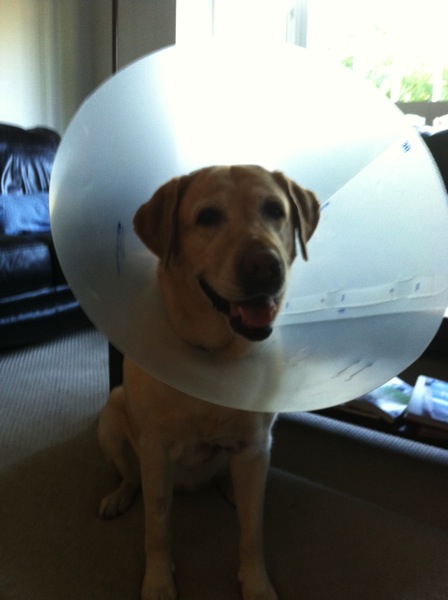
I was unprepared emotionally when Nira was diagnosed with cancer. The shock of her diagnosis and the unfairness of the news caused me to swerve between tears and distraught pragmatism. I arranged to have her tumors removed right away. Action would be crucial. Her growths were removed and I learned Nira had mast cell level one–the least dangerous kind. Then her stitches tore and our vet decided slow healing with an open wound would be preferable to stitching her up again. Nira and I are united in a period of duress and inaction. Her recovery could take as much as a month. My wife and I tend to her with syringes of warm water and salve. We button her up in my old shirts. She sports an oversized plastic cone on her head. My job is to sit beside her and keep her calm. 


Our roles are now reversed. I must be the calm one alongside her. I’m trying to be still and reassuring. I lie down on the floor beside her and whisper and she wags her tail. I say whatever comes to mind. I quote Zen and the Art of Motorcycle Maintenance: “life is on the sides of the mountain and not at the top” and tell her we’re both on a splendid journey. 


The Talking Dog

My guide dog Nira is now snoring having just had her pain medication. The poor girl has a ten inch incision on her belly and lower chest and while its healing properly the whole thing is red and swollen. At night she has to wear a plastic cone on her head to prevent her from licking the staples. And despite all this she wags her tail. I marvel. 


And I marvel at the little dog, “Harley” who is solicitous of his big sister. He walks up to her and touches his nose to her face. He wants the big dog “back” so he can play tug of war. But he knows something’s up. Dogs are compassion engines. He knows. 


Yes dogs are compassion engines and people can learn a lot from them. 


Emily Dickinson said :“Dogs are better than human beings because they know but do not tell.” I have not been able to find any record of Emily’s dog. My own say many things. 

Marchen

Here in my house it is quiet–a fairy tale–the prince and princess are asleep. I don’t know why I’m the privileged one who is awake. I know the television was invented to rob this moment from human beings. 


I walk about on very ordinary days and see strangers and feel tenderness and hope for them. This is the absolute truth. I feel these things though the world is a ruined carnival. 


Wind in the alders. A mourning dove. Rain on the roof. The grownups asleep. And the little dog keeps track of things at the window.