A Small But Hopeful Instance of Bi-Partisanship Today in the US Senate

It is easy to imagine agreement across the aisle is no longer possible and I’m not optimistic about the future of legislative negotiation but today’s Senate vote to bring the confirmation of Tom Perez as Labor Secretary to the floor tomorrow was a start. See the American Association of People with Disabilities site for more detail.


Judge Grants Temporary Stay For Warren Hill, Hours Before Scheduled Execution

(Atlanta Journal Constitution)
July 15, 2013

ATLANTA, GEORGIA– [Excerpt provided by Inclusion daily Express] A Fulton County judge on Monday granted condemned inmate Warren Hill a temporary stay of execution to give her more time to consider a new state law that shields the identities of those who make and supply Georgia’s lethal-injection drugs.

Superior Court Judge Gail Tusan issued the stay — the third Hill has been granted over the past year — just four hours before his execution was to be carried out at 7 p.m.

“For the court and the public, it is a big issue,” Tusan said of the state’s capital punishment procedure. She scheduled another hearing for Thursday after state attorneys told her the warrant that orders Hill’s execution expires on Saturday at noon.

Hill’s case has attracted international attention because three state experts who previously testified Hill was faking mental retardation have come forward over the past year to say they were mistaken. They said an improved understanding of mental disabilities has led them to believe Hill is mildly mentally retarded, which would make him ineligible for execution.

Hill recently asked the U.S. Supreme Court to consider his mental retardation claims, but it was Tusan who stepped in on Monday and granted him at least a temporary reprieve. The high court’s justices had said they would consider Hill’s petition in September, and it remains unclear what action they will take if Hill’s execution is rescheduled before then.

Entire article:
Fulton judge stays Warren Hill’s execution

http://tinyurl.com/ide0715131a
Related:
Disability advocates fight for change in death penalty law as Hill execution approaches (Athens Banner-Herald)
http://tinyurl.com/ide0715131c
Statement on Georgia Prisoner Warren Hill’s Scheduled Execution (American Civil Liberties Union)
http://tinyurl.com/ide0715131b
The Death Penalty and Mental Retardation (Inclusion Daily Express Archives)
http://www.inclusiondaily.com/news/laws/deathpenalty.htm

More Live Blogging from Syracuse University's Institute on Inclusion and Communication


IMG 0466


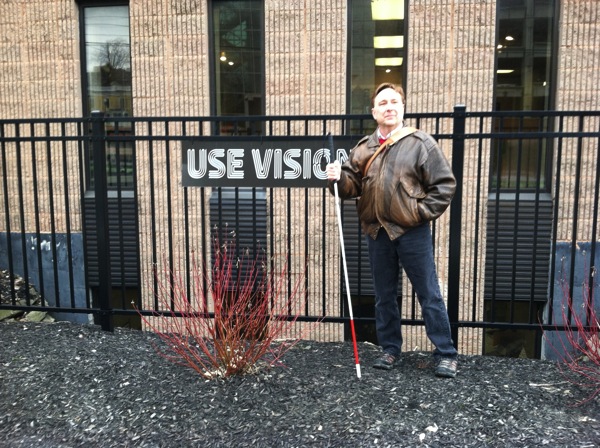
Photo of Stephen Kuusisto holding a white cane and standing beside a sign that says “Use Vision”.


Some days I admit I don’t know what to think. I feel like the linnet high in the apple boughs, tricked by light. That’s one of the things about my version of blindness: its brilliant, confusing, and beautiful always. This fact reflects my larger life, what we might call the life of the mind if we were in a literature classroom. The life of the mind for me is bright, confusing, driven by accidents of geography, and often despite the joys, the business of mentation is tiring. In the realm of disability studies the operative stance toward the successful disabled self is centered around the resistance of inspiration–successful people with disabilities don’t want to be known as being inspirational. But despite the conditional reflection of independence and egalitarian citizenship, disability is often hard and triumph is steep. I’m often fatigued by my brand of blindness. I take way too much Advil for daily headaches caused by stress. Reading and writing are challenging things. And I live with the self-directed impulse to make this all appear easy. I’m in mind of these things because I’m attending the Syracuse University Institute on Inclusion and Communication, a conference devoted to autism and language. 

All around me are people for whom language and community are “dear things”–things precious and challenging. I see non-speaking autists typing sentences, parsing their seconds, carving meaning in expectant air. 


When I was a young writer and studying poetry at the University of Iowa I had the habits of an aesthete: my desk had to be in the right location, light had to fall on the page in the proper way, my pencils had to be arranged just so. These were the habits and accommodations of an anxious young man who wanted to make a difference in the world with his art. I remember my 24 year old self with affection. He meant well. He wanted to make topiary gardens with words. I suppose now that I think about it I was Edward Scissorhands with a typewriter.  


Nowadays I can write anywhere. The airport, on the plane; right now I’m in the lobby of the Syracuse University Sheraton. There’s some kind of Muzak coming from a speaker in the hanging tiles behind me. And a woman with her autistic grandson is looking at family photos across the way. Its a busy world and writing has to keep up. I still have my precious desk in my closeted study but I write all over the place. I write because my disability dictates it. Because I can’t afford the 19th century atelier. I’m busy, exhausted, depressed, anxious, confused, cerebrally itchy, struck by the beautiful or made angry by injustices–and take them together or separately I don’t have time to loiter with words the way I once imagined I might. 


My autist friends, typing for their lives are really my brothers and sisters. We write so the world will do more than presume our competencies–we write for our place at the table.

Live Blogging from Syracuse Institute on Communication and Inclusion

I’m at the 2013 Summer Institute on Communication and Inclusion, a conference on disability and technology hosted at Syracuse University. I’m in a ball room with blind people, deaf people, autistic people–what we have come to call “planet Syracuse”. Inclusion means everyone is at the table and the “table” is education AND the public square. My friend D.J. Savarese is here beside me. D.J. is the first non-speaking student to attend Oberlin College. D.J. types to communicate. In a very real sense I do too. As a visually impaired person I use my talking computer to read web pages, process documents, take notes. My functional world is made possible by technology. But the Summer Institute on Communication and Inclusion is about much more than the utility and possibilities of tech–its about the validity of disability as a way of knowing. 


Ibby Grace, an autist blogger is about to speak. I’m eager to hear her. I’ve been lucky these past few years, blogging and loafing in the digital square to meet hundreds of people with disabilities who are pushing the envelope of disability in public. Her blog, Tiny Grace Notes is terrific. 


Ibby: communication has to do with the same word as community. Community and communication is the act of making things available to everyone in common. That’s why the center of a university is called the “commons” in the UK. 


Without communication we can’t have communities. 


We have an autistic community now…before internet…didn’t have access to autistic community. I was the only autistic person I’d ever met. They used to tell everybody to put the autistic people away. I never got the chance to meet people until I was 17 “out of institutions”. I got community. 


Internet: the keyboard is mightier than the sword. Having community via internet–across the nation and around the world we’re talking to one another. 


It’s helped people who don’t talk by yammering to have the same amount of voice–you can get your stuff said even if you’re not a chatter box. ON the internet you can say it out; on the internet you can say it out. Everyone should have the right to all the communication they can give. 


Doubters of FC and typing for autistic people are tricked out in fake science. Science means knowledge in its highest form–it means I like new knowledge.


We presume competence. 


Because: Duh!


We know we have things to say and we know we want to say them.


All of the people can start a blog…


Theres a word called alexithymia which means you don’t have the words for feelings. 


My parents believed in me always. No matter what other people thought. 


I was no picnic. Not even at a truckstop or bench on the street. But you believed in me and taught me things and stood by bravely when I didn’t get it. 


Not the doctors or the people at school. Neighborhood didn’t make it easy.


You made space for me and never gave up.


Sometimes its hard even though I’m older now. 


Positive neurodiversity theory. The people in the academic world begin to understand in a more theoretical way and treat us as diverse people rather than change us. 


Feel free to join the movement. We’re trying to occupy academia. 


The other thing simultaneously dismantle the type of research that has a choke hold that causes people to be mean to us, demean us. 


**


While Ibby is talking she’s using a talking keyboard and a microphone. 

People around the room are flapping their hands, working worry beads for anxiety, uttering vocables. My friend and colleague Doug Biklen leans over with a smile and says: you hear the background sounds of people; its great!”


And it is great. Inclusion and communication means everyone and every approach to language. 


**


“Everyone here has something that will improve the world.” (Voice from audience)


Ibby: “My autism isn’t in my speech; its in the knowledge of my body.”


**


Ibby: “Oh and I don’t know what time it is ever!”


**


Someone in audience with talking computer types: “I think its so important to educate the masses. I have so much to offer.”


 Someone else in audience types: “I’m so happy, I love the energy in this room!”


Gated Justice: A Disability View

Trayvon Martin was the dark child in a gated community. He died only because of this. Privileged space and cock of the walk stand your ground vigilante stalking came together in one terrible moment. Martin’s killer has been set free because the prosecution couldn’t prove who hit who first–as though murder is not much more than a school yard affair. In the end, the Libertarians got what they wanted: a pure defense of gated property and the rights of said property’s defenders to behave in whatever ways they wish. 

Public space is always provisional for people with disabilities. I’ve been shut out of many places because I travel with a guide dog–have endured the icy stares of the privileged who didn’t like the fact I was bringing my dog to the opera or the executive suite. Privileged space is the new American Express Card. “Don’t leave home without it.” “You better know where you’re walking sir. You can’t go over there, sir, dogs aren’t allowed; black children aren’t allowed; educated women aren’t allowed; tampons aren’t allowed.”

Privileged space and security guards go hand in hand. And with the travesty of justice in Sanford, Florida we’re told that anyone can be a security guard. And anyone can be gunned down.


Ways and Means


When I’m blue I wash clouds. 

Nature isn’t obedient. I clean 

what I can–

poverty-painted low cirrus 

just visible through blind eyes…


The clouds never come clean.

Rain falls along a fence.

I pass through the pinched waist of the hourglass.

Blue as a wrist bone; blue 

as blue as a sleeve…


Thoughts While Swimming Today in Oberlin, Ohio

Snake loves his shadow, never has to see it…

My mother’s fingers were green with envy, other people’s jewelry…

Dog in a dream is the whole dream…

New age for yellowing paperbacks, must find used bookstore…

Right shoulder nagging like rusted gate…

Jean Sibelius understood the oboe and almost never used it…

Dreamt I was in China with Michael Meteyer; we found a pavilion which, once inside, we saw was Kyoto…

In general swimming is the anodyne to wristwatches and aspirin…

First time I saw a pig in Iowa I thought it was a Greyhound bus…

Who sings of faith ought to look a bit insecure…

If death has a sting does life have a joy buzzer?

Wish I could share a cigarette with Theodore Roethke…

Who thinks of cigarettes while swimming? Me. I gave them up thirty years ago but think of them always, like an old man recalling the batting order of…

Don’t tell me about your academic novel, poems, new production–not until you’ve worked in a soup kitchen more than once….

Ain’t got no never mind no how…

Love Marvin Bell’s “dead man” poems. As good as Berryman but with more philosophy…

Took my shower in the “free gender expression” locker room. Felt expressive. Sang “Don’t Sleep in the Subway”.

Mid-day, mezzo-giorno, giddy and hopeful. What more can he want?


Talking Dog Joy All the Day

“Our new dogs require praise–lots of praise,” said L. “It’s all in the voice. Nowadays a guide dog loves it when you say good dog with a tone of true joy. Try it!” And we all said good dog just as L had shown us, with as much new joy as we could each muster.   


Corky raised her face to look at me, her yellow lion head pointed straight up. And every dog in the room did the same. Something palpable went around our circle–the star of praise that dogs can see was set free by our voices. Good dog! Our exaggerated tones were like laughter in an opera. And all the dogs experienced synesthesia and saw a shining standard. Tails were wagging. 


“We say good dog because Guiding Eyes dogs really want to work,” said L. “They have been through many months of training. These dogs enjoy their jobs. But just like you, they require praise. From this moment on you will be saying good dog as much as a hundred times a day.” 


Who affirms good things even a dozen times a day? Who makes “talking goodness” a habit of her or his minutes? I sat there with my new dog and thought about the “talking blues”–I’d heard of vocal sorrow, but never a running, day long practice of spoken good.