The Holy Writ

Republicans talking about the constitution are like those men you see in restrooms, the ones putting water on their thinning hair.


Democrats talking about the constitution are like nervous shop keepers, afraid of shoplifting.


Most Americans fail to understand the constitution was a document designed to appease slave holders. The Founders didn’t imagine it lasting more than twenty years.


The founders did not give the Supreme Court the power to interpret the constitution in the way that Marshall essentially invented.


The US should have a constitutional convention every 8 years. We might then become a nation with a government “by the people”.


I’m just daydreaming in the Moline, Illinois airport. I’m a utopian in a plastic seat.

Of Disability and Ambition

Wellness is not suborned to ambition, but is ambition itself. I’ve been in mind of this lately because I teach disability studies and travel widely as a disability contrarian, if I do say so myself. Wellness is ambition and not an abstraction. By this I mean that wellness differs from the dichotomous “illness vs. cure” trap disability advocates often fight–for you can be “well” though you’re blind and deaf, have MS, or a thousand other life function obstacles. This is elementary to many people with disabilities as we have necessarily learned how to live. By “many” I mean the fortunate of us, those with accommodations and prospects. These are not guaranteed and make no mistake about it, the right wing is doing everything it can to unfund disability social security. ABC’s infamously “disability-hostile” tabloid program “20/20” is poised to regurgitate all the histrionic and inaccurate characterizations of disability fraud that NPR has shamelessly unleashed in recent weeks. Accommodations and prospects are hard to acquire if you are a person who has entered the kingdom of disability as an older citizen. But I digress. Wellness is not about being cured but it is about choosing to live with dignity and spirit.


The boxer Mike Tyson once said “I don’t know how to live in the middle of life” which is a poignant thing for an athlete to admit and to which we may add “it’s always the middle of life” and yes, knowing how to live must have ambition which is wellness. It is a decision, then a practice, and requires only its own commitment. It is the story of Siddhartha. But it’s also a disability story.


I wish more disability activists could say this. My general impression is that people with disabilities are so caught in the business of declaring they’re not inspiring they lose the chance to share the acquired and hard to learn facets of living well. Instead we undermine ourselves, say with cynicism we’re just “super crips” (putting off all considerations of human success, deflecting them) allowing the ghost of Tiny Tim to rob us of all language having anything to do with emotional intelligence and social success. This isn’t good. And it isn’t fair to ambition.

For the poet Michael Tyrell Who Read Poems With Me Last Night in Iowa

What Was the Poet Doing in Ronkonkoma?


Death has ten fingers and one face

But why was Michael Tyrell in Ronkonkoma,

And why did he hand me his train stub,

And who talks of that ride

Like some Italian Futurist

Whose dog wiggles at electric lights–

For even the Long Island Rail

Is a miracle, if, for instance

You grew up in Abbasanta

Like Antonio Gramsci, who

Learned to write with twigs.

I only know how the poet got there.

But of the silken puppet–his actuarial angel

I know nothing–like Gramsci

I’ve got a slip of paper in my pocket

That whispers of cold becoming

In a town of industries and street lights.


Dedication: Poems for a Horse

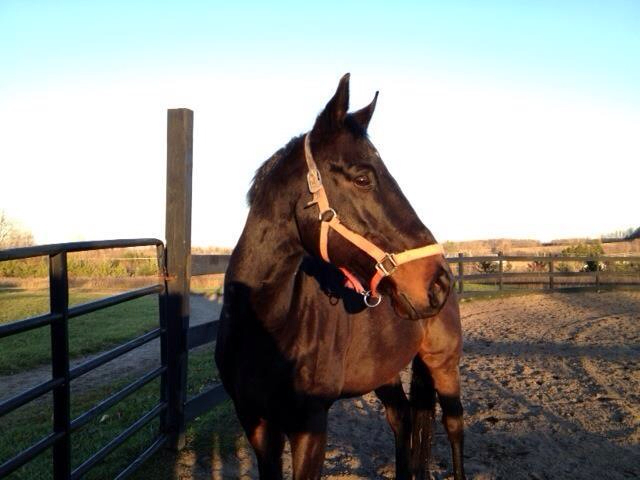
I am in Iowa City, Iowa where tonight I will read poems from my new book at Prairie Lights Books, one of the nation’s premier independent bookstores. I am hereby announcing that my brief reading is dedicated to “Luigi” who is pictured below

I am in Iowa City, Iowa where tonight I will read poems from my new book at Prairie Lights Books, one of the nation's premier independent bookstores. I am hereby announcing that my brief reading is dedicated to "Luigi" who is pictured below. For my blind readers Luigi is a thoroughbred "off the track" former race horse who entered our lives when my wife and I moved to Syracuse a year and a half ago. My wife rides Luigi and I feed him apples. Why dedicate a poetry reading to a horse? Because he has soul, he's a talker, and he has the kindest eyes of any animal I know. Sounds like poetry to me. And here is James Wright's amazing poem "A Blessing" because its one of the best poems I know:
"A Blessing"

Just off the highway to Rochester, Minnesota,

Twilight bounds softly forth on the grass.

And the eyes of those two Indian ponies

Darken with kindness.

They have come gladly out of the willows

To welcome my friend and me.

We step over the barbed wire into the pasture

Where they have been grazing all day, alone.

They ripple tensely, they can hardly contain their happiness

That we have come.

They bow shyly as wet swans. They love each other.

There is no loneliness like theirs.

At home once more,

They begin munching the young tufts of spring in the darkness.

I would like to hold the slenderer one in my arms,

For she has walked over to me

And nuzzled my left hand.

She is black and white,

Her mane falls wild on her forehead,

And the light breeze moves me to caress her long ear

That is delicate as the skin over a girl’s wrist.

Suddenly I realize

That if I stepped out of my body I would break

Into blossom.

–James Wright


Blindness, Babies, and Today's News

There’s an article in today’s New York Times (see link below) about a consortium of universities that failed to tell parents of severely premature babies that the use of heightened oxygen levels in incubation can cause blindness and other serious effects. Perhaps the most astonishing thing about this is that the blinding eye disease associated with oxygen in incubators has been widely known in medical circles since the late 1950’s. Accordingly, leaving this information off of consent forms for parents appears both incomprehensible and perhaps intentional.

Retinopathy of prematurity is the blinding eye disease that I have. I was born three months early in 1955, just before ophthalmologists at Johns Hopkins announced the link between oxygen and blindness in premature infants.

This story does contain more than a whiff of scandal.


http://nyti.ms/YkBx9O


Hey, Is That A Service Dog You Got There, Sonny?

When you have a service dog you have to be alert at all times for the crazies–I mean there are some really strange pilgrims on American streets. And boy, they love you when you’re blind. The dog, without meaning to, invites them in. Once in Minneapolis, checking into the Hilton, I met two really drunk college girls who professed to love my dog. They were stinko, blotto, plum loco, almost staggering. “Hey, your dog’s beautiful,” the first one said. “Yeah she’s really beautiful,” said the second. “Hey,” said the first, “You wanna touch my face?” “Yeah,” said the second, “You wanna touch me too?” “Oh your dog is so beautiful!” said the first one. “Oh yeah,” said the second. I backed away, half tripping over my suitcase. All I wanted was to check in. “No,” I said, “I don’t touch faces.” “Well what’s wrong with our faces?” said number one, her voice darkening. “Yeah, what’s wrong?” said number two. “Nothing’s wrong,” I said. “Now go away.” And then security appeared, for this was the Hilton, which is the tasteful lady of commercial hotels, and the face girls became belligerent, claiming that I lured them with the dog. Security said, brightly, “they got dogs outside.” And they went away, shouting, “You coulda touched us!” And this of course is legion, this incident, for every revolving door shoots another nut into the street. There was the lady in the Pittsburgh airport who told me how beautiful my dog was, then added that all her dogs were poisoned by malevolent strangers. Then she asked if my dog could have a treat. Really. This is often how it is.

On Conferences and The Body

By Andrea Scarpino


My heart’s newfound fluttering in my chest, I sit in the auditorium, half circles of cushioned seats facing a stage. A conference: illness, narrative, disability, medicine. I think about my body in pain. My body in pain listens to presentations on the body in pain.


Question: Sontag taught us illness doesn’t mean anything; illness is just illness. But aren’t we creatures who make meaning? Who relish stories, plot development, denouement? Who desire happy endings. Or barring happiness, desire at least a sense of an ending.


Here’s a happy ending: my body failed, continues to fail. And I am learning to live with it. There is no overcoming. It is no use wishing for something else.


Question: There is no overcoming?


Answer: Sometimes you can’t neatly tie together a narrative.


My heart flutters: a whoosh of blood relapsing when my mitral valve doesn’t close tightly. “Insignificant,” according to the cardiologist. My “new normal.” I feel it constantly. Behind my breasts in pain.


“What else to say?” Theodore Roethke asks.


A presenter distinguishes between illness—what she calls “transitory” and “needing to be fixed”—and disability— an “aspect of enduring identity.”


Question: What if illness is chronic? What if disability is not tied to identity?


Question: Does it matter what stories we tell? What changes when we change our stories?


Another presenter says every day we feel well is contingent. I like that word, contingent. Meaning: “of uncertain occurrence, befall, something happening by chance.” Contingent, my body’s pain, my heart’s fluttering.


Answer: Roethke: “We end in joy.”


“Life is amazing,” Valerie Harper says. She is dying faster than many of us. “Live it to the fullest. Stay as long as you can.”


I sit in an auditorium, listen to presentations on illness, medicine, narrative, disability.


Answer: Life and death. The heart flutters. Pain and no pain: contingent. There is no overcoming. Stay as long as you can.