Micro Memoir: I’m Ready for My Closeup


I try to think, where is my uninhibited side?  Is it attracted to coloratura snippets and therefore has to do with birds? Is it like a Russian chorale, a hundred fragments singing before a mirror? Damned if I know. My louche, unbuttoned, acerbic, free wheeling side pops up all the time. Says what it wants. Says what it wants. Said once: the enemy stars are the same as ours–said it to a military recruiter and why not? And said once to a government agent who was photographing a protest against Ronald Reagan’s involvement with the suppression of freedom in El Salvador: you know there are honest jobs, ones where you can make humble and lasting discoveries. And he of course photographed me.

Issue Three of the Canadian Journal of Disability Studies is Now Online


Issue Three of the Canadian Journal of Disability Studies is now online.


http://cjds.uwaterloo.ca/index.php/cjds/issue/current


Check it out and share it widely!


Featuring:


The Construction of the Disabled Speaker: Locating Stuttering in Disability Studies  

Joshua St. Pierre       


Paging Dr. Economicus: The Economics of ‘Obesity’ in the Canadian Medical Association Journal    

Angela Eileen Wisniewski


Creating a (More) Reflexive Canadian Disability Studies: Our Team’s Account           

Valorie Crooks, Sharon-Dale Stone, Michelle Owen


Climate Change, Water, Sanitation and Energy Insecurity: Invisibility Of People With Disabilities   

Gregor Wolbring, Verlyn Leopatra 


The “Slow Learner” as a Mediated Construct       

John Williamson, Jim Paul


Creation of a Canadian Disability Studies Program: A Convergence of Multiple Pathways    

Irene Carter, Donald R. Leslie, G. Brent Angell, Shelagh Towson, Debra Hernandez Jozefowicz         


what is said is: a poetic and oblique re/presentation of disabled women in a Canadian shelter

Nancy Viva Davis Halifax


Review: Titchkosky, Tanya and Rod Michalko, Eds. Rethinking Normalcy          .

Morgan Holmes        


Review: Murray, Stuart. Autism.     

Sarah Gibbons          


Review: Rioux, Marcia H., Lee Ann Basser and Melinda Jones, Eds. Critical Perspectives on Human Rights and Disability Law.    

Morgan Rowe

Micro Memoir 39


I wonder if I can stick to one thought, like a small hunting dog? Riding the train to New York, looking at the spoiled factory towns, the haunted river, can I hold with one thought?  I think I can be allowed a murmur. There has to be music in human silence. There may be music after this. Shadows fall together in the tall grass of a railroad siding.  Night crosses the desert of my understanding. I wonder if I can stick to one thought, like a small hunting dog?

Micro Memoir 10 PM

It is late. The day was like a forest of stone with stringent ballads. Some sang the songs, some did not. Most tried to navigate between lithic trees. I have been in more than one ossuary on my travels. Skulls lined up like nouns for school children. Don’t look at me ironically with your post-modern peepers. The falling we will do ere long will be without end. 


National Federation of the Blind Settles Complaint Against Sacramento Public Library

Library Will Deploy Accessible E-readers to Blind and Print-disabled Patrons

Baltimore, Maryland (August 30, 2012): The National Federation of the Blind (NFB), the nation’s leading advocate for access to information by the blind and other people with print disabilities, announced today that a complaint filed by the NFB with the United States Department of Justice, Office of Civil Rights, against the Sacramento Public Library Authority has been resolved.  The NFB filed the complaint last fall because the library was lending NOOK e-readers preloaded with e-books to its patrons.  Unlike some other e-reading devices, the NOOK, which is manufactured and sold by Barnes & Noble, cannot be used by blind and print-disabled readers because it does not have text-to-speech capability or the ability to send content to a Braille display. 


The goal of the agreement is “to provide a library e-reader circulation program where library patrons, with and without vision disabilities, are able to access and use the same technology to the maximum extent possible.”  Under the agreement, the library will “acquire only technology that does not exclude persons who are blind or others” who need accessibility features such as text-to-speech or Braille output and the ability to access the device’s menus and controls independently.  The library’s commitment is also in line with a resolution passed in 2009 by the American Library Association entitled Purchasing of Accessible Electronic Resources, which urged “all libraries purchasing, procuring, using, maintaining and contracting for electronic resources and services” to “require vendors to guarantee that products and services comply with Section 508 regulations, Web Content Accessibility Guidelines 2.0, or other applicable accessibility standards and guidelines.”


Dr. Marc Maurer, President of the National Federation of the Blind, said: “We are pleased that the Sacramento Public Library Authority is showing leadership by ensuring that the e-books that it lends will be accessible to all of its patrons, including those who are blind or have print disabilities.  E-books represent an opportunity for the blind to have access to the same books at the same time as our sighted friends, family, and colleagues, but sadly most e-book vendors have not designed their technology so that it can be used by the blind, despite the fact that it is not difficult or costly to do so.  Libraries, schools, and other institutions have a legal and moral obligation to make sure that the content they deploy is accessible to the blind and print-disabled.  If they meet these obligations by demanding accessibility from their e-book vendors, then accessibility will happen.”


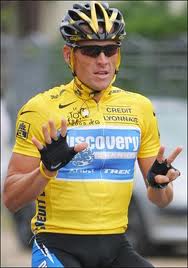
Wrestling with Armstrong

By Andrea Scarpino


Lance Armstrong


Seven Tour de France titles stripped. That’s the recent recommendation by the US Anti-Doping Agency in light of a plethora of doping accusations made against Lance Armstrong. 


I’m profoundly ambivalent. I want Armstrong to be clean with an irrationality that says more about my desire for athletic heroes than my interest in cycling. But I also think our cultural obsession with unfair advantages is a bit misguided. Remember Oscar Pistorius—some claim his carbon legs give him an unfair advantage even though they mean he has less musculature and must start each race slower than athletes with flesh and bone legs. 


We also allow all athletes to consume caffeine, which is a known performance-enhancing drug. And athletes with more money almost universally fare better. The more they can spend on coaches, trainers, massage therapists, sports psychologists, on technology that assesses every muscle’s twitch, on nutrition and nutritional supplements, on traveling to train in high altitudes, etc. etc., the better they perform. So caffeine and money are clear performance-enhancers—and are totally legal. The lines demarcating “unfair advantage,” in my mind at least, are drawn in a series of grays. Easily smudged. Not easily defended. 


And there’s something about Armstrong. His name, for one—how could you name a child “Lance Armstrong” and not expect him to become a superhero? His overcoming of testicular cancer. The way he has shifted his athletic career to cancer research and support. He may be a cheater. But I respect so much of what he’s accomplished—and that makes me want so badly to believe he was clean. Or at least, I want to believe he didn’t dope any more than any other first-rate cyclist. 


My friend Kevin, who knows much more about cycling than I do, wrote me, “If he is stripped, they will have to go pretty deep to award the win to a “clean” rider. I think some years you’re out of the top ten to find someone who hasn’t been implicated.” In other words, cycling is rife with doping. And if we believe Armstrong was doping, then we probably have to believe everyone of his caliber was also doping. 


And if everyone was doping and Armstrong still won, doesn’t that still make him the best rider? Such is the case with the high-tech half-body swimsuits used by many swimmers in the 2008 Olympics. Although those suits are now banned as providing unfair advantage, the swimmers who medaled while wearing them still get to keep their medals. I understand they weren’t illegal then, and maybe that’s the sticking point. But if everyone wore them, and three swimmers still performed better than everyone else in the pool. . . then what? Then aren’t those three swimmers still the best in the pool? 


I’m struggling through my thinking here, not sure—still, again—why I want so badly for Armstrong’s Tour de France success to remain. As I said, I don’t think the lines between “fair” and “unfair” are very well drawn, are very easily defensible—and often have more to do with knee-jerk reactions than actual science. But there’s something else simmering below the surface: a desire, maybe, to believe that a human can accomplish seemingly un-human feats without the help of specially concocted drugs. Isn’t that why we make heroes, because they’re better and stronger and braver examples of the human species? Because they reflect back to us the fullest extent of human potential? To leap tall buildings in a single bound! Wouldn’t we all like to make that leap? 


Brief Treatise on Morning

I wake to the sound of an electric fan and lie in bed with my eyes closed imagining, like the poet Lars Gustafsson, the silence in the world before Bach. Mornings can begin this way. The day is empty. There is room for the mind’s play. There is no place just now for capitalism. The mind is a question asked of another question. And just as I decide I don’t want to get out of bed the dogs come because their bellies are empty. 

Micro Memoir 32


Alright. A repeated fury has me by the toe. You see, the wind from dawn’s hourglass opened my eyes and I wasn’t ready. Now I want to tear the wreaths off my neighbor’s doors but it isn’t Christmas. 


There are so many unknown forces in the genes. Today I am a rabid king. Beware lest I appear on your doorstep. As Pablo Neruda once said: “Please, I beg a sage to tell me, where may I live in peace?”