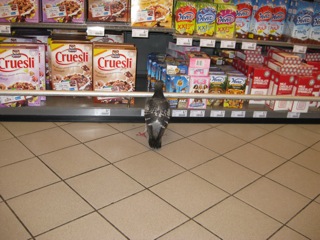
Photo taken by my stepson Ross who is visiting Amsterdam. I know just how this bird feels. Cruesli is no substitute for Cheerios.
Photo taken by my stepson Ross who is visiting Amsterdam. I know just how this bird feels. Cruesli is no substitute for Cheerios.


My friend, the poet Ken Weisner occasionally visits the New Camaldoli Hermitage at Big Sur because he can meditate there in complete silence. Yesterday, as his residency came to an end and he was headed back to civilization he found he was following a FedEx truck down the winding mountainside road. "What" he wondered, "had the FedEx truck delivered to the monks?"
Ken left me a lovely phone message wherein he offered the view that I might know.
Here are some speculations:
5,000 egg salad sandwiches mitt der dill pickles.
A truck's worth of remembered sorrows.
Fruit cake ingredients.
Imported tree frogs.
"The Miracle Hair Remover" from Ronco (500).
The rare cloth of Ch'i, white silk glowing and pure as frost on snow.
Chattering teeth, 500.
Big Foot imprint making devices.
On the television three politicians argue for the end of civilization as a platform. My house sways gently and branches tap the windows. In the morning crow tracks circle a lone catalpa tree. I’m a boy again for just a moment, the snow is perfect, like our blood’s sister who knows the names of things.
– Posted using BlogPress from my iPad
http://www.huffingtonpost.com/2011/12/16/feminist-poet-struggle_n_1154390.html?ref=books
Stephen Kuusisto
Director
The Renee Crown University Honors Program
University Professor
Syracuse University
Check out this article:
Oops! Rick Perry wants to cut $5 trillion — from $3.7 trillion budget
I found the following story on the NPR iPhone App:
http://www.npr.org/2011/12/17/143841703/u-s-somalis-lose-only-means-of-sending-cash-home?sc=17&f=1001U.S . Somalis Lose Only Means Of Sending Cash Home
by Rupa Shenoy
Minnesota Public Radio – December 17, 2011Just north of downtown Minneapolis stand two cement, skyscraper apartment buildings covered in faded pastel patches. Most of the people who live there are part of the city’s large Somali community. Once a month, many of them walk across the street to the small, blue shop that houses Kaah Express, a money-wiring business that links Somalis in Minneapolis to relatives in camps throughout East Africa.Soon, however, the patrons of Kaah Express will have to find a new way of getting money to East Africa. The last U.S. bank to work with Somali money-wiring companies has announced that it’s planning to eliminate that service, and Somalis in Minnesota warn that cutting off remittances could lead to a humanitarian crisis.Back at Kaah Express, Abde Mussa, a cashier at a convenience store, is sending $100 to his sister, who lives in a refugee camp in Nairobi, Kenya, with her two children. Remittances like Mussa’s add up to millions of dollars that have gone toward supporting millions of Somalis through civil war, mass famine and terrorism.Mussa says that without the remittances, his sister’s family could starve.Losing The Last U.S. BankSomalis in the U.S. have always worried about remittances getting into the hands of terrorists. They only trust African-owned money-wiring companies like Kaah Express to get money to East Africa, but the money-wiring companies need to work with an American bank.”It has essentially become an epidemic; banks avoiding us, banks terminating us,” says Aden Hassan, who does the books for Kaah Express. “So we knew, you know, that something had to give.”In 2008, the Minneapolis Somali community approached local, family-owned Sunrise Community Banks for help. Bank President David Reiling agreed to work with the money-wiring companies, and soon Sunrise was the only U.S. bank legally sending money to Somalia.But now Sunrise says it’s ending the service. According to Reiling, his bank will close money-wiring companies’ accounts by the end of December.”If you look at it from a legal basis,” he says, “it would’ve made sense to close the accounts down immediately.”Reiling says he got worried last year when two Somali women in Rochester, Minn., were convicted of aiding the terrorist group al-Shabab in part by sending money through wire transfers.The conviction prompted Sunrise Banks to examine its records to see if its systems had been used in the same way. To Reiling’s relief, they found no illicit transfers.”But could we have we stopped them from taking place?” he says. “The fact is that the people in either of those two cases were not on any particular list that would have flagged them in our systems.”Waiting For Word From WashingtonReiling admits he’s closing the money-wiring companies’ accounts to push the federal government to improve security. Until then, he wants Washington to offer his bank protection from prosecution.”It can come from the Treasury Department, the State Department, the Department of Justice and maybe the Department of Homeland Security,” he says.Minnesota’s congressional delegation has been trying to sort that out with letters to Secretary of State Hillary Clinton and calls to the White House. Minnesota Rep. Keith Ellison is one of two Muslim members of Congress. He says he doesn’t know whether the federal government will be able to act before the bank’s deadline, but it does need to find a long-term solution.”Are there better ways to maintain safety and to facilitate transactions that really do need to be made in order to keep starving people alive?” Ellison asks.The congressman says the welfare of millions of people in East Africa shouldn’t rest on the shoulders of one bank president in Minnesota. He and others point out that if Somalis can’t send money legally, remittances will be forced underground, making them far more likely to fall into the hands of terrorists. [Copyright 2011 Minnesota Public Radio]To learn more about the NPR iPhone app, go to http://iphone.npr.org/recommendnprnews
Sent from my iPhone
Yesterday, the Senate passed a bill that includes provisions on detention that I found simply unacceptable. These provisions are inconsistent with the liberties and freedoms that are at the core of the system our Founders established. And while I did in fact vote for an earlier version of the legislation, I did so with the hope that the final version would be significantly improved. That didn't happen, and so I could not support the final bill.
AL FRANKEN: Why I Voted Against the National Defense Authorization Act
Yesterday was the anniversary of the ratification of the Bill of Rights, and the passage of a bill provisions that are inconsistent with the liberties and freedoms that are at the core of the system our Founders established wasn't the way to mark its birthday.
Sent from my iPhone
A stunning piece on Christopher Hitchens’ last weeks by Ian McEwan:
From The New York Times:
OP-ED CONTRIBUTOR: Christopher Hitchens, Consummate Writer, Brilliant Friend
Where others might have beguiled themselves with thoughts of divine purpose (why me?) and dreams of an afterlife, Christopher had all of literature.
Stephen Kuusisto
Director
The Renee Crown University Honors Program
University Professor
Syracuse University
 Planet of the Blind