The Lyric Body


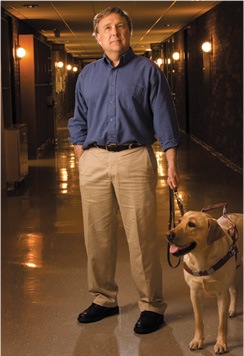
Ralph Savarese at Hobart and William Smith Colleges Susanne Antonetta at Hobart and William Smith Colleges Stephen Kuusisto and Nira   no_access_symbol Seneca Review

Hobart and William Smith Colleges


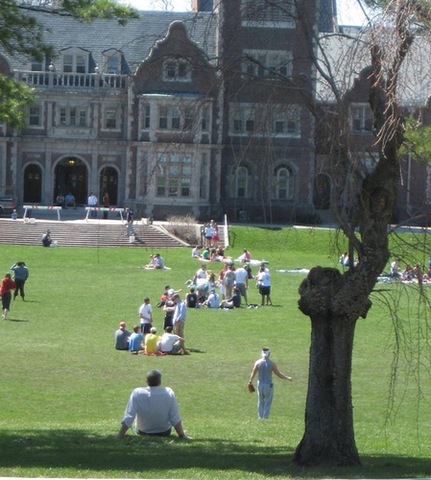
Since I’m a visually impaired person the images above are arranged without art. In general terms I think this is okay. My life as a writer has been informed by multiple rough hewn inelegancies–a word that Microsoft doesn’t want me to type. I am not cowed. My rough hewn stuff is around my neck and I wear it jauntily since that’s the way to wear it.    


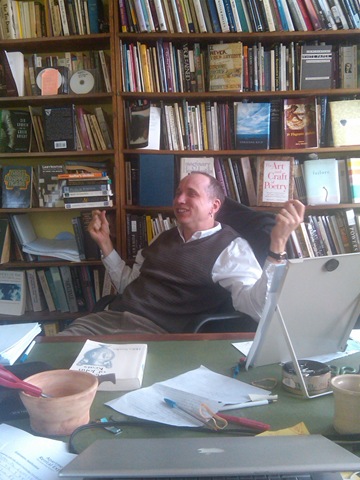
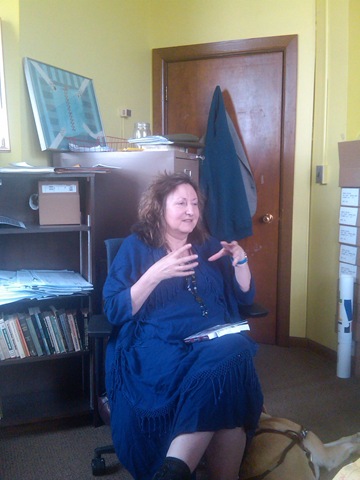
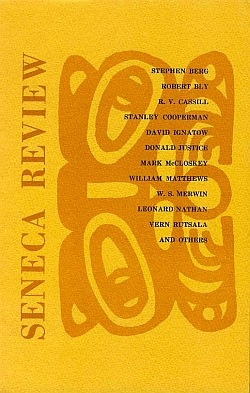
I am home in Iowa City after a trip that took me first to Meramec Community College in St. Louis  where I read poetry and nonfiction and taught a class of terrific students. Then I traveled to Hobart and William Smith Colleges in Geneva, NY for a festival on disabilities and the arts. HWS (as they like to call themselves) has long published Seneca Review a top tier literary journal that was founded some forty years ago by my dear friend Jim Crenner who is now an emeritus professor at the colleges. As the photo above suggests, Geneva, NY is a lovely place in spring. The campus at HWS is among the most beautiful in the nation. More lovely was the fact that we were there to honor April as disability awareness month and to talk about the latest issue of Seneca Review which is devoted to writing about disabilities and/or bodies of difference. I served as a guest editor for the magaizne along with Ralph Savarese (pictured above) and we’ve entitled the issue “The Lyric Body”. Also pictured above is the essayist, memoirist, and poet Susanne Antonetta who also goes by the name of Suzanne Paola. Susanne joined Ralph and yours truly on a panel discussing the power of disability and imagination to shape literary work that exemplifies rich and atypical inventiveness. We also taught a poetry writing class together.


This latest issue of Seneca Review contains extraordinary work from writers as diverse as Gregory Orr, Mark Doty, Adrienne Rich, Jim Ferris, Laurie Clements Lambeth, Rafael Campo, and many more. It’s also a feast for the eye as it contains brilliant artwork by artists with disabilities. Get yourself a copy!


We are off now to walk our beloved dog who has been in many airplanes and fair wondrously patient withal.


S.K.     

April is Child Abuse Awareness Month

By Laura Castle


Each April child abuse awareness activities are encouraged throughout the nation. The first child abuse awareness month was proclaimed in April 1983 by then President Ronald Reagan. Last year President Barack Obama continued this tradition stating that “Every American has a stake in the well-being of our nation’s children” as he proclaimed April 2009 as National Child Abuse Prevention Month.

Our nation’s statistics are revealing: there were 905,000 cases of reported child abuse in 2006. Of these, 794,000 were confirmed by Child Protective Services as being abused or neglected. In the United States children under six years of age are more likely to die from violence and neglect than from accident or illness. Although anything can trigger an attack on a child, the most common triggers are crying during toileting and feeding.

In Florida, last year (2009), 198 children lost their lives to abuse, a shocking increase in the number of deaths in one year. Across the country, the incidence of child abuse was up 20% last year, possibly due to the economic recession. 
Child abuse takes a terrible toll not only on individual lives, but on society as a whole as survivors who have not learned better behaviors fill our prisons. One out of three abused or neglected children will grow up to be an abusive parent. (I love to turn statistics around – two out of three of us will break the cycle of abuse through either non-parenthood or by learning good parenting skills. Hooray- there’s cause for hope!)

Many of us wear a blue ribbon throughout the month of April in honor of those who did not survive child abuse, a tribute begun by a Virginia grandmother in 1983, who tied a blue ribbon to the antenna of her car in honor of her grandson who died from abuse. By wearing a blue ribbon, we bring attention to the prevalence of violence against children and the harm it causes.

Let us all strive to educate the public about child abuse and encourage individuals and communities to work toward providing safe and healthy homes for children. My heartfelt thanks to all of you who took the time to read this!


Laura Castle is a survivor of childhood abuse. She lives in Florida and serves as an advocate for human rights.

On Death and Celebrating


By Andrea Scarpino


Los Angeles


This week, Zac defended his dissertation in Ohio, which means he can now officially call himself a Doctor of Philosophy. The afternoon before he defended, I went with his parents to euthanize their dying cat. And the day after he defended, his mother retired after 19 years at Ohio State.

Zac’s been working toward his Ph.D. for as long as I’ve known him, first getting his Master’s Degree, taking coursework, passing gate-keeping exams, spending the last three years hunkered down with writing and revision. Tuesday, after a two-hour defense, his committee chair shook his hand, congratulated him, signed paperwork, and that was that. No words of praise, no fireworks. Other people on campus went about their lives.

We had dinner with his committee, of course, and lots of drinks, but for a moment as big as passing the last big hurdle on the way to his career, the marking seemed a little insufficient. And so, too, his parents’ cat’s death. Last weekend, her kidneys started to fail and she yowled whenever she was left alone for even a minute or two. But it was an easy, nondescript death. She lay on a warm blanket and the vet gave her one clear shot. Then her body let go. Other people in the vet’s waiting room took no notice of us.

And Karen’s retirement, too. She’s worked most of her life in some capacity, and now, she’s done. She doesn’t have to work again unless she wants to. Her office had a party with a cake and balloons, then we went out to dinner to eat. But how do you really celebrate such a significant thing?

It seems to me that big moments of passing, of celebration, are so important to us that no honoring really seems worthy, no celebration really captures all the work and life that has led to that point. Indeed, maybe if it were possible to capture a sufficient marking, that would indicate the moment wasn’t important enough. When my father died, I remember thinking the news should have taken notice, his funeral should have been packed with thousands of people, something huge and important should have marked his death. But even if the Earth had stopped rotating, I’m not sure that would have felt big or important enough for the loss I felt. This week’s colliding of two milestones and a death seemed apt, somehow, even so. Each event carried a loss of some sort, a change, a moving on to other things. I’m not sure we marked them well enough, sufficiently enough to do them justice, but I’m also not sure we could have, what we would have done differently. I am sure, though, that it was one helluva week.


Andrea Scarpino is the west coast Bureau Chief of POTB. You can visit her at:

www.andreascarpino.com

Spring and All

What do you do with an elephant that has three balls?

You walk him and pitch to the giraffe.


(old barroom joke)


Well it is baseball season again and tomorrow night the Boston Red Sox will take on the New York Yankees at Fenway Park and all the spitting, scratching, secret signs, and improbable feats of gravitational defiance will begin anew. This is a moment for what the poet called the wilful suspension of belief as every fan can believe for a day or two that his or her team will be remarkable. This belief is superimposed against the abstraction that is still the summer to come. The combination of these two fancies is the meaning of hope. I don’t care at all for the talking heads on the sports channels or the radio; don’t believe what I read in the papers about my team’s prospects–I am allowed a great fancy and I take it. Like the elephant in the joke above “I take it” and for a moment I am allowed to go to first base, cheered by nothing more than optimism.


S.K. 

Can You Tell Me What It Means?


Half the people I meet believe the world is ending. The others believe that it has already ended. Now I know and you know that the economy is bad; that superstition reigns worldwide (as it always has, eh?); and that there’s plenty of dire ecological news. But when Americans, glutted, nostalgic, drunk, or sufficiently ill informed to buy a simple toaster are collectively swooning into the apocalypse then one must ask, why are we fighting the fanatics elsewhere who believe the same things? Your average Christian slave to Revelations and the people who blow themselves up in the name of a favored room in the afterlife do not appear substantially different. And yes, of course I’m gilding the Lilly, stuffing the owl, splitting revenant hairs–but I can’t see the end times what with all the bodies blocking the view.

Now I know why people without means, hope, or food would be susceptible to fanaticism. But Americans who have a great nation, a superior ethos, a nonpareil representative government, and plenty of Cheez Wiz (sp?) have little to no reason to throw themselves on the mattress of rapturing. Can the sheer ennui of wealth create this? Were we wrong all these years to say that Rome fell apart owing to lead poisoning? Is it inevitable that societies crash when they are too successful? Maybe. But the end of the world is a bad bet. Wishes and facts are remarkably and respectively incoherent for all who can’t find satisfactions in being alive. 

Being alive of course is a kind of mania. There’s a 19th century picture of Caruso as the murderous clown Canio and though it was taken in an era of studiously posed images it conveys an inspired, stagey madness. You can see a mercurial glow in the man’s eyes; his left hand is upraised and his thumb and ring finger make a strange “v”. He wears the famous Pagliacci costume and oddly enough he appears for all the world like a doctor who has become insane as opposed to a clown.

The photo is the real Caruso.

We know this in much the way we understand truth or deceit while playing cards in a neighborhood cafe. We are people of moods, conceits, tempers, and out-and-out lunacies. Most of us accept our roles devotedly. As Jimi Hendrix said: “You have to go on and be crazy. Craziness is like heaven.”

Of course I don’t mean to romanticize (or downplay) mental illness: far too much literary and academic damage has been done in that arena. And no, this is not a memoir of overcoming depression, nor is it a history of artistic or psychiatric alchemy rehashing again the triumphs of Antonin Artaud or John Clare. It’s possible for men and women with true mental illnesses to find their generous souls in art and just now, in our time we’re learning a great deal about neurodiversity and the magnificence of intellectual disabilities like autism. But this is not a blog post made of the attenuated histories of illness or the compensations of same.

This post is more in the spirit of the rapper Eminem when he says: “The truth is you don’t know what is going to happen tomorrow. Life is a crazy ride, and nothing is guaranteed.”

Or, if you prefer, here’s the famous fast ball pitcher Nolan Ryan: “It helps if the hitter thinks you’re a little crazy.”

I remember my first inkling that an assumed and barmy spirit was a vehicle—really a “getaway car” like something the Chicago mob would have had.

I was on a playground in Durham, New Hampshire. The year was 1960 and I was five years old. I had thick glasses and I was smaller than my classmates. A big kid who I’ll call Rollie came up to me with a handful of dirt which he clearly meant for me to eat.

“You will eat this,” he said.

“It looks good,” I said. “Hey Rollie, have you ever eaten an acorn?”

Rollie held his dirt before him like a little pillow.

“An acorn?” he said.

“Yeah, they’re just like peanuts, really good, that’s why squirrels like them. You want one?”

“Sure,” he said. He held out his other hand and I dropped a neatly shelled acorn into his palm.

“Go on Rollie, its yummy!”

Rollie ate it. Then he turned red, and I mean red, not beet red or fire engine red—he was red as an unkind boy with his mouth swollen shut. Acorns are among the bitterest things on earth. And of course I only knew this because I’d tried one. I was a solitary kid. Spent a lot of time in the woods. Those were the days when a boy could still go to the woods.

Rollie was incapacitated. I don’t think he ever bothered me after that.

I still recall the thrill of my discovery. That a feeling, a simple reaction, a swing tricked out with language could render a nemesis harmless was rousing.

I didn’t do a little dance. Didn’t brag about the matter. But I was on the way.

A lyric life, I will imagine, is one wherein you can access feelings and then, by turn do something productive with them.

The simplest definition of a lyric poem is a poem that expresses the writer’s feelings.

Freud said: “Life as we find it is too hard for us; it entails too much pain, too many disappointments, impossible tasks. We cannot do without palliative remedies.”

One of those palliative remedies is lyric itself. One may think of this as causative intuition, a feeling that trips a switch and makes you sing when you should properly be weeping or running for your life. Again Freud: “Man should not strive to eliminate his complexes, but to get in accord with them; they are legitimately what directs his contact in the world.”

We are getting in accord. We are beside a country road picking edible flowers in the cool of the day. We do not pick edible flowers beside highways because there are pesticides in trafficked areas.

We remove the pistils and stamens before eating.

“Hey Rollie, wherever you are, have you ever eaten Milkweed?”

“Rollie, you can trust me this time. It tastes like green beans.”


Give up on the end times. Let your feelings produce something unforseeable.


S.K.

Making Sense of March 31

The birds hereabouts are birding, rutting, whatever it is the birdies do when they do it. And the ones who are done with mating are building nests in the still barren trees. This morning, early, a robin who looked to be the size of a Buick walked across my lawn as if he was surveying the property. Soon perhaps, my doorbell will ring and a bird will offer to buy my house. “I’m not selling,” I’d say. And the bird would say “Sell or be occupied, it’s up to you.” “What have you done with Tippi Hendren?” By the by, did you know that birds can snarl?


The wildlife is healthy here in the Iowa River Valley and on this last day of March you can hear it stirking and crunking and humping. Even the nascent grass chatters in a grassy patois. Why shouldn’t it? Lucky nature, I say. Nature takes care of itself. Nature has its freedom to talk without history. That’s why it sounds so good. The red tailed hawk flying just 50 yards from my roof doesn’t care about the Eiffel Tower. He can snarl when he’s hungry. He can see a mouse on a boulder from a thousand years ago.


Andrew Marvell was born on this day in 1621. This has been a good day for poets and writers. All of the following were sprung on this day:


Marge Piercy

John Fowles

Octavio Paz

Nikolai Gogol


Let me also point out that Cesar Chavez was born on March 31.


To hell with the Eiffel Tower. That it opened on this date in history is small beans.

Tippi Hendren was not born on this day. But I’ll bet that on this date in history she was fighting off the advances of Alfred HItchcock. Poor woman. It was bad enough to be stalked by birds…


S.K.  

How I Spent My Birthday


downtown Iowa City


Yesterday was my b-day and I discovered much to my horror that long ago, too long for accurate memory, I’d scheduled a 9 am physical for meself. So I trudged to the doc’s office and sat in the windowless waiting room amidst truly sick people some of whom smelled of cheap cigars and stale beer and many of whom were coughing like chimney sweeps and I hunkered into meself, mannerly, withdrawn, properly so. In the examining room where I waited an additional 30 minutes in solo woolgathering I read a five year old issue of Popular Mechanics which had an article on wind mills. I think I like wind mills. I mean, I think I’m for them. I saw there in the doctor’s office that I’m rooting for the windmills.

Later I went to Prairie Lights Bookstore which recently made the news because President Barack Obama paid them a surprise visit last week and yes, he even bought some books for his kids. My friends who work there are still fair amazed and I got to hear about the President’s musings while in the store. He told Jan (the owner) that formerly one of the greatest pleasures in his life was browsing alone in a bookstore. And there he was, surrounded by cameras and reporters and security, and gawkers, and trying to pick out some books for his children. He did it with grace. Hemingway was right: “Courage is grace under pressure” and sometimes it’s just a matter of preserving the small graces. The president charmed everyone.

I see now that I’m 55 that I’m for “small graces”–that it may be the only thing to strive for. I should add “anymore” to the end of that. That’s what they do in Iowa. They say: “It’s getting so your house costs less than a tank of gas, anymore.” Or: “I could use some more bacon on my bacon, anymore.” Anymore is one of the small graces.

I went outside and watched a man in a chicken suit–a large chicken suit, a large man, all feathers white in the noon sun, watched him parade up and down clutching a sign on a stick which said “We Deliver” and I wanted to add “anymore” but decided I didn’t want to talk to the chicken so I kept moving.

I had lunch with my pal Paul Casella who teaches writing to the university’s scientists and who is, like me, an easterner who thinks Iowa City is the best place to live if you love literature and smart talk. Paul was just back from climbing Mt. Kilimanjaro. He told me that he’d seen references to “disability studies” in Tanzania and we talked about the African movement toward disability rights and the UN’s international charter on disability. We ate exceptional burritos. Anymore. Paul is on his way to Spain to address an international conference of doctors on writing. He said the doctors are urologists. I wanted to make a joke out of this but couldn’t think of one. An international conference of urologists who want to write better is inherently funny. Of course it is, anymore.

In the evening I met my wife Connie at an Iowa City restaurant called Devotay. They serve organic and “slow food” and local cuisine and we had a lovely meal and some serious laughs and perhaps indeed every day should be our birthdays, anymore?

While we were eating Connie saw a man wearing a top hat and tails dancing out on the street. Iowa City is that kind of town.


S.K.

Sorry I Can’t Hear You, I Have a Cruet in My Ear


The story that’s breaking in The New York Times that the Vatican did not defrock the late Rev. Lawrence Murphy who molested deaf boys in a Wisconsin “special school” is the latest evidence that the Catholic Church needs to be prosecuted “country by country” for it’s only through prosecution that corrupt institutions develop civil rights policies and procedures to guarantee them.


The full story: http://www.nytimes.com/2010/03/25/world/europe/25vatican.html?ref=todayspaper


It should go without saying that it’s difficult to have a disability. And it’s harder to report abuse when you can’t speak. Perhaps the church can mollify the world by bringing back “Limbo”?


I don’t know. I can only say that reading the Times this morning I felt, (as I often did when reading about the administration of George W. Bush) that there seems to be no bottom to the malfeasance.


Maybe Pope Benedict can resign and go on a speaking tour with Karl Rove. The Rove & Ratzinger Tour. Everyone do your own logo.


S.K. 

Scenes from the LA Marathon

By Andrea Scarpino


Start: Wheelchair racers are first across the starting line, then hand crank racers, elite women, elite men. Then the rest of us. Zac and I set our watches, begin a slow jog as the crowd pushes forward. As far as I can see, people run ahead of me, people run behind. The sound of tennis shoes on pavement, breath, spectators cheering on the sidelines.

Mile 2: Male runners pour into the bushes along the route, and a woman, too, stands next to a tree, moves aside her running shorts.

Mile 3: A long, steep uphill climb. I keep my head down, focus on breathing in and out to the count of three. Runners around us are stopping to walk. I’m slowing down. Then I hear taiko drums, look up. Long arms arc through the air with each drum beat, an echoing booming sound. I can’t tell my own heart from the beat of the drums. I run to the rhythm all around.

Mile 8: A group of onlookers hold a sign: “Let’s Create a Department of Peace.” When I raise my arms and cheer for them, they jump up and down, cheer back at me.

Mile 13: We’re minutes ahead of our goal pace. A woman behind us talks on the phone as she runs. Okay, I love you too. I’ve got to go. I love you. Yeah, I’ve got to go. Two barefoot runners, runners who look to be in their 70’s, runners who look to be 9 or 10. A group of Elvis impersonators pass us dressed in white jumpsuits, pushing a boom box playing Elvis songs. Thank you very much, one keeps saying as the crowd on the sidelines cheers.

Mile 15: I start to slow down, get a cramp in my side. We walk a few minutes but when we begin again, the cramp comes back. I get frustrated, tears well up in my eyes. We’re ahead of our goal pace, but I panic, begin to think I’m not going to finish after all. I’m trying to breathe into my cramp but it just keeps coming back.

Mile 16: A woman on the sideline hands out ice cubes in a square tray. I take two, eat one right away, hold the other in my hand.

Mile 17: Brentwood, a fancy French restaurant with patrons eating breakfast at outside tables, talking on their phones. I see women with designer handbags, men with Italian leather shoes. No one waves, no one even looks up to smile. This infuriates me. You could at least wave, I shout to the diners, We’re running over here. A few heads turn, someone screams a little bit. Then to Zac, Jesus Christ, rich people don’t know how to cheer. He looks at me and laughs, says, I’m glad to see you’re back.

Mile 18: I’m not having any fun, I say to Zac. What can we do to change that? Our yoga teacher always says in class, If you’re not having fun, change something. I’ve been so serious about failing, so upset the past couple of miles as my time slows, my side cramp returns. But this is only running, nothing to get so upset about. Zac starts to tell me knock knock jokes that don’t really have a punch line. I start to smile, to laugh.

Mile 20: Drag queens hula hoop on the sidelines, scream and wave and keep their hula hoops racing around their waists.

Mile 22: We’re finally at the last hill, finally entering our neighborhood, the section of the race Zac and I run every week. The cute clothing store, the coffee shop, the store with expensive yoga pants. Home turf at last.

Mile 24: The best sign of the race: “26.2 miles. Because 26.3 would be crazy.” Zac has us walk one minute for every four minutes we run. This is the only thing keeping me going. I count every breath until he says Thirty seconds left and then I start counting down from thirty.

Mile 25: Cheer alley. Team after team of high school cheerleaders line the sidelines, jump up and down with pom poms flying. Some stand on each other, others kick their legs high.

Mile 26: We only have two blocks left to run. The finish line up ahead, throngs of people on each side of the route. We can still finish strong if we kick it right now, Zac says. And we do. My legs speed up when I ask them to.

Finish: We cross the finish line and I grab for Zac’s hand. Someone gives me a bottle of water, a bag of bagels, someone wraps my shoulders in a heat blanket. I see an older woman with medals lined all the way up one arm. I walk straight to her. What a beautiful smile, she says as she puts the medal around my neck. Thank you, I say. I can’t stop saying Thank you.

Andrea Scarpino is the west coast Bureau Chief of POTB. You can visit her at:

www.andreascarpino.com

The Blood of Foreigners

A short story by Kulta Koira

“It’s no laughing matter,” he said. (A Berlitz instructor, now

openly drunk and knocking back another Finlandia.)

“It’s no laughing matter when you meet a vampire”

(This was Helsinki, a good vodka town.)

I was a visiting folklore scholar and new to the city. I’d gone to “Cosmos” reputedly the best bohemian bistro in the Baltic.

The waiter put more vodka on our table. They served it with pepper and wormwood.

“I mean,” my companion said, “how was I to know she really meant it?”

(He closed one eye and scrutinized his glass.)

“I thought the problem would be her husband—she said he was out of town but you know how that is.”

“Anyway I went home with her. I was stinking drunk and then we were in a taxi going to her place. I didn’t have any money so she asked the driver to come up and said she’d pay him in the apartment.”

“We’re waiting, standing in her living room, me and the cabbie– one of those Finns who never says a thing. And then she’s back and sweet Christ on a fuckin’ crutch she’s got blood all over her face and its dripping down her blouse.”

“I’m backing up but the driver gets in my way. It turns out he’s part of her act and he shouts in English, ‘You were going to fuck her!’ But it’s more a query—like stage dialogue if you know what I mean, and then he hits me with a karsh.”

The waiter returned with a basket of fried smelt.

“I’m from Dublin,” said Berlitz, staring at the waiter. “I can drink and I can bloody well take a bash to the noggin—but these Finns, they’re hardnosed—look—I eat my fish with a fuckin’ fork! (He turns to the waiter.) “Hey, Sibelius, show him how you eat a fish!”

The waiter, who, if he had to be compared with someone looked like James Dean with peroxide—the waiter picked up a fish by the tail and dropped it in his mouth. And then he swallowed it, bones and all.

“Next to the Finns I’m the Queen Mother!” said Berlitz, who was in point of fact eating his smelt with a fork.

“Anyway, I woke up in a closet. I crawled out and I was in her living room and the sun was coming up. I was feeling my head when I noticed that they’d taken my clothes. So I start looking. I’m still good and drunk. Crapacious. Embalmed. I had these insect eyes, you know? I could see everything at once. Newspapers on the coffee table…a view of factories through a window. Fifties era Alvar Aalto furniture but dingy. Rubber boots by the door. A black and white poster of Prague with a castle in silhouette…But I didn’t see my clothes. Just my shoes by the couch. And then I looked at my arms. They’d drawn these frigging Egyptian hieroglyphs on my arms with a magic marker. I mean Ptah, and Anubis, and these snake-like things. And then I saw they’d drawn them across my belly and down my legs.”

“Well for Christ’s sake, I thought, now I’m an art project for vampires. I went through the apartment then and sure enough they’d split. And then I realized there weren’t any clothes in the place. Not a shred of clothing. Every closet was empty. The dresser was empty. I even looked under the kitchen sink in case they’d stuffed some clothes in the trash. Nothing. Shit! I was buck naked and painted all over like the Rosetta stone—and you know—right about then I wondered what day of the week it was and I really couldn’t remember—I thought I could walk home in the nude if it wasn’t rush hour.”

“At last I found some towels. One was bloodstained. But the others were okay. They were from the “Hotel Alpina” in Obergurgul, Switzerland. I fit one around my waist and tried the apartment door. Of course it was locked from the outside.”

“What to do? I checked the phone. Thank God it was working! I thought maybe I’d call an ambulance. Why not? I was a naked foreigner having a heart attack. I thought that would be a good story. I’d tell the operator I was staying at the apartment of friends who were in the country and I would say I couldn’t remember the address and she’d have to trace the call. I’d say I needed an ambulance. They’d come and get me, break down the door. They wouldn’t care about the towel.”

“So that’s what I did. The ambulance got there in about 15 minutes. And there was a policeman who managed to get the door open with some kind of gizmo—so they didn’t have to chop it open. They were quick and what’s more they didn’t seem to notice anything unusual about a foreigner locked in an apartment and girthed in a towel with hieroglyphs all over his body. They thought I might be having a heart attack and they strapped me to a stretcher and hustled me out and slid me into the ambulance and that was it.”

”At the hospital they performed all kinds of tests. I didn’t mind. I was in a clean and curtained place. They kept me for observation. They gave me aspirin. The next morning they brought me to a young doctor. He must have been about 30 and he was thin and fair and I guessed that he’d never have to shave. He had John Lennon glasses and he looked serious. His eyes were extremely blue. ‘You haven’t had a heart attack,’ he said. ‘Your tests appear normal. There is nothing wrong with you. You can go home.’

“I started to get up and he said ‘there’s one more thing. The police would like to talk to you.’ Then he left and two detectives came in. They looked like members of the Finnish national skiing team—really tall and Nordic. ‘You have been to Egypt?’ said the first one. ‘Or maybe San Francisco?’ Then the other one said: ‘you are the fifth foreigner with hieroglyphs admitted to this hospital in the past three months.’ It was funny. Foreigners painted by the vampire woman and winding up in the hospital… Alright… But I didn’t laugh. Sometimes I try to look smart. I
didn’t know what was up. I
’m just sharp enough to know that all our falsehoods are divided—ergo, when they find out how stupid we are we’ve got nothing to fall back on. I think that’s why Mark Twain said: ‘when in doubt tell the truth.’”

“So I told them the truth. I got drunk at Urho’s Pub and went home with a woman who said her husband was out of town. I told them about the blood on her face and how I woke up in a closet and the missing clothes and Anubis all over my arms and legs.

“And then I went on. I told them I didn’t have a wife, so there was no scandal beyond having made an ass of myself. I said I didn’t feel the need to pursue matters and, well, I told them I was a man of limited imagination, didn’t like things kinky, couldn’t care less about the hieroglyphs…And then there was silence for quite awhile. I had run out of things to say. I wanted to ask them if they could loan me some clothes since I was wearing paper slippers and a hospital gown and still had to get home. Then I wondered what do they know that I don’t know?”

“The detectives spoke after a minute of silence. The woman was a self-proclaimed vampire. Her other victims were German businessmen. They too had been conked on the skull and painted with Egyptian grammar. The Germans had also seen blood on the woman’s face. I wanted to ask how they had arrived at the hospital but I knew the cops wouldn’t tell me. I had enjoyed believing I was original with my phone call and heart attack.”

“’The hieroglyphs are not known to have any semantic meaning, they are random drawings,’ said Cop Number One. “’We have to tell you that in the other cases the drawings were produced to cover the needle marks,’”

“’We will ask the doctor to come back and remove your hieroglyphs,’ said Number Two. ‘We must tell you that it’s likely that you are the victim of a crime.’”

“Blood theft! I was a victim of blood theft! In Scandinavia no less!

I was thinking what are the odds against that when the doctor came back in.”

“He scrubbed and the markings came away on his sponge: sure enough, there were needle marks all over. And I think my mouth was open. The doctor said that blood had been removed from my body in small increments—that is, they took more with each stab.”

“The doctor took off his John Lennon glasses and wiped them with a cloth. ’They took 10 ounces from you in calibrated bloodlettings,’ he said. ‘We found a high dose of Valium in your body. It appears they took the most blood from the skin around your navel—the needle mark is perforated there—the syringe was in that spot for quite some time.’”

“’It was the same with the Germans,’ said Number One. ‘We don’t know why this woman steals blood.’”

“Number Two leaned forward and said, “We’re chief detectives. The Finnish government takes a dim view of blood theft. Since Helsinki is at present the cultural capital of Europe there is also the issue of tourist confidence. This case has been given priority from the Interior Ministry.’”

“They introduced themselves. Number One was Chief Inspector Arvo Koski and his partner was Inspector Jussi Makela. They looked like brothers. Six feet plus and blond as platinum. ‘Here’s what we’d like,’ said Arvo, ‘we’d like to follow you in what the Americans call a “sting” operation.’”

“They played on my vanity. Said I was good looking, and unlike the Germans I spoke Finnish. ‘We want you to find her again,’ they said. ‘We don’t know the woman’s identity. The apartment she took you to is owned by a textile company. The company has no record of a man or woman matching the descriptions we’ve been able to obtain. She attacked her other victims in their hotel rooms.’”

“And so it came to pass that I, one James O Connell, Berlitz instructor, student of Finno-Ugrian languages, found myself in a sting. The plan was for me to hit the Helsinki nightlife with a bankroll and I’d be tailed. Koski and and Makela would never be far behind. And of course the entire country is crazy over cell phones—they’ll tell you they invented the cell phone—Nokia is a Finnish company. It’s the damndest thing, all these Scandinavians talking like mad on their cell phones—I mean it’s a nation of people who formerly never spoke more than ten words in their lives. Now they’re all fookin walkin’ around free associating to each other. It’s a fookin’ technological Haight-Ashbury around here for Christ Sake!

Every now and then Berlitz had to come up for air and a deep pull on the vodka. Then he’d signal James Dean with a snap of his fingers ending with a thumb and forefinger circle to signify mutual agreement. Then another tall vodka would appear with a dish of pickled onions.

“Vampires and spies…it’s some town for night life! Did you know there are more spies in Helsinki than in any other city in the world? It’s a hold over from the Cold War when the Soviets and the Americans each had an embassy with hundreds of employees. The Russkies and Yanks still drive around at night with their head lights off.

“On my first night out with Koski and Makela following me, I figured I’d go to “The American Bar” in the Hotel Torni—you know, a historic place. So I went there and drank Chivas and smoked a Cubano and watched the joint fill up.”

“I know 8 languages. My Da said I was destined to be a fook up , and he’s mostly right—but I can at the very least be called an international fuck up—I’m the guy you want if you need to find a lady’s dentures in a dumpster in Istanbul after a night of carousing—I can explain anything.”

“So there I was eavesdropping on two Danish secret service guys who were talking about blood. “

“It’s a race,” said Dane One. (Who looked like he was all dried out—you know, like an over the hill movie star.”

“Yes, But we’re going to find the vampire girl first,” said Da

ne Two. “I’ve got the blood right here.” He patted his suit jacket and I could see a bulge.

“Honest to God! There was a chubby Dane with a bag of bloodright there in the Hotel Torni.”

“I got up and moved to another table. I didn’t want them to think I was listening.

There were some Russians—probably agents sitting around a chess board.

Well wouldn’t you know, now it was the Russian’s turn to talk about the “blood girl”—they were vowing rather loudly to beat the Americans to the prize. I couldn’t believe it. They were just sitting there and talking so anyone could hear—assuming you spoke Russian. They said the whole thing was some kind of plot to smuggle Ebola virus into St. Petersburg.”

“I went to the Men’s Room and took a leak. There were two Finnish poets by the wash basins. I recognized them from a festival at the National Theater. They were talking about the vampire as metaphor: the theft of blood standing for class warfare and one of them said any “vampire girl” had to be working class.”

“Well, Deep Fried Jesus!” I thought. “The whole blasted city knows about this damned thing.”

“I went outside and hailed a cab. I didn’t have a plan in mind.”

“Alright,” I thought, “So it’s a small town. East meets West though inexactly, Finnish Capitalism is oddly aggressive but like all Western systems it absorbs strangers, even though that whole business is grudging. And so I was thinking like that, and thinking who really wants to drink blood, not as a metaphor for the Industrial Revolution, but for real—Christ Almighty talk about the Eucharist! Then toss in Gnostic pre-Christian, neo-Egyptian hieroglyphs—literal meaning, no jerking around with French post-structuralism—who would want to be that person?

Berlitz was eyeing a stain on the table cloth. He was far away—whether from vodka or the little cinema in his head I couldn’t tell. I knew I wouldn’t tell him I was a folklorist. I wanted him to keep going. We were the only customers left in the old Czarist restaurant. He looked up and plunged ahead.

“I told the cab driver to take me to the amusement park. Helsinki’s version of “Coney Island”—even though it was winter and the “off season”—even sensing that metaphor and semiotics were of limited use—I just thought, well what’s the closest thing to Kairos? Where would you live if you wanted to live forever in the frozen north? Where could you drink blood alone?”

“I wasn’t much of a school boy but I remembered that the Egyptians didn’t think the body was real—I mean for them the flesh was only real in the afterlife which meant you always wanted to be in a place where your blood could be close to the stars. Maybe I was just blowing it out my ass. But that’s how I remembered it.”

“Why would a blood drinker want only foreign blood? Why would she live in a universe of Egyptian grammar?”

“Because, “ I thought, for this vampire woman blood and hieroglyphs are both the same. Each is a kind of translation. Don’t ask me to explain it. I just knew somehow that I was “on to something” as the Americans say.”

“I imagined that the blood of foreigners had something to do with language. I couldn’t figure it beyond that level—it was like a math problem or something.”

“ I could see the Olympic Stadium and the rows of shops bravely lit against the winter night. I told the driver to stop at a liquor store. I knew I’d need some Koskenkorva—that precious Finn vodka that they don’t export. The vodka that beat Stalin.”

“An abandoned amusement park at night in winter in the far north is not a difficult place to break into. The stumble bums manage to find their ways under fences. Some of the poor bastards are under the roller coaster drinking anti-freeze through hollowed out loaves of bread—it’s a hard town.”

Well you can see that any man, woman, boy or girl, or any Grecian hermaphrodite would be hauled along by a story like the one that Berlitz was telling. And while I’ve been known to tell a few stretchers myself, I’ve never lied when I felt the ghost of my mother stirring my fate so I’ll come out with it. Berlitz had just finished telling me about the drunkards who strain Prestone through French bread when he up and died. I mean dead.

He snapped off like an appliance—eyes wide as saucers, with no sign of pain—he simply fell over into his smelt.

At first I thought he had merely passed out but soon enough the waiter and I saw that he was ardently dead.

Then the ambulance came and the emergency guys confirmed that he was richly, starkly, widely, crookedly done for. I mean they socked him with the paddles and injected him with a big syringe that actually looked like a “play” syringe from when you were a kid and you used to play doctor. But Berlitz was now a case for requiem and I said truthfully that I didn’t know the man.

I looked in the paper the next day for news. There was a small article in the “City” section about the death by heart attack of an Irish Berlitz instructor named James O’Connell and the paper said he was from Dublin and that he apparently had no family.

I like to think of him wandering under the frozen roller coaster deep in the arctic night searching for his blood thief under the fat northern stars.

Kairos indeed.

Not everyone gets to die the way they lived.

I was trying to decide whether O’Connell’s demise meant that he was truly Irish or Finnish when there was a knock at my door.

I didn’t answer it.

The last part of a requiem is the “Libera me Domine”—God has risen; which means of course he’ll come again.

By the way I looked it up: Arvo Koski and Jussi Makela actually exist They are genuine detectives.

It’s also true that Helsinki is still full of spies even though the city isn’t as important as it was during the Cold War. .

As for the vampire girl and her partner—I figure they’ve moved on. Helsinki has changed so much in the past couple of years. They’ve got the Hard Rock Café now and California pizza. It’s got to be very difficult to steal blood in a well lit, commercial town unless you’re in Washington or L.A.

Still, I’m glad I didn’t answer the door when it was almost spring in the far north.

Kulta Koira lives in the far north.