Three Minutes of Morning Television


So there I was just this morning drinking coffee and channel surfing. I heard three public figures tell three separate lies in just three minutes on three different channels. First up was that old reprobate Newt Gingrich who told Matt Lauer on the Today Show that Americans don’t need the president’s health care plan because health care can be paid for by cutting existing medical costs. Mr. Lauer absorbed this without a twitch. Newt’s nose grew a couple inches but the viewers didn’t see because they’d cut to Al Roker by then.


The second lie was over on ESPN where I heard Shaq tell viewers that falling over backwards when playing defense, thereby landing flat on the floor, arms outstretched, all as a reaction to being bumped by an offensive player is in the NBA’s rules. If you believe that you’ll buy almost anything and the good news is that pro sports will sell almost anything these days. But falling to the floor like a demolished building is not part of the rule book in basketball.


The third lie was really really quick. I don’t know what channel it was. The voice said that Jesus only helped the poor people who helped themselves. Jesus of course said no such thing. I love how these slick, blow dried Christo-quacks appropriate the most beautiful man in history. They’ll say anything.


Three TV lies in three minutes. And no one on any of these stations was available to stand for truth. The truth is too slow these days. We need more   clowns! “Hurry! Get us some talking clowns on speed dial! We wouldn’t want any veracity to break out!”


S.K. 

Scott MacIntyre Makes "The Finals"

Given the fact that this blog is called “Planet of the Blind” you might suppose that all blind people know one another, the way all the people in Iceland are rather openly related. But such is not the case and yet we at POTB are cheering for Scott MacIntyre who we haven’t met as if he was the guy next door. Let’s be clear: it isn’t every day that a gifted musician who happens to be blind turns up as a finalist on one of the nation’s most widely viewed television talent contests. Though the groundbreaking aspect of Scott MacIntyre’s accomplishment on the show are obvious to all who are interested in the subject of people with disabilities its surely worth pointing out that Mr. MacIntyre has classical music training and he is bringing a keen intelligence as well as his considerable ardor to bear on his Idol quest. And so we are cheering for him as an artist who is in love with his art and whose passion is captivating.

I hope to meet Scott one of these days. His form of blindness, a genetic disease called Lebers Congenital Amaurosis is being researched right here at the University of Iowa and I know for certain that people with LCA have a good likelihood of being in another winner’s circle as a cure for this form of blindness is going to happen in our time.

The twin passions of the arts and the sciences are alive and well in this place and this time. There’s a lot to be applauding.


S.K.

Problem is Just Opportunity in Drag


My friend Leo who manufactures and sells eccentric toys and is a leader in the fight to cure blindness in our lifetimes once spoke to a toy maker in the far east and pointed out that the toys under discussion were defective–as I remember it, the heds were on backwards. “Ah, Mr. Hauser,” said the toy man. “Problem is just opportunity in drag!”

I rarely let a day go by without thinking of this story.

Once upon a time my father told me that in his view I seemed unable to learn from my mistakes. My father was very angry at me because I’d walked out of an exam in an English class and accordingly I’d failed the course. I should point out that I’d never done that kind of thing before. My father was painting me with a broad brush to say the least. Nevertheless I told him that failing the exam was a good thing. It would be some thirty years before I’d meet Leo.

“What in the Hell do you mean?” my father sputtered.  He was the president of the college where I had just failed the course. He was taking the matter rather personally I thought.

“Look,” I said. “I’m legally blind and frankly I don’t have enough help to read and study. I get head aches. Has it ever occurred to you that in my efforts to seem entirely independent and perfect that I might be genuinely in need of help and support?”

My father was a good guy but he was not very mindful of my disability. He had a “mind over matter”view of the human condition. This quite likely had to do with the fact that his father was a Finnish Lutheran minister who had a very strict view of our responsibilities regarding divine will. A simpler way to say this is: “Just get on with it.”

Disability requires a different language than that. One doesn’t say to a person who travels with a wheelchair: “Well just squeeze and crawl into the inaccessible bathroom my friend , for we at the University haven’t had the time to make this building accessible and right now we have bigger problems than your obvious character problem.”

The problem however is also an opportunity.

The person who says I need access is the one who opens the doors for others who will be coming.

The administrator who says that providing an accommodation for a student with a disability is really a burden is failing to see the opportunity in drag. When you bring true diversity and accessibility to a college campus you also bring more friends to the parents and alumni communities. This means more donors and even more opportunities.

Disabled people are not a burden.


S.K.

Scott MacIntyre: High Hopes and High Fives

Congratulations to Scott MacIntyre for his performance this evening on American Idol.  And dare I say that the fact that he initiated that high five with Ryan Seacrest was very satisfying to those of us living on the planet of the blind?!  We thought all that chatter a few weeks ago about Seacrest trying to high five the "blind guy" was simply ridiculous.  I think Scott's gesture conveyed that very same message tonight. 

Good luck, Scott!

~ Connie

Ode to a Three Way Mirror

1.

You can’t rule the half light: not like you can at mid-day, the “mezzo-giorno”, that false impression of sunlight that says you will live forever and the baby will stay a baby and first love will always stay in your sleeves. Half light is merciless. There is a spiritual blue about the veins in the old man’s face and he’s your father and then he’s you and god almighty then he’s your child and the mirror remains standing as a museum piece at the Hermitage.

2.

In a winter dream I start my life, then forward it, hurrying the mathematical rivers and trees…Venetian masks rise and fall, friends from childhood…Two girls…their hair in braids…Finland, Midsummer…a boat…a boy with leukemia…Gray this. Blue that. A thousand suns…I whisper in house after house… Bread and wine…Old dog trying to stand…Now my own deathbed, a corner room under pines…my children coming near…Sons and daughters of Apollo—each a sharp sail on night’s river…Outside by moonlight crows build nests from the pages of my books…

3.

My father had such restless hands. Even when he was buying a suit and standing before the mirror he would reach out and tap at the glass as though confirming something with his reflection. “Hey, you in the suit,” the gesture said, “stand up more. Slouching like that you look guilty or sad.”

Me? I slouch. Think too much. Pray quietly. Forget the proper words. Walk about. Get lost in the Hermitage. Hell I get lost yes yes.


S.K.

Bodies in Motion. And at Rest.


Andrea Scarpino

Los Angeles


I love public radio. I listen to KCRW my local NPR station, while cooking, while driving in the car, while cleaning the apartment, sometimes even while eating dinner. So during this year’s winter fundraising drive, after listening to the station managers plead with listeners to donate more money to offset our bad economic times, I decided to give an extra donation on top of my yearly membership . When I called, the volunteer with whom I spoke mentioned that two tickets were available to a dance performance by The Batsheva Dance Company.  The company was co-founded by Martha Graham, the volunteer explained. Enough said. I had never heard of Batsheva, but I love Martha Graham and I love dance. I bought the tickets as part of my extra donation.

My tickets were for last Saturday night’s performance. I had thought about writing a post this week about the performance, about the power of watching bodies in motion, about the things dance can teach us about our own bodies’ capacities and abilities. But when I opened my email Saturday morning, I had a message from a friend involved in the US Campaign for the Academic and Cultural Boycott of Israel. She was going to be protesting the Batsheva Dance Company, and linked to her email a story about the protest from the LA Times. Batsheva is actively funded by the Israeli government. She was hoping I would join the protest. Now this was a quandary.

I’ve participated before in boycotts and protests of Israeli government actions against Palestinians, and think I understand many of the issues that make speaking about Israel and Palestine in the US so complicated. But protesting dancers? What pressure would be put on Israel to stop its treatment of Palestinians if I let my dance tickets sit empty? I’m a writer and I believe strongly in supporting other artists. I also wouldn’t want to be protested because of the actions of the American government, especially the actions of the past eight years.

But the Campaign for the Academic and Cultural Boycott of Israel is based on similar boycotts of South African artists and scholars during apartheid, and is supported by people like Archbishop Desmond Tutu who believe the anti-apartheid boycotts were effective in South Africa. Putting pressure on a country from all angles—politically, economically, religiously, culturally, socially—enacts change much more quickly than focusing on one angle.

I wrote back to my friend and she responded, “Of course we wouldn’t have gone to see an all-white South African dance troupe that refused to denounce apartheid policies, or supported a segregated South African soccer team.” That’s right, of course. Just like I won’t support cosmetic companies that insist on testing on animals or businesses that discriminate against people with disabilities. Maybe it doesn’t make a difference in the world that Proctor and Gamble hasn’t received my money for the past 10 years—it certainly isn’t hurting their bottom line. But as an activist, don’t I have to make these statements, even with just the hope that they will enact change? And why should artists and scholars be immune to responses to the actions of their country’s governments? Aren’t I always arguing that art and politics go hand in hand?

Indeed. And that means that I can’t attend the performance of an Israeli government supported dance company while Israel’s government supports an apartheid system. And I have to do something more than just letting my tickets go unused. I have to make it known why those seats were empty, what my dissatisfaction is. So here goes: I believe in the inherent dignity of the human body, no matter its color, size, sex, gender, religion, ability, preferences. I believe the human body should be treated with respect and should be valued from birth until death, and then even after death. And when the human body isn’t treated with respect, I believe it is my duty to take a stand against that treatment, no matter if that stand is big or small, wildly important or invisible to all but a few.

So instead of writing about dance, about the body’s ability to awe through movement, I’m writing about the importance of bodies at rest. About the ability of silence, an empty seat, an empty audience, a business no longer frequented, a product no longer purchased, to enact change. About the ability of every human body to help another that’s being oppressed.

For more information:

 http://usacbi.wordpress.com/


Andrea Scarpino is the West Coast Bureau Chief of POTB.

Visit her at: www.andreascarpino.com
 

Calling Home the Austerities: Some Thoughts on Memory in Nonfiction

As a writer of autobiographical prose, readers often ask me how it’s possible to remember events that have happened a long time ago. Most people can’t remember what they ate for breakfast last Monday, and they certainly can’t recall what they said to the bus driver that very same morning.

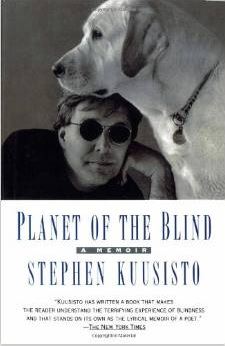
In my first memoir, Planet of the Blind, I recall scenes from my early childhood, moments when I first became aware that I was different from other people owing to my blindness. Although I have always been “legally blind” I’ve been able throughout my life to see impressionistically. If I can press my nose to something I can make it out. Do I see things exactly as they are? I’ll never know. My seeing is invariably wrong and yet surrealistically true. Here’s a moment in Planet of the Blind when I recall being in Helsinki, Finland at the age of 3:

“In Helsinki I lean close to the gray, birdlike women with ether eyes who ride the trams. Each has survived the wartime starvation, and now, in the darkest city on earth, they are riding home with their satchels, which had taken all day to fill; the stores were ill-stocked and the lines were long. I remember their almost feral attention to the trolley’s windows at twilight. As a small boy, I climb ever closer to them, their strangeness imprinting on me an indelible image of hardship.”

When I wrote this passage I was forty-three years old. The boy who rode the tram was three. Forty years separate the boy’s mind from the man’s—then again, maybe not? The boy’s mind does not in fact exist. In lyric terms it’s an elapsed fragment, a lost scroll, the oral tradition song that people failed to sing. Memory, especially early memory does not exist without a lyric structure.

I cannot rely on memory if it’s conceived as a series of time capsules buried by my former selves. The writer Rebecca West put it this way: “My memory is certainly in my hands. I can remember things only if I have a pencil and I can write with it and play with it. I think your hand concentrates for you.”

It’s possible to argue that there is no memory outside of writing. I remember things by following my hand across the page. Writing, like all modes of composition depends on a weird marriage of luck and discernment. Writing is the petri dish wherein memories grow. The idea is unsettling. It’s like the discovery that there is no true green in nature. Memories do not exist without imagination.

How do I know if my memories are true? I don’t. This is where artistic method becomes important. The desire to remember and the desire to write must be understood as twin activities requiring critical attention. Chekov put it this way: “I can write only by thinking back; I have never written straight from nature. I need to let a subject strain through my memory until only what is important or typical remains as a filter.”

What a wonderful idea Chekov has! Memory can be thought of as a filter. Another way to look at this is to imagine that images from the past are only reliable when we catch them more than once. I must write my paragraph about the trolley ride more than once and pay attention to the repetitions and similarities in the imagery. One can think of this as a writer’s system of checkcks and balances: imagination is strained through netted memory, and invention is checked against the careful arrangings of similar images or “archetypes” as Carl Jung would call them. There are, it turns out, buried images that are too powerful for mere fancy. The gray, birdlike women with ether eyes are a substantive memory after forty plus years.

It’s important to notice that I don’t give these gray women oversized, ostrich feather hats, or lap dogs. It would be fun to transform these women through the sudden electrolysis of imagination. Suddenness is the imaginative thing that makes literature so appealing as a cure all for the commonplace. This is important for writers of nonfiction to understand. We must employ memory but with restraint. I remember these old women who rode the trolley in the Finnish winter. They were distinctly “curious” and touched by the forces of gravity. Both the women and the child have passed away. It took me many days of writing to bring them back with their many austerities.


S.K.

In Honor of Dr. Seuss's Birthday: I Do Not Like Green Eggs and Sham


“I do not like green eggs and sham,” said Unvle Sam.

“I do not like them in my Dodge Ram.”

“I do not like them in Afghanistan.”

“I didn’t like them in Viet Nam.”

“No, I do not like green eggs and sham.”


“I do not like them in my bank.”

“I do not like them in my tank.”

“I watched this morning as the stock market sank.”

“I do not like them, I’ll be frank.”   


“You think I’m joking? Go and smell.”

“I do not thing green eggs are swell.”


Etc.


S.K.

The Dangers of Faulty National Memory


In his book Ravens in the Storm: A Personal History of the1960s Antiwar Movement Carl Oglesby writes of a time that is still broadly misunderstood and often poorly remembered. Just last week at the CPAC scrum the nation was treated to the opinions of “Joe the Plumber” who, among other things argued that members of Congress should be shot for opposing the war in Iraq—apparently re-imagining the good old days when wwar protestors could be gunned down in America.

Oglesby writes:

“Student reaction to Nixon’s April 30, 1970, invasion of Cambodia-Operation Rock Crusher-was immediate and massive across the country’s campuses,1 nowhere more so than at Kent State, my first school. Ohio governor James Rhodes ordered a brigade of the National Guard onto the campus to restore order. He warned the Guardsmen that the students were “scum.”

The situation at KSU had been tense for a while. In April, having crashed a trustees meeting to demand that a war-related research project be ended, the SDS chapter had lost its charter.

Then on the night of May 2, two days after Cambodia, either an angry student or a provocateur had torched the ROTC building.

The Guard were summoned to restore order but only brought more disorder. Student-Guard confrontations immediately became violent. On May 3, Guardsmen bayoneted several students.

At 12:30 P.M. the next day, May 4, without warning, Guardsmen fired sixty-one shots in thirteen seconds point-blank into a group of about two hundred students, murdering Allison Krause, Sandra Scheuer, Jeffrey Miller, and William Schroeder and wounding nine others.”

I think the word “provocateur” is the most interesting moment in this passage.

In May of 1970 my father was president of the State University of New York at Albany and he had just been named the new president of Hobart and William Smith Colleges in Geneva, New York. That month, yes, a provocateur incited students to firebomb the ROTC office on campus. That “provocateur” was in fact working for the FBI. The story briefly made the national news before it disappeared.

I went to see the Nixon-Frost movie on Saturday and Joe the Plumber was still fresh in my mind. I was aware that Nixon used all the resources at his disposal to undermine the antiwar movement in the U.S. and he used federal agencies to incite violence.This part of the campus protests is poorly understood and much more work needs to be done on this treasonous aspect of the Nixon administration.  

Meanwhile Joe  the Plumber reminds me of another group of plumbers –you know, those dudes over at the Watergate hotel.


S.K.  

On Being a Professor Who Has a Disability

In one of his wise and funny essays the poet Theodore Roethke wrote: “Stick out your can, /Here comes a lesson plan.” Roethke was for many years a professor of English both at the University of Washington in Seattle and at Bennington College in Vermont.

I used to think the lines were merely lowbrow comic relief from a man who was universally judged to be a great teacher of writing. Pursuing the rounds of a teaching life we’ve all longed for a moment of well-timed irreverence. We love it when in the film “The Paper Chase” Professor Kingsfield (played by John Houseman) hands a student a dime and tells him to call his mother. “Tell her,” Kingsfield says, “tell her that you will never be a lawyer.”

I am a blind professor and I labor steadily. Theodore Roethke was profoundly disabled—bi-polar, manic depressive—after forty years we still don’t know Roethke’s true diagnosis. Lately however I’ve begun to understand Roethke’s sharp and private marginalia as being part of a disabled teacher’s life. Certain disabilities, particularly blindness and the emotional and learning disabilities, assure that the labor of pedagogy will be intrinsically steep. One may think of Sisyphus, Camus’ version, laboring with the consciousness of his own labor—Camus’ Sisyphus climbs and knows all the weariness of the climb. The teacher with a disability does not work harder than his or her non-disabled colleagues, but the disabled teacher knows in minute ways how the acquisition of that old fashioned and bourgeois clarity “costs” the body. Teaching in pain is not heroic. Still it’s a shaman’s art: the slow acquisition of a text by a learning disabled teacher can singularly change a reading of a text. As a blind reader I am called upon to listen to cadences in every line of the text before me. We are slow and methodical and this pays off.

I begrudge lesson plans and IEPs and the gum chewing of education department types not merely because I am a poet who studied poetry writing but because I suspect that most learning comes from the discovery of the irrevocable and private passion of study. A good teacher is the one who causes a revolution in the personal argument inside a student. After reading Whitman with a person who has read Leaves of Grass over and over in Braille you may hear some engagement with Whitman’s great and passionate heart and some ironic ideas about the poet’s lousy ear. The student will hear that according to his blind professor Whitman lived and wrote as though the words might run out at any moment. Forget D.H. Lawrence’s portrayal of Whitman’s poetry as a steam engine chuffing with amorous love. The blind professor will say that Whitman was throwing those long lines out of fear. Whitman, for all his love of health and robust affection lived in expectation that ill health or madness would stop him prematurely just as it had stopped his mad brother and his fragile father. Just so, says the blind professor, these lines proceed without room for breath. Does reading Leaves of Grass in Braille make such observations more probable? Yes. You come to feel it. Just as Whitman felt it when he loaded all the lead typefaces into racks after hours in a darkened newspaper office.

Roethke was afraid that hard won clarity would leave him. He knew that poetry came from disorder and that the making of poetry was therefore essentially risky as an anodyne for depression. Forget Freud’s naïve contention that poetry is merely a variant of the talking cure. Poetry and the teaching of it both spring from the chaotic and impure regions of the cave of making. Each requires a deft arrangement of logic and imagination. Work. Evanescence. Painful encounters with the consequential difference between what we think and what we like to think. In poetry this difference requires exquisite self-awareness. In turn such self-awareness comes after taking a walk in the dark. If you wish to write poetry a lesson plan may be of almost no value. Even Milton’s Areopagitica can’t help. The Lesson Plan may in this context be a kind of permission to take shortcuts by assuming that the reading list in hand offers the proprietary secret to imaginative life. Roethke read everything he could get his hands on. He read while he was receiving hydrotherapy in the mental hospital. He read and in his mind’s eye moved the words around and found new rhythms and new locations for the syllables and consonants. This isn’t Romantic and it’s not on the syllabus. I like these lines by Ikkyu, the fifteenth century Japanese Zen master:

break through one impasse there’s another let the sweet

lychee slip over your tongue and down

Ikkyu was not disabled as far as we know. But try to eat properly and with spiritual awareness and you will find that almost everyone faces physical difficulties. This Zen fragment offers a glimpse into disability consciousness—which is inherently a poetic realization. The poem comes to mind because the way is steep.

There is no lesson plan for this minute by minute mind’s flight.  One learns the body’s  poetry without a syllabus.


S.K.