Lines in Spring

When I say I’m “of or pertaining” to sadness
It’s a joke—as are men
And women, as are the trees
The holdouts amid
Houses their orchard
Gone fifty years.

Mortal humor
Old man stands
Under branches
“How sad are you?”
April vaudeville
Resting blind face
Against bark
Says: apples
Coming
Soon everyone
Will have a myth.
Hang it All, Robert Browning

Hang it All, Robert Browning

There can be but one sourdough. Inside poetry joke.

**

There were two Hopalong Cassidys.

**

Talking to the apple trees this morning.

**

I have read a good deal “in” the Frankfurt School. I still believe in defending us against storming passions and a terrible fate.

**

Great dream last night: tent, forest, island, believed dead “back” from where they’d been. Excellent camp fire.

**

I hope in my next dream I can eat a baked apple with Max Horkheimer.

When the Numbers Start Screaming

More gun deaths in America. More Black people murdered by cops. More virus deaths. I want to go outside and pound the lawn with my fists. I swear I’ve never felt so helpless and enraged. And then I remember I’ve felt this all my life. As a youngster I watched with horror the vast cruelty of the Viet Nam War and the assassinations of every brave leader Black and white. I was thirteen years old in 1968. I woke up early. Like you and you I’ve lived in suspended horror and this means living with numbness and lowered expectations. And if one has energy to spare it goes into raising hope. Yes, Emily Hope is the thing with feathers. Look at me waving these quills. Just look at me.

They Say How Did You Go Blind

They Say How Did You Go Blind?

I tell them about dropping from a cloud
A sober cloud
In the Gulf of Finland
Tight as a mother’s wish
And how this falling
Was my only sight
I’m a hit at cocktail parties

**

They Say How Did You Go Blind? Part Two

Masturbation
Licking poisonous stamps
Eating pine bark
Reading the novels of Robbes-Grillet
Standing up for innocence
Kissing urchin spines
Keeping airplanes aloft with my thoughts

Rain on the Roof

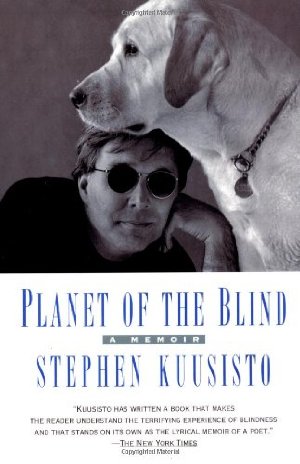
This is a story about how strange being disabled really is. It’s not inspirational. I swear it isn’t gloomy either. Being blind has taught me that the world is just what it is and not what I think about it. I have no idea if you’ll understand me. I get things wrong. I think those sighted people in the airport lounge are staring at me. I imagine they’re thinking how lucky they are to not be blind. But I have it wrong. They’re grieving the loss of their dog and now they come over and ask if they can pet my guide dog, a yellow Labrador named Caitlyn. They know this isn’t ordinarily permitted. Their dog has died. And I understand that I had their story all wrong, that I was foregrounding my own sensitivities. The world is just what it is.

As I get older I find this is the hardest lesson I’ve learned. Hard because I’ve learned this badly, often after great pain or having made serious mistakes. I have misunderstood people. Have imputed bad motives to others when they didn’t have them. I’ve worn my sense of alienation on my sleeve. And so this is the trick: avoiding the brittle insertions of ego and fantasy; the self absorption of it; keeping clear; forgiving myself and others when I have the chance.

If you’re disabled you know there’s a lot of ableism and discrimination. You learn to stick up for yourself and others. You lick your wounds. You’ll face problems in the future. You know you’ve got to be prepared for them. And yet, and yet I don’t want to be broken in spirit. I don’t want this.

It’s raining today. A cold rain. I can hear it on the roof. The world is just what it is. My story doesn’t change this. I’m learning to take comfort in this.

After

1.

It does not matter the after—
Sex or burial
You’ll speak a dog’s language.
I’ll come back to it.
I will weep or laugh
With the tarot
And soon
I’ll come back to that.

2.

After my father died
I lay down
Before his grave—
The after-dog.
It didn’t matter
As a boy
Baltic rain woke me
Or that the dog came home
In a Finnish rhyme.

3.

And it doesn’t matter.
Execution is the chariot
Of genius Blake said—
Here’s a place to weep.
Dog-talk.
I like saying
I’m going on—
This leads to a garden.

In the Garden

As a small boy I used to pick up the telephone just to talk to the operator. She was always there. “Where’s your mommy?” she’d ask. How could I tell her my mommy was depressed and always sleeping? So I’d say: “she’s in the garden.”

Of real gardens there’s much to say. But the gardens of abstraction also need mentioning.

By the age of three I knew something about the real garden. I’d buried my spectacles there. My little Windsor specs, thick as dishes, designed to turn legal blindness into a better form of legal blindness and which older children laughed at. I buried them under the rhubarb.

Magic happens in gardens. Why wouldn’t my mother be there?

“Gardens are not made by singing ‘Oh, how beautiful!’ and sitting in the shade.” (Kipling)

But I remember sitting in the shade and wishing my mother would get up.

Ravenna

“I, too, have been in Ravenna.
It is a little dead city
That has churches and a good many ruins.
You can read about it in books.”

—Hermann Hesse (translated by James Wright)

I’ve never been to Ravenna my friend
But I know the little dead cities.

There’s a caste to the men in those towns
As though they must walk backwards

Because of history. Look around
They seem to say—

Everybody draws back into
His own time till it’s dark again.

Now please don’t fall in love there
Or there no matter your heart

Your face and hands.
We go through so much

Over time, distress,
Moments of fear

The small triumphs,
Do not fall in love in this place.

Karl Jasper’s Parable

Two halves of a life were debating, rather bitterly, like unhappy twins. Both had studied the classical methods of confession so were voluble but insincere. Neither half knew how to escape forward. Anyway, it was late in the day when shadows spread across the lawn like symbols of past actions when the transitive life stood between them—one may call her “future pneuma perfect” though it scarcely matters for she can take care of herself.

“What,” she said, “causes you to think the past is definitely settled? Don’t you know it’s changing right now, beneath your feet?” “This is the future of resignation—patience, day-dreams, small plantings…”