Notebook: Show Us Your Elephant….

George Orwell is to animal writing as Newton is to the cultivation of apples. Neither man had a dog. George shot an elephant. There’s no evidence regarding Newton’s experience with elephants. The first elephant in England arrived in 1255 and was housed in the Tower of London by King Henry III. It is altogether possible Newton actually saw an elephant. In 1696 Newton was appointed Warden of the Royal Mint which was, you guessed it, housed in the Tower of London. Just coins. No pachyderms. He is known to have interviewed criminals and dabbled in alchemy while in the tower. There is no record of Newton conversing with the rooks.

Did Orwell talk to birds? Only on train trips I think. All writers must speculate. Here’s Orwell from “1984”—“For whom, for what, was that bird singing? No mate, no rival was watching it. What made it sit at the edge of the lonely wood and pour its music into nothingness?”

**

Last night I remembered these lines of Newton’s: “Trials are medicines which our gracious and wise Physician prescribes because we need them; and he proportions the frequency and weight of them to what the case requires. Let us trust his skill and thank him for his prescription.”

That misfortune can, even today be read as divine beneficence is so quant and melancholic. As I said once to an overheated Christian: “if Jesus could cure the blind, why didn’t he get rid of blindness altogether?”

Well if God made gravity he must also have made plagues. This is what happens when you live in the Tower of London. A good plague is certainly a privileged idea.

**

“England’s first and most surprising elephant was given to Henry III in 1255 by his cousin King Louis IX of France: “… a beast most strange and wonderful to the English people, sith most seldome or never any of that kind had been seene in England before that time”. The elephant’s large ears in the familiar drawing by Matthew Paris show that this was an African elephant not a more docile Indian elephant. Paris observed: “that this was the only elephant ever seen in England, or even in the countries on this side of the Alps; wherefore the people flocked together to see the novel sight”. Like other many other royal animals it was housed in the menagerie at the Tower of London, which lasted from about 1204 to 1831 when, on the orders of the Duke of Wellington, the animals were transferred to the newly founded Garden of the Zoological Society, i.e. the London Zoo.”

Aha! It is therefore possible that Newton “did” see an an elephant. Unless he didn’t get out as much as we imagine.

**

“Elephants are susceptible to some diseases spread by mosquitoes and to some inflictions that affect humans, such as intestinal colic, nettle rash, pneumonia, constipation, and even the common cold.”

https://seaworld.org/animals/all-about/elephants/longevity/

Dear Newton, trials are not medicines.
Regrets, I’ve Had a Few….

There’s nothing like quarantine to develop a good dose of personal regret. When one is home there’s plenty of time to remember mistakes both large and small. Of course remembering is one thing, the regrets are another. Speaking for myself there aren’t enough anti-depressants to address the regrets. If you have time for regret you have have too much time—I know it. But then we’re back to the quarantine.

Years ago I heard the poet Robert Bly tell a lecture hall filled with admirers that Americans are too damned happy, that they need to embrace sorrow more, that this is where liberation lies. So here’s a regret: I’m sorry I believed this. I spent my entire twenties and thirties thinking that being profoundly sad was the key to being artistic and original. I also regret not understanding that sorrow is a very poor teacher since it thrives only on its own stories. I’m sorry I didn’t know sooner that sorrow is a dullard.

I’m sorry for insulting people when I drank too much. Sorry for not listening better to people whose opinions were obviously inconvenient to my fatuous and childlike insistence that I was smarter than almost everyone. (As a disabled young man I had to believe this. How else to swim upstream? I know. But I still regret my green egoism.)

If you’re trapped in your sorrows you can’t understand the pain of others. In fact other people are an inconvenience, they’re competitors in what we in disability culture like to call “the oppression Olympics”—yes, you’re in a bad way, but I’ve got it so much worse. Or, you’ve got it better than me—you’re deaf, you can drive a car.”

Kierkegaard said: “I see it all perfectly; there are two possible situations — one can either do this or that. My honest opinion and my friendly advice is this: do it or do not do it — you will regret both.”

He was right. Regret has no judgment and nuance. The hard thing is recognizing life is filled with choices and they all lead to doubts, private rumination, and varieties of melancholy. Sometimes I say to friends “it’s a high gravity world” because sorrows are universal.

There are not many good jokes about regret but I like this one:

A famous professor of surgery died and went to heaven. At the pearly gate he was asked by the gatekeeper:’ Have you ever committed a sin you truly regret?” Yes,’ the professor answered.’ When I was a young candidate at the hospital of Saint Lucas, we played soccer against at team from the Community Hospital, and I scored a goal, which was off-side. But the referee did not se it so, and the goal won us the match. I regret that now.” Well,’ said the gatekeeper.’ That is a very minor sin. You may enter.” Thank you very much, Saint Peter,’ the professor answered.’ Im am not Saint Peter,’ said the gatekeeper.’ He is having his lunch-break. I am Saint Lucas.’

I don’t like pieties. But I don’t think Americans are too damned happy. This is a nation pushed by overwork and insufficient pay. The quarantine is brutal. I regret I’ve time for regret. And then I don’t.

Notebook in the Rain Featuring Cabbages and Poems

Wallace Stevens’ blackbird is a real bird until it enters the mind. Once there it becomes human nature. A neat trick.

**

What if I told you about the first window, the first one you ever saw? Would you trust me then?

**

Spent his life climbing in and out of cars when all I wanted to do was sit beside a well.

**

I love the word lucent perhaps because I’m blind. Don’t care so much about the damned flying buttresses.

**

Help help help. Rain in my shoes.

**

A good conversation yesterday with a first rate poet who still thinks poems make positive things happen in the world. He was happy so I didn’t say “well, cabbages do so also.” If I’m being scrupulous and nuanced I’ll admit even the finest cabbage will not linger in the mind like a poem. And then, voila! Ruth Stone’s superb poem “The Cabbage” sprang to mind!

You have rented an apartment.
You come to this enclosure with physical relief,
your heavy body climbing the stairs in the dark,
the hall bulb burned out, the landlord
of Greek extraction and possibly a fatalist.
In the apartment leaning against one wall,
your daughter’s painting of a large frilled cabbage
against a dark sky with pinpoints of stars.
The eager vegetable, opening itself
as if to eat the air, or speak in cabbage
language of the meanings within meanings;
while the points of stars hide their massive
violence in the dark upper half of the painting.
You can live with this.

**

Now the phrase “you can live with this” is central to poetry. Like Horace the poem says Seize the day, trusting little in the future. They do in fact mean the same thing.

A Birthday Gift at 65 from Heraclitus

Now and then the birch trees. Up river a fantasy.
Across town a birth.

**
Rain carries dreams of foreigners.

**

“None love, but they who wish to love.” (Racine)

**

My childhood home was a very small house.
More and more I want to return there.

^^

Laughing in the mornings.
The dogs approve.
I must do their laughing for them.

**

“Silence, healing.” (Heraclitus)
000000s in the ear.

**

Yesterday my neighbor washed his house.

**

Like Pentti Saarikoski
I like to imagine Ezra Pound
Without his snakes.

**

If you were like me you’d be quiet too.

Donald Trump: A Jungian Take

Like everyone I have opinions. I think Beethoven’s violin concerto is the most beautiful musical composition ever written. I believe bubble gum is disgusting. My point is that opinions are always matters of taste until they’re informed by nuance and scruple. I can change my mind about Beethoven’s concerto though probably not about the gum.

We grow out of our first tastes if we’re lucky. “Lucky” means we’re capable of growing which means we become capable of seeing complexity. We turn into adults. I used to like a certain rock and roll band. Now when I hear them I cringe. What happened? My world got bigger. Miles Davis took the place of Frank Zappa. The more intricate your self awareness the more so your taste.

Years ago the Jungian psychoanalyst Marie Louise Von Franz wrote a terrific book about men in modern societies who fail to become adults. She called them eternal boys. They are everywhere. These men are marked by an inability to form lasting relationships with adults, tend to jump from job to job and are disposed to leave town abruptly if life gets too serious. They crave recognition for their talents but hate responsibility. Here’s an interesting quote: “The one thing dreaded throughout by such a type of man is to be bound to anything whatever. There is a terrific fear of being the singular human being that one is. There is always the fear of being caught in a situation from which it may be impossible to slip out again. Every just-so situation is hell.”

Just so situations are of course the primary ingredient in growth. The eternal boy does not want to grow up and becomes angry when forced to deal with adult matters. It’s the girl friend’s fault he can’t manage his business; it’s the people around him who are the source of his essential problems.

You’ve lived through adolescence and you know the type. If you work in any kind of office setting you know the type. The current president of the United States exhibits eternal boy child characteristics. The eternal boy child wants praise but really hopes to avoid responsibility. Now as we face a critical shortage of medical supplies and equipment Trump refuses to lead. Boys can’t do it. In Roman times the generals put the boys in front so they’d die first and they were called the infantry.

There are eternal girl children too. Toxic ingrown adolescence is no longer just for boys. American entertainment knows this and panders to it. All pop music and Hollywood culture is designed for people stuck in adolescence.

When you watch Donald Trump’s fatuous and self-aggrandizing press conferences notice Dr. Anthony Fauci. He’s the adult. Trump is the eternal angry boy who loves the limelight but resents his duty.

Two Horses

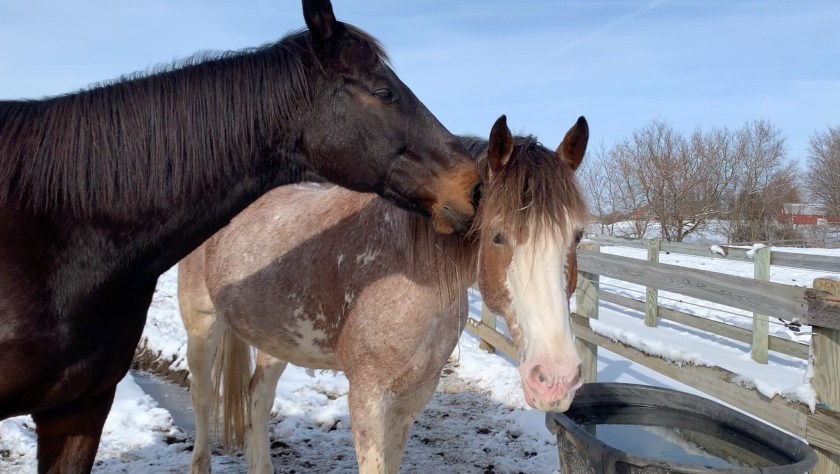
–Luigi and Turner

1.

The darker “bay” chestnut
With the fawn nose
Is impatient—thoroughbred
That he is, ears pinned
He says it’s time to eat.
Funny how his eyes betray him
Being pools of black kindness.

2.

Half draft, half Welsh—
Pony in a big frame,
Rust on ice for a coat
With the longest mane
You’ll ever see.
He’s Dylan Thomas alright:
Though lovers be lost love shall not.

Bad Bones

For some reason the Gods gave me bad eyes.
Green scarf my first toy, a bandage,
But they weren’t done, I got an orphan’s share
Of joy, madcap blues, blind abacus
Until you think to say “whatever ”
Feigning indifference til silence comes
Like a wounded bird.

I have bad bones
And wave a red candle.
Climbing the twisted stairs
Of James Tate’s cemetery willow.
Sadness is just the rules of a game
No sharp foundling plays.

—for D.J. Savarese

Mr. President I’m One of Those Who Needs Reassurance

Yes, there are vulnerable people in this country….

stevekuusisto's avatarPlanet of the Blind

I’m disabled, Mr. President. I work with the disabled. We represent every ethnicity and nationality: we’re old, young, veterans, parents; we’re gay and straight, and yes, we have physical and other limitations that cause us to be medically and socially vulnerable. When yesterday you rebuked NBC reporter Peter Alexander for his “nasty” question about how you might reassure anxious Americans you essentially dismissed the 60 plus million Americans with Disabilities. I think you knew you were doing it.

Not once in any of your press conferences about the novel Coronavirus has the word disability been uttered. Not once. I know why. You think Americans who need “reassurance” are weak. Moreover you think without irony that life is unfair. When asked why star athletes are getting virus tests while ordinary Americans are waiting you told us this is how life in America operates. Reassurance is a pesky word isn’t it? It…

View original post 209 more words

Life is Unfair, We Must Not Say So

What is helpful? Dark times call for serviceable imago—no Disney mouse, no reiteration of that oldest American thing, Puritan optimism, the “city on a hill.” Better to say we’re the help we need. Better to say Donald Trump isn’t one of us. “Life is unfair,” he said when asked why athletes are being tested for Coronavirus while ordinary Americans are not. If the point of democratic governance is lost on him we should say as Governor Cuomo of New York is now proposing, “we must be the help.” When the presidency is held hostage by a grifting conspiracy theorist and racist who doesn’t want government to work, indeed thinks a functioning government will hurt him, well, we’ve got some reimagining to do.

Forgive me my rampant tone. My grandfather was a Finnish Lutheran preacher and I fear I’ve inherited his moralist’s stole. I try to take it off most days. When I’m forced to show it I think it’s best to know why. “You are not only responsible for what you say, but also for what you do not say” Luther wrote. I’m owning what I do not say. This should be done by all. One thing I do not say is I believe life is craftsmanship. Luther again: “The Christian shoemaker does his duty not by putting little crosses on the shoes, but by making good shoes, because God is interested in good craftsmanship.” (Luther was making fun of the Pope’s shoes but he too was a fallen man.) I have no idea why God should be interested in good craftsmanship, and have no interest in ideas of universal design, but let’s imagine every life is the raw material of what Auden called “the cave of making” and yes this leads me back to democracy for the aim of the democratic nation state is to provide the means to pursue happiness which I’m calling craftsmanship. When Trump says life is unfair during a pandemic he’s saying democracy is of no interest to him. He’s saying you have no right to pursue your life. And yes, I’ll dare to say it, he’s being un-Christian. The latter is not news.

John Locke was the ghost behind Jefferson: “Being all equal and independent, no one ought to harm another in his life, health, liberty, or possessions.”

John Locke: “Personal Identity depends on Consciousness not on Substance.”

Being an idea, democratic government is hard to defend in a nation devoted to commodity fetishism. Every run on toilet paper reminds me of this fact. Without consciousness, no crafted lives. Without craft no freedom. And that’s when you get a tricked out shill for oligarchy telling you life is unfair.