Thirty for Thirty on the ADA: Essay Four “Among”

What do we mean when we say “thirty years since the ADA?” I think as disabled people we’re talking about a living document and not an artifact. There are three ways in which the Americans with Disabilities Act is not static and therefore keeps up with the times. One: it’s protections for people who lack the capacity to see, hear, walk, stand, speak, engage in normative modes of thinking (a phrase I detest) or who have invisible disablements (HIV, cancer, auto-immune conditions) are inclusive. AIDS patients were and are protected by the ADA though when the law was passed no one could have imagined this. Number one is connected to number two: disabilities are complex, often unforeseeable. The law makes room for this. Three: opponents may not like this, but the ADA says equal access means equal access and the law is strong enough to make it stick despite fierce and consistent objections from business groups, universities and corporations that have cried foul from the day President George H. W. Bush signed the bill into law. At thirty we can say the ADA is still very much alive and living with us. That’s the thing about civil rights laws: they have to be tough and equally imaginative. Diverse societies depend on imagination. Daily we see racist, homophobic, ableist, misogynistic, xenophobic people assert that critical thinking is for losers. This proves to be untrue in a nation of well written laws.

This leads to the sad truth that laws are not always enforced and can be subverted especially in provincial places. I recall in particular the ugly story of a blind woman in Iowa who was prevented from bringing her guide dog to a computer class “for” the blind. She filed suit in a local court which in turn saw no problem with the discrimination. I think of my late friend Bill Peace who was denied proper medical care at Yale University Hospital while attending a conference on disability. He had a heart attack. Because he was a wheel chair user they put him in a dark corner of the emergency room and left him alone for hours. I think you see where I’m headed: sectoral and isolated places still believe even thirty years after the ADA that it’s still 1910. I pick that date almost at random but it serves the purpose: the disabled were imagined to be fit only for the family’s tool shed or the asylum. In either case they were ignored. The ADA says we cannot be ignored. Plenty of people who do not currently have a disability think that having one is a monumental tragedy. When TV programs like “Dateline”feature a blind person they often say: “He was “Struck down” by blindness.” This old Victorian language still haunts every person with a disability.In his wonderful memoir “Moving Violations” John Hockenberry describes an encounter he once had with an airline hostess who, seeing that he used a wheelchair, opined that if she was in his shoes she’d probably have to kill herself. All people with disabilities can share stories like Hockenberry’s.

The ADA says our lives are worth living. Are disability lives not worth living? The long history of “abled” voices has said, and continues to say “no”–a “no” that has been complicated by pre-natal testing and divisive political rhetoric about the nature of what a qualified life really is. In 2005 the Terri Schiavo case demonstrated to disability rights activists that when it comes to protecting disability life, conservatives had more empathy and courage than neo-liberal Democrats (with the notable exception of the Rev. Jesse Jackson). The very idea that a disabled life is not a life at all depends both on the medical appropriation of curative utility (life with illness only possesses value in relation to its amelioration) and simple metaphor (disability understood as a ruined identity, see Erving Goffman). The dichotomies of spoiled identity have a long history on both sides of the Atlantic–eugenics, forced sterilizations, the “ugly laws”, institutionalization, and the Nazi “T4” mass murder of adults and children with disabilities. The pattern is one of distillation: disability, (post industrial revolution) is broadly conceived–has been conceived as economically unviable, hence lacking all capacity for the pursuit of happiness in the world of economic-biography.

The darker version of this is the resentment of social welfare (Hitler famously depicted people with disabilities as “useless eaters”). The utilitarian (Benthamite) position (Peter Singer) holds that the greater good of society must trump the needs of a minority in pain–”good” is understood as the potential for achieving pleasure. The Benthamite pleasure principle subborns life to economic life and forgoes the question of what constitutes individual autonomy when imagined outside of industrial labor. In turn it’s the right of the majority class, the “duty” of the majority class to debate the probable happiness potential and index of the minority. Many disability rights activists and scholars have pointed out the inevitable connection of Jeremy Bentham’s ideas (and Singer’s fealty to same) as the foundational principles of Nazism. There is truth to this because eugenics was driven by the principles of Bentham.)

The 21st century extension of disability as a cathexis of the utilitarian body and the medical model of physicality (that abnormality only has value in relation to its likelihood of cure) is now intensified by pre-natal testing. Mr. Singer would counsel parents to abort a fetus if its future birth would result in a child without arms and legs. In his view that child would have no likelihood of happiness and (more sinister of course) such a child would impede the greater happiness of society. Singer is no scholar of economies of scale or of their pre-history. The idea that a legless man might be a great singer or poet demands an appreciation of proto-industrial village life: the majority history of human kind. But enough of Singer.

A friend wrote me recently. She’s a young writer and a new mother of a little girl with a disability. She wrote because she’s experienced the insensitivity of her academic colleagues and friends who have opined that they couldn’t imagine raising a child with an intellectual or developmental disability. My friend has been shocked by the thuggish candor of these remarks. And by turn of the imaginative poverty of the conceptualization of a challenged life as no life at all. This is the marriage of utilitarian philosophy (absorbed through capitalism’s ubiquitous social rhetoric) and the medical model of disability which holds that physical difference without the prospect of cure is not worth enduring. We are living in creepy and reactionary times. And though I’ve been a life long liberal, I applauded the efforts of former Florida governor Jeb Bush to save the unimaginable life of Terri Schiavo. I’ve never felt any ambiguity about that. Perhaps my lifetime of nearly incomprehensible difficulty to live and stand among the able bodied has given me a strange capacity for steepened joy. Not an easy joy. Not a hot rod, drive your car fast joy, It’s the joy of living beautifully in the solitudes of challenge–something your average doctor or utilitarian philosopher can’t imagine because they don’t understand the vitality of pain.

So clearly part of our job is to help those who work in the public sphere and who have no experience of disability understand the vitality of lives that are lived in what I’m calling “the vitality of pain” because the phrase reflects rather accurately what all life is. 

Another part of our job is to make strong connections with groups and organizations that are leveraging the legislated rights of people with disabilities by insisting that states and municipalities live up to the Americans with Disabilities Act. The New Hampshire story above and recent developments in New York State offer some examples but there are more. 

The Justice Department’s recent comprehensive settlement agreement with the Commonwealth of Virginia resolved problems in the state’s system for serving people with developmental disabilities, including intellectual disabilities, and further resolved violations of the Americans with Disabilities Act (ADA). 

Under the ADA and the Supreme Court’s landmark decision in Olmstead v. L.C., individuals with disabilities have the right to receive services in the most integrated settings appropriate to their needs. The ADA and Olmstead require states to provide people with disabilities the opportunity to live and receive services in the community instead of in institutions.  

It’s clear that with sufficient stamina, persistence, and networking we can fight for the rights of people with disabilities. It is right to remember the words of Jim Ferris, a poet who often writes about disability from the experience of having a disability. He says: We are not signs,/we do not live in spite of/or because of facts,/we live with them,/ around them,/among

Among. If you are looking for a one word slogan that’s it. The ADA @30 is Among.
 

Thirty for Thirty on the ADA: Essay Three “Lyric Life”

Thirty for Thirty on the ADA

As we near the thirtieth anniversary of the Americans with Disabilities Act I’ve decided to post thirty short essays about the law, the anniversary, and the cultural impact of #ADA @30. I’m doing this as a disabled person who’s lived half his life before the ADA. I’m reflecting on the “before and after” of the law.

Essay 3: Lyric Life

I was on a playground in Durham, New Hampshire. The year was 1960 and I was five years old. I had thick glasses and was smaller than my classmates. A big kid who I’ll call Rollie, who daily taunted me and called me “Blindo” approached me with a handful of dirt which he clearly meant for me to eat.

“You will eat this,” he said.

“It looks good,” I said. “Hey Rollie, have you ever eaten an acorn?”

Rollie held his dirt before him like a little pillow.

“An acorn?” he said.

“Yeah, they’re just like peanuts, really good, that’s why squirrels like them. You want one?”

“Sure,” he said. He held out his other hand and I dropped a neatly shelled acorn into his palm.

“Go on Rollie, its yummy!”

Rollie ate it. Then he turned red, and I mean red, not beet red or fire engine red—he was red as an unkind boy with his mouth swollen shut. Acorns are among the bitterest things on earth. And of course I only knew this because I’d tried one. I was a solitary kid. Spent a lot of time in the woods. Those were the days when a boy could still go to the woods.

Rollie was incapacitated. I don’t think he ever bothered me after that.

I still recall the thrill of my discovery. That language could render an enemy harmless was rousing.

I didn’t do a little dance. Didn’t brag about the matter. But I was on the way.

A lyric life, I think, is one wherein you can access feelings and then, by turn do something productive with them.

The simplest definition of a lyric poem is a poem that expresses the writer’s feelings.
Freud said: “Life as we find it is too hard for us; it entails too much pain, too many disappointments, impossible tasks. We cannot do without palliative remedies.”

One of those palliative remedies is lyric itself. One may think of this as causative intuition, a feeling that trips a switch and makes you sing when you should properly be weeping or running for your life. Again Freud: “Man should not strive to eliminate his complexes, but to get in accord with them; they are legitimately what directs his contact in the world.”

We are getting in accord. We are beside a country road picking edible flowers in the cool of the day. We do not pick edible flowers beside highways because there are pesticides in trafficked areas.

We remove the pistils and stamens before eating.

“Hey Rollie have you ever eaten Milkweed?”

“Rollie, you can trust me this time. It tastes like green beans.”

You will laugh at me, but I think of the ADA as green beans….

I think of it as the dictionary for disability assertion.

Now bullies ye will always have with ye. Of course.

Today’s disabled kids must also endure bullies.

Even now as a grownup I still endure them.

Not long ago I was called an “ignoramus” by a fellow faculty member at Syracuse University where I teach and run a program devoted to disability research. It is never appropriate to call anyone an ignoramus in an educational setting for the term’s antonym s are “brain “ and “genius” and its synonyms include: airhead, birdbrain, blockhead, bonehead, bubblehead, chowderhead, chucklehead, clodpoll (or clodpole), clot [British], cluck, clunk, cretin, cuddy (or cuddie) [British dialect], deadhead, dim bulb [slang], dimwit, dip, dodo, dolt, donkey, doofus [slang], dope, dork [slang], dullard, dum-dum, dumbbell, dumbhead, dummkopf, dummy, dunce, dunderhead, fathead, gander, golem, goof, goon, half-wit, hammerhead, hardhead, idiot, imbecile, jackass, know-nothing, knucklehead, lamebrain, loggerhead [chiefly dialect], loon, lump, lunkhead, meathead, mome [archaic], moron, mug [chiefly British], mutt, natural, nimrod [slang], nincompoop, ninny, ninnyhammer, nit [chiefly British], nitwit, noddy, noodle, numskull (or numbskull), oaf, pinhead, prat [British], ratbag [chiefly Australian], saphead, schlub (also shlub) [slang], schnook [slang], simpleton, stock, stupe, stupid, thickhead, turkey, woodenhead, yahoo, yo-yo…

As a disabled person I know full well what the delegitimizing effects of language can do to anyone who hails from a historically marginalized background but where disability is concerned the labeling I’ve described has a particularly specious and ugly history. Idiot, moron, half-wit, dolt, cretin are all familiar to the disabled. One would expect relief from these terms at a university. What’s particularly galling is that the subject I was discussing with the professor in question was ableism—namely that I’d said hello to him on an elevator, I, a blind man with a white cane, and he simply stared at me. No acknowledgement. When two students got on the elevator he lit up and talked breezily about how he hates snow. I followed him to his office and said that by not acknowledging a blind person he creates a social dynamic that feels off-putting and I wanted to discuss the matter. He became instantly contemptuous.

Now of course that’s because of the synonyms above. In this man’s antediluvian world view the disabled really shouldn’t be in the academy. Ableism is not only more pervasive than people generally understand its also more consistent at universities than is commonly recognized.

As for me, I’m an ignorant man to professor “p” for that’s what I’m calling him. “P” for privileged.

He doesn’t know it yet, but incapacities likely await him.

The good news is that when and if he’s discriminated against should that eventuality arise the ADA will likely protect him.

Thirty for Thirty on the ADA: “Coming out of the Dark”

Thirty for Thirty on the ADA

As we near the thirtieth anniversary of the Americans with Disabilities Act I’ve decided to post thirty short essays about the law, the anniversary, and the cultural impact of #ADA @30. I’m doing this as a disabled person who’s lived half his life before the ADA. I’m reflecting on the “before and after” of the law.

Essay 2: “Coming out of the Dark”

“Get out of your comfort zone.” “Think outside the box.” You’ve heard the phrases. Disabled people are ironic counterpoints to both of these sayings—we’re not in the comfort zone and we don’t have to be told to think imaginatively—all our rendezvous with “normal” require fresh thinking.

The ADA was signed in the year of Billy Joel’s “We Didn’t Start the Fire” and if you’re a fan of cognitive dissonance you’ll recall the disabled “did” start the fire—Viet Nam veterans, advocates for the mentally ill, Baby Boom cripples who wanted lives and careers from main street to Wall Street—these men and women started a fire with their identification papers. They also crawled up the steps of the US Capitol, disrupted political conventions, and occupied hundreds of hostile public spaces.

This thirty year old landmark civil rights law didn’t happen overnight. You can read about the groundbreaking work to launch the ADA in Enabling Acts by Lennard Davis. He tells how pioneering disability activists like Judy Heumann, Ed Roberts, Pat Wright, Bob Funk, Arlene Mayerson, Mary Lou Breslin made the difficult journey from California to Washington DC in 1980. The back story of the ADA is remarkable for its grass roots, its sophisticated, its doggedness, its faith and tireless optimism.

The fuel for the fire was pure, unadulterated inaccessibility. If you were a wheelchair user you couldn’t take public transportation, couldn’t get into civic offices, businesses, take a taxicab; if you were blind you could get a guide dog or a stick but you had no rights to education. If you were mentally ill or neuro-divergent you could count on being a shut in or a patient in a ward. If you were born after the ADA you might not know how bad it was unless you’ve taken a disability history course. It was bad.

While Judy Heumann and so many others were descending on Washington I was in Iowa City, blind, trying to get a grad degree and finding the university was hostile to the disabled. I didn’t have disability pals. I internalized the disdain of others and suffered. I was abject.

The only thing I knew how to do in 1980 was dream. Dreaming is good. But there were fighters out there in the bigger world who were and remain my allies though I didn’t know about them back then.

In 1980 I didn’t have the knowledge as a blind person about how to travel safely.

My memoir Have Dog, Will Travel: A Poet’s Journey in part relives that era:

I’d worked all my life—had actually choreographed it—so I could travel to small and secure places without a white stick. I’d attended college at Hobart and William Smith in Geneva, New York, where my father was the president. I knew every inch of the campus. I learned in a private, ill-favored way how to walk mnemonically. It was eight steps down from the English Department to the sidewalk; seventeen steps to a funny break in that same sidewalk which somehow never got repaired; thirty steps between the post office entrance and my mailbox. I wandered by rote. At a school with only 1,600 students I could pretend to see. When I couldn’t manage it, I’d say I had vision problems. Anything sounded better than blindness. I had “vision issues.” I needed extra time to complete reading assignments. One of my eyes drifted. But still, seeing me move with intention from place to place, many friends and faculty had no idea how all encompassing my charade really was.

When I decided to attend graduate school at the University of Iowa’s Writers’ Workshop I flew to Iowa City three months early and walked the town like a crime-scene investigator. I walked in little grids. I moved haltingly up and down dozens of streets. When I thought no one was watching I drew a telescope from my pocket and read the street signs. I hiked in the stifling summer heat and worried about people marking me as deviant.

Far away from Iowa smart activists were challenging everything I was struggling with. Disability would no longer be deviant.

Today I teach at Syracuse University and work on interdisciplinary disability teaching and research in the Burton Blatt Institute.

Burton Blatt was also a pioneer of disability rights. The BBI website notes he was “an advocate of deinstitutionalization, and he helped initiate community living programs and family support services. In his clinical work he emphasized the provision of education to children with severe disabilities, those whom he called “clinically homeless.” As a national leader in special education, he called for programs to integrate students with disabilities into public schools and worked to promote a more open society for them.”

Thirty years after the ADA was signed that work continues. Inclusion means opening the doors for non-speaking people, making certain the clinically homeless are part of the community, standing for accessible design, pushing for self determination, fighting for ecological justice, black disabled lives, inclusive education—and this is only a partial list.

Another great song from 1990 was Gloria Estefan’s “Coming Out of the Dark.” Perfect.

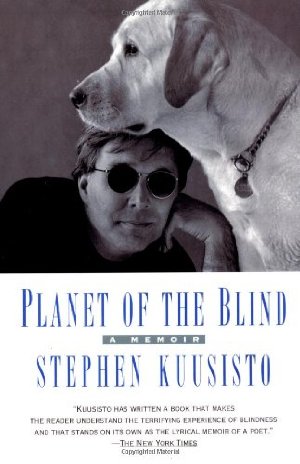
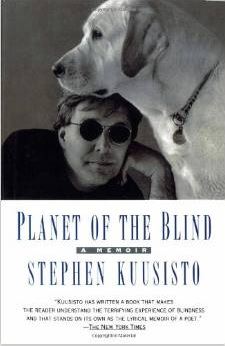
Stephen Kuusisto and HarleyABOUT: Stephen Kuusisto is the author of the memoirs Have Dog, Will Travel; Planet of the Blind (a New York Times “Notable Book of the Year”); and Eavesdropping: A Memoir of Blindness and Listening and of the poetry collections Only Bread, Only Light and Letters to Borges. A graduate of the Iowa Writer’s Workshop and a Fulbright Scholar, he has taught at the University of Iowa, Hobart and William Smith Colleges, and Ohio State University. He currently teaches at Syracuse University where he holds a University Professorship in Disability Studies. He is a frequent speaker in the US and abroad. His website is StephenKuusisto.com.

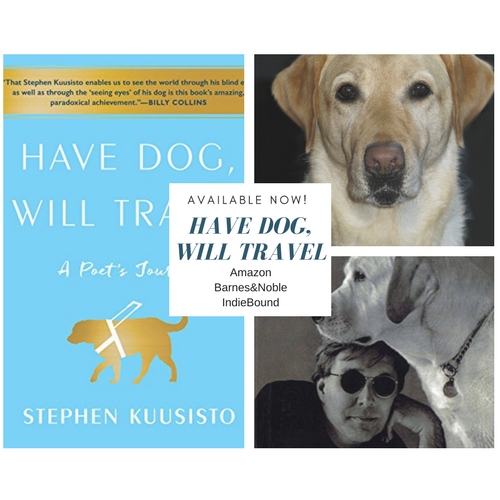
Have Dog, Will Travel: A Poet’s Journey is now available for pre-order:
Amazon
Barnes and Noble
IndieBound.org

Have Dog, Will Travel by Stephen Kuusisto

(Photo picturing the cover of Stephen Kuusisto’s new memoir “Have Dog, Will Travel” along with his former guide dogs Nira (top) and Corky, bottom.) Bottom photo by Marion Ettlinger 

Thirty for Thirty on the ADA 


As we near the thirtieth anniversary of the Americans with Disabilities Act I’ve decided to post thirty short essays about the law, the anniversary, and the cultural impact of #ADA @30. I’m doing this as a disabled person who’s lived half his life before the ADA.  I’m reflecting on the “before and after” of the law. 

Essay 1:

“Bicycle-Blind & Belabored”  

In the mid 1990’s just three years after the adoption of the ADA I decided to write a memoir about growing up blind before I had any rights. Nonfiction was suddenly all the rage. The critical and commercial success of books like The Liars Club and Angela’s Ashes brought the  memoir to the public’s attention. Where formerly “the memoir” had been the metier of statesmen or Hollywood has beens (I exaggerate only slightly) young writers were sharing stories about achieving self-awareness. The memoir was now about comic irony. Everyone could have his or her own bildungsroman and it was refreshing and by God there was a new law for cripples and overnight we had the public’s eye in new ways. Lucy Greeley’s Autobiography of a Face was brand new as I began my first book, Planet of the Blind. Memoir was fresh; the ADA was new; disabled writers had a chance. 

Literature aside this is what the ADA means: the disabled getting their chance. (A joke I love says we call the United States “the melting pot”  because  scum rises to the top while the people on the bottom get burned.) The disabled were always on the bottom, a fact made all the worse if they were poor, black, or if they were crippled women. America had always believed cripples belonged in asylums, “special” schools, that room behind the family garage—anyplace but the village square.  In her groundbreaking 1998 book Claiming Disability Simi Linton presented a new vision of the Parthenon marbles, a bas relief for what the ADA meant and means:

We have come out not with brown woolen lap robes over our withered legs or dark glasses over our pale eyes but in shorts and sandals, in overalls and business suits, dressed for play and work — straightforward, unmasked, and unapologetic. We are, as Crosby, Stills, and Nash told their Woodstock audience, letting our “freak flag fly.” And we are not only the high-toned wheelchair athletes seen in recent television ads but the gangly, pudgy, lumpy, and bumpy of us, declaring that shame will no longer structure our wardrobe or our discourse. We are everywhere these days, wheeling and loping down the street, tapping our canes, sucking on our breathing tubes, following our guide dogs, puffing and sipping on the mouth sticks that propel our motorized chairs. We may drool, hear voices, speak in staccato syllables, wear catheters to collect our urine, or live with a compromised immune system. We are all bound together, not by this list of our collective symptoms but by the social and political circumstances that have forged us as a group. We have found one another and found a voice to express not despair at our fate but outrage at our social positioning. Our symptoms, though sometimes painful, scary, unpleasant, or difficult to manage, are nevertheless part of the dailiness of life. They exist and have existed in all communities throughout time. What we rail against are the strategies used to deprive us of rights, opportunity, and the pursuit of pleasure. 

It was a dazzling party. Even if disability scholars and writers didn’t quite know each other in the last moments before the world wide web, the ADA had sprung us; provided us with optimism; it gave us what Linton calls the dailiness of life. And along with that came stories. I wrote about being lonesome as a boy, about the hardships of blindness and the static miseries of shame. I described my mother’s terror of disability and how she pushed me to pretend to be normal—a story which is legion among the disabled and is all too often prevalent among people like me who are legally blind. We can’t see well enough to read books, recognize people, read signs—we see like abstract painters. My mother wanted me to go to a public school, not the dreaded school for the blind, and she pushed me into a very unfriendly world always demanding that I never reveal how blind I really was. That was life pre-ADA. Pre-inclusive education. No one in my parents’ circle believed the disabled could pursue pleasure unless they appeared normal. One of the first passages I wrote in Planet of the Blind was a memory about riding a bicycle in early childhood: 

I would conquer space by hurtling through it. I wore telescopic glasses, suffered from crushing headaches, but still chose to ride a bicycle—with nothing more than adrenaline for assurance.

How do you ride a bicycle when you can’t see? You hold your head like a stiff flower and tilt toward the light. You think not at all about your chances—the sheer physicality of gutters and pavements. One submits to Holy Rule and spins ahead.

Picture this: A darkness rises. Is it a tree or a shadow? A shadow or a truck? The thrill of the high wire is the greatest wonder of the brain. There is, at the center of our skulls, a terrible glittering, a requiem light. I lower my face to the cold handlebars and decide it’s a shadow, a hole in sunlight, and pedal straight through.

Here’s another shadow, and another. I turn sharply but this time plunge into tall weeds. Insects rise into my hair, cling to my sweaty face. From the road comes the hiss of angered gravel, a car roars past. Thanks be to God! I’m alive in the wild carrot leaf!

I let a bee walk along my wrist, feel it browse on my perspiration. The bicycle coasts, and I squint in the glare, and then I hit a root. As I fall, I take the sting of bee, then the sting of cement. My glasses fly off. The only thing I wonder is whether I’ve been seen. Nothing with this boy must be amiss! He belongs on the street!

Now I’m on my knees groping for the glasses. My wrist has swollen. One wheel is still spinning. I’ve barely struck the ground, and my fingers are everywhere. I must find the glasses before anyone sees me. No one must know how evanescent is my seeing. No one must know how dangerous my cycling really is.

In summary, if I didn’t look normal, if I wasn’t successful in the attempt, then putative strangers would come and take me to the “blind school”—my mother made certain I understood this. She passed her fears down to her altogether trusting little boy. 

Pre-ADA was about ugly charades, the “on fire” agonies, the humiliations of passing. God help you if you couldn’t. There would be no public square for you. By this I mean available, open, admissible space. If you were crippled on the street you were subject to cruelty. If you were crippled at the university they’d be sure to tell you to leave. 

As late as 1985—yes, believe it—just five years before ADA, I was told by a graduate professor that if I was blind I shouldn’t be in his class. This was at the University of Iowa. That’s pre-ADA in a nutshell. I went to the department chair—he called me a whiner; I went to the Dean, he looked at his watch; I went to the university’s “ombudsmen” (quite a feat since his office was incredibly well hidden) and he also looked at his watch; I talked to the moribund and ineffectual disability support office—they said, the best we can do is give you a note that says you can have more time for exams. The demeaning, bigoted, ableist hostility was untouchable. 

I left without my Ph.D. I already had a graduate degree in poetry writing. I packed up. Pre-ADA there was no recourse. If they told you to get lost, well, you didn’t have ammo to fight with. 

Those who say the ADA has’t done enough for the disabled are not wrong. And there are still professors everywhere like the late Dr. Sherman Paul who treated me with unspeakable disdain. But post-ADA you can fight back. Post-ADA there are consequences provided you’re willing to snarl and push. There’s still a boatload of ableism around. It may even be fashionable with some. But ableism is long past its sell date and it smells funny—by which I mean you can’t hide it anymore. 

I know the ADA hasn’t created lots of jobs and I know it hasn’t changed every mind. Even now the Chamber of Commerce still fights disability rights. Last year with the Chamber’s help Domino’s Pizza tried to say the blind don’t have the right to use their websites—they lost in court—but you see how it goes.

No one should have to risk death to prove he or she or they belong on the street as I had to so long ago. The ADA has driven a stake through that monster’s heart.

Stephen Kuusisto and HarleyABOUT: Stephen Kuusisto is the author of the memoirs Have Dog, Will Travel; Planet of the Blind (a New York Times “Notable Book of the Year”); and Eavesdropping: A Memoir of Blindness and Listening and of the poetry collections Only Bread, Only Light and Letters to Borges. A graduate of the Iowa Writer’s Workshop and a Fulbright Scholar, he has taught at the University of Iowa, Hobart and William Smith Colleges, and Ohio State University. He currently teaches at Syracuse University where he holds a University Professorship in Disability Studies. He is a frequent speaker in the US and abroad. His website is StephenKuusisto.com.

Have Dog, Will Travel: A Poet’s Journey is now available for pre-order:
Amazon
Barnes and Noble
IndieBound.org

Have Dog, Will Travel by Stephen Kuusisto

(Photo picturing the cover of Stephen Kuusisto’s new memoir “Have Dog, Will Travel” along with his former guide dogs Nira (top) and Corky, bottom.) Bottom photo by Marion Ettlinger 

Alone with Caruso in the Attic at Five

I was alone but not unhappy. That was the thing. Wind up the Victrola, listen to incomprehensible words and musical notes. And sometimes hornets flew over my head. Was it Caruso who kept them away? Whatever the case the hornets never bothered me. The snick of the needle hit the outermost circumference of disk. The systolic static from the horn. One more second and the music starts. 

Thinking of Cesar Vallejo, Early Morning, in the Age of Police Brutality

I want to begin with a short poem by the great Peruvian poet Cesar Vallejo, translated by Robert Bly: 

Black Stone Lying On A White Stone

I will die in Paris, on a rainy day,

on some day I can already remember.

I will die in Paris—and I don’t step aside—

perhaps on a Thursday, as today is Thursday, in autumn.

   It will be a Thursday, because today, Thursday, setting down

these lines, I have put my upper arm bones on 

wrong, and never so much as today have I found myself

with all the road ahead of me, alone.

   César Vallejo is dead.  Everyone beat him

although he never does anything to them;

they beat him hard with a stick and hard also

   with a rope.  These are the witnesses:

the Thursdays, and the bones of my arms,

the solitude, and the rain, and the roads. . .

This poem has been much on my mind for several reasons. Vallejo wrote it in despair and weariness. As a Marxist poet living in exile in Paris he was hounded by the police, was frequently arrested and subjected to beatings. His is the true story of literary exile in Paris as opposed to the white privilege story of Hemingway and his circle. Hemingway’s crowd held no political positions and fought for no causes. 

It’s also been in my thoughts because it’s about life inside the broken body which to my mind makes it a disability poem. His upper arm bones are wrong, his will can’t change the fact, and like so many cripples he finds himself alone. The only witnesses? The opaque and unfeeling days. 

The third reason the poem’s been in my thoughts is that we’re living in a globalized police state now. From Minneapolis to Mumbai; from Atlanta to Ashgabat police violence is not just the norm, it’s welcomed by the ruling classes. This poem is about the toll this takes “on the inside”—what this does to “the inner life.”

The poet will die in Paris on a rainy day—a day he can already remember, for death by persecution really never ends. 

It’s a brave poem. It skips the contemporary American penchant for lyric poems that sentimentalize the glories of nature or the joys of sex.  

It’s a brave poem. There’s a hint of Orwell. (The jackboot that’s going to step on you throughout eternity.) 

It’s a brave poem. Cesar Vallejo never does anything to anyone and they beat him for his very consciousness and his foreign appearance. 

It’s a brave poem because he wrote it without sentimentally. 

It is much on my mind. 

Disabled in the Faculty Ranks, a Tiresome Tale…

If you’re like me and you’ve a disability and you work in higher education you know that discrimination on the basis of physical difference is just as rampant from the left as the right. If you’re a faculty member who requires accommodations in the workplace you’re a nuisance. You might even be an embarrassment. I’ll never forget walking in a faculty procession with my guide dog and actually hearing a university trustee snicker as I passed. The chuckle wasn’t friendly and it spoke volumes. “Look! There goes our esteemed faculty! I always told you they didn’t know anything!” This happened at Syracuse University and yet it could have occurred on any campus. Disabled faculty are not the norm. Worse, we face bureaucratic delay and dismissive arguments when we bring up the inaccessibility of physical and digital spaces.   

I submit it’s hard to avoid growing bitter. It’s hard to feel the very apparent lack of interest in disability discrimination even from faculty who hail from other marginalized positions. No one wants to imagine disability as being intersectional. Diversity and inclusion generally doesn’t include the cripples. Because this is so, the loneliness of being disabled in the faculty ranks is considerable. Ableism is a machine for isolation and deprivation. When you say, well people of color also have disabilities people look at their watches. The great liberal fiction is that universities are welcoming. All of this came to the surface for me this morning when I read about two black professors at the University of Virginia who were denied tenure. The academy does not welcome bodies of difference and while I’m not a person of color I can say I’ve seen the discriminatory daily routines “up close and personal” and I’m getting pretty close to being worn out.

Not so long ago I was called an “ignoramus” by a fellow faculty member who was snotty to me and my white cane. I know, it’s hard to believe. Of course It is never appropriate to call anyone an ignoramus in an educational setting for the term’s antonym s are “brain “ and “genius” and its synonyms include: airhead, birdbrain, blockhead, bonehead, bubblehead, chowderhead, chucklehead, clodpoll (or clodpole), clot [British], cluck, clunk, cretin, cuddy (or cuddie) [British dialect], deadhead, dim bulb [slang], dimwit, dip, dodo, dolt, donkey, doofus [slang], dope, dork [slang], dullard, dum-dum, dumbbell, dumbhead, dummkopf, dummy, dunce, dunderhead, fathead, gander, golem, goof, goon, half-wit, hammerhead, hardhead, idiot, imbecile, jackass, know-nothing, knucklehead, lamebrain, loggerhead [chiefly dialect], loon, lump, lunkhead, meathead, mome [archaic], moron, mug [chiefly British], mutt, natural, nimrod [slang], nincompoop, ninny, ninnyhammer, nit [chiefly British], nitwit, noddy, noodle, numskull (or numbskull), oaf, pinhead, prat [British], ratbag [chiefly Australian], saphead, schlub (also shlub) [slang], schnook [slang], simpleton, stock, stupe, stupid, thickhead, turkey, woodenhead, yahoo, yo-yo…

As a disabled person I know full well what the delegitimizing effects of language can do to anyone who hails from a historically marginalized background but where disability is concerned the labeling I’ve described has a particularly specious and ugly history. Idiot, moron, half-wit, dolt, cretin are all familiar to the disabled. One would expect relief from these terms at a university. What’s particularly galling is that the subject I was discussing with the professor in question was ableism—namely that I’d said hello to him on an elevator, I, a blind man with a white cane, and he simply stared at me. No acknowledgement. When two students got on the elevator he lit up and talked breezily about how he hates snow. I followed him to his office and said that by not acknowledging a blind person he creates a social dynamic that feels off-putting and I wanted to discuss the matter. He became instantly contemptuous.

Now of course that’s because of the synonyms above. In this man’s antediluvian world view the disabled really shouldn’t be in the academy. Ableism is not only more pervasive than people generally understand its also more consistent at universities than is commonly recognized.

As for me, I’m an ignorant man to professor “p” for that’s what I’m calling him. “P” for privileged.

He doesn’t know it yet, but incapacities likely await him.

Some day, long after I’m dead colleges and universities will be welcoming places for all. And disabled folks who are people of color will thrive. And yes blind people will not be laughed at.

Disabled in the Faculty Ranks, A Tiresome Tale…

If you’re like me and you’ve a disability and you work in higher education you know that discrimination on the basis of physical difference is just as rampant from the left as the right. If you’re a faculty member who requires accommodations in the workplace you’re a nuisance. You might even be an embarrassment. I’ll never forget walking in a faculty procession with my guide dog and actually hearing a university trustee snicker as I passed. The chuckle wasn’t friendly and it spoke volumes. “Look! There goes our esteemed faculty! I always told you they didn’t know anything!” This happened at Syracuse University and yet it could have occurred on any campus. Disabled faculty are not the norm. Worse, we face bureaucratic delay and dismissive arguments when we bring up the inaccessibility of physical and digital spaces.   

I submit it’s hard to avoid growing bitter. It’s hard to feel the very apparent lack of interest in disability discrimination even from faculty who hail from other marginalized positions. No one wants to imagine disability as being intersectional. Diversity and inclusion generally doesn’t include the cripples. Because this is so, the loneliness of being disabled in the faculty ranks is considerable. Ableism is a machine for isolation and deprivation. When you say, well people of color also have disabilities people look at their watches. The great liberal fiction is that universities are welcoming. All of this came to the surface for me this morning when I read about two black professors at the University of Virginia who were denied tenure. The academy does not welcome bodies of difference and while I’m not a person of color I can say I’ve seen the discriminatory daily routines “up close and personal” and I’m getting pretty close to being worn out. 

Not so long ago I was called an “ignoramus” by a fellow faculty member who was snotty to me and my white cane. I know, it’s hard to believe. Of course It is never appropriate to call anyone an ignoramus in an educational setting for the term’s antonym s are “brain “ and “genius” and its synonyms include: airhead, birdbrain, blockhead, bonehead, bubblehead, chowderhead, chucklehead, clodpoll (or clodpole), clot [British], cluck, clunk, cretin, cuddy (or cuddie) [British dialect], deadhead, dim bulb [slang], dimwit, dip, dodo, dolt, donkey, doofus [slang], dope, dork [slang], dullard, dum-dum, dumbbell, dumbhead, dummkopf, dummy, dunce, dunderhead, fathead, gander, golem, goof, goon, half-wit, hammerhead, hardhead, idiot, imbecile, jackass, know-nothing, knucklehead, lamebrain, loggerhead [chiefly dialect], loon, lump, lunkhead, meathead, mome [archaic], moron, mug [chiefly British], mutt, natural, nimrod [slang], nincompoop, ninny, ninnyhammer, nit [chiefly British], nitwit, noddy, noodle, numskull (or numbskull), oaf, pinhead, prat [British], ratbag [chiefly Australian], saphead, schlub (also shlub) [slang], schnook [slang], simpleton, stock, stupe, stupid, thickhead, turkey, woodenhead, yahoo, yo-yo…

As a disabled person I know full well what the delegitimizing effects of language can do to anyone who hails from a historically marginalized background but where disability is concerned the labeling I’ve described has a particularly specious and ugly history. Idiot, moron, half-wit, dolt, cretin are all familiar to the disabled. One would expect relief from these terms at a university. What’s particularly galling is that the subject I was discussing with the professor in question was ableism—namely that I’d said hello to him on an elevator, I, a blind man with a white cane, and he simply stared at me. No acknowledgement. When two students got on the elevator he lit up and talked breezily about how he hates snow. I followed him to his office and said that by not acknowledging a blind person he creates a social dynamic that feels off-putting and I wanted to discuss the matter. He became instantly contemptuous.

Now of course that’s because of the synonyms above. In this man’s antediluvian world view the disabled really shouldn’t be in the academy. Ableism is not only more pervasive than people generally understand its also more consistent at universities than is commonly recognized.

As for me, I’m an ignorant man to professor “p” for that’s what I’m calling him. “P” for privileged.

He doesn’t know it yet, but incapacities likely await him.

Some day, long after I’m dead colleges and universities will be welcoming places for all. And disabled folks who are people of color will thrive. And yes blind people will not be laughed at. 

Kwame Appiah, We Hardly Knew Ye

Some months ago I wrote a blog post about the complications of identity politics. In a nutshell I suggested the powerful self affirmations of identity engagement also carry limitations. I’m a disability activist. I don’t see the world entirely through my disability since, for instance, I care about single mothers in poverty who do not have disabilities and whose children do not have disabilities. Strict identity politics can become exclusionary if we allow it.

In my post I quoted from Kwame Anthony Appiah who has written probingly about the pros and cons of identity politics. I didn’t know he’s an ableist who believes the disabled are burdensome, but yes, that’s what he thinks according to his advice column in the NY Times.

Briefly, he writes a fatuous advice column for the Times where he offers advice to the ethically unwashed. Think of Dear Abbey for people who imagine they should have something like a conscience but understand they don’t.

In summary Appiah said that the prospect of dating a disabled person may carry the further prospect of a burden and hence it’s OK to not date a cripple.

The term in rhetoric for the anticipation of objections during an argument is prolepsis. I can reckon you’re argument against me and prepare for it. That all dating or marriages are a proleptic exercise is lost on Appiah who imagines there are non-obstructive relationships instead of complicated ones. One imagines he must also believe in the tooth fairy.

People get sick. They get well. They require help. They don’t require help. But you’ll never know if you think there’s a prospect of trouble on the horizon and avoid humanity. My wife who is not blind married me. I’m blind. She didn’t have to think twice.

Dear Kwame: don’t think twice babe, it’s alright.

Old White Finn’s Homage to Black Disabled Lives Matter

Some of the most important intersectional human rights work being done in the United States comes from Black Disabled Lives Matter. This work doesn’t have analogies. Strictly speaking it’s not a slogan, only the meretricious and ill conceived parodies (Blue Lives Matter, All Lives Matter) are slogans, for DBLM is proleptic, it materializes objections to disabled black human rights by stating what should be true but isn’t. Blue lives already have the money and power; “all lives” means white able bodied life and we know it has the bacon.

I’m a 65 year old Finnish-American blind writer and activist. I don’t know what it’s like to be black and disabled. As a guide dog user I’ve been prevented from entering public accommodations. I’ve been denied cab rides. When I was unemployed a social worker told me I’d never find another job and I should be content to collect social security disability. I’ve been treated badly by airlines, academics, bus drivers, weirdos on the streets and even once in a church. But no one is generally out to shoot me. And because of my cheerful whiteness I’ve even been approached by cops who wanted to help me. (They thought I was lost. You know all blind people are permanently lost.)

If you’re disabled and black you’re pre-judged by systemic racism and ableism. Disability is cheating. Blackness is nascent criminality. Illness is a civic burden. Added together: the black disabled must be locked away. In public they can be tased, shot, whatever, and before you say, “why is this different from non-disabled people of color” let me add that it isn’t but disabled people of color are imagined by racist and ableist society as not ever belonging in public. They are rolling, tapping, ventilating reminders of all civil rights history. Hence they make even some black people uncomfortable. Kudos to Rev. Al Sharpton for mentioning black disabled lives at George Floyd’s funeral.

One of the best things happening is that Black Lives Matter means black disabled lives matter. BLM is amplifying the voices of black disability activists who have critically important stories to tell. Check out the Black Lives Matter page “Black, Disabled and Proud : College Students with Disabilities: https://www.blackdisabledandproud.org/black-lives-matter.html

There you can read Darnelle Moore’s excellent piece on racism as a mental health trigger. Moore writes about the horror and exhaustion of systemic racism.

Check out the Black Lives Matter Washington Disability Rights page: https://www.disabilityrightswa.org/2020/06/01/black-lives-matter/
Here you can read about BLM and disability rights where policing is concerned:

https://www.disabilityrightspa.org/newsroom/black-lives-matter-justice-in-policing/

**

If you know your history you’ll remember that the Black Panther Party was a significant promoter of disability rights and inclusion. If you know your history you know that Brown vs. Board of Education opened the doors of public schools for disabled kids like me. The intersections are tight between civil rights movements. But if there’s a moment beyond history—whatever we mean by history in the making—black disabled activists are pushing for true universal rights. They speak for veterans, the elderly, those who steer their chairs with breathing tubes, the guide dog teams, the mentally ill, the homeless, the unemployed, the deaf and non-speaking.

Now being blind I’m terrible at posting videos and I even struggle with pasting links but please check out the work of Vilissa Thompson, LeRoy Moore, and this terrific article published just two days ago at The Guardian; https://www.theguardian.com/commentisfree/2020/jun/09/sandra-bland-eric-garner-freddie-gray-the-toll-of-police-violence-on-disabled-americans

In creative writing circles we’re asked, all of us, the old question, “who are you writing for?” I’ve never known how to answer this. I don’t think I write for blind people only. Certainly not cis gendered white men; not ableist or racist or homophobic types. I think though that today I’m writing for an old friend who is black and trans and has a guide dog.

And yes, nothing here is exhaustive, there’s so much more to be read and said. And yes I’m in total awe of disability activists everywhere.