What a Dog Can Do

So I’m writing a book about my decade spent with “Corky” my first guide dog. When you live with a dog every day and travel everywhere with her you ask yourself questions.

I thought she was heroic. She thought I was hopeless. Question one: “what was Corky really thinking while guiding me?”

I could only surmise what was in her head. This would become a habit.

I imagined the exercise of man-to-canine dialogue was good for the mind. If you play the game properly it means you’re tough minded. For instance, a man thinks his dog is always looking out for him—she’s valiant, non-distractible. This isn’t entirely correct but he chooses to believe it. He needs to think it. After all he has his insecurities.

But he also knew his dog was a dog.

And so, walking in strange cities I thought about my investment in ideas about Corky versus Corky’s likely thoughts.

She watched cars. We were in Wichita, Kansas. I said “forward” and she didn’t budge.

A bus roared past and then a truck.

How had I not heard them?

She’d done her job—had stopped at a curb and had scanned all movement.

I was thinking about all the summers that might remain. How long might I live? What oceans had I yet to swim in?

Oh heroic dog! Who’d saved me! She was “Lassie” and “Rin Tin Tin” rolled into one.

We walked a few blocks and entered Wichita’s Botanical Garden and I asked Corky directly if she felt like Rin Tin Lassie. She wasn’t paying attention to me.

“She’s watching butterflies,” said a woman. “You’re talking to her, and she’s got butterflies on the brain!”

She had a smoker’s laugh, big and phlegmy.

“We have a lot of butterflies here,” she said. “This is the “Butterfly Garden”.”

“Ah,” I said. Smoker woman went away.

“Butterflies and trucks,” I thought, “are equally compelling in a dog’s eyes.”

A bright flash of color. Each appears at the margins of vision. Both warrant full attention. They create amplitude—both ends of the motion spectrum are the same.

“Dogs aren’t heroic,” I thought. “but they are alert, quick, and certain.”

Dogs say: “That’s motion and it’s mine.”

Sitting there amid the Wichita butterflies I saw that it takes some bravery to understand your dog’s view of things.

Once you understand this there’s a purity to it.

A dog sees all the dizzying, big eyed sparks of dailiness.

And doesn’t worry about it.


Perception: a Guest Post by Author Sheila Applegate

Sometimes the miracles of life are just beyond the rules of logic.
When we change our perspective, we just might let a little magic into our life!


Please help me welcome new author and CNY neighbor Sheila Applegate to the Planet of the Blind.  Sheila is hosting a virtual book tour, assisted by my wife, Connie, via Authors' Virtual Solutions.  In her guest post below, Sheila brings a fresh new perspective to this planet of mine.

Tell me, have you ever had an experience like this?  If so, please feel free to share it in a comment below.

Perception

by Sheila Applegate

How we perceive the world around us has everything to do
with how we experience this world.

Have you ever been faced with a frustrating situation that
no matter how hard you tried to solve there just seemed to be nothing you could
do to change it?

Finally there is the moment of surrender in which you give
up because you do not know what else to do. 
Then out of nowhere you are presented with an alternative that you never
would have believed possible. A simple change in perspective seems to create an
opening for a magical solution.

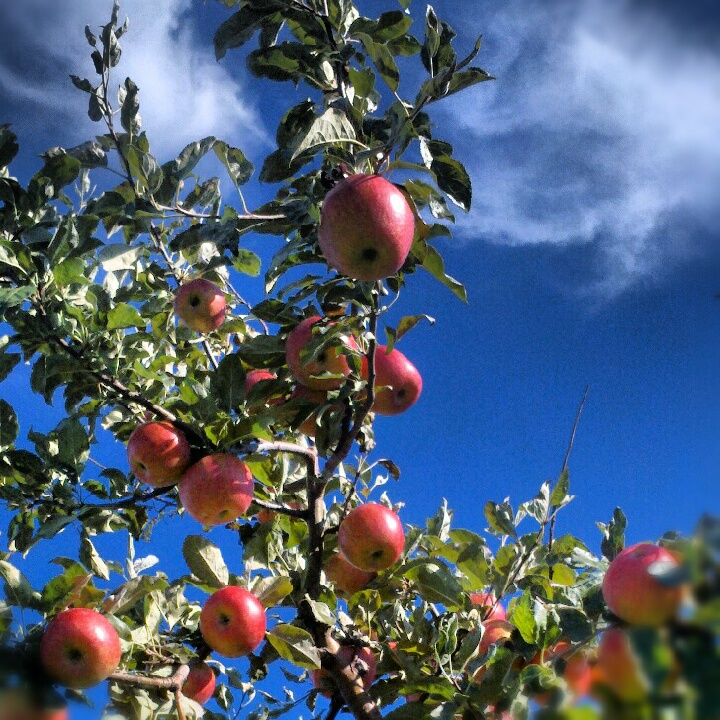
I experienced this in the middle of an apple orchard on a
beautiful autumn day just this past September.

IMG_20120911_194137Image: photo taken looking up at branches of an apple tree highlights ripe red apples against a bright blue sky

The leaves were just beginning to change, radiating warm
colors against a crisp blue sky. As soon as my kids got home from school, I
piled them into the car for our first apple-picking excursion of the season.

We arrived at the orchard just in time to hop onto the wagon
for a ride deep into the orchard. My 7 year old niece was with us. She was
filled with such excitement that even my teenage children were as giddy and excited as they were when they were her
age.

As we arrived at the designated section the tractor driver
instructed us to stay within the two red flags, giving us about 5 rows to pick
from.

It was a picture perfect day as we picked apples and nibbled
on a few as we went. My kids showed their younger cousin how to take a bite of
an apple while it remained on the tree, a favorite prank their dad had
taught them when they were young.

It was a perfect afternoon.

Once our bags were full we piled them onto the wagon and
climbed up for the ride back to the parking lot. By now we were hot, thirsty and ready to head home. I reached into my
pocket for my keys, only to find an empty pocket. After a long search at the
car we all piled back onto the wagon, explaining to the perplexed driver why we
were heading back into the orchard.

This time, as he told the newly arriving apple pickers to
stay in between the flags he also announced to the group that we had lost a set
of keys, asking people to keep their eyes out for them.

Walking up and down the lanes of trees over and over we
could not find the keys anywhere. Wagonloads of people came and went. Each new group was instructed to keep an eye out for our lost keys.

Nothing.

The kids reached their limit. So I called for help. My
sister came to drive the children home. My friend brought me the spare key I had
at home. Unfortunately, the spare key did not have a computer chip and was
limited to opening the doors. So it was of no use in starting the car.

A call to AAA informed me that a locksmith would be sent to
the orchard to make a new key for a mere $200!  My bagful of fresh apples was starting to look
very expensive!

As my friend and I
waited for the locksmith we decided to walk into the now-closed orchard for
one more look. My friend threw his keys onto the ground in front of me.
Pointing out how easily it should be to
see my lost keys in the grass

I was shocked. As the
search had drawn out for so long, I was now starting to feel like I was looking for a needle in
a haystack. How on earth could I be missing something so easy to spot?

We reached the
familiar red flagged area and as my friend began his search I felt like I was past
my limit.

The thought of walking down this same grassy tree line again
gave me a stomachache. It was as if I could not look for one second longer.

Then I heard a voice from within,  "change your perspective".

A little intrigued, I lifted my gaze from the muddy earth
and once again noticed the incredible view of the horizon that had filled me
with such surrendered joy only a few hours earlier.

I felt my body begin to relax.  As I scanned the horizon, breathing the beauty
in for the first time in hours, I suddenly caught the shimmering silver of my
keys!

They were chest high, hanging on a branch, five trees away from where I stood, deeper into the
orchard than I even believe I had gone! 

I actually paused before going to them as my brain
recalculated the impossible.

There is still no logical answer for how those keys got into
that tree. Everyone has his or her own idea of how this happened. Not one of them
seems logical.

Sometimes the miracles of life are just beyond the rules of
logic.

When we change our perspective, we just might let a little
magic into our life!


~~~~~~~~~~~~~~~~~~~~~~~~~~~~~~~~~~~~

SA_image2

As a clinical therapist, motivational presenter, author & teacher, Sheila's passion is to provide a forum for people to process emotion & integrate spiritual understanding into their daily lives. Her new book, Enchanted One: The Portal to Love, provides readers with a guide to embracing love in every moment. www.sheilaapplegate.com
In celebration of the release of Enchanted One, Sheila is offering this raffle contest for multiple chances to win one of two Amazon Gift Cards.

TAKE NOTE (if I may be so bold)! PLEASE… Share your thoughts and comments below and to show my appreciation and support I am making this special offer (in addition to the raffle contest offer above!).
(Click all links for details).

Congrats – and thank you – to Cindy Leland

Cindy purchased a copy of Stephen Kuusisto’s new book, , “Letters to Borges, and saved $ by taking
advantage of the pre-order price. In so doing, she also entered a random drawing
and is the winner this week of an autographed copy of “Only Bread, Only
Light”, Steve’s first book of poetry (Copper Canyon Press).

Will you be next week’s winner?

***************************************

Professor Stephen Kuusisto is the author of Eavesdropping: A Memoir of Blindness and Listening” and the acclaimed memoir Planet of the Blind, a New York Times “Notable Book of the Year”. His second collection of poems from Copper Canyon Press, “Letters to Borges,
is scheduled for release in October 2012.  In addition to giving
literary readings, Steve speaks widely on diversity, disability,
education, and public policy. www.stephenkuusisto.com

This week's winner…

Congrats – and thank you – to Erin Coughlin Hollowell.

Erin
purchased a copy of Stephen Kuusisto's new book and saved $ by taking
advantage of the pre-order price. In so doing, she also entered a random drawing
and is the winner this week of an autographed copy of "Only Bread, Only
Light", Steve's first book of poetry (Copper Canyon Press).

Will you be next week's winner?

***************************************

Professor Stephen Kuusisto is the author of Eavesdropping: A Memoir of Blindness and Listening” and the acclaimed memoir Planet of the Blind, a New York Times “Notable Book of the Year”. His second collection of poems from Copper Canyon Press, "Letters to Borges",
is scheduled for release in October 2012.  In addition to giving
literary readings, Steve speaks widely on diversity, disability,
education, and public policy. www.stephenkuusisto.com

“Creative Writing and Disability Studies: Liminal Epistemologies”

–“Life is a hospital where every patient is obsessed by the desire of changing beds.”
–Charles Baudelaire, Paris Spleen

1.

What can we learn from poetry about the body and the culture of bodies? Is what we see in a poem merely a figurative illustration of extrinsic historical or political truths or can a poem create a new and unforeseen nexus of identity and consciousness? As scholars concerned with the social construction of disability identity we know instinctively that the answer to the question is determined by our own rhetorical stance toward figuration. A poet is Aristotelian if she’s aiming to look beyond history for the subject of her poem. A poet is essentially Platonic if she is working in the service of verisimilitude. These categories aside we know that Ezra Pound was echoing Aristotle when he said that the poet is “the antennae of the race”. The Aristotelian imagination probes in the unknown space ahead and reports back to the great segmented worm of culture.The poet Richard Wilbur writes: “The mind is like some bat/ Beating about in caverns all alone/ Trying by a kind of senseless wit/ Not to conclude against a wall of stone.” Poetry is instinctive, far-seeing in its peculiar interiority, re-constructing the world that surrounds it. This vision of poetry holds that figurative language is exploratory, (neo)constructionist, progressive, lyrically alive.

2.

Again Baudelaire: “It always seems to me that I should be happy anywhere but where I am, and this question of moving is one that I am eternally discussing with my soul.” One can say that lyric poetry in general is concerned with moving as an operation that defies analysis. The soul is always the totem of irresolvable and competing desires. In poetry the soul is a synonym for the reliquary; it is a place. We position the furniture of our suffering in the soul’s room. But the lyric insists there is life outside the hospital–life beyond the ward. Notice that lyric poetry concerns itself with containment. One can add adjectives that work well with suppression: abject containment, unaware containment, irrational containment—disability studies scholars will recognize this impressionistic terrain as inherently akin to the historic figurative language of disability—the lyric concerns itself with the conditions of individual abjection and is always therefore a fit medium for exploring disability awareness. The modernist Italian poet Salvatore Quasimodo wrote the following lyric in the 1930’s as Italy was descending into Fascism:

And Suddenly It’s Evening

Each of us is alone
At the center of the earth,
Pierced by a ray of sunlight,
And suddenly it’s evening.

I don’t know of any more beautiful cris de couer from the Age of Existentialism. My feeling is that lyric discord, rendered almost always in figurative darkness represents the creation of what the Swiss psychoanalyst Carl Jung referred to as “individuation” a state where the conscious and unconscious modes of thought are brought into harmony. The condition of the mind in such poems is fearful, repressed, circumscribed, and lost. The lyric mindscape is blindness whether the poet behind the poem is literally blind or not. The lyric occasion does not represent blindness. It merely works from the epistemological and psychic locus of blindness. I do not mean figurative blindness but the very real step-by-step navigation of the unknown. The urgencies of perception are necessarily reckoned with care.

3.

Claiming disability (Simi Linton’s term) is to claim the lyric. In turn the lyric is the mode of poetry that best resists the falsifications of narrative imprinting. If people with disabilities have been exiled by history, by the architectures of cities and the policies of the state, then the lyric and ironic form of awareness is central to locating a more vital language. The exile that belongs to oneself,/the interior exile…(Richard Howard) We claim disability by lyric impulse. And by lyric impulse we rearrange the terms of awareness. The lyric mode is concerned with momentum rather than certainty. This is the gnomon of lyric consciousness: darkness can be navigated. The claiming of disability is the successful transition from static language into the language of momentum. But of particular importance in this instance is the brevity of the lyric impulse. The urgency of short forms reflects the self-awareness of blocked paths and closed systems of language. The lyric reinvents the psychic occasion of that human urgency much as a formal design in prosody will force a poet to achieve new effects in verse. Igor Stravinsky put it this way: “The more constraints one imposes, the more one frees one's self. And the arbitrariness of the constraint serves only to obtain precision of execution. We are in a hurry. We must tell the truth about the catastrophe that is human consciousness. And like Emily Dickinson who feared the loss of her eyesight we will tell the truth but “tell it slant”—the lyric writer may not have a sufficiency of time.

4.

Poetry about the body looks beyond the constraints of physicality. The lyric is in this manner a metaphysical pursuit. William Blake’s sick rose is the mandala of consciousness:

O rose, thou art sick!
The invisible worm,
That flies in the night,
In the howling storm,

Has found out thy bed
Of crimson joy,
And his dark secret love
Does thy life destroy.

The body is not our own. In lyric time the body is faced with the urgencies of the Elizabethan memento mori. This self-awareness we describe in terms of the body is equivalent to what disability advocates refer to as the condition of being “temporarily abled” but it’s useful to understand this condition as a crucial circumstance of imaginative and spiritual consciousness.
One thinks of T.S. Eliot’s narrator in “Gerontian”: “I an old man,/A dull head among windy spaces.” How should consciousness proceed in the company of the failing body? This has always been the lyric occasion. In her booklength poem an Atlas of the Difficult World Adrienne Rich writes:

I know you are reading this poem in a waiting-room
of eyes met and unmeeting, of identity with strangers.
I know you are reading this poem by fluorescent light
in the boredom and fatigue of the young who are counted out,
count themselves out, at too early an age. I know
you are reading this poem through your failing sight, the thick
lens enlarging these letters beyond all meaning yet you read on
because even the alphabet is precious.
I know you are reading this poem as you pace beside the stove
warming milk, a crying child on your shoulder, a book in your
hand
because life is short and you too are thirsty.
I know you are reading this poem which is not in your language
guessing at some words while others keep you reading
and I want to know which words they are.
I know you are reading this poem listening for something, torn
between bitterness and hope
turning back once again to the task you cannot refuse.
I know you are reading this poem because there is nothing else
left to read
there where you have landed, stripped as you are.

5.

Lyric consciousness is “stripped” consciousness. The word is menacing because the world is invariably opposed to youth, sexual freedom, multi-racial identities, disabilities, the poor…
In Adrienne Rich’s poem momentum and the deciphering of language are equivalent. The lyric occasion demands a larger future because it is the epistemological equivalent of the alphabet—
a new alphabet, one acquired in transition or in pain. Emily Dickinson thinks of this epistemological circumstance as an equation:

I reason, earth is short,
And angu
ish absolute,
And many
hurt;
But what of that?
I reason, we could die:
The best vitality
Cannot excel decay;
But what of that?
I reason that in heaven
Somehow, it will be even,
Some new equation given;
But what of that?

The lyric intelligence is Emersonian, ”transcendental” and concerned with instinctual knowing. Lyric poetry is not inherently opposed to materialism or the body—but neither is it concerned with the body as the figurative representative of spiritual or divine perfection. The broken body is as good as the one without blemish. But what of that? In this view the body is not a vehicle of transcendence. The lyric is akin to Emerson’s “other half” of man—the mind beyond the body’s confining narrative preoccupations with the establishment of a representational self.

6.

As it became a component of English departments the discipline of creative writing began to be understood as the teaching of craft. But the signature work of contemporary poetry has been concerned with the narrative constraints of identity politics and the languages of social enforcement. Poets as diverse as W.S. Merwin, Gregory Orr, Adrienne Rich, Olga Broumas, Primus St. John, Patricia Goedicke and hundreds of others have turned the lyric impulse toward the (re)visioning of social and intellectual freedom. It seems right that in “claiming disability” the work of poets should occupy more than passing interest to the emerging field of disability studies.
In turn the crucial question is “What can (re)visioning suggest in disability terms?”

7.

Walt Whitman is the progenitor of the “disability memoir.” His discovery of lyric prose, first as a hospice nurse, and then as a man experiencing paralysis represents the creation of a wholly conscious rendering of altered physicality in prose. Whitman begins his reminiscence in a wholly new mode. This is not the metaphorized body of the strapping, ideologically constructed man of robust, democratic labor:

Specimen Days

A HAPPY HOUR'S COMMAND
Down in the Woods, July 2d, 1882. — If I do it at all I must delay no
longer. Incongruous and full of skips and jumps as is that huddle of
diary-jottings, war-memoranda of 1862-'65, Nature-notes of 1877-'81, with
Western and Canadian observations afterwards, all bundled up and tied by a big
string, the resolution and indeed mandate comes to me this day, this hour, —
(and what a day! what an hour just passing! the luxury of riant grass and
blowing breeze, with all the shows of sun and sky and perfect temperature, never
before so filling me body and soul) — to go home, untie the bundle, reel out
diary-scraps and memoranda, just as they are, large or small, one after another,
into print-pages. (Whitman 689)

This is the lyric Whitman, the disabled poet working to shape and re-shape his memories as well as his present circumstances. He does so with fragments, jottings, things untied, things untidy, nature notes, bureaucratic memoranda… He is announcing his intention to create a “lyric collage” –and by announcing that this is for the printed page he is also announcing that this is a work of art, one created out of a new urgency.
Here is Whitman again, writing of his increasing paralysis and its effect on his ways of living:

Quit work at Washington, and moved to Camden, New Jersey — where I have lived since, receiving many buffets and some precious caresses — and now write these lines. Since then, (1874-'91) a long stretch of illness, or half-illness, with occasional lulls. During these latter, have revised and printed over all my books — Bro't out "November Boughs" — and at intervals leisurely and exploringly travel'd to the Prairie States, the Rocky Mountains, Canada, to New York, to my birthplace in Long Island, and to Boston. But physical disability and the war-paralysis above alluded to have settled upon me more and more, the last year or so. Am now (1891) domicil'd, and have been for some years, in this little old cottage and lot in Mickle Street, Camden, with a house-keeper and man nurse. Bodily I am completely disabled, but still write for publication. I keep generally buoyant spirits, write often as there comes any lull in physical sufferings, get in the sun and down to the river whenever I can, retain fair appetite, assimilation and digestion, sensibilities acute as ever, the strength and volition of my right arm good, eyesight dimming, but brain normal, and retain my heart's and soul's unmitigated faith not only in their own original literary plans, but in the essential bulk of American humanity east and west, north and south, city and country, through thick and thin, to the last. Nor must I forget, in conclusion, a special, prayerful, thankful God's blessing to my dear firm friends and personal helpers, men and women, home and foreign, old and young."

In lyric terms this prose is necessary to assure the poet’s survival. Gregory Orr’s useful polarities of lyric incitement come to mind: Whitman is experiencing “extremities of subjectivity” as well as the “outer circumstances [of] poverty, suffering, pain, illness, violence, or loss of a loved one.” As Orr points out: “This survival begins when we "translate" our crisis into language–where we give it symbolic expression as an unfolding drama of self and the forces that assail it” –see Orr's insightful book "Poetry of Survival" the most elegant analysis of crisis recast as fragmentary immanence.

SK

– Posted using BlogPress from my iPad

No Odd Job Too Small

Have you been pining for another deformed criminal mastermind?  Are you tired of all the clean cut post-modern corporate bad guys who can’t be distinguished from your local insurance agent?  Are "thrillers" and detective novels letting you down when what you need is some old fashioned freak show figuration?

Well rest assured.  The latest James Bond novel, "Devil May Care (James Bond) " written by Sebastian Faulks (under the imprimatur of Ian Fleming Productions) carries on the misadventures in the "Fleming-way" world of disability villainy.Devil_may_care  

The writing is terrible and you’ll have to stagger over more patriarchal cold war clichés than one supposed could be arranged between the covers of a single book, but that’s okay because the chief evil-doer is a dude named Gorner who used to be a Nazi but then became a Commie and all because "back in the day" when he was a student at a British prep school the other boys made fun of his deformed left hand.

Bond learns of him from "M" and here’s how it goes:

"The man crops up everywhere.  One of his hobbies is aviation.  He has two private planes.  He spends a good deal of time in Paris, but I don’t think you’ll have much difficulty in recognizing him."

"Why’s that?" said Bond.

"His left hand," said M, sitting down again, and staring Bond squarely in the eye.  "It’s a monkey’s paw."

"What?"

"An extremely rare congenital deformity.  There’s a condition known as main de singe, or monkey’s hand, which is when the thumb makes a straight line with the fingers and is termed ‘un-opposable’.  Being in the same plane as the other digits, it can’t grip.  It’s like picking up a pencil between two fingers." M demonstrated what he meant.  "It can be done, but not very well.  The development of the opposable thumb was an important mutation for Homo sapiens from his ancestors.  But what Gorner has is something more.  The whole hand is completely that of an ape.  With hair up to the wrist and beyond."

Something was stirring in Bond’s memory.  "So it would be larger than the right hand," he said.

"Presumably.  It’s very rare, though not unique, I believe."

Yep.  In "Devil May Care" (the title is completely irrelevant) you get a socio-pathologized Nazi-cum-Commie Social-Darwinized "missing link" who wears an oversized white glove in a vain attempt to hide his monkey paw.

The book aims for balance because Bond’s best friend, the redoubtable Felix Leiter of the CIA has lost a leg and an arm and now gets around on his true grit.  So you get dueling cripples in this book which of course makes the whole thing acceptable.

I can only add that this book should be divided into halves.  Each half should then be thrown away.  You can accomplish this whether your thumbs either do or do not work.

Trust me.

S.K.

Harriet McBryde Johnson: She will be deeply missed.

Last night over dinner with friends I learned that Harriet McBryde Johnson has passed away.

My first thought was: “How can we tell our sorrow from our bread?”

We had been talking around the table about untimely death. Not so long ago my friend Deborah Tall died young from breast cancer. She was just hitting her stride as a poet and editor. Her memoir “A Family of Strangers” (which was Published just weeks before her death) is a stunning accomplishment.

Now Harriet has died at 50.

America has lost a disability rights leader and a pioneering voice for dignity and justice.

I don’t want to write obituary prose. I can’t bring myself to do it.

Harriet McBryde Johnson’s wonderful memoir “Too Late to Die Young” should be on America’s summer reading list.

She had the unshakable determination to stand up for the rights of the disabled and she took on public figures who would demean or discount the lives of people whose disabilities scare the pants off of shallow “normates”.

When Jerry Lewis opined in a 1990 “Parade Magazine” piece that in his view being disabled must be like being half a person—Harriet McBryde Johnson took him on.

When Peter Singer opined that certain lives are not worth living she took him on.

She took people on in court as an able attorney.

She took on the Democratic party when it couldn’t see why Terry Schiavo’s story was more than just one family’s tragedy.

She fought for the dignity of human life and fought those forces that would diminish our human experience with sophistry and outworn symbolism.

She will be deeply missed.

Let us carry her flag.

S.K.

LINKS:

Yesterday, from Kay Olson’s The Gimp Parade, where you will also find numerous links to her writings:

Nm0900harriet_2
Overwhelmingly sad news today: Harriet McBryde Johnson has died at age 50.

Image
description: The photo shows Johnson in a flowered-print navy dress
looking toward the camera. She sits in her wheelchair, though the image
is a close-up focusing on her and not the chair. Johnson leans forward,
right elbow on knee, chin in right hand. She’s a middle-aged white
woman with dark hair in a very long braid trailing over her shoulder
and into her lap. She’s not quite smiling, but looking interestedly
back at you.

The Post and Courier of Charleston, SC, provides a preliminary notice, with a more formal obituary expected soon

Also:

Beth Haller from Media dis&dat,
at a loss for words,
Sad News,
RIP, Harriet McBryde Johnson

New Book: The Lolita Effect

I was out of town – As the mother of two I’m sorry I missed this reading… ~ Connie

University of Iowa News Release
April 25, 2008

Professor: profit motives behind sexualization of ‘tween girls

At Abercrombie & Fitch, little girls were sold thong underwear tagged with the phrases "eye candy" and "wink wink." In Britain, preschoolers could learn to strip with their very own Peekaboo Pole-Dancing Kits — complete with kiddie garter belts and play money. And ‘tween readers of the magazine Seventeen discovered "405 ways to look hot" like Paris Hilton.

This kind of sexualization of ‘tween girls – those between the ages of 8 and 12 — in pop culture and advertising is a growing problem fueled by marketers’ efforts to create cradle-to-grave consumers, a University of Iowa journalism professor argues in her new book.The_lolita_effect

Gigi Durham will read from "The Lolita Effect" at 7 p.m. Thursday, May 8 at Prairie Lights Books, 15 S. Dubuque St., Iowa City.

"A lot of very sexual products are being marketed to very young kids," Durham said. "I’m criticizing the unhealthy and damaging representations of girls’ sexuality, and how the media present girls’ sexuality in a way that’s tied to their profit motives. The body ideals presented in the media are virtually impossible to attain, but girls don’t always realize that, and they’ll buy an awful lot of products to try to achieve those bodies. There’s endless consumerism built around that."

Continue reading “New Book: The Lolita Effect”

Match Girls For Everyone!

Why do I hate novels with this kind of plot? And why are so many of them being written these days? The "young girl who leaves home without a plan and no clue novel" is everywhere This is the plot summary for Fay a novel by Larry Brown. Read on:

Fay Jones had no education, hardly any shell you can’t call what her father’s been tryin’ with her since she grew up "love." So, at the ripe age of seventeen, Fay Jones leaves home. She lights out alone, wearing her only dress and her rotting sneakers, carrying a purse with a half pack of cigarettes and two dollar bills. Even in 1985 Mississippi, two dollars won’t go far on the road. She’s headed for the bright lights and big times and even she knows she needs help getting there. But help’s not hard to come by when you look like Fay. There’s a highway patrolman who gives her a lift, with a detour to his own place. There are truck drivers who pull over to pick her up, no questions asked. There’s a crop duster pilot with money for a night or two on the town. And finally there’s a strip joint bouncer who deals on the side. At the end of this suspenseful, compulsively readable novel, there are five dead bodies stacked up in Fay’s wake. Fay herself is sighted for the last time in New Orleans. She’ll make it, whatever making it means, because Fay’s got what it takes: beauty, a certain kind of innocent appeal, and the instinct for survival.

I don’t mean to be disingenuous. I really don’t know why these match girl novels, almost exclusively written by men, are all over the place.

Is it simply a function of male boomers who now have daughters working out their conflicted feminist schadenfreude?

SK