Disability and Faculty Self-governance in the Age of Neoliberalism

When talking to faculty, students, and staff with disabilities who work or study at America’s colleges and universities, one quickly learns that higher education is broadly disinclined to treat disability in a concerted and efficient manner, but instead engages in widespread administrative deflection. From architectural barriers to simple pedagogical modifications colleges routinely drop the ball where equal access is concerned. So ubiquitous have these stories become one can browse the web for hours reading of school after school that has violated basic civil rights protections guaranteed by the Americans With Disabilities Act. From the University of Michigan, to Penn State to Harvard, one finds dramatic instances of disability discrimination. As a disability rights activist and professor who teaches that incorporating physical difference in the village square creates powerful opportunities and advantages I’m often asked why higher education performs so poorly. For many years I imagined these failures had simply to do with a basic financial resentment of the ADA, as one hears the widespread complaint from college administrators that it’s simply an “unfunded mandate.” The idea that barriers should be removed as a matter of civil rights is represented as a violation of libertarian principle. This seemed reasonable enough until over time I realized there’s a broader delegitimization of disability in the Ivory Tower and it’s only loosely connected to money.

In a recent interview at TruthOut Henry Giroux observes of Neoliberalism:

As a form of public pedagogy and cultural politics, neoliberalism casts all dimensions of life in terms of market rationality. One consequence is that neoliberalism legitimates a culture of cruelty and harsh competitiveness and wages a war against public values and those public spheres that contest the rule and ideology of capital. It saps the democratic foundation of solidarity, degrades collaboration, and tears up all forms of social obligation.


The past quarter century has seen the American academy shift from collaborative and democratic agreements about social obligations toward an embrace of monetized aggression. During this period the ADA has been overtly ignored by colleges of every kind. The two developments are syncretic, reflecting what Giroux rightly calls the failure to contest the rule and ideology of capital. It’s relevant to note in this context that “disability” first appeared in the mid-19th century as a term for laborers who’d been rendered unfit to work. The 20th century saw sustained advances in rehabilitation and employment services for people with disabilities, improvements which culminated in the passage of the ADA in 1990.

Neoliberal pedagogy and campus politics depend on limited faculty governance, the erosion of public debate, and the establishment of a culture of severe economic competition. Disability is re-inscribed as a 19th century problem. Accommodation services are sequestered—students are “sent” to ancillary offices for accommodations which they may or may not receive; faculty are taught nothing about pedagogy and disability; basic services like sign language interpreting or accessible technology are hard to find, and sometimes non-existent. At one liberal arts college where I recently spoke, a disabled student told me, “the disability office is hidden like an asylum.” Indeed. Disability is a drain on capital. Not because it’s an unfunded mandate but because after all is said and done, neoliberal visions of success are built as Giroux rightly says on cruelty and competitiveness.

Harvard and MIT are contesting the demands of deaf students and staff that instructional videos be captioned. Harvard’s opposition is symptomatic of the neoliberal university’s war on basic public values. In terms of governance Harvard’s resistance represents perfectly the academy’s abandonment of the principles of social obligation. But institutions only arrive at such a place when faculty are deterred from self-governance by the obligation to write endless grants and compete for provenance in the marketplace of capital ideas, when teaching and idealism are considered quaint and immaterial. In turn the civil rights of academic communities are “handled” by offices that are both physically and culturally distant from the “agora” or academic life of the campus.

The neoliberal campus relies on distention of self-governance and enforces centralized administration. Moreover it thrives on factionalism. A faction, as James Madison famously wrote in essay 10 of The Federalist Papers is a group “who are united and actuated by some common impulse of passion, or of interest, adversed to the rights of other citizens, or to the permanent and aggregate interests of the community.”

Because college faculty are often divided by competing interests and since some of these divisions reflect the complications and struggles of identity, it’s difficult to forge consensus about disability and disability rights—they seem tailor made for deflection, a problem for a specialized office. In other words, disability is often viewed by academics who are already narrowly factionalized as too difficult to embrace. As Lennard Davis notes in his book Bending Over Backwards: Disability, Dismodernism, and Other Difficult Positions:

Because disability is an amorphous identity with porous boundaries, other identity groups in the United States have had difficulty incorporating it into their goals. Previously legitimized groups such as Latinos or African Americans have been reluctant to admit disability into the multicultural arena. For example, in 1996 a disabled, white assistant professor at a historically black university found that the chair of the department and the dean of the school had recommended against tenure, saying that any analogy between disability and race was both methodologically unsound and insulting to the unique history of African Americans. For them, the categories of oppression were mutually exclusive and should not be mixed. After much public outcry from the disability community, the president of the university decided to award tenure to the assistant professor. Nevertheless, the issue of an identity defined by impairment as opposed to one defined by race or ethnicity is a sticking point for some. When some faculty members at Hunter College in New York City tried to include disability studies as part of the requirement for a multicultural curriculum, they were opposed by many of the ethnic and national groups that usually make up the progressive wing of the university. Hunter ended up deciding to omit disability from the curriculum.


From a disability studies perspective one sees how sectarian infighting among faculty concerned with categories of oppression can further the work of neoliberal administration, not by embracing the neoliberal brand of governance, but by replicating its effort to de-legitimize disability as a mainstream concern. De-legitimized disability remains in the province of non-academic offices. In turn university faculty fail to understand and embrace the nation’s largest minority. Such neglect reinforces a central fact of neoliberal administration which supports deflection where accountability is concerned and it represents rather broadly a further symptom of weakening faculty self-governance.


Me Before You, Benedict Arnold…

If disability is pictured as a thermometer one sees at the very top of the mercury scale “Courage” and at the bottom “Cowardice”—a register of willfulness or mind over matter which represents disablement as being entirely a state of mind rather than physical or neurological reality. How often does one have to endure the slogan: “the only disability is a bad attitude?”

Quite often it turns out. Courage is an easy word to bandy about. Whenever the first “c” word is used in media representations of the disabled, it’s invidious twin is suggested, as if living a crippled life is a stark affair when you roll down the street or follow your dog. You’re either heroic or you’re some kind of attitudinal traitor, a Benedict Arnold of the spirit.

Of course temporarily abled people don’t live this way. They’re not heroic in the supermarket, not cowardly when they shake their fists at drivers in front of them. The emo-thermometer is reserved solely for the cripple. I’ve lived with this fictitiousness all my life and if you’re one of my crippled readers I’m certain you have too.

Lately there’s been much consternation and outrage among disabled activists and their extended supporters about the film “Me Before You” as it depicts a paralyzed man’s decision to end his life, not merely because his disability is insupportable, but because he doesn’t want to burden the abled woman who loves him. The film is creepy, inauthentic, and ugly. What interests me however is it’s emo-thermometer reading: “Courage” becomes “Cowardice” or subsumes it in a way that suggests “the only bad attitude is a disability”—a twist that’s chilling and should alarm even the most seasoned viewers of films and television programs. Living with disability is presented in “Me Before You” as a traitorous act, a betrayal of love.

Love is presented as light while disability is dark and overshadows life. Now, ahem, life itself doesn’t work this way. In life trains arrive and depart, sunlight strikes the telephone wires, groceries are purchased, lawns are clipped—which is to say, life, living it, is, as any bird will tell you, simply a matter of the daily worm. Moreover living is essentially the hard thing, dying is easy.

This is what’s so objectionable about the film. Dying is easy. Disabled life is presented as a bad choice, a bad attitude if you will. “Me Before You” turns the standard (and already crappy) disability emo-thermometer upside down.

Ugh.


The National Doubt

R.D. Laing wrote: “Pain in this life is not avoidable, but the pain we create avoiding pain is avoidable.”
 
 I don’t think this is true. Let me be clear: I used to wish it was.
 
 I get Laing’s point of course. Repressed feeling leads to additional pain. As I often say to those who’ve asked me for emotional advice: “depression feeds on itself and occupies us.” Everything looks the same when we have the blues. The whole world becomes impossible to live in.
 
 Avoiding depression then, is a necessary task. One wishes to not fall under the sway of depression’s stories.
 
 Back to Laing: depression results in part from the avoidance of pain.
 
 But in the political world, a place Laing knew a good deal about, the adverse of his maxim is often true: the avoidance we create by avoiding pain becomes policy.
 
 Pain as policy requires a rhetoric of inevitability. By pretending we’re not avoiding it we fantasize about the health of the nation. A common example is the argument that Social Security can’t be sustained. Though the assertion is specious many Americans inevitably believe it because they’ve been taught to believe distress is inevitable.
 
 Since the majority of Americans want Social Security to continue the political class tables the business of fixing it. Neither do they overtly destroy it. The rhetoric of doom is reconfigured for the next election. The eventual death of Social Security is presented as being something natural like the expiration of the sun.
 
 We could fix Social Security in a jiffy if we really wanted to. But the avoidance of pain isn’t deemed good politics.
 
 Americans must be taught that there are no political solutions for pain.
 
 And so avoidance becomes policy.
 
 We could fix the nation’s roads and bridges.
 
 We could pay teachers better.
 
 Give veterans better health care.
 
 Take a stab at reducing the national debt.
 
 Because avoidance is policy politicians must cultivate a rhetoric of impossibility.
 
 And that of course is just about the only thing that works.


 – Posted using BlogPress from my iPad

The Art of Getting Disabled and a Short Rant

We talk about the art of getting naked or of flower arranging, but we never speak of the art of becoming disabled. In America disability is discussed simply as rehabilitation, as if living is no more complicated than lighting a stove.

The art of getting disabled is a necessary subject. When we look to history we find examples of this art everywhere. Disabled makers stand against loss. They make something of difference. When traveling in France Thomas Jefferson broke his wrist. A surgeon set the break badly. A major facet of his life was changed forever. He was forced to put aside his treasured violin. In turn he took up long, slow, leisurely horseback rides as a meditative practice.

Blind people don’t necessarily need dogs. White cane travel is a very fine way to get around. But I say guide dog travel is an art. It’s a means toward living much as Jefferson learned to live. Moving in consort with an excellent animal is one way to make a life. Art is mysterious. Some find a path to a certain form. Some find an unlike form.

Oh I know Jefferson sang to his horses. He was very fond of singing. Moving in consort requires it I think.

It’s hard to imagine singing to a white cane.
Do you need to sing to live well? No. I’ve a great good friend who is nonspeaking. But in turn his whole body is music.
My deaf friends sing.
“You got to keep something moving all the time,” said Huddle Ledbetter, otherwise known as “Leadbelly” when asked how he played the 12 string guitar.

Many of my wheelchair pals are dancers.
Several of my disabled friends are comedians.
We crackle, zip, exhale, inhale, sport with our fingers, flap, jump, pop wheelies, and jingle with harnesses.

Resourceful life is practiced. Sometimes it is silly. Art can and often should be frivolous. With permission from curators at the Museum of Modern Art I was once allowed to spin Marcel DuChamp’s famous wheel, a bicycle fork with front wheel mounted upside-down on a wooden stool. DuChamp was a DaDaist. He made art by placing things side by side that did not formally belong together. A MOMA staff member handed me a pair of latex gloves and I pulled them on and with Corky watching beside me, I reached out and gave DuChamp’s aluminum wheel a spin. “This is the steering wheel of my life,” I thought. Eccentric motion. A dog walking life not always understood by others, but simple and smoothly elegant.

No you don’t need a dog, or any other animal if you have a disability. Solo life contains its own joys.

I certainly know some blind folks who would say I’m over the top talking about art in the context of service dog life. I know people who say a guide dog is just a mobility aid. I’m fine with that. As long as they’re kind to their dog machines I’ve nothing to say about this view. To each his own. I have friends who don’t like poetry. I don’t think their worlds are harmed by their disinterest. All I know for sure is what a guide dog can do. Though the stationary wheel of your life seemed forever stopped, she says give it a turn. You’ll be surprised where the imagination can take you.

**

Nowadays one thing the blind have to contend with is service dog proliferation. There are many kinds of professionally trained dogs performing dozens of assistive tasks for disabled people. This is a very good thing in my view, as dogs and humans working together can change the world or at least the playing field. Service dogs are, in the strictest sense, dogs trained specifically to help the disabled manage one or more life functions that otherwise would be impossible.

In fact that’s what disability is — a function disjunction. The ADA makes it clear:
The term ‘disability’ means, with respect to an individual (A) a physical or mental impairment that substantially limits one or more major life activities of such individual, (B) a record of such an impairment or (C) being regarded as having such an impairment. Major life activities
include: but are not limited to, caring for oneself, performing manual tasks, seeing, hearing, eating, sleeping, walking, standing, lifting, bending, speaking, breathing, learning, reading, concentrating, thinking, communicating, and working.

Major bodily functions means: “functions of the immune system, normal cell growth, digestive, bowel, bladder, neurological, brain, respiratory, circulatory, endocrine, and reproductive functions.”

The range of disability is broad not because bureaucrats have big imaginations but because substantial limitations are wide spread in a complex society. In turn, when thinking of service dogs, I’m reminded of the digital slogan: “there’s an app for that.” Nowadays there’s a dog for almost any disability as canines assist wheelchair users retrieve objects, open cupboards, hand money to cashiers or help with balance, just to name a few of their skills. Dogs are trained to detect the onset of seizures or help hearing impaired people detect audible signals. Some dogs assist diabetics by sensing changes in blood sugar. There are dogs to help children with autism and dogs who accompany people with Post Traumatic Stress Disorder. All these skills reflect the amazing talents of dogs and the pioneering vision of the guide dog movement which started the service dog industry by pairing trained dogs with blind veterans.

Despite the acceptance and advantages of working dogs many who use them are experiencing increasing obstacles in public. One reason is dogs are often trained to help people with invisible disabilities. Many wounded warriors are being helped by extraordinary dogs trained to help with anxiety. Post Traumatic Stress Disorder is crippling but it can’t always be seen. Ironically, when a trained dog helps its owner stay focused and calm, his or her disability won’t be at all apparent. Legitimate service dog users are routinely denied entrance to public venues and are often humiliated. Lately the stories have been piling up on my desk — a service man and his superbly trained dog were recently booted out of a fast food restaurant; another veteran not long ago was denied access on a public bus. A legally blind woman, whose blindness allows her what’s called “residual vision” was recently hassled in a movie theater by another customer who argued loudly that she and her dog were fakes. As I say, the stories are legion. Not long ago I was prevented from entering a restaurant near Central Park by an overly officious doorman. He didn’t question my disability — he questioned whether my dog was legit.
Some argue these problems could be prevented by requiring service dog users to carry identification cards. But there’s a good reason we’re not compelled to do this — my disability is my business and not yours. Why should I have to disclose that I have a psychiatric condition or a neurological disease? Moreover the ADA defines a service animal as any guide dog, signal dog or other animal individually trained to assist an individual with a disability. If they meet this definition, animals are considered service animals under the ADA regardless of whether they have been licensed or certified by a state or local government.
The simplest way to tell if an a dog is a working animal is by its professionalism. If you’re a business owner the law does not force you to endure a misbehaving animal. In fact it’s the performance of a service dog that really matters — not just in traffic or in crowds, but everywhere. Public life is the goal for the disabled but I fear the village square is narrowing and has grown more covetous over the past decade. Not long ago a reporter for a major New York tabloid took her own badly behaved dog into a famous restaurant, telling the manager she had a disability, knowing full well she didn’t need to produce any proof. Then she ostentatiously encouraged her dog to eat off plates on tables. Her point? Anyone can bring his or her dog anywhere because of the specious ADA. Lost on on this writer is the hoary fact that people can imitate anything in America. If you wish, you can pretend to be a Rockefeller or dress as a priest. We’ve always been a nation of con men and the able bodied have always pretended to be disabled, imagining advantages like better parking or early boarding on airplanes. But here’s what I suggest: Look for the professionalism of the disabled and their companion animals and try to remember the village is open space, and we’re here: women, men and our dogs.


To Have Done with the Massacre of the Body: A Disability Perspective on Rachel Dolezal

I have been trying to think magnanimously about Rachel Dolezal’s self declared blackness, a venture that many who write critically about embodiment and society ought to attempt, if for no other reason than to interpret the difference between an emotional reaction to a cultural circumstance and a nuanced reading of the current moment. I can’t help but recall Jacques Lacan’s observation that to live in a body is to experience fragmentation, moreover, according to the principle of corps morcele, every man and woman lives out his or her imaginary anatomy. The self-consciousness of embodiment is one form of hysteria and it’s fair to say that in a culture where eating disorders, gender dysphoria, and the abjections that accompany physical flaws are legion, Rachel Dolezal’s story isn’t unique. The 24-7 news cycle insists we think so, demanding indignation because her black identification is merely a ruse. This is fair enough. It’s also fair to argue, as many have, that her “act” was possible only by virtue of white privilege. Others say that by pretending to be a woman of color she stole public positions that ought, rightfully, to have gone to an authentic black person. Yes, the story is a mess. Add the long history of miscegenation and “one drop” jurisprudence and Dolezal’s act appears cynical and perhaps even cruel.

I’m a blind person. For many years I tried to prove I could see because my parents said appearing sighed was crucial for me. My story isn’t unique. Many people with disabilities struggle to accept their bodies. Beyond acceptance one learns about the body politic—the values assigned to bodies are often the products of sinister histories. But I digress. I know a little something about pretending to be someone else, and I know a good deal about not liking the corps morcele. Did I do damage to people back in the days when I pretended I could see? I think so. I made other people hostages to my circumstance—I needed people to accompany me even as I feigned capacities of self-determination I didn’t possess. Deceit isn’t good for the deceiver and it pollutes his surroundings.

And so, back to my earlier point—Lacan’s really—that all of us live in our imaginary anatomies. These visions can be strictly compensatory, like thinking you’re athletic when you’re not. Or telling yourself you can see when in fact you can’t. Or they can be artfully constructed and exceed simple escapist desires. Who would not say Ru Paul isn’t authentically alive and dazzling?

Let us all play act at being one another. There is more health in constructive imaginations of embodiment than there is in culturally enforced denial. We need new public narratives for Lacan’s fragmented anatomies.

What if we applauded people for telling us how they really feel on the inside?

In his famous essay “To Have Done with the Massacre of the Body” the French philosopher Felix Guattari wrote:

No matter how much it proclaims its pseudo-tolerance, the capitalist system in all its forms (family, school, factories, army, codes, discourse…) continues to subjugate all desires, sexuality, and affects to the dictatorship of its totalitarian organization, founded on exploitation, property, male power, profit, productivity…Tirelessly it continues its dirty work of castrating, suppressing, torturing, and dividing up our bodies in order to inscribe its laws on our flesh, in order to rivet to our subconscious its mechanisms for reproducing this system of enslavement.

With its throttling, its stasis, its lesions, its neuroses, the capitalist state imposes its norms, establishes its models, imprints its features, assigns its roles, propagates its program… Using every available access route into our organisms, it insinuates into the depths of our insides its roots of death. It usurps our organs, disrupts our vital functions, mutilates our pleasure, subjugates all lived experience to the control of its condemning judgments. It makes of each individual a cripple, cut off from his or her body, a stranger to his or her own desires.

What I saw this week in moist and spasmodic reaction to the Dolezal affair was affirming of Guattari—which is to say, the outrage may have a great deal to do with repression, the condemning judgments may be designedly disruptive, assuring we will not talk about the provisional anatomies we’re forced to live under the flag of “norms”.


Starbucks and the “Racing Together” Dilemma

When Trayvon Martin was murdered (and I’ve no compunction saying so) I published a blog post saying race and disability are linked by stigmatizing architectures. I wrote from an outlier’s position as I’m a blind man whose presence in public is nearly always conditional. One thing my friends of color and my pals with disabilities (and yes, sometimes they’re the same) know is that nowadays there are more gated spaces in the US than ever. Some places have patrolled fences while others offer no signs of implicit exception. All outliers understand that when you transgress—when you expect to enter closed spaces you’ll be sized up. I said:

As a person who travels everywhere accompanied by a guide dog I know something about the architectures and the cultural languages of “the gate” –doormen, security officers, functionaries of all kinds have sized me up in the new “quasi public” spaces that constitute our contemporary town square. I too have been observed, followed, pointed at, and ultimately told I don’t belong by people who are ill informed and marginally empowered. Like Trayvon I am seldom in the right place. Where precisely would that place be? Would it be back in the institution for the blind, circa 1900? Would it be staying at home always?

Tippy-toe-racist-ableist-architecture isn’t new. Slavery was always architecture. And the “ugly laws” kept cripples off the streets of America for a century. Yes, we’re living in a time of vicious retrenchment. Enter Starbucks.

By now almost everyone knows the CEO of Starbucks, Howard D.Schultz  launched a campaign called “Racing Together”—baristas were instructed to write the phrase on every coffee cup sold. Starbucks’ aim was to start a national conversation about race. I’m saying the motive was good but I’m also scratching my head, for Mr. Schultz must have imagined his franchises are genuine 18th century coffee houses where informed citizens gather regularly to exchange ideas and conduct solemn conversations. I love the notion. I enjoy picturing Samuel Johnson seated across from me, slumped in a leather chair, hoisting his mocha latte, and cheerily dissecting our manners.

I fear Mr. Schultz had a good idea but oddly, inexplicably, misunderstood what the average Starbucks essentially is. Note: I’m not claiming his coffee shops are gated spaces (though some may be) nor am I saying conversations about tricky subjects shouldn’t happen—for I believe our nation is woefully indisposed to the art of engagement. In fact I care so much about conversing I even wrote a book about it called Do Not Interrupt: A Playful Take on the Art of Conversation.

No. I think Mr. Schultz forgot that for over sixty years, Americans have been schooled by Madison Avenue to think they deserve a break today. Although the slogan was originally coined for MacDonalds, it stands for the advertized appeal of every commercial space. The slogan was also accompanied by the claim: “at MacDonalds it’s clean.” The subtexts are variable but one thing’s for sure: you shouldn’t feel guilt when spending money on junk food (you deserve it) and you have every right to expect the place where this food is sold offers “time out” from your daily troubles. All franchise businesses in the United States sell these presumptions.

In fact, so trouble free are these franchises imagined to be, their managers often run afoul of the Americans with Disabilities Act. There are frequent stories about people with service dogs, mothers with crippled children, deaf people trying to sign—all experiencing discrimination in fast food venues.

Some gated communities are entirely created by the advertising industrial complex. (How can the Hamburglar cheer up the tots when there’s a motorized wheelchair user at the next table?)

Where would the right place be for coffee and conversation about outliers when long ago we sold the vision that fast food restaurants are fully sanitized for our protection?


The Real Scandal at Hobart and William Smith Colleges

Last Sunday a front page article in the New York Times detailed a horrific series of events that occurred not long ago at Hobart and William Smith Colleges in Geneva, New York. The headline alone is awful: “Reporting Rape, and Wishing She Hadn’t: How One College Handled a Sexual Assault Complaint”. Summarizing the story runs the danger of trivializing a tragedy but here are some necessary bullet points:

  • A young woman, who goes by the name of “Anna” in the article woke up after a night of heavy drinking with hazy memories of the night before. Her vagina was bruised. She’d had forcible sex. She remember parts of the evening and not other parts.

Sub-set: she received alcohol at a fraternity on campus. Underage drinking is illegal. Giving alcohol to “minors” is illegal. There are no exceptions to this law.

  • A student saw Anna being raped in a campus dance hall and reported it.

Subset: according to the eyewitness there were several students cheering on the rapist.

  • The Colleges’ in house investigation found no cause to expel the boys involved.

Subset: the boys were football players.

Subset: as the New York Times correctly reports—“It took the college just 12 days to investigate the rape report, hold a hearing and clear the football players. The football team went on to finish undefeated in its conference, while the woman was left, she said, to face the consequences — threats and harassment for accusing members of the most popular sports team on campus.”

  • The local police were out of their depth investigating the conflicting stories.

Subset: the police investigation has haphazard and transcripts show inaccuracies.

  • The woman endured hate speech and threats.

Subset: this alone is sufficient to expel people from college.

You can read the story yourself. It is filled with tawdry vignettes and extravagant mistakes, misrepresentations by the accused, and the usual competing narratives from bystanders and officials that appear in every tragedy.

Make no mistake. This story is a tragedy.

The Colleges were quick to release not one, but two statements. First there was an email to the “community” from the Presidents Office. Then a letter to the New York Times from the Chairwoman of the Colleges Board of Trustees.

Talk about Typhoid Mary. If there was a way to infect a bad story with more contagion, Hobart and William Smith found it. They declared the New York Times left out their side of the story and added that because of limitations imposed upon them by the federal privacy act FERPA there are facts the school can’t reveal. There’s another reason the school can’t reveal anything—they’re under federal investigation because of this case.

Here is where I must disclose my own relation with Hobart and William Smith Colleges. I’m the son of a former president of the school; an alum, and a former dean and faculty member. I’ve held tenured positions at Ohio State, the University of Iowa, and now at Syracuse University where I teach in the Center on Human Policy, Law, and Disability Studies. I know from broad experience that small and even large institutions of higher education are capable of circling the wagons in the service of their own self interest.


While I don’t know all the facts about Anna’s story at HWS, I know this: there’s a thing called citizenship. Underage drinking, sexual impropriety, hate speech, any one of these justifies taking action against students. Let’s forget the rape allegations for just a minute. Let’s forget about whether or not the staff of the Colleges review committee was competent to hear a rape case. The men in this story were and are guilty of profound misconduct. By pretending the New York Times story is about the “provability” of Anna’s contention trivializes the very notion of community that President Gearan and the Board of Trustees now say they care so much about.

This is for me the most disheartening thing of all.


Disability and the Radial Republic

NewImage

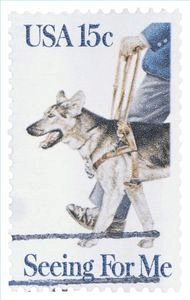
US Postage stamp honoring guide dogs, picturing Morris Frank and his pioneering American guide dog Buddy, a German Shepherd. Beneath them it says: “Seeing For Me”


I haven’t been posting on my blog lately. Sometimes the limbed life of physical difference is overwhelming and one feels a temptation to lie down in the long ditch of sadness. The largest psychiatric hospital in the United States is the Los Angeles County Jail. Veterans with disabilities  since 9/11 face extraordinary obstacles to employment. Rehabilitation services for all persons with disabilities are underfunded. 70% of the disabled remain unemployed in the US. Only one quarter of matriculating college students with disabilities actually graduates. Long standing charities like guide dog schools are experiencing a general decline in philanthropic donations—Baby Boomers and their children aren’t as generous as “The Greatest Generation” it seems. 


Meanwhile the toxic and shrill bloviating of politicians like Paul Ryan (who argue social programs are the root of America’s financial problems) helps to convince Americans that generosity and fairness are nearly unpatriotic—and would this were not so—for giving hard working and ambitious people with disabilities a shot at the American Dream ought to be deeply carved on the entablatures of our public buildings. 


What do I mean by a “radial republic”? Many things of course but principally a renewal of the social contract—our American contract which has grown stronger after every war and which has assured veterans with disabilities will be properly assisted, treated, educated, and welcomed. What do I mean by a radial republic? As we nurture disabled vets we assist all Americans with disabilities. Many people know I’m a guide dog user but I’m willing to bet that most of my readers don’t know that guide dogs (or “Seeing-Eye Dogs” as they’re sometimes called in the US in homage to North America’s first guide dog school which is named “The Seeing-Eye”) are the product of rehabilitation work in Germany at the end of WW I. 


Halfway through the First World War a German physician, Dr. Gerhard Stalling introduced a blind veteran to his pet dog. The two men were in a hospital garden when Stalling was suddenly called away. When he came back the soldier whose name is now lost, was laughing as the dog licked his hands. Stalling saw dogs might be trained to guide the blind. The war had produced an astonishing number of blind veterans. The total number of wounded from the first world war remains unknown but during the four and a half years of the conflict 230 soldiers died every hour. 11% of France’s entire population was killed. The ten month Battle of Verdun in 1916 caused over a million casualties. Chlorine and mustard gas killed nearly 90,000 troops and left one and a quarter million men permanently disabled. Blindness was a common result of gas warfare and one of John Singer Sargent’s most famous paintings (“Gassed” 1919) depicts a ragged line of soldiers, their eyes bandaged, all the men walking in a line, each man’s hand on the shoulder of the man before him—with two sighted men in the lead. The sky is yellow above a field of corpses. 


Trench warfare included working dogs. Germany employed 30,000 dogs in the field and their work was divided according to need. Sentry dogs were used on patrols. They were taught to give warning when a stranger entered a secure area. Scout dogs were also used. Their job was more refined—they accompanied soldiers on reconnaissance and had to keep quiet. They could detect the enemy at a distance of a 1000 yards, “scenting” and pointing. 


Casualty or ‘Mercy’ dogs, also known as ‘Sanitatshunde’ were trained to find wounded or dying soldiers in the heat of battle. They carried medical supplies on their backs. The wounded could use the supplies if they were able, or they could count on the Mercy Dog to wait with them as they died.


Dogs also ran long distances across battle fields carrying messages, often during artillery attacks. The heroism of working dogs was well known on all sides. The Germans employed 30,000 dogs during the war. British and French forces had approximately 20,000 dogs in the field.    


The guide dog was a consequence of war. Because dogs had proved themselves capable of miraculous work under the worst battle conditions ever seen, it was clear to Stalling war dogs could be trained to help the blind navigate post-war streets which were suddenly filled with automobiles. With a small group of military dog handlers Stalling began training dogs for blind soldiers. Old photos show trainers and veterans working with German Shepherds, all the men wearing peaked hats and long wool coats. In addition to harnesses the dogs wore tunics bearing the Red Cross logo—the insignia of the battle field “mercy” dog.   


Stallings idea captivated the public’s imagination. An official guide dog school opened in in Oldenberg in 1916. The sight of veterans and dogs working in traffic was powerful and seemed natural. In popular imagination blind people had always been accompanied by dogs: a first century mural in Roman Herculaneum depicts a blind man with his dog.  A 19th century woodcut from the United States shows a blind man from Boston being lead by a dog and crossing the Commons. Such pairings were likely the products of serendipity—the blind and their dogs forged relationships by necessity. The history of blindness is filled with sorrow. Before reforms like Social Security and organized rehabilitation services were created in the 20th century, the blind often begged for food and shelter—some played musical instruments—many wandered searching for compassion. Dogs helped ease their loneliness and offered untrained navigational assistance.    


Sometimes I like to joke by saying the guide dog is the only good thing every invented by the German Army. This may be true. But what is true is that rehabilitation programs for disabled veterans impact the broader republic. Nowadays when an autist, or a deaf person is accompanied by a trained service dog we can and should give thanks to Dr. Stalling. And in turn we should be seeking with all our Republic’s strength to carry on the difficult work of lifelong optimism that disability rehabilitation and education calls for. 


I’m not fond of the term “wounded warrior” precisely because disability isn’t a wound—it may heal in some dimensions, but in others it will always be present. A commitment to people with disabilities in general and to veterans in particular means understanding the full arc of life. The radial republic means giving people with disabilities and equal shot at education, travel, vacation, family, housing, medicine, you name it. 


Making this happen benefits all.


Thank you to The Huffington Post

I’d like to thank The Huffington Post for allowing me the privilege of being an occasional guest blogger.  I am honored to have this opportunity.

Steve_Corky_GEBIn this post titled Dogs on the Playing Field I discuss the role of professionally trained service dogs serving people with disabilites in the U.S. today and ask (and answer) this question: …even 23 years after the passage of the Americans with Disabilities Act and 70+ years since the introduction of guide dogs in the U.S. life in public isn’t always friendly. Lately it seems more unfriendly than at any time since the late 1930s when the blind had to fight for the right to enter a store or ride a public bus. What’s going on?

I am grateful to The Huffington Post for allowing me the use of their platform to explore this issue.  You would “make my day” by stopping by and sharing THIS POST with your social circles.  Thank you!

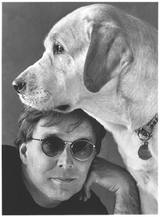
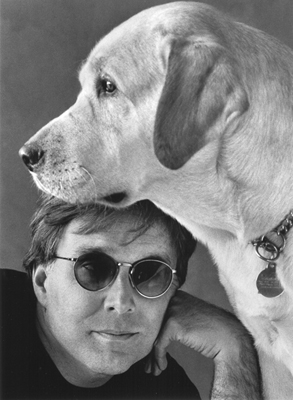
Photo: author Steve Kuusisto being guided by yellow Labrador, guide dog “Corky”, circa 1995.

Dog Schmooze

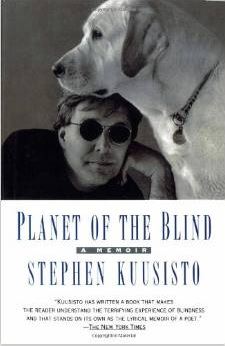
Professor Stephen Kuusisto is the author of Eavesdropping: A Memoir of Blindness and Listening” and the acclaimed memoir Planet of the Blind, a New York Times “Notable Book of the Year”. His second collection of poems from Copper Canyon Press, “Letters to Borges has just been released. Listen to Steve read “Letter to Borges in His Parlor” in this fireside reading via YouTube. He is currently working on a book tentatively titled What a Dog Can Do. Steve speaks widely on diversity, disability, education, and public policy. www.stephenkuusisto.com, www.planet-of-the-blind.com

NPR: Unfit to Write About Disability

There’s a piece by Chana Joffee-Walt on NPR’s website entitled “Unfit for Work: the Startling Rise of Disability in America” which is so ill informed about its subject it reminds me of one of those Ronald Reagan stump speeches. Driven by anecdote rather than cultural analysis, her thesis is simple: the number of unemployed Americans receiving disability benefits has skyrocketed over the past twenty years. She intimates without fully declaring it, that there’s a vast social “scam” taking place–in the absence of good middle class jobs, and following the “end welfare as we know it” enterprise, poor people simply decline into aches and pains, thereby getting themselves declared unfit for work.

Alas, Joffee-Walt hasn’t done her homework, a matter that may be inapparent to many of NPR’s readers, just as Reagan’s audiences were unaware that behind the curtain the Gipper believed “facts were stupid things” and was untroubled by any and all of the misrepresentations of social programs that propelled his candidacy for president. Such arguments depend on pathos rather than facts. Joffee-Walt fails to address the biggest fact in the room, that disability is a social construction even more than a medical category, and in turn the artificial architectural and physical constraints marshaled against people with disabilities are both products of history and the industrial revolution. One wishes she had bothered to read Lennard J. Davis’ essay “Constructing Normalcy: The Bell Curve, the Novel, and the Invention of the Disabled Body in the Nineteenth Century”. Disability is entirely economic and has been so since the move to industrial models of labor. Those who cannot work in the factory were labeled “disabled” and that model of human economic utility largely continues to this day. Reasonable accommodations are the solution for workers whose physical capacities decline but as any seasoned person with a disability who has managed to remain in the workforce knows, obtaining accommodations is often so difficult, so humiliating, so Kafka-esque, most people give up.

70% of the blind remain unemployed in the United States, many of whom might well be able to work with the proper accommodations but employers don’t want to provide accommodations fearing the expense, though in point of fact most workplace accommodations are relatively inexpensive. Think of a laborer, someone who is required to lift boxes. He suffers a ruptured disc. He can’t lift boxes. Perhaps he could be retrained to work with software. Most businesses resist this kind of accommodation, preferring medical and social determinations that are no more sophisticated than those the Victorians had.

Another way to say this is that a nation that believes in work is also a nation that believes in accommodations. Joffee-Waitt misses this dynamic and ongoing dialectic and fails to illuminate the true nature of disability and joblessness. 

~~~~~~~~~~~~~~~~~~~~~~~~~~~

Professor Stephen Kuusisto is the author of Eavesdropping: A Memoir of Blindness and Listening” and the acclaimed memoir Planet of the Blind, a New York Times “Notable Book of the Year”. His second collection of poems from Copper Canyon Press, “Letters to Borges has just been released. He is currently working on a book tentatively titled What a Dog Can Do. Steve speaks widely on diversity, disability, education, and public policy. www.stephenkuusisto.com, www.planet-of-the-blind.com