Don’t Think Twice, It’s Alright, or, Traveling with a Guide Dog

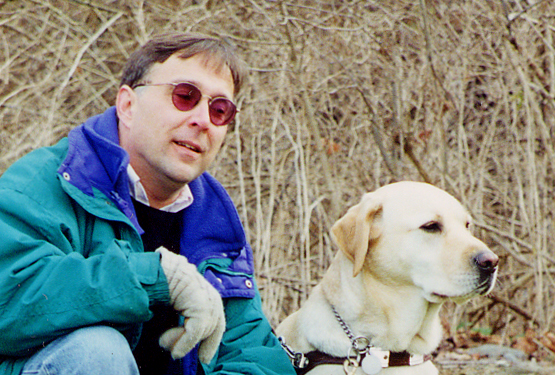
When, as I do, you travel everywhere with a guide dog public space becomes a confessional of sorts. It’s a rare day when a stranger doesn’t approach to say, “I had a dog like that once, but he died,” or, “Labradors, they’re the best dogs in the world, but mine’s dead.” The first time this happened I was a newbie guide dog user, alone, in the Pittsburgh airport, and a woman said, “I had a dog like that once, but someone poisoned it.” She had an overpowering minty odor and kept snapping her fingers. My dog and I ran away from her.

It took some time but I began to see these encounters as having nothing to do with dogs. Or the dog was simply a calling card. My guide dog Corky meant in the eyes of passersby that I was approachable and might well have a heart. A more sinister variant was that being blind they might believe I couldn’t escape—like a hapless passenger on the Greyhound. I chose not to believe the latter. I am, essentially, a boy scout, (OK, not really) but I do believe in kindness and I’m as naive as the next man, or woman, and what the Hell, I thought, it costs me next to nothing to talk to wounded, anomalous weirdoes.

Of course “next to nothing” is just faux metaphysics—it did cost me. You can’t absorb the griefs of subway riders and ballpark fans without grinding your bearings. Three years into guide dog life I understood that the village square is filled with Tennessee Williams characters, lots of Blanches and Stanleys whose hearts are so broken they’ll think nothing about approaching a blind man to talk about the deaths of their pets. And I saw that behind the stories of doggie demise were divorces, run away children, job losses, car accidents, so that I wanted to weep for our strangeness. This is a high gravity world.

As a poet this wasn’t big news to me. About suffering they were never wrong, the Old Masters. Not only is it always occurring, but we’re invited to look away. Unless, that is, you go absolutely every place with a dog. On the airplane. In the shopping mall. Riding escalators. Then all bets are off. A guide dog user becomes a mark. In effect I became a walking minister. A circuit rider. My Finnish grandfather was a Lutheran pastor who preached to immigrant congregations in Minnesota and Wisconsin. I saw Corky was my Model T Ford. The common street was our patch of souls.

I’m an irreverent fellow. But I couldn’t laugh at the unbidden, constant sadnesses of happenstance people. And I couldn’t let them dominate me as the price of listening. Nor could I let them ruin my days. Her dog had been poisoned. His dog lived to be fifteen but succumbed to joint disease. Her dog got stolen. His was shot by hunters. You’re sipping coffee. You’re sitting on a bench. The sorrowing come to you like birds.

The trick as I saw it, was to abandon belief in fairy tales. The guide dog schools like to say that with a dog the blind have newfound horizons, freedoms, opportunities, etc. They’re right. But one aspect of freedom is that you’ve become a citizen like anyone, and yes, because of your dog you’re interesting. I listened. Still listen. Just enough. Then I say, “I’ve got to get back to reading,” and put on my headphones. Or tap my talking watch, then say, “nice talking, but Ive got to go.”

My guide dog brought me love. It cuts both ways: I’ll be your confessor, I’ll be on my way.

The Washington Post’s Distorted View of Rural Disability

The Washington Post has published an article that purports to examine a steady increase in disability Social Security claims by poor families. Under the heading “Disabled America” the headline bellows: “One Family, Four generations of disability benefits. Will it continue?” If you’re disabled like me and you’ve a sense of disability history you have to shudder since the half-rhetorical question evokes an edict by Supreme Court Justice Oliver Wendell Holmes who infamously wrote: “three generations of imbeciles are enough” in Buck vs. Bell, a 1927 ruling that upheld the right of Virginia to sterilize “mental defectives” without their consent. (You can read more about the case here.) In short, the Post’s headline raises the specter of eugenics whether the writer or editor knows it or not. Either way its fair to say “shame on them.”

Shame also for committing the journalistic equivalent of what I call “Betsyism” for Betsy DeVos who presides loudly over our education system without experience, knowledge, or curiosity. Only Betsyism, the willful extrusion of facts for ideological purposes explains the Post’s perfervid and ill informed article. Why is it ill informed? Because like other mainstream media forays into the subject of disability and Social Security there’s only a singular narrative: the US is filled with fake cripples who are stealing from good old you and me–a story that received considerable traction two years ago when the redoubtable radio hipster Ira Glass rebroadcast (without journalistic fact checking) a spurious story from Planet Money asserting phony social security disability claims are officially out of control in America. The provenance of the story hardly mattered to Glass, who, when confronted with its falsehoods simply declared himself a journalist and shrugged. It mattered not at all to the doyen of “This American Life” that the tale was largely the dream child of a notorious rightwing think tank, or that the outright falsehoods contained in the broadcast might do tremendous damage to the disabled. Falsehoods about the powerless play well.

One also remember’s NPR’s broader foray into this terrain when Chana Joffee-Walt launched a blockbuster series of stories about disability benefits. Her stories argued there’s a massive fraud taking place, that the number of people claiming disability benefits has gone up alarmingly. What’s of interest from a disability studies perspective is that Joffee-Walt offered (as a means of laying the foundation for her story) that there’s no medical diagnosis for disability–a matter that she found shocking.

Disability isn’t a medical condition for obvious reasons: the limitation of function that renders a person “disabled” depends on multiple factors–some have etiologies, some have a great deal to do with structural and social barriers. This is why scholars who study disability do so through both medical and social analyses. A Betsey-esque analysis lacks this sophistication and suggests poor people with disabilities should be held as suspect for not being–well, rich. Or as Herman Melville put it: “Of all the preposterous assumptions of humanity over humanity, nothing exceeds most of the criticisms made on the habits of the poor by the well-housed, well- warmed, and well-fed.”

The Post’s article (which I won’t summarize) argues that poor people beget intellectually disabled children—actually pray to have them—for kids with bi-polar disorder or who are on the so-called autism spectrum are trailer park cash cows. A la Betsyism if you want people to believe an elitist narrative, startle them with the nefariousness of poverty as Reagan did with his mythological story about a welfare cheat who owned several Cadillacs. If you want readers to evince a collective moue of disgust tell them about real life hillbillies who are just like the characters in Katherine Dunn’s novel Geek Love—circus performers who’ll do anything they can to have crippled and deformed children—this is the insidious face of American poverty. Don’t tell your readers that impoverishment increases the likelihood of illness, that the lack of access to prenatal care and education increases the probability of childhood disability. Don’t tell them that the absence of accommodations in pre-school and all subsequent schooling assures failure for children with intellectual disabilities. Don’t tell them. Just insinuate the poor are up to dirty tricks. Don’t remind your readers that Adolf Hitler called the disabled “useless eaters.”

Denied a Cab Ride, Grieving for Who We Are…

Tomorrow I’m heading to the University of Michigan to participate in a program on accessible publishing hosted by the UM Press and the University’s library. As a blind writer who teaches I know as much as almost anyone about how difficult it often remans to get access to books, journals, online publications, websites, software platforms—it’s a long list. So my hat is off the the folks in Ann Arbor for taking seriously the challenges of access for people with disabilities and putting together an ambitious workshop on accessibility.

In a mood of warm anticipation, packing for my trip from Syracuse to Detroit, I was wholly unprepared for the mean spirited encounter I had by phone with a cab company in Ann Arbor this afternoon. Just recounting what happened is an exercise so objectionable I’m forced to be brisk as the altercation was nasty.

I told the man who answered the phone I needed a ride from Detroit-Ft. Wayne airport to the U of Michigan. He was agreeable. Then I said I had a guide dog. He was disagreeable. He said:

“These dogs are stinky, they go to the bathroom, they’re dirty, I can’t have them.”

“Not the first time this has happened to me,” I thought.

“Guide dogs are allowed everywhere,” I said.

“I don’t care, now you’re going to tell me all about your rights,” he said. (Sneering, he was. Your rights…uttered as if I was some whiny baby.

“Well yes,” I said, “it’s a violation of state and federal laws to deny a blind person and his dog a cab ride.”

“I don’t care,” he said.

“You should care,” I said. “It will become a big story. Plus there’s a huge fine associated with this.”

“I don’t care,” he said.

“This will become a news story,” I said. “I myself write for newspapers like the New York Times…)

It’s hard to describe the effect this had on him. He began shouting that Donald Trump had won the presidency and “you people” (apparently meaning blind New York Times readers) “don’t matter anymore.”

He was absolutely vicious and crowing about how people like me don’t matter.

I said, “well, I’m going to turn you in to the Department of Justice.”

He said he didn’t care.

I hung up.

I went upstairs to tell my wife.

Five minutes later he called me back.

I answered.

He said, “I have allergies.”

He’d apparently shared his conversation with someone else. This was his effort to pull his leg out of a hole.

“It doesn’t matter, you still violated my civil rights,” I said.

He began abusing me again. Hot, geothermic mistreatment.

I hung up.

I posted his company’s name and phone number and a description of what I’d experienced on Facebook.

I didn’t know the man’s name.

He apparently received dozens of phone calls throughout the afternoon, including some from the press.

He’s now claiming victim status. He has allergies. He can’t be expected to take a passenger with a service dog.

The law is very clear on this matter. He doesn’t have to. All he has to do is find me a cab that “will” take me.

He chose contempt and mean-spirited bullying.

Some people on Facebook have messaged me to say he now regrets the matter.

Me too.

Whatever happened to saying, “hey, I know all about having a physical condition! I have one myself. I can’t help you but I’ll get you someone who can.”

Instead he went into a rebarbative snarl and wouldn’t stop.

He apparently told someone on FB that I ruined his day.

I have in fact filed a formal complaint with the Department of Justice and the Michigan Department of Civil Rights.

I’m still shaking. I want to close by saying I’ve heard promptly from the U of Michigan. They’re as upset as I am.

Is Trump’s ascendancy now a patented script?

If you hail from a historically marginalized group you know the answer.


More About Teaching with a Dog

I knew one in five of my students likely had a disability; that one in four had probably been assaulted sexually; that approximately 40% had alcoholic parents or relatives. One can’t teach without knowing such things—at least not be teaching properly. Could being disabled “before them” and working with Corky foster communicative possibilities beyond merely inserting my life, my story—the professor as “other?” I wasn’t sure at first. You walk into a classroom with a dog, it’s like a joke.

Since service animals can’t be ignored I said: “for Corky the past is prologue.” “She’s more well adjusted than most of us.”

“A guide dog’s childhood is impressive,” I said. “Love, encouragement, modest rules, then more love, more encouragement…”

“Who among us gets to have that?” I asked. No one raised a hand.

So here’s what I did. I invited students to coffee klatches with Corky. It was kumbaya. And so what?

We created a small circle around a dog.

I took the harness off.

Corky circled putting her head on people’s knees.

“In order for ideas to have value,” I said, “one must feel secure enough to be inquisitive.”

My coffee drinkers agreed this wasn’t easy.

We were newly minted adepts of John Dewey’s pragmatism, hugging a dog, insisting our everyday experiences mattered.

I will not tell my students stories.

But sometimes at night walking to the bus I thought of them bearing up under their burdens and of how they still desired lives of trust.

This is no small thing when you feel it. No small thing….

Teaching with a Dog at My Feet (Part One)

I returned to academe with a dog by my side. Entering a class at Ohio State students observed us with wonder. It was hard to know if they were surprised by a blind professor or by the sight of a dog, or both. “Oh!” cried three women in the front row. “Oh, I miss my dog,” said a boy.

“The only perk to being blind is you can take your dog anywhere,” I said.

Teaching with a dog at my feet was wonderful. All dogs radiate comfort and make the space around them congenial. They’ve been sharing this with humans for 30,000 years.

One afternoon when discussing Mary Shelley’s Frankenstein—one of the bloodier sections, Corky began moaning in her sleep.

“This even disturbs the dogs,” I said. There was nervous laughter.

Over time I saw how having a dog in the classroom changed teaching for me. It wasn’t just the shtick of the thing—as when students were silent and I’d say, “Well Corky knows the answer…”

It was a shy, unanticipated gracefulness as for the first time in my academic life I felt even-tempered and unflustered. Silence was good. I didn’t have to fill every gap in conversation but could afford to wait for a a shy student to offer up a Socratic answer.

And if a student was distressed he or she could have a dog petting session. Education is painful, steeped in competitions, often without evident maps or rules. “Dogs. Another natural place for dogs,” I thought.

We do our best learning when we’ve bonded, when we’re safe, when we experience intimacy with thought. We don’t learn well by arbitrary pressure and force. Dogs bond with us when they stare into our eyes, releasing in us oxytocin, the bonding hormone—lord knows it works, our pulse rates drop, our breathing steadies.

My own as well. When the teacher’s breathing is steady the whole room changes for the better. It wasn’t zazen, formal Zen Buddhist breathing, but still a slower more invitational mode of breath.

When a man or woman is breathing well, they like themselves better. Running. Sitting. Dog’s eyes. Even the fluorescent lights in a cheap university classroom won’t bother you.


After the Cruel Nun Threw Me and My Guide Dog Out of the Church

“Here’s the thing,” I thought as I stroked Corky’s beautiful face with one hand and brushed my tears with the other, “disability is not a clean ‘coming out’—just because you’re no longer hiding you’re still only accepted conditionally.” It was a hard thought, something like a friend’s betrayal.

There was a meanness out there. It might come from a nun, a bus driver, a person at work, the man who runs the delicatessen…moreover it wasn’t an infrequent nastiness. What to do with this?

I stood in the sunlight of Milan and thought, “abuse ye will always have with ye…”

What does one do about it? Discrimination is a sign of knowledge for the disabled. Your dog offers no fairy tale solution. Split the difference, maybe half the world accepts you and half does not. The numbers aren’t precise. You’ll never know the real numbers. Perhaps thinking half the world accepts you is too optimistic. Whole areas of the planet are opposed to service animals; large portions of the world treat the disabled as unwanted burdens. You know this and still you need to enter life, stand before Leonardo’s masterpiece, visit the opera, eat risotto a la Milanese with saffron, stand in the dear sunlight and whisper. Life beckons. You harness your dog and go.

“So I’ve come out,” I thought. “And there was less of a celebration than I’d imagined.”

“At least,” I thought, “I know who I am. They can’t take that away.”


Ubiquitous Ableism Run Amok Department

The Finnish poet Tua Forsstrom once wrote “nothing terrifies us more than the godforsaken places” but I don’t think it’s true. I think disability frightens people even more than death or a profane landscape with goblins. A wheelchair or a blind man scares the pants off of most folks. They’re not even circumspect about it. “I think if I had to ride around in a chair like you, I’d have to kill myself” is a phrase heard often by my paralyzed friends. I kid you not. It’s in circulation, this idea that disability is worse than dying. Once, riding in a cab in New York the driver told me I must be the victim of voodoo. My blindness was living evidence of demonism. His subtext was clear: I’d be better off dead.

Lately we’ve seen several instances of disability murder—from Japan to California to the Middle East. From ISIS murdering children with Down Syndrome to a ceremonial garden party where tastefully dressed men and women say goodbye to their hostess who’s decided to end her life because she has Lou Gehrig’s disease, the idea that disabled lives ain’t worth living is absolutely everywhere and largely unchallenged. Of course there are plenty of us in disability circles who cry foul. We ask on social media why the news reporting is so ubiquitously one sided; why disability life remains so undervalued in our media. How frustrating it is for those of us who raise this question, since we already know the answer. We’re locked out of television networks; under represented in even the progressive press. Where’s the disability writer for The Nation or Mother Jones?

In our absence networks treat disability almost exclusively as inspiration. Recently NBC’s “Today Show” raised a guide dog puppy “on air” as a year long feature. While this was engaging the program never explored what blindness in America means, how real blind people live, what they do, how they do it. The treatment of the guide dog puppy was reduced to what we in the disability rights community call “inspiration porn” which is to say it was designed explicitly to make able bodied people feel good. That sweet Labrador puppy would soon change a blind person’s life. Fair enough but they missed the chance to interview blind computer designers, attorneys, school teachers—you name it. Who’d know blind people aren’t passively sitting in dark rooms awaiting the gift of dogs who’ll save their lives? Who’d know blind lives aren’t summed up by dogs?

When able bodied people don’t understand the richness and beauty of disabled lives they remain convinced disability is a calamity. Sometimes I think we should just drop the word disability and use calamity instead. Calamity Parking. Calamity seating. Calamity services.

Imagine the conversations. “How did you become calamitized?” “Oh, I played with dark magic…” Or: “God grew tired of me.”

I’m closing with a link to this terrific interview with disability activist John Kelly over at the website of Not Dead Yet. Disabled lives are not merely under represented in the mainstream, they’re actually under attack in movies and TV shows that suggest our deaths are better than our lives.

http://notdeadyet.org/2016/08/in-case-you-missed-it-john-kelly-video-interview-on-me-before-you-assisted-suicide.html

Me Before You, Benedict Arnold…

If disability is pictured as a thermometer one sees at the very top of the mercury scale “Courage” and at the bottom “Cowardice”—a register of willfulness or mind over matter which represents disablement as being entirely a state of mind rather than physical or neurological reality. How often does one have to endure the slogan: “the only disability is a bad attitude?”

Quite often it turns out. Courage is an easy word to bandy about. Whenever the first “c” word is used in media representations of the disabled, it’s invidious twin is suggested, as if living a crippled life is a stark affair when you roll down the street or follow your dog. You’re either heroic or you’re some kind of attitudinal traitor, a Benedict Arnold of the spirit.

Of course temporarily abled people don’t live this way. They’re not heroic in the supermarket, not cowardly when they shake their fists at drivers in front of them. The emo-thermometer is reserved solely for the cripple. I’ve lived with this fictitiousness all my life and if you’re one of my crippled readers I’m certain you have too.

Lately there’s been much consternation and outrage among disabled activists and their extended supporters about the film “Me Before You” as it depicts a paralyzed man’s decision to end his life, not merely because his disability is insupportable, but because he doesn’t want to burden the abled woman who loves him. The film is creepy, inauthentic, and ugly. What interests me however is it’s emo-thermometer reading: “Courage” becomes “Cowardice” or subsumes it in a way that suggests “the only bad attitude is a disability”—a twist that’s chilling and should alarm even the most seasoned viewers of films and television programs. Living with disability is presented in “Me Before You” as a traitorous act, a betrayal of love.

Love is presented as light while disability is dark and overshadows life. Now, ahem, life itself doesn’t work this way. In life trains arrive and depart, sunlight strikes the telephone wires, groceries are purchased, lawns are clipped—which is to say, life, living it, is, as any bird will tell you, simply a matter of the daily worm. Moreover living is essentially the hard thing, dying is easy.

This is what’s so objectionable about the film. Dying is easy. Disabled life is presented as a bad choice, a bad attitude if you will. “Me Before You” turns the standard (and already crappy) disability emo-thermometer upside down.

Ugh.


Poetry, and a Service Dog Memory as Autumn Comes

I have joined poet Bob Herz as co-editor of Nine Mile Magazine, and Nine Mile Books. Our latest issue, Spring 2015 is now online and you can read it here. I also urge my blog readers to visit our wonderful series of podcasts “Talk About Poetry” available both on Sound Cloud and iTunes.

“Do not be shy about poetry,” said the great American poet known as “My Dog” who has been to more poetry readings than most two legged poets, “for poetry is memory turned toward affection.”

I quizzed her about this. “Affection can’t be “all” that a poem is concerned with, surely,” I asked.

“I mean affection in a mammalian sense,” she said. “Affection is whatever ain’t neurosis.”

Aside from the fact my dog is a Jungian (and perhaps a bit sentimental in a Manichean way) I think she’s right. Poetry is the best available means of crafting both our memories and our instincts.

Robert Frost said famously: “A poem begins as a lump in the throat, a sense of wrong, a homesickness, a lovesickness.”

The crafting is another matter. The poem, a made thing, a true “fancy” is more than a lump in the throat. In effect a poem becomes a mythos—wherein past and present combine, and in turn, where that combinative work changes the future. Frost understood this better than many. We love him for knowing it. “Two roads diverged”:

“I shall be telling this with a sigh

Somewhere ages and ages hence:

Two roads diverged in a wood, and I—

I took the one less traveled by,

And that has made all the difference.”


What poems give us whether we are makers or readers is the artful relief of aleatoric forces, the accidents, the large or small calamities that winnow us, frighten us, deplete our spirits.

Poetry always says we are smarter than we knew. We were homesick at first, then we found true Ithaca.

“True Ithaca” might be the title of a good poem. Please write it.

Meanwhile I hope you will visit our magazine. f

**

Odd events happen when you have a service animal, what I like to call little movies. For instance I was minding my p’s and q’s in Ithaca, New York, when the phone rang. The woman’s voice was gravelly and hesitant. “I don’t know you,” she said, “but I asked around about you.” “Oh yes,” I said and waited to hear what she had to say. “Well,” she said, “I’m the president of the local garden club and we’re a group of women who gather and talk about nature and we thought it would be fun if you came to our next meeting. You know, just talk about guide dogs.”

I agreed to do it. What harm could there be? I pictured a tastefully decorated sun room and a dozen women and a tea trolley. I should have suspected things would be different when Mrs. Grundy (for that’s what I’ll call her) dispatched a limousine to get me and bring me to their party. And I should have been suspicious that the garden party was meeting in the evening. Who holds garden parties at night?  Corky and I got into the Lincoln town car and the uniformed driver drove us through the rainy night for over half an hour only to drop us at a remote farm house. I didn’t know where I was. For some reason it didn’t occur to me to ask. I was attending a garden party at a gentle farm. How bad could it be? I had my dog. How bad could it be? The driver drove away. I stood for a moment in the rain and collected my wits and headed for the front porch. Up the steps we went. And the door swung open and there was Mrs. Grundy laughing to see us.

Soon enough we learned it wasn’t a garden party at all, but an “Amway” meeting—the event was about recruiting women to sell cleaning products and we were treated to a film about soap and stain removers and a dozen of us sat in rickety chairs and rain beat at the windows and I did my best to smile while stroking my dog’s ears—my dog as familiar, my dog as lucky blanket. I was in the country home of Mrs. Grundy who had a smoker’s cough and a watery personality, which is to say, she didn’t understand human beings are something other than images in dreams. We were captive in the temple of her thin, rural dream—we would sell soap and she would become the queen of soap and our chairs squeaked and every now and then you could hear November wind punching at the eaves of the old house.

When it was time for discussion, following the movie, and Grundy’s pitch about financial independence through soap, which meant, selling lots of soap, and in turn, recruiting people to sell soap, for Amway is a pyramid scheme—you sell detergent and get ten acquaintances to sell detergent, and you’re promised a handsome return—and after all that, I asked what any of this had to do with guide dogs. I was kindly or so I thought. Wasn’t I supposed to talk about nature?

Well Grundy had a different take for she said without irony that blind people are poor—aren’t they? And why couldn’t I recruit an army of blind soap sellers and thereby make sightless people rich? I could, couldn’t I? And that was my introduction to the able-bodied idea that all blind people must necessarily know all other blind people.

One woman spoke up. I don’t remember her name. She said: “How can Steve know every blind person? Do you think blind people just hang out together under a bridge somewhere?”

I loved her for saying it. But Grundy had no irony as I say, and she sailed onward:

“He can call all the guide dog users, they must have a network,” she said.

I was properly kind—said something about privacy laws.

It got worse of course. Mrs. Grundy said something about “the problem” with disabled people. That they don’t want to work.

I decided to walk out of her house and into the rainy night. I had no idea of the Lincoln town car would be outside. It didn’t matter. I figured with my dog by my side I could hitch hike back to Ithaca. I felt strong. The unknown didn’t bother me. It was a new feeling for me. I’d barely been home a month from guide dog school and I felt utterly independent.

I just got up. Opened the door and shut it behind me.

I walked a long way in the rain with Corky jingling beside me. Eventually I reached the bottom of Grundy’s twisted drive and just as I did so, the Lincoln pulled up and the driver swung open the back door and in we climbed and off we went.

I shared none of the story with the driver. Maybe he was Grundy’s grandson.

Blind people don’t want to work. All blind people must know each other. What wonderful medieval ideas, I thought. I pictured the blind, all of them, living under a bridge in Paris, all clutching battered fiddles, one or two of them with an untrained skinny dog on a string.


Disability by Any Other Name

Each day clouds arrive in the public square. No one can ignore them.

Men and women at the water cooler, who talk of football matches, they’re going to the clouds. I wish I could help them.

One may become cloudy at any moment.

I think its necessary to have cloud parking.

The UN Charter on the Rights of People with Clouds is important.

I wonder if its OK for cloudy couples to have sex?

People don’t really take the proper time to buy cloud insurance. Only a few think of it.

Once you’re clouded it’s best for everyone if you just stay home.

The University has a special office for its cloud students.

Age related clouds…

Birth clouds…

Veterans who come home with clouds…

“How can I study from below, that which is above?” (Aristophanes)


You have to take a course or two in Cloud Studies.