I was at the guide dog school and it was Sunday. I did some unrehearsed and ridiculous dances with my dog. I had a blues harp and I played and lunged around the room and she jumped and wagged. My hair was crazy. I was a Viking beserker, the stranger you don’t invite home to meet your mother. I was cross-eyed and happy and unkempt. I was blind Enkidu. And that’s when a knock came at the door and I opened it and there before me was the Mayor of New York City and his family—his wife and children and a photographer, and the president of the school. “Hi,” said Rudolph Giuliani, “I’m Rudy Giuliani.” It was 1994. Rudy wasn’t yet “America’s Mayor” and he hadn’t yet cashed in all his political and PR capital as “the man who cleaned up New York” but he was working on it. Instead of his daily charcoal Armani suit he was wearing a “Members Only” aqua baseball jacket and blue jeans. He was having a day in the country. Life was “tres sportif” and photogenically arranged, save that now the Mayor was meeting Volroth the Hairy whose forest green cable sweater was covered with dog fur; whose hair was pure electrolysis—his hair almost on fire with weirdness. To better understand this moment, you must know I’m a lifelong Democrat, without reservation and I wasn’t certain I should touch Giuliani, for I am truly a primitive; he might have had cooties; but his kids were there, and my dog Corky was poking her head into the hallway and Giuliani’s little daughter had come forward and was reaching out and so I shook the man’s hand because what else could I do—and I said something about the wonders of the guide dog school and its amazing dogs and staff. And the Mayor smiled. He had one of those glacial smiles. Its chief asset was its largeness. And the entourage moved on.
Category: Disability News and Views
Huffington Post: Dogs in the Playing Field
I’m so very pleased to mention I’ve been invited to be a guest blogger for The Huffington Post. It’s quite an honor. Below is an excerpt published yesterday, December 4. I’d be grateful if you’d visit the site and if you like the post, please feel free to share it with your social circles. Thank you!
Dogs on the Playing Field
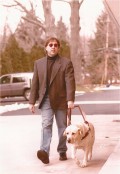
No one gets a free pass to public life — “public life” — the elusive goal people with disabilities strive for. While the village square is sometimes difficult to enter often a service animal can help. In my case I travel with a guide dog, a yellow Lab named Nira who helps me in traffic. Together we race up Fifth Avenue in New York or speed through O’Hare airport in Chicago. We’re a terrific team. But even 23 years after the passage of the Americans with Disabilities Act and 70+ years since the introduction of guide dogs in the U.S. life in public isn’t always friendly. Lately it seems more unfriendly than at any time since the late 1930s when the blind had to fight for the right to enter a store or ride a public bus. What’s going on?
Read more of Dogs on the Playing Field…
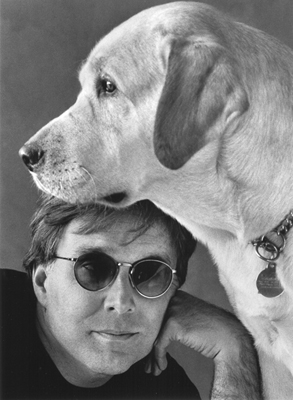 Professor Stephen Kuusisto is the author of “Eavesdropping: A Memoir of Blindness and Listening” and the acclaimed memoir “Planet of the Blind”, a New York Times “Notable Book of the Year”. His second collection of poems from Copper Canyon Press, “Letters to Borges“ has just been released. Listen to Steve read “Letter to Borges in His Parlor” in this fireside reading via YouTube. He is currently working on a book tentatively titled What a Dog Can Do. Steve speaks widely on diversity, disability, education, and public policy. www.stephenkuusisto.com, www.planet-of-the-blind.com
Dog in Heart

Dog Man Writes to Parts of Himself
If there’s a dog in your heart it will do you no damage. If there’s a thistle inside you, you’re in trouble. Only weeks after getting my first guide dog, and walking freely on the ordinary streets I met the thistle hearted all around me. They were people who lived in the famine of effect—unhappy inside and projecting unwarranted hostility outside. Meeting them with a dog at my side, and a dog inside me, a protective dog of the heart, well, that was different—to say the least. Standing in line at the bank a thistle-woman caught sight of Corky and screamed quite literally: “You damned disabled with your damned dogs!” She waved her arms like she was on the flight deck of an aircraft carrier. There were three or four other customers. They all backed away. She kept shouting her wild gibberish. And Corky wagged her tail. I felt it against my left leg. She was telling me that two worlds described our rewards, we were in tandem, we were in accord. We were a musical chord. Her tail was saying: “each lives in one, all in the other.”
So I smiled. Just smiled. I probably looked like a simpleton. But our dog heart was smiling. The woman turned and bolted out the door. Of course that’s when the other customers began speaking up. “Wow, she was really out of line!” “There must be something wrong with her!” But I had Morse Code dog heart—which was all I needed.
While still at Guiding Eyes I’d kept a journal—titled “Dog Man Writes to Parts of Himself”.
One entry read:
You were always a dog in your heart—you were forced to conclude the matter when, one morning, early, you felt a giddiness, a happenstance wakeful half-assed joy. It wasn’t the electrolysis of sex or the sticky dendritic jazz of chocolate or bourbon that marked your inner life. It was dog, dog-ness, dog all the while. You were standing at the window, still wearing your pajamas. You felt like running into the yard and rolling in snow. You didn’t care what the neighbors might think. A good snow roll in your PJs was in order. You saw that now, saw it was always “the thing”—to be a dog and sharply alive with all your senses in order. No tax forms. No darkness blotting out hope. Dogs are the darkness. Dogs are hope. You saw there was nothing more to be said about the matter.
**
I was insensibly happy. The person bearing my name had been transformed. He was lighter, like a character in fiction—the fairy tale dog man was walking, running. He didn’t have to explain himself. That was the great thing. He didn’t have to explain the convoluted gears and motors of his brain.

Professor Stephen Kuusisto is the author of “Eavesdropping: A Memoir of Blindness and Listening” and the acclaimed memoir “Planet of the Blind”, a New York Times “Notable Book of the Year”. His second collection of poems from Copper Canyon Press, “Letters to Borges“ has just been released. Listen to Steve read “Letter to Borges in His Parlor” in this fireside reading via YouTube. He is currently working on a book tentatively titled What a Dog Can Do. Steve speaks widely on diversity, disability, education, and public policy. www.stephenkuusisto.com, www.planet-of-the-blind.com
MacDowell Downtown Presents Activist Stephen Kuusisto This Friday, March 1
The following content was originally posted on the MacDowell web site by David Macy, Resident Director
MacDowell Downtown on Trusted Companions
This Friday evening at 7:30 p.m., author and Colony Fellow Stephen Kuusisto will share stories of guide dogs and their people experiencing the world together. A New Hampshire native and Fulbright Scholar, Kuusisto has appeared on programs such as The Oprah Winfrey Show, Animal Planet, and National Public Radio.
Entertainer and intellectual, poet and activist, Kuusisto could also be described as a surrealist comedian with a wise man’s heart. In the late 90s he served as Director of Student Services at Guiding Eyes for the Blind, a charitable nonprofit dedicated to training guide dogs for people with multiple disabilities. In 2000 he returned to his alma mater, the University of Iowa, to teach creative nonfiction at the graduate school. Today he directs the Renée Crown Honors Program at Syracuse University where he also holds the post of University Professor.
Returning to Peterborough after a hiatus of 18 years, Steve is the author of Planet of the Blind, a New York Times notable book, and Eavesdropping: A Memoir of Blindness and Listening. In his most recent book,Letters to Borges, published by Copper Canyon Press earlier this month, Kuusisto explores seeing, blindness and being through themes of travel, place, religion, music, art, and loneliness. In May he will be traveling for the U.S. State Department to discuss human rights and literature in Azerbaijan, Turkistan, and Kazakhstan. He is a fascinating character with a lot to say about a lot of things, and for Friday night the thematic link will be man’s best friend.
Please spread the word to those who might be interested… I look forward to seeing you all at Bass Hall!
David Macy
Resident Director
PS- check out the Friday Arts program from WHYY in Philadelphia; this documentary short by filmmaker and MacDowell Fellow Michael O’Reilly… it tells the story of visual artist Marc Brodzik and the impact his MacDowell experience has had on the arc of his career.
MacDowell Downtown
Talk and Reading by author and MacDowell Fellow Stephen Kuusisto
“A Place Among Dogs, or, How Service Animals Make Our World”
Friday, March 1, 2013
7:30 – 8:30 p.m.
Bass Hall at
The Monadnock Center for History and Culture
19 Grove Street
Peterborough, NH
Cost: Free
Jim Ferris, Laurie Clements Lambeth and Stephen Kuusisto Reading at Syracuse University
Disabilities as Ways of Knowing: A Series of Creative Writing Conversations: Part II
The Disability Experience and Poetic Verse
Reading by Poets Jim Ferris, Laurie Clements Lambeth, and Stephen Kuusisto
March 28, 2013
Reading 7:00 to 8:00 pm at Watson Theater
Reception and book signing from 8:00 to 9:00 pm at Light Work
SU Campus
Jim Ferris, Laurie Clements Lambeth and Stephen Kuusisto will be reading from a selection of their poetry, followed by a reception and book signing, for all members of the S.U. community. While this event is geared specifically to raise and support awareness among undergraduates, everyone is welcomed to participate in this exciting set of opportunities. This event will feature works from Beauty is a Verb: The New Poetry of Disability (Cinco Puntos Press) and launch Letters to Borges (Copper Canyon Press), where “best-selling memoirist Stephen Kuusisto uses the themes of travel, place, religion, music, art, and loneliness to explore the relationship between seeing, blindness, and being. In poems addressed to Jorge Luis Borges—another poet who lived with blindness—Kuusisto leverages seeing as negative capability, creating intimacy with deep imagination and uncommon perceptions” (from http://www.stephenkuusisto.com).
American Sign Language (ASL) interpretation will be provided during both the reading and the reception/book signing. Communication Access Realtime Translation (CART) will be provided during the reading.
If you require accommodations or need information on parking for this event, please contact Radell Roberts at 443-4424 or rrober02@syr.edu.
This event is made possible through the Co-Curricular Departmental Initiatives program within the Division of Student Affairs, and cosponsorship by the Disability Cultural Center, the Renée Crown University Honors Program, the Center on Human Policy, Disability Studies, the Burton Blatt Institute, the Dept. of Women’s and Gender Studies, the Lesbian, Gay, Bisexual, Transgender Resource Center, the Office of Multicultural Affairs, the Slutzker Center for International Services, the Creative Writing Program, the Disability Law and Policy Program, the Disability Student Union, the Beyond Compliance Coordinating Committee, and the Disability Law Society.
As aspects of variance and diversity, disability cultures and identities enrich the tapestry of life on and off the SU campus.
~~~~~~~~~~~~~~~~~~~~~~~~~~~
Professor Stephen Kuusisto is the author of “Eavesdropping: A Memoir of Blindness and Listening” and the acclaimed memoir “Planet of the Blind”, a New York Times “Notable Book of the Year”. His second collection of poems from Copper Canyon Press, “Letters to Borges“ has just been released. Listen to Steve read “Letter to Borges in His Parlor” in this fireside reading via YouTube. He is currently working on a book tentatively titled What a Dog Can Do. Steve speaks widely on diversity, disability, education, and public policy. www.stephenkuusisto.com, www.planet-of-the-blind.com
A Disability History of the United States
“What emerges in this volume is a history of several ideas. The first is the definition of disability, which has been the subject of an ongoing and spirited debate.” ~ Stephen Kuusisto
Are you a rascal?
Provided by the Department of VSA and Accessibility at the John F. Kennedy Center for the Performing Arts, Writing Spotlights is an educational tool teachers can use in their classroom.
According to the web site, this tool “features short literary works by prominent writers with disabilities. Designed to engage middle and high school students and encourage dialogue about disability and diversity, each Writing Spotlight is accompanied by discussion questions and writing activities to promote language arts skills, including reading comprehension and creative writing.”
Stone Strong was written by Stephen Kuusisto specifically for Writing Spotlights. Here is an excerpt:
I’m an old man nowadays but don’t let that fool you—I’m a bit of a rascal. I always was a rascal.
…I always loved to tell stories and from my earliest days I could talk to anyone. Let’s be honest: if you’re blind it really helps if you can talk to people—especially by being bold, not waiting for others to talk to you first. You can’t be a wallflower and go places in this world and that’s particularly true if you can’t see. When I catch a train I don’t stand around the station waiting for someone to tell me where to go. I just ask the invisible people around me where the train to Poughkeepsie is. You can’t be shy if you have a disability—any kind of disability. Anyway, a rascal is someone who likes to talk and occasionally he’ll even stretch the truth if he has to. That’s just how it is.
Free poetry book: "Only Bread, Only Light"
Congratulations – and thank you – to Cindy Leland!
Cindy purchased a copy of Stephen Kuusisto’s new book, , “Letters to Borges“, and saved $ by taking
advantage of the pre-order price. In so doing, she also entered a random drawing and is the winner this week of an autographed copy of “Only Bread, OnlyLight”, Steve’s first book of poetry (Copper Canyon Press).
Will you be next week’s winner?
***************************************
Professor Stephen Kuusisto is the author of “Eavesdropping: A Memoir of Blindness and Listening” and the acclaimed memoir “Planet of the Blind”, a New York Times “Notable Book of the Year”. His second collection of poems from Copper Canyon Press, “Letters to Borges“,
is scheduled for release in October 2012. In addition to giving
literary readings, Steve speaks widely on diversity, disability,
education, and public policy. www.stephenkuusisto.com
Yes, Amy Wallace; I enjoyed your Bus 52 video.
Amy Wallace forwarded this note to me and I’m glad she did. Take a look at what the folks on Bus 52 are up to. (Thanks for sharing, Amy.)

Photo: front of a converted 1984 International School Bus. It looks to be painted green with a cream colored hood.
Hello,
My name’s Amy Wallace, I’m part of a nonprofit project called Bus 52. We travel around the country making videos about people who are doing inspiring things for their community.
We made a video about Our Thrift Store in Franklin, Tennessee, which is a nonprofit thrift store that employs people with disabilities and puts back all the profits of the store into employing community members.
I thought you and your readers might enjoy the video we make about it, which can be seen here: http://youtu.be/neF-hekUpKM
Please let me know if you have any questions,
Thanks! Amy
Amy Wallace
www.bus52.com
*****************
Professor Stephen Kuusisto is the author of “Eavesdropping: A Memoir of Blindness and Listening” and the acclaimed memoir “Planet of the Blind”, a New York Times “Notable Book of the Year”. His second collection of poems from Copper Canyon Press, “Letters to Borges“, is scheduled for release in November 2012. In addition to giving literary readings, Steve speaks widely on diversity, disability, education, and public policy. www.stephenkuusisto.com
Thank you, Christopher Bowsman
Thank you, Christopher Bowsman, for your kind words ~sk
Steve Kuusisto on Poetry and Disability Studies
The Blackwell Inn was a big lavishly decorated hotel, and the conference was held in the ball room. I saw Steve Kuusisto moving up to the podium and talking to his dog “Come on, girl.” Moving in unison with the dog up to the podium. He introduced himself, his guide dog Nari, (Who “by the miracle of frozen sperm” is from his last dog), and began to explain disability as a mode of perception. The ability to re-claim “embodiment” (How our bodies are perceived.) is as ancient as language, he argues.
Steve was funny, articulate, and poetic. Frequently, he made allusions to other poems, or modes of perception that “re-claim embodiment.” That is, he examined the inner world of disability, its lived experience, in contrast to being defined as reified (lacking. Blindness being the absence of light. Deafness being the absence of hearing, etc. In his poetry, he describes his dog as being much more than a dog; that sometimes they are one being. This is actually how I feel about my wheelchair too. He tells stories of watching drunken men in wheelchairs eating flowers, and wrote about that poetically. Through poetry, Steve gains insight and a unique epistemology.
Continue reading post on Christopher Bowsman’s blog, Through Alien Eyes, The Sci-fi Worldview of Chris B.
 Planet of the Blind