Structural Inequality at Syracuse Can Change….

Things are going badly at my university where diversity is concerned. In fact this is an understatement. The racist, ableist, homophobic, misogynistic videos from a fraternity party are chilling. Syracuse U didn’t make these videos happen; didn’t instruct fraternity boys to unleash hatred. I give the university a pass on coercion. Yet our civic space, or “agora” has long been exclusionary, toxic, and even cruel to historically marginalized students, staff, and faculty. 

Right now there’s a lot of talk about systematic change. Committees are being called. Grievance meetings are being held. They are good first steps. 

Syracuse University cannot succeed unless her administrators, staff, students and faculty have a collective and shared intellectual experience that examines bigotry in all its institutional and hegemonic ways. 

Disabled as I am, I have seen first hand how senior administrators have shrugged their shoulders when told that accommodations and access for disabled students, staff, visitors, and faculty are not easy to obtain and are often lacking altogether. 

This isn’t a new experience for me. I’ve been teaching here for 7 years and have been ignored for much of that time. Course management software not accessible? Thanks for telling us Prof. K. Ho Hum. You know of a student who failed a course because she didn’t get note taking accommodations in a timely way? Thanks for telling us Prof. K. Ho Hum. What? You can’t get access to teaching materials in accessible formats? Thanks again. Ho Ho Hum. 

7 years is a long long time to be waiting for action. Now, because of the horrid videos mentioned above the university is talking about changing its culture. 

My argument, such as it is, is that ableism is rife in the academy. Most scholars believe that education is a race and it goes to the fittest. They believe disabled people are only on campus because of the sufferance imposed by disability rights laws. How many students have come to me over the last few years sharing tales of faculty who don’t want to provide them with reasonable accommodations—extra time on tests, the ability to record lectures because they’re blind, sneering at them because owing to autism they wear noise reduction headphones in class—the list of faculty misdeeds is a long one. Then there are the senior administrators, deans, provosts, associate vice presidents, who think disability accommodations are best left to a later day. Who say to themselves, “We’ll get to that next year.” Who believe disabled students and faculty are malcontents. I know because I’ve been labeled as such. 

Ableism is built into the very buttresses of higher education. Higher Ed is a seat of privilege, merit, exceptionalism; it’s a race that goes to the swift; maybe the good looking; if you need any kind off academic help you shouldn’t be here. Unless you’re a star athlete of course. Ho Hum. I mention the athletic support system not to denigrate it, but to point out that the cost of helping disabled students isn’t the real issue—ableism assures us that the appearance of helping the disabled presents the image of a college or university with undeserving students. 

I’m not wrong about this. In his new book Academic Ableism: Disability and Higher Education Jay Dolmage writes: “basically, academia exhibits and perpetuates a form of structural ableism.”Then he adds, and I think this is key: 

“I borrow to a certain degree from the notion of structural racism, defined by the Aspen Institute as follows:

A system in which public policies, institutional practices, cultural representations, and other norms work in various, often reinforcing ways to perpetuate racial group inequity. It identifies dimensions of our history and culture that have allowed privileges associated with “whiteness” and disadvantages associated with “color” to endure and adapt over time. Structural racism is not something that a few people or institutions choose to practice. Instead it has been a feature of the social, economic and political systems in which we all exist. (n.p.)

Likewise, ableism has to be seen as a series of entrenched structures—not just the action of an individual or of individuals. We have to understand that because of these pervasive structures, we live in a society that resists efforts to ameliorate or get rid of ableism. As scholar and activist Daniel Freeman writes, “Able-bodied people all have things that they fall short with, skills or tasks that they will never master. But when disabled folks say, ‘These are the things I need in order to do my very best,’ it is labeled as an ‘accommodation.’ . . . The language itself is ableist in nature, bringing into focus the reality of how disabled bodies are seen as barriers to able-bodied life” (n.p.). Accommodation is thought of as something that always needs to be created, something that has a cost. ”

Excerpt From: Jay Dolmage. “Academic Ableism: Disability and Higher Education.” iBooks. 

Until the administration at Syracuse understands the structural dynamics of intersectional and pervasive delimitation the problems experienced by people who hail form historically marginalized backgrounds will persist. Let us point out that disabled students and all other minority students are paying for the opportunity to get an education. Or as one disabled student said to me yesterday, “paying for the opportunity to be treated badly.”

Moreover Syracuse can’t get better so long as its public rhetoric about disability is steeped in the lingo of 1970. Take the following passage from the School of Education’s web site on accessibility: 

Syracuse University and the School of Education are dedicated in their mission to fully include persons with disabilities and special needs. In compliance with Section 508 and the Americans with Disabilities Act (ADA), Syracuse University and the School of Education are committed to ensure that “no otherwise qualified individual with a disability…shall, solely by reason of disability, be excluded from participation in, be denied the benefits of, or be subjected to discrimination under any program or activity.”

Special needs is a term that should be tossed into the dust bin of history. As for stating the university is in compliance, that’s simply not true. Hasn’t been true. Not as long as I’ve been teaching here. 

On the matter of “special needs” I like what activist Erin Human has to say:

Every time someone says “special needs,” they reinforce the false notion that disabled people are asking for “extras” when we require accommodations, modifications, and/or support to access the same things that non-disabled people are able to access, such as education, public spaces, community involvement, and so on. 

That’s the first problem, because access is not “special” for disabled people. It’s our right. The Americans with Disabilities Act of 1990, modeled on the Civil Rights Act of 1964, protects disabled Americans from discrimination, requires us to be accommodated in the workplace, and grants us equal access to public spaces and institutions. Other countries have laws in place to protect disability rights in similar ways.

The second problem is, the phrase “special needs” flies in the face of the social model of disability. The social model says, the disabled person’s inability to access things is due not to the disabled person’s failings, flaws, or deficits, but on the environment’s failure to provide access to the things. For example, a Blind person is not disabled because they can’t see, they are disabled because the world was set up by seeing people for seeing people and is made of many things that are inaccessible to non-seeing people.

To make a metaphor of it, imagine taking a brand new car and submerging it in a lake. The car is disabled; there’s nothing wrong with the car itself, it still does everything it’s designed to do, but it cannot operate in its current environment. If were in an environment well suited to its needs and purposes, like say a road, it would be able to do all the things a car does.

The current environment at Syracuse University, ironically the first college in the United States to offer a disability studies program needs to change for everyone to operate, not merely suited to his or her or they needs and purposes, but with dignity. 

Disabling Your Enemy is Terrorism

During the past month of demonstrations along the border between Gaza and Israel, at least 17 Palestinians have suffered gunshot wounds that ultimately cost them their legs, according to the Palestinian Health Ministry in Gaza.

The Washington Post

Lest it’s lost on anyone the purpose of warfare is not to destroy enemy combatants but to shatter their village square. Disablement is a strategy, rape is a policy, affecting civilian casualties, all are matters of policy.

Disablement isn’t an unfortunate side effect of protests in Gaza as the Israeli Defense Force’s argument has it. Disabling civilians is overtly designed to shatter not just legs but the human will to freedom and dignity. What is the best semiotic for imprisonment and despair? Disability of course. Disability as a practice of war is criminal. It doesn’t matter who is producing the disablement. Disabling your enemy is an act of terror.

Terrorism is defined in Title 22 Chapter 38 U.S. Code § 2656f as “premeditated, politically motivated violence perpetrated against noncombatant targets by subnational groups or clandestine agents.”

Nations that paralyze their enemies should be forced to pay for their health care.

Think how quickly that would put a stop to war.

Yeah. That’s what I think.

Two days ago I took an Uber ride. My driver was from Iraq. He told me that his wife has a master’s degree, he has a master’s, his children are in college in the US.

I told him how angry and ashamed I am that the United States has killed one million civilians in his land.

He got out of the car and we hugged. We stood there, uneasily on the street, my guide dog looking on. Who provides guide dogs to Iraqi children? No one.

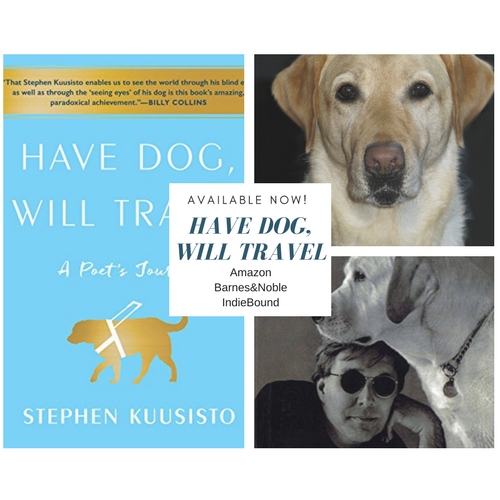
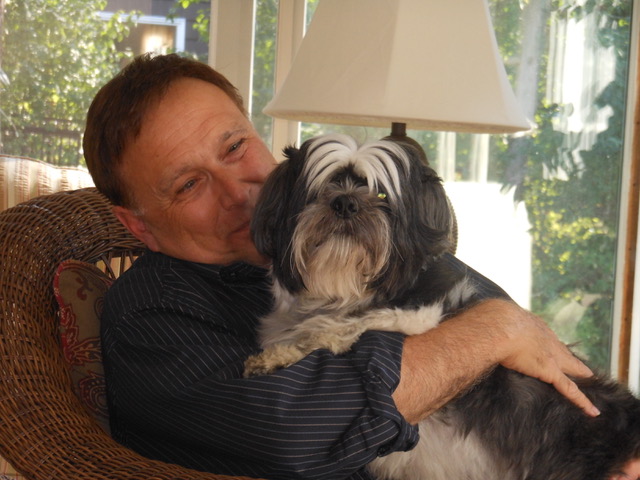
Stephen Kuusisto and HarleyABOUT: Stephen Kuusisto is the author of the memoirs Have Dog, Will Travel; Planet of the Blind (a New York Times “Notable Book of the Year”); and Eavesdropping: A Memoir of Blindness and Listening and of the poetry collections Only Bread, Only Light and Letters to Borges. A graduate of the Iowa Writer’s Workshop and a Fulbright Scholar, he has taught at the University of Iowa, Hobart and William Smith Colleges, and Ohio State University. He currently teaches at Syracuse University where he holds a University Professorship in Disability Studies. He is a frequent speaker in the US and abroad. His website is StephenKuusisto.com.

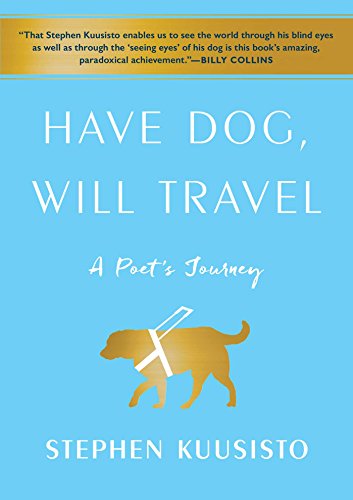
Have Dog, Will Travel: A Poet’s Journey is now available for pre-order:
Amazon
Barnes and Noble
IndieBound.org

Have Dog, Will Travel by Stephen Kuusisto

(Photo picturing the cover of Stephen Kuusisto’s new memoir “Have Dog, Will Travel” along with his former guide dogs Nira (top) and Corky, bottom.) Bottom photo by Marion Ettlinger 

Disability, Expectation, and a Just a Whiff of Episcopalianism

“I expect color to be used against me,” writes John Edgar Wideman in the closing story of his latest collection American Histories. “Amen,” I think, early, the sun not up, reading alone with my talking computer. Race is the first they “they” see—the predatory “they” ruthless, short tempered and ubiquitous—good God is it everywhere. And the sun not up, alone, I want to reach through circuits and virtual pages and shake Wideman’s hand.

Each of us does her or his or they own dance with the expectation of disadvantage in advance. If you’re black, or Latinx, or queer, or disabled you are far more likely to live this on a daily basis. Not likely. I take that back. One does. What was I thinking?

I expect disability to be used against me.

Long ago I read a definition of resentment which I can’t attribute or source: resentment is drinking poison and waiting for others to die.

I not only expect but know disability will be used against me so how do I escape the poison-resentment-complex? Or “we”—how do we do it? Black, queer, neurodivergent, women in male dominated professions, in my case blind at a university that has poor support services for the disabled and more than passing hostility?

I don’t like poison. It tastes like wormwood and iodine. Trust me I know what it tastes like.

When I’m home alone, after a day of discriminatory treatment, being told to shut up, etc., I think, as I’m sure Wideman must, “I’m a good guy; I’m funny; I like people, why is this happening to me?”

That’s the effect of the poison. Swallowing it you fall into false consciousness, a false expectation about others. You think they’re supposed to change and you’re dying inside and the ableist, racist, homophobic people go on happily about their business. As Auden says famously in his poem Musee des Beaux Arts—suffering is unnoticed by the privileged. He says it better. Read the poem.

The key to having a good life when you know your difference is going to be used against you, perhaps in a minute, perhaps later this afternoon is mysterious and there are few prescriptions in tablet form or in holy books that are proper anodynes. I love the psalms. I adore Eleanor Roosevelt: “No one can make you feel inferior without your consent.” Shit, I’m an Episcopalian. I have whole passages of the New Testament memorized. I love Christ not for his suffering but his transcendence of it. He’s both the king of those who are mocked and of those who persist in love. But I’ll admit it: most days Jesus is too mystical for me when I’m struggling disabled in a hostile world.

I expect disability to be used against me.

It’s that word “expect” that’s the killer.

Expect is related to spectacles. It comes from Latin “to look out”.

Later it comes to mean imagining things that will happen. Somewhere in the 16th century the word transitioned from “fact” (to see what’s coming) to fiction—one of the pejorative dynamics of imagination, suspecting things will happen because they’ve happened in the past. I often tell creative writing students only ten percent of imagination is worthwhile. That estimation may be generous.

This is the poison of imagination. I expect the next bad thing. Ungoverned this becomes depression. The depressed imagination sees everything in the world as equal and equally bad.

Wideman’s literary character is correct: race will be used against him. Finding love in the face of this is the most difficult challenge of all. We can invent machines that defy gravity but so far no machine has defied hate.

I like to think they’re working on this at MIT—maybe something like an aluminum spaghetti colander with wires sticking out that you wear on your head and with a flip of the switch voila hate disappears and water turns into chablis.

As far as I know—not far of course—is the only machine that can zap hate is the imagination which we’re currently under utilizing. Like the oft repeated maxim that we only use ten percent of our brains, we simply fail most days to push our imaginations toward loving others.

I expect to be disliked. It’s a certainty. This is the story of Christ. It’s the story of my neighbor.

I expect to be more loving. Will start today.

I expect to spit. (Expectorate)

“I tell you, you will not see the new beauty and the truth, until you make up your minds to spit.” (Malevich, Essays on Art)

Aim carefully.

Read John Edgar Wideman.

Stephen Kuusisto and HarleyABOUT: Stephen Kuusisto is the author of the memoirs Have Dog, Will Travel; Planet of the Blind (a New York Times “Notable Book of the Year”); and Eavesdropping: A Memoir of Blindness and Listening and of the poetry collections Only Bread, Only Light and Letters to Borges. A graduate of the Iowa Writer’s Workshop and a Fulbright Scholar, he has taught at the University of Iowa, Hobart and William Smith Colleges, and Ohio State University. He currently teaches at Syracuse University where he holds a University Professorship in Disability Studies. He is a frequent speaker in the US and abroad. His website is StephenKuusisto.com.

Have Dog, Will Travel: A Poet’s Journey is now available for pre-order:
Amazon
Barnes and Noble
IndieBound.org

Have Dog, Will Travel by Stephen Kuusisto

(Photo picturing the cover of Stephen Kuusisto’s new memoir “Have Dog, Will Travel” along with his former guide dogs Nira (top) and Corky, bottom.) Bottom photo by Marion Ettlinger 

The Blind Guy Persisted….

Because racism, ableism, homophobia, misgogyny are rampant right now at Syracuse University (the story broadly told) I feel unwelcome on campus. I’m blind and have struggled to get basic accommodations as a faculty member for seven years. When I speak about this I’m largely treated to double talk. It’s too hard for this university to make books and articles accessible in a timely way. It’s too hard to assure that sighted support is available to the blind. I’ve been told these things and if I’m hearing them I can only imagine what disabled students are experiencing. Except I don’t have to imagine. They tell me. They tell me over and over what a mean spirited place SU really is.

Yesterday I was told to be quiet. My mistake? I posted a cris de coeur about these problems on a departmental listserv. I was told that my opinions offended people.

That’s of course how ableism works. It offends the ableists to know they’re part of a structural system. They think themselves liberal, progressive, tolerant. Blaming the disabled for calling attention to the problem is Ableism 101.

I said I’d never post to the departmental listserv again.

But I won’t stop talking about the ugliness of higher education and disability discrimination. I won’t.

I love the fact that Syracuse was the first university in the US to formally launch a disability studies program. I’m proud to be an activist faculty member who insists on human rights and who, like my faculty colleagues in many areas of study speaks about the hegemony of discrimination and the role of institutions in the creation of second class status for so many, including the disabled.

Closing, here’s a poem I wrote in the manner of Allen Ginsberg:

America with your history of eugenics.
With your hostility to the global charter on disability rights.
With your jails, stocked with psychiatric patients—worse than the Soviet Union. We are Gulag Los Angeles; Gulag Rikers Island; Gulag Five Points in Upstate New York.
America with your young Doctor Mengeles.
With your broken VA.
With your war on food stamps and infant nutrition.
With your terror of autism and lack of empathy for those who have it.
With your 80% unemployment rate for people with disabilites.
With your pity parties—inspiration porn—Billy was broken until we gave him a puppy.
With your sanctimonious low drivel disguised as empathy.
With your terror of reasonable accommodations.
With your NPR essays about fake disability fraud, which is derision of the poor and elderly.
With your disa-phobia—I wouldn’t want one of them to sit next to me on a bus.
America when will you admit you have a hernia?
When will you admit you’re a lousy driver?
Admit you miss the days of those segregated schools, hospitals, residential facilities—just keep them out of sight.
When will you apologize for your ugly laws?
When will you make Ron Kovic’s book irrelevant?
America, you threatened Allen Ginsberg with lobotomy.
Ameica you medicated a generation of teenagers for bi-polar depression when all they were feeling was old fashioned fear.
When will you protect wheelchairs on airlines?
When will you admit you’re terrified of luck?

–Stephen Kuusisto

Stephen Kuusisto and HarleyABOUT: Stephen Kuusisto is the author of the memoirs Have Dog, Will Travel; Planet of the Blind (a New York Times “Notable Book of the Year”); and Eavesdropping: A Memoir of Blindness and Listening and of the poetry collections Only Bread, Only Light and Letters to Borges. A graduate of the Iowa Writer’s Workshop and a Fulbright Scholar, he has taught at the University of Iowa, Hobart and William Smith Colleges, and Ohio State University. He currently teaches at Syracuse University where he holds a University Professorship in Disability Studies. He is a frequent speaker in the US and abroad. His website is StephenKuusisto.com.

Have Dog, Will Travel: A Poet’s Journey is now available for pre-order:
Amazon
Barnes and Noble
IndieBound.org

Have Dog, Will Travel by Stephen Kuusisto

(Photo picturing the cover of Stephen Kuusisto’s new memoir “Have Dog, Will Travel” along with his former guide dogs Nira (top) and Corky, bottom.) Bottom photo by Marion Ettlinger 

Hate at the University

The trouble with haters is they force you to think about hate. Whatever passes for immunity to the virus of bigotry breaks down. You have a head cold suddenly. You can’t think about the beauty of spring. You’re too busy thinking about the Neo-Nazis or the hateful videos produced by the fraternity at your university, or the anti-Muslim graffiti sprayed on a mosque. The birds are singing real pretty but you’re sealed up. At a remove from joy.

This is how I’m feeling as a member of the Syracuse University community. Thousands of us who study or work at SU are feeling this. No matter your background you have to be deeply disturbed by the hatred that has leaked out around us.

Now I’m an old hand at hate. Disabled, bullied in childhood, discriminated against in education and employment, I’ve lived a long time in hate-ville. Here’s the thing: able bodied white people don’t understand that if you’re from a historically marginalized background you have to put yourself together anew every day. I don’t mean putting on your makeup or shaving. I mean a full scale, internal, hot to the touch assembly of hope, aspiration, belief in the future, and a reserve of irony—you’ll meet people who don’t get you all day long and you’ll manage them with humor, forceful insistence, passion, and compensatory self-regard. Able-bodied white people don’t need to do any of this. The worst thing they can imagine is a bad day in junior high.

A robin is walking across the top of a hedge outside my window. And I’m having to think, to engage with hate. “Big deal,” I say, “it’s nothing new.”

So here, frat boys, ableist staff and administrators, smug warriors of privilege, I’m handing back your hate. Look. I’ve put it in a little basket, like the one Moses floated in. It has a little blanket on top. When you bring it ashore and look inside you’ll find nothing at all. That’s what your hate is. It’s just moist, empty air.

Stephen Kuusisto and HarleyABOUT: Stephen Kuusisto is the author of the memoirs Have Dog, Will Travel; Planet of the Blind (a New York Times “Notable Book of the Year”); and Eavesdropping: A Memoir of Blindness and Listening and of the poetry collections Only Bread, Only Light and Letters to Borges. A graduate of the Iowa Writer’s Workshop and a Fulbright Scholar, he has taught at the University of Iowa, Hobart and William Smith Colleges, and Ohio State University. He currently teaches at Syracuse University where he holds a University Professorship in Disability Studies. He is a frequent speaker in the US and abroad. His website is StephenKuusisto.com.

Have Dog, Will Travel: A Poet’s Journey is now available for pre-order:
Amazon
Barnes and Noble
IndieBound.org

Have Dog, Will Travel by Stephen Kuusisto

(Photo picturing the cover of Stephen Kuusisto’s new memoir “Have Dog, Will Travel” along with his former guide dogs Nira (top) and Corky, bottom.) Bottom photo by Marion Ettlinger 

Syracuse University is in a Jam

Like all of us at Syracuse University I’ve been stunned by the ugly events that have unfolded over the past week. As a disabled faculty member, and therefore someone from a historically marginalized community, I believe the racism, homophobia, anti-semitism, misogyny and ableism in the Theta Tau videos display intersectional bigotry. While we can say the videos are not truly representative of Syracuse they are certainly a “wake up call” and this is what I want to focus on.

This morning walking my guide dog I thought “maybe a more representative motto for the university should be “Buildings Over People” as opposed to our current motto “knowledge crowns those who seek her”?” We’re great at putting up buildings that show us in the best light. We have “Ernie Davis Hall” but guess what? Ernie Davis’s developmentally disabled son was rejected from SU. We have a multi-million dollar Institute for Veterans and Military Families going up on the site of the former Disability Studies Program’s building. We dispersed the disability faculty across campus without a place to meet. Meanwhile veteran-students have related to me their disappointment at SU, remarking that the campus is an unwelcoming place. This is what I think is most central to our dilemma and which only the Board of Trustees can address: SU is not and I repeat “not” a welcoming institution for veterans, the disabled, people of color, LGBTQ students and staff, foreign students, women, it’s a long list.

Buildings over people is the proper latinate maxim for us. I believe the Trustees bear more than a little responsibility for this situation. So keen are they to cut budgets and put the university on a strict business model management system they’ve forgotten that the buildings don’t mean a thing if the people feel disparaged, maligned, under served, ignored, and of little value.

I’m a disability rights activist among other things and I’ve been asked by students and faculty to weigh in on what’s going on here and I’m trying hard to be measured. Syracuse is a good university with lots of great people. We must reaffirm what’s good here and resist what’s deleterious about our community. We need to do this with brave leadership and a true commitment to change. Buildings and heated sidewalks and underfunded resources in community services and academic programs won’t cut it, as they say in the vernacular.

Stephen Kuusisto and HarleyABOUT: Stephen Kuusisto is the author of the memoirs Have Dog, Will Travel; Planet of the Blind (a New York Times “Notable Book of the Year”); and Eavesdropping: A Memoir of Blindness and Listening and of the poetry collections Only Bread, Only Light and Letters to Borges. A graduate of the Iowa Writer’s Workshop and a Fulbright Scholar, he has taught at the University of Iowa, Hobart and William Smith Colleges, and Ohio State University. He currently teaches at Syracuse University where he holds a University Professorship in Disability Studies. He is a frequent speaker in the US and abroad. His website is StephenKuusisto.com.

Have Dog, Will Travel: A Poet’s Journey is now available for pre-order:
Amazon
Barnes and Noble
IndieBound.org

Have Dog, Will Travel by Stephen Kuusisto

(Photo picturing the cover of Stephen Kuusisto’s new memoir “Have Dog, Will Travel” along with his former guide dogs Nira (top) and Corky, bottom.) Bottom photo by Marion Ettlinger 

Just for the Books

IMG 2248

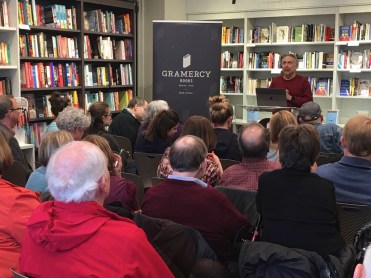
On Wednesday last, April 11, I had the privilege of reading from my new memoir Have Dog, Will Travel: A Poet’s Journey  at Gramercy Books  in Columbus, Ohio. Gramercy’s owner, Linda Kass took this terrific photo of the event. I’m standing in front of a good sized audience, my purple sweater covered with dog hair, and I appear to be just about to make an extravagant gesture with my hand, like the opera tenor I’d really like to be….

As I’ve said before on my blog, I adore independent book stores. People come there for the books. They really do. Oh they might get a frou frou coffee, some poodle-ish beverage, but for Indie shoppers that’s just “value added” as they say in marketing circles. Customers who shop in independent book stores are drawn by words, intuitions, giddiness, mystery, fantasy, Dostoevsky, or “news that stays news” as Ezra Pound once said, describing why poetry matters.

You can’t tell from this photo but there are several guide dog users at the event. And puppy raisers from Guiding Eyes for the Blind.

What could be better than books and dogs, and lots of readers?

Stephen Kuusisto and HarleyABOUT: Stephen Kuusisto is the author of the memoirs Have Dog, Will Travel; Planet of the Blind (a New York Times “Notable Book of the Year”); and Eavesdropping: A Memoir of Blindness and Listening and of the poetry collections Only Bread, Only Light and Letters to Borges. A graduate of the Iowa Writer’s Workshop and a Fulbright Scholar, he has taught at the University of Iowa, Hobart and William Smith Colleges, and Ohio State University. He currently teaches at Syracuse University where he holds a University Professorship in Disability Studies. He is a frequent speaker in the US and abroad. His website is StephenKuusisto.com.

Have Dog, Will Travel: A Poet’s Journey is now available:
Grammercy Books
Amazon
Barnes and Noble
IndieBound.org

Have Dog, Will Travel by Stephen Kuusisto

(Photo picturing the cover of Stephen Kuusisto’s new memoir “Have Dog, Will Travel” along with his former guide dogs Nira (top) and Corky, bottom.) Bottom photo by Marion Ettlinger 

Disability, Resurrection, Poetry

It’s Easter Sunday and I’m thinking about human equality, disability, and the poetry uniting both. Strange really, the resurrection of Christ, equal rights, a poetics. Here’s what I mean: Christ rises from his grave, the very action the most extraordinary figure of rehabilitation in human history. All resurrection myths proclaim equality is not out of reach—that soon enough you’ll be unrecognizable to yourself, clean, bright, and favored like others.

Poetry may not always be concerned with religion or equality. The early modernist poets in their desire to rival the immediacy of photographs were at times dispassionate—see Imagism or Vorticism as practiced by Pound—yet poetry often is where we find empathy. I wept alone in my faculty office one afternoon when, after a day of pain, my legally blind eyes unable to keep up with the tasks before me, in the days before reliable speech technology, I read the following poem by Adrienne Rich with my left eye only a half inch from the page:

I know you are reading this poem
late, before leaving your office
of the one intense yellow lamp-spot and the darkening window
in the lassitude of a building faded to quiet
long after rush-hour. I know you are reading this poem
standing up in a bookstore far from the ocean
on a grey day of early spring, faint flakes driven
across the plains’ enormous spaces around you.
I know you are reading this poem
in a room where too much has happened for you to bear
where the bedclothes lie in stagnant coils on the bed
and the open valise speaks of flight
but you cannot leave yet. I know you are reading this poem
as the underground train loses momentum and before running
up the stairs
toward a new kind of love
your life has never allowed.
I know you are reading this poem by the light
of the television screen where soundless images jerk and slide
while you wait for the newscast from the intifada.
I know you are reading this poem in a waiting-room
of eyes met and unmeeting, of identity with strangers.
I know you are reading this poem by fluorescent light
in the boredom and fatigue of the young who are counted out,
count themselves out, at too early an age. I know
you are reading this poem through your failing sight, the thick
lens enlarging these letters beyond all meaning yet you read on
because even the alphabet is precious.
I know you are reading this poem as you pace beside the stove
warming milk, a crying child on your shoulder, a book in your
hand
because life is short and you too are thirsty.
I know you are reading this poem which is not in your language
guessing at some words while others keep you reading
and I want to know which words they are.
I know you are reading this poem listening for something, torn
between bitterness and hope
turning back once again to the task you cannot refuse.
I know you are reading this poem because there is nothing else
left to read
there where you have landed, stripped as you are.

–Adrienne Rich, from An Atlas of the Difficult World

Consider a “stripped” reader—consider her bent low. Stripped is vulnerability, a nakedness, and yet it’s also the first turn toward new language, one that allows us to tenderly imagine ourselves renewed.

It’s renewal that interests me. If equality is a moral concept, as I believe it is, than the broken body is also a moral agent; if “where you have landed” is neither a sacred or profane space, it is solely Jeffersonian—embodiment, whatever the circumstance is human, therefore fully, entirely human. In Disability Studies we often speak of resisting “overcoming narratives” by which we mean a resistance to medical persuasion—the idea that humans are only valuable insofar as they can be cured of their maladies. We call this the “medical model” of disability and many a disabled person has written a book touting his or her “miracle cure” often attributing it to a marriage of god and science. Sometimes of course it’s god alone or simply science. In either case the subtext of these books is routine: only a physically able and firm body has value. I think such stories are immoral for unlike Adrienne Rich’s poem which holds out the possibility of new directions in despair, overcoming narratives are steadfast in their insistence only the healthy body matters.

In his new book “One Another’s Equals” Jeremy Waldron observes:

“When we talk about equality, one of the most important distinctions we have to make is between prescriptive and descriptive equality. Descriptive statements tell us how things are, and prescriptive statements tell us how things ought to be and / or what things ought to be done. Crudely, we can say descriptively (or deny descriptively) that people are equal in some respect; we can say their opportunities are equal or that there used to be less inequality of income than there is now. Or we can say, prescriptively, that people ought to be equal. We can say that in general—for example, that they ought to be treated with equal respect—or we can say it in some particular regard, such as their income or opportunities.”

Excerpt From: Jeremy Waldron. “One Another’s Equals.” iBooks. https://itunes.apple.com/us/book/one-anothers-equals/id1242543605?mt=11

He adds:

“Prescriptive statements call for something to be done that might not otherwise be done.”

This is essentially what poetry is or concerns itself with. And one thinks of Robert Kennedy’s famous declaration: “There are those that look at things the way they are, and ask why? I dream of things that never were, and ask why not?”

Resurrection is prescriptive and whether its a fantasy or not matters less to me than its moral inference: we are equal in renewal which differs profoundly from being cured or healed. Jesus, risen, still had his wounds. He remains, even glorified, our physical equal, in flesh our aspirational moral equal.

The best disability poetry tends to work in these areas though it may not be overtly spiritual in nature. Embracing the equal status of the disabled body is invariably renewing.

In her poem “Future Biometrics” JILLIAN WEISE writes:

the body that used to
contain your daughter

we found it
behind the fence

It was in a red coat
It was collected

Is she saved
Is she in the system

You’re lucky
we have other bodies

to put your daughter in
Come on down

to the station

Weise combines the medical model, the curative, with a post-human vision of cyber-resurrection. The “it” daughter, not entirely human, dead behind a fence will be transmogrified through technological means, industrial means, one imagines a whole new shipment of alternative bodies arriving by train. A motto for the poem could read: “beware what resurrection you’re calling for” or the like.

Jim Ferris describes resurrection as survival—after eugenics, after Aristotle, the disabled actually dare to thrive:

“Tell Aristotle”

    As to the exposure and rearing of children, let there be a law that 
      no deformed child shall live.
            Aristotle, Politics

Tell Aristotle I lived.
    Tell him Dave did too.
Tell him the state has not
    yet fallen, though you know
kids these days. Tell him perhaps
    all our words are but
elaborations, repetitions
    of that crier’s claim.
Tell Aristotle, tell the Spartans,
    tell the legions of those
who think they can’t afford the difference
    that difference makes,
tell Montaigne, tell Hobbes,
    tell Dr. Tiergarten
and that off-key singer
    of sad and silly songs,
tell them the useless eaters
    have survived,
tell them there are more of us now
    than ever, disorderly,
imperfect, splashing out the gene pool,
    what a messy species,
tell them my brother Dave and I
    inhabit this moment,
tell Aristotle we are alive,
    tell them all we thrive
.

Resurrection is imperfect, splashing out of the gene pool, more of us now, and implicitly, firmly, prescriptively, morally equal.
The poet Laurie Clements Lambeth writes:

and then there are days when I can stride across the house
five times even, springing forward with an armful of laundry
 
as though I never forgot how, no longer offering the body
instruction in hip tuck or the proper undulation of each foot
 
(hold wall, heel first, steady now, lift the next). My gratitude
at such moments is not for the walking, that easy
 
grace. It’s for the shadow, that other gait hovering around
my frame, a faint, wavering outline, staggering dragged
 
water-edge purling behind. How can one measure time or space?
The miles I saw stretch across this little house unfurled a span
 
to heave through, now condensed to mere feet. I will see those
miles again, I know, and somehow now: I keep a foot in each world.

Embodied, prescriptive, we’re equally unknowable—the truest definition of equivalence and equality one may ever know. Disability as poetics, an epistemology is a resurrectionist school but not a school of overcoming or cure.

Stephen Kuusisto and HarleyABOUT: Stephen Kuusisto is the author of the memoirs Have Dog, Will Travel; Planet of the Blind (a New York Times “Notable Book of the Year”); and Eavesdropping: A Memoir of Blindness and Listening and of the poetry collections Only Bread, Only Light and Letters to Borges. A graduate of the Iowa Writer’s Workshop and a Fulbright Scholar, he has taught at the University of Iowa, Hobart and William Smith Colleges, and Ohio State University. He currently teaches at Syracuse University where he holds a University Professorship in Disability Studies. He is a frequent speaker in the US and abroad. His website is StephenKuusisto.com.

Have Dog, Will Travel: A Poet’s Journey is now available for pre-order:
Amazon
Barnes and Noble
IndieBound.org

Have Dog, Will Travel by Stephen Kuusisto

(Photo picturing the cover of Stephen Kuusisto’s new memoir “Have Dog, Will Travel” along with his former guide dogs Nira (top) and Corky, bottom.) Bottom photo by Marion Ettlinger 

Disability Today

Like you no doubt I wake and reach for the newspaper. If you’re younger maybe you reach for your Twitter feed but the instinct to see what’s happened overnight beyond the cave is universal. I’m still a newspaper dude though I view them online with screen reading software. Assistive technology keeps me in the game though I don’t really believe in that term since all technology is assistive whether you’ve a disability or not and there shouldn’t be any categorical distinctions.

Reading the news with a computer generated voice is not a good aesthetic experience. Hearing that a woman has just killed her autistic son with a band saw because “she couldn’t take it anymore” is shattering no matter how you encounter the story, but there’s something about the dolorous and impersonal computer that further shivers one–as if my Mac knows something I don’t. As if the Voiceover software invented by Apple to make all their products usable by the blind has been in touch with Hal from 2001 Space Odyssey and together they know disability doom is coming.

Disability doom is a large subject. From pre-natal testing and the abortion of Down syndrome babies to a new militant rightwing hostility to the Americans with Disabilities Act there’s every reason to think there’s a war on the disabled.

As what’s left of Western democratic traditions wilts under corporatized Neo-liberalism and nationalist populism (fascism) the disabled are in the cross hairs. Everyone’s in the crosshairs: high school children, people of color, women, trans and gay people. Fascism, allowed in the mainstream, sees all difference as deviant. Yet there’s something unique about the disabled: they trigger apprehension across all cohorts of diversity. As people literally struggle to survive, it’s easy to imagine the disabled are a burden. They’re a burden at your rally, your business, and yes, on the streets.

Cries come from all directions: we must get the mentally ill back into gated institutions. If we no longer have money to build these facilities we should put them all in prison. Currently the largest mental health faculty in California is the Los Angeles county jail.

Even as I type there’s a concerted movement on Capitol Hill to roll back important parts of the ADA. Even as I type the unemployment rate for the disabled remains at close to 70%. Even as I type veterans with disabilities are being denied services or or made to wait in line for help–a line that grows longer and longer.

As a poet who’s disabled I know a thing or two about irony. When disability is talked about in political circles there’s an assumption that “they” are not “us”–as if disability is something that happens to some other tribe, as if the disabled aren’t your mother, your father, sister, brother, uncles, neighbors, children, children, children. It’s this othering strategy that scares me the most. When the Americans with Disabilities Act was signed into law in 1990 there was a strong bi-partisan sense that the disabled are us. I think there’s an erosion going on. The irony works this way: we celebrate singular disability achievements–Aimee Mullins running on her blades and wearing designer clothing for the cameras; Marlee Matlin’s acting, Stevie Wonder’s music, and yet we think of them as exceptions, even as we imagine they’re representative of a large population. You can’t have it both ways. The disabled are us. Black, white, trans, gay, women, men, oh, wait I’ve already said that.

Right now I’m on a book tour of sorts. When interviewers ask me about my experience growing up pretending I could see more than I really could, asking as though I’m unique in that regard, I say: “this is not an uncommon story” because it’s true, and also to underscore that the singularity of one blind poet shouldn’t be mistaken for an isolating and categorical representation. The disabled I know, both here in the United States and around the world are struggling to stay in the public square.

Stephen Kuusisto and HarleyABOUT: Stephen Kuusisto is the author of the memoirs Have Dog, Will Travel; Planet of the Blind (a New York Times “Notable Book of the Year”); and Eavesdropping: A Memoir of Blindness and Listening and of the poetry collections Only Bread, Only Light and Letters to Borges. A graduate of the Iowa Writer’s Workshop and a Fulbright Scholar, he has taught at the University of Iowa, Hobart and William Smith Colleges, and Ohio State University. He currently teaches at Syracuse University where he holds a University Professorship in Disability Studies. He is a frequent speaker in the US and abroad. His website is StephenKuusisto.com.

Have Dog, Will Travel: A Poet’s Journey is now available for pre-order:
Amazon
Barnes and Noble
IndieBound.org

Have Dog, Will Travel by Stephen Kuusisto

(Photo picturing the cover of Stephen Kuusisto’s new memoir “Have Dog, Will Travel” along with his former guide dogs Nira (top) and Corky, bottom.) Bottom photo by Marion Ettlinger 

Optimism, Cripples, Family Bibles, and Good Old John Rawls….

“Call me Ishmael” says the family bible which sits lithically on its shelf and which no one has opened since grandmother died. “Please call my Ishmael” it says, adding: “let me wander to the far off houses…” But the Bible you see is like an impoverished man who must sit and sit. In this way the old thing is like a cripple alone in a back room in a farm house in a country town. The lame one who, if revealed, will spoil the daughter’s arranged marriage. Try this if you think I’m kidding: take the dark, thick, dusty family bible into the street and offer it to passersby and see what happens…

**

“Change the subject,” says Uncle History. He’s sick of religion. I don’t blame him. “Let’s have some of those American prunes,” he shouts.

Meantime: Pierre Fournier, Beethoven, Sonata for Cello and Piano #1 in F.

**

“For the most part I examine the principles of justice that would regulate a well-ordered society. Everyone is presumed to act justly and to do his part in upholding just institutions.”

John Rawls “A Theory of Justice”

Oh Rawls, you were such a willful optimist. But you see, I struggle with you—yes, you’ve a fictive epistemology; yes, the rights of the disabled derive from just such optimism.

The lesson: imagine rational utopias. Evidence may come later.

**

Meanwhile the disabled, people like me, we trouble the mechanisms.

**

I want more patience. Dear Rawls…..

**

So the river with all its catfish is filled with various kinds of music. Let’s get that straight.

**

“But the main reason we are so anxious about the genomic revolution is that we are psychologically equipped to misunderstand it. Unlike, say, the study of subatomic physics, where almost no one outside of the physics community feels that he or she can make heads or tails of it, the notion that we possess genes that make us who we are makes intuitive sense. But it turns out that conclusion is inaccurate, or at least imprecise. Yet we persist in this belief that our genes control our lives. We are genetic fatalists.”

Excerpt From: “DNA is Not Destiny.” iBooks.

And so, back to the dark toad family bible….

I picture a two horse race: science is in the lead, but wait, here comes superstition…oh my, this race is coming down to the wire!”

**

For me, well, it takes a bus load of Beethoven to get by.

Piano and cello off shore in a boat….

**

Please, I just want a horse race where the animals are trained with optimism and no one gets hurt.

Stephen Kuusisto and HarleyABOUT: Stephen Kuusisto is the author of the memoirs Have Dog, Will Travel; Planet of the Blind (a New York Times “Notable Book of the Year”); and Eavesdropping: A Memoir of Blindness and Listening and of the poetry collections Only Bread, Only Light and Letters to Borges. A graduate of the Iowa Writer’s Workshop and a Fulbright Scholar, he has taught at the University of Iowa, Hobart and William Smith Colleges, and Ohio State University. He currently teaches at Syracuse University where he holds a University Professorship in Disability Studies. He is a frequent speaker in the US and abroad. His website is StephenKuusisto.com.

Have Dog, Will Travel: A Poet’s Journey is now available for pre-order:
Amazon
Barnes and Noble
IndieBound.org

Have Dog, Will Travel by Stephen Kuusisto

(Photo picturing the cover of Stephen Kuusisto’s new memoir “Have Dog, Will Travel” along with his former guide dogs Nira (top) and Corky, bottom.) Bottom photo by Marion Ettlinger