The Blind Whale, Part One

I am inside the blind whale. I should say it isn’t Melville’s whale nor is it Jonah’s brute. The blind whale is made of all the dreams of sighted people occurring now and simultaneously. It is easier to say what the blind whale is not: it isn’t a prospect; it’s not a fortune; it’s not a standard nightmare. It isn’t of the left or of the right.

**

Now is the blind whale distinct from blindness itself? Yes. Genuine blindness is just a fish. A small one. A guppy. It swims in shallows. By distinction the blind whale cannot be seen. It’s a visual man’s phantasm. Or woman’s. Women are also screwed up by the blind whale.

**

Of course sighted people are terrified of blindness but this isn’t that. If the damned blind whale has significance beyond furnishing my roof it must be this: it’s composed of the oneiric afterthoughts of all visual humans. I do not mean repressed fears. Forget Freud and Jung. I mean the dropped car keys and lost buttons in dreams.

**

Petty detail is what the blind whale feasts on. The krill swims straight into the maw. What I mean is “sighted petty” —the blind spot in a rearview mirror.

**

I’m inside a non-fictive creature designed haphazardly by the small frights of the sighted. This is a problem.

**

When reading “Moby Dick” I’m always struck by what Melville doesn’t have to say. For instance he needn’t say that the intricate industrial-scientific butchery of a whale carcass is merely bloody psychoanalysis misunderstood. Nor does he have to say, “always remember what’s under the boat.”

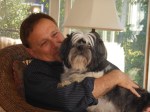
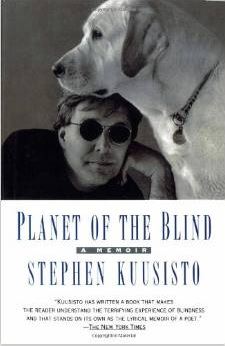
Stephen Kuusisto and HarleyABOUT: Stephen Kuusisto is the author of the memoirs Have Dog, Will Travel; Planet of the Blind (a New York Times “Notable Book of the Year”); and Eavesdropping: A Memoir of Blindness and Listening and of the poetry collections Only Bread, Only Light and Letters to Borges. A graduate of the Iowa Writer’s Workshop and a Fulbright Scholar, he has taught at the University of Iowa, Hobart and William Smith Colleges, and Ohio State University. He currently teaches at Syracuse University where he holds a University Professorship in Disability Studies. He is a frequent speaker in the US and abroad. His website is StephenKuusisto.com.

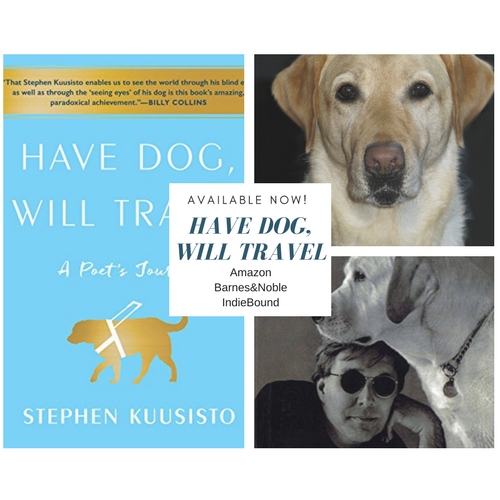
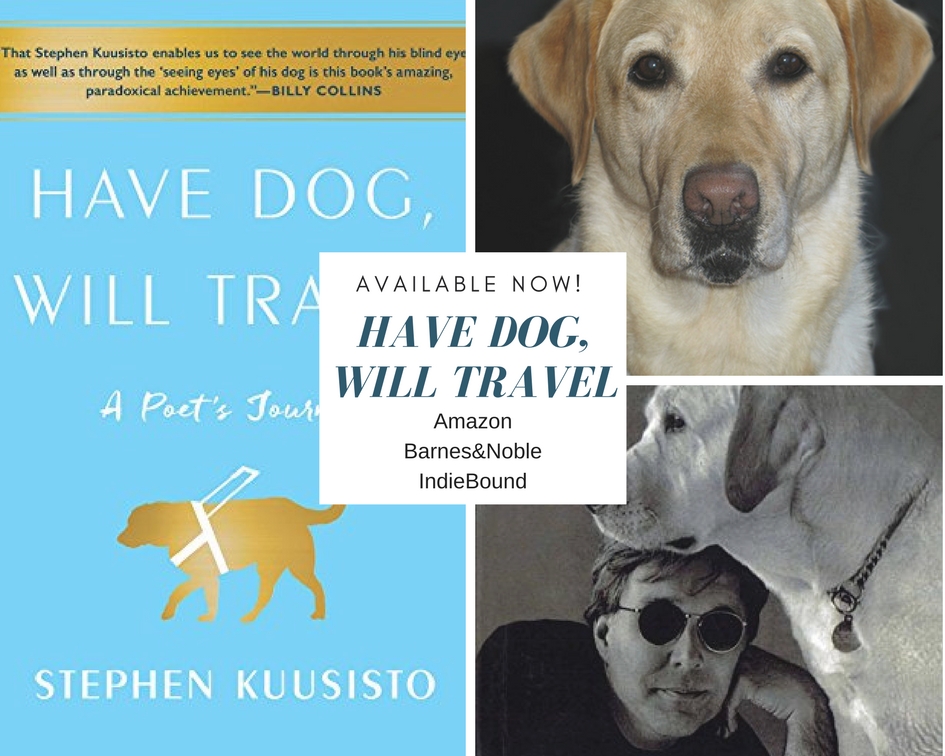
Have Dog, Will Travel: A Poet’s Journey is now available for pre-order:
Amazon
Barnes and Noble
IndieBound.org

Have Dog, Will Travel by Stephen Kuusisto

(Photo picturing the cover of Stephen Kuusisto’s new memoir “Have Dog, Will Travel” along with his former guide dogs Nira (top) and Corky, bottom.) Bottom photo by Marion Ettlinger 

Lyric, Crippled Anger

Two nights ago I over drinks and dinner with poets and writers at the University of Cincinnati I let my disability freak flag fly. Sometimes (though I aim to be circumspect and polite, especially with new found friends) I feel the distress of disablement–the peninsula effect of the matter—my people are the last people to be surveyed, especially in academic circles. While some American universities have disability studies programs or courses the majority of colleges do not. Moreover, while diversity gets discussed in neoliberal circles within higher education these discussions usually leave the disabled out. I admitted the following things to the poet Rebecca Lindenberg one of my hosts:

I’m 63 years old and still fighting for disability inclusion everywhere. The fight often seems to be going badly, or backward.

As I age I feel the pull of the soul—really, those roads of the guitar as Lorca might say. I don’t want to die angry. While I don’t expect to vanish tomorrow, I could. I cross the streets with a guide dog. I navigate on faith. The unseen is very present in my daly thoughts.

I’m tired of the academic creative writing industry with its conferences that are often hostile to disabled participants. With academic literature programs that foreground the notion of intersectionality but still leave disability out of discussions of hegemony and oppression.

I told Rebecca how disheartened many of us are in the disability community (which is hardly monolithic) by the steep struggle we still face to be recognized by feminist scholars, LGBTQ scholars, African-American scholars, and so forth.

Such things aren’t on my mind as exercises. This summer at the famous MacDowell Colony for the Arts I heard a famous novelist tell a huge crowd that the MacDowell Colony would no longer be blind and poor when it comes to recognizing comic novels as an art form. He then repeated the phrase because he thought it was so apt. And there I was, sitting on a folding chair with my guide dog. Disability as metaphor is used by artists and progressives all the time. This hurts. No wonder the Association of Writers and Writing Programs conference remains indifferent and even rude to disabled writers. Everyone knows there’s something wrong with us beyond the obvious.

I talked about the war on disability that’s underway because of genetic research and the movement to eliminate disabled bodies which comes from both the scientific community—eugenics 2.0—and political persuasions—Iceland has eliminated people with Down syndrome for example. Hitler called the disabled “useless eaters” and we’re still imagined that way by the political state, even European states.

I rattled on and on, letting out my frustrations. I talked about academic creative writers who have disabilities and pretend they don’t and how much this disturbs me.
I know I was venting in good company for Rebecca Lindenberg has her own disability and struggles with it hourly.

And there’s the specter of Trumpism, being triggered, feeling a neurological highjacking going on all the time, a fight or flee distress because deviant bodies are under attack.

And so it occurred to me Rebecca snd I might start a very informal back and forth dialogue to which we can invite others here on this blog. What is just anger for writers? How do we build bridges? Or as the poet James Tate once said, “start a fire with our identification papers.?

—Stephen Kuusisto

Rebecca Lindenberg responds:

Thank you so much for sharing the note above with me. I think it captures the breadth of our conversation aptly, though I think it’s worth mentioning (in the spirit of candor) how emotionally charged such conversation can be, though I think of that as a positive thing. Sometimes I wonder how much of the American conversation would be different if we were all a little more willing to be uncomfortable for the sake of someone else, to push our own envelopes more. To wrestle with the difficult. Because for me, part of the defining characteristic of living with chronic disease and disability is learning to persist with difficulty, to muddle through what you cannot get “over” or around, to sit with uncomfortable realities, and also, learn to problem-solve them. Problems, I find, are easier to solve in collaboration than alone, pretty much every time. But you can’t solve a problem that one of your collaborative group does not acknowledge or understand. The bravery to be candid, and also the courage to hear what is candidly spoken, are two kinds of strength that the world requires of us if we’re to make it any better.
I’ve thought about this a great deal. I remember one evening, many years ago, after a sort of semi-official writerly function where my late partner Craig had been (it seemed to me at the time) somewhat bracingly frank with our hosts, I sort of wearily admonished him for acting like kind of a jerk. And I’ll never forget his response, because it was: “Do you want me to be Good, or do you want me to be Nice?” I remember my initial thought was, Why can’t you be both? But years on, I think more and more every day that it is too often difficult to be both. And while I very much want people to like me, as I think most socialized humans do, when push comes to shove, I’d rather be Good. By “good” in this context, I mean just. I mean compassionate and humane, but also unafraid to advocate for myself, for my trans daughter, for my students, and so forth. I also mean fair, and mindful of others, and cognizant of complexities, and insofar as I am able, conscious of my own positions of privilege and my own gaps of knowledge and understanding. As we were talking about together the other night, I do not think candor is opposed to kindness, and I do not think “politeness” is particularly healthy – in fact I think it’s a coercive and often insidious way of keeping people “in line” who might otherwise disrupt the status quo from which the mighty (pretty much singularly) benefit. And politeness insists that those in charge not be made uncomfortable. But if they (or in some cases, we) do not feel uncomfortable, how can they (or we) come to know that something is very, very wrong? And along those lines, I believe that anger is a very important emotion, and a healthy one. (I was joking about this on social media the other day, actually, a beloved friend of mine responded to one of my posts with “Anger is healthy,” and I replied in all caps, “THEN I AM FULL OF HEALTH,” which is especially ironic for me, and for the sources of my anger.) But it’s true – anger is a source of energy, of activity, and of agency. Anger empowers. But anger should never, ever be confused with abuse. Abuse does not empower, it silences, it paralyzes. And it is designed to silence and paralyze. And it can come from any of us, at any time. Anger is interested in getting things going the right way, abuse is only interested in getting its own way. And at almost any cost. But because anger – and I almost feel Blakean about its “infernal energy” – has so much to offer, we do sometimes have to put politeness away in its favor. Because the one thing politeness is designed to avoid, really, is anger. Here’s a joke to show you what I mean:
Two Southern Belles are sitting on a porch, rocking in their rocking chairs, fanning themselves with their fans. Southern Belle #1 turns to Southern Belle #2 and says (you have to imagine your best high-falutin’ Southern drawl here):

Do you see that horse out there? My daddy bought me that horse because he loves me so much.

Southern Belle #2 says: That’s nice.
Southern Belle #1 says: Do you see that grand house over yonder? My daddy bought
me that house because he loves me soooo very much.
Southern Belle #2 says: That’s nice.
Southern Belle #1 says: See that there shiny auto-mobile? My daddy bought me that auto-mobile because he loves me so much.
Southern Belle #2 says: That’s nice.
Southern Belle #1 says: What’s your daddy done for you lately?
Southern Belle #2 says: He sent me to a finishing school in Switzerland.
Southern Belle #1 says: What’s finishing school?

Southern Belle #2 sighs, folds her fan in her lap and says: It’s a boarding school for young ladies, where you learn such things as proper deportment, and elocution, and which spoon to serve with which kind of soup, and how – when you really, really want to say Go Fuck Yourself – you say, ‘That’s Nice’.

It’s funny, that joke, but it kind of gets at the point I’m trying to make, nonetheless. “Politeness” is – by its very design – repressive. And that joke is funny because, as they say, nobody died. But it’s not always so amusing.
Now, to clarify a little, I’m all in favor of being considerate of those around you, their feelings and experiences. I think it was Lucille Clifton who once said (not wrote, she just came out and said it), “Walk into any given room, and every single person in that room is going through something you could not even begin to comprehend.” And I think I try to walk into every room mindful of that truth – a truth I have found bears out again and again and again. But “politeness” as we have socially constructed it (a system of “do’s” and “don’ts” like “never talk about sex, politics, or religion,” a nearly-invisible way of propping up a social hierarchy that rewards conformity and punishes difference) isn’t really about being kind or compassionate to people, actually. It’s about asking people, often the most vulnerable people in any given setting, to suffer their own discomfort for the sake of the comfort of whomever in that setting is perceived to have the power or the authority. A man might make a move on a woman, which might make her uncomfortable. Rather than react appropriately (that is, angrily) she will very often downplay the situation, or try to laugh it off and smooth it over, or feel compelled to “let him down easy” so as to “not make a scene,” but that’s more about preserving his dignity than it is about protecting her own. (I should know, I’ve been there, and beaten myself up about it afterwards.) A person of color might find themselves on the receiving end of a rude, racist remark, and instead of calling out the person who made the remark, they might just ignore it, or change the subject, or find a way to gently excuse themselves from the situation. It might be because to correct someone requires more emotional labor than they wish to do at that moment, but one of the reasons it IS emotional labor in the first place is because they’re trying to respond within a code of conversation and behavior that requires certain niceties be observed and maintained, the offending party not be too embarassed, lest (among other things) they somehow retaliate. The implicit threat in coercive politeness is that the person in a position of privilege or power will escalate the situation, if the more vulnerable party does not tow the line. Therefore, being “polite” in a discomforting situation just reminds the individual striving not to “make a scene” or whatever that we don’t really feel safe. Our safety is as fragile as this pretense, which we are primarily called upon to maintain. And people with disabilities are frequently – no, constantly – coerced by this unspoken, culturally-ubiquitous code of “politeness” and asked to hide, downplay, apologize for, or try to compensate for our disabilities. I’m diabetic and I have some of the unfortunate visual complications of my disease (in part because for so long I had no access to meaningful health care, but that’s a whole other story). I have been diabetic for 30 years, or three-quarters of my life, and I can’t tell you the number of times I’ve sneaked off into bathrooms to test my blood sugar secretly in the stall rather than at a table in a restaurant where I might make someone uncomfortable, or the number of times I’ve apologized for having to interrrupt a conversation or shared experience with someone in order to treat a low blood sugar (a situation which, untreated, can be fatal). At some point I caught myself out. Why, I wondered, am I apologizing to this person for trying to keep myself alive? When for a time I couldn’t drive because of hemorrhaging in my eyes, I found myself being excessively obsequious to my Uber drivers, conscious as I was that without them my mobility around a city with really crappy public transportation was very, very limited. So even when I found myself appalled by an assertion about American politics, or a story about a drunk female passenger, or rudeness offered to me personally, I was meek, ameliorating, polite. And it hurt more than I cared to admit to myself, as I became increasingly aware that I was pandering to people I knew were in the wrong, because I also knew that in that situation, I was somewhat frighteningly dependent upon them. Because I felt vulnerable, I tacitly agreed to stroke the egos and protect the dignities of the people who were making me feel my own vulnerability even more. A wound, the salt.
But beyond that, my real beef with coercive politeness is that it inhibits open, honest conversation. Like this one! Like the ones we got a chance to share in Cincinnati. Open, honest conversation can be bracing – for everyone. But I think of that feeling I get from such a conversation – which is a little like being together in a tiny boat at sea – seems to me to represent the feeling of going-through-something with someone else, its own kind of solidarity. It is for me, too, the feeling of growing as a person and a thinker, of pushing my own envelope a little, placing myself in a scenario that would feel, if not for the good intentions of my interlocutor, precarious. It’s work, for sure. But I’d rather do that work than the work of self-censoring, beating myself up, coping endlessly with feelings of awkwardness and discomfort – my own, or yours.
I would be so interested in hearing your further thoughts on these things, and I would be so, so very interested in hearing the thoughts of others, which I expect might be very different from my own, and I would welcome that. It’s my experience that I have had plenty of occasions in my life to think about the things that make my life very, very hard to live sometimes. I know that someone whose life is made hard to live by a different set of circumstances would almost certainly have a different take on things – perhaps expanding upon this conversation, or problematizing some of what I’ve offered. For me, my obsession with literature stems in no small part from my infinite fascination in hearing from others about experiences and points of view that differ from (and also re-contextualize for me) my own.
I wonder who else we could invite to join our conversation? Should we just reach out an invite people? Run it up the flagpole, as it were?
I look forward to our continued correspondence. And I totally forgot to have you sign your book for me so: Next time?

Very warmly,
Rebecca

**

Dear readers, especially poets and writers (though you needn’t hail from this territory alone) please feel welcome to chime in.

You can send me your thoughts and I will post them.

Stephen Kuusisto

stevekuusisto@gmail.com
Stephen Kuusisto and HarleyABOUT: Stephen Kuusisto is the author of the memoirs Have Dog, Will Travel; Planet of the Blind (a New York Times “Notable Book of the Year”); and Eavesdropping: A Memoir of Blindness and Listening and of the poetry collections Only Bread, Only Light and Letters to Borges. A graduate of the Iowa Writer’s Workshop and a Fulbright Scholar, he has taught at the University of Iowa, Hobart and William Smith Colleges, and Ohio State University. He currently teaches at Syracuse University where he holds a University Professorship in Disability Studies. He is a frequent speaker in the US and abroad. His website is StephenKuusisto.com.

Have Dog, Will Travel: A Poet’s Journey is now available for pre-order:
Amazon
Barnes and Noble
IndieBound.org
Have Dog, Will Travel by Stephen Kuusisto

(Photo picturing the cover of Stephen Kuusisto’s new memoir “Have Dog, Will Travel” along with his former guide dogs Nira (top) and Corky, bottom.) Bottom photo by Marion Ettlinger 
And the Wind a Grain of Salt

I’m going to let the kitty out of the wrapper and admit I’ve never believed the teaching of creative writing is more than a pastime. Like baseball, academic discussions of poetry and fiction, nonfiction and playwriting tend toward exquisite minutiae and nostalgia but without regard for what’s happening outside the stadiums or sports bars. I’m employing nostalgia with irony of course—using it in the Greek sense meaning returning home in pain. Odysseus is nostalgic. In turn he’s single minded.

**

Odysseus is more than nostalgic. He’s religious in the worst way, Huck Finn praying for a fishing hook. Athena is his familiar and gets him “home” on rage. Most religious pastimes are about nothing more than this.

Justice is absent from Homer save for divine vengeance that good old Olympian smack down.

We better know what we mean about the effects of poetry, what we mean by justice, where the study of poetry or literature stands in relation to human rights.

At the poetry conferences save for very few, human rights are not discussed at all. It is assumed by the writing workshop crowd that just thinking about writing elevates.

**

I told a fine poet last evening that I’m running out of time. At 63 I need to turn my prow toward the far shore, away from time, to that place where coins are useless. That I’ve long been in the fight for disability rights (which are all human rights insofar as disability admits everyone) means I’ve had to sculpt and shape my anger into productivity. Just anger admits justice and eschews vengeance. Just anger is not nostalgic. It’s also a form of ambition. Pentti Saarikoski wrote: “I want to be the sort of poet whose words build houses for people….” Amen. Meanwhile, how to let go of anger, or just enough of it to die happy?

**

“Life is a hospital where all the patients want to change beds,” said Baudelaire. I want to pick up my bed and walk—not because I’m cured but because I learned (am learning) to make my burdens light and my rest easy. I want this for you and you.

**

So I gravitated away from the teaching of creative writing to work in the eddies of human rights. 80% of the disabled remain unemployed in the United States. Some will tell you its only 70%. Some will tell you they’re a drain on society. (Hitler: the disabled are useless eaters.)

If human rights mean anything they stand for the manifest opportunity to think, believe, examine, eat, sleep, all unencumbered. And as I think about the bow of my boat I’m remembering these lines by the Norwegian poet Olav Hauge:

“Don’t give me the whole truth,
don’t give me the sea for my thirst,
don’t give me the sky when I ask for light,
but give me a glint, a dewy wisp, a mote
as the birds bear water-drops from their bathing
and the wind a grain of salt.”

On Being a Dirty Utopian

Non-disabled people think ableism is part of a hierarchy—as if treating others poorly or illegally is indexible. I’ve heard it said that “the disabled are just the latest to be (insert phrase here) “necessary for us to think about….” (does nicely) and along with this comes “you best get in line” as if human rights are a kind of supermarket.

I realize I’m just banging my head against a tree by talking about this. I’ve been talkin’ about this all my life. I’ll go to my grave talkin’ ‘bout it.

On the roadside are mushrooms and crimson leaves.
On the mountain of imagination are extraordinary beings with equally extraordinary wings.

Silly utopian. Why can’t he admit the grime of human relations is the lion’s share?

Gandhi: “I make no hobgoblin of consistency. If I am true to myself from moment to moment, I do not mind all the inconsistencies that may be flung in my face.”

My consistency is my hobby horse if not my hobgoblin.

I believe when universities, businesses, public occasions purport to be open to the public they must include the disabled public seamlessly and without grudge.

No inconsistency there.

It’s the grime of insistence makes one—well, gritty.

I’m a dirty utopian.

Stephen Kuusisto and HarleyABOUT: Stephen Kuusisto is the author of the memoirs Have Dog, Will Travel; Planet of the Blind (a New York Times “Notable Book of the Year”); and Eavesdropping: A Memoir of Blindness and Listening and of the poetry collections Only Bread, Only Light and Letters to Borges. A graduate of the Iowa Writer’s Workshop and a Fulbright Scholar, he has taught at the University of Iowa, Hobart and William Smith Colleges, and Ohio State University. He currently teaches at Syracuse University where he holds a University Professorship in Disability Studies. He is a frequent speaker in the US and abroad. His website is StephenKuusisto.com.

Have Dog, Will Travel: A Poet’s Journey is now available for pre-order:
Amazon
Barnes and Noble
IndieBound.org

Have Dog, Will Travel by Stephen Kuusisto

(Photo picturing the cover of Stephen Kuusisto’s new memoir “Have Dog, Will Travel” along with his former guide dogs Nira (top) and Corky, bottom.) Bottom photo by Marion Ettlinger 
The Cage We’re Forced to Watch

My neighbor is eating good ham. He drives a nice car. He voted for Trump. He’s a stand up guy. Just ask him. He’ll tell you he loves America. In fact he loves it more than you do. You describe problems with the USA. He only sees timeless verities: cowboys and Indians; slaughter on behalf of the railroads; local jobs based on environmental destruction. While the Colorado River basin runs out of water he says global warming is a hoax.

Sleeping he dreams of a wide cushiony bed where no one has sex, it’s a white, protestant cloud if you will.

When he wakes he turns on Fox News and tells himself America is great again because “those people” are getting their comeuppance.

**

Yesterday I hosted film maker Federico Muchnik and poets Doug Anderson and Preston Hood at the 15th annual Syracuse International Film Festival.

Federico’s film “Hunter in the Blackness: Veterans, Hope, and Recovery” details the experiences of American soldiers—veterans with traumatic brain injury, PTSD, and other poly-traumas. Doug Anderson and Preston Hood, both veterans of the Viet Nam War are featured in the movie alongside vets from America’s involvement in Bosnia, Iraq, and Afghanistan. It is a haunting film. The lack of awareness of civilians is a recurring theme. We send boys and girls to wars while America shops at the mall. When troops return with grievous conditions many Americans don’t want to know.

22 veterans commit suicide daily in these United States.

Last evening, after I bid farewell to my new found friends, I took an Uber home. My driver was a veteran of the war in Iraq. He has PTSD and traumatic brain injury. He told me how his best friend from his time in the military recently committed suicide.

And there we were, riding in a Dodge pickup, through the gritty nighttime rainy streets of Syracuse, NY, and it was impossible for me to blink away the machinations of my country. My driver told me about his TBI, his facial disfigurement, his stress condition, and the ongoing difficulties he has had with the VA to get the help he needs.

Rain spattered the windshield.

**

Swedish poet Lars Gustafson writes: “And a cage/which never held a bird can easily give/a feeling of disorder.”

I’ve not been to war. But I know the cage we’re forced to stare at.

Stephen Kuusisto and HarleyABOUT: Stephen Kuusisto is the author of the memoirs Have Dog, Will Travel; Planet of the Blind (a New York Times “Notable Book of the Year”); and Eavesdropping: A Memoir of Blindness and Listening and of the poetry collections Only Bread, Only Light and Letters to Borges. A graduate of the Iowa Writer’s Workshop and a Fulbright Scholar, he has taught at the University of Iowa, Hobart and William Smith Colleges, and Ohio State University. He currently teaches at Syracuse University where he holds a University Professorship in Disability Studies. He is a frequent speaker in the US and abroad. His website is StephenKuusisto.com.

Have Dog, Will Travel: A Poet’s Journey is now available for pre-order:
Amazon
Barnes and Noble
IndieBound.org

Have Dog, Will Travel by Stephen Kuusisto

(Photo picturing the cover of Stephen Kuusisto’s new memoir “Have Dog, Will Travel” along with his former guide dogs Nira (top) and Corky, bottom.) Bottom photo by Marion Ettlinger 
A Valediction of Fainting

The surgeon plucked at my eye with a forceps. I said I was fainting. Then I fainted.

It was a textbook instance of the “vasovagal reflex”. You can ask the CIA. Touch the lenses of the eyes and you can induce loss of consciousness.

Reader: perhaps you’re a frequent fainter and are familiar with the poetry of the matter. I doff my hat to you.

I woke in a chair. Although I couldn’t see I heard a nurse say: “I can’t hear his pulse.”

The neo-cortex (mine) which thinks fast (yours does too) said inwardly: “Merd! Je suis mort!”

(The neo-cortex it turns out, speaks only French, as it was in fact discovered by Denis Diderot. You don’t have to know French to understand the neo-cortex. The translation process is automatic. It does not matter if you are a Finn or a Croat or Laotian.)

(Theory: the French language was invented by and for dead people.)

(Proof of above: Diderot: “Man will never be free until the last king is strangled with the entrails of the last priest.”)

The nurse said next: “Okay. I can hear his pulse but it is very faint.”

Stephen Kuusisto and HarleyABOUT: Stephen Kuusisto is the author of the memoirs Have Dog, Will Travel; Planet of the Blind (a New York Times “Notable Book of the Year”); and Eavesdropping: A Memoir of Blindness and Listening and of the poetry collections Only Bread, Only Light and Letters to Borges. A graduate of the Iowa Writer’s Workshop and a Fulbright Scholar, he has taught at the University of Iowa, Hobart and William Smith Colleges, and Ohio State University. He currently teaches at Syracuse University where he holds a University Professorship in Disability Studies. He is a frequent speaker in the US and abroad. His website is StephenKuusisto.com.

Have Dog, Will Travel: A Poet’s Journey is now available for pre-order:
Amazon
Barnes and Noble
IndieBound.org

Have Dog, Will Travel by Stephen Kuusisto

(Photo picturing the cover of Stephen Kuusisto’s new memoir “Have Dog, Will Travel” along with his former guide dogs Nira (top) and Corky, bottom.) Bottom photo by Marion Ettlinger 
Stop With Your Ableist Lazy Rage

Over the course of the last two years (post election and the year prior) I’ve watched people throw ableist insults. From the right the favored term is “libtard” and from the left one hears “moron” “idiot” and “imbecile” all echoing eugenics both in Germany and the United States when the disabled were marked for elimination.

When disability must be employed to register rage then its nothing more than lazy rage. Rather than call a Trump supporter an imbecile why not say: “there’s a person who doesn’t understand his shadow.” Not so much fun as ableizing him or calling him a pig or weasel.

Lazy rage is fun rage. Even in their discontent Americans like to have fun. Trump knows this. Its perhaps the only thing he knows.

We’re got rape culture to worry about; children in cages; wholesale destruction of the environment at hand; black men in the school to prison pipeline; eroding medical services for veterans and the poor; unending American involvement in ruinous wars; the collapse of public education; big Pharma slinging opioids in every corner of the nation; religious extremism attacking science; an outright war on the Americans with Disabilities Act—I’m just getting started.

And all I see on facebook is callow name calling with an especially able bodied smugness.

As John Lennon might say: here’s another clue for you all. You are as much the problem as the problem.

Read Carl Jung on “the shadow” and know your own deep despairs before saying someone else is “lame” and for god’s sake join a volunteer organization of some kind.

“Its Against the Rules, Disabled Person…”

If you’ve a disability you’re used to hearing: “its against the rules” in hundreds of settings. “Its against the rules for you to stand near that painting”; “against the rules to sit in a wheelchair in this section”; “have extra time on a test”; “wear those headphones in class”; “take three incompletes in a semester”; on and on. “Against the rules for a guide dog to ride this bus”; “against…blah blah blah….”

A major facet of ableism rests with the rhetoric of rules and rule bound thinking. A friend of mine a blind attorney who graduated from Harvard Law once said in a job interview something like, “dude, my whole life is outside the box.”

Bureaucrats, administrators, college faculty, politicians, etc. like to say they want to “think outside the box” but their boxes are never open where disability is concerned.

Rules are good. Don’t walk on the grass. Don’t shout fire in a theater. But rules preventing the disabled from participating in mainstream activities are always ableist and ugly.

I was told as a child I wasn’t allowed to play games with other kids. Told I didn’t belong in almost any room where I found myself.

All disabled people know that story.

It especially kills me when administrators at colleges and universities can’t find it within themselves to solve an accessibility problem because the problem defies the ordinary.

My friend Scott Lissner the ADA Coordinator at The Ohio State University once found a way to get a wheelchair using student aboard a tractor.

Accommodations require imagination and a can do spirit.

When you’re tempted to say “against the rules” where disability access is concerned its time to scratch you head and say, “what if we….?”

Disability accommodations represent old fashioned American know how.

Stephen Kuusisto and HarleyABOUT: Stephen Kuusisto is the author of the memoirs Have Dog, Will Travel; Planet of the Blind (a New York Times “Notable Book of the Year”); and Eavesdropping: A Memoir of Blindness and Listening and of the poetry collections Only Bread, Only Light and Letters to Borges. A graduate of the Iowa Writer’s Workshop and a Fulbright Scholar, he has taught at the University of Iowa, Hobart and William Smith Colleges, and Ohio State University. He currently teaches at Syracuse University where he holds a University Professorship in Disability Studies. He is a frequent speaker in the US and abroad. His website is StephenKuusisto.com.

Have Dog, Will Travel: A Poet’s Journey is now available for pre-order:
Amazon
Barnes and Noble
IndieBound.org

Have Dog, Will Travel by Stephen Kuusisto

(Photo picturing the cover of Stephen Kuusisto’s new memoir “Have Dog, Will Travel” along with his former guide dogs Nira (top) and Corky, bottom.) Bottom photo by Marion Ettlinger 

Oh, the Poor Sighted People, etc.

I will tell you how to be blind but only when first you tell me how it is to be sighted. You will tell me what you see which has very little to do with the matter. You cannot help yourself. To see, seeing is this sail turning before the wind, this nearly transparent orchid. When your thoughts turn atavistic your vision has much to do with being a prey animal for humans have a great deal in common with horses.

So by turns, given this is what you believe about sight—that it is the sum of its contexts and each “peep” stands for something universal—you must believe the absence of sight is nothing more than a mineral blank.

You think there’s a tribe called “the blind” and we are pulling off a sinister trick by our very attempt to live in the world. You want to ask: “how can you live if you can’t see?” You know you want to ask it. A famous fiction writer once asked me during a job interview: “How can you write so clearly if you can’t see?” Translation: “How exactly are you fooling us? Maybe you can see? In any event you must be dishonest.”

Blindness is dishonesty to many sighted. If I can be called “blind” you can be called “sighted” though I prefer mis-sighted for you. In any event you believe you’re the sum of your sights however poorly apprehended.

Yes, you see as through a glass darkly. Most of you know it and are afraid. “Why if I lost my little peephole it would be like death itself.”

The blind are, to the poorly apprehended, the walking dead.

Yes. The blind are zombies to the P.A. kids.

Yes. The poorly apprehended are just kids.

Children who believe they’re the sum of their toys.

Seeing is toy collection.

Wouldn’t life without toys be impossible?

You’d have to be a zombie.

**

Not long ago while visiting a famous arts colony I heard a notable writer say that henceforth the famous arts colony would no longer be blind and poor when it comes to appreciating outlier forms of art. He said it twice during a formal speech.

And there I was with my guide dog. I’ve spent the last thirty years writing six books which argue that blindness is a rich way of knowing.

I was insulted and remain so. Yet this is business as usual for the poorly apprehended who can’t describe sight but imagine they know it thoroughly and think the blind are among the sighted “on sufferance” and yes, we make the P.A. tribe nervous by our very appearance.

I share with my black and LGBTQIA pals and all my foreign friends a capacity to make the poorly apprehended nervous. All of us are believed to be “here on sufferance” but there’s something especially dishonest about the blind, the lame, the halt.

The dishonest thing is that you, the sighted, unable to tell me what vision means, and only able to describe your toys, you fascinations as it were, the majority of you have no spiritual center. Without this you can’t imagine the glory of life itself. You think sight seeing is the secret to living.

And if you believe this, then you also must believe that language isn’t much of a thing.

My answer to the famous writer who wanted to know how I could write about the world with clarity was simple: all nouns are images. Horse. Battleship. Rose bush.

All I have to do is jot down a noun and voila! I saw what you saw little dude.

Or: of course I didn’t see it. But according to neurological findings, neither did you.

Stephen Kuusisto and HarleyABOUT: Stephen Kuusisto is the author of the memoirs Have Dog, Will Travel; Planet of the Blind (a New York Times “Notable Book of the Year”); and Eavesdropping: A Memoir of Blindness and Listening and of the poetry collections Only Bread, Only Light and Letters to Borges. A graduate of the Iowa Writer’s Workshop and a Fulbright Scholar, he has taught at the University of Iowa, Hobart and William Smith Colleges, and Ohio State University. He currently teaches at Syracuse University where he holds a University Professorship in Disability Studies. He is a frequent speaker in the US and abroad. His website is StephenKuusisto.com.

Have Dog, Will Travel: A Poet’s Journey is now available for pre-order:
Amazon
Barnes and Noble
IndieBound.org

Have Dog, Will Travel by Stephen Kuusisto

(Photo picturing the cover of Stephen Kuusisto’s new memoir “Have Dog, Will Travel” along with his former guide dogs Nira (top) and Corky, bottom.) Bottom photo by Marion Ettlinger 

Disability, Coltrane, Thorn Soup, etc.

The opportunity one sometimes has to hear John Coltrane playing Soul Eyes. That’s a sentence for the indirect object is perfectly implied. If you don’t get it you don’t.

If you don’t get that I’m blind but not deficient in imagination or discernment well, you don’t get it. Artists at the famous arts colonies and conferences don’t grasp this. I’m used to it.

I’m a poor, blind, unknowing wretch.

I’ve been writing against disability as pejorative metaphor for thirty years.

What can I say?

Soul Eyes.

Try it.

The narrow highways of ableist fancy take the sighted to the shopping malls of vanity where no reappraisal of physical trauma will ever jar their consumerist ambitions.

**

By day I want to go from the white square to the black. I don’t require much. Ambient chess in the wind torn world.

**

I have a sense of myself as a social thorn. And the ablest types are happy to confirm this. What they don’t know is I come from a culture that makes excellent thorn soup.

**

Scientists think they’ve discovered the secret to Coltrane’s high notes. They think it has to do with the man’s glottis.

I say its thorn soup.

Stephen Kuusisto and HarleyABOUT: Stephen Kuusisto is the author of the memoirs Have Dog, Will Travel; Planet of the Blind (a New York Times “Notable Book of the Year”); and Eavesdropping: A Memoir of Blindness and Listening and of the poetry collections Only Bread, Only Light and Letters to Borges. A graduate of the Iowa Writer’s Workshop and a Fulbright Scholar, he has taught at the University of Iowa, Hobart and William Smith Colleges, and Ohio State University. He currently teaches at Syracuse University where he holds a University Professorship in Disability Studies. He is a frequent speaker in the US and abroad. His website is StephenKuusisto.com.

Have Dog, Will Travel: A Poet’s Journey is now available for pre-order:
Amazon
Barnes and Noble
IndieBound.org

Have Dog, Will Travel by Stephen Kuusisto

(Photo picturing the cover of Stephen Kuusisto’s new memoir “Have Dog, Will Travel” along with his former guide dogs Nira (top) and Corky, bottom.) Bottom photo by Marion Ettlinger