Disability and the Clock

Baba Yaga


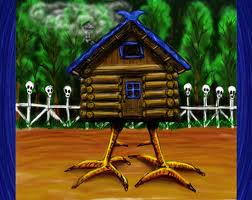
This morning I am hurrying. I am not alone in this. The clock says: “The only thing now is not to disappear.” In this way the clock is opposed to instinct, opposed to the body, even opposed to nature. The folk poetry of the world (pick anyplace) tells us that disappearance is imminent. There’s a witch coming, she’s dressed up like a shack and she runs on chicken legs and she’s going to devour you because you were minding your own business. Which gets me to my point: Marxists will say that the clock was given its exceptional power in the Industrial Revolution, but those of us who are forced to hurry, like geese before the rod, know that the clock is just trying to tell us that the witch with the chicken legs is coming. Keep moving. Keep rolling. Keep blinking. Keep limping. Erving Goffman understood the stigma of disability but he left out this insight: able bodied people see, in people with disabilities, and far down in their collective unconscious–see people who won’t outrun the witch dressed like a shack and running on her chicken legs. When people who do not currently have a disability see pwds they worry about running from the Baba Yaga. Trust me on this. Meanwhile, I have to get going, just like you my friend. The lines of the day are fuzzy. Where are my gloves?


Disability On Theory Road

–after Pentti Saarikoski


In the morning on Theory Road

Ableists and doctrineaire landscapers accosted me

Told me I was sily wanting to go places like everyone else

A little higher up under my apple tree a fawn and her twins nosed fallen fruit

Malice, dressed as a bureaucrat told me to give up

His forehead wavy, eyes quite specific, didn't much like the blind he said

I climbed the steps to the dance floor

Late summer clouds calling me

To dance with them but I lay down on my back

& listened as if my life depended 

Tell Congress No on Subminimum Wages for People with Disabilities

This blog ardently supports the efforts of the National Federation of the Blind to protest sub-minimum wages for people with disabilities.

Blind Americans To Protest Subminimum Wages
(National Federation of the Blind)
July 20, 2011

BALTIMORE, MARYLAND–The National Federation of the Blind, the oldest and largest nationwide organization of blind people, announced today that its members will conduct informational protests across the United States to raise awareness about the practice of paying wages below the federal minimum wage to Americans with disabilities.

The protests will take place at the district office locations of United States Senators serving on the Senate Committee on Health, Education, Labor and Pensions (the HELP Committee). The HELP Committee is currently considering legislation — the Workforce Investment Act — which would reauthorize the payment of subminimum wages to disabled workers.

Dr. Marc Maurer, President of the National Federation of the Blind, said: “Unequal pay for equal work on the basis of disability is unfair, discriminatory, and immoral. The senators who serve on the HELP Committee must decide whether they stand for the outrageous exploitation of disabled workers, or for true equality for Americans with disabilities.”

On Wednesday, August 3, the HELP Committee will vote on the Workforce Investment Act, which contains language reauthorizing the Rehabilitation Act of 1973, as amended. The Rehabilitation Act is supposed to provide services to disabled Americans so that they can obtain competitive employment, but Title V, Section 511 of the proposed Rehabilitation Act language references Section 14(c) of the 1938 Fair Labor Standards Act, which allows certain entities holding special wage certificates to pay workers with disabilities less than the federal minimum wage.

Entire press release:
Blind Americans to Protest Subminimum Wages
http://www.nfb.org/NewsBot.asp?MODE=VIEW&ID=826

World Premier in Iowa City: See you there, Friday night, Feb 5th!

Imagine your world going dark. Contemplate the fading sight of a loved one. Grapple with the responsibility of delivering a diagnosis. Renowned
theater artist and UI graduate Rinde Eckert takes you behind the eyes
and into the heads and hearts of those surrounded by the shadows of
blindness. Crafted from interviews collected via an unusual
collaboration between Eckert and the University of Iowa Carver Family
Center for Macular Degeneration, Eye Piece
will feature performers from the UI Theatre Arts and Dance departments
and the School of Music as well as Eckert himself. With humor and
compassion Eckert will lead us on a journey through darkness toward a
different kind of illumination.

Rinde Eckert, Eye PieceRinde

Friday and Saturday, February 5 and 6, 8 pm
Sunday, February 7, 2 pm
Friday and Saturday, February 12 and 13, 8 pm
Sunday, February 14, 2 pm
Mabie Theatre

A HANCHER COMMISSION AND WORLD PREMIERE

Imagine your world going dark. Contemplate the fading sight of a loved one. Grapple with the responsibility of delivering a diagnosis. Renowned
theater artist and UI graduate Rinde Eckert takes you behind the eyes
and into the heads and hearts of those surrounded by the shadows of
blindness. Crafted from interviews collected via an unusual
collaboration between Eckert and the University of Iowa Carver Family
Center for Macular Degeneration, Eye Piece
will feature performers from the UI Theatre Arts and Dance departments
and the School of Music as well as Eckert himself. With humor and
compassion Eckert will lead us on a journey through darkness toward a
different kind of illumination.

RELATED EVENTS
Monday, January 25, 5:30 pm / 1289 Carver Biomedical Research Building,
Kelch Conference Room. Panel discussion about the creation of Eye Piece with Rinde Eckert, Dr. Ed Stone, Steve Kuusisto, and two cast members. Open to the public.

Tuesday, January 26, 12-1 pm / Braley Auditorium in UIHC’s Pomerantz Family Pavilion. Discussion about the impact of vision loss on family members with Rinde Eckert, Dr. Mark Wilkinson, and others. Open to the public.

This
project is made possible in part by a grant from the Association of
Performing Arts Presenters Creative Campus Innovations Grant Program, a
component of the Doris Duke Charitable Foundation.

It
is presented in collaboration with the UI Theatre Arts Department’s
Partnership in the Arts and the UI Division of Performing Arts’
Creating the Future Initiative. It is also presented in collaboration
with the University of Iowa Carver Family Center for Macular
Degeneration and the University of Iowa Carver College of Medicine
Writing Program.

Waiting for the Toilet Installers to Arrive and Replace the Pink Toilet with a White One Department

First I should tell you that the toilet boys are subcontractors. Everyone is a subcontractor nowadays. Need a filling for your tooth? The dentist will be right back but in the meantime Dr. Squatch will be happy to take care of you. He's "board certified" in Malibu. And he knows all about pain management. Many patients prefer him to the real dentist we're told.

The toilet boys came to my house last week and replaced two commodes. Or to be more specific: the commodes and the tanks. Toilets are two part affairs, even nowadays, some 150 years after Sir Thomas Crapper first flushed his flusher for Queen Victoria. I suppose I knew this. Like you I know lots of stuff. For instance one of the early Christian saints lives inside my chimney and he occasionally blows soot into my living room to remind me of my moral obligations. But I digress.

Toilets are two part inventions and that's all you need to know. The toilet boys installed the crappers and fled.

My mistake was to tell them I was blind. If you're new to this game take some advice from me: never never tell the toilet boys you can't see. Its best to act like Al Pacino driving that Ferrari and fooling the traffic cop by pretending to look him dead in the eye. Look the toilet boys right in the eye. Tell 'em the dead crappers are upstairs. Tell 'em not to track feathers on the rug. Whatever. Just leave the blindness out of the affair.

I revealed my blindness to the toilet boys because they were doing the subcontractor fandango. Here's how it works: we're in your house and we can fix your toilets but we really don't want to fix your toilets since that necessitates actually procuring the new toilets which in turn requires us to drive to "Toilet Town" and pick up the new machines (for indeed these are machines in the proper sense) and we don't want to do this–we'd rather that "you" the customer go to "Toilet Town" while we sit here on your wonderful front porch with its inviting rocking chairs. While you're away at "Toilet Town" we will eat our breakfasts and feed the rabbit who evidently lives under your lilac bush and we'll probably tell a couple of dirty jokes.

So of course I told them that I can't drive to "Toilet Town" because I can't see, etc. etc. Oh I tell you the Toilet Boys were crestfallen. But off they went.

When they came back with many boxes I didnt' think much about it. I was busy writing some recommendation letters for former students. I have always found that you can't write a good recommendation if you're thinking about toilets. I left the installation to the professionals.

They made lots of noises. And after an hour they told me they were done. They showed me the new toilets. They invited me to flush. Everyone was happy. They took the old toilets and drove away.

Ah but never never tell them you can't see. When my wife Connie got home and checked things out we discovered that the Toilet Boys had assembled a white commode with a pink tank. Why not? The blind guy won't notice. And probably the blind guy is married to a blind woman–isn't that the way it works? She won't notice either. Who wants to make two trips in one day to "Toilet Town"? Not me. Not me either. So let's just install pinky and get the hell out of Dodge.

Of course not everything is a disability story. For the sake of broad mindedness I should assume that the toilet boys were simply incapable of reading the box or, perhaps like many sighted people they weren't using their eyes at all. (Have you ever noticed how many sighted people become completely blind in airports? It turns out that when sighted people are feeling goal oriented they lose the ability to see what's in front of them. I'll write more on this in a subsequent post.)

Or maybe the toilet boys were suffering from toilet blindness. Its like snow blindness I imagine. If you stare at too many shiny white bowls and tanks you lose the ability to see colors.

Whatever the explanation there it was: a custom assembled pink and white toilet. It looked a bit like the Cadillac that Elvis bought for his mother.

Now I'm awaiting the return of the boys. How long will I wait today? That, as they say, is anybody's guess.

S.K.   
What's Wrong with the Guide Dog Schools?

Note: I wrote this piece over a year and a half ago andI still think it’s worth reading, particularly if you’re blind and a guide dog user.

SK 

If you visit the blindness blogosphere you will quickly discover anecdotal postings about the failings of the major guide dog schools in the

U.S.

  The reporting is of course subjective and the anger bubbles over into some pretty hard hitting assertions. One reads for instance that guide dog schools are patrician, dismissive of blind people in general, dishonest in their granting of services, even capricious—as you read these posts you’d be tempted to think you were reading about Oliver Stone’s version of the Nixon administration

I worked at Guiding Eyes for the Blind as the Director of Student Services from 1995 to 2000 before taking a job as a professor at The Ohio State University. I left Guiding Eyes because I was longing to return to college teaching. As it happened,

Ohio

State

was developing a new disability studies curriculum and I was offered the opportunity to be part of some exciting academic initiatives. Yet I left the world of the guide dog schools with mixed emotions. I consider the American guide dog schools to be remarkable institutions and I count friends among staff at many of the programs.

Still the blogs tell a story and I want to think aloud about what these narratives may tell us about the guide dog schools and the contemporary world of blind Americans. As they like to say in the public relations business: perception is everything.

It’s clear from the blogosphere entries that many blind people consider the guide dog schools to be out of step with the times. This may be an unavoidable offshoot of two factors: 1. Guide dog schools are essentially residential rehabilitation associations which are strongly reminiscent of 19th century institutions; 2. as disability rights have expanded some blind people may forget that having a guide dog is not a right but a privilege: one that results from demonstrating that the client can look after a dog with discipline and adhere to the training principles that are essential to guide dog work.

These two factors appear to be irreconcilable until you consider the possibility that not all institutions are bad and that not all rules are devised to harm historically marginalized groups, even those who experience blindness or low vision. While many blind people argue that the guide dog schools are mostly run by sighted people and offer this as proof of a kind of institutional infantilization of the clients, its also true that guide dog schools are extremely interested in the views and ideas of their alumni. To read what’s on the blogosphere you’d imagine that the guide dog schools are operating as medieval fortresses with all the peasants locked up inside.

Still it’s true enough that the guide dog field should pay closer attention to important changes in blind culture. Many of today’s blind college students are not at all interested in taking time out from campus life to attend an isolated institutional setting.

Additionally it would be very useful if the guide dog schools stopped imagining that the provision of a guide dog is heroic work. Old fashioned sentimental rhetoric that still lurks behind some of the guide dog industry’s fund raising should be updated now that almost 20 years have passed since the ADA was adopted. Times change.

What’s wrong with the guide dog schools? Not much. But they need to pay more attention to today’s blind customers.

Old Fart Eats His Own Tail Like King Salmon

My friend Bill Peace is right: today’s college students are working harder outside the classroom than ever. Many are holding more than one job while taking full course loads. In turn their professors who are charged with providing post-secondary educational course work are frustrated by the many ways today’s students seem to vanish from classes or vanish in conditional ways. My post below raises the thorny issue of “post-ADA” students with disabilities who don’t seem to have the insane work-ethic of their “pre-ADA” professors who often really did have to shoulder whole mountains in the bad old days when accommodations and social acceptance for pwds could be severely conditional at best.

And so I am an old fart. I like to think of myself as a scarred and dented King Salmon who has learned how to bounce off of the rocks and keep on going. In fairness to old farts everywhere and in further latitude to disabled students, I think most students today are reading less and asking fewer tough questions both of themselves and of the faculty.

“Ipse dixit,” says the old salmon. “Ubi sunt?”

The other salmon eye him from a safe distance before they swim away.

S.K.

Born Rich and Squishy

I continue to marvel at the appalling acceptance of the McCain campaign’s repeated assertions that “with Sarah Palin, parents of special needs children will have a great friend in Washington” etc. blah blah blah. For some good writing and other blog references on this disgraceful misrepresentation of Palin’s record I recommend William Peace’s blog “Bad Cripple” at:

http://badcripple.blogspot.com/

I believe that the lives of real parents and the problems that their very real “special needs” children face daily are so complex, fatiguing, socially driven, and seriously in need of assistance that I can’t accept the simplistic manipulation of these problems by a cynical political campaign.

As for John McCain: just look at his woeful record when it comes to supporting the health care of veterans.

For my money the telling thing about the McCain-istas utilization of “special needs” is that the term is divorced from the broader denomination  “people with disabilities” which means that the right wing base of the GOP can rest easy that no one at McCain-Palin is seriously proposing anything that looks like a  real social program. “Special needs” means sentimentality only. “Hey Muriel, that little special needs baby they’re holding up sure is cute!” Ah, but who in the GOP wants to think of a lifetime of physical and social struggle to get accommodations and an education for that special needs child?

I like the word “squishy” for this kind of neo-Victorian sentimentality. Translation: it’s at once soft and dead.

S.K.   

How Many Stories Am I Holding Up?

The film "Blindness" which is now in theaters offers the latest instance of what scholars David Mitchell and Sharon Snyder have called "narrative prosthesis" where in effect, disability is used as an artificial device to help what is otherwise a weak story line.

Blindness remains a frightening disability in no small measure because the literal condition, the disruption of the physical eye is invested with outworn symbolism that still resides in what the psychoanalyst Carl Jung called the cultural subconscious. People may know next to nothing about eye diseases but they know deep in their bones that there’s something suggestive and darkly portentious about the blind.

In literature and film the blind have often functioned as a form of narrative prosthesis: their presence in the story is designed to deflect the reader’s attention from the fact that the narrative is essentially uninteresting. Stevenson’s "Blind Pew" is a classic example of the technique. Aside from evil blind figures there are hundreds of stories in which a blind man or woman is victimized. Never mind that blind people are no more likely to be victimized than anyone else–the imagined scenario is all that matters. Fear sells a bad story every time a strong imagination isn’t doing the typing.

For more information about how the blind community is responding to the film visit this excellent link at the American Council of the Blind:

http://www.acb.org/press-releases/press-release_Blindness_the-movie.html

There are of course real lives in the balance. As I have said many times previously on this blog the unemployment rate for the blind remains unacceptably high in the United States and around the world. The film "Blindness" or the execrable novel that birthed it are guilty of false disability figuration–aesthetic choices that can only further harm real people.

S.K.

ADA Alive and Kicking

Yesterday the U.S.Senate Passed the ADARestoration Act.

See this article at Civil Rights dot org:

http://www.civilrights.org/library/features/024-senate-adaaa.html

If you are a person with a disability or you’re a friend or family member of a pwd you will be disappointed by some of the compromises that came about during the long struggle to introduce, debate, and pass this legislation. Yet it is undeniably true that the act, which President Bush is expected to sign into law, will reinvigorate civil rights protections for people with disabilities who may experience discriminatory actions by employers or yes, even educators.

If you were channel surfing yesterday you would not have seen any coverage about this remarkable triumph of bi-partisanship.

But there it is.

I for one will be popping a cold bottle of Italian fizzy water.

S.K.