Disability, Expectation, and a Just a Whiff of Episcopalianism

“I expect color to be used against me,” writes John Edgar Wideman in the closing story of his latest collection American Histories. “Amen,” I think, early, the sun not up, reading alone with my talking computer. Race is the first they “they” see—the predatory “they” ruthless, short tempered and ubiquitous—good God is it everywhere. And the sun not up, alone, I want to reach through circuits and virtual pages and shake Wideman’s hand.

Each of us does her or his or they own dance with the expectation of disadvantage in advance. If you’re black, or Latinx, or queer, or disabled you are far more likely to live this on a daily basis. Not likely. I take that back. One does. What was I thinking?

I expect disability to be used against me.

Long ago I read a definition of resentment which I can’t attribute or source: resentment is drinking poison and waiting for others to die.

I not only expect but know disability will be used against me so how do I escape the poison-resentment-complex? Or “we”—how do we do it? Black, queer, neurodivergent, women in male dominated professions, in my case blind at a university that has poor support services for the disabled and more than passing hostility?

I don’t like poison. It tastes like wormwood and iodine. Trust me I know what it tastes like.

When I’m home alone, after a day of discriminatory treatment, being told to shut up, etc., I think, as I’m sure Wideman must, “I’m a good guy; I’m funny; I like people, why is this happening to me?”

That’s the effect of the poison. Swallowing it you fall into false consciousness, a false expectation about others. You think they’re supposed to change and you’re dying inside and the ableist, racist, homophobic people go on happily about their business. As Auden says famously in his poem Musee des Beaux Arts—suffering is unnoticed by the privileged. He says it better. Read the poem.

The key to having a good life when you know your difference is going to be used against you, perhaps in a minute, perhaps later this afternoon is mysterious and there are few prescriptions in tablet form or in holy books that are proper anodynes. I love the psalms. I adore Eleanor Roosevelt: “No one can make you feel inferior without your consent.” Shit, I’m an Episcopalian. I have whole passages of the New Testament memorized. I love Christ not for his suffering but his transcendence of it. He’s both the king of those who are mocked and of those who persist in love. But I’ll admit it: most days Jesus is too mystical for me when I’m struggling disabled in a hostile world.

I expect disability to be used against me.

It’s that word “expect” that’s the killer.

Expect is related to spectacles. It comes from Latin “to look out”.

Later it comes to mean imagining things that will happen. Somewhere in the 16th century the word transitioned from “fact” (to see what’s coming) to fiction—one of the pejorative dynamics of imagination, suspecting things will happen because they’ve happened in the past. I often tell creative writing students only ten percent of imagination is worthwhile. That estimation may be generous.

This is the poison of imagination. I expect the next bad thing. Ungoverned this becomes depression. The depressed imagination sees everything in the world as equal and equally bad.

Wideman’s literary character is correct: race will be used against him. Finding love in the face of this is the most difficult challenge of all. We can invent machines that defy gravity but so far no machine has defied hate.

I like to think they’re working on this at MIT—maybe something like an aluminum spaghetti colander with wires sticking out that you wear on your head and with a flip of the switch voila hate disappears and water turns into chablis.

As far as I know—not far of course—is the only machine that can zap hate is the imagination which we’re currently under utilizing. Like the oft repeated maxim that we only use ten percent of our brains, we simply fail most days to push our imaginations toward loving others.

I expect to be disliked. It’s a certainty. This is the story of Christ. It’s the story of my neighbor.

I expect to be more loving. Will start today.

I expect to spit. (Expectorate)

“I tell you, you will not see the new beauty and the truth, until you make up your minds to spit.” (Malevich, Essays on Art)

Aim carefully.

Read John Edgar Wideman.
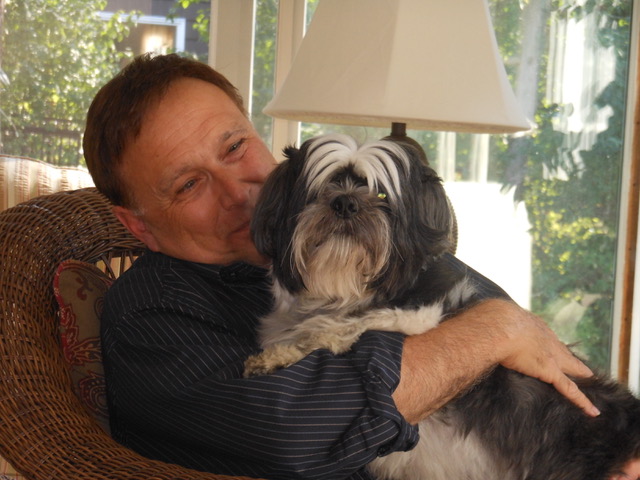
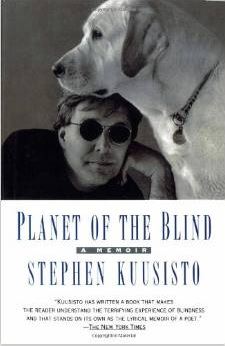
Stephen Kuusisto and HarleyABOUT: Stephen Kuusisto is the author of the memoirs Have Dog, Will Travel; Planet of the Blind (a New York Times “Notable Book of the Year”); and Eavesdropping: A Memoir of Blindness and Listening and of the poetry collections Only Bread, Only Light and Letters to Borges. A graduate of the Iowa Writer’s Workshop and a Fulbright Scholar, he has taught at the University of Iowa, Hobart and William Smith Colleges, and Ohio State University. He currently teaches at Syracuse University where he holds a University Professorship in Disability Studies. He is a frequent speaker in the US and abroad. His website is StephenKuusisto.com.

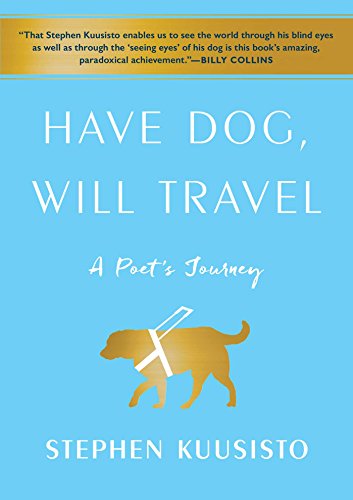
Have Dog, Will Travel: A Poet’s Journey is now available for pre-order:
Amazon
Barnes and Noble
IndieBound.org
Have Dog, Will Travel by Stephen Kuusisto

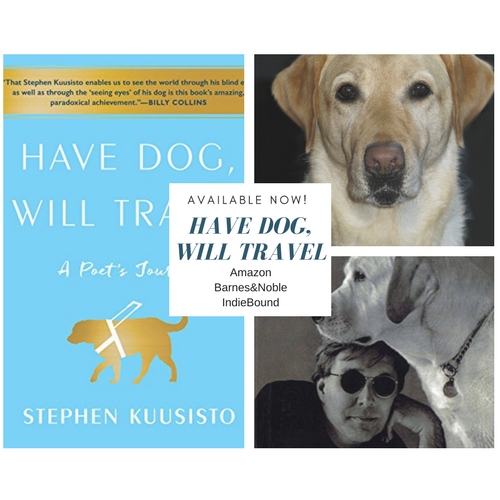
(Photo picturing the cover of Stephen Kuusisto’s new memoir “Have Dog, Will Travel” along with his former guide dogs Nira (top) and Corky, bottom.) Bottom photo by Marion Ettlinger 
Optimism, Cripples, Family Bibles, and Good Old John Rawls….

“Call me Ishmael” says the family bible which sits lithically on its shelf and which no one has opened since grandmother died. “Please call my Ishmael” it says, adding: “let me wander to the far off houses…” But the Bible you see is like an impoverished man who must sit and sit. In this way the old thing is like a cripple alone in a back room in a farm house in a country town. The lame one who, if revealed, will spoil the daughter’s arranged marriage. Try this if you think I’m kidding: take the dark, thick, dusty family bible into the street and offer it to passersby and see what happens…

**

“Change the subject,” says Uncle History. He’s sick of religion. I don’t blame him. “Let’s have some of those American prunes,” he shouts.

Meantime: Pierre Fournier, Beethoven, Sonata for Cello and Piano #1 in F.

**

“For the most part I examine the principles of justice that would regulate a well-ordered society. Everyone is presumed to act justly and to do his part in upholding just institutions.”

John Rawls “A Theory of Justice”

Oh Rawls, you were such a willful optimist. But you see, I struggle with you—yes, you’ve a fictive epistemology; yes, the rights of the disabled derive from just such optimism.

The lesson: imagine rational utopias. Evidence may come later.

**

Meanwhile the disabled, people like me, we trouble the mechanisms.

**

I want more patience. Dear Rawls…..

**

So the river with all its catfish is filled with various kinds of music. Let’s get that straight.

**

“But the main reason we are so anxious about the genomic revolution is that we are psychologically equipped to misunderstand it. Unlike, say, the study of subatomic physics, where almost no one outside of the physics community feels that he or she can make heads or tails of it, the notion that we possess genes that make us who we are makes intuitive sense. But it turns out that conclusion is inaccurate, or at least imprecise. Yet we persist in this belief that our genes control our lives. We are genetic fatalists.”

Excerpt From: “DNA is Not Destiny.” iBooks.

And so, back to the dark toad family bible….

I picture a two horse race: science is in the lead, but wait, here comes superstition…oh my, this race is coming down to the wire!”

**

For me, well, it takes a bus load of Beethoven to get by.

Piano and cello off shore in a boat….

**

Please, I just want a horse race where the animals are trained with optimism and no one gets hurt.

Stephen Kuusisto and HarleyABOUT: Stephen Kuusisto is the author of the memoirs Have Dog, Will Travel; Planet of the Blind (a New York Times “Notable Book of the Year”); and Eavesdropping: A Memoir of Blindness and Listening and of the poetry collections Only Bread, Only Light and Letters to Borges. A graduate of the Iowa Writer’s Workshop and a Fulbright Scholar, he has taught at the University of Iowa, Hobart and William Smith Colleges, and Ohio State University. He currently teaches at Syracuse University where he holds a University Professorship in Disability Studies. He is a frequent speaker in the US and abroad. His website is StephenKuusisto.com.

Have Dog, Will Travel: A Poet’s Journey is now available for pre-order:
Amazon
Barnes and Noble
IndieBound.org

Have Dog, Will Travel by Stephen Kuusisto

(Photo picturing the cover of Stephen Kuusisto’s new memoir “Have Dog, Will Travel” along with his former guide dogs Nira (top) and Corky, bottom.) Bottom photo by Marion Ettlinger 
Fear of Falling, Twenty Times Each Day

I walk up and down stairs while I’m awake and as far as I know I don’t do it in my sleep. Stairs are bad enough in my waking life. My blindness means every set of steps will be both challenging and vaguely frightening. Often walking with sighted friends they sail down staircases talking all the while as I nervously feel my way with electrostatic feet. I’ve always loved James Tate’s line: “when riding an escalator I expect something orthopedic to happen.” Me too James. Or worse. I expect to fall face forward into death’s arms.

No matter how proficient you are at traveling blind you’re always aware of the manifold instances when, frankly, you’re risking physical harm. It is not fashionable to say this. What’s fashionable is to assert blindness is a minor inconvenience—with the proper accommodations it is practically nothing.

And then there are stairs, intersections, drunk drivers, distracted bicycle messengers, tiny revolving doors, all the daily invitations to behead myself.

On the surface I appear collected. Underneath, even with a guide dog by my side I feel that old fear of falling, feel it at least twenty times a day.

Connie Kuusisto :
Stephen Kuusisto and HarleyABOUT: Stephen Kuusisto is the author of the memoirs Have Dog, Will Travel; Planet of the Blind (a New York Times “Notable Book of the Year”); and Eavesdropping: A Memoir of Blindness and Listening and of the poetry collections Only Bread, Only Light and Letters to Borges. A graduate of the Iowa Writer’s Workshop and a Fulbright Scholar, he has taught at the University of Iowa, Hobart and William Smith Colleges, and Ohio State University. He currently teaches at Syracuse University where he holds a University Professorship in Disability Studies. He is a frequent speaker in the US and abroad. His website is StephenKuusisto.com.

Have Dog, Will Travel: A Poet’s Journey is now available:
Amazon
Barnes and Noble
IndieBound.org

Have Dog, Will Travel by Stephen Kuusisto

(Photo picturing the cover of Stephen Kuusisto’s new memoir “Have Dog, Will Travel” along with his former guide dogs Nira (top) and Corky, bottom.) Bottom photo by Marion Ettlinger 

I Just Lost My Civil Rights Thanks to the GOP

Yesterday, February 15, 2018 the U.S. House of Representatives voted 225-192 to gut the Americans with Disabilities Act.   The bill known as “The ADA Education and Reform Act, or H.R. 620” is designed, so its proponents argue, to prevent frivolous “drive-by lawsuits” brought by lawyers who see inaccessible businesses and want to capitalize on the problem. The bill requires those filing against businesses for violating the ADA to first give business owners 60 days to describe how they’ll fix the problem. Then they have another 120 days to implement the changes. Sounds reasonable right? But the bill is actually designed to make the problem of lawsuits go away and does not put any onus on businesses to actually make changes.

As the Consortium for Citizens with Disabilities correctly notes: “H.R. 620 would create significant obstacles for people with disabilities to enforce their rights under Title III of the Americans with Disabilities Act (ADA) to access public accommodations, and would impede their ability to engage in daily activities and participate in the mainstream of society. Rather, the burden of protecting the right to access a public place is shifted to the person with the disability, who first has to be denied access; then must determine that violations of the law have occurred; then must provide the business with specific notice of which provisions of the law were violated and when; and finally, the aggrieved person with the disability must afford the business a lengthy period to correct the problem.”

The “lengthy period” is a red herring as the bill’s supporters know. Again from the Consortium for Citizens with Disabilities: “We know of no other law that outlaws discrimination but permits entities to discriminate with impunity until victims experience that discrimination and educate the entities perpetrating it about their obligations not to discriminate. Such a regime is absurd, and would make people with disabilities second-class citizens.”

As of this morning my civil rights and the rights of over 50 million Americans are now in jeopardy. Like thousands in the disability community I’ve watched with growing alarm as a well organized largely Republican lead coalition both in state and federal government has moved aggressively to weaken or even eliminate the rights of the disabled. Betsy DeVos has instructed the Department of Education to look the other way when matters of equal access for students with disabilities are on the table. Congress and the Trump administration are cutting Medicate.

These are outrageous developments.

Imagine this scenario if you are not disabled. One day you decide to go to a commonplace establishment. A popular eatery or coffee joint. When you get there the owner says, “Well, I don’t like serving  people with cartoon character tee shirts.” Then he adds: “Mickey Mouse violates my decor. And I don’t have time or resources to change my decor” You’re turned away.

Do you think this analogy is fatuous? I admit it seems ludicrous. But the principle is the same. The shop owner has made a decision, rather consciously, that there’s a type of customer he doesn’t want. Rather than admit his prejudice he complains that resolving the issue will likely cost him plenty. He tells you to go away.

Imagine that you then had to explain through lengthy filings why your rights were violated. Then further imagine that the owner has almost unlimited opportunities to do nothing.

How does that grab you?

Stephen Kuusisto and HarleyABOUT: Stephen Kuusisto is the author of the memoirs Have Dog, Will Travel; Planet of the Blind (a New York Times “Notable Book of the Year”); and Eavesdropping: A Memoir of Blindness and Listening and of the poetry collections Only Bread, Only Light and Letters to Borges. A graduate of the Iowa Writer’s Workshop and a Fulbright Scholar, he has taught at the University of Iowa, Hobart and William Smith Colleges, and Ohio State University. He currently teaches at Syracuse University where he holds a University Professorship in Disability Studies. He is a frequent speaker in the US and abroad. His website is StephenKuusisto.com.

Have Dog, Will Travel: A Poet’s Journey is now available for pre-order:
Amazon
Barnes and Noble
IndieBound.org

Have Dog, Will Travel by Stephen Kuusisto

(Photo picturing the cover of Stephen Kuusisto’s new memoir “Have Dog, Will Travel” along with his former guide dogs Nira (top) and Corky, bottom.) Bottom photo by Marion Ettlinger 
No to H.R. 620, No to the GOP, Defend the Disabled!

Some days are hard to bear—you’re a single mom and rent is due. You don’t know where that money is coming from. Child care is hit or miss. Your children are sick and what meagre health insurance you have is being depleted by politicians who imagine poverty is a moral weakness.

There’s a lot of “moral weakness” going around these days in the United States. If you listen to GOP senators, and house representatives you hear that the lame, the halt, the poorest among us are undeserving of public help. There’s something wrong with them, according to the right wing narrative. They’re lazy. Feckless.

The disabled are part of this objectified collection of wanton souls. We’re costly. What with our needs for ramps and Braille and breathing tubes. What with our claims on health care. It’s hard to escape the lingering horror of Adolf Hitler’s dictum that the disabled are just “useless eaters.” The aggressive, rightward tilt of the GOP leans toward the wholesale elimination of Medicaid and deep cuts in medicare. This isn’t some kine of fiction—fake news—the GOP is working overtime to make sure the elderly, the poor, and the disabled have no supports to help them live. Pro-life party indeed.

Right now the GOP is pushing in the house a bill (H.R. 620) which is the product of long standing and relentless lobbying by organizations like the Better Business Bureau, and which is designed to eliminate the capacity of the disabled and their allies to sue businesses for willfully ignoring the accessibility provisions in the Americans with Disabilities Act. Here are some basic bullet points that have been shared nationally by The Disability Rights Education and Defense Fund.

HR 620 will eliminate the need for businesses to be accessible until a complaint is received; there will be no need to make a business accessible until someone complains; that will mean many groups building new buildings, renovating buildings, opening new businesses will not make their services accessible

HR 620 shifts the burden of accessibility from those who offer services to the person with a disability; no other group needs to prove their right to access to publicly offered services

We should not be gutting the rights of people with disabilities; if there is a problem, we should be limiting the actions of a small number of lawyers who are bad actors

HR 620 will take away the civil rights of people with disabilities; would we ever think about eliminating the rights of any other group of Americans? This is disgraceful.

You can read more about H.R. 620 and the cover language the GOP is using to confuse the public about the bill here:

https://dredf.org/wp-content/uploads/2017/08/myths-and-truths-about-the-ada-education-and-reform-act.pdf

**

What does it mean when a nation decides that the most vulnerable of its citizens should be stripped of their rights to participate in civic society? What’s the deep text underscoring predates of the weak?

The answer lies in right wing melodrama. Like the Third Reich, today’s Republicans have a scarcity narrative which is predicated on the idea that Mom and Pop America won’t get what’s due them if we take care of these obviously non-productive people. That we’ve come down to this just 28 years after the wholly bi-partisan adoption of the ADA is both horrifying and quite telling. Not long ago I was at an event in Washington, DC where former U.S. Senator Bob Dole, a wounded veteran, who championed the ADA said openly, “Today I fear that law could never pass on Capitol Hill.”

Please, if you’re reading this, call your local U.S. Representative and say “No!” to H.R. 620.

Stephen Kuusisto and HarleyABOUT: Stephen Kuusisto is the author of the memoirs Have Dog, Will Travel; Planet of the Blind (a New York Times “Notable Book of the Year”); and Eavesdropping: A Memoir of Blindness and Listening and of the poetry collections Only Bread, Only Light and Letters to Borges. A graduate of the Iowa Writer’s Workshop and a Fulbright Scholar, he has taught at the University of Iowa, Hobart and William Smith Colleges, and Ohio State University. He currently teaches at Syracuse University where he holds a University Professorship in Disability Studies. He is a frequent speaker in the US and abroad. His website is StephenKuusisto.com.

Have Dog, Will Travel: A Poet’s Journey is now available for pre-order:
Amazon
Barnes and Noble
IndieBound.org


The ADA is Under Attack

The ADA is under attack.  Next week, the House will be voting on a bill, H.R. 620 that would undermine the protections of the ADA and take away the rights of people with disabilities.  Please call your Representative and ask them to #VoteNo and #ProtectTheADA

Here are talking points:
·         HR 620 will take away the civil rights of people with disabilities

·         It will make people with disabilities wait for up to 180 days for services that other people have immediate access to

·         The wait may be even longer than 180 days because a business that is making “substantial progress” toward fixing a problem can take even longer than 180 days

·         HR 620 will eliminate the need for businesses to be accessible until a complaint is received; there will be no need to make a business accessible until someone complains; that will mean many groups building new buildings, renovating buildings, opening new businesses will not make their services accessible

·         HR 620 shifts the burden of accessibility from those who offer services to the person with a disability; no other group needs to prove their right to access to publically offered services

·         We should not be gutting the rights of people with disabilities; if there is a problem, we should be limiting the actions of a small number of lawyers who are bad actors

·         HR 620 will take away the civil rights of people with disabilities; would we ever think about eliminating the rights of any other group of Americans? This is disgraceful.

And here is a fact sheet from our colleagues at Disability Rights Education and Defense Fund (DREDF) about the myths and realities of this bill.

Stephen Kuusisto and HarleyABOUT: Stephen Kuusisto is the author of the memoirs Have Dog, Will Travel; Planet of the Blind (a New York Times “Notable Book of the Year”); and Eavesdropping: A Memoir of Blindness and Listening and of the poetry collections Only Bread, Only Light and Letters to Borges. A graduate of the Iowa Writer’s Workshop and a Fulbright Scholar, he has taught at the University of Iowa, Hobart and William Smith Colleges, and Ohio State University. He currently teaches at Syracuse University where he holds a University Professorship in Disability Studies. He is a frequent speaker in the US and abroad. His website is StephenKuusisto.com.

The GOP and Medicaid

I have relied on accommodations all my life from kindergarten to the halls of academe. I can count on one hand the times a simple request was treated with courtesy, understanding, and warmth not to mention efficiency. When I write about ableism, whether in the academy or on a common bus, I’m pointing to the fact that hostility to the disabled is rife, both in the United States and abroad. As I grow older—I’ll be 63 in March—I’m seeing how effective neoliberalism has been at creating systemic structures that make it harder for the disabled to live, and yes, this translates intersectionally across historically marginalized differences. This is hardly news to those of us who live in coverts of fragile identity, but one feels the need to keep typing. This morning I’ve awakened to see the GOP is trying to tie Medicaid to new work initiatives—a thing so heinous I can’t find the proper analogy for it—one pictures a plutocrat dangling medicine on a string before an elderly woman with a wheelchair—“C’mon, if you want this, stand up!”

When in the service of cruelty the powerful initiate stumbling blocks for the weakest and count themselves “prudent” and “efficient” one must remember that the role of democratic government is to assure the common good of the people. The only way to rationalize an opposing opinion is to say that many lives don’t matter echoing Hitler’s famous characterization of the disabled as “useless eaters.”

I am angry today. At 63 I’ve come to realize I’ve entered a doubly abject cohort—I’m disabled and old. I’m lucky because I have a job, at least for a little while longer. If all goes well I’ll get to appear useful for a few more years. But when I’m older, blinder, more inform, will I have to leap for a string? Will my job be crawling across the floor for amusement?

This morning it’s starting to look that way.

The Forehead Egg, Biopolitics, Disability

When I was in my early twenties I read a lot of poems by James Tate. If you’re an American who’s interested in poetry and you’re over forty there’s a good chance you’ve visited Tate’s poignant, Da-da universe where dark alleys and cemetery willows remind a man to have a cigarette; where Sam Beckett’s people enter cereal naming contests; where only a dish of blueberries can pull you out of a lingering funk. Somewhere in my reading I saw a line about a man who feels like a fried egg has been glued to his forehead, which is to say, he walked around that way. There I was, blind, in college, cross eyed, the streets before me erasing themselves as I moved, lonesome, stamped by the U.S. Department of Alienation, hyper-aware that a cutting remark would be coming my way any moment. I knew Tate’s fried egg was my third eye, my sunny side up stigma. Disability can feel like that.

When we, the disabled discuss the biopolitics of disability, which is to say, the economic and political performances and entrapments of disablement, it often seems, at least to me, we’re talking about eggs and foreheads as much as anything else. What kind of egg will it be? Will you cook it yourself or will someone do it for you? Just so, will you self-apply your egg or have it done professionally? (I’m not metaphorically describing disability but the stances one must take because of it.) And there’s more: will it be a free range organic egg or from a factory? Perhaps if you’re lucky it will be cooked just right.

The neoliberal egg-on-forehead (hereafter NEOF) is like the cereal naming contest above–you have to pay to win and while you may be named Estragon you’re reliably in the game because it’s now an inclusive economy. In the bad old days you’d have been forced to live in the NEOF asylum but suddenly you have putative value. A productive, non-normative worth has either been declared or assigned. You round up your pals who once lived in the ward with you and together you create a federation. You’re online. Christ, you even blog. You belong to a Single Condition User Group. You’re no longer just a person with egg on the unibrow, you’re informed, itchy, talkative, contrary, ardent if not militant.

In their groundbreaking book The Biopolitics or Disability: Neoliberalism, Ablenationalism, and Peripheral Embodiment, David Mitchell and Sharon Snyder point out that: “as medical citizens within neoliberal biopolitics we are expected to take active control of our health management regimes to a greater extent than in any time in history. This active control taking health represents the double-edged sword of biopolitics and results in the desperate necessity of participating in funding initiatives on behalf of physicians and researchers to provide the missing profit motive for future investigations of potential medical treatments for members of rare condition groups.”

You were in a special hospital not so very long ago but now you’re an anguished expert on forehead eggism because you must be. You must be because either you’ve a job and want to keep it (you’ll need an accommodation—you can’t wear standard issue hats) or you hope to have a job—or jobless, you wish to have community relevance, which means among other things you should have the right script memorized.

I for one commit to memory a lot of self-declarative language. Yesterday I went to the ophthalmologist. I told him all about my eyes. In ophthalmology land I’m a failure. You mustn’t imagine eye doctors view low-to-no vision patients as successful and autonomous citizens. I felt the need to take care of myself and control the medical narrative to the best of my ability. I wasn’t an uninformed blind person. I wasn’t in need of rehab. No. That’s not a laser scar on my left retina, that’s what it looks like. You see, I don’t need to be cured, and even if that’s something in the cards it’s not happening today. I like the eggs. Yeah you can call me Estragon.


Ableism in the Academy, Thoughts on Moliere

Ableism, the experience of it, requires the French adjective écœurante —for disability discrimination is simultaneously heartless and sickening. I recall the professor of English at the University of Iowa who told me my blindness would preclude me from being in his “famous” graduate class on Charles Olson. Another professor snickered when I said I was reading books on tape. When I protested the chairman of the English department said I was a whiner and complainer. I wept alone in the Men’s room. My path forward to a Ph.D. in English at the University of Iowa was stymied. This was a full six years before the ADA was signed into law. Who was I to imagine a place at the agora’s marble stump?

I had an MFA degree from the creative writing program at that same university and I just went ahead and wrote books and sometimes appeared on radio and television and I wrote for big magazines and over time I received tenure at The Ohio State University. Later I went back to teach at Iowa despite my earlier experience and these days I’m at Syracuse. I’m a survivor of sorts. I’m a blind professor. The odds were never in my favor. Somewhere along the way I began thinking of Moliere in my private moments and I laughed because after all, every human occasion is comical and Moliere recognized the comedic types one encounters in closed societies better than anyone before or since.

It doesn’t really matter what institution of higher education you’re at, if you’re disabled you’ll meet the following Moliere-esque figures. The heartless and sickening ye will always have with ye if you trek onto a college campus. You’re more likely to spot them first if you hail from a historically marginalized background however, the ecoeurantists are more prone to blab at you if you’re disabled, especially behind closed doors. Ableists love closed doors. All bigots love closed doors.

The “Tartuffe” is an administrator, usually a dean or provost who will tell you with affected gestures that he, she, they, what have you, cares a great deal about disability and then, despite the fact a disabled person has outlined a genuine problem, never helps out.

The “Harpagon” is also an administrator, but he, she, they, can also be a faculty member. The Harpagon is driven by rhetorics of cheapness. It will cost too much to retrofit this bathroom, classroom, syllabus, website, etc. If the Harpagon is a professor he, she, they, generally drives a nice car.

Statue du Commandeur: a rigid, punctilious, puritanical college president—“this is the way we’ve always done it. If we changed things for you, we’d have to change things for everybody. Yes, it certainly must be hard…” See:

The Geronte: when his son is kidnapped he says: “Que diable allait-il faire dans cette galère?” (What in the deuce did he want to go on that galley for?” In other words, he brought this upon himself. “Really, shouldn’t you try something easier? I could have told you.”

These are the principle types of ableists. I invite you to add your own.

The one thing they have in common besides a privileged and thoroughly unexamined attachment to the idea that education is a race requiring stamina and deprivation, is that they all genuinely believe accommodations are a kind of vanity.


Ableism, the Academy, and Good Old Jean Jacques Rousseau

The poet W. H. Auden wrote: “Educational theory begins when society has become differentiated, when different classes are living so differently, and doing such different things that the question arises: ‘What shall we teach and to whom?’”

I have been in mind of this straightforward question for some time now, especially as I’ve been wrestling with the deficiencies of my own education, and in particular how that education relates to disability. As Auden might have it: ‘What was I taught and who did those teachers imagine I was?’”

The answers depend upon whether or not you believe the nature of society is static—which is to say whether you think social relations where disability is concerned are changeable. Here I am piling a question on a question. Can disability ever slip the knots of ableism and be understood as a fully dignified dynamic of cultural life? (I take it as given that disability is no better or worse than any other fact of life.)

Okay. Since I don’t think society is static, at least since the time of Rousseau (everywhere we are in chains, post-innocent, and humankind is collectively capable of freedom) I think disability rights are a barometer of progress. Civil rights reflect modernity’s belief that all individuals are unique. After Freud all people are unique. If so, then good old Jeffersonian law must assure our unique equality.

Now imagining the law could guarantee my dignity was foolish yet I’ve been guilty of this variegated disappointment, of letting it get to me, for a long time now. How long? Since the mid 1980’s when the Americans with Disabilities Act was being built. Like millions of disabled in the U.S. I thought the adoption of civil rights meant throwing off chains. I allowed myself to believe this. I know I’m not alone.

And here is where my education failed me, my high modernist, early post-modernist, calculating small “d” democratic, structuralist-psychoanalytic education—it failed me. Teachers failed me. I was allowed to believe the law could take the place of civics. Of civics I was taught nothing save that every citizen will be equal under the law. Here is the specific failure: I was taught that individualism is the core of identity, that identity is the well spring of citizenship, and that laws will take care of equality. Of course I read Foucault. I understood the precarity of life under the state, saw how language can and often does fail us.

Nothing in my education prepared me for structural ableism.

For years I’ve allowed myself to believe that my eloquence, my irony, my belief in the law, would mean success where disability is concerned, and by this I mean “as lived” and by this I mean “in the workplace” and accordingly I have been navigating without some important details.

You see I thought the law and self-declared dignified individualism were all I needed. These things are not without their importance, but they weren’t enough.

I’ve been physically assaulted in the workplace; denied accommodations; told during meetings that my need for accessible materials would slow down progress; told to “get in line” behind other non-disabled faculty when I needed sighted help in the form of a grad assistant; been lectured to by so many overtly ableist administrators about the difficulty of disability—how it gums up the works of the system—this is a long list, forgive me—and in all cases I imagined my capacity to be clear, direct, and persistent would solve the problem. That was my deficiency. From my mid thirties onward, believing overmuch in the ADA and the power of my language, I failed to see how profoundly ableism cuts down the disabled, even in the most self-declared progressive work spaces. Yes it’s a matter of note I’ve been making my way in higher education.

Boo hoo for me, didn’t everything I ever read about oppression allow me to see the deep and broad discriminatory practices in the big bad world? Of course. But my mistake was to think, to allow myself to think that equality for the disabled had come.

How foolish I feel. Worse, how beleaguered I am after years of being treated badly as a disabled student and scholar.

Ableism is ubiquitous. Higher education is rife with it. It’s in the street. It’s on the bus. It’s in every corner of the civic square. It is an unholy master in the world of American medicine. Ableism is shrugs, hoots, snickers, red tape, ugly information technology, badly designed airplanes, inaccessible voting places. It’s what’s for breakfast.

Ableism is worse today than when the ADA was adopted. Like the brutal renaissance of racism and misogyny and homophobia it’s out and its everywhere.

It exists in the classrooms, the technology labs, the science classes, the lecture halls. It is so customary in higher ed that it’s no wonder three quarters of students with disabilities who matriculate to college never graduate.

And ableism exists in the silence of non-disabled faculty who know how ugly it is for students and staff who believed modernity’s promise, post-Freud, that they could also be individuals.