The Dog Who Loves You

It’s always seemed to me that adults, by which I mean most adults, by which I mean many of those I’ve met, have difficulty giving thanks. I don’t mean just saying “thank you” when the barista hands you a latte, but worshipful thanks. I suppose I’m talking about praise where creation is concerned.  If you’re agonistic or an atheist you’ll see straightaway the predicament I’m in. I’m now standing on the thin ice of religious devotion and some might stop reading this because of it. But you see, what I’m really talking about is the love of dogs. Everyday I give thanks to creation for dogs.
The Dog Who Loves You Stephen Kuusisto

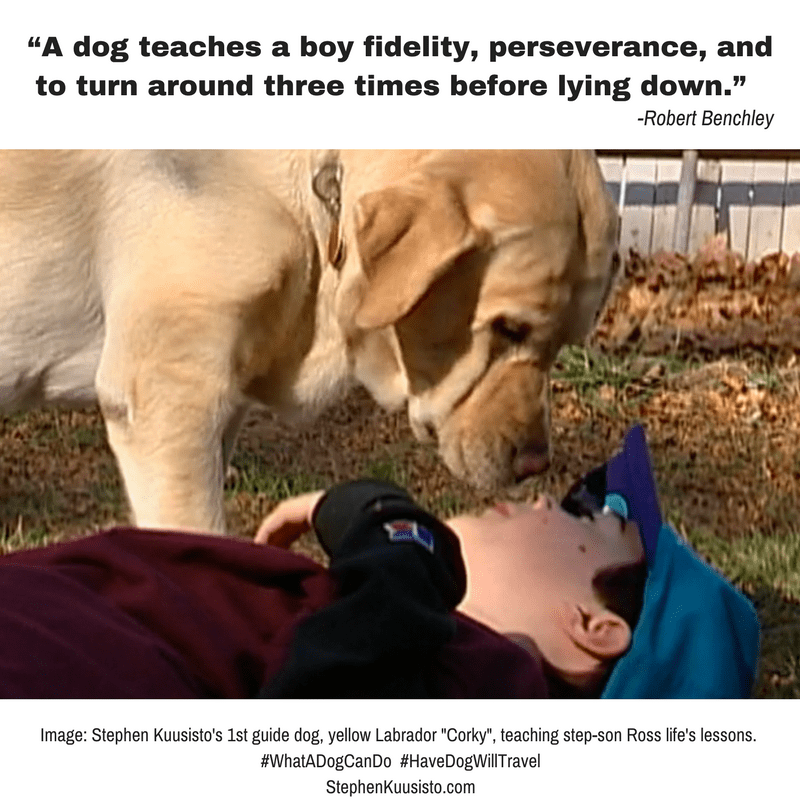
(Image: Young 10-year old boy, Stephen Kuusisto’s step-son Ross, is lying in the grass. Yellow Labrador and guide dog “Corky” is standing above him and is about to “kiss” his nose.”)

Tenderness, dog spirit, moves beside and within me. She has me talking to myself in the street. Stranger I am well. My hands, so often clenched fly open. I am loved by dogs.

This of course sounds ridiculous. The great dog spirit, Canis Tempus is walking me straight out of the profane world.

But this is so.

Shortly after I was paired with met first guide dog, a yellow Labrador named “Corky” I rode the subway to Coney Island.  It was April and cold but the famed Boardwalk was a great place for a brisk walk. Hardly any people were about. We pounded over the wood planks fronting the ocean and I talked to Corky softly. She held her head up, very high, to scent the Atlantic, and it was easy to imagine she was experiencing delight.

Aristotle defined happiness as “human flourishing” which he said involved activity and exhibiting virtue, and both should be in accord with reason. “Corky,” I said,“you are my virtue.” I wasn’t entirely sure what this meant.

“She can’t be my full virtue,” I thought. “She can only be the agent of my honor.” “But it’s lovely, Corky, walking this boardwalk with you and the ghost of Aristotle,” I said half aloud.

A policeman approached us and said, “Are you OK?”

“He’s seen my lips moving,” I thought. “He probably thinks I’m lost.”

“I’m just happy,” I told the cop who was taken aback.

“That’s a first for me,” he said. “I mean, no one ever says that, even at Coney Island!”

“You know,” I said, “I grew up blind in the middle of nowhere and never learned how to travel. Then I got this incredible dog! I just can’t tell you how happy I am.”

Of course I was more than happy. I was thankful. Now, 24 years later, I’m still mindful and full of praise for the dogs in my life.

The dog who loves you turns up in your dreams. Last night she was a woman on a train who said her name was “Evensong” (I kid you not) and she was old and dignified.

The dog who loves you is part of your soul (I kid you not) and she insists that mirth never dies. That is, as they say, how things stand.

Carl Jung had it wrong: the anima or animus is not the man or woman inside you but the dog who loves you; the one who first loved you; who loves you now. Sorry Yeats, here’s how the poem should go:

“Young man lift up your russet brow,

And lift your tender eyelids maid,

And brood on dogs and dogs who love…”
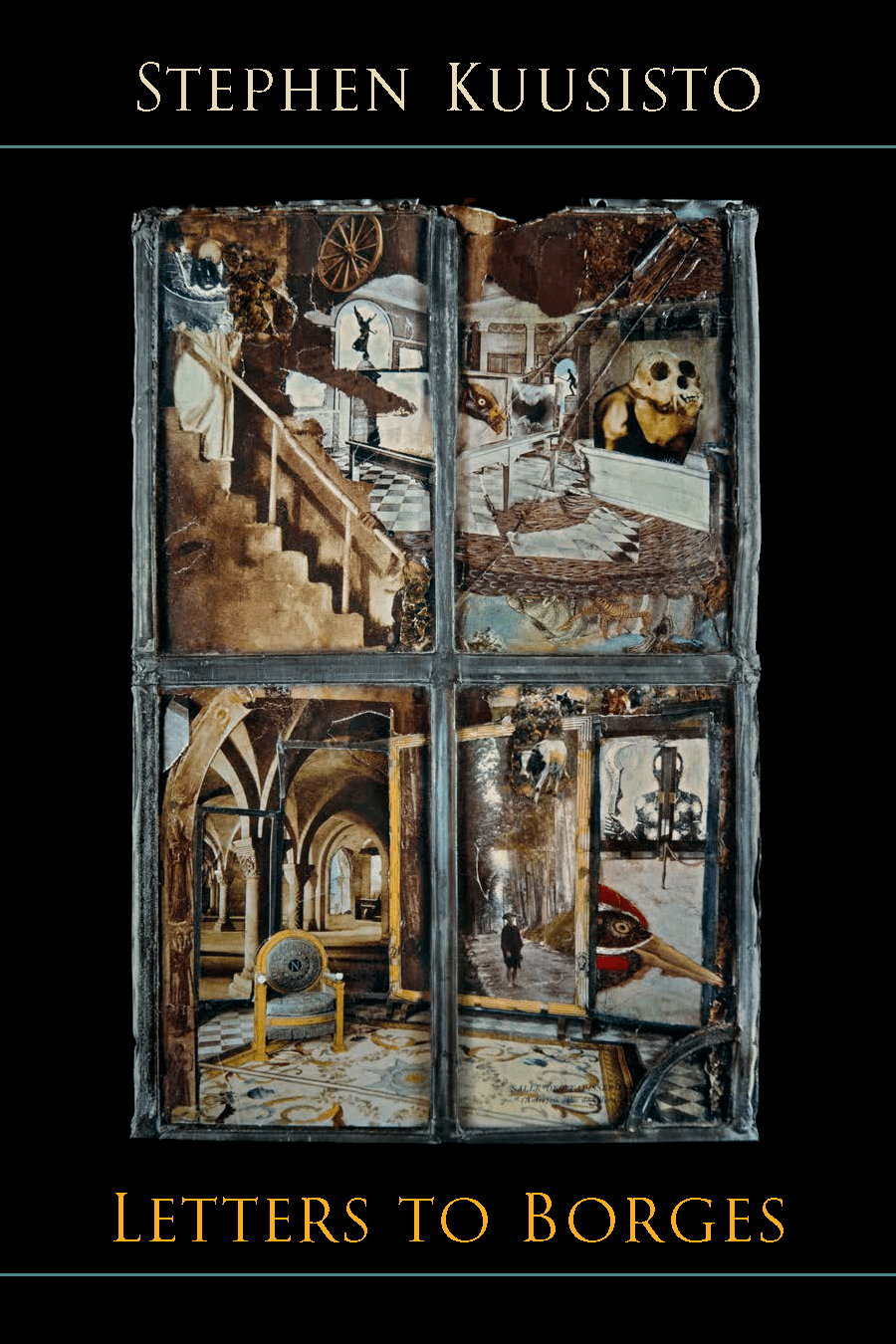
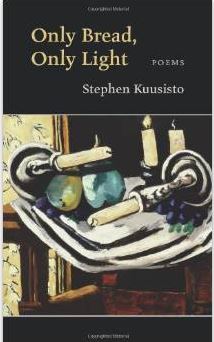
Stephen Kuusisto and HarleyABOUT: Stephen Kuusisto is the author of the memoirs Have Dog, Will Travel; Planet of the Blind (a New York Times “Notable Book of the Year”); and Eavesdropping: A Memoir of Blindness and Listening and of the poetry collections Only Bread, Only Light and Letters to Borges. A graduate of the Iowa Writer’s Workshop and a Fulbright Scholar, he has taught at the University of Iowa, Hobart and William Smith Colleges, and Ohio State University. He currently teaches at Syracuse University where he holds a University Professorship in Disability Studies. He is a frequent speaker in the US and abroad. His website is StephenKuusisto.com.

Have Dog, Will Travel: A Poet’s Journey is now available for pre-order:
Amazon
Barnes and Noble
IndieBound.org
Have Dog, Will Travel by Stephen Kuusisto

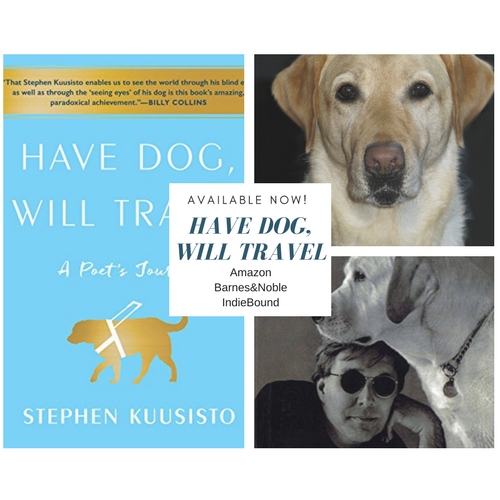
(Photo picturing the cover of Stephen Kuusisto’s new memoir “Have Dog, Will Travel” along with his former guide dogs Nira (top) and Corky, bottom.) Bottom photo by Marion Ettlinger 

The Forehead Egg, Biopolitics, Disability

When I was in my early twenties I read a lot of poems by James Tate. If you’re an American who’s interested in poetry and you’re over forty there’s a good chance you’ve visited Tate’s poignant, Da-da universe where dark alleys and cemetery willows remind a man to have a cigarette; where Sam Beckett’s people enter cereal naming contests; where only a dish of blueberries can pull you out of a lingering funk. Somewhere in my reading I saw a line about a man who feels like a fried egg has been glued to his forehead, which is to say, he walked around that way. There I was, blind, in college, cross eyed, the streets before me erasing themselves as I moved, lonesome, stamped by the U.S. Department of Alienation, hyper-aware that a cutting remark would be coming my way any moment. I knew Tate’s fried egg was my third eye, my sunny side up stigma. Disability can feel like that.

When we, the disabled discuss the biopolitics of disability, which is to say, the economic and political performances and entrapments of disablement, it often seems, at least to me, we’re talking about eggs and foreheads as much as anything else. What kind of egg will it be? Will you cook it yourself or will someone do it for you? Just so, will you self-apply your egg or have it done professionally? (I’m not metaphorically describing disability but the stances one must take because of it.) And there’s more: will it be a free range organic egg or from a factory? Perhaps if you’re lucky it will be cooked just right.

The neoliberal egg-on-forehead (hereafter NEOF) is like the cereal naming contest above–you have to pay to win and while you may be named Estragon you’re reliably in the game because it’s now an inclusive economy. In the bad old days you’d have been forced to live in the NEOF asylum but suddenly you have putative value. A productive, non-normative worth has either been declared or assigned. You round up your pals who once lived in the ward with you and together you create a federation. You’re online. Christ, you even blog. You belong to a Single Condition User Group. You’re no longer just a person with egg on the unibrow, you’re informed, itchy, talkative, contrary, ardent if not militant.

In their groundbreaking book The Biopolitics or Disability: Neoliberalism, Ablenationalism, and Peripheral Embodiment, David Mitchell and Sharon Snyder point out that: “as medical citizens within neoliberal biopolitics we are expected to take active control of our health management regimes to a greater extent than in any time in history. This active control taking health represents the double-edged sword of biopolitics and results in the desperate necessity of participating in funding initiatives on behalf of physicians and researchers to provide the missing profit motive for future investigations of potential medical treatments for members of rare condition groups.”

You were in a special hospital not so very long ago but now you’re an anguished expert on forehead eggism because you must be. You must be because either you’ve a job and want to keep it (you’ll need an accommodation—you can’t wear standard issue hats) or you hope to have a job—or jobless, you wish to have community relevance, which means among other things you should have the right script memorized.

I for one commit to memory a lot of self-declarative language. Yesterday I went to the ophthalmologist. I told him all about my eyes. In ophthalmology land I’m a failure. You mustn’t imagine eye doctors view low-to-no vision patients as successful and autonomous citizens. I felt the need to take care of myself and control the medical narrative to the best of my ability. I wasn’t an uninformed blind person. I wasn’t in need of rehab. No. That’s not a laser scar on my left retina, that’s what it looks like. You see, I don’t need to be cured, and even if that’s something in the cards it’s not happening today. I like the eggs. Yeah you can call me Estragon.


Notes on Christmas Morning 

Those houses in Iceland like boats half buried

And their prows pointing to heaven

We were driving aimlessly

I was chattering about Snorri Sturluson

As literature students will do

My friend Gary wanted a good cigar

Saarikoski: “We were simply too simple.

Time went by, men and women, bellies and bird song.

We came to be old, we fluttered, that’s all.”

Wind in the chimney flu

Sun not up

Saarikoski: “The canaries on their way to the Faeroe Islands are lurking in their pleasures.”

**

When I was younger I complained about everything

E. Power Biggs on the radio

Gramophone shards in my boots

Poetry was like a yellow flower handed me by a strange woman

What I knew I really knew

Ice covered the pond like an illness on a pretty face

I was sad in my twenties

Sometimes I read the right things

Silly old Kalevala and John Donne

**

I love this Jesus who lets me stay blind

Thoughts and poems circulate

**

I love Pasolini’s Gospel According to St. Matthew

I would also like to be a Catholic-Marxist


The Fictive Life

Since poetry says so, I bring my father back from the dead and then my mother with her broken laugh. My brother, gone since infancy, he comes along, though not in human form, he’s like the northern lights. “There’s nothing to be astonished about,” I tell them. “Let’s leave off where we were.” So we fall together like leaves in wind and sweep across the velvet ditch of fictive life—you know, the one we imagined we’d live and live.


Just Pete Seeger and his Banjo

Late morning, winter, dancing alone in the kitchen

Solo entertainment of a grown child

Just now he shucks off his cruel father

Who taunted him for being blind

A wind blows his torso dips

The father ghost retreats

To its covert—and his raving mother

She follows, carried by shadows

Dancing alone, not a poem,

Nothing literary about it

The Ploughman

A ploughman comes to me in my dream—synesthesia—his odor is of wine, the taste of wine, ripened cherries and earth and when he speaks I hear only syllables as I do not know his language. Even in dreams there’s something of the ironist, the upper hand of the subconscious, and I know this is a Finno-Ugrian tongue, Altaic and not calibrated to contemporary joy. Each sound is sorrow. We meet on a plain of losses and the sun is amber like Russian tea in a glass and soon it will be gone and the ploughman says things I do not understand but in my dream-like way I take to mean: sun-sorrow; course-sorrow; child-loss; deep-hunger; long shadows.

Essay Concerning Last Year’s Ashes

My dog of course, now in a can, who saved my life. She’s on my mantle, and I would scatter her to the wind but sadness presses down the tin box, my sadness akin to faith-paranoia, like the superstitious passenger who thinks his mind holds the plane aloft. I must keep my dog’s ashes close just as I maintain books on shelves and worn shoes in the closet.

There was a year in my youth when I was terribly lonely in a strange city. I knew very few people and the ones I did know were the quotidian kind—magazine seller, doorman, a severe librarian at the local university, which is to say they knew me as a creature, and I knew them as living beings but without true culture—we had no shared songs. One may live this way for a season or two. This was that kind of time. I arranged knickknacks carefully on my desk.

Sometimes I went to the botanical garden. It dated from Tsarist times and there were winding paths that seemed to lead nowhere—bafflements for clandestine conversations—and I walked in expanding circles among lilies, ferns, and flowers whose names I’d never know for vandals had long ago stolen the signs. Yes, there were flowers taller than men and they had no names and I liked them a great deal. It’s foolish to say it, but plants are silent the way you wish your friends could be, and this was especially true that year, when I was far from friends back home. The great, drowsy, half shaggy plants of the Tsars…how kind they were. They simply “were” and this was all I needed most mornings.

I had books. Stendahl, Neruda, Harry Martinson. In those days I smoked cigarettes and I’d light up in my imperial bower with its anonymous shrubs and think about what I liked and didn’t like about words. I saw I didn’t like “faith” or “rage” but I could do with “ardor” and “pique”—not because they were literary words but because they had nuance and unless you’re genuinely seasick this is how you want your feelings to be—of or pertaining to intuitions, gut gasps, solitudes in gardens.

Of course I’d put the ashes in my pockets along with the cigarette butts. It was best not to leave a trace. And here I am, forty years later, holding on to my lovely dog’s ashes because I can’t bear to part with even the starkest reminder. What coat might I carry them in? What knowing garment?

Foolish again. The ashes in every instance.