”
I started this blog ten years ago. In 2007 I didn’t know what I was getting into but I was mindful of Samuel Johnson’s dictum—via Boswell—”No man but a blockhead ever wrote, except for money.” “Would blogging,” I wondered, “be vanity and/or a waste of time?”
It’s both and neither. But it can be wonderfully egotistical.. Here’s one of my early posts:
I watched part of the Tony Blair-George W. Bush news conference and was reminded of the old folk story about the turtle on a fence post. Here were two men who know that their respective places in history will be circumscribed by the course of events in Iraq. They can’t imagine how this turtle got on top of that fence post. And so of course they talked about courage and they spoke about the hard decisions that leaders must make and they spoke affirmingly of their corresponding strength of purpose.
The trouble is that for George W. Bush the war in Iraq was always meant to be nothing more than a theatrical production. It was supposed to be easy. It was never meant to be a war on terror. Iraq was nothing more than an extravaganza. And when it quickly became a civil war with a swift infusion of real terrorists Bush failed to put enough troops on the ground to manage the situation. We don’t have to wait for history to know these things.
I am certain that our nation’s current course of action is utterly wrong. No rational person inside or outside the military believes that we should keep our troops in a civil war.
But courage in this instance requires more than the social semiotics of the turtle on the fence post. Iraq is not the front line in the “war on terror”–it’s a blunder that looks and smells like imperialist occupation and the sooner the U.S. gets out the sooner we can work toward peaceful solutions for the many conflicts that are heating up across the Middle East.
Such a move will look at first like defeat. But it won’t be. History assures us of that.
Why was I egotistical? You can probably guess. It’s the last sentence. History offers no assurances about abandoning war, nor does it give examples of military withdrawals in the service of statecraft. Wars end badly. What was I thinking?
C.S. Lewis: “If a man thinks he is not conceited, he is very conceited indeed.”
Well there’s nothing like looking at old blog posts to bring one down a peg.
One has to ask, “Isn’t blogging after all just an ego trip?”
Of course it is. Being a blogger is like imitating those dudes who give away poems on the street in Haight Ashbury. The only difference is the street poets sometimes get paid.
So the glib immediacy of web writing is both its attraction—no editors, no delays, just my words emblazoned across the digi-sphere—and it’s greatest peril. You’re guaranteed to make an ass of yourself at least part of the time.
But it’s the other moments I’m attracted to and that keep me going. The immediacy gives you a chance to say some necessary, even righteous things in Kerouac style—first thought best thought—and if, like me, you come from a historically marginalized position this is all to the good. Example:
Disability in the Morning
Why am I such a sad man? Oh I’m funny alright. I can talk Dolphin like Robin Williams and imitate a medieval jester’s lavish chicken bone dance, but I’m sad. Some days I think it’s because of disability—a “dis-life” is a daily struggle and there’s no use pretending otherwise. If the attitudes of the able bodied don’t get you, the built environment will. Every cripple knows it.
My friend Bill Peace (who is paralyzed) and I often talk about the moments when, early in the morning, we sense respectively we don’t want to leave our houses. The spirit flags. Bill can see it coming: the ugly encounters with parking lot bullies who steal the handicapped parking; the smarmy waitress who says, “I don’t think I could live if I was in your situation.” These things really do occur almost daily. Blind? There are all sorts of miscreants waiting for you. “You can’t come in here with that dog.” “We don’t have time to make our software accessible.”
Whatever. And then one has to imagine the possibility that sadness precedes this life. We bring it with us. Born crying. We die crying, most of us. In the middle we’re supposed to smile.
Don’t get me wrong. I love smiling. I’m not against a good grin.
Sadness, conditional, part of mortality, is exacerbated by disability and there’s no way around it.
The politics of disability struggle keep me awake, literally, for I think about all the disabled who don’t have jobs. They don’t have jobs because there’s profound discrimination in HR circles. If you don’t think so, try this:
Apply for a job. When they call you, tell them you’re blind. You’ll be astonished at what happens next.
Longfellow said: “Every man has his secret sorrows which the world knows not; and often times we call a man cold when he is only sad.”
A consolation I think: few will call me cold.
There’s something about the instantaneous element of web writing that produces a nurtured confessionalism, at least for me. Pushing myself to write quickly I throw caution aside. It’s not a barbaric yawp but it’s principled and necessary—I need to get something emotional out. Sometimes this need is sparked by nothing more than a new day:
Many Happy Returns to You and Your Shadow
The year is new—hypo allergenic like certain poodles—and you can feel lucky or dreadful but the year (like a poodle) will have none of you, for the year is high strung and indifferent as years must be. I won’t go on with the simile. I’m sorry. Perhaps you love your poodle. I’m sincere. I don’t wish to offend “poodlers”. No one can live without sentiment. Capitalism as its now bruited will do anything to rob you of your last ounce of sentiment. I’m sorry I kicked your poodle. But whatever I say, the year will have only indifference like the stars.
When I think about the virgin year I’m mindful of just how provisional and difficult the lives of people with disabilities remain worldwide. If you want to know about cruelty and “ranking” (in the crudest sociological sense) than look to disability. Look to it here at home in the United States and you’ll see how the police in Maryland killed a young man with Down Syndrome; see how a blind man and his guide dog were kicked off a US Air flight; see how the liberal press (Chris Hedges, Democracy Now, Alternet, etc.) actively rooted for a disabled American veteran of the Iraq war to kill himself—just so they could pin it on Bush and Cheney. These examples are from the US. When you look at disability globally things are no better. A UNICEF Report on the state of the world’s children highlights the plight of kids with disabilities across the planet—ill clothed, unschooled, without health care, denied food. The virgin year indeed. Don’t let the new year rob you of your heart’s renewal. If you’re an able bodied person I suggest you write your Senator and demand passage of the UN Charter on the Rights of Persons with Disabilities.
A friend sent me a poem in which he calculates how far William Wordsworth walked in his lifetime and in turn, calculates the poet’s mileage per line of verse. I love this idea. What if instead of watching vulgar automobile commercials (as most Americans will do today, especially if they watch college football—for every sporting event is now sponsored by Lexus, BMW, Audi, and Mercedes Benz. Gone are the days of shaving cream, Schlitz, and Aqua Velva)—what if instead of vulgar car advertisements Americans were challenged to imagine their human and social productivity per mile? Emerson would have championed this. Why I think even Teddy Roosevelt would have endorsed such a plan. Our new year dawns on a nation more politically immune to suffering and the true calling of our souls than at any time in its history. I take no pleasure saying so.
Here’s wishing you long walks, walks with ideas, chance meetings with wise and kind strangers. And triumphs of the spirit. I’m wishing you those.
I think we gave away too much when we abandoned Freud and Jung, preferring pills and “big pharma” to the hard work—the acknowledgment—that the unconscious has lots of darkness. America is a nation of terrifying smiles. I can’t find the quote right now, but Alice Munro said recently the most frightening people are the do gooders (paraphrase mine). I tend to think we’re in Fascist times and its proper and necessary both to say it aloud and to know who you’re looking at—whether on television or in a board room or on a street corner. As World War II commenced the poet W.H. Auden wrote the following poem. It strikes an eerie chord, or if not a chord precisely, maybe some thermemin music.
Blessed Event
Round the three actors in any blessed event
Is always standing an invisible audience of four,
The double twins, the fallen natures of man.
On the Left they remember difficult childhoods,
On the Right they have forgotten why they were so happy,
Above sit the best decisive people,
Below they must kneel all day so as not to be governed.
Four voices just audible in the hush of any Christmas:
Accept my friendship or die.
I shall keep order and not very much will happen.
Bring me luck and of course I’ll support you.
I smell blood and an era of prominent madmen.
But the Three hear nothing and are blind even to the landscape
With its towns and rivers and pretty pieces of nonsense.
He, all father, repenting their animal nights,
Cries: Why did she have to be tortured? It is all my fault.
Once more a virgin, She whispers: The Future shall never suffer.
And the New Life awkwardly touches its home, beginning to fumble
About in the Truth for the straight successful Way
Which will always appear to end in some dreadful defeat.
**
Yes. The Wise Men, poor dears, have walked into a story “in medias res” and damned if every human actor isn’t two actors—one smiling, the other stricken by guilt. What a dramatis personnae. Cue that Theremin music indeed.
And the new year with its pretty pieces of nonsense is here.
So if ostensibly I write to you about a clean slate, look behind me to see what my shadow is up to.
I know for certain, owing to dreams, my shadow is very upset about the children of war.
Happy new year. Small letters. Happy straight successful Way. Capital “W” for will and work.
I think blogging has turned me, made me warmer to readers. And also more ironic about my own peccadilloes and motives. My shadow is upset and yours is too. We can see our shadows dancing.
When I was twenty and wildly in love with poetry I admired indirection and complexity in writing. And though I still do (who can give up on Wallace Stevens?) I’ve grown to demand fewer refinements from myself. It’s not that I want to blab about my tennis shoes, but really, one can’t be finicky and openly contrarian at the same time. If being an awakened disabled person has taught me anything it’s that delay and deferral have no place in advocacy. Say what’s on your mind. Example:
Why “Nothing About Us Without Us” Should Be Required Reading for Everyone in Higher Education
In his groundbreaking book Nothing About Us Without Us, published in 1998, James Charlton declared the disabled have a culture, an extensive one, and that time is up for able bodied people to be making decisions about the disabled without their input. In one of my favorite passages Charlton writes about the imperatives behind his book:
““Nothing About Us Without Us” requires people with disabilities to recognize their need to control and take responsibility for their own lives. It also forces political-economic and cultural systems to incorporate people with disabilities into the decision-making process and to recognize that the experiential knowledge of these people is pivotal in making decisions that affect their lives. Third, while the number of people affected by this epistemological breakthrough is relatively small, a movement has emerged. The disability rights movement has developed its own ideology and politics. It is a liberation movement that is confronting the realpolitik of the world at large. The demand “Nothing About Us Without Us” is a demand for self-determination and a necessary precedent to liberation. Fourth, the philosophy and organization that the international DRM {Disability Rights Movement} embraces includes independence and integration, empowerment and human rights, and self-help and self-determination. The demand “Nothing About Us Without Us” affirms the essence of these principles. Finally, the DRM is one of many emerging movements in which new attitudes and world views are being created. Through its struggle comes a vision that requires a fundamental reordering of priorities and resources.”
Excerpt From: James I. Charlton. “Nothing About Us Without Us.” iBooks. https://itun.es/us/gEPDU.l
Nowadays self-determination for the disabled has grown from a nascent concept to a global movement. From Africa to Asia, Finland to the Middle East, disability activists are not merely calling for their rights but are living their lives in accord with the best principles of independence and empowerment—educating others, assisting their sisters and brothers, demanding opportunities for children, health care, freedom to travel…just to name the basics.
The passage of the Americans with Disabilities Act in 1990 helped create international opportunities for dialogue between the disabled and served to incite a worldwide confrontation with what Charlton calls “realpolitik” but I’m calling “business as usual” because—why not?
What does “business as usual” mean where disability is concerned? Historically the disabled have been segregated, locked up, hidden, euthanized, sterilized, denied educational opportunities, kept out of public spaces, and perhaps worst of all—they’ve been talked over. Their lives are narrated (and mediated) by medicine and rehabilitation programs that always fortify pejorative meanings about disability—not disability as it’s actually lived, but instead reinforcing how it’s understood by the public. Biz as Usual pushes a medical model of disability which designates imperfect bodies, ill bodies, “incurable” bodies as outlier corporealities, things not devoutly to be wished—they become failed patients, abnormalities. Accordingly the abnormal must be farmed out to “special” places which stand at the edge of the fairground where normal people remain happily assembled. Consider the average college campus. Disability is “dealt with” “managed” “serviced” “accommodated” by underfunded offices that in many instances are hard to locate both physically and administratively. I’ve been to many universities where the disability services office is in the basement of a building—reachable only by elevator, or on the top floor of a building, reachable only by elevator—where in the event of fire there’s no way out. I’ve been to campuses where renovations to facilities have left out necessary improvements to make auditoriums accessible; classrooms usable; technology approachable; where there’s minimal or entirely unacceptable transportation for disabled people. These examples are legion and not exceptions. In Biz as Usual disability is conceived as a marginal issue, something that must be grudgingly acknowledged because of the Rehab Act of 1974 and the ADA of 1990, but not as a matter of culture, inclusion, communication, or respect. When college administrations make decisions about the physical or digital agora they seldom if ever consult with the disability communities on their campuses. “Nothing About Us Without Us” should be required reading for administrators, staff, and faculty in higher ed. Of course in 99% of the cases, there’s no required reading for the aforementioned. Faculty know next to nothing about disability, relying on the hidden “special” unit to solve whatever student accommodation request comes their way—and note, accommodation is always narrated as a problem. And so the disabled student is a problem. He or she is defective and trying to get into the happy tent. Faculty Member A resents having to think about this. “Doesn’t someone else handle this?” The disabled must be “handled” —the imagery is perfect given our histories, we’re straight jacketed and dragged away.
At Syracuse we offered the first disability studies courses in the country. We understand disability is part of our diversity and inclusion aspirations. But still we have problems. All too many students, staff, and faculty with disabilities feel left out of important conversations. And we have real problems. Unfortunately, raising them, we’re often made to feel like oppositional figures, malcontents, stylized figures with megaphones, waving our crutches. This should be easy to solve. Invite the disability community “in”—ask them what they think. Employ what I like to call the Ed Koch gambit—“How am I doing?” If the question is sincere it will come after listening. And then we will take positive, culturally engaged action.
Back to James Charlton whose book remains indispensable.
“Life itself is a series of struggles—some won, some lost. Resistance for most people with disabilities is a necessity for survival. The DRM should never lose sight of this. Throughout the course of this project, I have been impressed with how many of the stories and experiences of politically active people with disabilities reflect this proposition. We have begun to speak for ourselves, to make demands, to organize, and to educate others. ”
Excerpt From: James I. Charlton. “Nothing About Us Without Us.” iBooks. https://itun.es/us/gEPDU.l
In the coming years “best practices” in every human endeavor must acknowledge the experiences of the marginalized and embrace the opportunities for education diversity offers.
I think colleges and universities do a lousy job with disability. Administrators believe listening to disabled students and staff is a mistake and look for ways to avoid it. Those of us for whom this matters feel the contempt.
What has blogging done for me, or done to me, as a poet? Ha! I won’t presume to tell. If you don’t honor poetry by asserting her essential mystery you’ll be in trouble. But I can say I’m less finicky. I don’t throw paint at the walls but I’m less cautious than I used to be. I used to think I had to feel a certain way to write a poem. I can’t describe that feeling but it was moody, self-abnegating, even obsessive. My pencils had to be lined up like boy scouts. Not a one could be crooked.
Blogging has led me to writing prose poems like this:
Hydra and Cricket: A Micro Memoir
Always I write about the boy, not out of innocence, but because he is me and not me and the not me is where the advantages of irony can be found. I like knowing this. The boy always loved hieroglyphs. Once the boy spent a day believing he was an Ibis. In school they made fun of him for being blind. The Ibis was better. People who dismiss mythology probably don’t understand the nature of personal suffering. Hercules and the Hydra together make a child. The clear sunlight and the boy searching for mushrooms. He was all alone in the woods. He did not play with toy soldiers. He played with the life around him, the miniature “up close” creatures that let him in. “They are me and not me,” he thought. “That also means I am not me.” Long before there was a disability rights movement he knew he wasn’t any one thing. Later in college he read Emerson and he admired “Self Reliance” and: “Be yourself; no base imitator of another, but your best self. There is something which you can do better than another. Listen to the inward voice and bravely obey that. Do the things at which you are great, not what you were never made for.” Secrets came to him then. He lay face down on the frozen pond and knew there was ice under the ice but the fish could move there. And there were private crickets inside his sleeves. He could talk sideways to living things. That boy is me and not me. The man cannot spend his day face down with the ice fish though often he would like to do this. The poor man must workaday workaday in the steep hours feeling the tensile struggle to retain his innocence and curiosity. If he has irony its in the service of protection. The boy ran away; the man carries the woods with him. And the man knows why this isn’t sentimental at all. He also rescues crickets whenever he can.
What else?
A blogger can cry with affection:
Lately as spring arrives and the days grow longer I’ve found myself dreaming of the dead–though not the abstrract chalky missing, but rather those who I have loved and who I still miss though my days are filled with bus schedules and the nearly private gamesmanship of getting by in the political world.
I miss John Lydenberg, Professor of English at Hobart and William Smith Colleges who taught me how to read Herman Melville. I deeply miss his sharp, unsentimental humor and his unapologetic leftist politics which he learned at Harvard in the years before the second world war when pacifism and idealism weren’t yet sullied by all that’s come since. I especially miss his game of cutting out funny, overlooked newspaper headlines: “Young Couple Happy on Small Newspaper” was particuarly good. I thought of him the other day when I read: “Pope’s Condom-stance Under Fire” .
I miss my father who died on Easter Sunday 2000. One doesn’t need a reason to miss one’s father but today I miss him because I’ve been reading William Manchester’s “The LastLion” about Winston Churchill and I know that he would have very interesting things to say both about Manchester as a historian and about Sir Winston. I miss my dad’s voice. I miss the way he used to sing to the dog.
14 years ago today I arrived home in Ithaca, New York with my first guide dog “Corky” who
changed my life in a thousand ways. How I miss her! I could start crying right now.
So I love the odd, innocent, half-shy silliness of the Bloomsbury crowd. Tonight I want to wear a turban with a sapphire pinned to the front. I want to carry on a bit with my gorgeous and beloved dead and feel them touching my hair.
I don’t think that’s too much to ask.
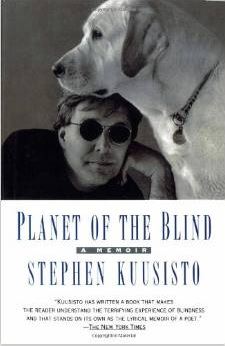

 Planet of the Blind